Updated in 2026 with a short summary, new graphics, a permanent link to the thesis and links to the papers that have grown out of it.
My thesis, “How do political parties use Facebook and what does it offer to their campaigns?”, examines how UK parties campaigned on Facebook from 2010 to 2018, including the 2015 and 2017 general elections in huge detail. It is free to read, share and cite.
The thesis
PhD, University of Bath, 2021. ESRC funded. Open access.
Cite as: Hotham, T. (2021). How do political parties use Facebook and what does it offer to their campaigns. PhD thesis, University of Bath. https://doi.org/10.5281/zenodo.23300280
In short
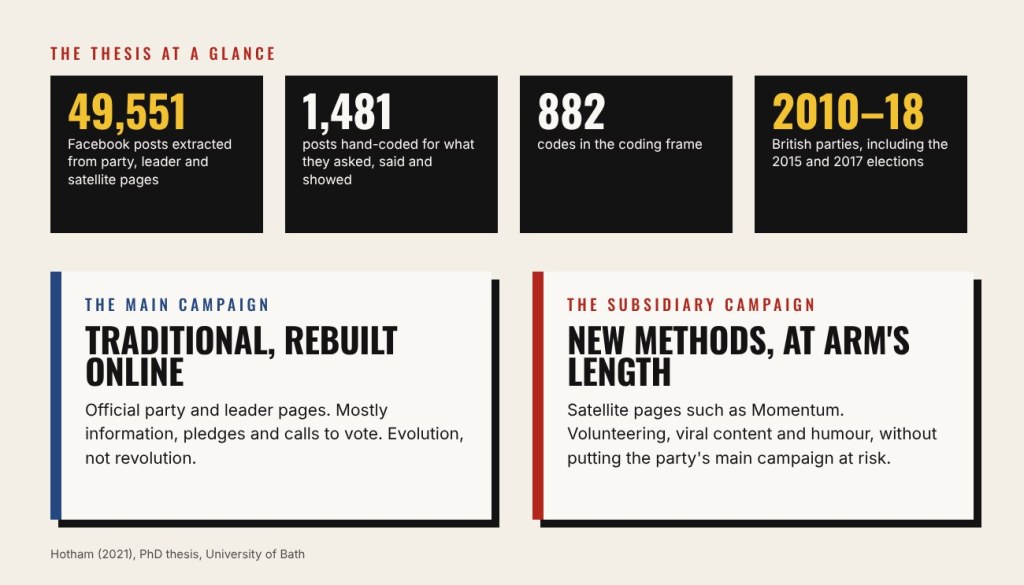
- Evolution, not revolution. Parties mostly used Facebook to rebuild the traditional campaign online: information, pledges and calls to vote.
- Two faces. Alongside that main campaign, the two big parties ran a subsidiary “new methods” campaign through satellite pages such as Momentum. I call this Janus-faced campaigning.
- Satellites can take risks. They let a party campaign in more adventurous ways, with a strong focus on participation and shareable content, without putting its main campaign at risk.
- Virtual memberships. Parties built Facebook audiences that were larger and more representative than their official memberships, and could use them to campaign.
What I studied
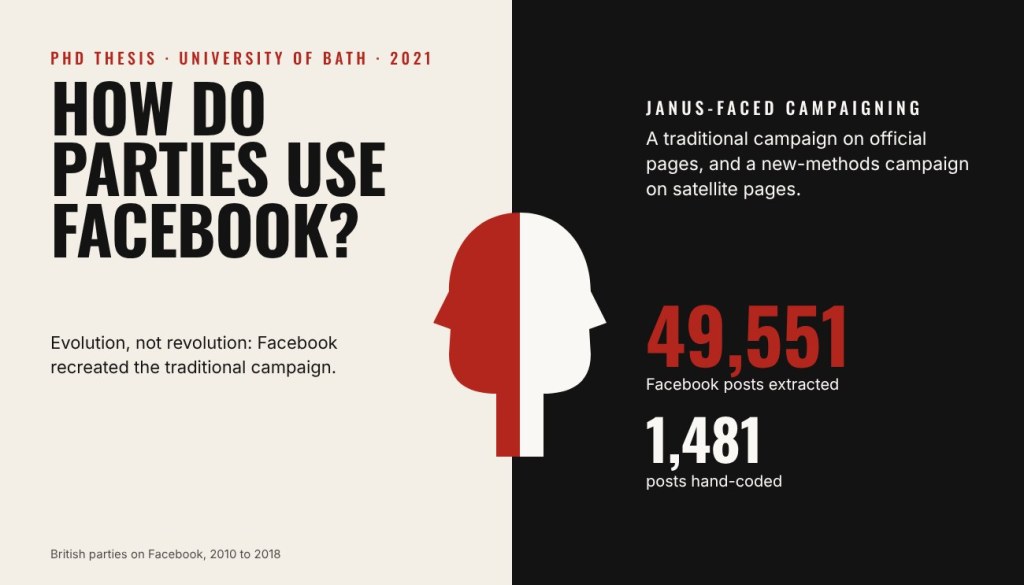
The thesis examines the use of Facebook as a campaign tool by British political parties over a decade. It measures and conceptualises party approaches to Facebook through extracted Facebook posts (49,551), hand-coded Facebook posts (1,481 posts, 882 codes), Facebook Audience Insights and survey data.
Two faces of the same campaign
It finds that the two major parties’ campaigns are defined by a traditional Facebook campaign, alongside a subsidiary new methods Facebook campaign. This use of different pages for different audiences is what I call Janus-faced campaigning, after the Roman god with two faces. There is a short explainer on the idea here.
Evolution, not revolution
Overall, the thesis argues that Facebook is centrally used for the digital recreation of a traditional offline campaign. Information provision is far more central than participation content, with participation content (if seen) focused on engagement, registering to vote and voting. Although Facebook is showing evolution rather than revolution for party campaigns, the platform offers enhanced abilities for recreating tried and tested traditional campaign methods. Facebook has abilities for superior campaign content such as video, while parties have generated larger, more representative virtual memberships (than official memberships) that can be used to campaign to Facebook’s broad audience base.
Facebook has given political parties a powerful broadcast tool that bridges the digital and physical doorstep, where social context allows for enhanced message impact. Thus, it is in the mainstream use of Facebook that we are most likely to see its electoral impact.
Satellites and the permanent campaign
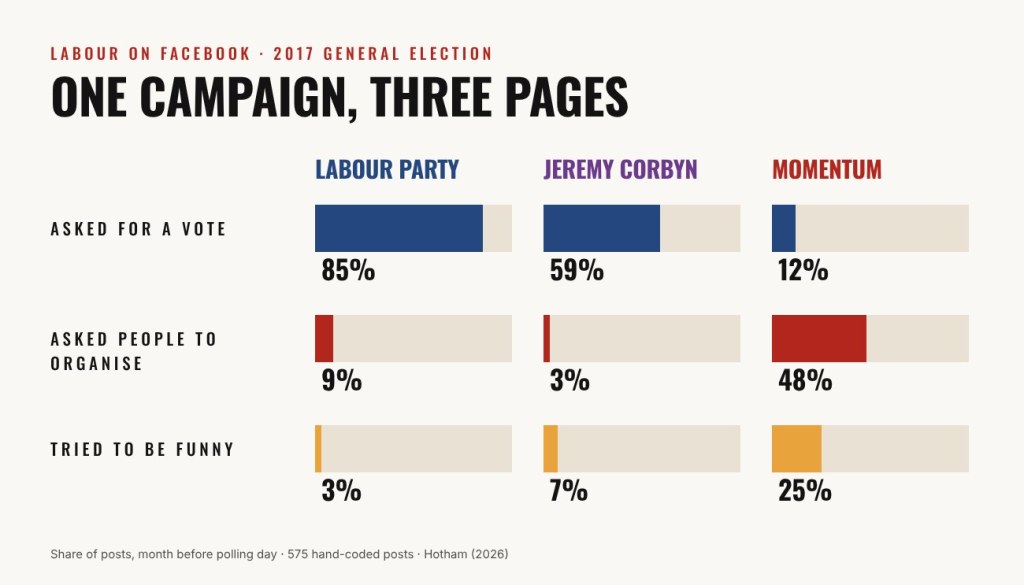
Although the central approach seen by parties is the recreation of a traditional campaign, the thesis also examines satellite pages through the study of Momentum. Satellite campaigns are found to offer parties the ability to campaign in more adventurous ways without threatening their traditional Facebook campaign. Momentum during the 2017 General Election campaigned in a more radical way, including a very strong focus on participation, partisan viral content and using virtual members like official members. This approach offered Labour the best of both worlds.
Finally, the thesis conceptualises permanent campaigning and examines it through Momentum’s content across 2018. The page shifted towards an internal campaign role, showing how parties can use Facebook in a partisan marshalling role outside of elections.
Where the research went next
In 2026 I went back to the thesis data and wrote up several parts of it as open-access papers, each with its own plain-English post:
- What does a satellite campaign do? Momentum, Labour and Corbyn in 2017. This replaces my 2021 working paper.
- From the doorstep to the debate: what Momentum did on Facebook after 2017.
- The machine and the person: how party pages and leader pages split the work.
- Who gets to be in the picture? How Labour and the Conservatives swapped places.
- Facebook loved Corbyn and Farage. The polls had other ideas. Ten years of leaders, party pages and the polls.
All of my papers are listed at tristanhotham.com/research.