
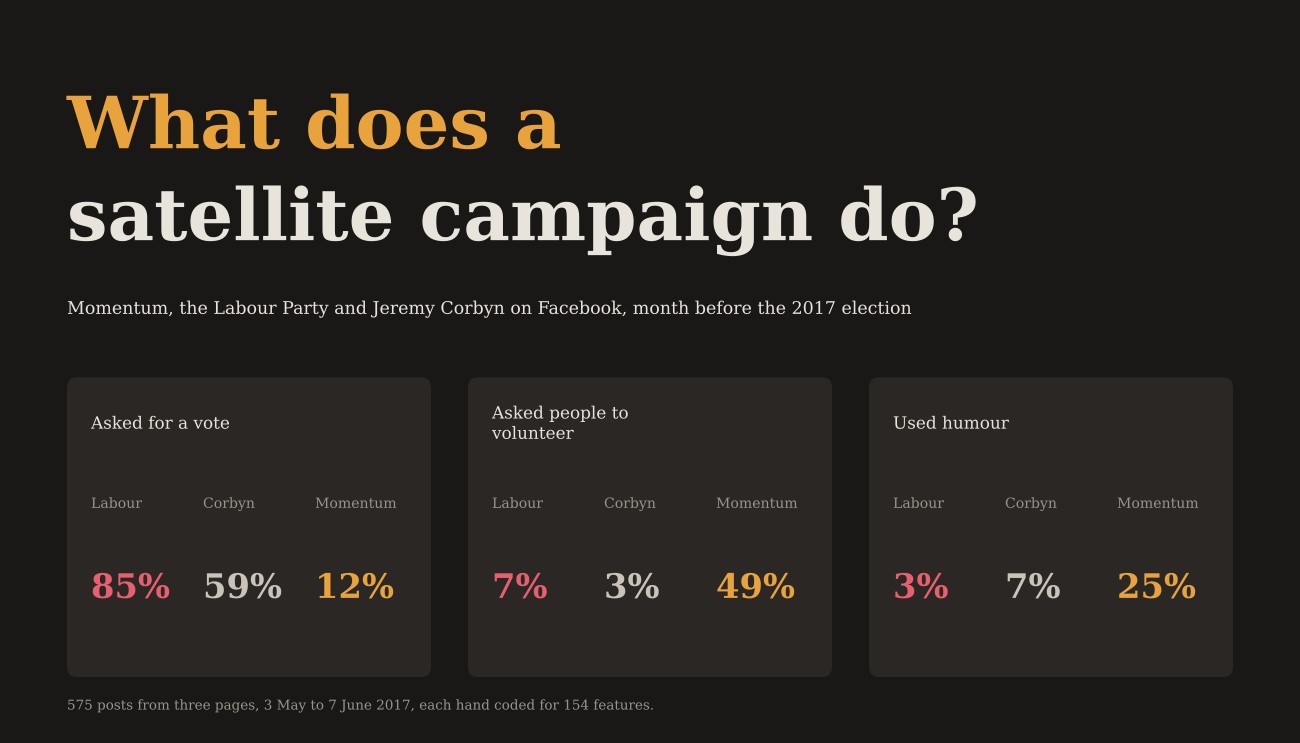
In the 2017 general election, Labour campaigned on Facebook through at least three pages: the party’s own, Jeremy Corbyn’s, and Momentum’s. Momentum was not part of the party. It was what Katharine Dommett and Luke Temple called a “satellite campaign”: a group outside the party’s structure that campaigns on its behalf. So what did the satellite actually do that the party could not?
I first tried to answer this in a 2021 working paper. I have now gone back to the data, rerun everything with proper tests and corrections, checked which codes were reliably measured, and found something I had missed. The new paper, What Does a Satellite Campaign Do? Momentum, the Labour Party and Jeremy Corbyn on Facebook in the 2017 General Election, is free on Zenodo and replaces the old one.
The preprint
Open access, free to read, share and cite. 10 pages, 2 figures. Not peer reviewed. The coded counts for every feature and page are in the record.
Cite as: Hotham, T. (2026). What Does a Satellite Campaign Do? Momentum, the Labour Party and Jeremy Corbyn on Facebook in the 2017 General Election. Zenodo. https://doi.org/10.5281/zenodo.23296712
Three pages, three jobs
I coded every retrievable post from the three pages in the month before polling day, 575 in all, for 154 features: what each post asked people to do, what it said, and how it said it.
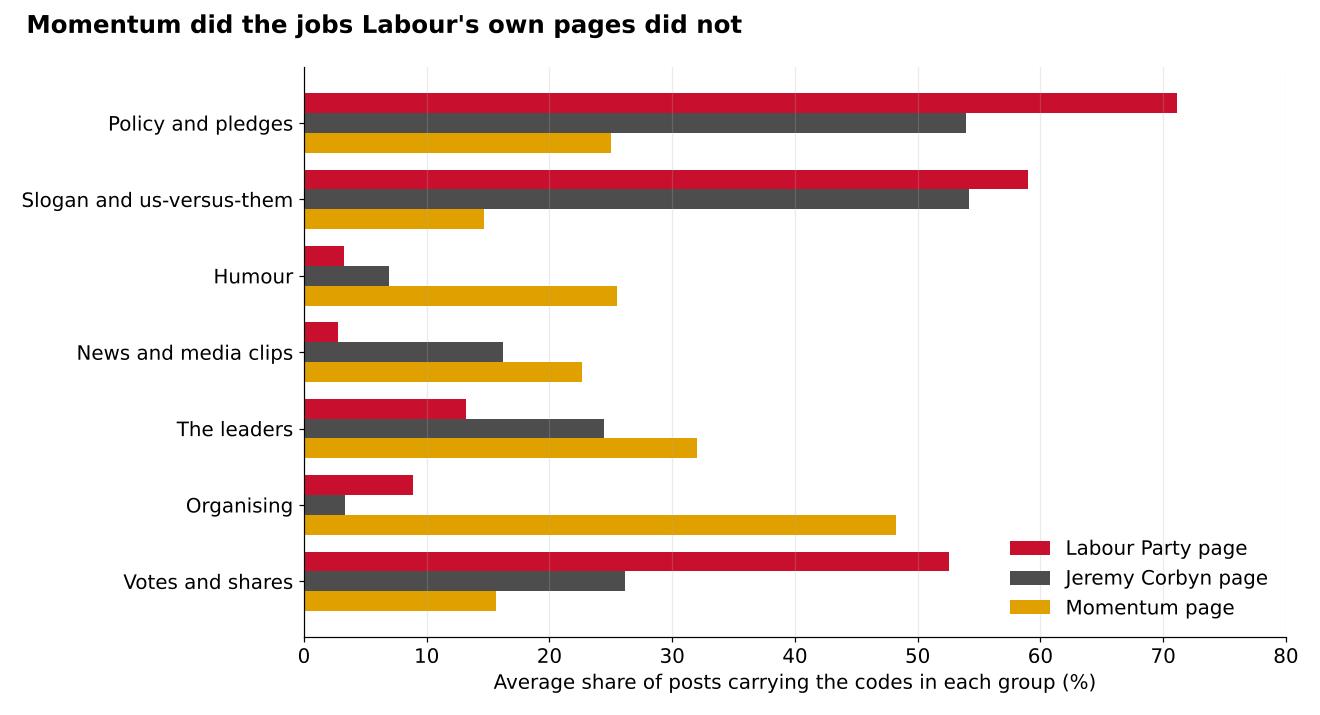
The party page was a campaign for votes. 85% of its posts asked for a vote, two-thirds made a pledge, and four in five used “For the many, not the few”.
Momentum barely asked for votes at all (12% of posts). It asked for time. About half its posts asked people to help on the doorstep, volunteer or sign up to campaign. Labour’s own pages did that in 3% to 7% of posts. Momentum was also much funnier: a quarter of its posts were trying to be funny, against 3% on the party page and 7% on Corbyn’s. And it praised Corbyn in over a third of its posts, far more than the party page did. Cheerleading for the leader came mostly from outside the party.
The leader in the middle
This is the bit I missed in 2021. I used to describe Labour’s campaign as two-faced, in the Janus sense: a traditional campaign on the party and leader pages, and a new-style one on Momentum. That is not quite right.
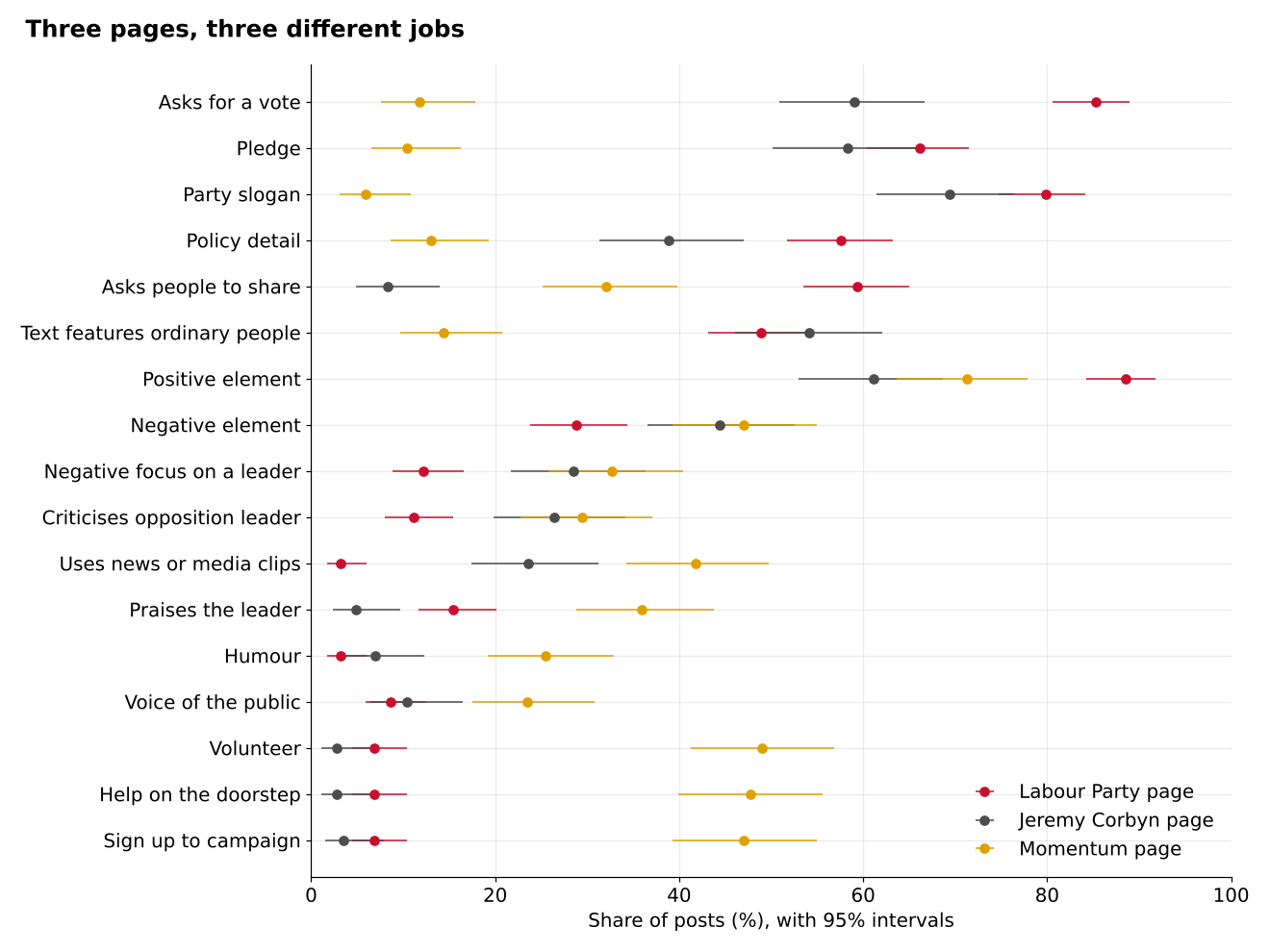
Corbyn’s own page was mostly like the party page: pledges, the slogan, calls to vote. But wherever it parted company with the party page, it moved towards Momentum. I checked every reliably measured feature where the two Labour pages differed significantly. There were eleven, and on all eleven Corbyn’s page was off in Momentum’s direction: less policy detail, fewer calls to vote, more news clips, and more attacks on Theresa May (26% of posts, against 11% on the party page and 29% on Momentum’s).
So the Labour side of 2017 looks less like two faces and more like a sliding scale. At one end, a formal, positive, policy-heavy party page. In the middle, a leader’s page with the same programme but a sharper voice. At the far end, a satellite asking its followers to get off Facebook and onto the doorstep.
What happened next
The satellite did not stay that way. In a companion paper I follow Momentum’s page into 2018. Once the election was over, the doorstep requests almost vanished, and the page turned to arguing with the media and opposition MPs instead.
The caveats
Facebook only let researchers retrieve a page’s most engaged-with posts, so these are the posts people engaged with most, not every post. Some of the features I coded in 2017 turned out to be hard for a second coder to reproduce, such as whether a post was “mainly rhetorical”, so the new paper leans on the ones that were reliable and flags the rest. Reliability was tested on the Labour pages, not on Momentum’s. Nothing here shows whether any of this worked, or whether Labour and Momentum planned it together. The data show what each page asked for, not what anyone did next.
Read it
Hotham, T. (2026). What Does a Satellite Campaign Do? Momentum, the Labour Party and Jeremy Corbyn on Facebook in the 2017 General Election. Preprint, Zenodo. https://doi.org/10.5281/zenodo.23296712
For background, there is a short explainer on satellite campaigning and a piece on how party and leader pages split the work.
The views in this post and the paper are my own.

