
Every British party campaigns on Facebook twice. There is the party’s own page, and there is the leader’s page. Same staff, same campaign, overlapping audiences. So do they say the same things?
For my PhD I hand-coded every retrievable post from the Labour and Conservative pages and the pages of Ed Miliband, David Cameron, Jeremy Corbyn and Theresa May in the month before the 2015 and 2017 elections: 1,208 posts. That gives four neat pairs, a party page and a leader page for each party at each election. I have finally written up what they show. The paper is Follow the Leader? How British Parties Divided the Work between Leader Pages and Party Pages on Facebook at the 2015 and 2017 General Elections, free on Zenodo.
The preprint
Open access, free to read, share and cite. 8 pages, 2 figures. Not peer reviewed. The counts behind every number are in the record.
Cite as: Hotham, T. (2026). Follow the Leader? How British Parties Divided the Work between Leader Pages and Party Pages on Facebook at the 2015 and 2017 General Elections. Zenodo. https://doi.org/10.5281/zenodo.23280205
The machine
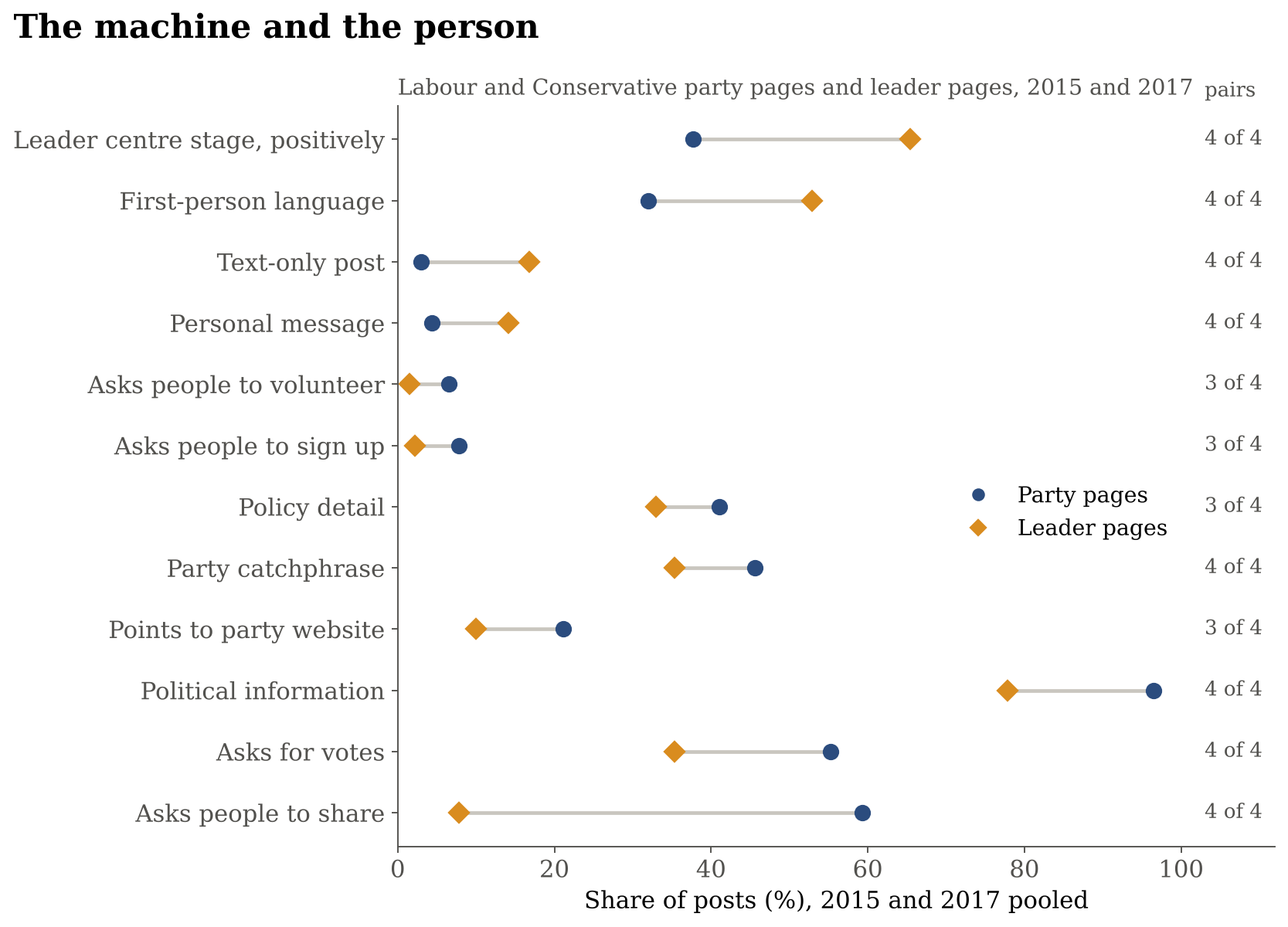
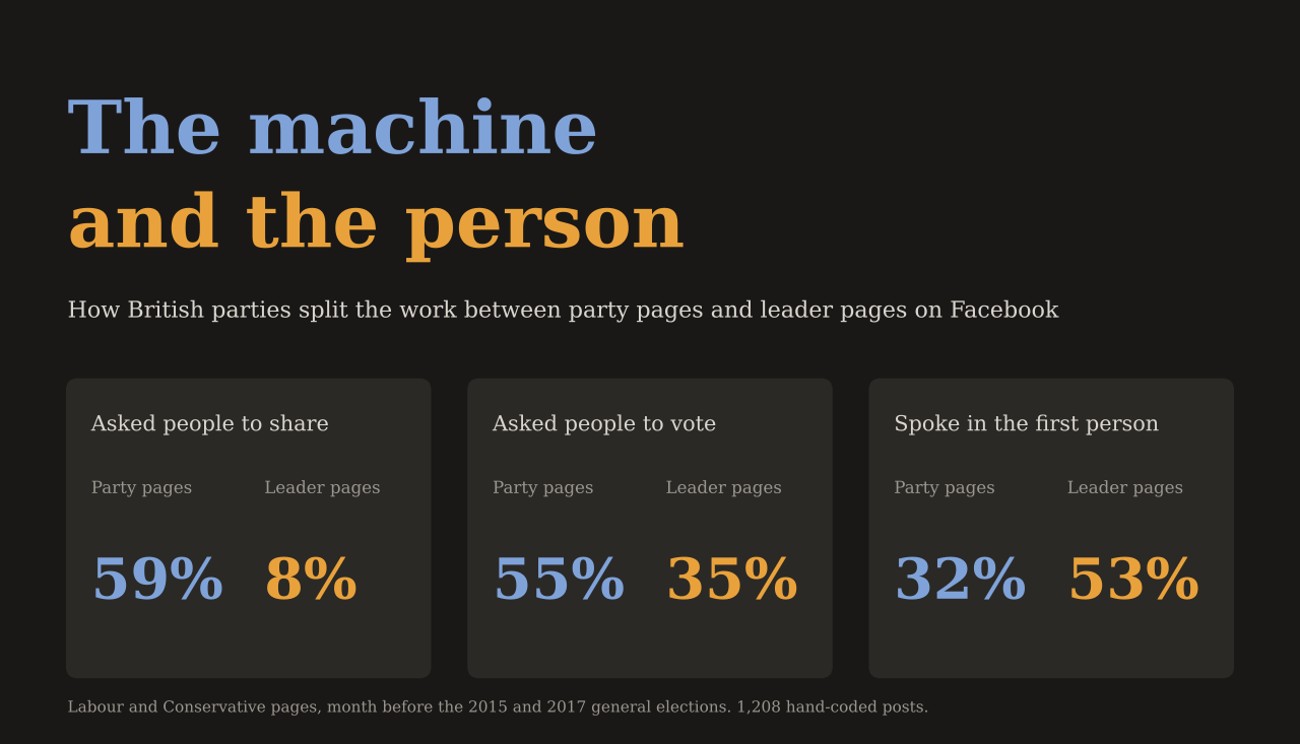
The party pages did the selling. Almost every post carried political information (97%, against 78% on leader pages). They used the slogan more, linked to the party website more, and above all they asked people to do things. Party pages asked people to share in 59% of posts; leader pages in 8%. On the Conservative page in 2015, three posts in four asked to be shared; on David Cameron’s page, one in twenty-five. Party pages asked for votes in 55% of posts, leader pages in 35%. These gaps show up for both parties at both elections.
The person
The leader pages talked like a person. First-person language in 53% of posts (32% on party pages). Personal messages that were not about policy in 14% (4%). Plain text posts, no picture or video, just words, in 17% (3%). Miliband and Cameron did this most, in more than a quarter of their posts each. Every one of these differences points the same way in all four pairs. Think of it as a division of labour: a leader who asked you to share every post would sound like a salesman, and a party page that spoke in the first person would sound odd.
Who throws the punches?
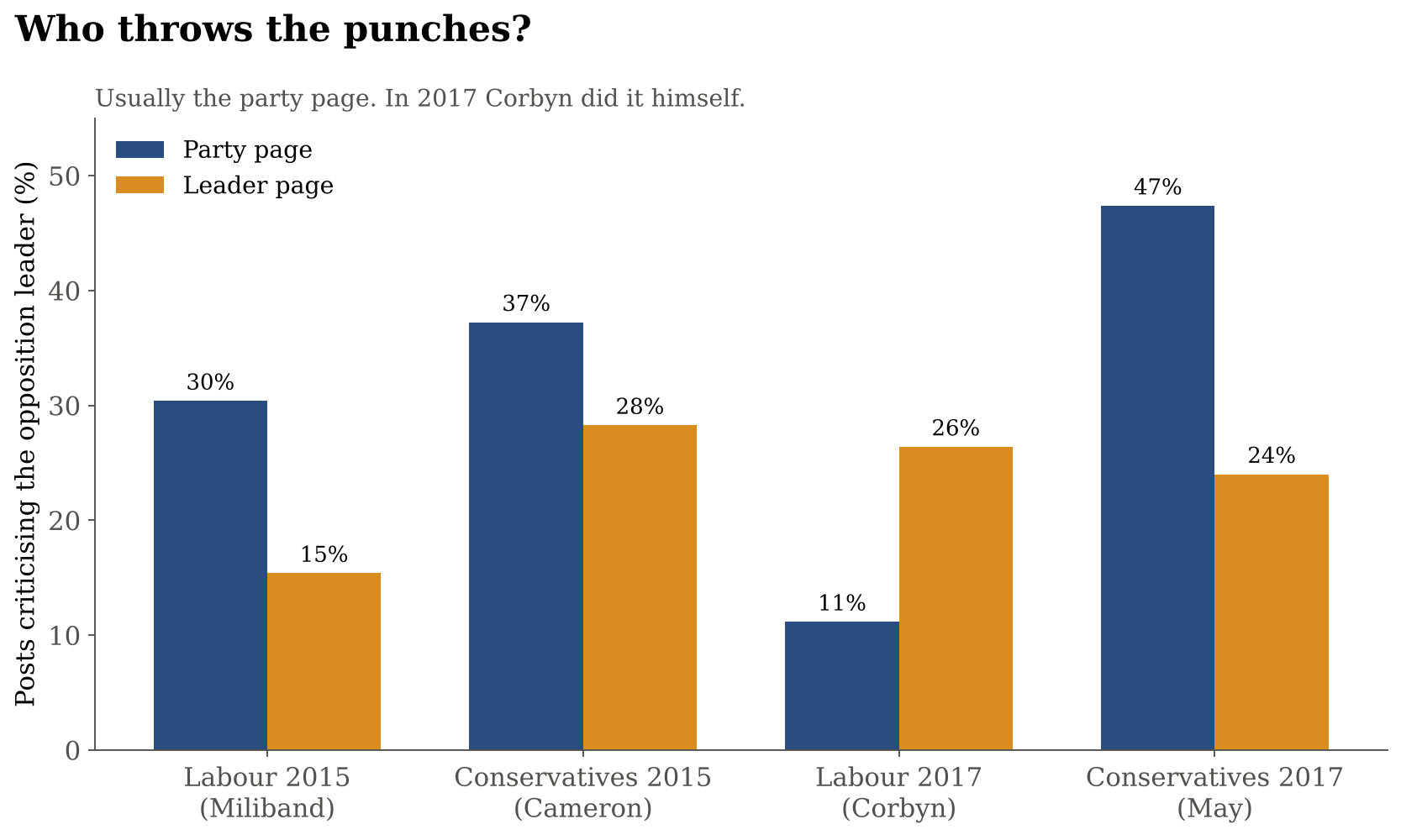
You might expect parties to keep their leaders clean and let the party page do the attacking. Three times out of four, that is what happened. Labour’s page went after Cameron twice as often as Miliband’s page did. The Conservative page went after Corbyn in nearly half its 2017 posts, twice as often as Theresa May’s page. The exception was Jeremy Corbyn. In 2017 his own page criticised May in 26% of its posts, while Labour’s party page did so in only 11%. Corbyn threw his own punches, alongside Momentum, while the party page stayed on message. So who attacks is a choice that depends on the leader, not a fixed rule.
The caveats
Four pairs of pages is not many, and the 2017 Conservative pages only had 145 posts between them. Facebook limited which posts could be retrieved, favouring the most engaged. My archive holds counts by page rather than post-by-post records, so I cannot link any of this to likes and shares. And a leader’s page is run by staff, so the personal voice is a campaign choice about how the page should sound, not proof that the leader typed it. All of this is in the paper.
Read it
Hotham, T. (2026). Follow the Leader? How British Parties Divided the Work between Leader Pages and Party Pages on Facebook at the 2015 and 2017 General Elections. Preprint, Zenodo. https://doi.org/10.5281/zenodo.23280205
It goes with my other recent preprints from the same PhD data: who the parties pictured in 2015 and 2017, what Momentum did after 2017 and leaders, party pages and the polls.
The views in this post and the paper are my own.

