
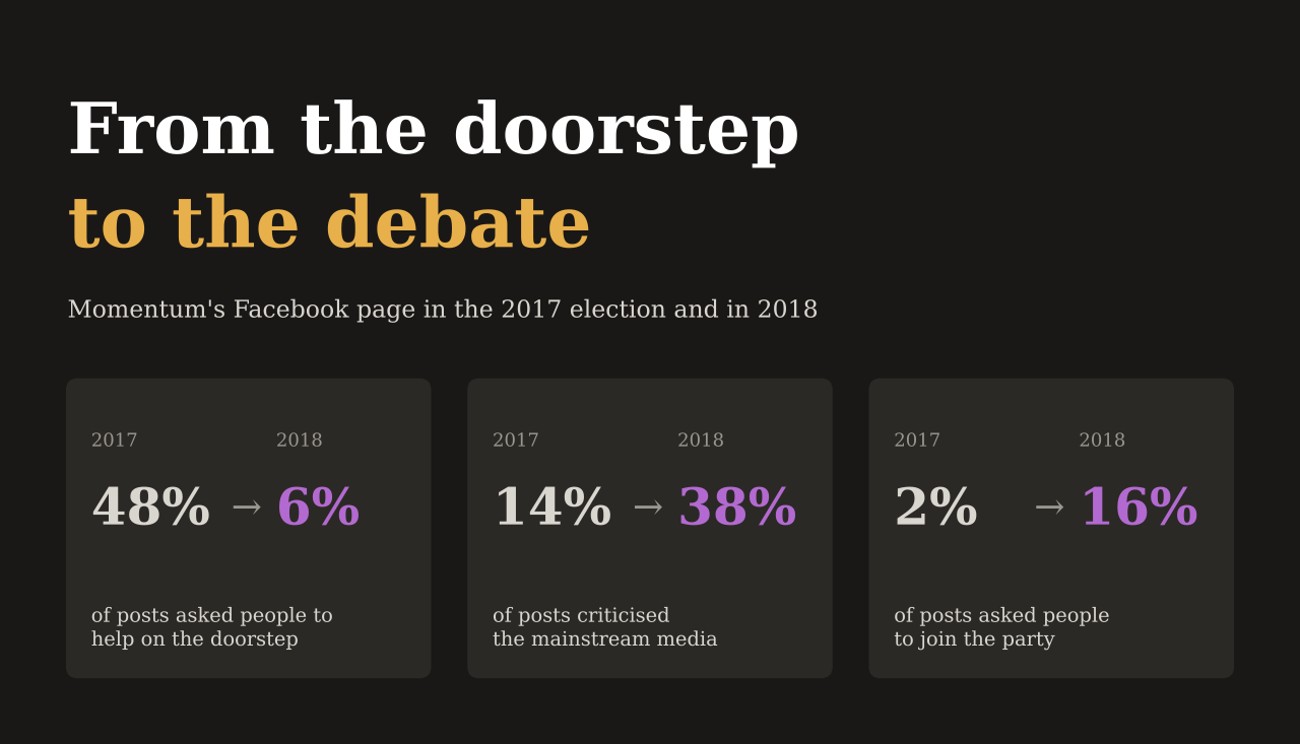
In 2017, Momentum was the story of Labour’s digital campaign. Viral videos, an army of young volunteers, buses to marginal seats. Back in 2021 I wrote a working paper on what its Facebook page did during that election. But campaigns like Momentum don’t pack up when the votes are counted. So what does a satellite campaign do when there is no election to fight?
For my PhD I also hand-coded a random sample of Momentum’s posts from across 2018: ten from every month. I have finally written up the comparison. The paper is From the Doorstep to the Debate: Momentum’s Facebook Page in the 2017 General Election and the 2018 Permanent Campaign, free on Zenodo.
The preprint
Open access, free to read, share and cite. 9 pages, 2 figures. Not peer reviewed. The counts behind every number are in the record.
Cite as: Hotham, T. (2026). From the Doorstep to the Debate: Momentum’s Facebook Page in the 2017 General Election and the 2018 Permanent Campaign. Zenodo. https://doi.org/10.5281/zenodo.23280073
2017: one campaign, two jobs
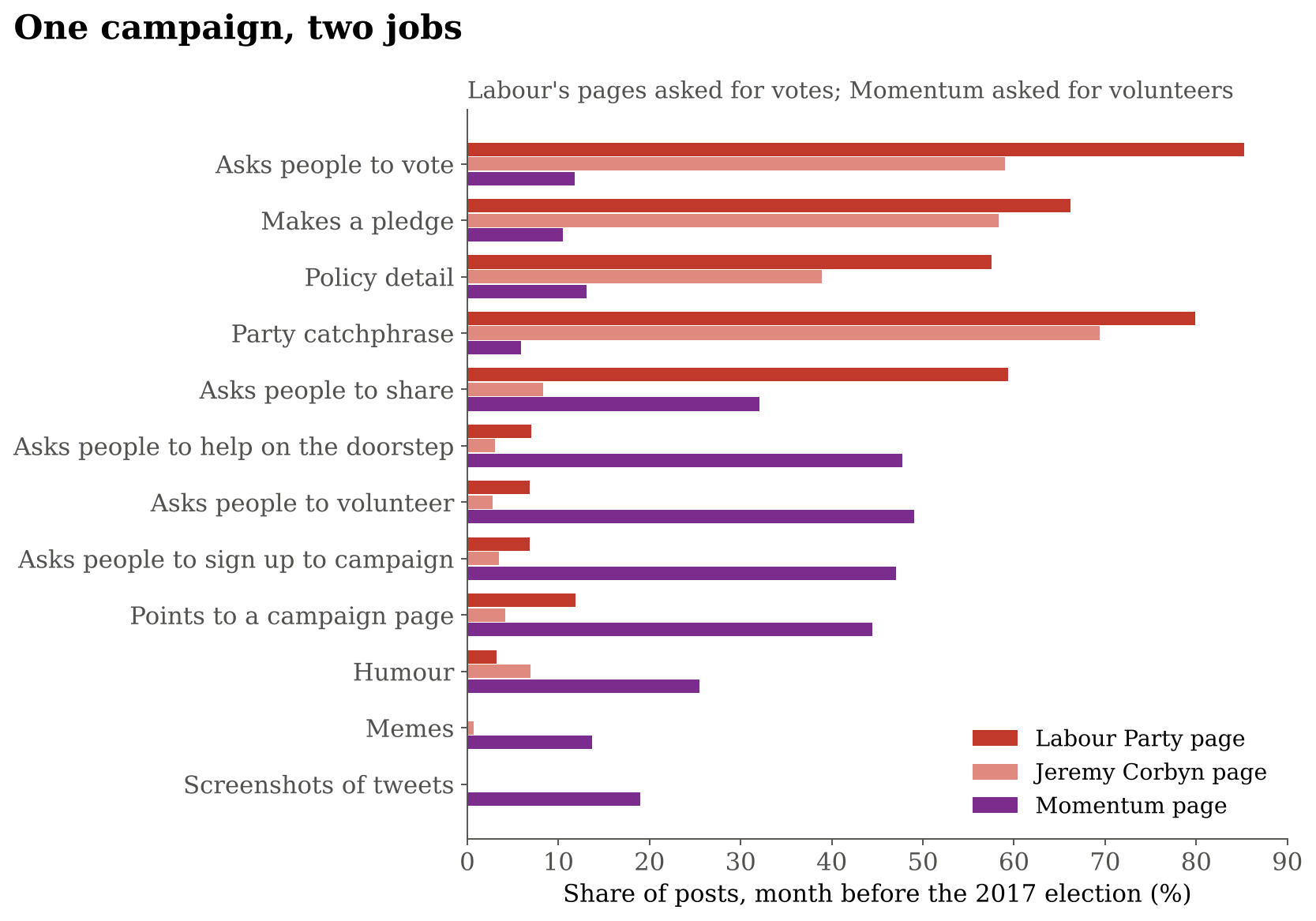
During the election, Labour’s own pages and Momentum split the work. The Labour Party page asked people to vote in 85% of its posts, made a pledge in two-thirds and used the slogan in four out of five. Momentum hardly did any of that. Instead, about half of its posts asked people to help on the doorstep, volunteer or sign up to campaign, something Labour’s pages did in under one post in ten. Momentum also had the jokes: humour in a quarter of its posts, memes in one in seven, screenshots of tweets in one in five. Labour’s official pages barely touched them.
The party ran a broad campaign for votes. The satellite turned fans into foot soldiers.
2018: from the doorstep to the debate
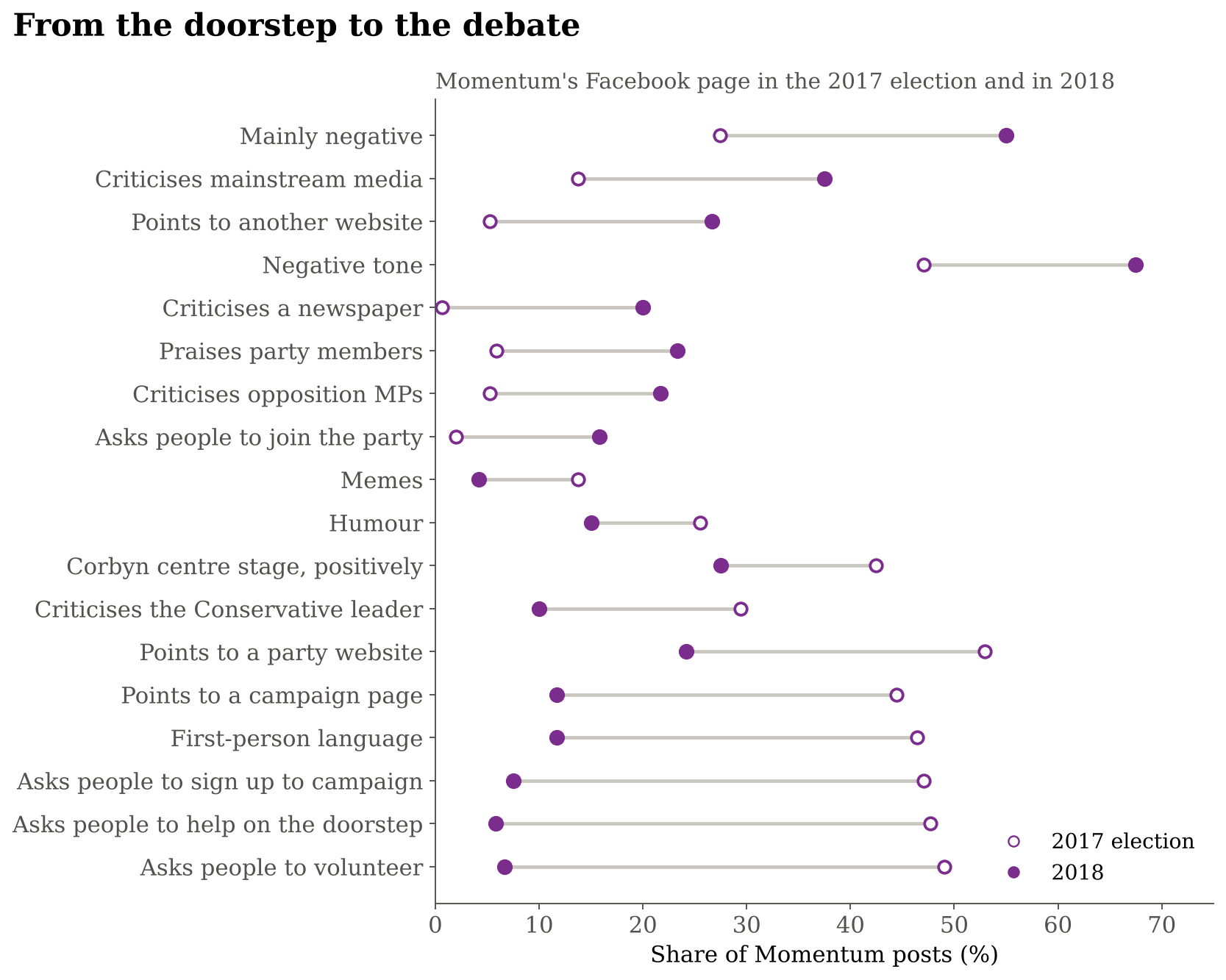
A year later the organising had almost gone. Requests to help on the doorstep fell from 48% of posts to 6%. Requests to volunteer fell from 49% to 7%, and to sign up to campaign from 47% to 8%. Requests to vote stayed where they were, at about one post in eight.
What replaced it was argument. Posts that were mainly negative doubled, from 28% to 55%. The targets changed too. Criticism of Theresa May fell (from 29% of posts to 10%), but criticism of the mainstream media rose from 14% to 38%, of named newspapers from 1% to 20%, of experts from 7% to 20% and of opposition MPs from 5% to 22%. Criticism of Labour’s own politicians stayed rare (4 posts out of 120 in 2018). The page also turned towards its own side: it praised party members four times as often (6% to 23%) and asked people to join the Labour Party far more (2% to 16%). And it got less fun. Humour and memes both fell.
Why it matters
We mostly study satellite campaigns during elections, when they help the party do things it cannot do itself. Between elections, the same freedom can be used for something else. Labour’s official pages speak for the whole party and have to be careful. Momentum could attack newspapers and opposition MPs, praise its own activists and recruit members, which also strengthens its position inside the party. Its page did not just get quieter after 2017; it changed job, from organising campaigners to arguing on behalf of its side.
The caveats: this is one organisation, so it tells us about Momentum’s choices rather than satellite campaigns in general. The 2017 posts cover an intense election month and the 2018 posts are spread across an ordinary year, so some of the change is simply the difference between the two. And my archive holds counts rather than post-by-post records, so I cannot link any of this to likes and shares. Everything is set out in the paper.
Read it
Hotham, T. (2026). From the Doorstep to the Debate: Momentum’s Facebook Page in the 2017 General Election and the 2018 Permanent Campaign. Preprint, Zenodo. https://doi.org/10.5281/zenodo.23280073
It builds on my PhD at the University of Bath and my recent preprints on who the parties pictured in 2015 and 2017, leaders, party pages and the polls and targeted ads in 2017 and 2019.
The views in this post and the paper are my own.

