
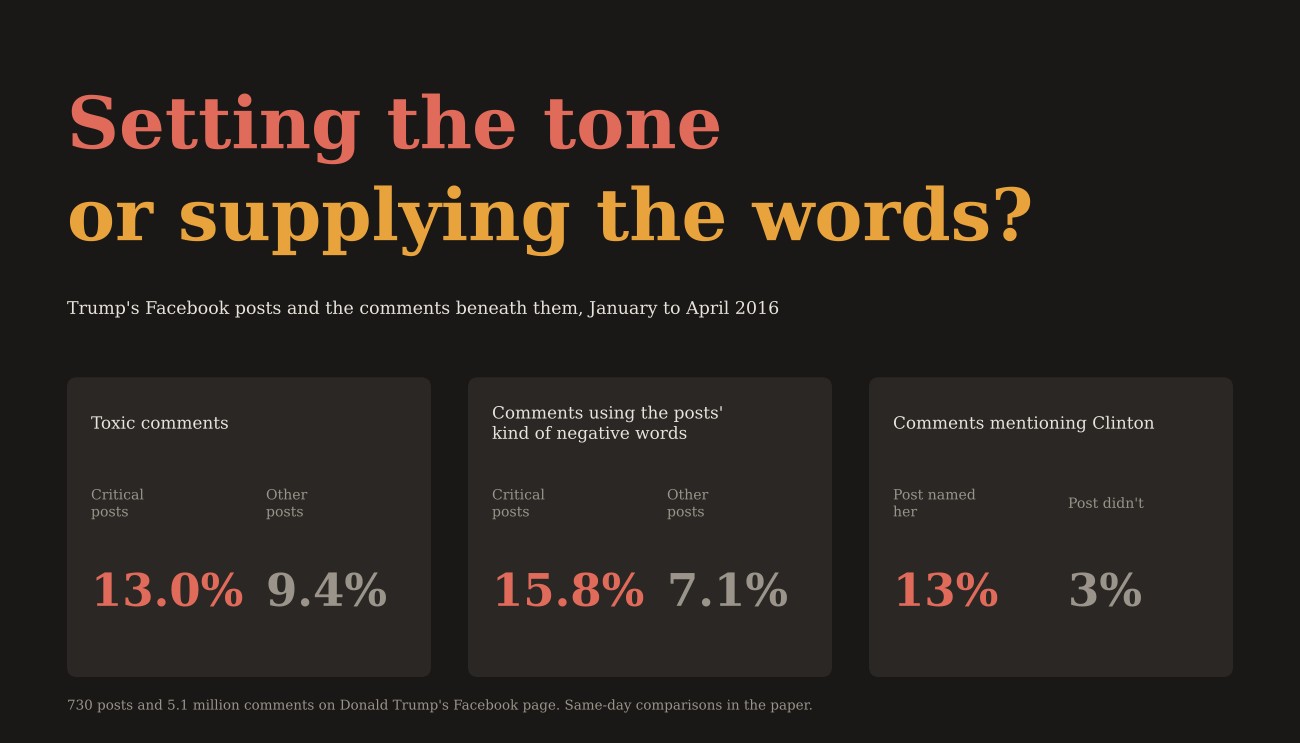
Earlier today I wrote about the crowd in Trump’s and Clinton’s Facebook comments: 5.3 million comments, about one in ten toxic, week after week. That left an obvious question. Did it matter what Trump actually posted? If he went after Ted Cruz in the morning and thanked Iowa in the afternoon, did the comments beneath those two posts sound different?
The campaign posted about eight times a day, so I can compare posts published on the same day. That holds the news, the stage of the race and the mood of the audience roughly constant, so differences between posts are not just differences between days. I linked all 730 posts from January to April 2016 to the 5.1 million comments beneath them. The paper is Setting the Tone or Supplying the Words? Donald Trump’s Facebook Posts and the Hostility of His Comment Section in the 2016 Republican Primaries, free on Zenodo.
The preprint
Open access, free to read, share and cite. 14 pages, 3 figures. Not peer reviewed. An aggregate post-level dataset is in the record; no post or comment text is shared.
Cite as: Hotham, T. (2026). Setting the Tone or Supplying the Words? Donald Trump’s Facebook Posts and the Hostility of His Comment Section in the 2016 Republican Primaries. Zenodo. https://doi.org/10.5281/zenodo.23288125
Critical posts, busier and nastier comments
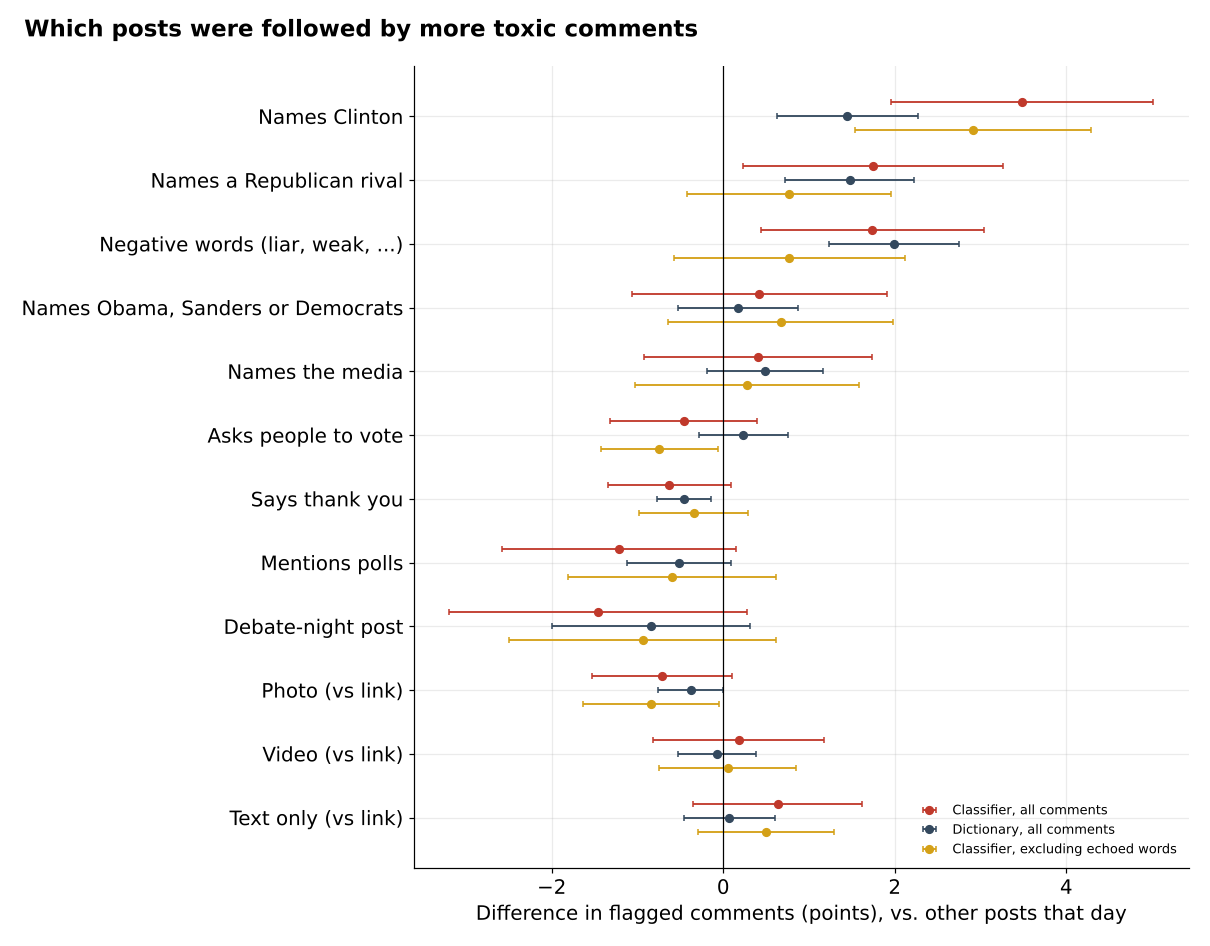
Posts that named Hillary Clinton were followed by the most toxic comment sections, 3.5 percentage points above Trump’s other posts that day, on an average of about 10%. Posts naming a Republican rival or using words like “liar”, “weak” or “loser” came next. Posts that thanked supporters were followed by slightly calmer comments.
The sharpest contrast is with what I call critical posts: the 35 posts that named an opponent or the media and used negative words. Their comment sections were 13.0% toxic against 9.4% for everything else, and they drew about a quarter more comments. Criticism got attention.
But listen to the words
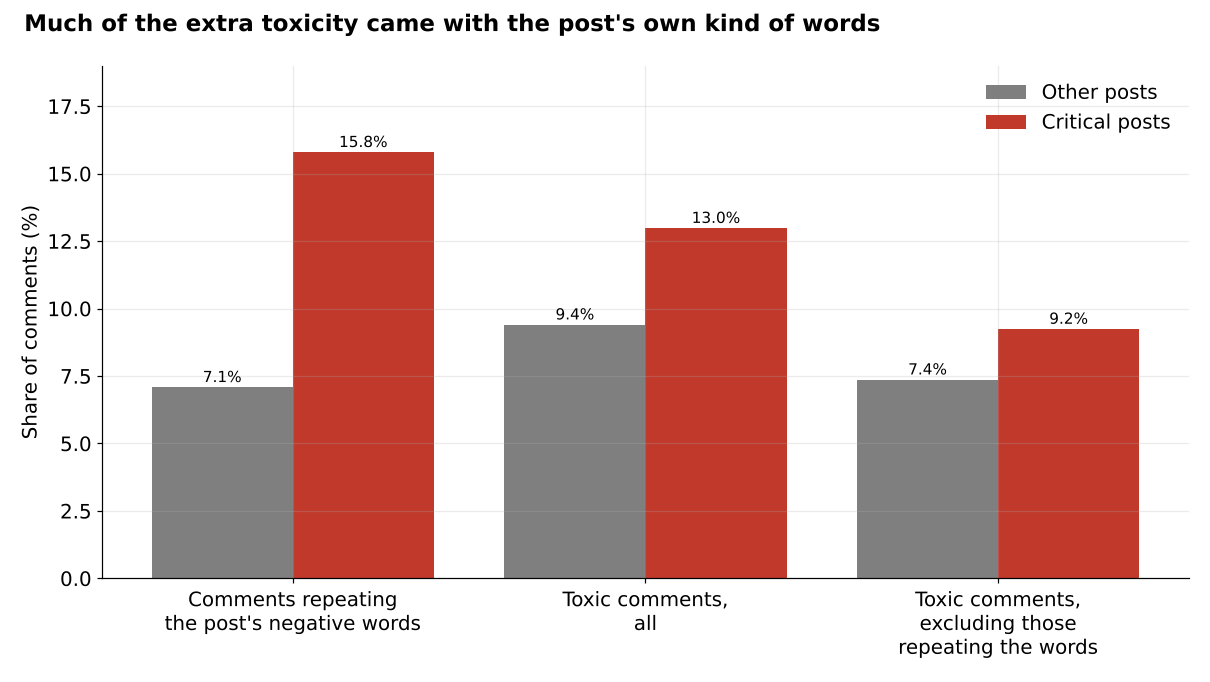
This is the bit I did not expect. Beneath critical posts, commenters were twice as likely to use the same kind of words the posts used: liar, weak, loser, the campaign’s nicknames for its rivals. And toxicity classifiers count those words as toxic. A supporter cheering “Lyin’ Ted!” scores as hostile, which, to be fair, it is if you are Ted.
So I took those words out and scored the comments again. Most of the gap went with them. Comparing posts on the same day, the difference shrank from about 2.3 points to somewhere between half a point and a point and a half, depending on how you weight the comments, and it is not always distinguishable from zero. In other words, Trump’s critical posts were less a match lit under his audience’s temper than a script his audience picked up. Researchers call this mimicry, and it is worth separating from a genuine rise in anger.
Clinton was the exception. Posts that named her were followed by more toxic comments even with the echoed words removed, and even after setting aside gendered language that classifiers are known to over-flag. Something about her drew hostility in its own right. My guess, which the data cannot test, is that she was the one opponent almost everyone on a Republican candidate’s page agreed on.
Name someone, change the subject
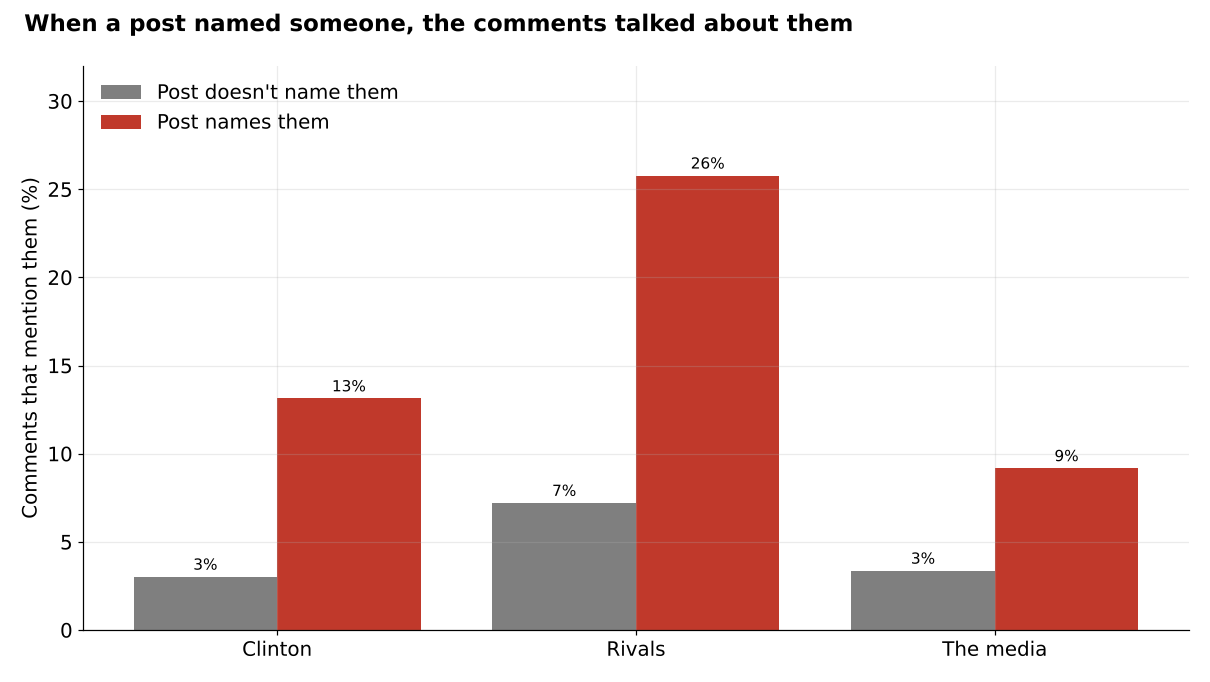
The clearest pattern of all is the simplest. When a post named Clinton, 13% of the comments beneath it mentioned her, against 3% under other posts. Name a rival, and a quarter of the comments were about rivals. Name the media, and the media came up three times as often. Of course comments respond to the post above them. The point is the size: one name in a post moved the whole conversation.
Put it together and the answer to my question is: the post mattered, but mostly for what people talked about and which words they used. A general rise in hostility, beyond the echo, is smaller and harder to pin down.
The caveats
These are associations, not proof of cause: the campaign may have attacked on the same days and moments its audience was already riled. Only 35 posts count as critical, and my word lists are precise but miss some criticism (a check against 100 posts read with AI assistance found they caught about half the critical ones). The comments are the ones that survived until they were collected, often months later. And this is one candidate in one primary; other politicians’ posts might well get the same response. All of this is in the paper.
Read it
Hotham, T. (2026). Setting the Tone or Supplying the Words? Donald Trump’s Facebook Posts and the Hostility of His Comment Section in the 2016 Republican Primaries. Preprint, Zenodo. https://doi.org/10.5281/zenodo.23288125
It is a companion to the crowd in the comments, and part of a series of preprints from my PhD data, including whether Trump’s YouTube numbers predicted the county vote.
The views in this post and the paper are my own.

