
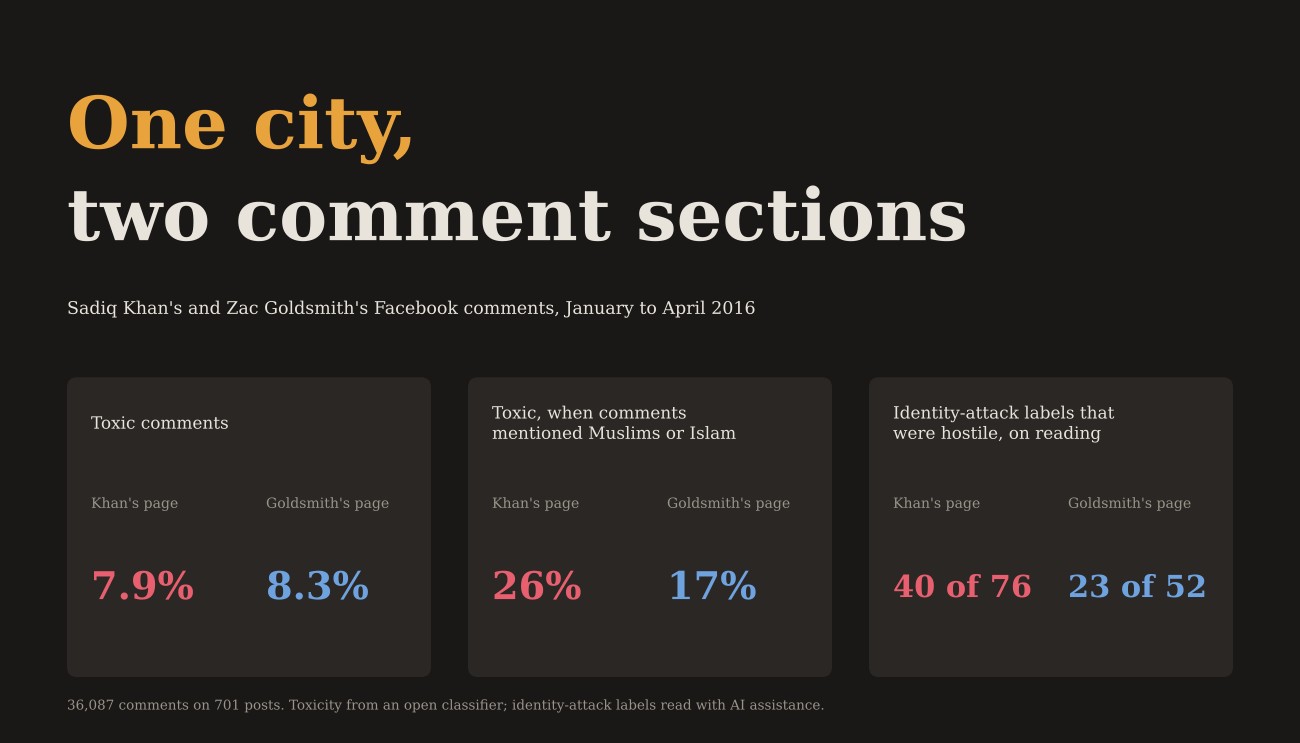
Ten years ago, in spring 2016, London chose between Sadiq Khan and Zac Goldsmith for mayor. Khan won and became the city’s first Muslim mayor. It was a campaign about housing and transport, but religion and extremism became part of it too, and both candidates addressed them on their own Facebook pages.
As part of my PhD I collected the comments beneath both candidates’ posts from January to mid-April 2016: about 36,000 comments on 700 posts, collected at the same time from both pages. After two papers today on Trump’s and Clinton’s comment sections, this one is closer to home. The paper is One City, Two Comment Sections: Toxicity and Identity on Sadiq Khan’s and Zac Goldsmith’s Facebook Pages, 2016, free on Zenodo.
The preprint
Open access, free to read, share and cite. 10 pages, 3 figures. Not peer reviewed. Aggregate results are in the record; no comment text is shared or quoted.
Cite as: Hotham, T. (2026). One City, Two Comment Sections: Toxicity and Identity on Sadiq Khan’s and Zac Goldsmith’s Facebook Pages, 2016. Zenodo. https://doi.org/10.5281/zenodo.23288552
Two very different crowds
Khan’s page posted more than twice as often, 505 posts to Goldsmith’s 217. But Goldsmith’s posts pulled in far more comments: a median of 75 each, against 13 on Khan’s. His comment section was busier, more argumentative (38% of comments were replies to other commenters) and more dominated by regulars, with the most active 1% writing a fifth of everything.
The same level of toxicity
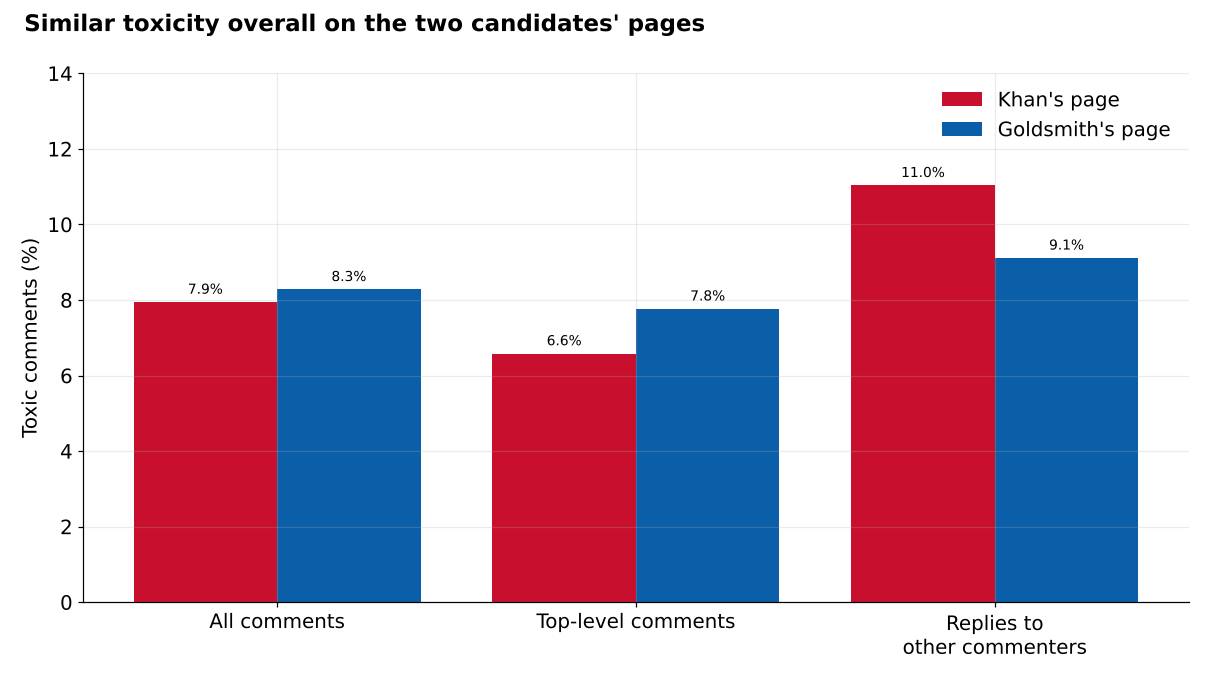
By the usual measure the two comment sections were almost identical: 7.9% of comments on Khan’s page were toxic and 8.3% on Goldsmith’s. On both pages, comments about the other candidate were nastier than comments about the page’s own. And the 593 people who commented on both pages behaved about the same on each, unlike the people who crossed between Trump’s and Clinton’s pages.
But not the same kind of hostility
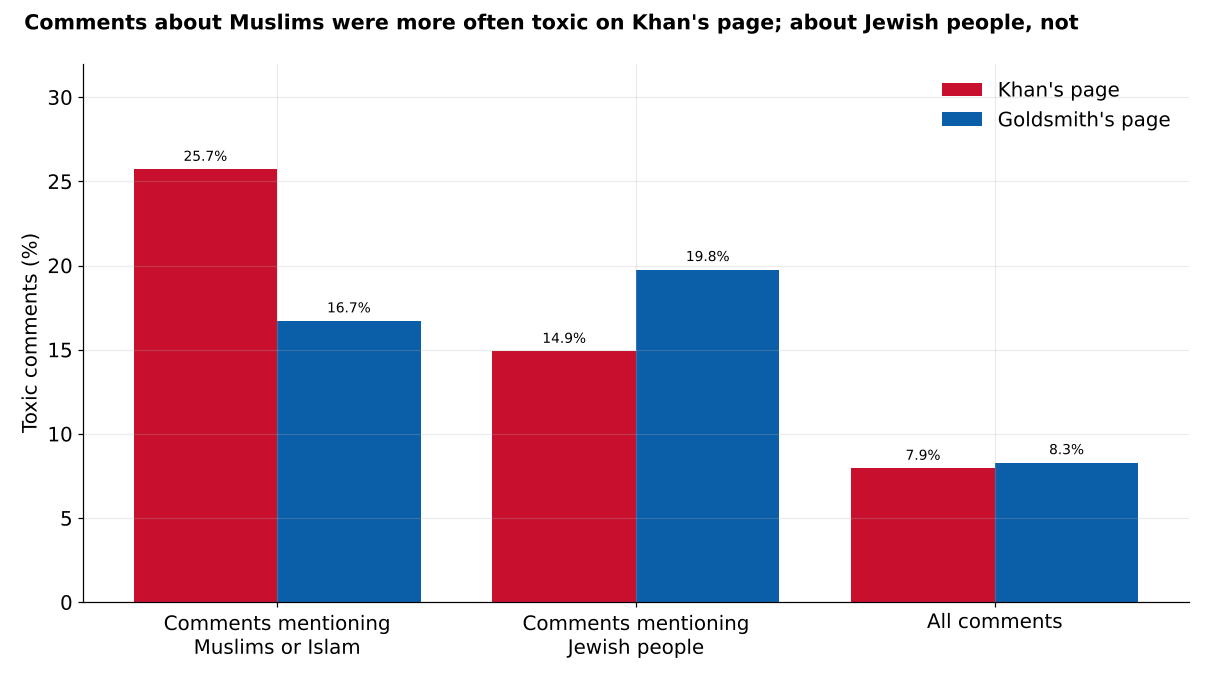
When comments mentioned Muslims or Islam, a quarter of those on Khan’s page were toxic, against about a sixth on Goldsmith’s. Comments that mentioned Jewish people pointed the other way, though that difference is too small to be sure of. Hostility around religion did not run in only one direction.
The classifier also flags “identity attacks”, and these were more than twice as common on Khan’s page (76 comments against 52). But I did not want to count those labels blind, so I read all 128 of them, with AI assistance. Only about half were actually hostile attacks on a group. Many were the opposite: people objecting to racism, or defending Muslims or Jewish people, which the classifier scored as attacks because they mention a group. On that reading, comments hostile to Muslims or Islam appeared on both pages, 25 on Khan’s and 15 on Goldsmith’s. Khan’s page also had a handful of comments hostile to white or English people, and Goldsmith’s a few antisemitic ones. These are small numbers in tens of thousands of comments, and the coding still needs checking by a second person.
Religion came up more as the race went on
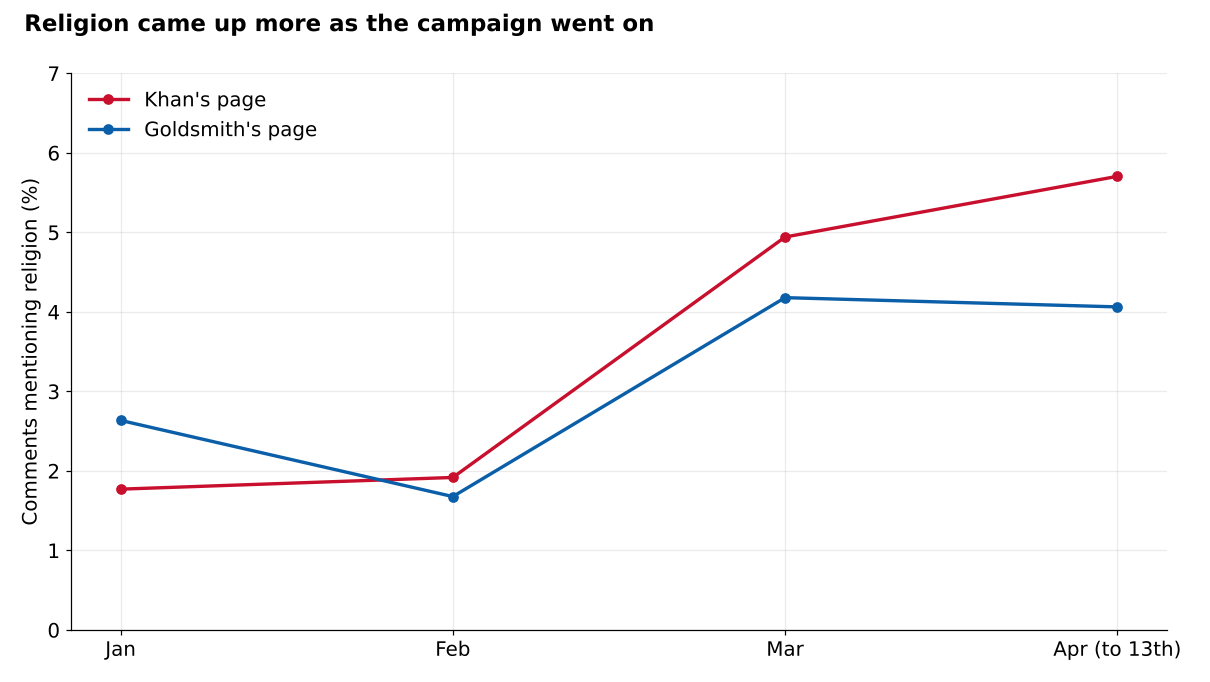
In January about one comment in fifty mentioned religion on either page. By April it was about one in twenty on Khan’s page and one in twenty-five on Goldsmith’s. Part of the April rise came from two posts in which the candidates addressed religion directly, one on each page, in the last week before my data were collected. The best-known row of the campaign, over a newspaper article in May, came after my data ends, so this paper says nothing about it.
Why this matters
If I had stopped at the headline toxicity rate, I would have said the two candidates faced the same environment. They did not quite. And if I had counted the classifier’s identity labels without reading them, I would have overstated the abuse on both pages and counted people standing up to prejudice as part of it. Anyone measuring abuse of politicians with these tools should read what they flag.
The caveats
The data end three weeks before polling day. The classifier is imperfect and misses coded abuse. The reading of flagged comments was AI-assisted and done once, and borderline cases matter when the counts are this small. Some comments were hidden or deleted before collection, slightly more on Goldsmith’s page. And none of this shows that any post caused the comments beneath it. All of this is in the paper.
Read it
Hotham, T. (2026). One City, Two Comment Sections: Toxicity and Identity on Sadiq Khan’s and Zac Goldsmith’s Facebook Pages, 2016. Preprint, Zenodo. https://doi.org/10.5281/zenodo.23288552
It sits alongside the crowd in Trump’s and Clinton’s comments and what happened beneath Trump’s posts.
The views in this post and the paper are my own.

