
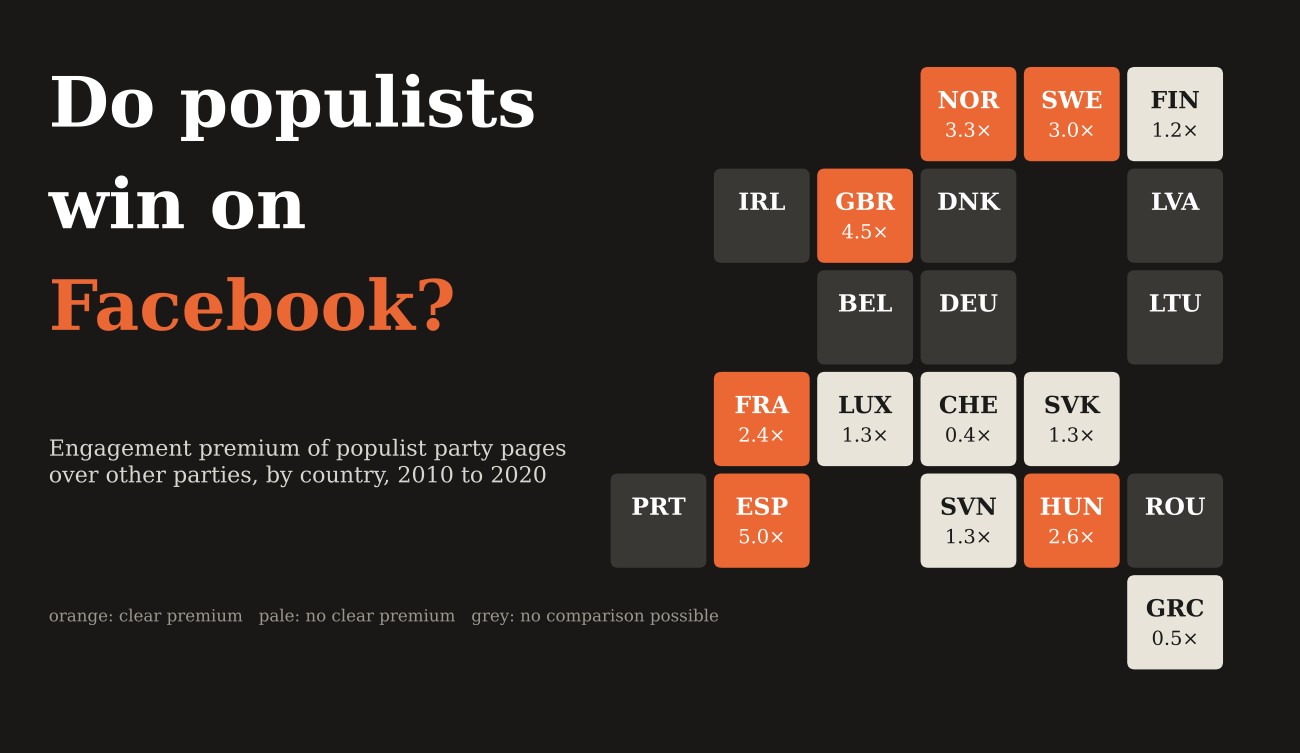
Everyone “knows” populists are good at Facebook. Farage, Orbán, Le Pen, Podemos: the story goes that their angry, people-versus-the-elite messages are made for a platform that rewards clicks and fury. In October 2020 I exported ten years of Facebook posts from party and politician pages across Europe through CrowdTangle. I never wrote them up. Now I have.
The paper is Do Populists Win on Facebook? The Engagement Premium of Populist Parties in Europe, 2010 to 2020, free on Zenodo. The short answer to the title is: yes, mostly, but not everywhere, and not quite for the reason you might think.
The preprint
Open access, free to read, share and cite. 14 pages, 6 figures. Not peer reviewed.
Cite as: Hotham, T. (2026). Do Populists Win on Facebook? The Engagement Premium of Populist Parties in Europe, 2010 to 2020. Zenodo. https://doi.org/10.5281/zenodo.23270350
What I did
I took 669,760 posts from the official Facebook pages of 112 national parties in 17 European countries, from January 2010 to September 2020, plus 186,939 posts from 74 party leaders. I classified each party using the PopuList, a classification of European populist, far-right and far-left parties by country experts, year by year, so that a party like SYRIZA or Podemos can change category over time. I added each party’s vote share and whether it was in government, from ParlGov.
The key trick is the comparison. Facebook use differs hugely between countries and grew a lot over the decade, so I only ever compare a populist party’s post with posts by other parties in the same country and the same month, and I adjust for how big the party is and whether it was in government.
Yes: populists got about two and a half times the engagement
A typical post by a populist party got about 2.5 times the likes, comments, shares and reactions of a post by a comparable non-populist party. The median populist post drew 312 interactions; the median post by another party drew 138. Populist parties also posted a bit more often, so their monthly totals were well ahead too. When I randomly reshuffled which parties counted as populist, 2,000 times, not one reshuffle produced a gap as big as the real one.
It is populism, not radicalism
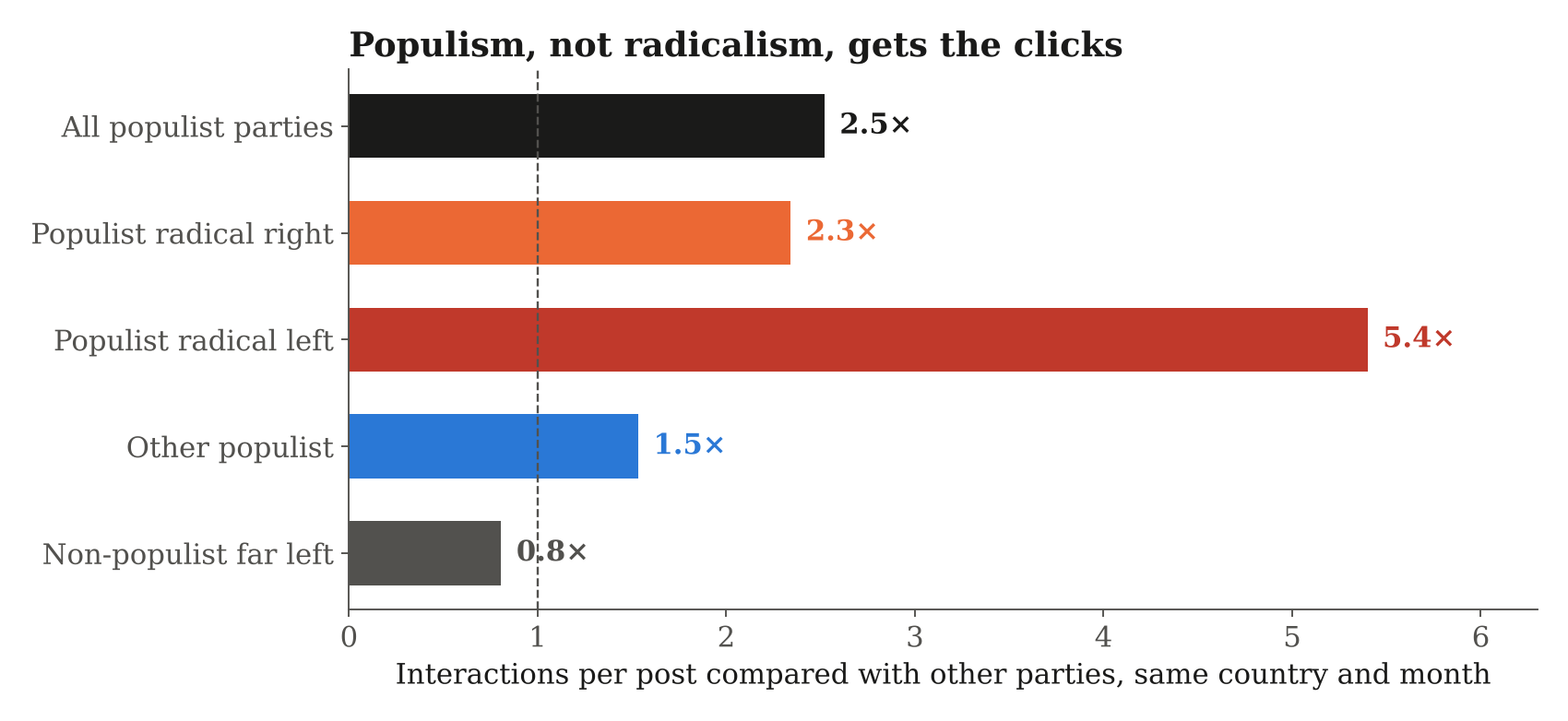
This is the bit I find most interesting. The biggest premium went to the populist radical left: Podemos, La France insoumise, SYRIZA (before 2016), MeRA25 and Levica got about five times the engagement of mainstream parties. The populist radical right, from the National Rally to the Sweden Democrats, got about 2.3 times. Far-left parties that are not populist, mostly old communist parties, got no premium at all that I can detect. Euroscepticism adds nothing once you know whether a party is populist.
So it looks like the people-versus-the-elite frame, not the radical ideology, that attracts attention. One caution: there are only seven non-populist far-left pages, and most of the populist left are new movements, so this is suggestive rather than settled.
But not everywhere
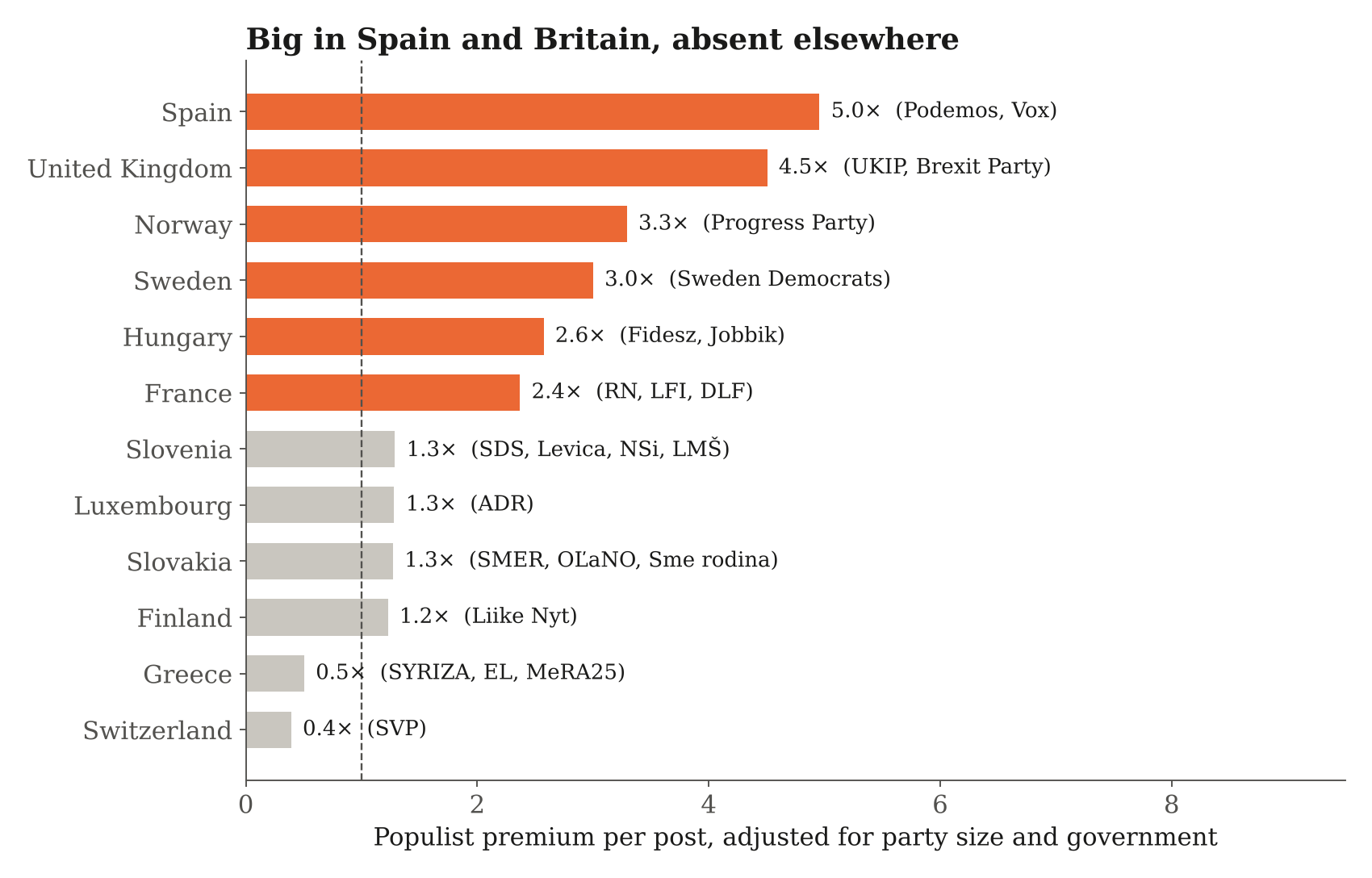
The premium is big in Spain (Podemos and Vox, about five times), the UK (UKIP and the Brexit Party, about four and a half), Norway, Sweden, Hungary and France. In Slovenia, Luxembourg, Slovakia and Finland I cannot detect one, and in Greece and Switzerland the estimates are actually below one, though not significantly. Some of this is about which pages I had: in Finland the only populist page in my exports is Liike Nyt, a small movement, because the Finns Party is missing. In Greece SYRIZA spent much of the period governing. The country numbers rest on a handful of parties each, so I would not hang much on any single one, but the overall message is clear: the premium is common, not universal.
Mostly, populists just had bigger audiences
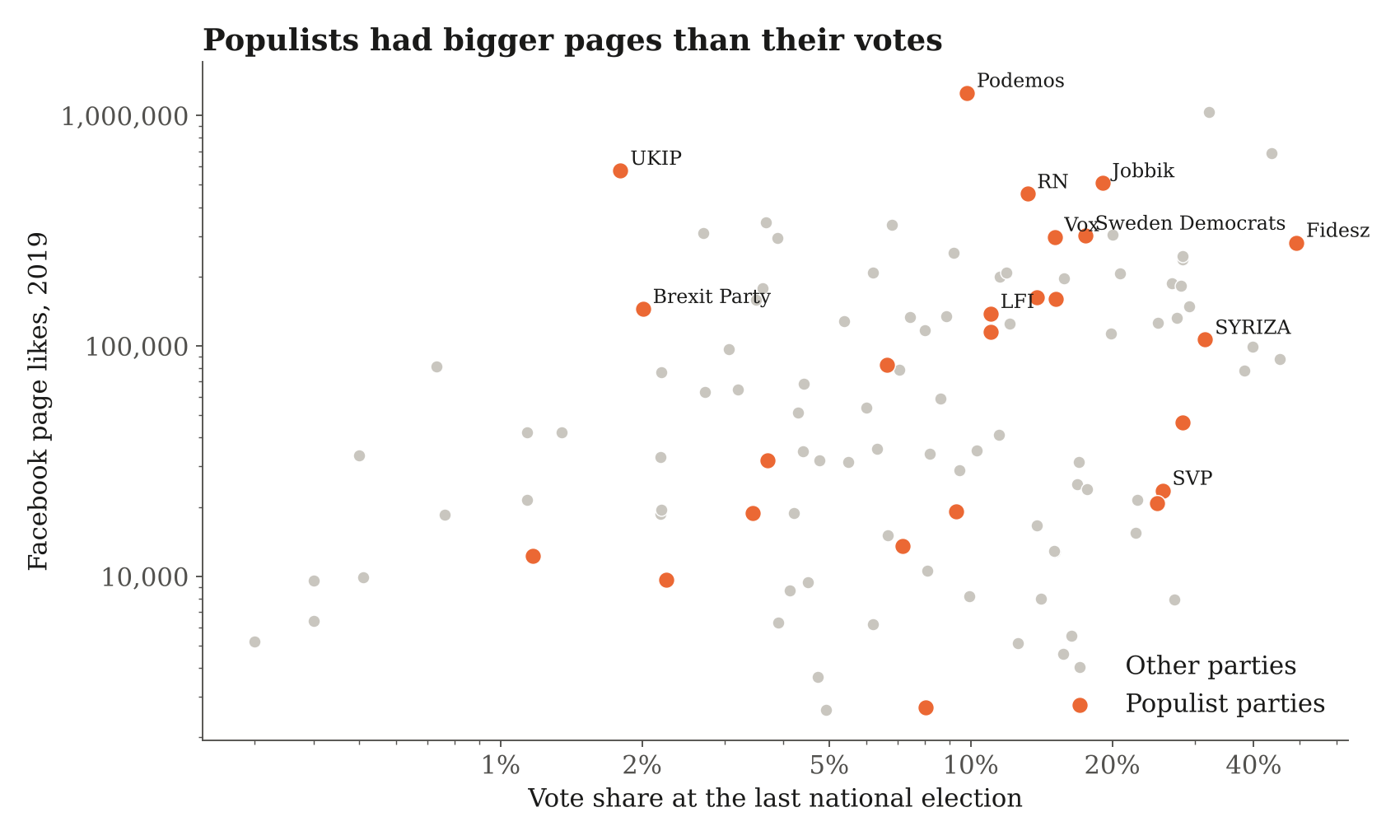
Where does the extra engagement come from? Mostly from audience size. In 2019 populist pages had about 1.9 times the page likes of other parties with the same vote share. Podemos had more than 1.2 million on under 10% of the vote; UKIP had over half a million on 1.8%. Once I hold page size constant, the premium shrinks from about 2.6 times to about 1.5 times. So more than half of it is that populists built unusually big followings, and their followers then engaged only a bit more than everyone else’s.
That matters for how we think about it. It is less that each populist post is magic, and more that populists were very good at gathering people who wanted to hear from them.
And a bit angrier
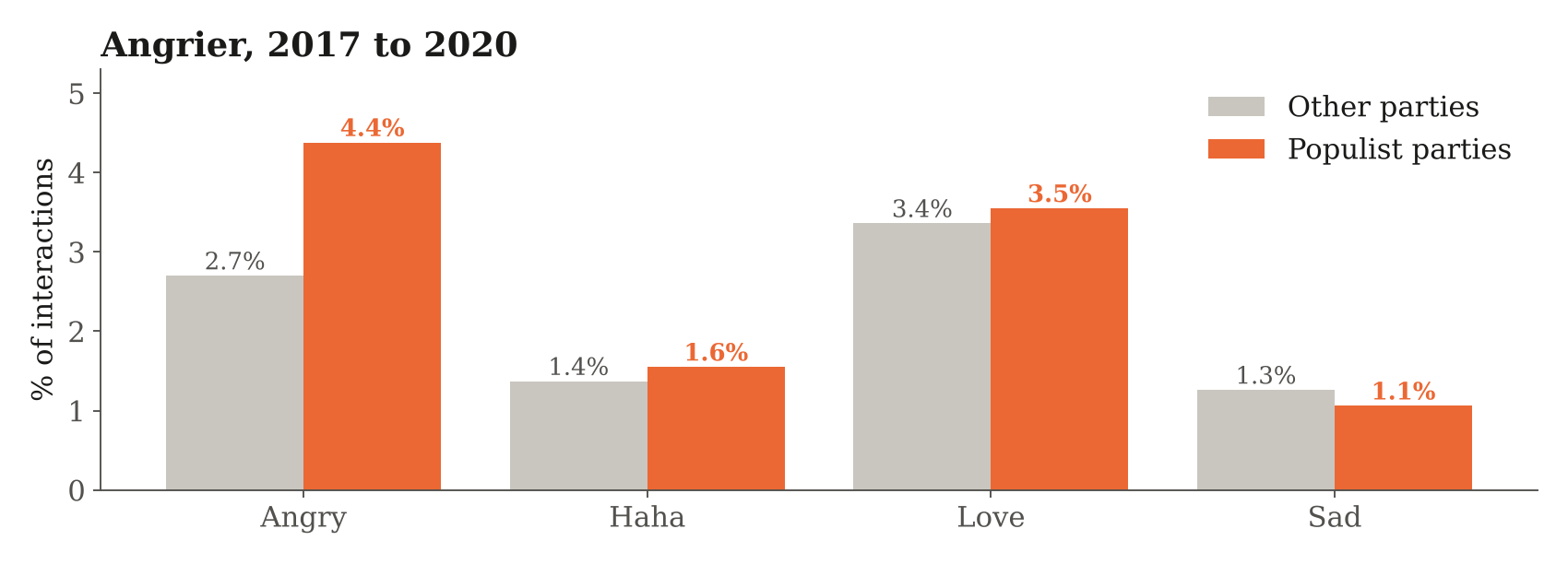
The mix of engagement was similar, with one exception: anger. Angry reactions were 4.4% of the interactions on populist posts and 2.7% on other parties’ posts, about three-fifths more. Shares, comments and likes were much the same.
Facebook’s 2018 algorithm change did not widen the gap
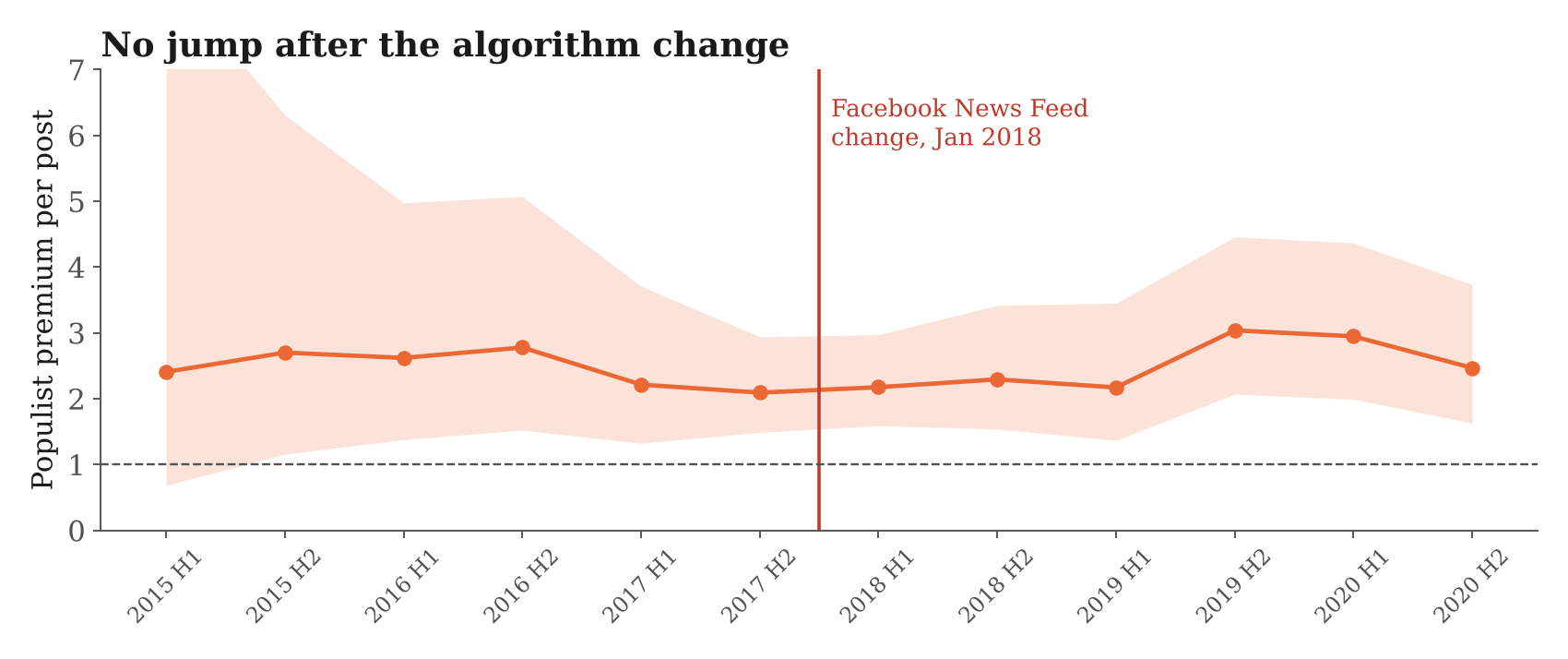
In January 2018 Facebook changed its News Feed to favour “meaningful social interactions”. Leaked documents later suggested parties in Europe felt pushed towards angrier content as a result. If that change helped populists in particular, the premium should have jumped after it. It did not: it was about 2.1 times in late 2017 and 2.2 times in early 2018, and steady after that. I cannot rule out modest changes, but there is no sign of a jump.
What about government?
Populist parties in opposition had a bigger premium (about 2.8 times) than populists in government (about 1.7 times). But the difference is not statistically significant, and when the same party moves in or out of government its premium does not change much. So I would not claim that power tames populists on Facebook. The leaders tell a similar story to the parties: Orbán, Farage, Åkesson and co. got about 2.5 times the engagement of other leaders, but all of that is accounted for by their bigger audiences.
The caveats
These are my CrowdTangle lists from 2020, not a census. Some big parties are missing, including the Finns Party, Chega, the national Alternative for Germany page, the German Social Democrats and Greens, and Fine Gael and Fianna Fáil, and there is no Poland or Italy. Engagement is not reach and certainly not votes. The PopuList classifies parties, not individual posts. And CrowdTangle’s terms mean I cannot share the raw posts; the tool itself shut down in 2024. All of this is set out in the paper.
Read it
Hotham, T. (2026). Do Populists Win on Facebook? The Engagement Premium of Populist Parties in Europe, 2010 to 2020. Preprint, Zenodo. https://doi.org/10.5281/zenodo.23270350
It builds on my PhD at the University of Bath on how parties use Facebook, and on my recent preprints on leaders, party pages and the polls, Leave and Remain on Facebook and targeted ads in 2017 and 2019. This is the first one to leave Britain.
The views in this post and the paper are my own.

