
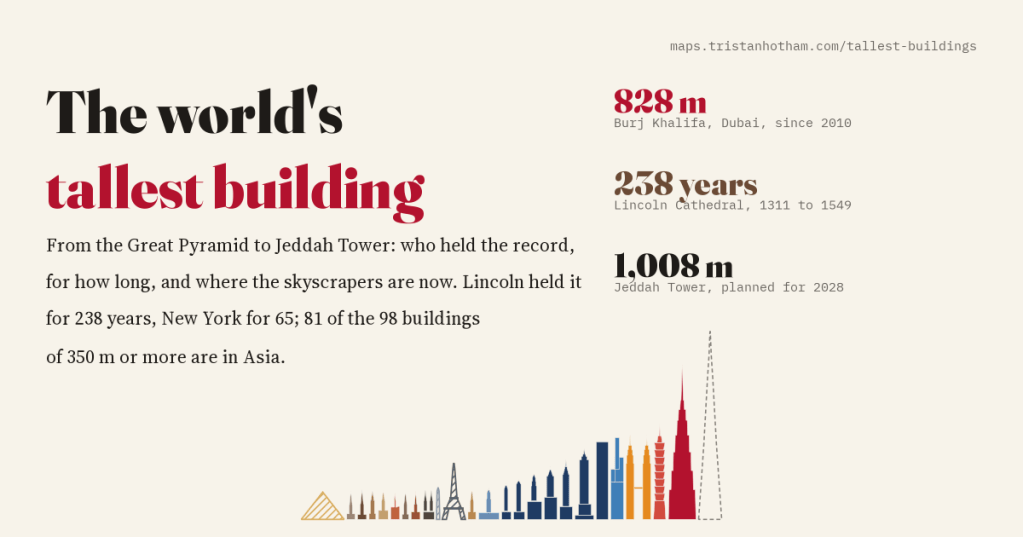
Which was the tallest building in the world in 1500? Or 1890, or 1970? I followed the record from the Great Pyramid of Giza through the spires of medieval Europe and the race up Manhattan to the Burj Khalifa, worked out how long each city held it, and mapped where today’s tall buildings stand. The longest reign does not belong to a skyscraper. It belongs to Lincoln.
The tallest building in the world is easy to name: the Burj Khalifa in Dubai, 828 m, since 2010. Go back a little and it gets harder. It depends on what you call a building, how you measure it, and whether the spire was still standing that year. Wikipedia keeps a careful history of the record, with tables of every holder, and a list of every building of 350 m or more standing today. Wikidata, its structured sister, has heights, places and dates for thousands more. I put them together.
A tomb, then the churches
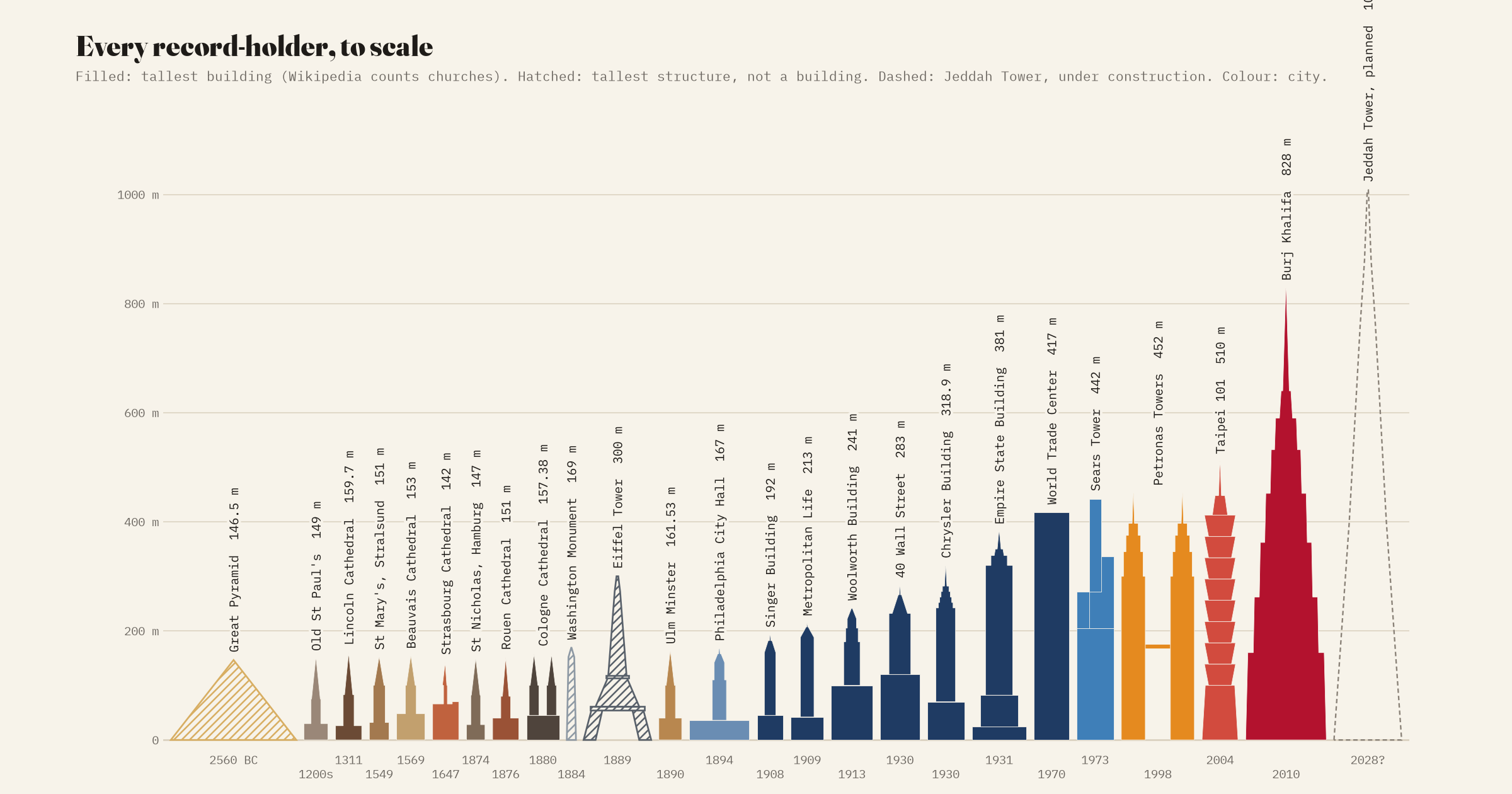
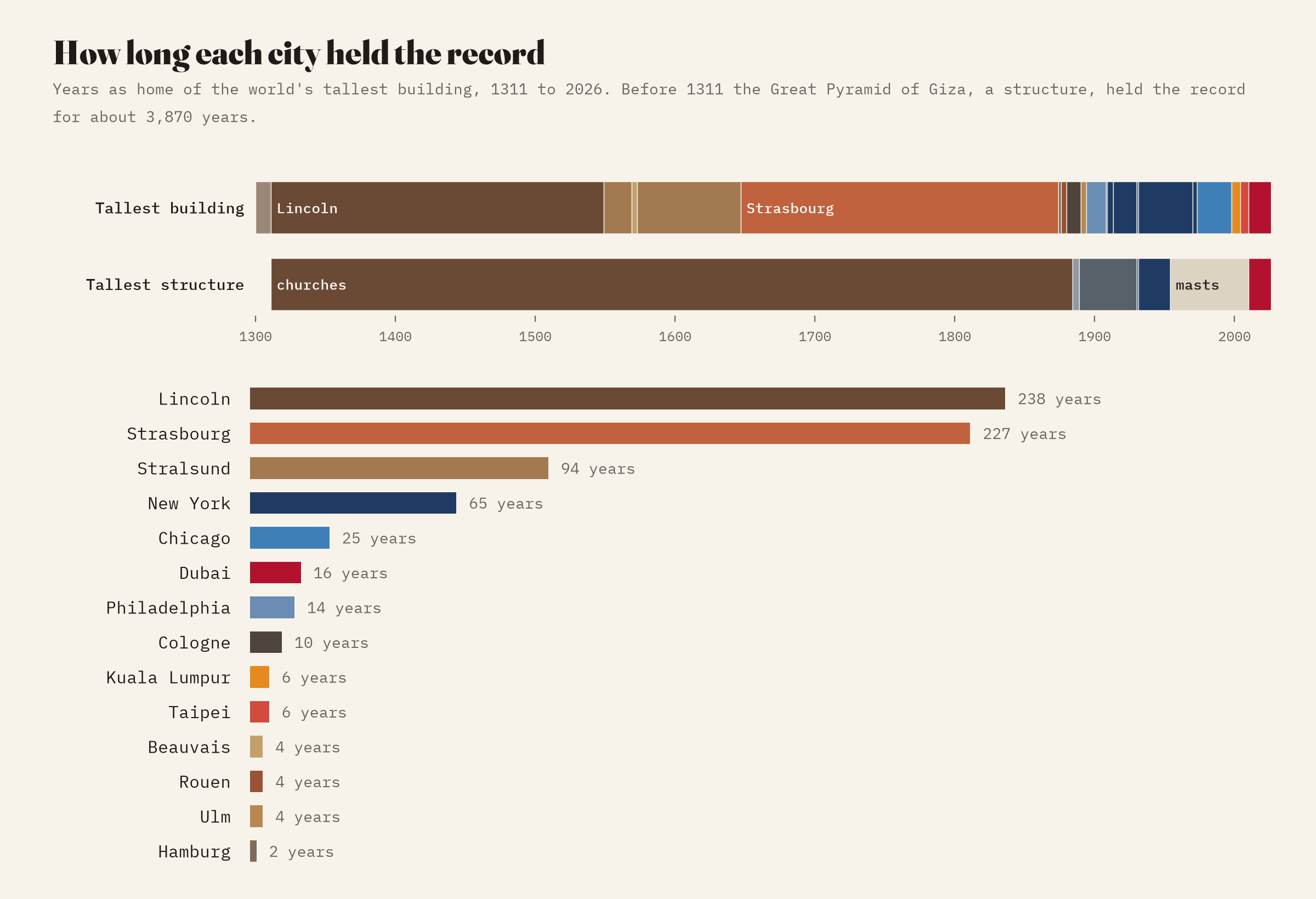
For about 3,870 years the tallest thing people had built was the Great Pyramid of Giza, 146.5 m when it was new. But a pyramid is a tomb, not a building: nobody lives or works inside it. Wikipedia’s history starts its list of buildings with London’s Old St Paul’s Cathedral and then, in 1311, Lincoln Cathedral, whose spire reached 159.7 m. It stood for 238 years, until it collapsed in 1549. No building, before or since, has held the title for longer.
What followed was a game of collapse and fire. St Mary’s in Stralsund on the Baltic took over, then Beauvais Cathedral, whose central tower fell four years later, then Stralsund again until its bell tower burned in 1647. Then Strasbourg Cathedral, at 142 m the shortest record-holder of all, held on for 227 years. Hamburg, Rouen, Cologne and Ulm each had a turn in the 19th century, and Ulm Minster, 161.5 m in 1890, was the last church to hold the record. Counting the years since 1311, churches held it for 583 of 715: 82% of the time.
Buildings, towers and masts
The definitions matter. The Washington Monument (169 m) beat the churches in 1884 and the Eiffel Tower (300 m) beat everything in 1889, but neither is a building, so neither counts. Wikipedia’s history, following the Council on Tall Buildings and Urban Habitat, measures to the architectural top, spires included, antennas not. It does count cathedrals as buildings, though most of their height is a spire nobody can use. Its list of today’s tallest is stricter: enclosed buildings with occupiable floors, 350 m or more. And the arguments never stopped. In 1930 the Chrysler Building assembled its spire in secret inside the building and hoisted it into place to beat 40 Wall Street. In 1996 the Petronas Towers beat the Sears Tower because spires count and antennas do not.
From Manhattan to Asia
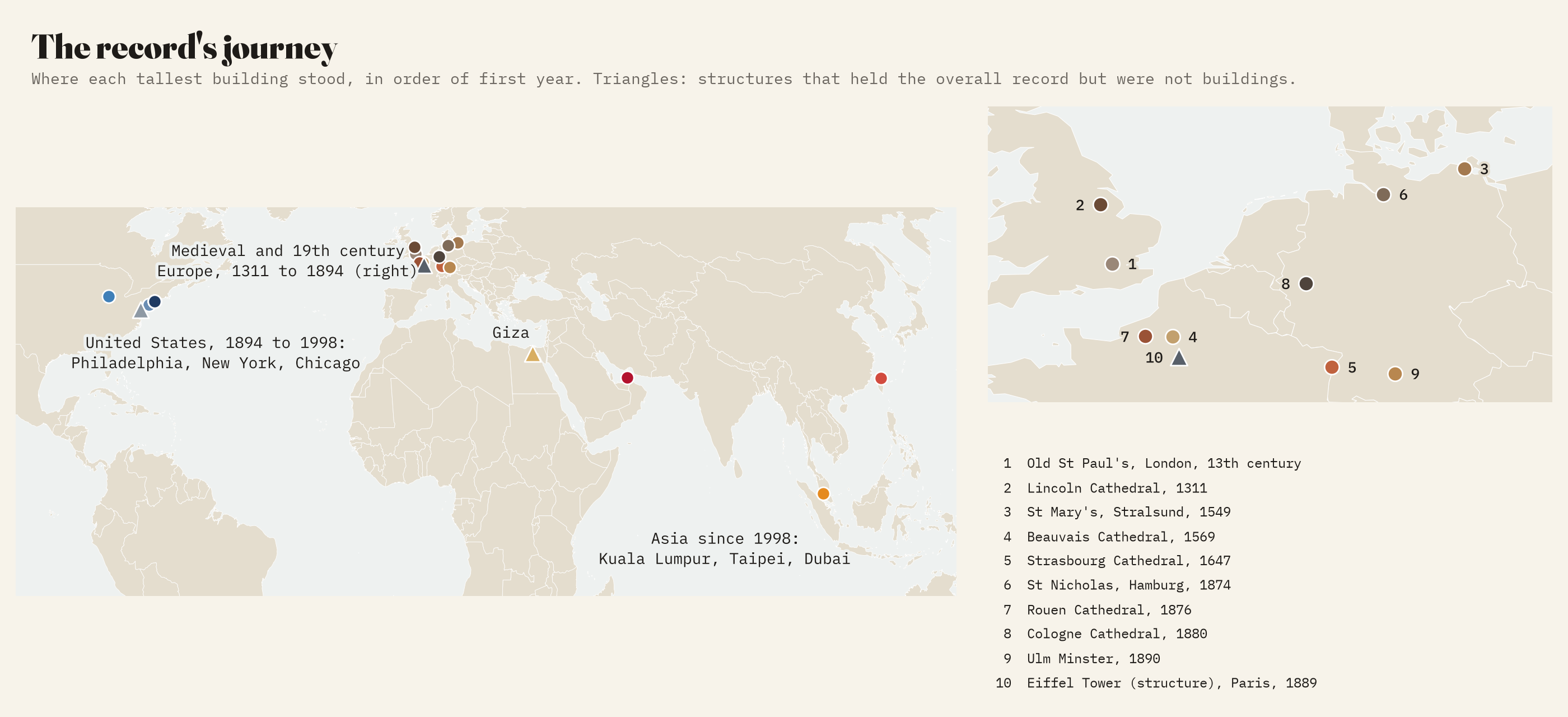
Philadelphia City Hall took the title in 1894, and from 1908 to 1973 it never left Manhattan: the Singer Building, the Metropolitan Life Tower, the Woolworth Building, 40 Wall Street and the Chrysler Building, the Empire State Building for 39 years, then the World Trade Center. Chicago’s Sears Tower had it from 1973. For 104 years the tallest building in the world was American. Then in 1998 the Petronas Towers took it to Kuala Lumpur, Taipei 101 followed in 2004, and in 2010 the Burj Khalifa beat Taipei 101 by 318 m, the biggest jump the record has ever made.
For 238 years the tallest building in the world stood in Lincoln. New York had it for 65.
The boom
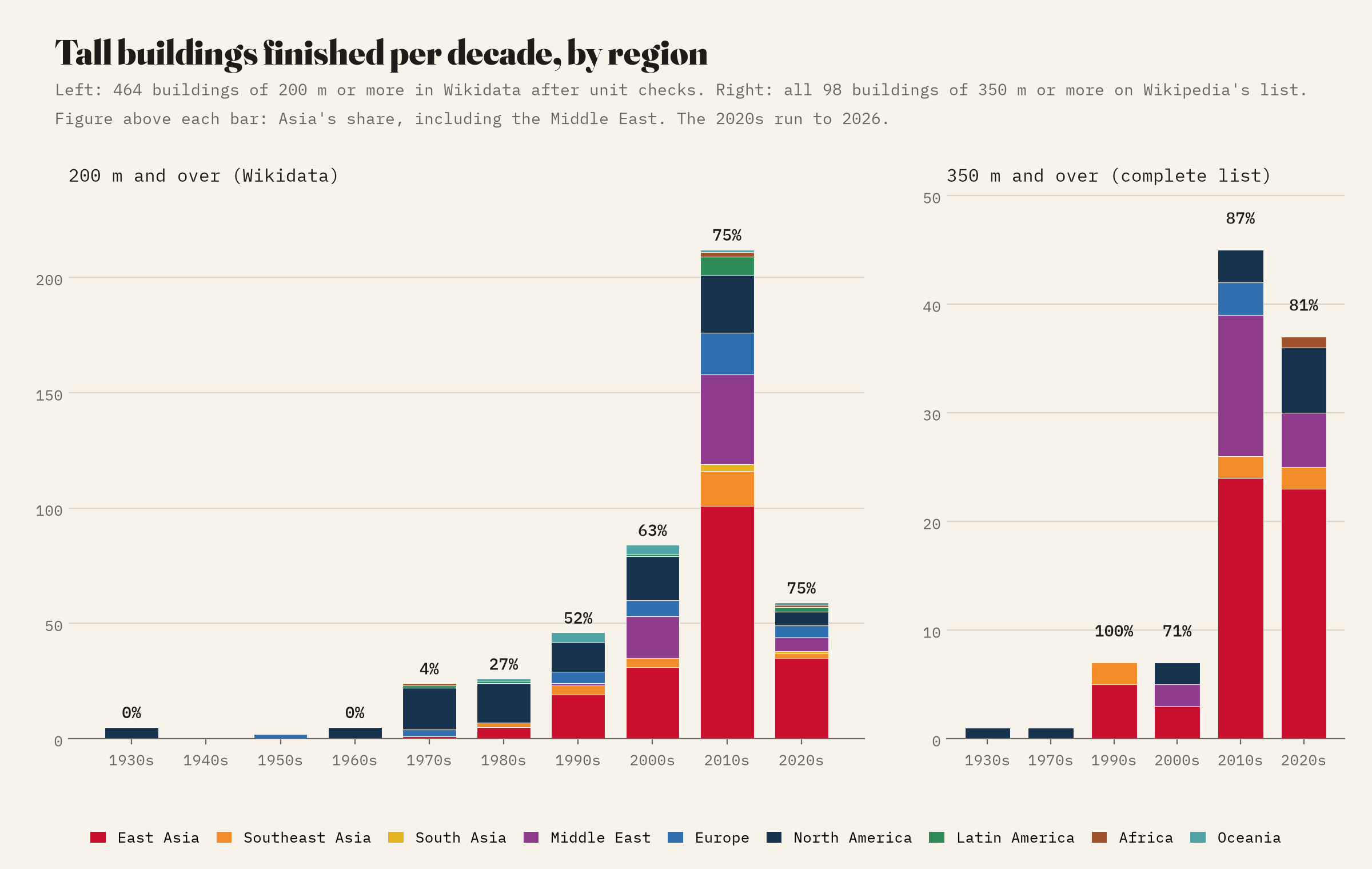
The record moved to Asia because the building moved there. Among the 464 buildings of 200 m or more I could check in Wikidata, 73% of those finished before 1990 are in North America. Asia’s share of new ones rose from 27% in the 1980s to 52% in the 1990s and 75% in the 2010s, the busiest decade by far with 212 completions. Wikipedia’s complete list of buildings of 350 m or more is starker still: 81 of the 98 are in Asia, including the Middle East, and 82 were finished in 2010 or later. The oldest building on it is the Empire State Building.
Where they stand today
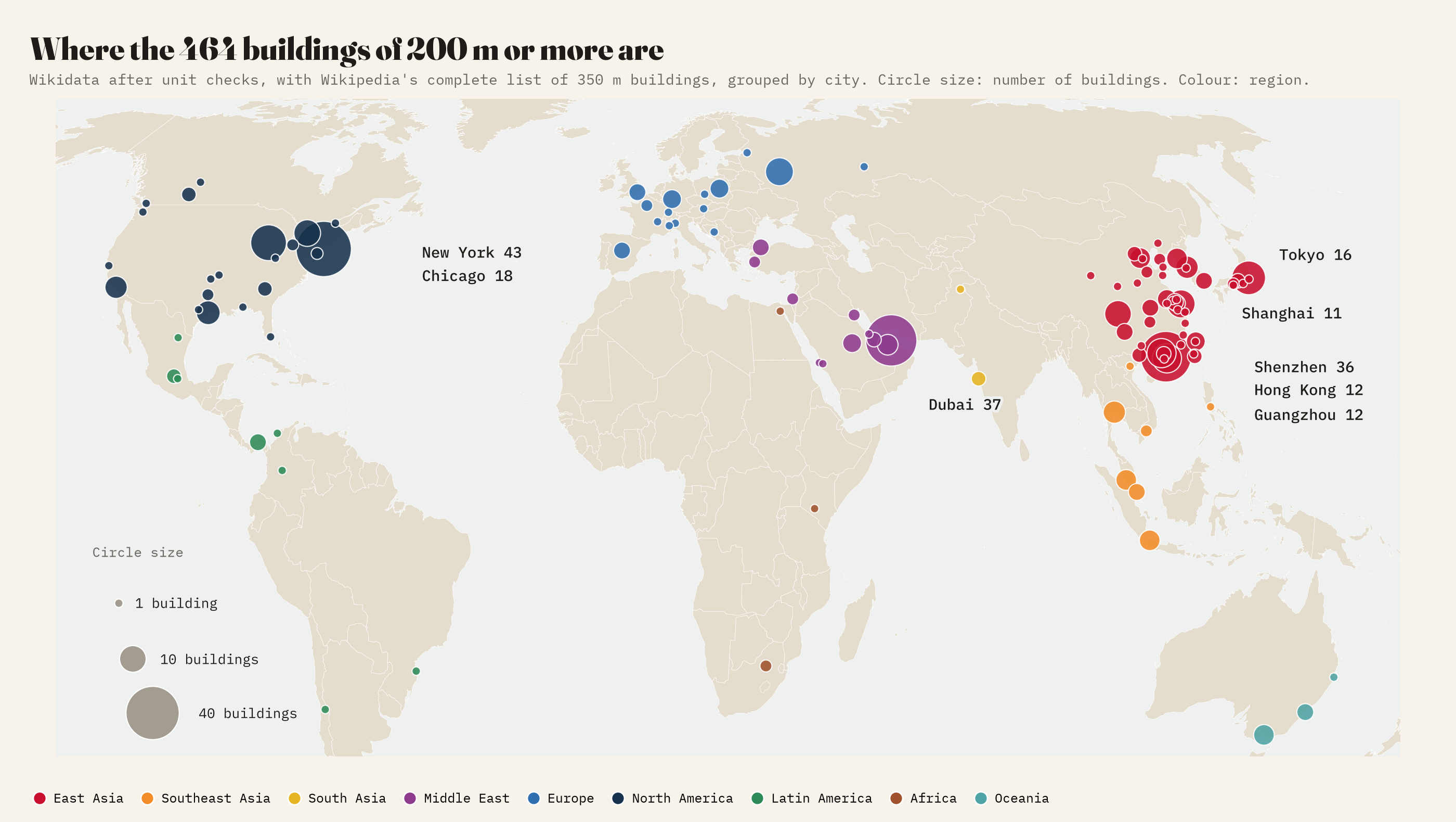
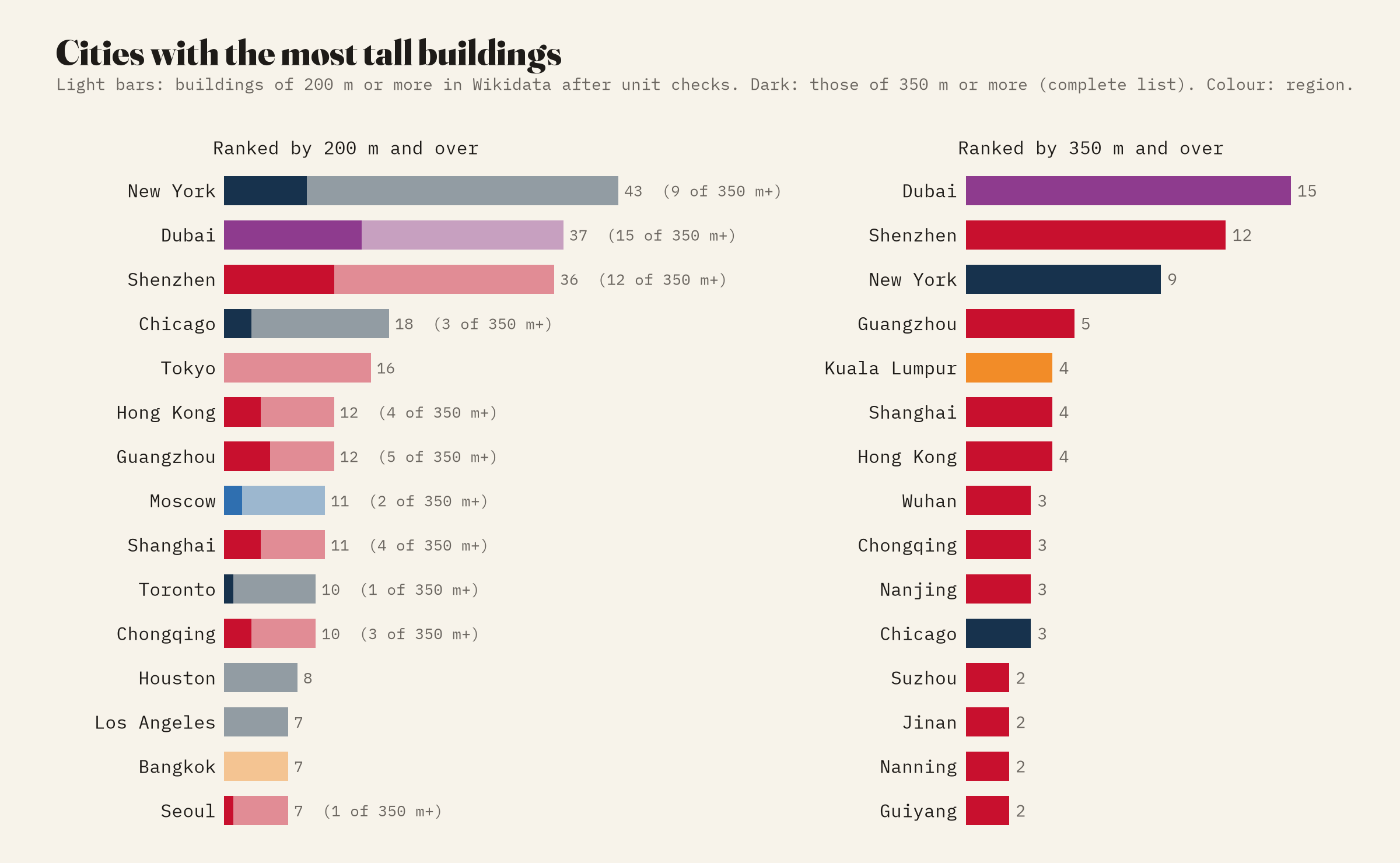
Count the buildings of 200 m or more in Wikidata and New York comes first with 43, then Dubai (37) and Shenzhen (36). Take that with a pinch of salt: Wikidata is patchy, and patchiest for China, where 10 of the 52 buildings of 350 m or more are missing from it altogether. On the complete list of the very tallest, Dubai leads with 15, then Shenzhen with 12 and New York with 9.
A kilometre in Jeddah
The next record-holder is already listed. Wikipedia shows Jeddah Tower in Saudi Arabia under construction with a planned architectural height of 1,008 m, 167+ floors and completion planned for 2028: 180 m taller than the Burj Khalifa, and the first building of a kilometre, if it is finished as planned. It is one of 46 buildings of 350 m or more under construction, 42 of them in Asia and only 1 in the United States. I have taken only what the page says: planned heights and dates have a way of changing.
How I did this
The record-holders, their years, cities and heights come from the two tables in Wikipedia’s ‘History of the world’s tallest buildings’, and the structures (the pyramid, the Washington Monument, the Eiffel Tower, the masts) from its text. The page does not date the pyramid, so I used Wikidata’s 2560 BC. Today’s tallest come from Wikipedia’s ‘List of tallest buildings’.
Wikidata was the hard part. Its heights came without units, and plenty are in feet: one 1929 office block in Quebec City appears at 269 m. So I kept only buildings, dropped anything taller than the Burj Khalifa, required every building of 350 m or more to appear on Wikipedia’s complete list (which then supplied its height and year), and checked every American height under 350 m against an independent dataset derived from the CTBUH’s Skyscraper Center, keeping only the 156 that matched. That leaves 1,343 buildings of 100 m or more, 464 of them over 200 m. Even so, these are counts of records, not a census: some heights outside the United States will still be wrong, and leaving out unchecked American records lowers North America’s share. Count them all and Asia’s share of new 200 m buildings in the 2010s would still be 65%.
Notes and sources
- English Wikipedia, History of the world’s tallest buildings and List of tallest buildings (CC BY-SA 4.0).
- Wikidata, structures with a height of 100 or more (CC0).
- CORGIS skyscrapers dataset, derived from the CTBUH Skyscraper Center, used only to check the units of United States heights.
- Natural Earth outlines and place names (public domain). Base map tiles on the interactive page © Esri.
- I wrote the text, with drafting and editing assistance from Claude (Anthropic), which also helped prepare the analysis code. I reviewed and checked all text and results.

