
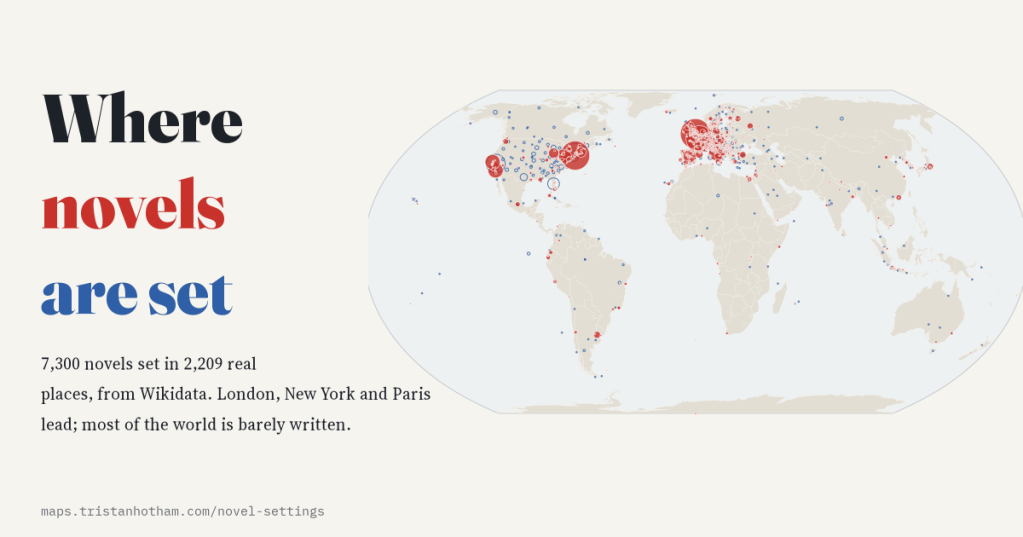
Wikidata records the real places where 7,300 novels are set. I put every one of them on a map. Fiction loves three cities, rarely travels far from home, and leaves most of the world almost unwritten. And in one small country, a few volunteers have mapped literature down to the street.
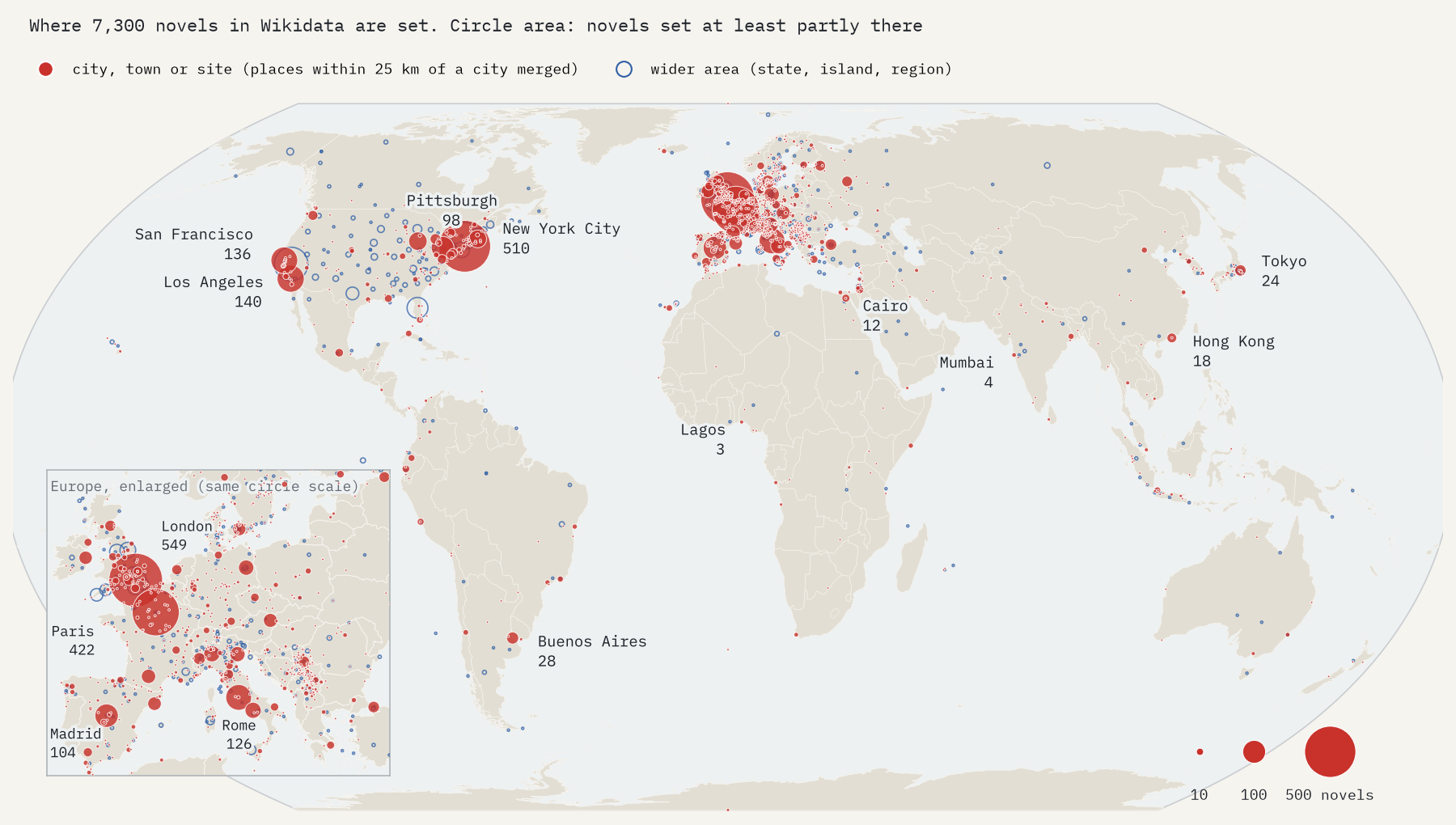
Every novel happens somewhere. Dickens has his London, Balzac his Paris, Raymond Chandler his Los Angeles. Wikidata, the free database that sits behind Wikipedia, records these places with a property called narrative location, and because each place has coordinates, the settings of literature can be drawn on a map. I downloaded every literary work in Wikidata with at least one real setting: 13,218 works, 7,300 of them novels, set in 4,057 distinct places in 154 countries.
Three cities
Three cities tower over the rest. 549 novels are set at least partly in London, 510 in New York and 422 in Paris; between them they appear in 20% of all the novels on the map. Count plays, short stories and poems too, and Paris takes first place with 877 works. Then comes a long drop to Los Angeles (140), San Francisco (136), Rome (126) and Madrid (104).
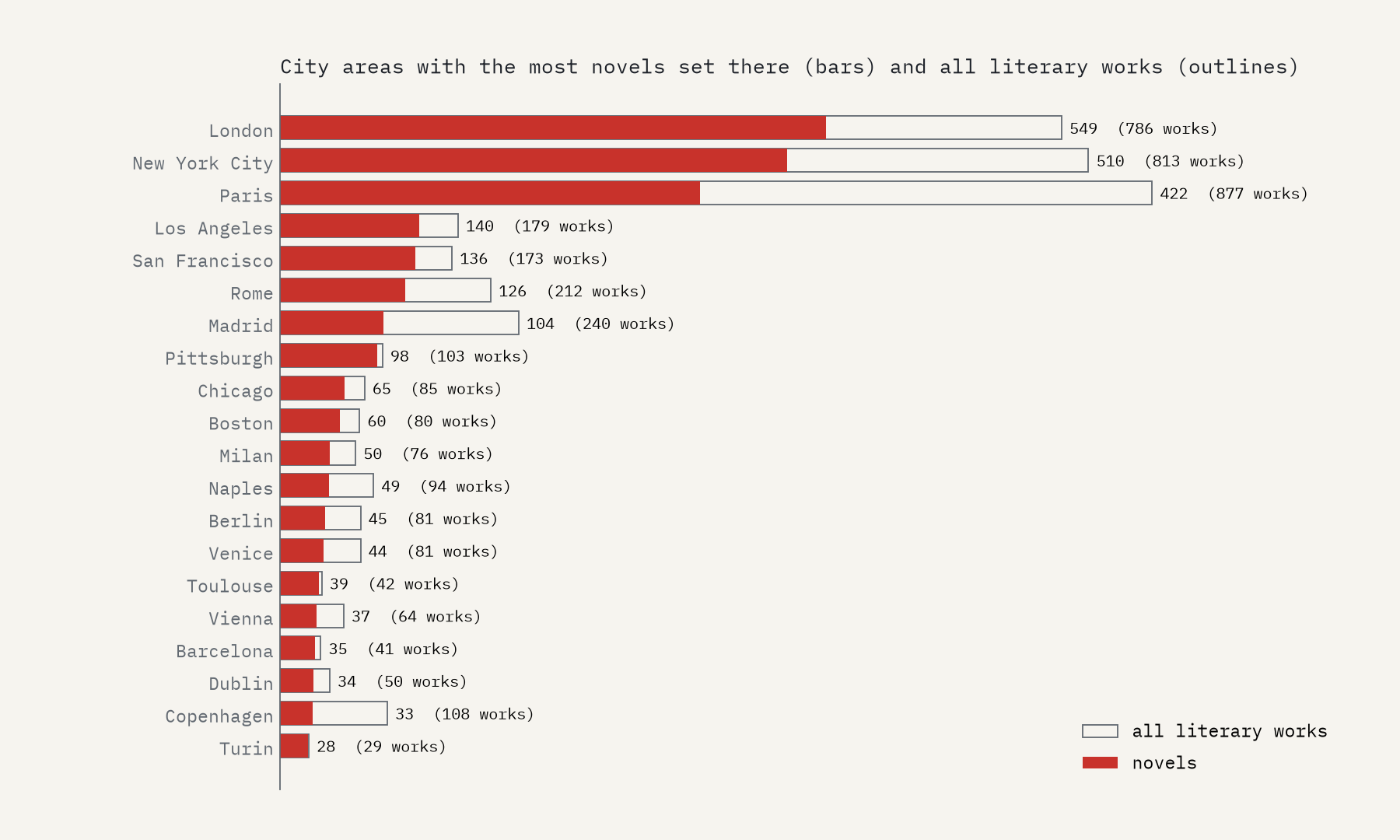
Prolific writers shape the list. Benito Pérez Galdós accounts for 37 of Madrid’s novels, Rex Stout’s Nero Wolfe for 43 of New York’s and Georges Simenon’s Maigret for 38 of Paris’s. And then there is Pittsburgh, eighth in the world with 98 novels, ahead of Chicago. Pittsburgh is not the literary capital of America; its novels are simply unusually well catalogued. Mumbai, a city of about 19 million people, has 4.
Paris, then London, then New York
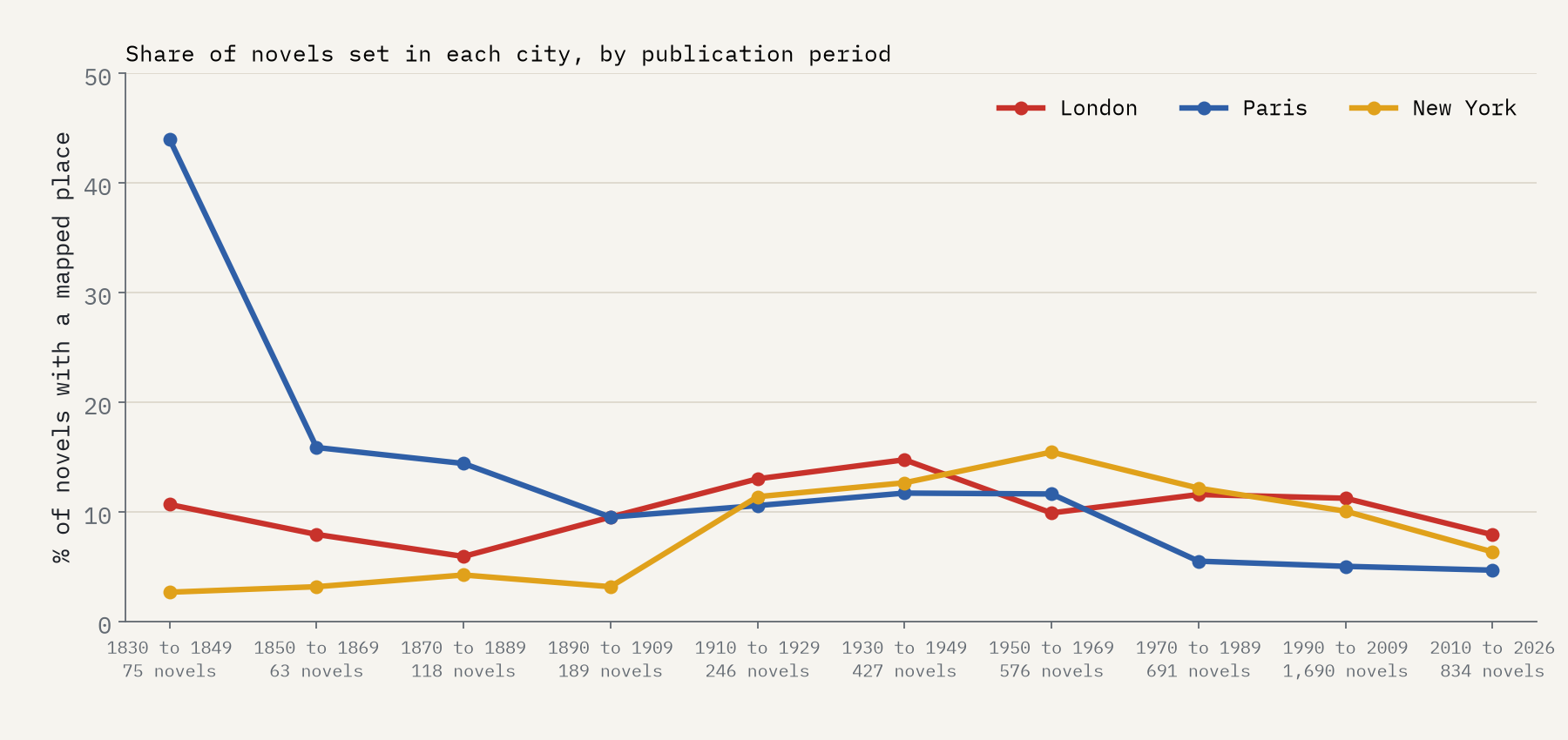
The three have taken turns at the top. Among novels first published between 1830 and 1849, the age of Balzac and Hugo, 44% of those with a mapped place are set in Paris. London had caught up by 1900 and led between the wars. From 1950 to 1989 New York led, with 15% of the novels published in the 1950s and 1960s. Since 1990 London has been back in front, while Paris has slipped to about 5%.
Write what you know
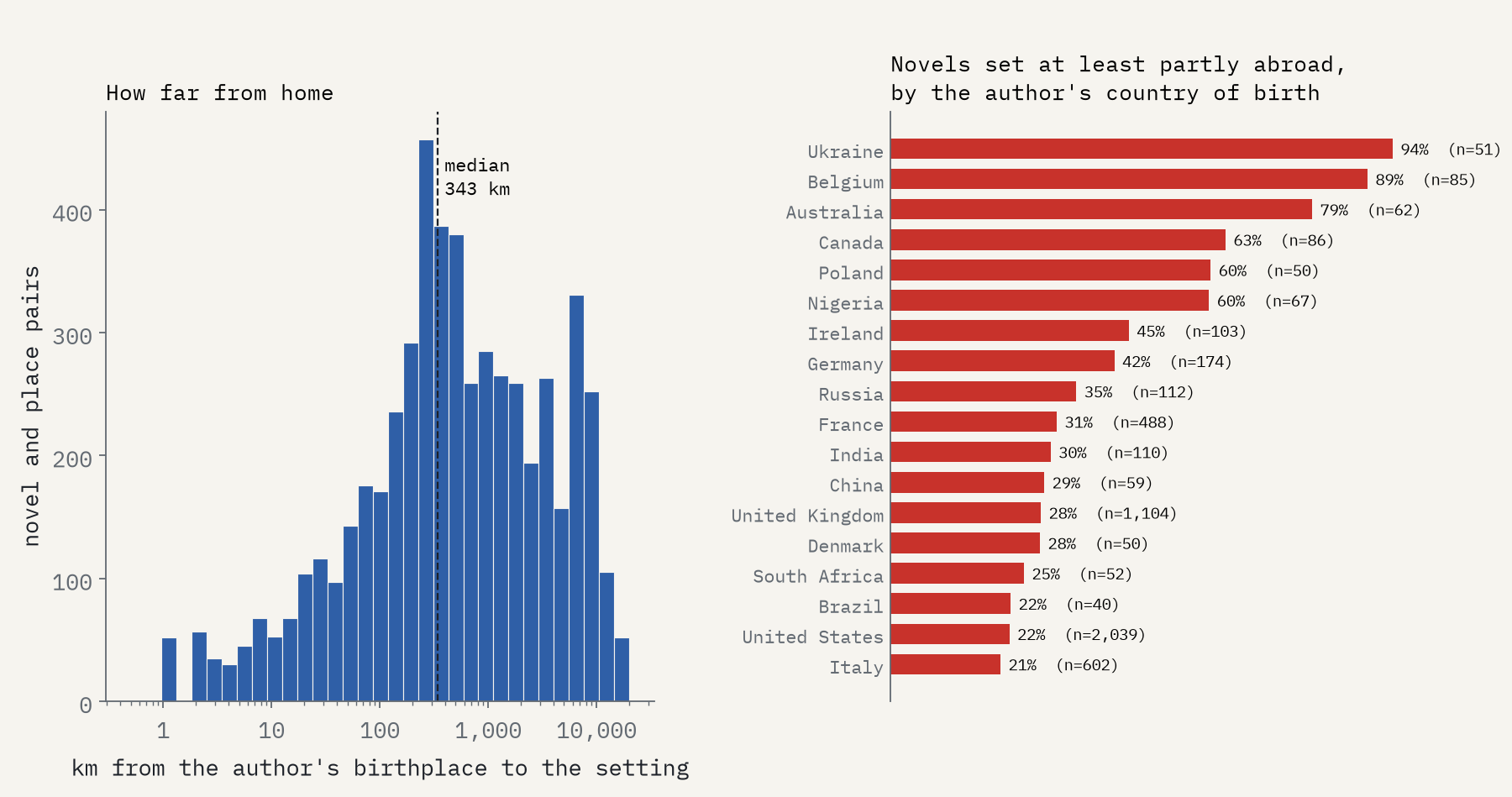
For 6,654 novels Wikidata knows where an author was born and the country of a setting. 69% are set entirely in the country where their author was born. Measured from the author’s birthplace to each mapped place, the median distance is just 343 km, and a quarter of all settings lie within 50 km of where the author was born.
The great travellers stand out. Ngaio Marsh, born in Christchurch, New Zealand, set 8 of her 10 mapped detective novels in Britain: Death at the Bar, set in Devon, is 19,174 km from her birthplace, the longest journey on the map. P. L. Travers, born in Australia, set all 7 of her Mary Poppins books in London. Birthplace is not nationality, though: writers born in what is now Ukraine top the list of those who set their books abroad (94%), because Joseph Roth, Irène Némirovsky and Giorgio Scerbanenco were born there and wrote about Austria, France and Italy.
Crime in Paris, science fiction in San Francisco
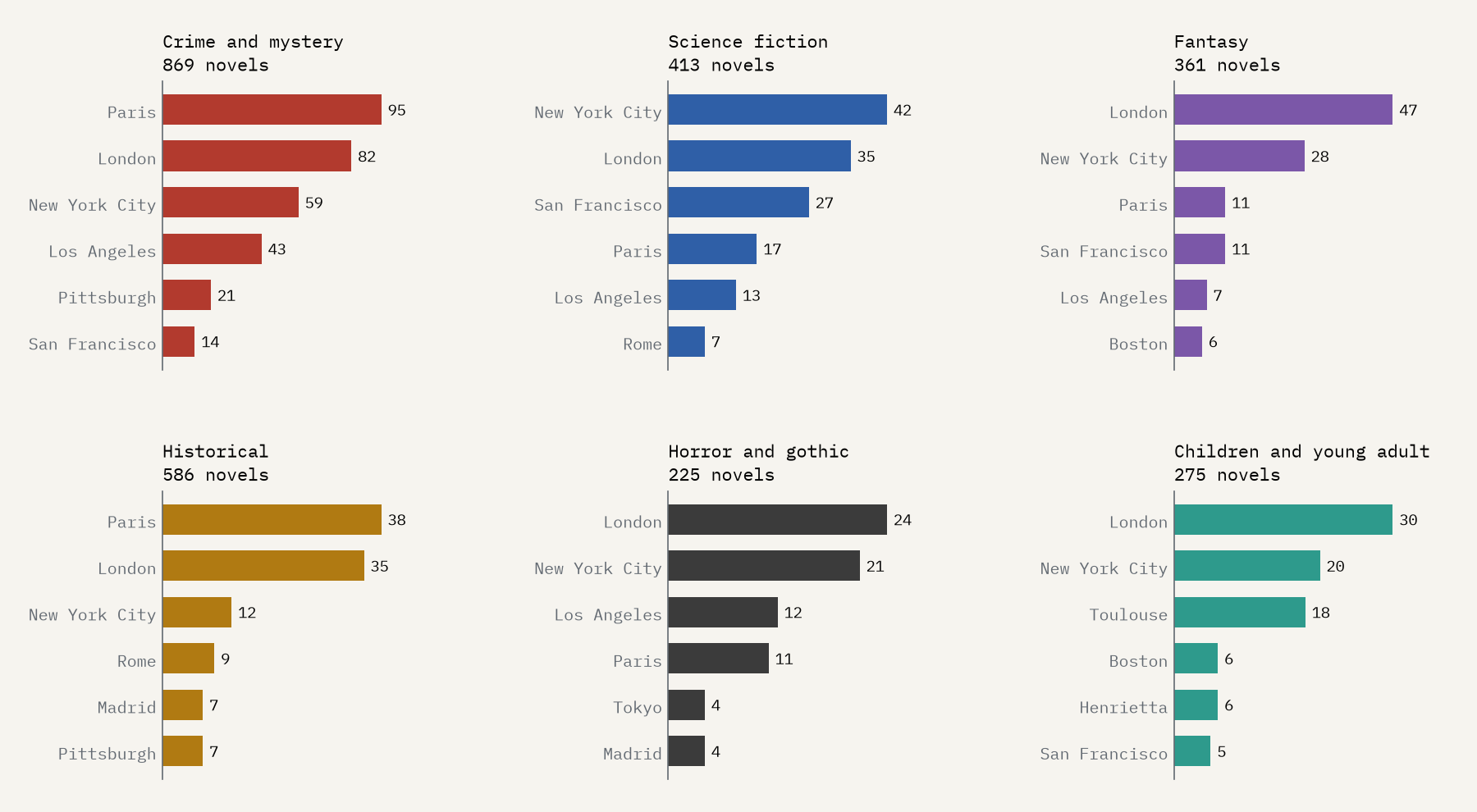
Crime and mystery is the biggest genre with real settings, 869 novels, and its capital is Paris (95, many of them Maigret’s), ahead of London (82) and New York (59). Science fiction that uses real places goes mostly to New York and London, but it is 3.5 times as likely as the average novel to be set in San Francisco. Fantasy belongs to London. And 25 works in Wikidata are set at least partly on the Moon.
The unwritten world
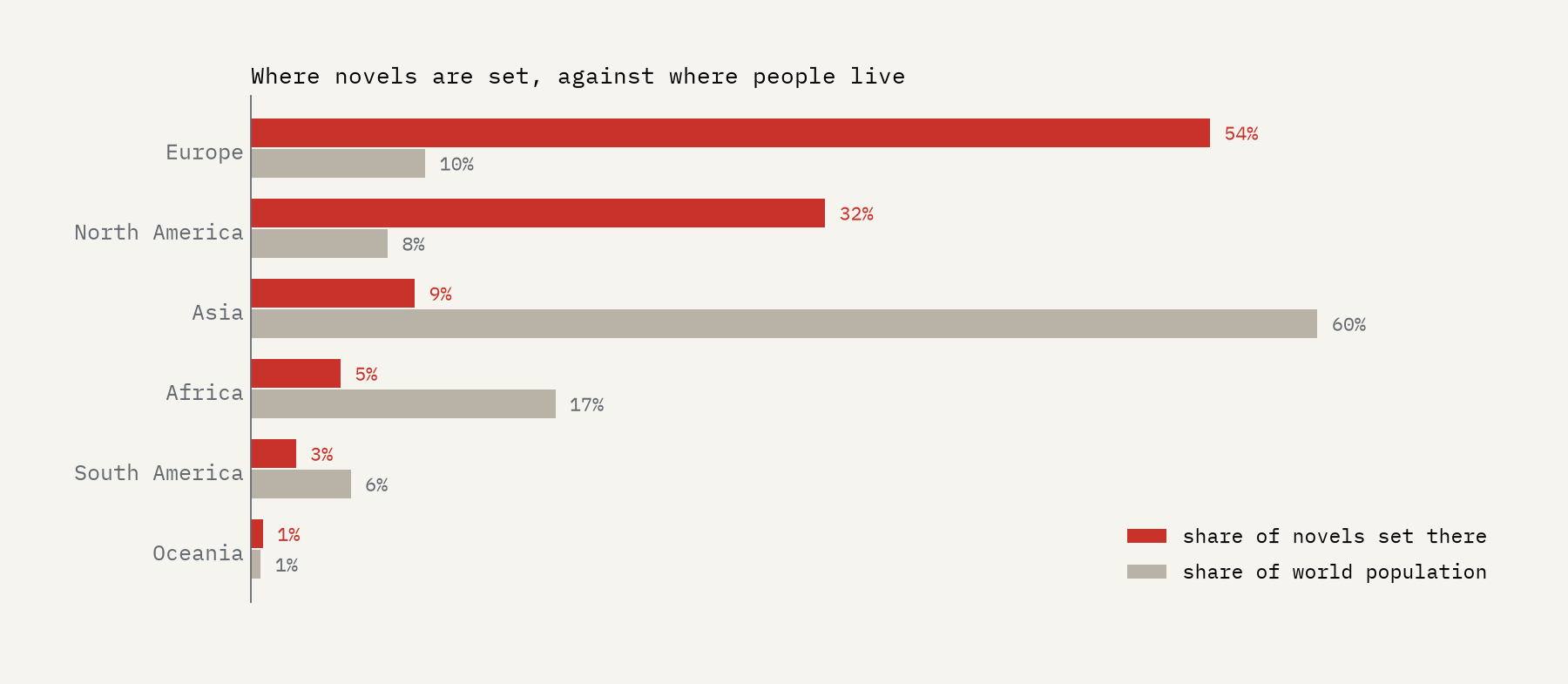
54% of the mapped novels are set at least partly in Europe, home to 10% of the world’s people, and 32% in North America. Asia, with 60% of humanity, has 9%; Africa, with 17%, has 5%. China has 111 mapped novels and India 158; the United Kingdom has 1,216. That says less about where fiction is written than about what has been catalogued, in English, by Wikidata’s mostly European and North American volunteers.
Why Denmark glows
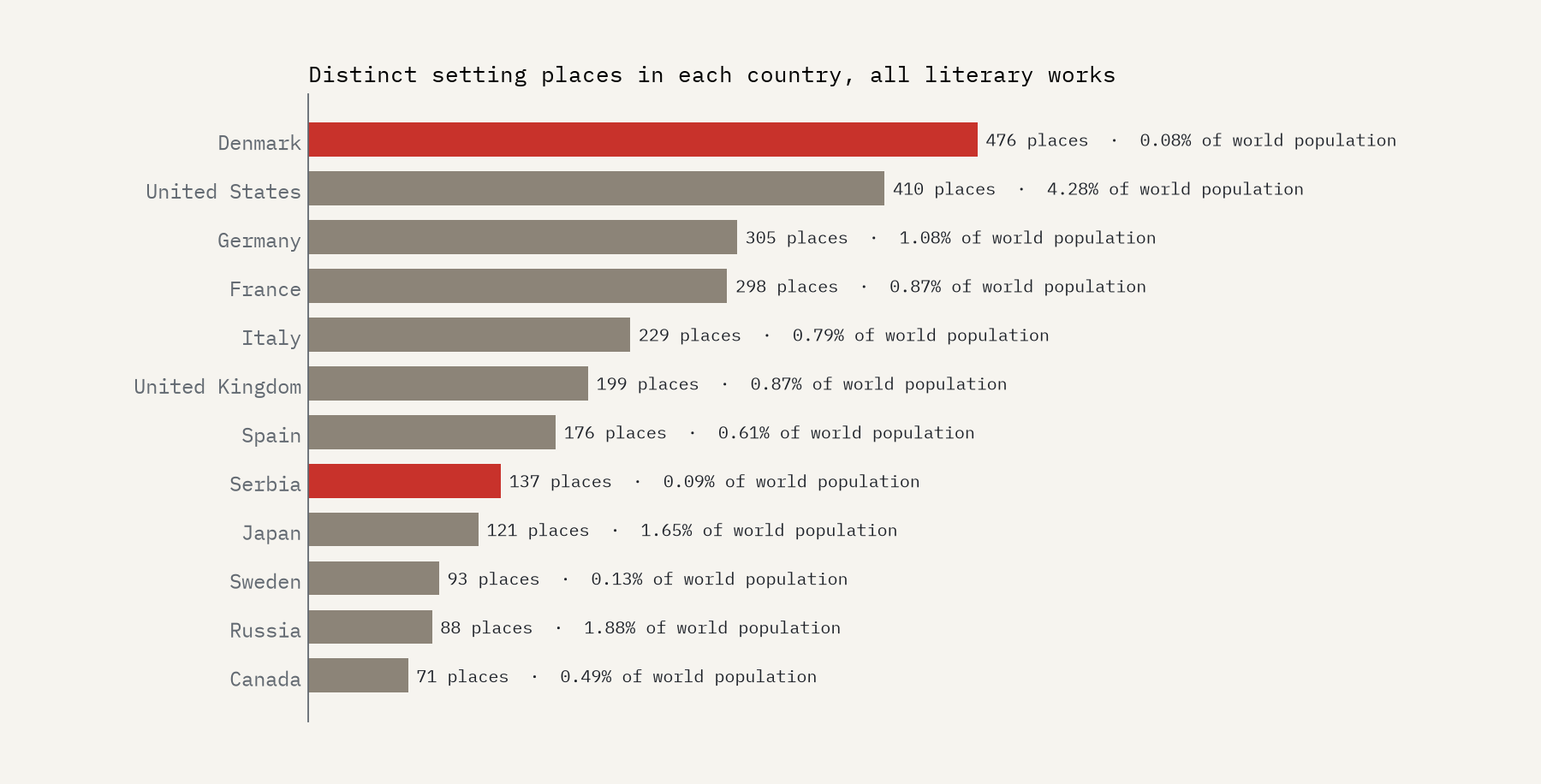
Zoom into the map and Denmark lights up. It has 476 distinct setting places, 12% of every place in the data and more than the United States, despite having 0.08% of the world’s people. China and India together have 110. Works in Danish list an average of 3.0 settings each, down to individual Copenhagen streets, against 1.1 for works in English; one Danish novel lists 53. Serbia is a second case, with 137 places, mostly from Serbian works published before 1930. These are the work of dedicated volunteers adding the settings of their national literatures, and they are a reminder that a map like this measures the attention of the people who build the database as much as literature itself.
How I did this
I queried Wikidata with QLever for every literary work with a narrative location that has coordinates, then added each work’s genre, form, language, authors and their birthplaces, and each place’s type and country. A novel is anything Wikidata gives the form novel or novella, or that belongs to a class with “novel” in its name, except the tales of the Decameron and the Odyssey. Places are grouped into cities, sites, wider areas and whole countries by their Wikidata classes, and every place within 25 km of a big city counts for that city. Home means the present-day country of the author’s birthplace. All of it describes what Wikidata records, not all of literature, and the paper sets out the caveats.
Notes and sources
- Wikidata, CC0: narrative locations, coordinates, authors, birthplaces, publication dates, genres and forms of literary works, queried with QLever in 2026.
- Natural Earth country outlines, populations and populated places (public domain).
- I wrote the text, with drafting and editing assistance from Claude (Anthropic), which also helped prepare the analysis code. I reviewed and checked all text and results.

