
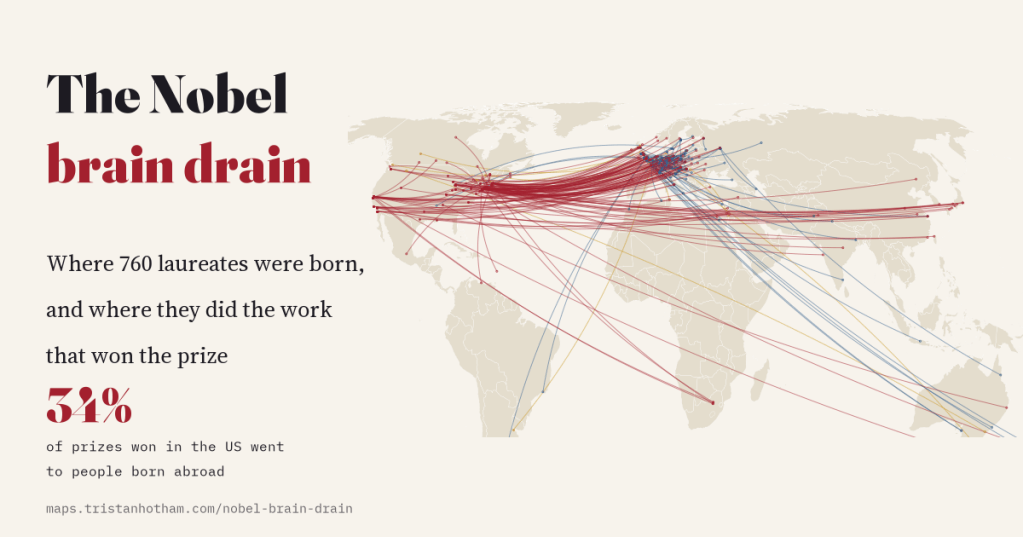
Every Nobel prize is claimed twice: by the country where the laureate was born and by the university that employed them when the call came from Stockholm. I drew a line between the two for 760 prizes in the sciences and economics, and one country turned out to have collected more than everyone else put together.
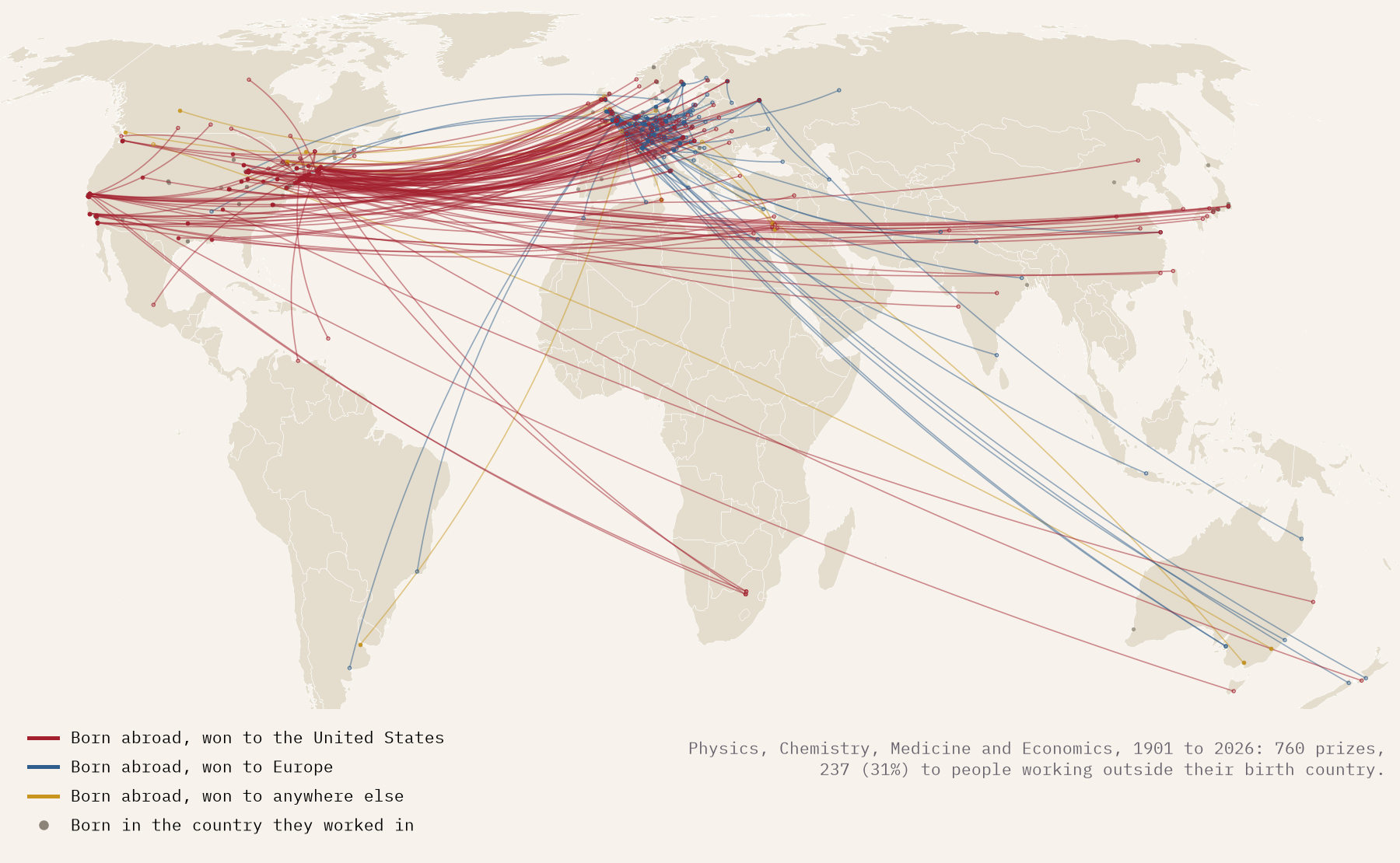
The Nobel Prize has its own open data. Its API records, for every prize since 1901, where the laureate was born and which institutions they were affiliated with when the prize was awarded. Add coordinates from Wikidata and you can draw every laureate’s journey from birthplace to prize. For physics, chemistry, physiology or medicine and economics, 760 prizes have both ends of that line, and 237 of them, 31%, went to someone working outside the country they were born in.
One winner, many losers
For each country I counted the prizes won by people working there and subtracted the prizes won by people born there. The United States comes out 131 ahead: 402 prizes won in America against 271 won by people born there. Only 5 countries finish in credit at all, and after America the gains are tiny: Switzerland +9, the United Kingdom +2, Denmark and Sweden +1 each.
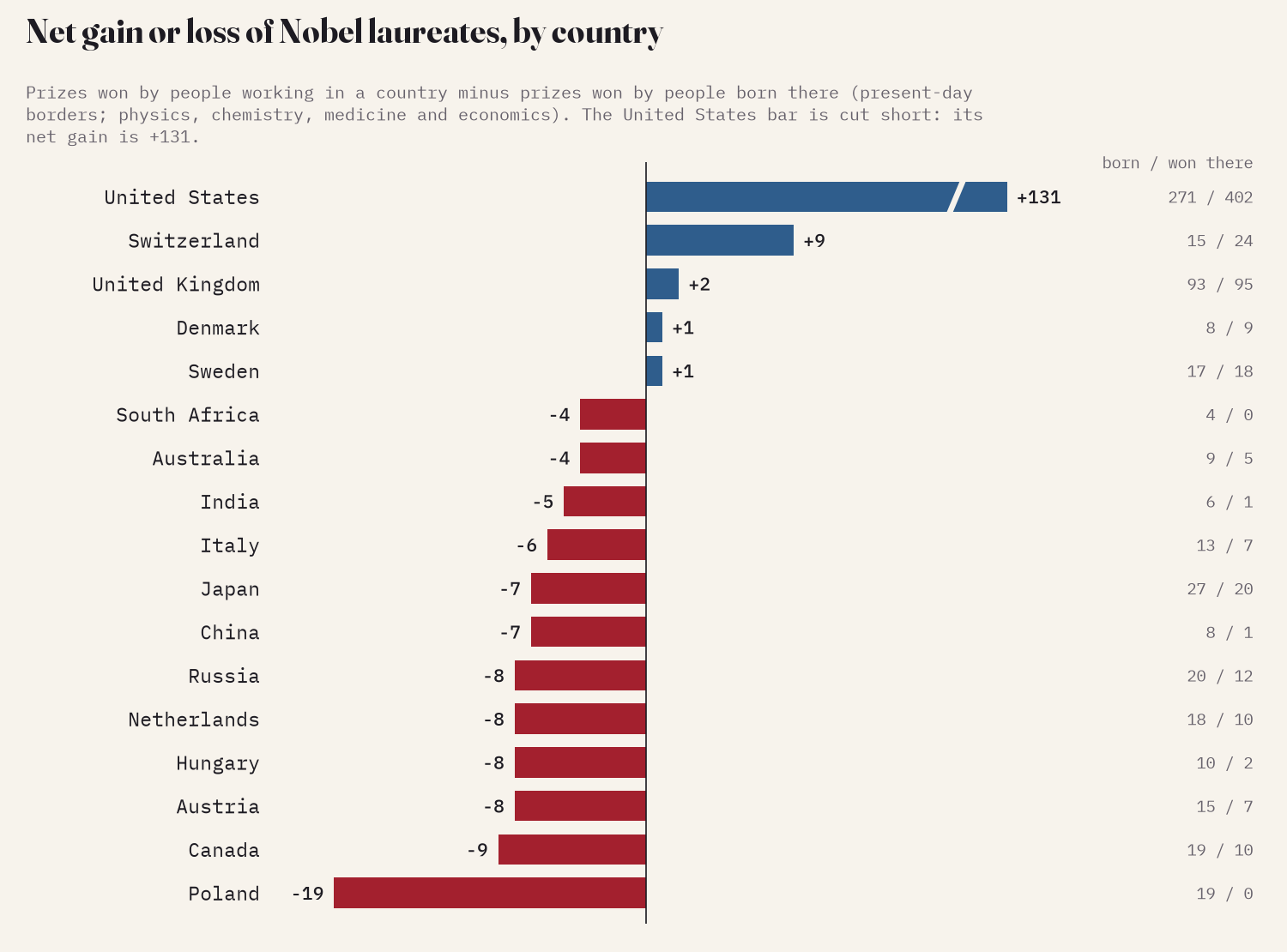
The losers are a roll-call of the twentieth century. Hungary saw 8 of its 10 laureates win abroad and Austria 10 of 15. Every Canadian-born laureate who won abroad was working in the United States. Poland looks like the biggest loser, at -19, but that is mostly borders moving rather than people: 14 of its 19 laureates were born in what was then Germany, in Breslau and the Prussian east.
The great importer
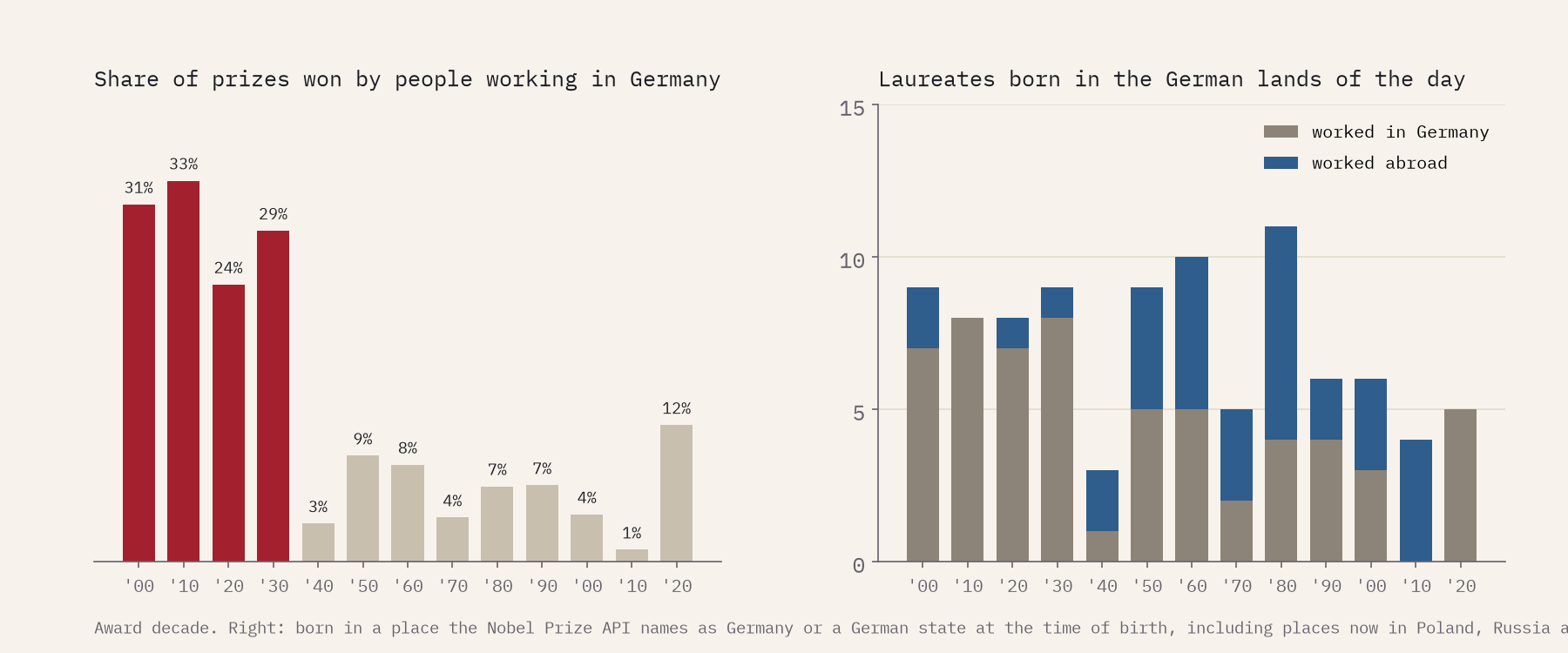
It was not always like this. Before 1940 only 12% of science prizes went to people working in the United States, and Germany led every decade from the 1900s to the 1930s. The United States has led every decade since the 1940s, and since 1950 it has taken 62% of all prizes in the four subjects. A third of those went to people born abroad: 135 of the 402 prizes won in America, from 40 birth countries, led by the United Kingdom (20), Canada (15) and Germany (12).
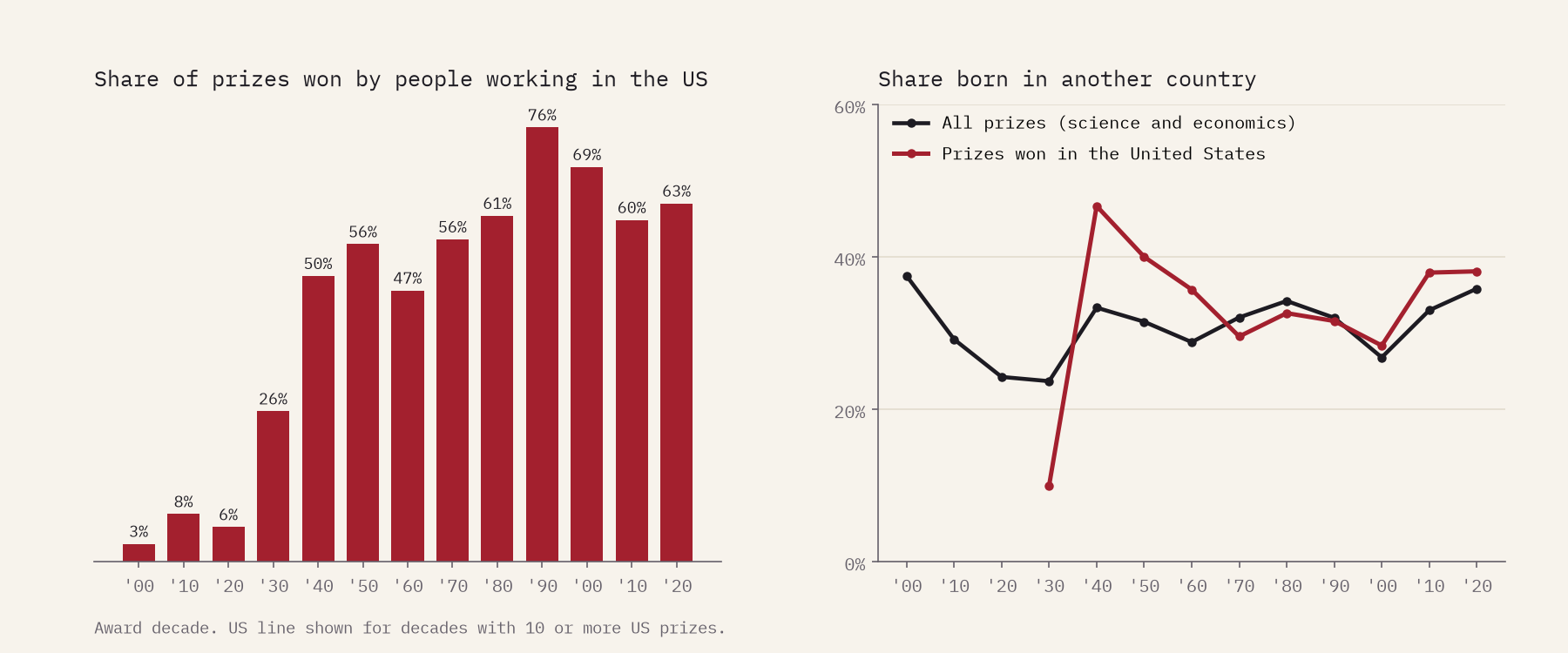
The foreign-born share of American prizes was highest in the 1940s, fell to 28% in the 2000s and has climbed back to 38% in the 2010s and 38% in the 2020s so far. Of every prize won by someone working outside their birth country, 57% were won in America.
Germany’s loss of the 1930s shows up in the prize record years later, in Britain and America.
Germany, before and after 1933
Up to 1932, 31 of the 99 science prizes went to people working in Germany, and almost every German-born laureate of the time stayed at home: only 10% were working abroad. Since 1933 Germany’s share has been 7%, and 49% of German-born winners have been working in another country. Because prizes reward work done years before, the dismissals of 1933 show up late: Otto Stern won in America in 1943, Hans Krebs and Max Born in Britain in the 1950s, Hans Bethe in America in 1967. The data say where people were when the prize came, not when or why they left, so I have kept the numbers to that.
Japan, the late riser
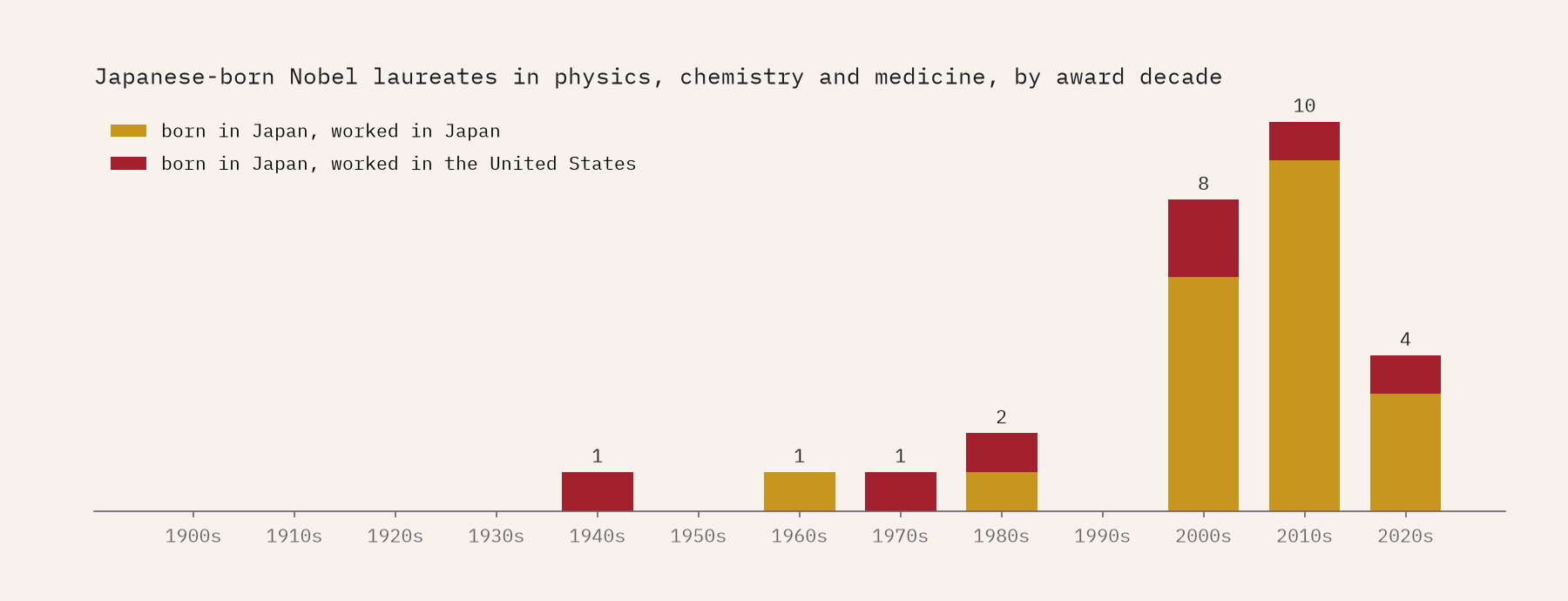
Japan had 5 science laureates in the whole of the twentieth century and 22 since 2000, making it the third most common birth country of laureates since then, behind the United States and the United Kingdom. And unlike most countries outside America, it keeps them: 7 of 27 Japanese-born laureates won in the United States, the rest at Kyoto, Nagoya and Tokyo universities and at companies such as Shimadzu. One of the seven is a warning about the method: Hideki Yukawa developed his meson theory in Japan, but the Nobel data list Columbia University first among his affiliations in 1949.
Harvard, MIT, Stanford
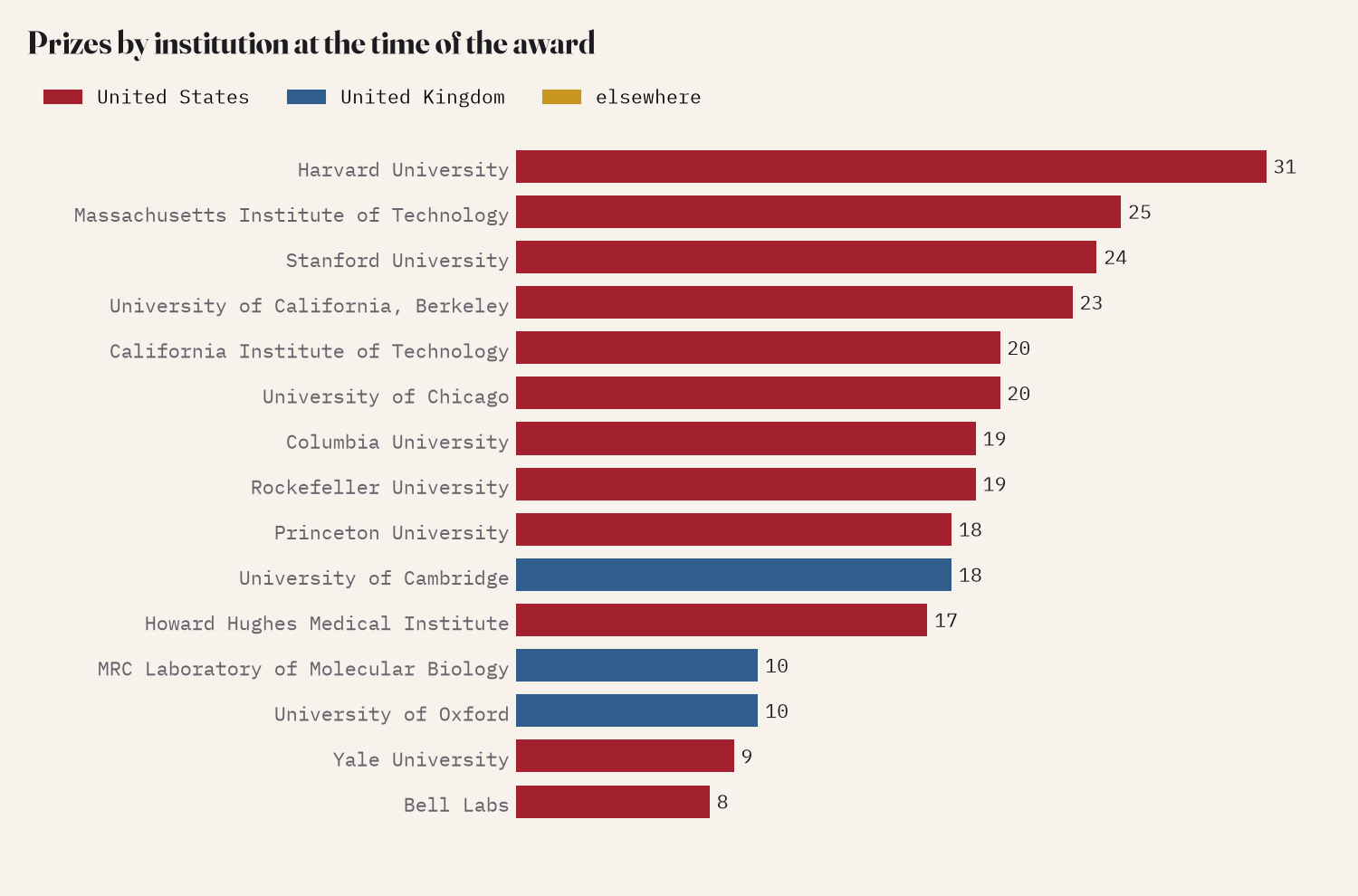
Counting every affiliation listed at the time of an award, Harvard comes first with 31 prizes, then MIT (25), Stanford (24) and Berkeley (23). Nine of the top ten are American; Cambridge, with 18, is the first outside the United States. These counts match Wikipedia’s list for 15 of its top 20 institutions.
Women
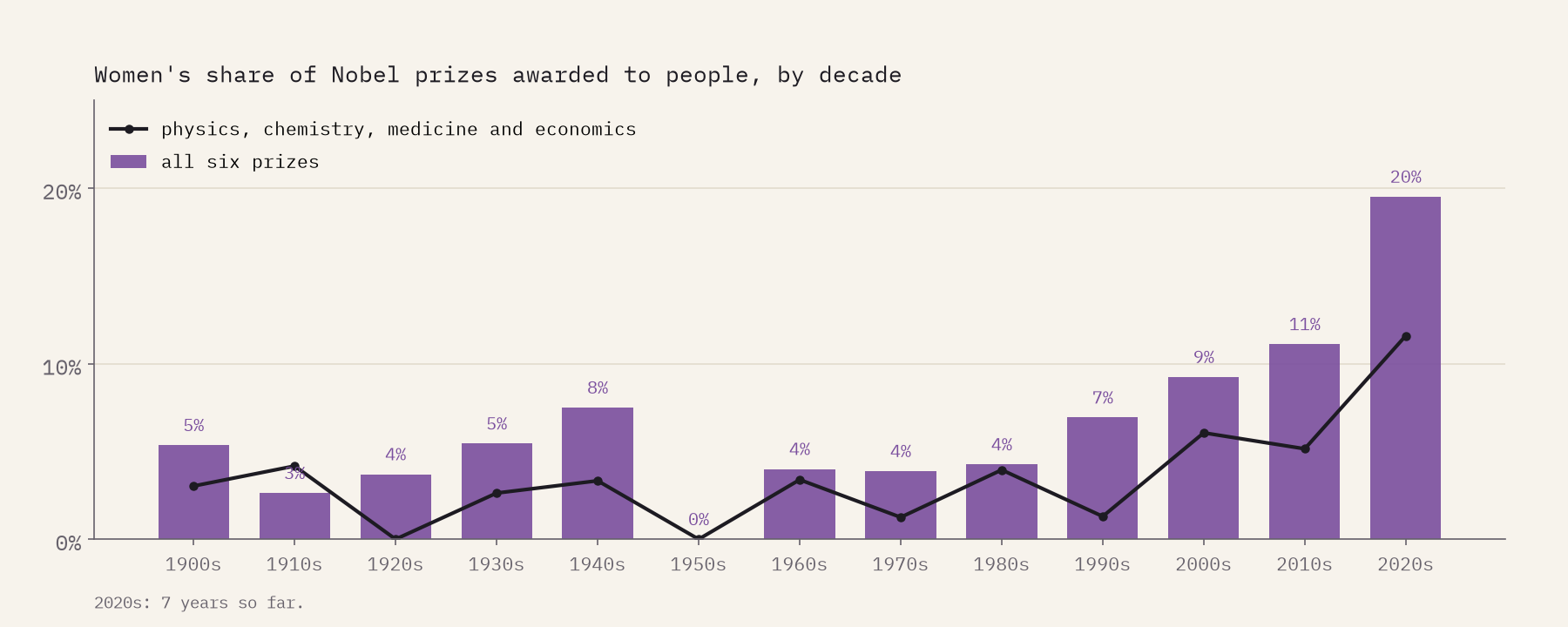
Women won 12 of the 314 Nobel prizes awarded to people before 1960, and 16 of 82 in the 2020s so far (20%). The sciences have moved more slowly than peace and literature: 7.2% of science and economics prizes since 2000 went to women. Physics has had 5 women laureates in 231 prizes. Women scientists were born abroad about as often as men.
How I did this
I took every prize awarded to a person from the official Nobel Prize API, with the laureate’s birthplace and their affiliations at the award, and matched the physics, chemistry and medicine laureates to Wikidata by their Wikidata ID, checking that prize and year agree (all 668 matched). Wikidata gives coordinates for birthplaces and for laureates’ employers; where an employer matches the affiliation’s name and lies near its city I used it, otherwise the API’s city point. Countries are present-day ones, except in the Germany section, which uses the country named at birth. Peace and Literature laureates have no affiliation in the Nobel data, so they are left out of the flows and treated separately by country of residence: 18% were living outside their birth country.
Two caveats matter most. Affiliation when the prize is awarded is not always where the winning work was done, which can be decades earlier. And birth country is not nationality: many laureates born abroad moved as children. The Wikidata extract also contained a fictional laureate, Sheldon Cooper, who did not match anything in the Nobel data.
Notes and sources
- Nobel Prize API v2.1, Nobel Prize Outreach, retrieved 2026. The downloaded file carries no licence statement; see the terms of use on nobelprize.org.
- Wikidata, via QLever, retrieved 2026: birthplace and employer coordinates. CC0.
- Wikipedia, List of Nobel laureates by university affiliation, used to cross-check institution counts. CC BY-SA 4.0.
- Natural Earth countries and populated places. Public domain.
- Paper: Hotham, T. (2026) The Nobel brain drain: where laureates were born and where they won. Zenodo. https://doi.org/10.5281/zenodo.23857487
- I wrote the text, with drafting and editing assistance from Claude (Anthropic), which also helped prepare the analysis code. I reviewed and checked all text and results.

