
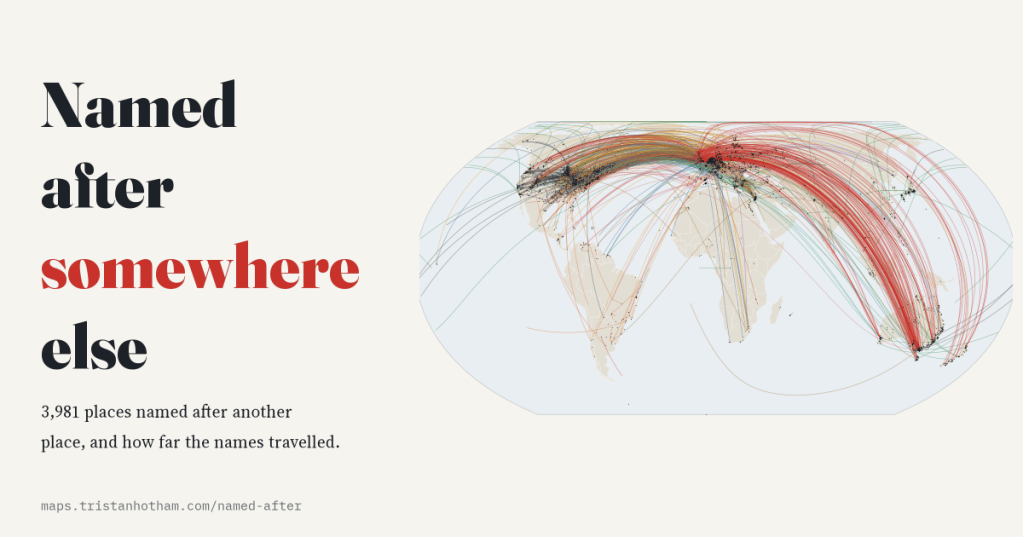
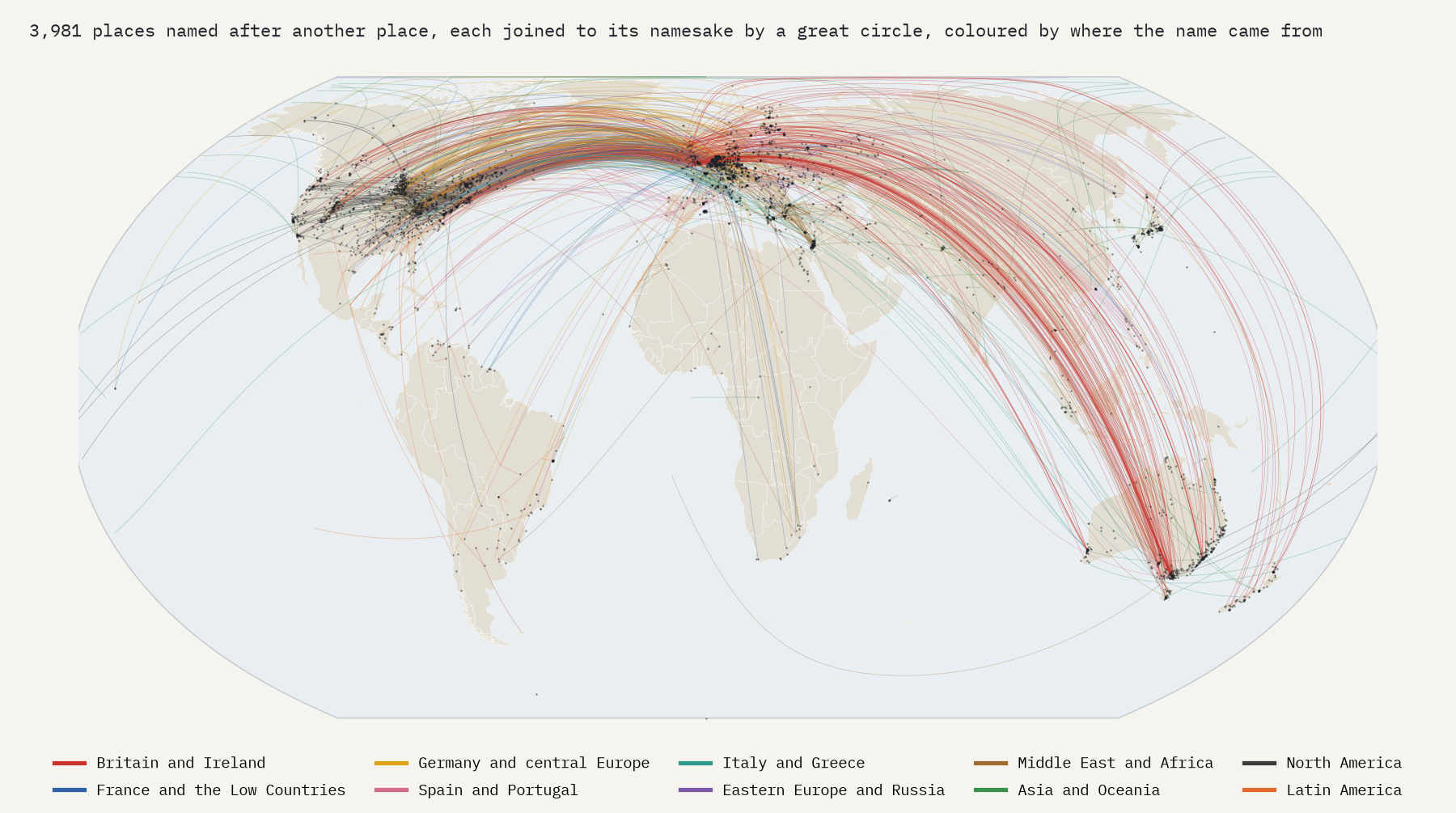
Wikidata knows, for some places, what they were named after. I mapped every settlement it says is named after another place, 3,981 of them, and drew a line from each namesake to the place that borrowed its name.
Boston in Massachusetts is named after Boston in Lincolnshire, 5,222 km away across the Atlantic. Perth in Western Australia is named after Perth in Scotland, 14,690 km away. Brooklyn is named after Breukelen, a village near Utrecht. On Kiritimati, an atoll in the middle of the Pacific, there is a Paris and a Poland. Borrowed names are everywhere, and Wikidata, the open database behind Wikipedia, has started to record them in a property called “named after”.
I took every settlement that Wikidata says is named after another geographical place. The raw query gave 7,666 links, but most were not settlements at all: 3,295 were US census “urban areas”, which Wikidata names after their main town. Once those, and camps, stations, parks and other oddities, were removed, 3,981 links were left, from 3,837 places to 3,551 namesakes.
Mostly the river, or the town next door
The first surprise is how local most names are. Only 37% of the places are named after another settlement. The rest borrow from the landscape: 570 from rivers and streams, 298 from mountains and hills, 254 from lakes and seas, and hundreds more from bays, islands, castles, forts and even streets. Half of all the namesakes are less than 4.4 km from the place named after them (counting each link once).
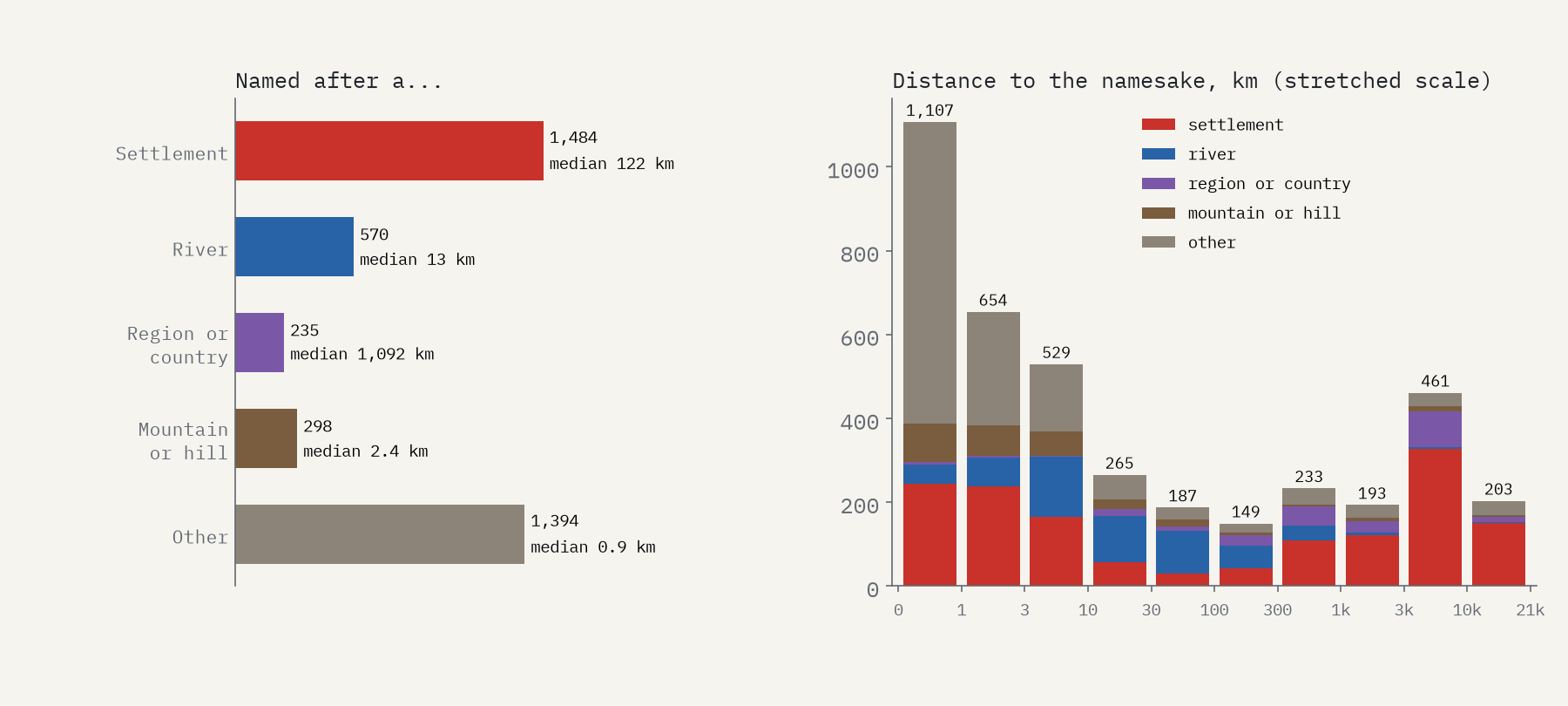
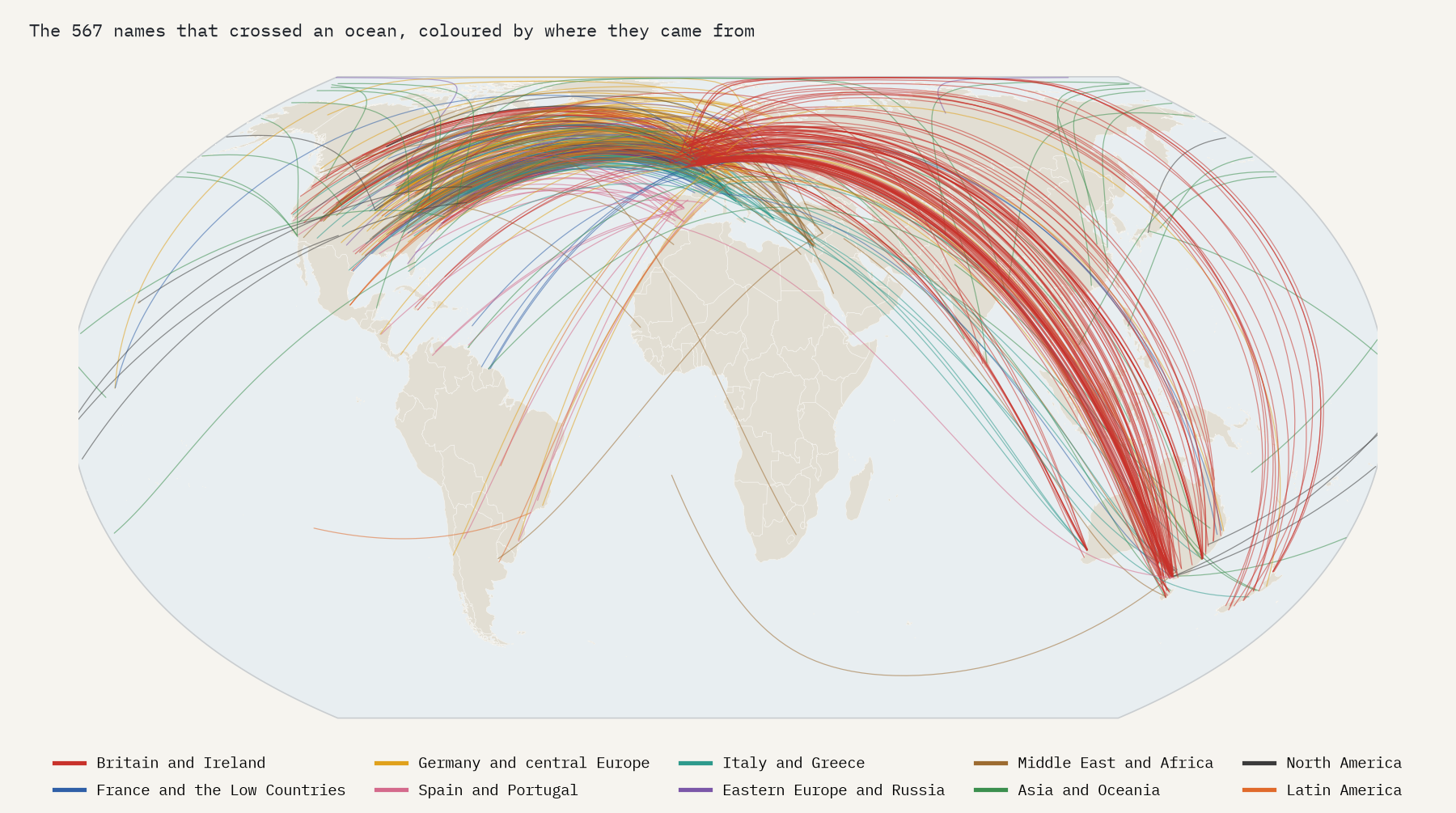
But the distances have two humps. One is the neighbours. The other is the migrants: 857 links are more than 1,000 km long, and 567 (14%) join two different landmasses. Between the two, the counts dip. A name mostly either stayed at home or crossed an ocean. The longest journeys all end in New Zealand, where Lansdowne is named after Lansdown in the United Kingdom, 19,071 km away, almost the far side of the planet.
Britain to the world
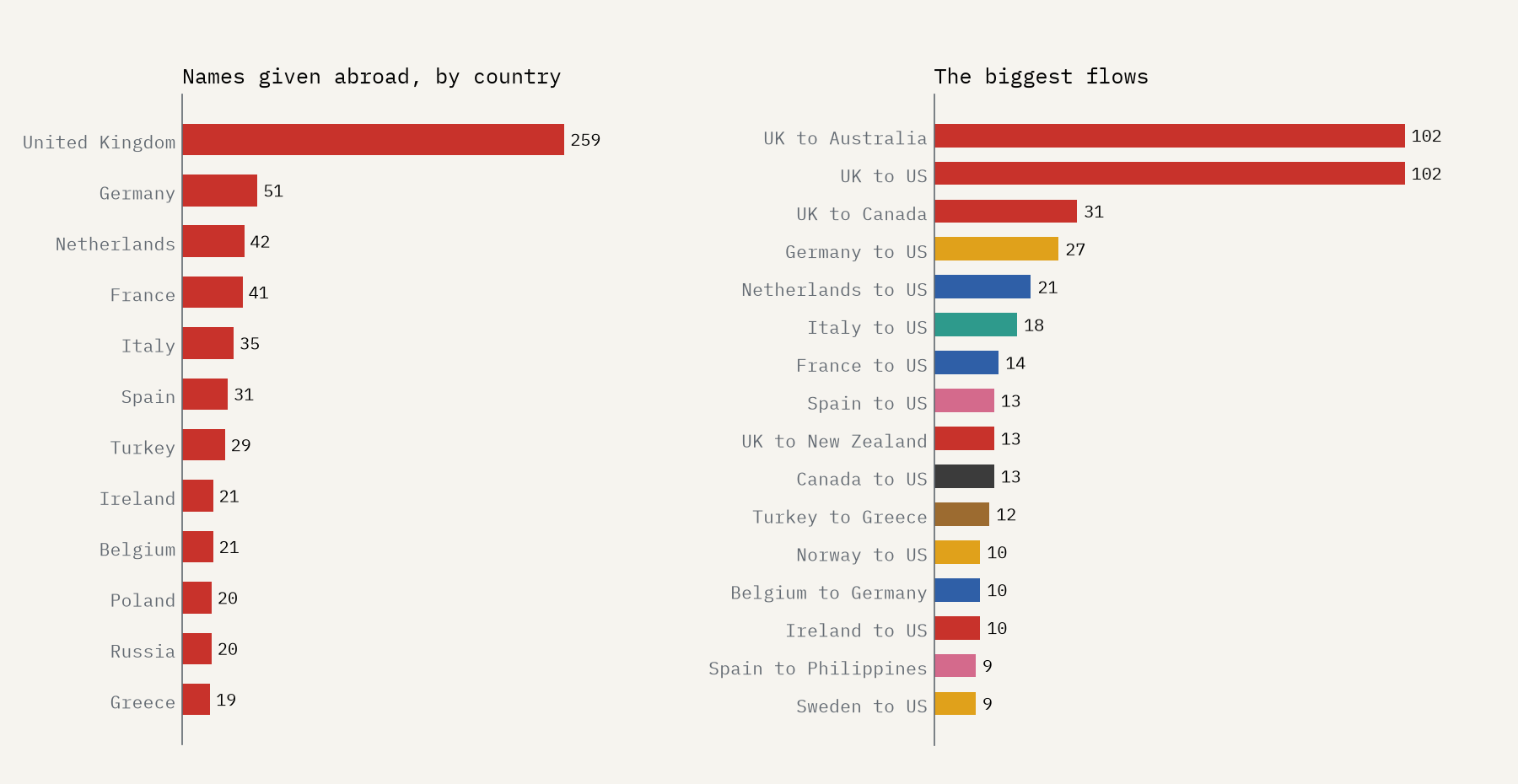
881 links cross a national border, and the United Kingdom gave 259 of them, 29%, five times as many as Germany (51). 96% of Britain’s names went to just four countries: 102 to the United States, 102 to Australia, 31 to Canada and 13 to New Zealand. Smaller streams tell their own stories: Dutch names in what was New Netherland, from Brooklyn to New Utrecht; German, Norwegian and Swedish names across the Midwest; and 12 Greek towns, such as Nea Smyrni, named after places in Turkey by refugees in the 1920s.
Prague, Amsterdam and the New Xs
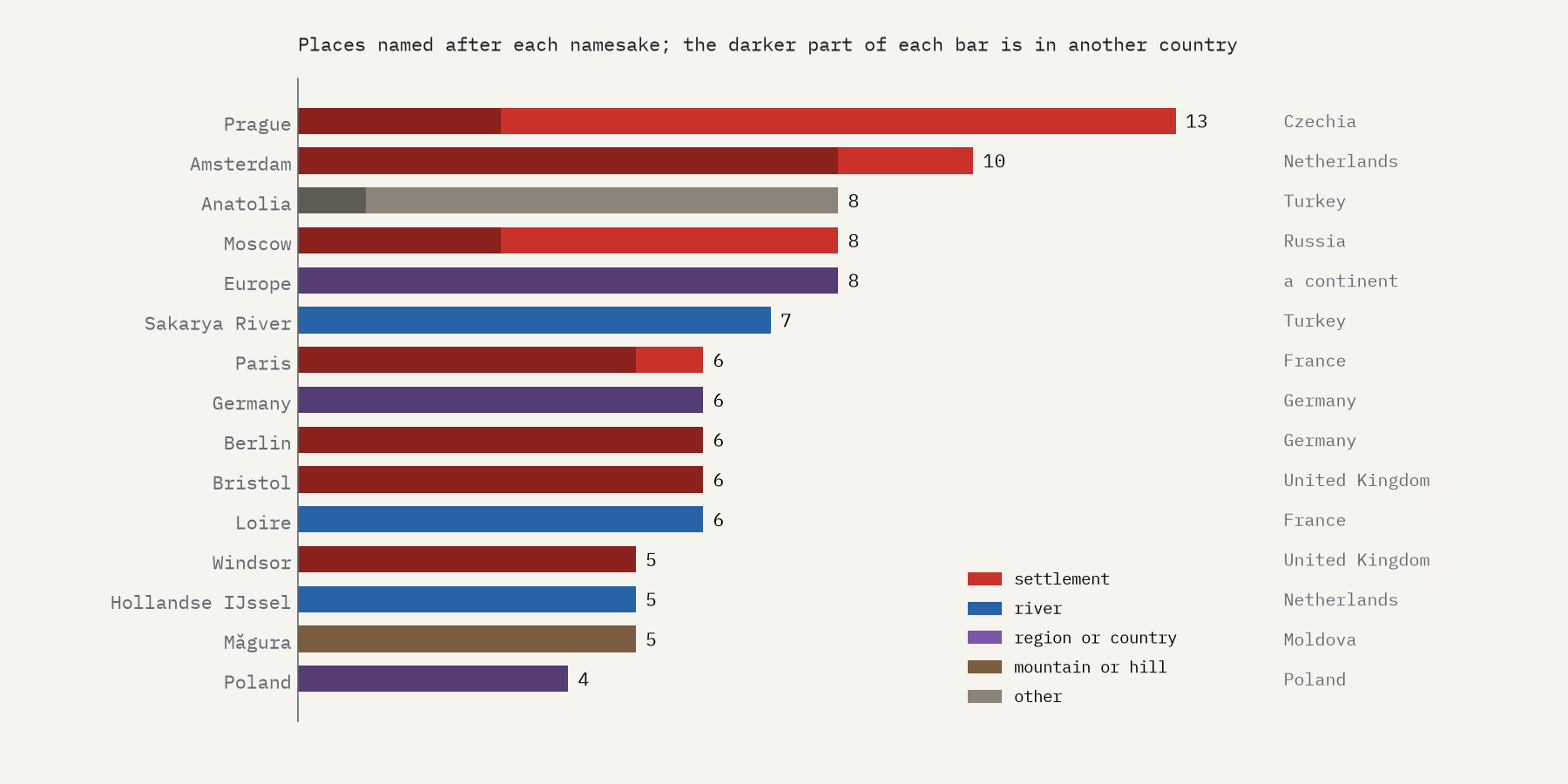
The most borrowed namesake is Prague, with 13 places, but most are Czech suburbs called Pražské Předměstí, “Prague suburb”. Amsterdam (10) is the champion abroad: New Amsterdam on Manhattan, Nieuw Amsterdam in Suriname, New Amsterdam in Guyana, and Amsterdams in New York, Missouri, Canada and South Africa. Then come Moscow, Berlin, Paris, Bristol and Windsor.
75 places are a “New” version of their namesake: New, Nieuw, Neu, Nova, Novo, Nueva. Most are not far from the old one: 55% are within 30 km, like Neu-Ulm across the Danube from Ulm, New Delhi beside Delhi, or the new desert cities of Egypt. 18 crossed an ocean, from New Amsterdam and New Madrid to Novo Hamburgo in Brazil and Nueva Palmira in Uruguay, named after Palmyra in Syria.
Athens, Rome and Belgium Township
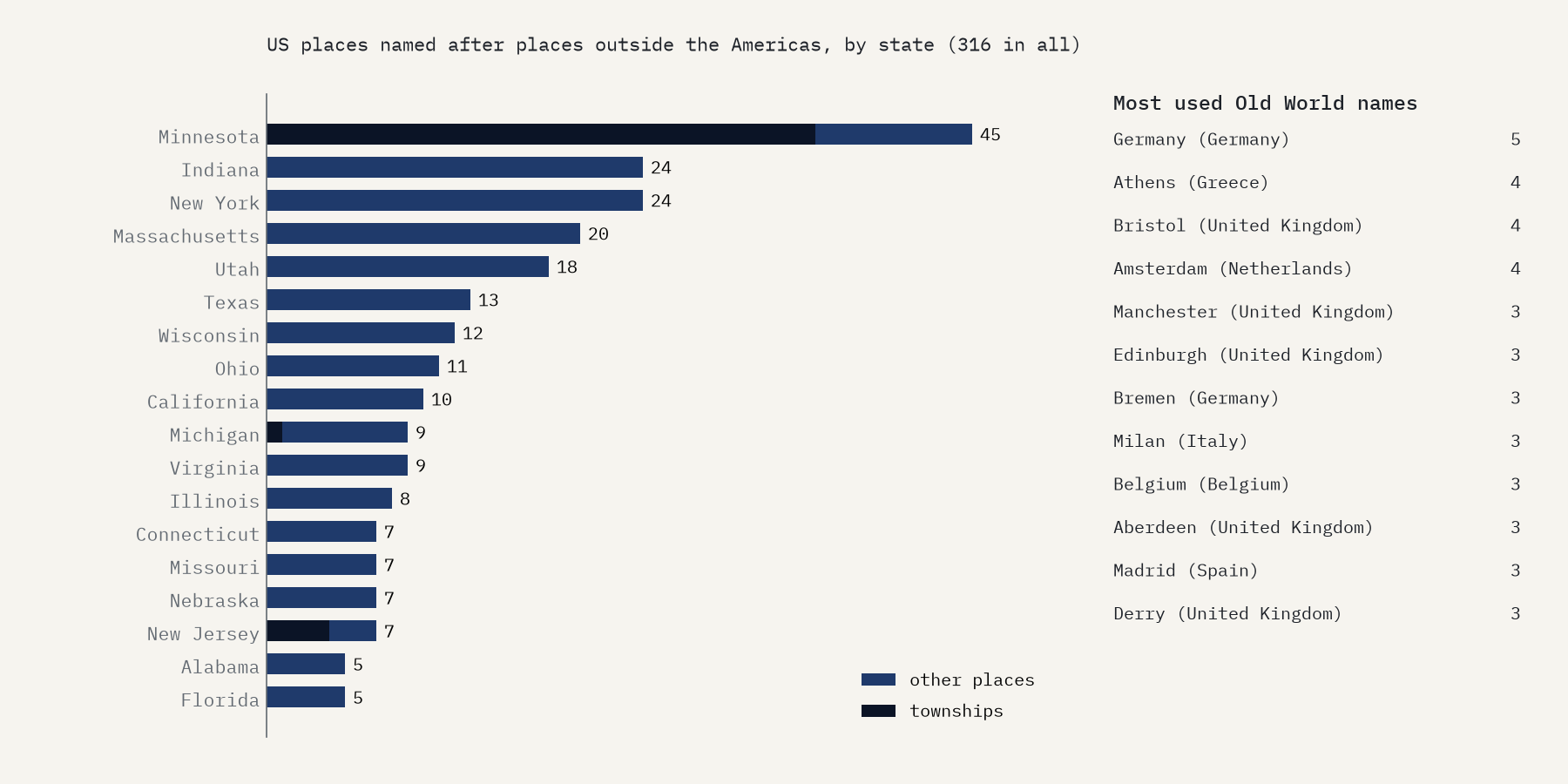
A quarter of all the links are in the United States, and 316 of them are to places outside the Americas: classical names like Athens, Sparta and Syracuse, biblical ones like Bethlehem and Hebron, and the homes of immigrants. Minnesota tops the list with 45, but that says more about Wikidata than about Minnesota: most are townships, such as Belgium Township and Christiania Township, whose name origins someone entered in bulk.
A map of who fills in Wikidata
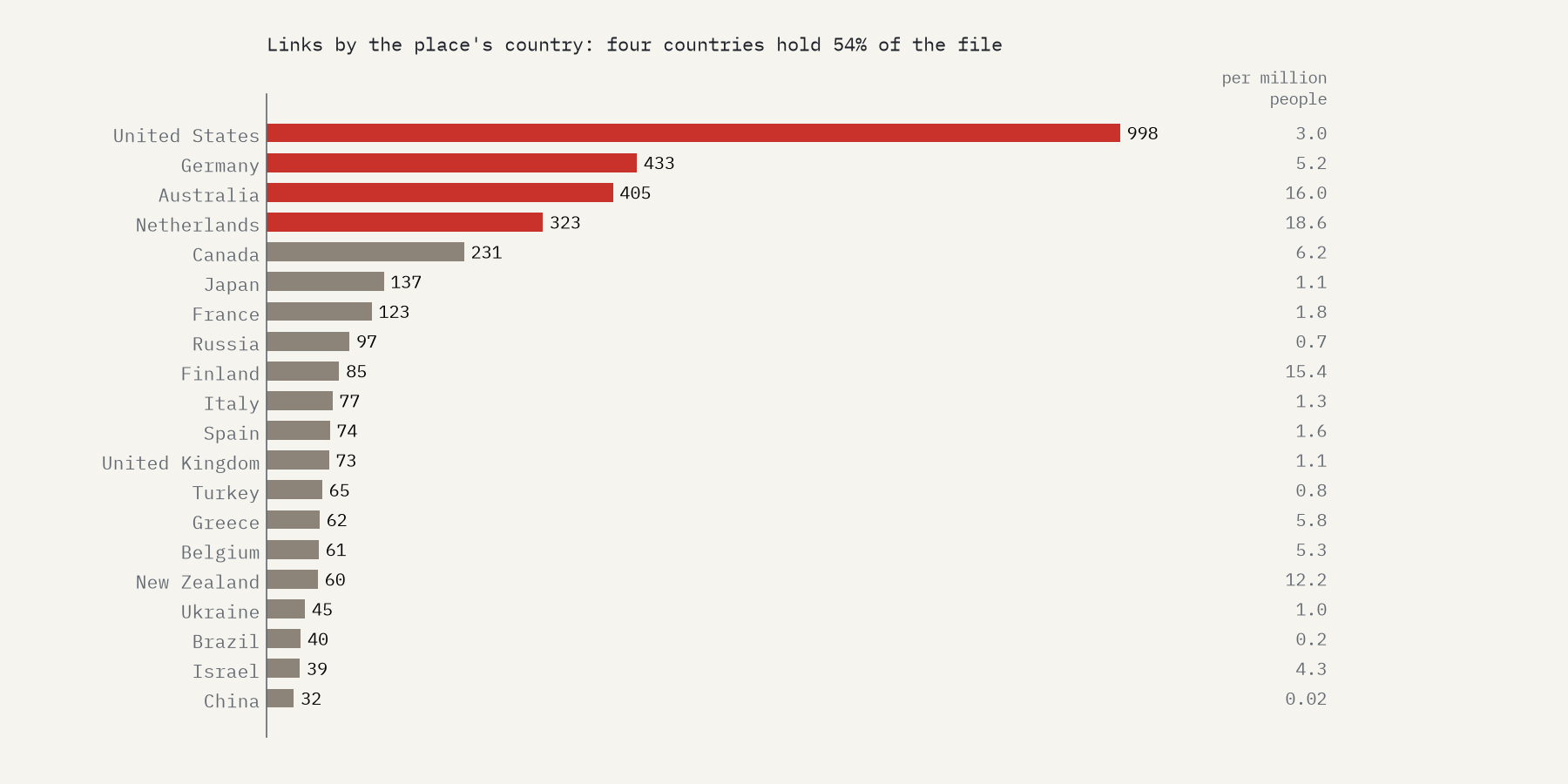
The biggest caveat is coverage. Four countries, the United States, Germany, Australia and the Netherlands, hold 54% of all the links. India has 13, China 32, Mexico 1. The great Spanish naming of the Americas is almost absent: Spain and Portugal gave only 6 names to Latin America in the file. Famous borrowed names like New York City are missing too, because Wikidata does not record them as named after a place with coordinates. So the patterns are real, but this is an early and partial atlas. It will fill in as Wikidata does.
How I did this
One Wikidata query, run on the QLever engine in 2026: every human settlement with a “named after” value that is a geographic location, both with coordinates. I collapsed the repeated rows, removed statistical areas, camps, stations and other non-settlements, and sorted the namesakes into settlements, rivers, regions, mountains and other things from their Wikidata classes. Distances are great circles; borders use Wikidata’s own countries; an ocean crossing means the two ends are on different landmasses. The paper sets out every rule and caveat.
Notes and sources
- Wikidata contributors, “named after” (P138) and related properties, queried with QLever. CC0.
- Natural Earth outlines (public domain).
- I wrote the text, with drafting and editing assistance from Claude (Anthropic), which also helped prepare the analysis code. I reviewed and checked all text and results.

