
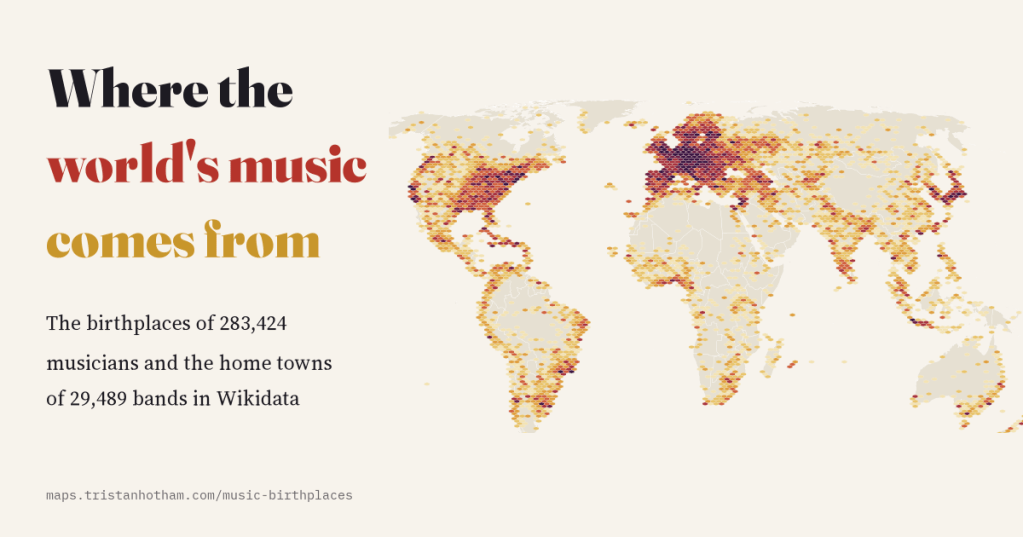
Every musician was born somewhere, and every band started somewhere. I mapped the birthplaces of 283,424 musicians and the home towns of 29,489 bands in Wikidata to see which cities made them, where each genre lives, how the map moved over three centuries, and where the women are.
Wikidata, the open database behind Wikipedia, records 478,552 people whose occupation is musician or one of its many varieties: composers and singers, organists and rappers, DJs, conductors, fado singers and kobzars. It also records 115,219 bands, choirs, orchestras and other musical groups. For 291,579 of the musicians it knows the country of birth, and for 283,424 the birthplace has coordinates.
So I put them all on one map. The interactive version switches between musicians and bands, filters by kind of musician, family of genres, gender and fame, and has a decade slider you can play like a record. Click any hexagon and you get the people or bands from there, best known first.
New York, London, Paris and Vienna
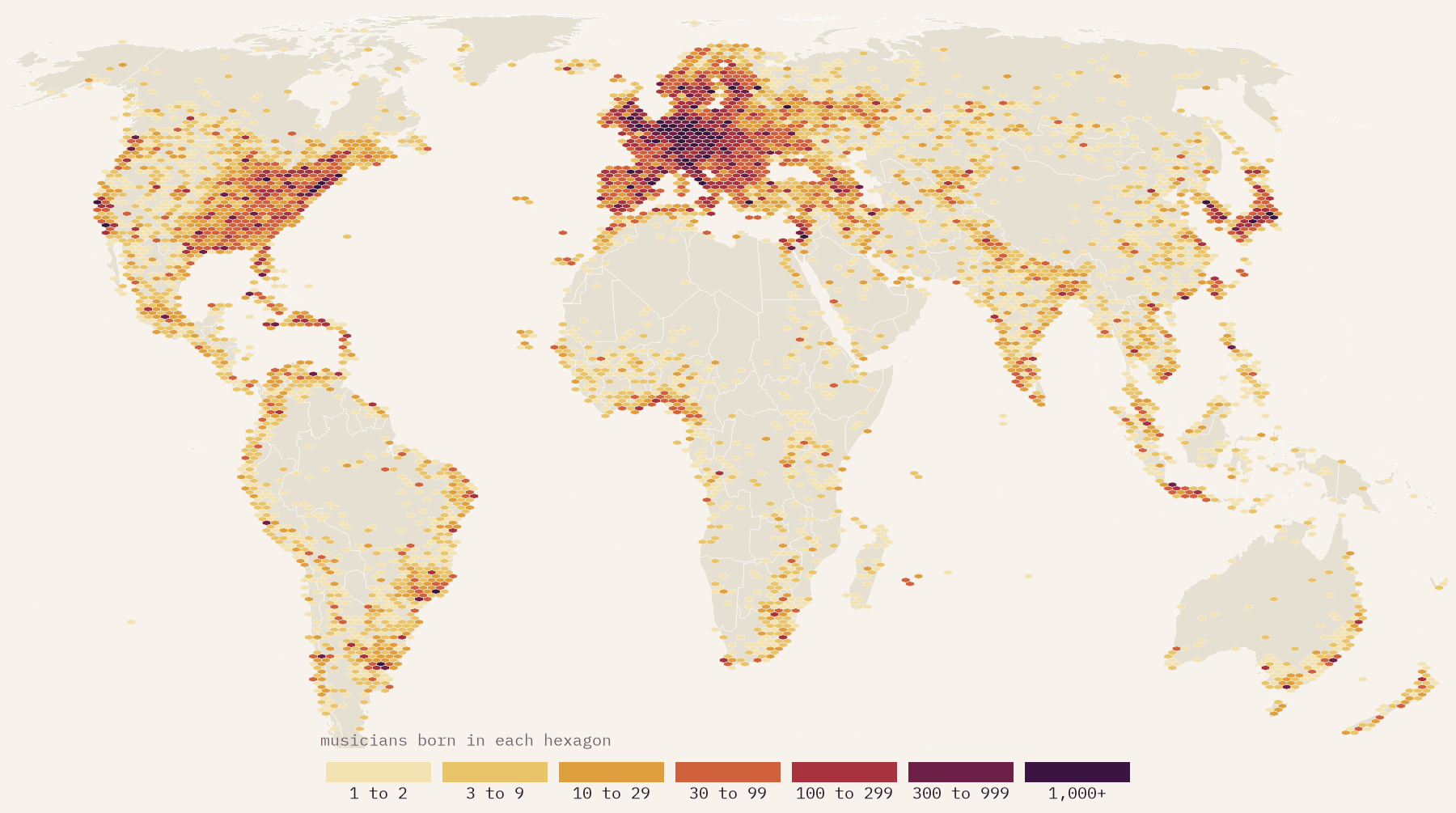
Wikidata often records a district rather than a city, Brooklyn or Hollywood or a Paris arrondissement, so I grouped every birthplace within 25 km of a city of 200,000 people or more. New York comes first with 6,124 musicians, then London (4,627), Paris (4,466) and Vienna (4,102), with Tokyo the first city outside Europe and the Americas. As a single place, Vienna is the most common birthplace of all.
Bands have a different map. Los Angeles is where most bands in Wikidata were formed (1,454), ahead of New York and London, with San Francisco and Seattle not far behind. Per head of today’s population, the band towns are Ljubljana, Bergen, Malmö and Oslo, with Liverpool, the British leader on both counts, close behind.
Two maps of music
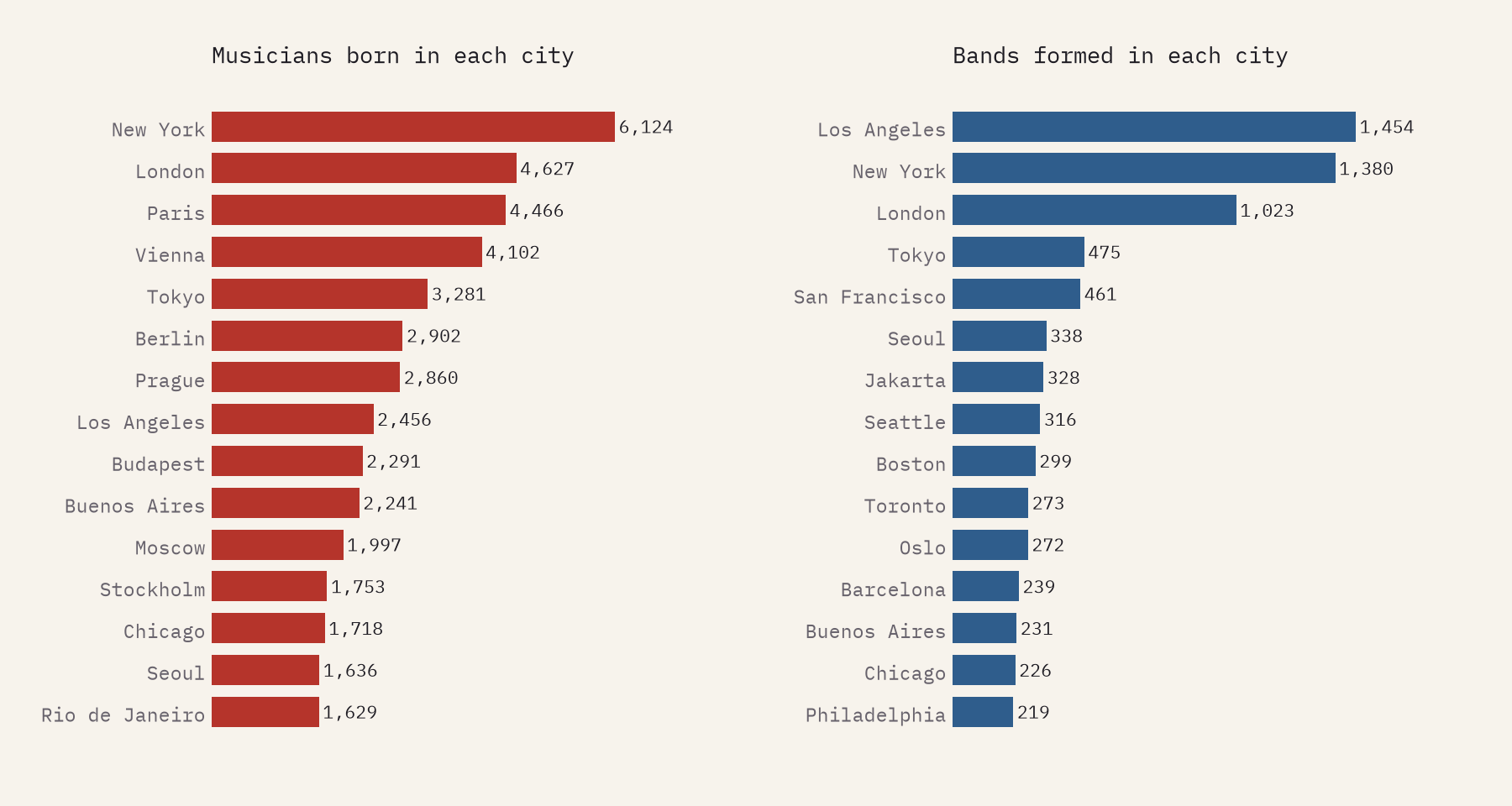
The kind of musician changes the map completely. Composers born before 1900 were 88% European: Vienna leads with 850, then Paris, London, Prague, Berlin, Naples and Barcelona. Pop, rock and metal musicians born since 1940 are only 48% European, and the map spreads to the United States, Japan, Indonesia and Brazil. Conductors are the most European kind of musician (80%); rappers are as likely to come from North America as from Europe.
Every genre has a home town
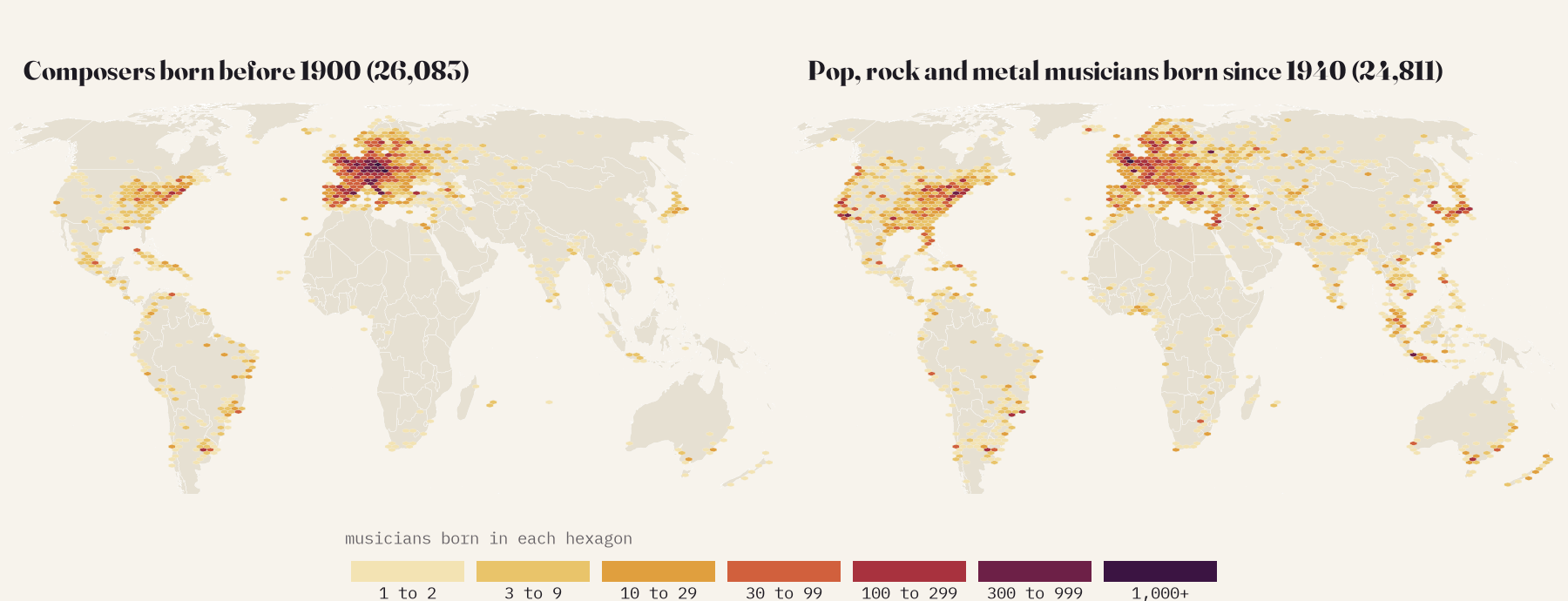
Some music is everywhere, but some has an address. Of all the K-pop acts on the map, musicians born or bands formed, 52% are from Seoul. Rio de Janeiro has 57% of samba, Buenos Aires 52% of tango, Lisbon 49% of fado, Hong Kong 74% of cantopop, London 56% of grime and Kingston 23% of reggae. Black metal’s capital is Oslo, with Bergen second, grunge’s is Seattle and Afrobeats’ is Lagos.
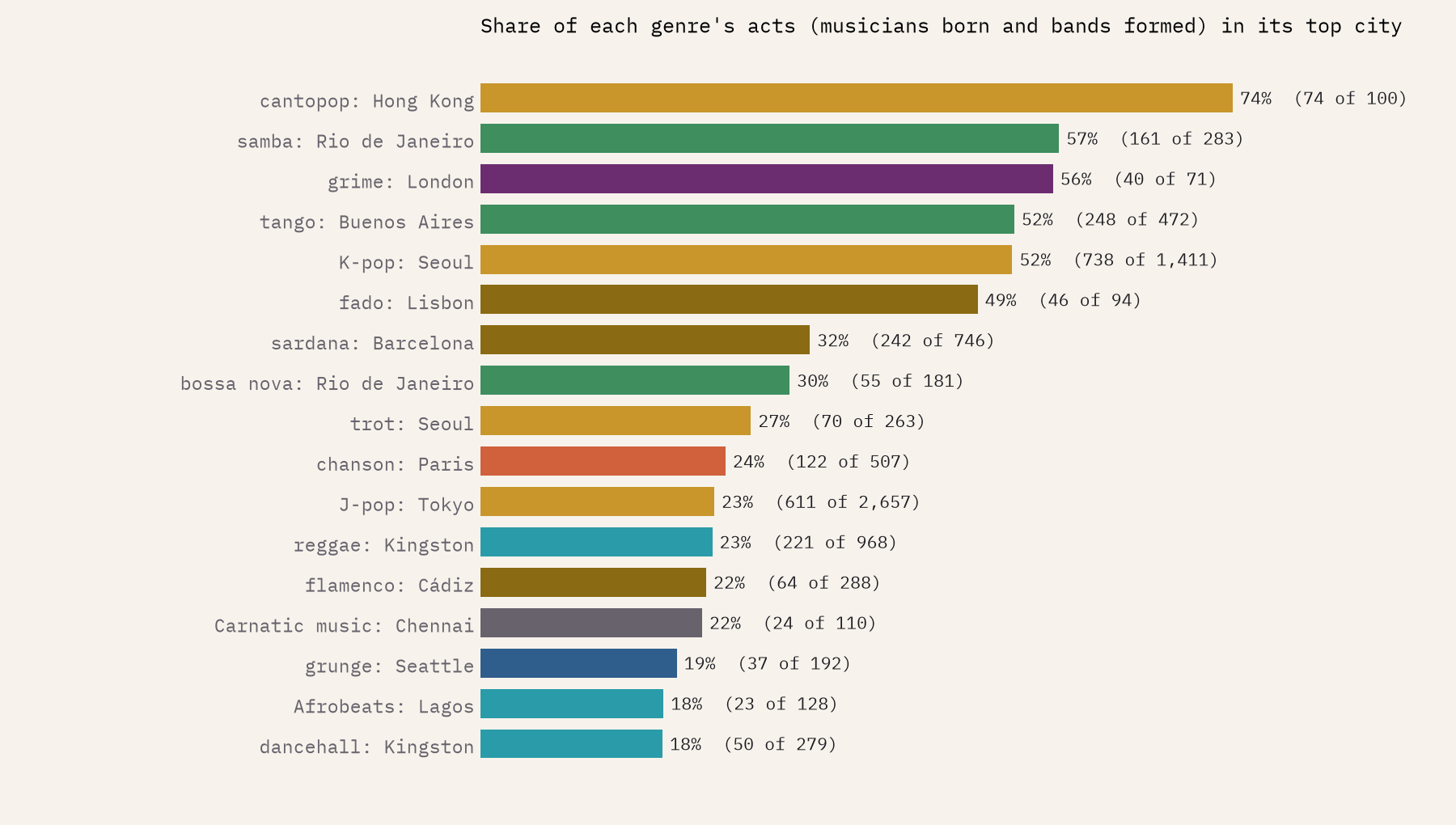
Country music is the interesting exception. Country acts are spread right across the United States, so Nashville has only 5% of them. But turn the question round and Nashville stands out more than anywhere: its acts are 13.0 times as likely as the world’s to be country. By the same measure, New Orleans is jazz’s city, Atlanta hip hop’s and Detroit soul’s.
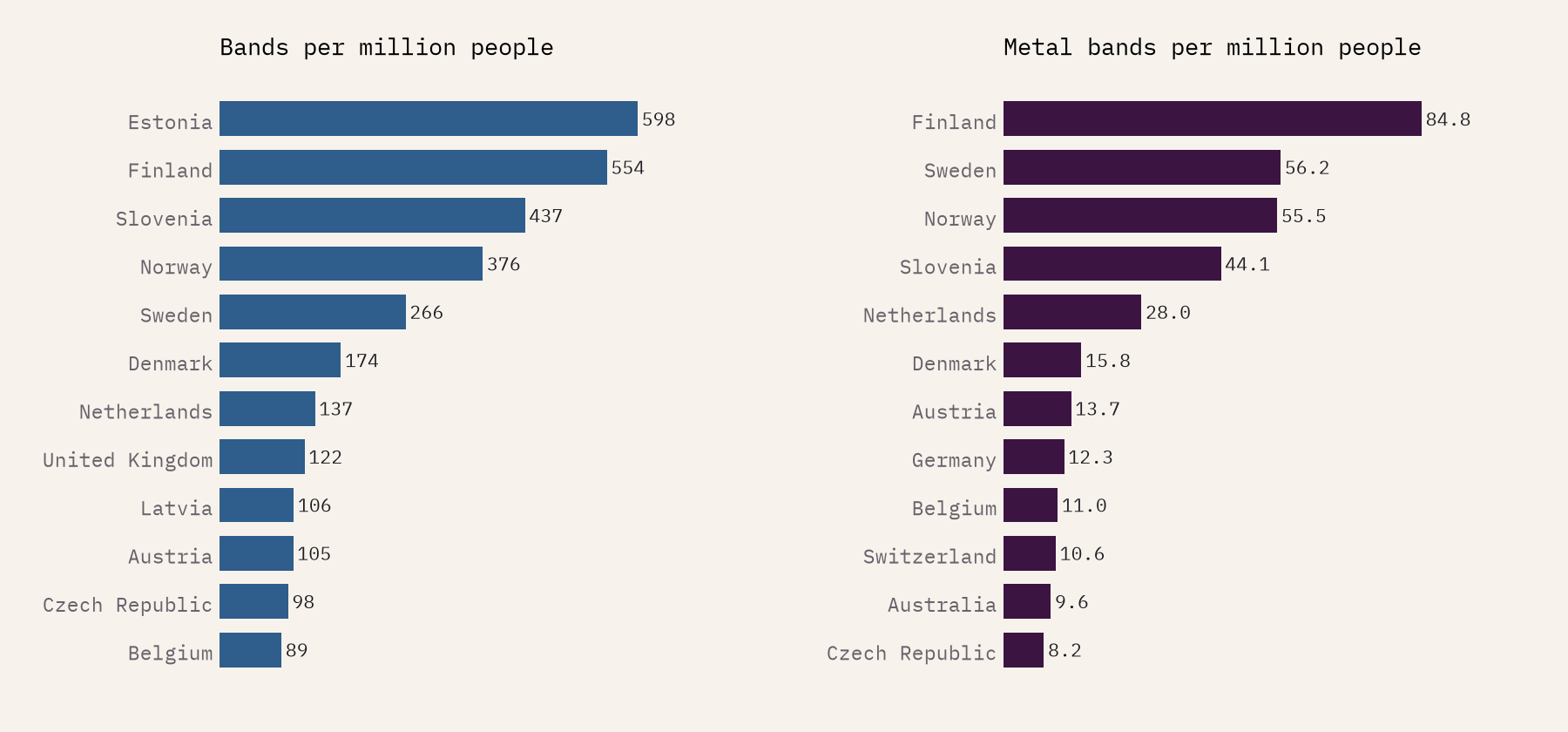
Finland has 84.8 metal bands in Wikidata for every million people. The United States has 6.7.
The Nordic band countries
Per head, the Nordic countries are band countries. Finland has 553.8 bands per million people, Norway 376.4 and Sweden 266.2. For metal the gap is wider still: Finland 84.8, Sweden 56.2, Norway 55.5, Germany 12.3. Part of that is real, a famously metal-loving region, and part is the work of keen Nordic Wikipedia editors who have written up their local scenes.
Where the women are
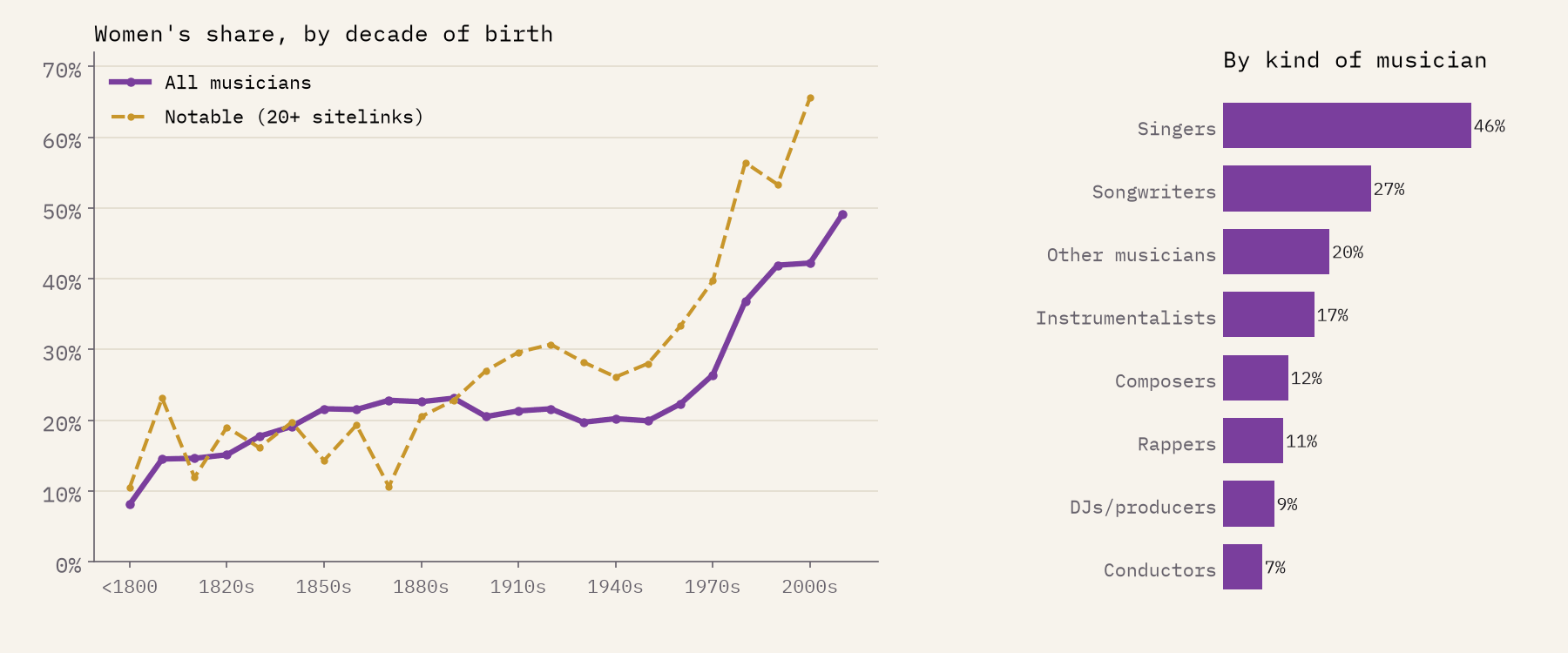
Women are 25.4% of musicians whose gender Wikidata records. By decade of birth, the share climbs from 8.1% before 1800 to about a fifth in the nineteenth century, stays there for musicians born up to the 1950s, and then rises to 42% for those born in the 1990s. But the kind of musician matters more than the decade: women are 46% of singers and 27% of songwriters, but 12% of composers, 11% of rappers, 9% of DJs and producers and 7% of conductors.
A map of who keeps records
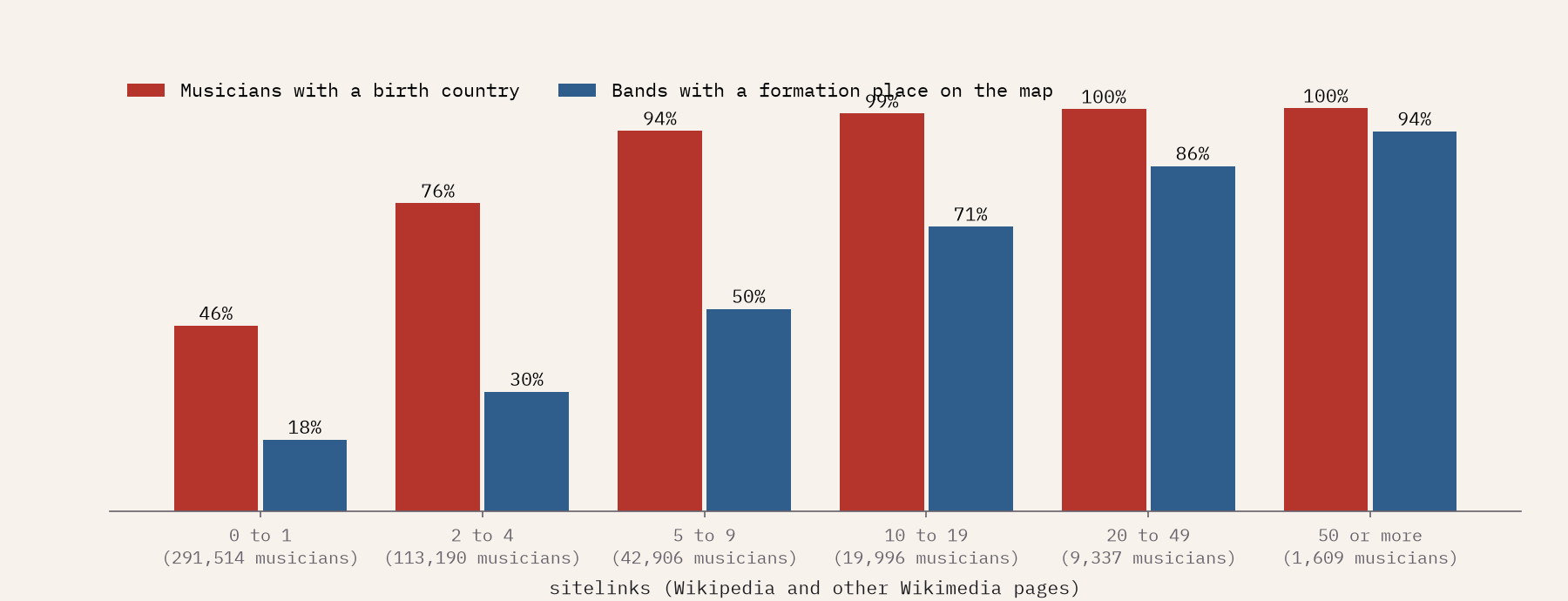
All of this rests on what Wikidata happens to know. It has a birth country for 99.8% of famous musicians but only 46% of those with one Wikipedia article or none, and a formation place for just 27% of its bands. Whole national library catalogues have been copied in for some countries, which is why Tallinn, Prague and Brno top the per-head list of birth cities. So the map is best read as the open record of music: rich where archives and enthusiasts have filled it in, thin where they have not.
How I did this
Queries to Wikidata through the QLever service gave every person with a musical occupation, with birthplace, birth date, gender and number of sitelinks, every musical group with its place and date of formation, and the genres of both. I placed each point in its present-day country with Natural Earth outlines, grouped points within 25 km of cities of 200,000 people or more, and grouped the 534 occupations into eight kinds of musician and the 3,743 genres into thirteen families by rules on their names. The lists are published with the data, so you can regroup them. Everything is in the paper, with the code and data on GitHub.
The usual caveats apply, and here they matter a lot. Wikidata is not a census of musicians. Its occupations are generous (the most linked “musicians” include Leonardo da Vinci, Goethe and Nietzsche, who all played or composed), it records gender mostly as a binary, genres for only 23% of musicians, and its coverage depends on which catalogues have been imported. Countries use today’s borders, so a composer born in Lviv in 1850 counts as Ukrainian.
Notes and sources
- Wikidata, via QLever (qlever.cs.uni-freiburg.de), retrieved 2026. CC0.
- Natural Earth countries, land and populated places, with population estimates. Public domain.
- Paper: Hotham, T. (2026) Where the world’s music comes from: the birthplaces of 291,579 musicians and the home towns of bands in Wikidata. Zenodo. https://doi.org/10.5281/zenodo.23850287
- I wrote the text, with drafting and editing assistance from Claude (Anthropic), which also helped prepare the analysis code. I reviewed and checked all text and results.

