
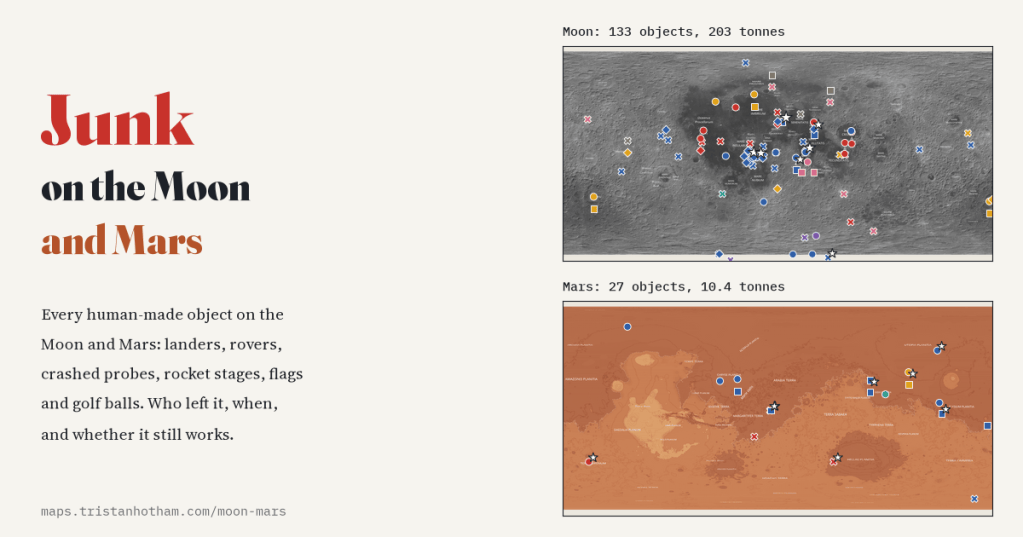
Since 1959 we have scattered 203.2 tonnes of hardware across the Moon and 10.4 tonnes across Mars: landers, rovers, crashed probes, spent rocket stages, six flags and a handful of golf balls. I mapped all of it.
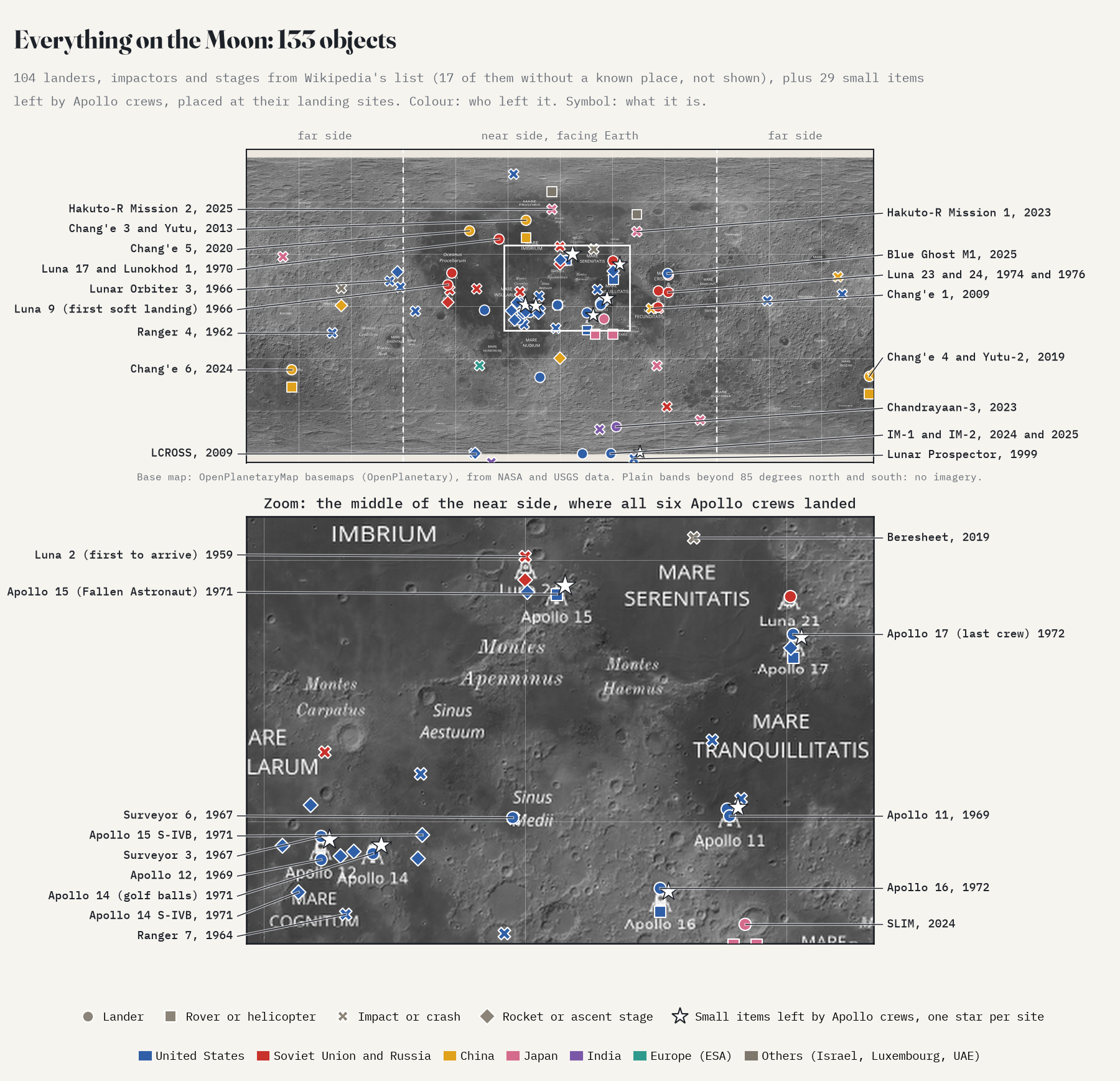
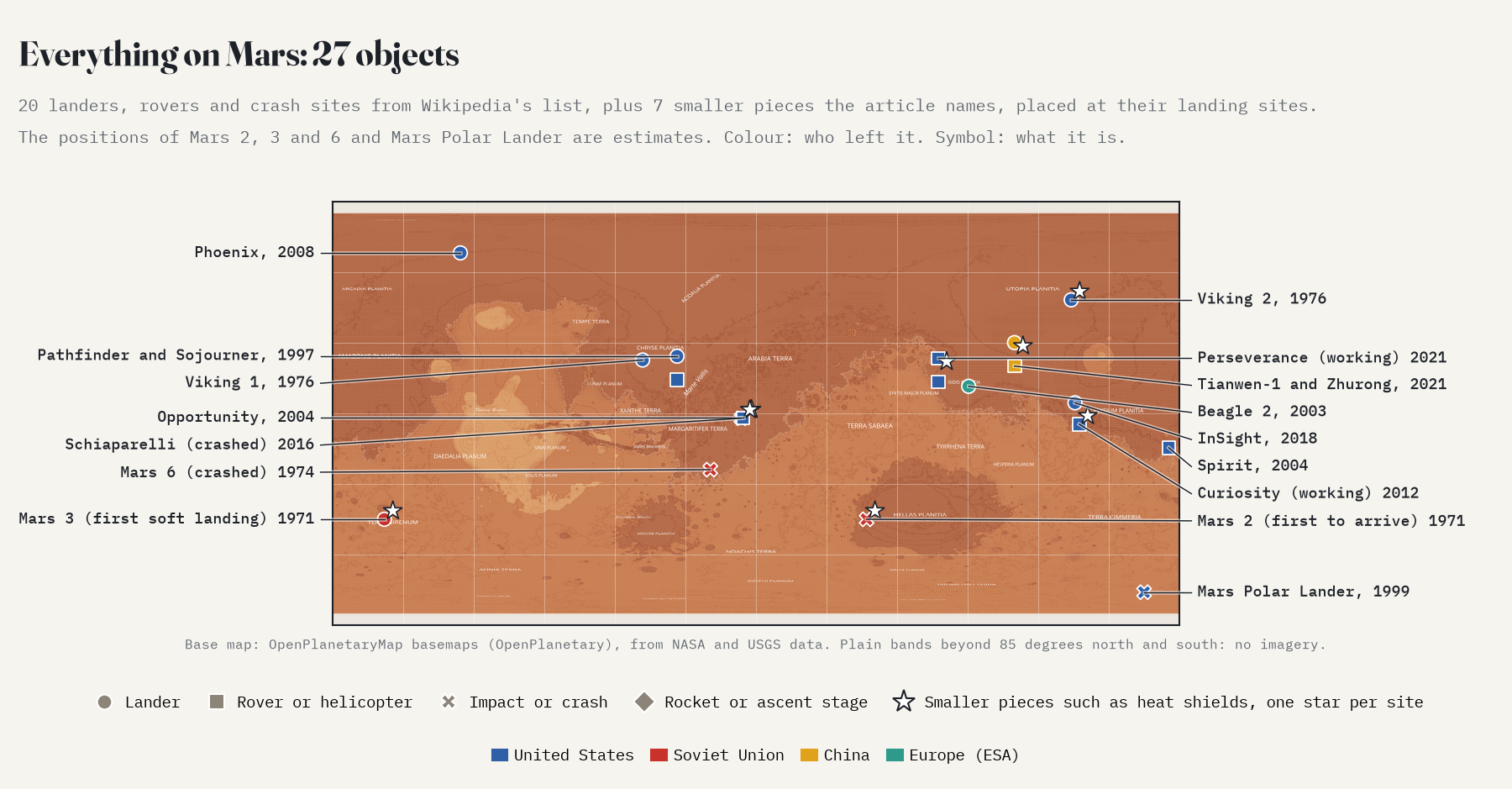
On 13 September 1959 a Soviet probe called Luna 2 hit the Moon, and the 9,100 kg rocket stage that had carried it crashed down nearby. Nothing made by people had touched another world before. Sixty-seven years later, Wikipedia’s list of artificial objects on the Moon has 104 rows, and its Mars list another 20. I turned those lists into one table, added the small things the Apollo astronauts left behind that the tables skip, and put the lot on maps of both worlds: 133 objects on the Moon and 27 on Mars.
Mostly American, mostly rockets
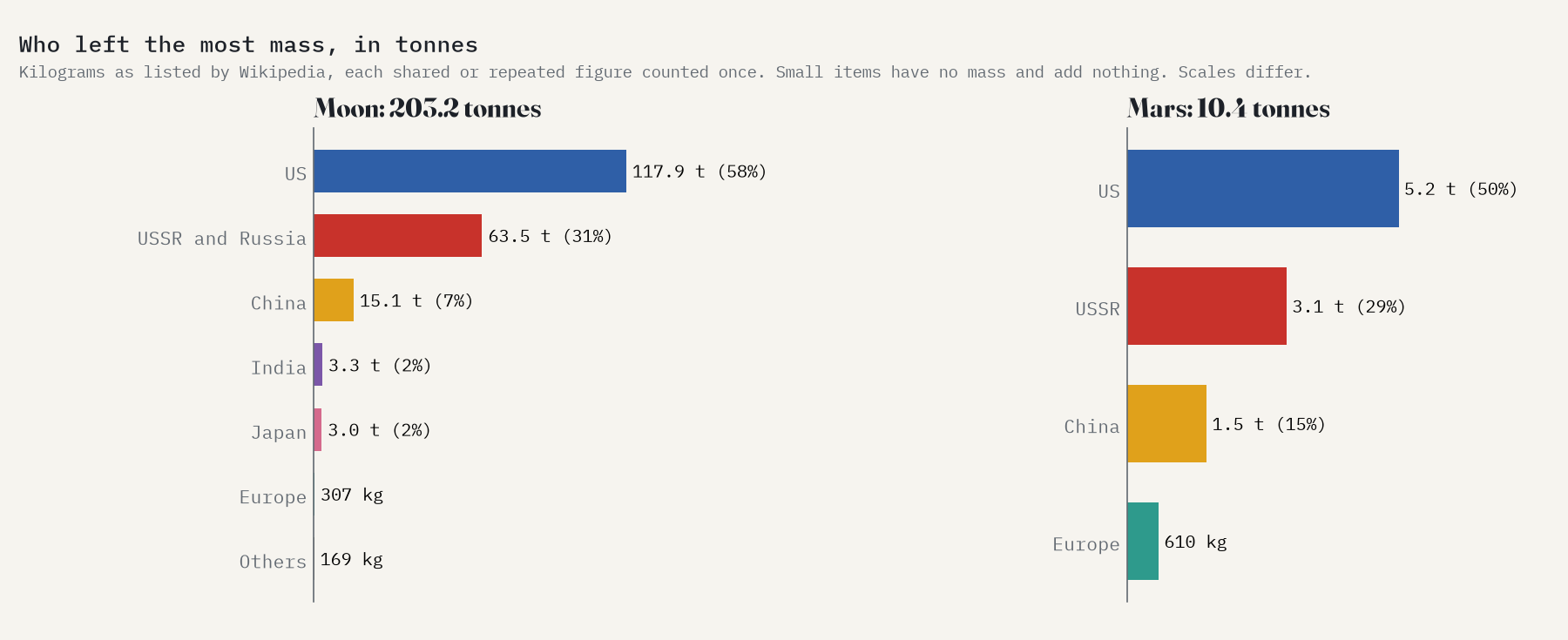
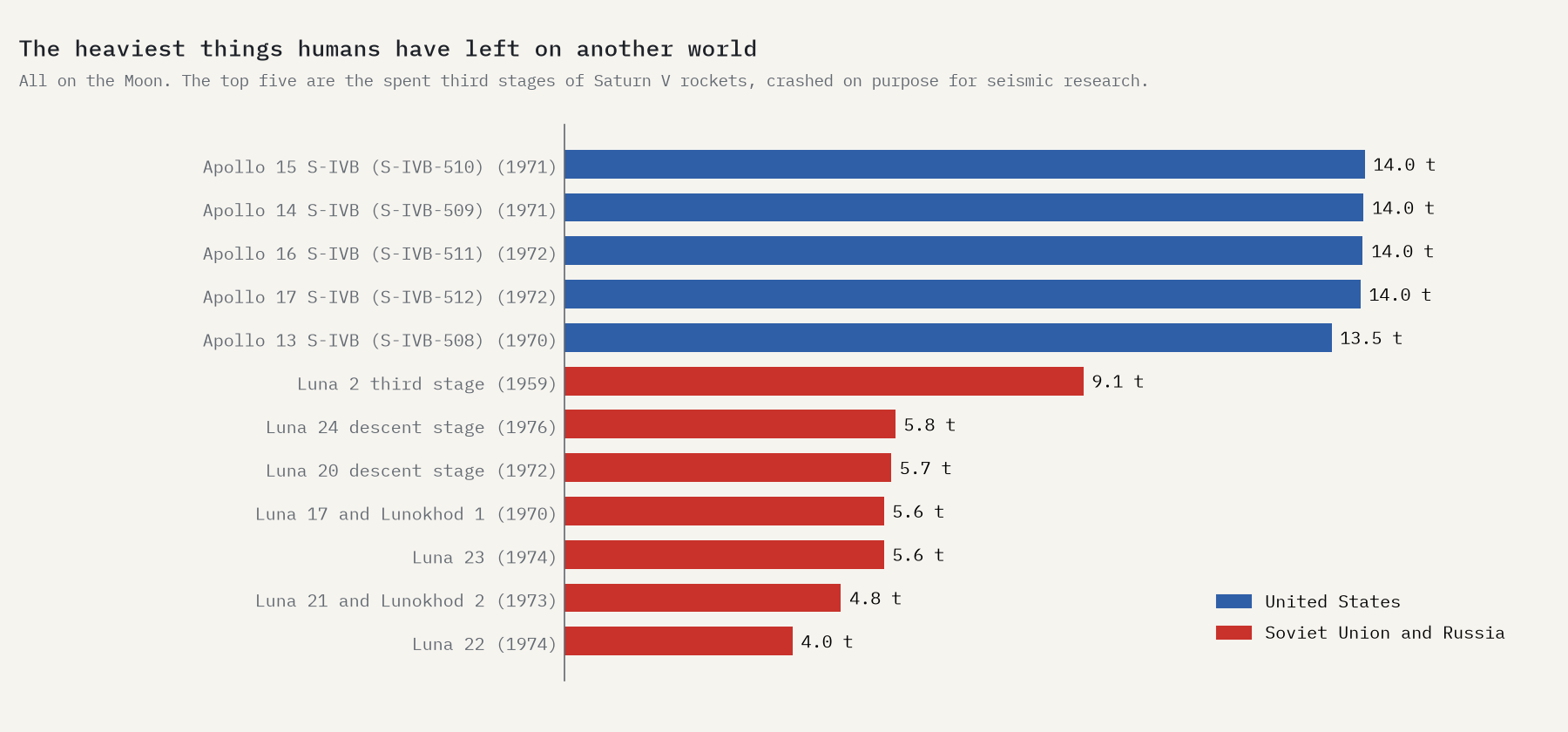
Add up the masses in the tables, counting each figure once, and you get 203,228 kg on the Moon. The United States left 58% of it, the Soviet Union and Russia 31%, and China, which only started landing in 2013, already 15.1 tonnes. A third of the whole lot is just five objects: the third stages of the Saturn V rockets from Apollo 13 to 17, each about 14 tonnes, which NASA deliberately crashed into the Moon for seismic research. Mars has about a twentieth as much, 10,380 kg, half of it American.
Two waves
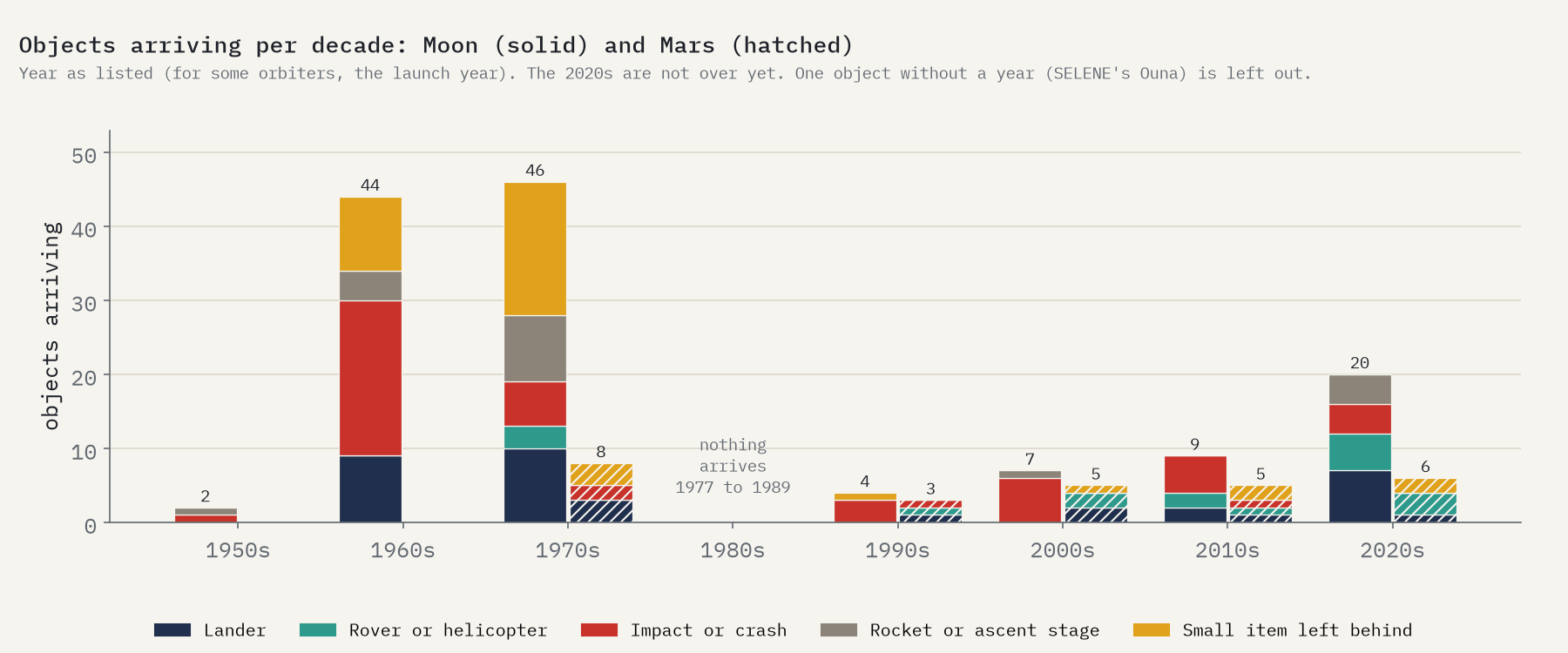
The Moon’s junk arrived in two bursts. The space race brought 34 objects in the 1960s and 28 in the 1970s. Then, after the Soviet Luna 24 in 1976, nothing in the list reached the Moon until 1990. The second wave is now. The 2020s have already brought 20 objects from 7 countries, more than the 2000s and 2010s combined, and for the first time many of them are private: SpaceIL, ispace, Intuitive Machines, Firefly and others. Of the 9 company objects in the table, 3 landed in one piece.
Landing is hard. Mars is harder.
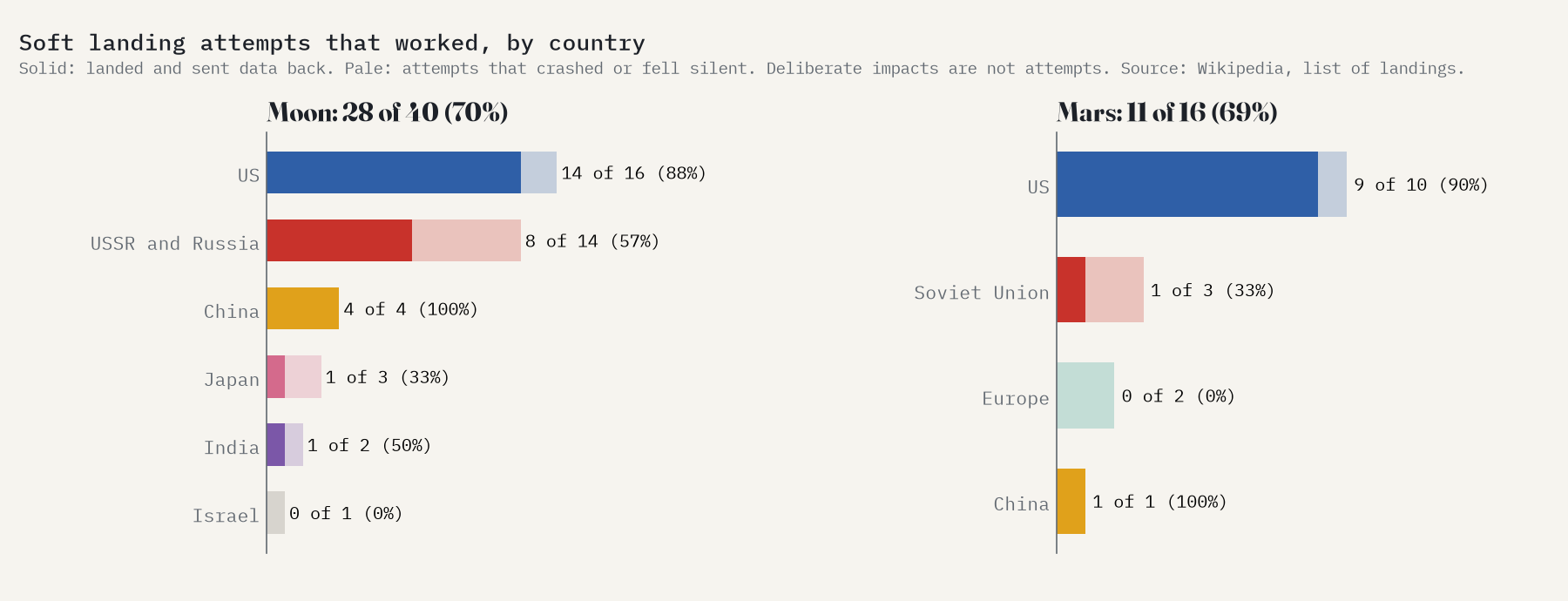
Wikipedia’s list of landings records 40 attempts at a soft landing on the Moon. 28 worked, 70%. China has a perfect four out of four; the Soviet Union and Russia managed 8 of 14, ending with Luna 25’s crash in 2023; commercial landers are at 3 of 6. On Mars 11 of 16 attempts worked. NASA landed 9 of its 10; the Soviet Mars 3 touched down in 1971 and fell silent almost at once; Europe’s Beagle 2 and Schiaparelli both failed; and China got Zhurong down first time in 2021.
The graveyard is quiet
Almost all of it is dead. Of the 104 rows in the Moon table, 68 hit the surface hard, by accident or on purpose, and only three are listed as still operating, all Chinese. On Mars, NASA’s Curiosity and Perseverance are still driving. The quiet survivors are the simplest things on the Moon: mirrors called retroreflectors, left by Apollo 11, 14 and 15 and carried by the Soviet Lunokhod rovers and India’s Chandrayaan-3, which still bounce laser pulses back to Earth so that the distance to the Moon can be measured.
Flags, golf balls and a Fallen Astronaut
The tables skip the small stuff, so I added 29 items that Wikipedia’s articles name. Six American flags, five of them still standing, according to pictures from orbit; Apollo 11’s was blown over by the engine on take-off. A plaque on the ladder of each Lunar Module. The golf balls Alan Shepard hit on Apollo 14. A Bible left by David Scott, and the Fallen Astronaut, an 8.9 cm aluminium figure he laid beside a plaque naming 14 astronauts and cosmonauts who had died. And a small vial of the ashes of the lunar scientist Eugene Shoemaker, which rode Lunar Prospector into a crater near the south pole in 1999: the only human remains on the Moon.
How I did this
Everything comes from English Wikipedia: the lists of artificial objects on the Moon and on Mars, the list of landings on extraterrestrial bodies, and the articles on the Moon landings, the Fallen Astronaut, the Apollo science packages and the lunar rover. I parsed the tables cell by cell, counted shared or repeated masses once, converted Martian longitudes to one convention, and kept objects without a known position off the map rather than guessing. The small items are placed at their landing sites, so their positions are approximate. The two Wikipedia lists disagree on where 8 objects are, by more than a degree; I kept the object tables’ positions. The paper sets out every step and caveat.
Notes and sources
- Wikipedia, List of artificial objects on the Moon, List of artificial objects on Mars, List of landings on extraterrestrial bodies and related articles, CC BY-SA 4.0. Revision numbers are in the paper.
- Base maps: OpenPlanetaryMap basemaps (OpenPlanetary), from NASA and USGS data.
- I wrote the text, with drafting and editing assistance from Claude (Anthropic), which also helped prepare the analysis code. I reviewed and checked all text and results.

