
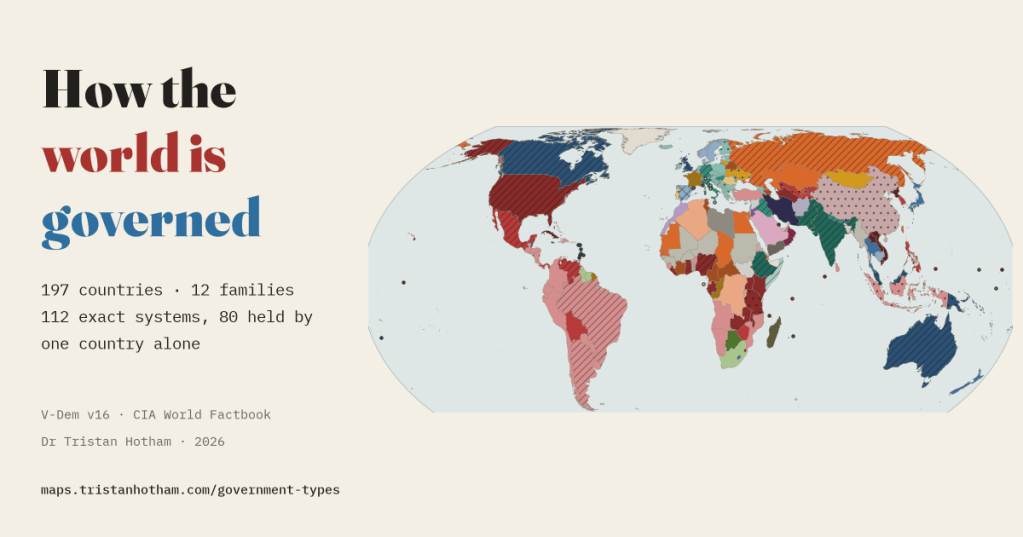
Most maps of political systems have two colours: democracy and not. I wanted one that shows how each country is actually put together. Compare the head of state, the executive, the federal structure, the chambers and the voting system, and the world’s 197 countries fall into 12 families and 112 exact systems. 80 of them are found in just one country.
Germany and Italy are both parliamentary republics with a ceremonial president. On a democracy map they are the same colour, and fair enough: V-Dem calls both liberal democracies. But they are not built the same way. Germany is a federation whose Bundestag is elected by mixed-member proportional representation, where the list seats top up the constituency seats until the parliament matches the vote. Italy is a regionalised state, and its Chamber of Deputies uses a parallel system, where the two kinds of seat are counted separately. Cousins, not twins.
So I tried to classify every country properly. Eight features for each: the kind of head of state and how they get the job, the executive, whether one office is both head of state and head of government, federal or unitary, one chamber or two, how the lower house is elected, and any power sharing fixed by religion, ethnicity or language. Each comes from two independent sources, V-Dem’s expert coding and the CIA World Factbook, compared field by field. Where they disagree, or the case is simply hard, I decided by hand and wrote down why: 83 decisions, each with a citation.
Twelve families
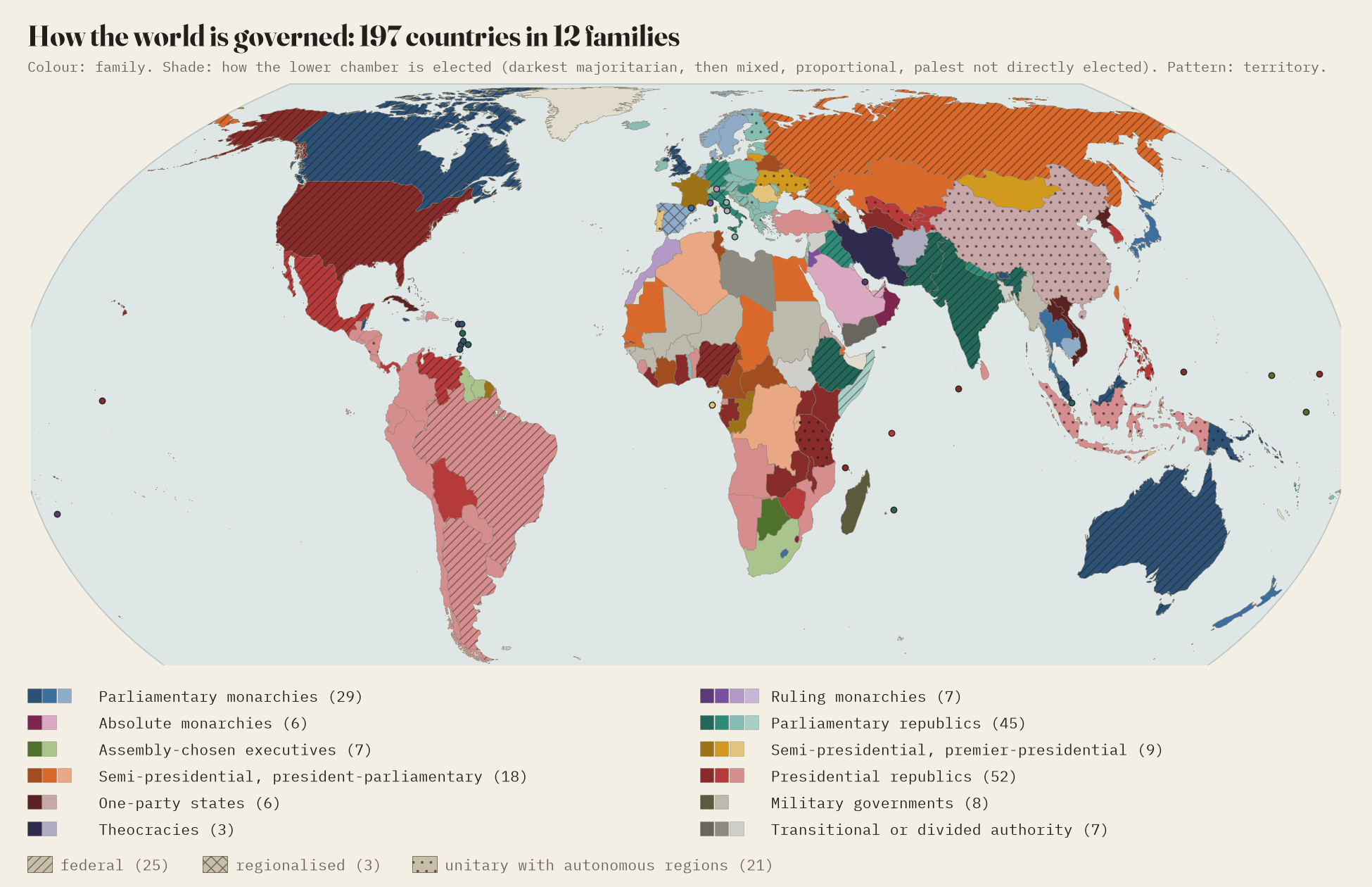
The families group countries by their head of state and by how the government is formed and removed. The two biggest are the presidential republics (52 countries) and the parliamentary republics (45), and each holds a little over a quarter of the world’s people. Then come 29 parliamentary monarchies, 14 of them Commonwealth realms with a king in London.
Count people rather than countries and the picture shifts. The 6 one-party states hold 19% of humanity, nearly all of it in China. The semi-presidential countries, where an elected president shares power with a prime minister, split in two. In the 9 premier-presidential ones, France among them, the government answers to parliament. In the 18 president-parliamentary ones, including Russia, Egypt and Algeria, the president can sack the prime minister too, and that family alone holds 8% of the world’s people.
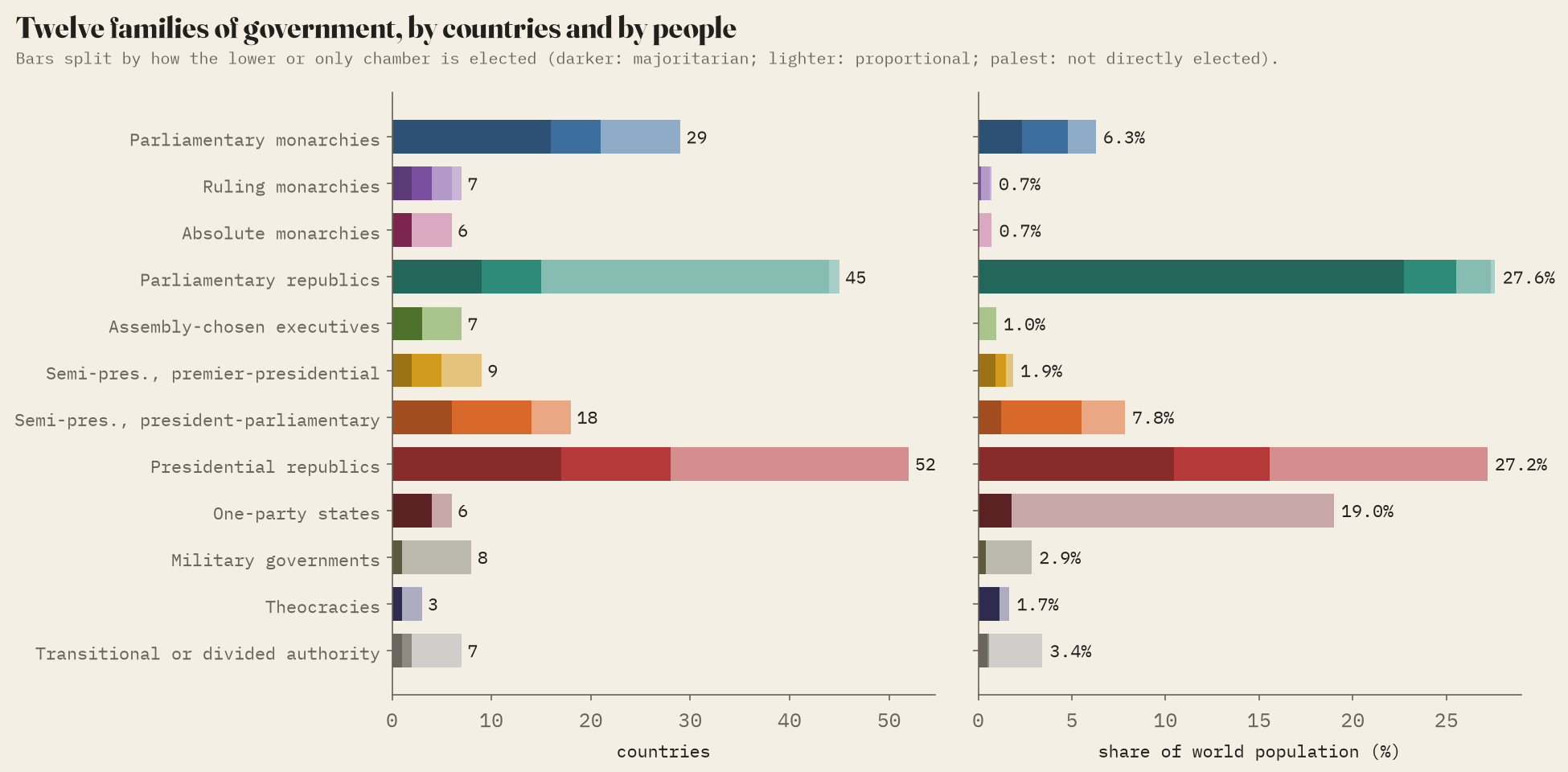
25 countries are federations. That sounds few, but they include India, the United States, Pakistan, Nigeria, Brazil and Russia, so 41% of the world’s people live in one. And 30 countries, home to 28% of humanity, are run by a party, an army, a cleric, a royal family or a transitional council rather than by anyone the voters chose.
Twins, cousins and loners
Here is the part I found most surprising. Insist that all eight features match before two countries count as having the same system, and there are 112 systems in the world. Only 32 are shared. 80 countries, two in five, have a system nobody else has.
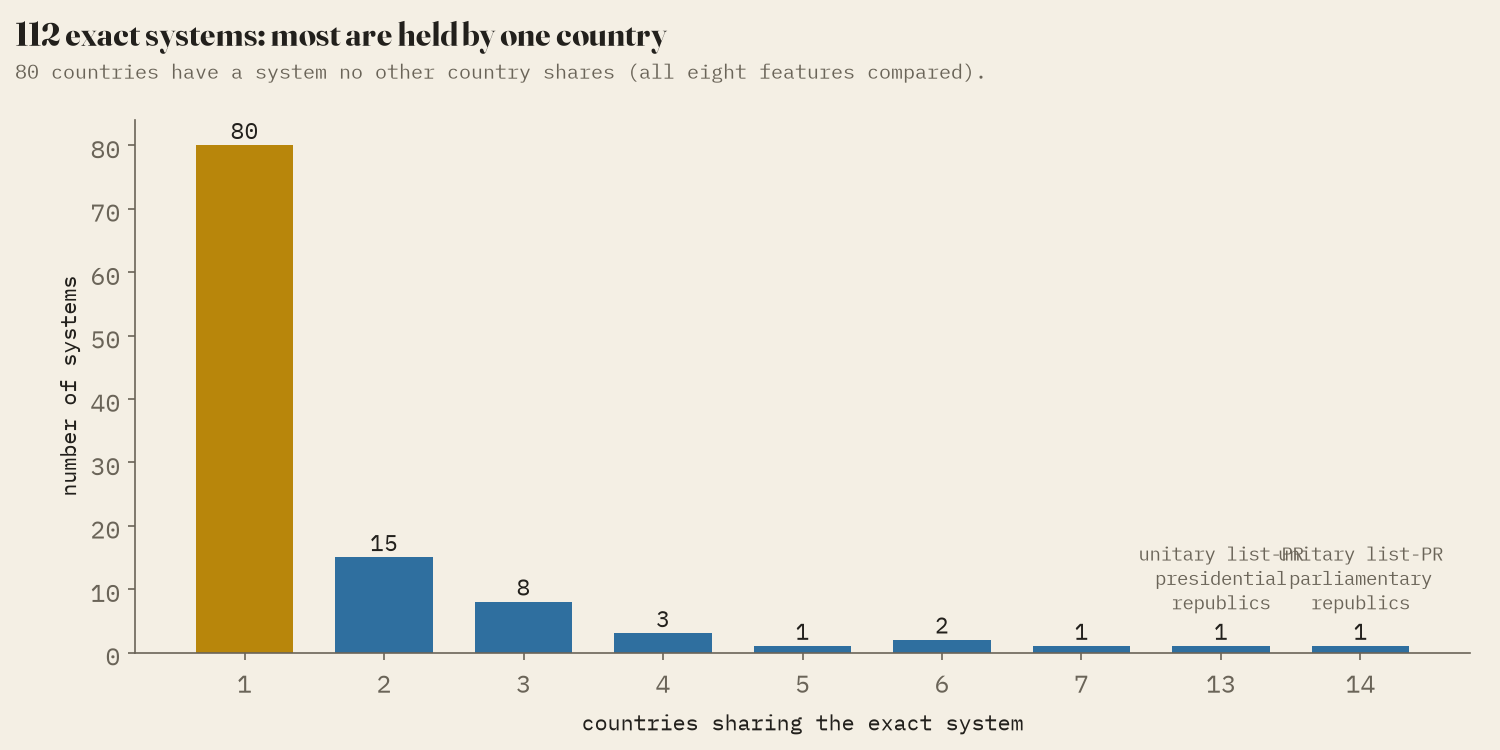
The biggest club, 14 members strong, is the classic post-communist design: a unitary parliamentary republic with one chamber elected by list proportional representation. Estonia, Latvia, Croatia, Bulgaria and North Macedonia are in it, and so are Israel, Iceland, Armenia, Cabo Verde and Fiji. The second, with 13, is its presidential mirror, six of them in Latin America. Some pairings made me look twice: India shares its exact system with Pakistan and Ethiopia, the United States with Nigeria, Brazil with Argentina.
Europe shows how much variety sits behind one democracy colour. Neighbours that look alike on a regime map turn out to be monarchies and republics, federal and unitary, proportional and majoritarian.
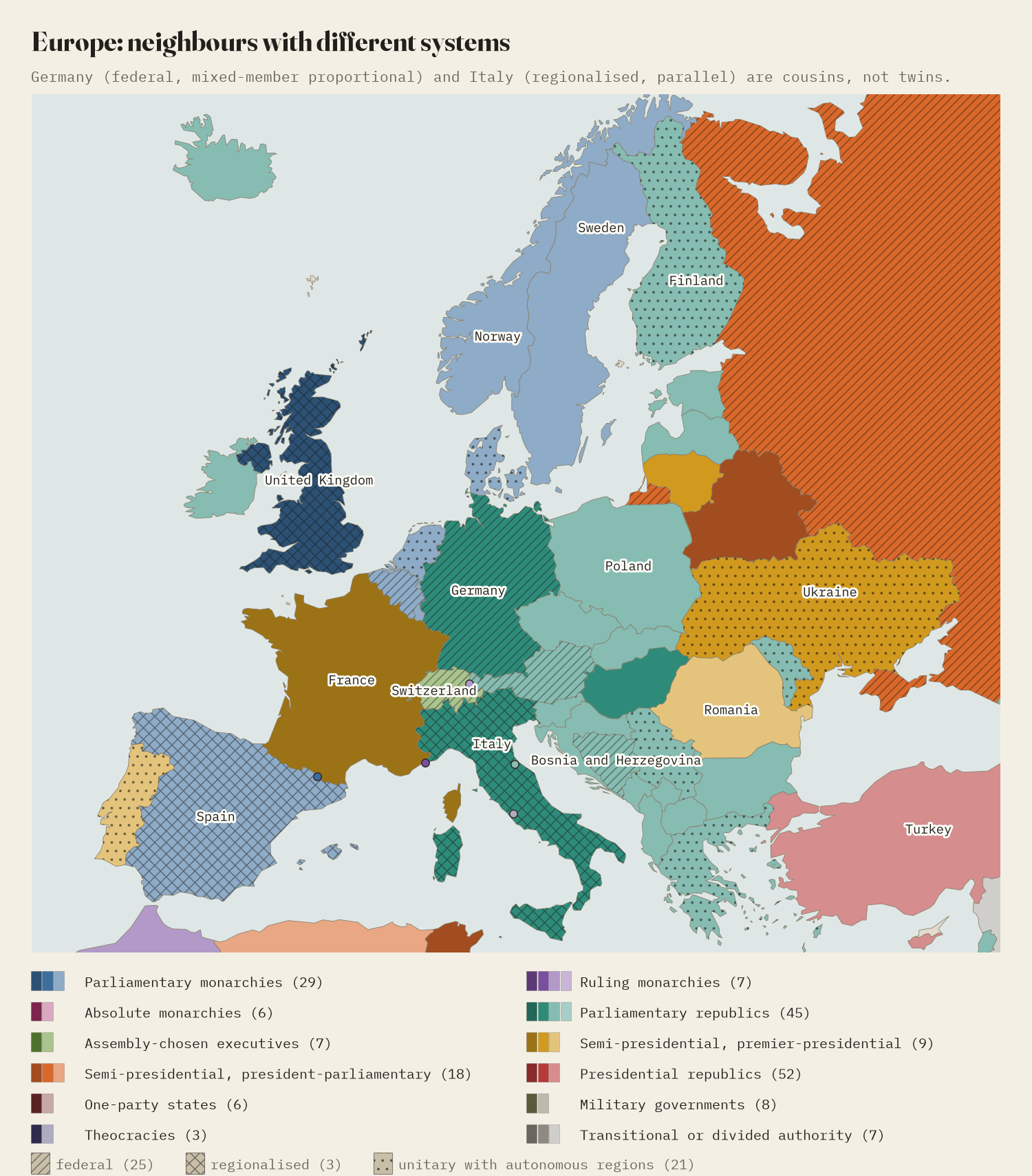
The loners are fascinating. Switzerland is run by a seven-member Federal Council that nobody can vote out mid-term. Bosnia has a three-member presidency, one Bosniak, one Croat and one Serb. Lebanon shares out its parliament and top offices by religion; without that feature it would be an exact twin of Israel. Andorra has two co-princes, one of them the President of France. Ireland is unique for its single transferable vote, Nauru for its Borda count. And the biggest loners of all are China, Indonesia, Russia, Mexico, Japan, Iran and Germany.
Form is not freedom
One pair sums up why I kept the form of government separate from how democratic it is. France and the Republic of the Congo have exactly the same constitutional design: premier-presidential, unitary, two chambers, the two-round system. V-Dem scores France’s liberal democracy at 0.80 and Congo’s at 0.12. A constitution can be copied without its spirit.
Two countries can share a constitution line for line and still live under very different governments.
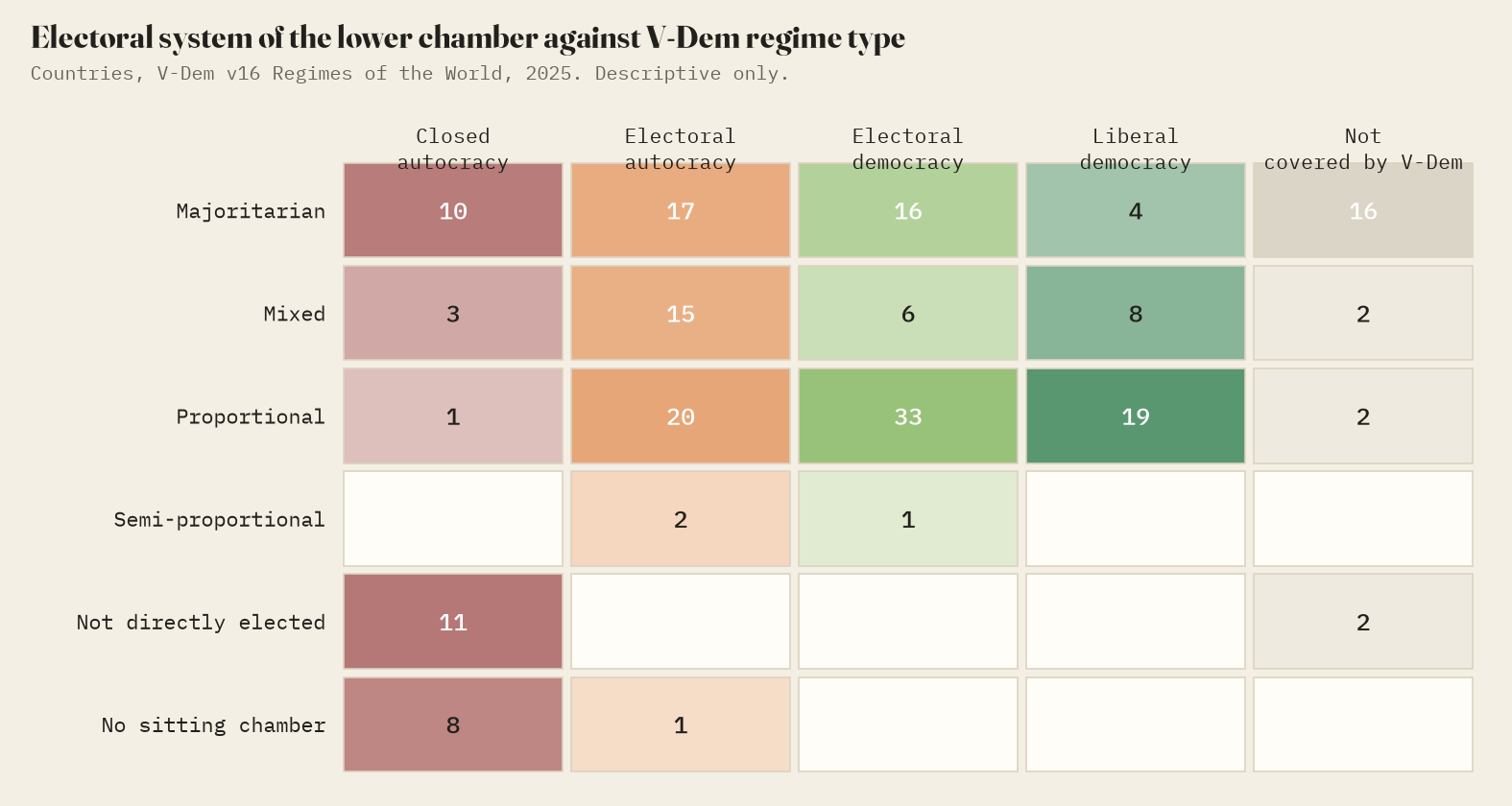
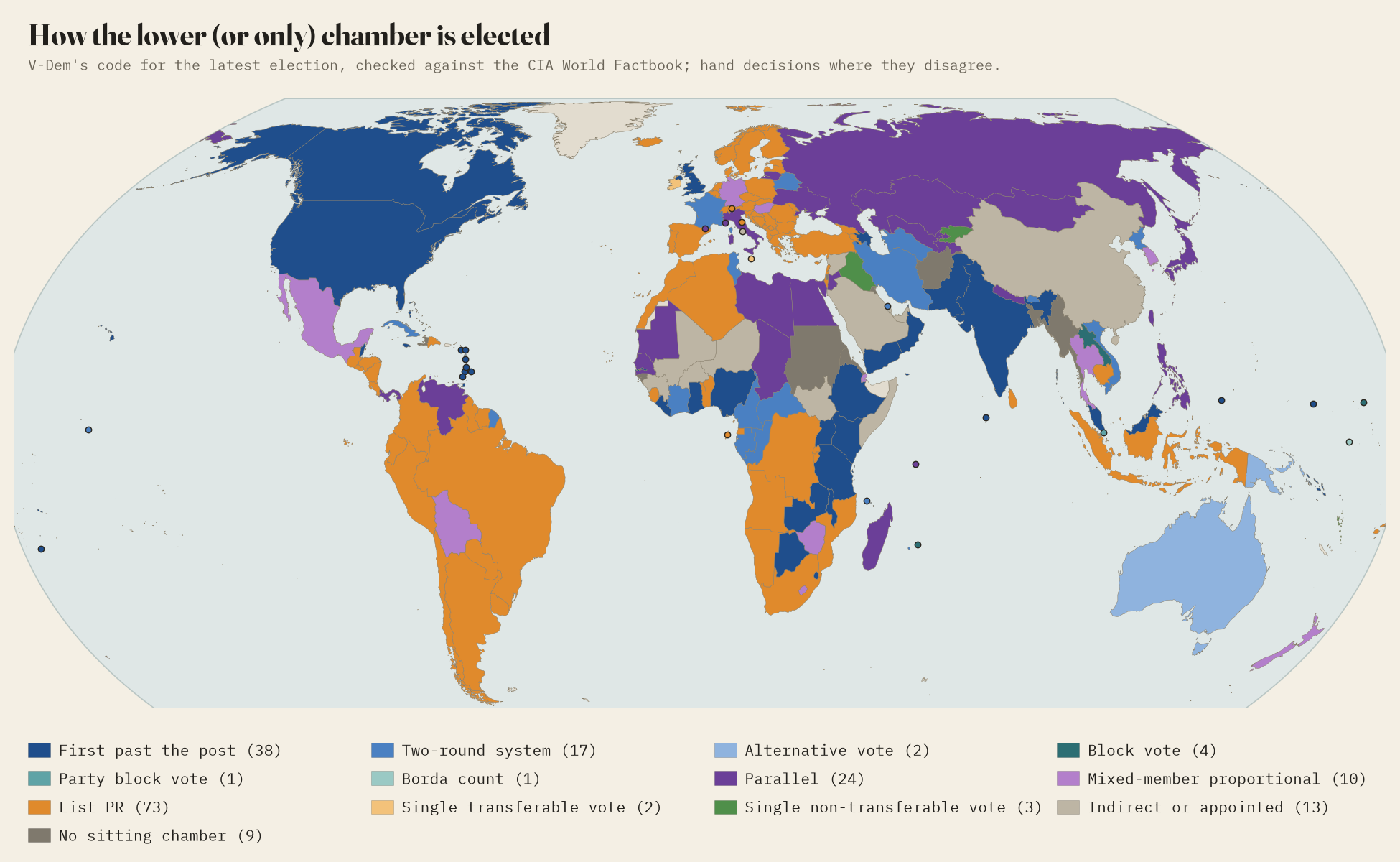
Still, set the features beside V-Dem’s Regimes of the World and some patterns are hard to miss. 71% of the countries that elect their lower house by proportional representation are democracies, against 43% of those with a majoritarian system. List PR is the commonest system by count (73 countries) but covers only 19% of the world’s people, while first past the post, used by 38 countries, covers 36%, mostly because of India and the United States.
Then there are the monarchies. The ceremonial monarchies that V-Dem scores have the highest average liberal democracy score of any family, 0.64 against 0.50 for parliamentary republics, and the top three countries in the world on V-Dem’s index are Denmark, Sweden and Norway. That is a story about Scandinavia and the old Commonwealth rather than about crowns: Thailand, Cambodia and Papua New Guinea are ceremonial monarchies too, and V-Dem calls all three autocracies. Where the monarch really rules, the scores are low.
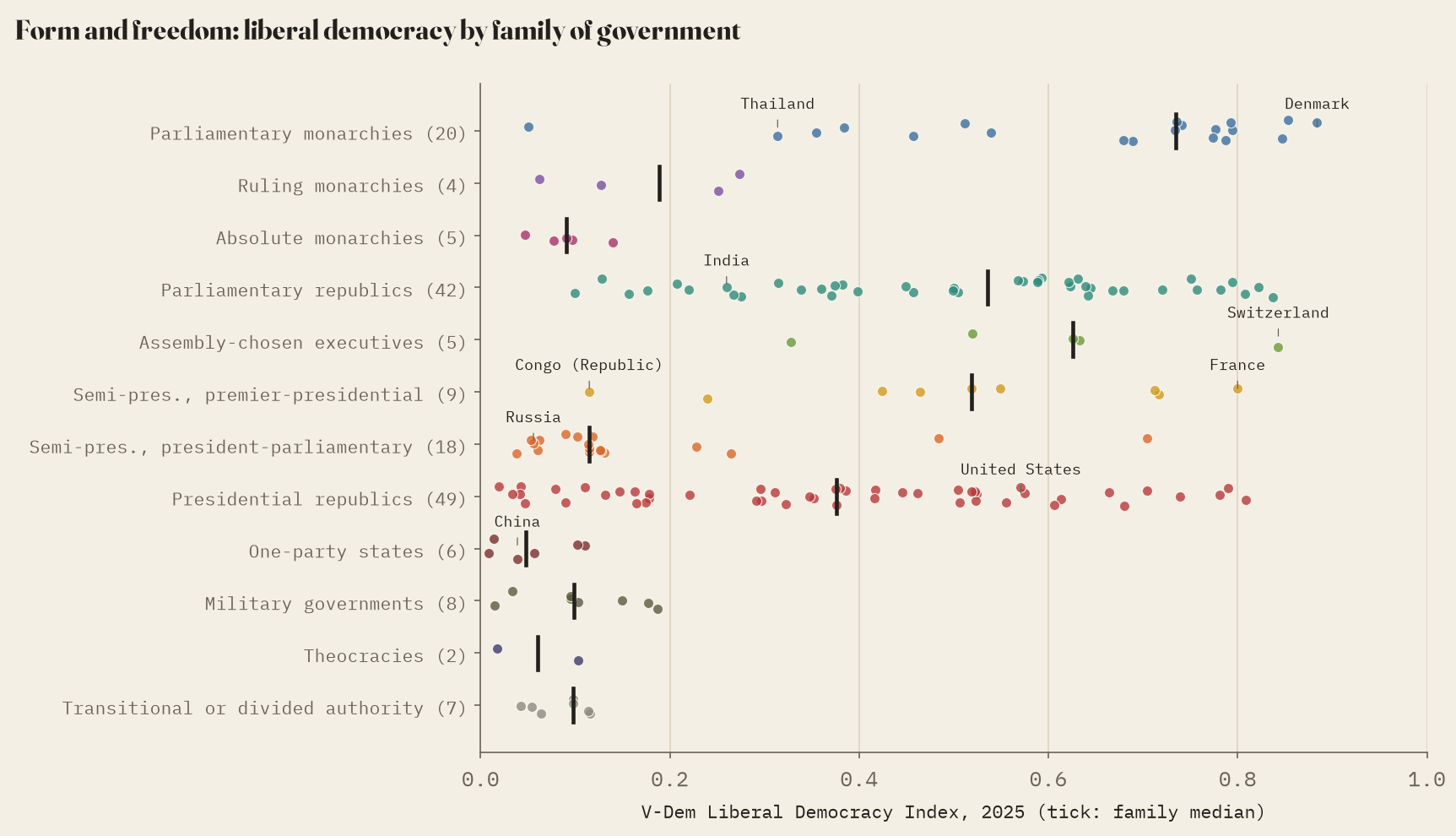
None of this is cause and effect. Region, history, wealth and colonial inheritance shape both the institutions a country chooses and how free it is. But it does mean the familiar two-colour map hides a lot, and that the shape of a government and its quality are worth mapping separately.
How I did this
I took V-Dem’s v16 dataset (latest year 2025) and two editions of the CIA World Factbook, and wrote explicit rules to turn their codes and labels into the eight fields, for the 193 UN members plus the Holy See, Palestine, Taiwan and Kosovo. Each field records both sources and whether they agree. The hard cases (the United Kingdom’s devolution, France’s constitution, Switzerland, Iran, Bosnia, Lebanon, the Vatican, Andorra, Malaysia, the Emirates, and the military and transitional governments of Libya, Myanmar, Afghanistan, Sudan and Haiti among them) are hand decisions with a reason and a citation. The interactive map lets you colour the world by any single feature, click any country for its full record and sources, and light up the systems most like it. The paper sets out every rule and its limits.
Notes and sources
- Coppedge, M., Gerring, J., Knutsen, C. H. et al. (2026) V-Dem Country-Year Dataset v16, Varieties of Democracy Project (CC BY-SA 4.0), via the vdemdata package. Regimes of the World: Lührmann, Tannenberg and Lindberg (2018).
- Central Intelligence Agency, The World Factbook, 2026 and December 2024 editions (public domain), via factbook.json.
- World Bank population, 2025 (CC BY 4.0); Natural Earth boundaries (public domain). The constitutions and statutes behind each hand decision are listed in the data.
- The data, text and figures are shared under CC BY-SA 4.0 because they include V-Dem values; the code is MIT.
- I wrote the text, with drafting and editing assistance from Claude (Anthropic), which also helped prepare the analysis code. I reviewed and checked all text and results.

