
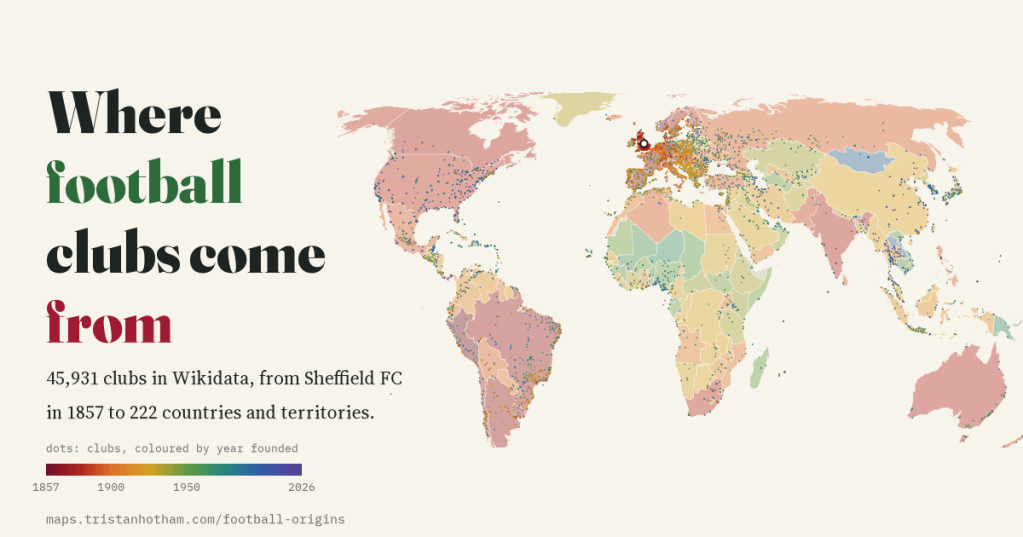
In 1857 two young cricketers in Sheffield founded a football club. I put every football club in Wikidata on one animated map, in the order they were founded, to watch the game spread from Yorkshire to 222 countries, and to see which clubs did not make it.
Every football club has a birthday. Sheffield FC’s is in 1857, Notts County’s in 1862, Peñarol’s in 1891, Genoa’s in 1893. Most clubs’ birthdays are known only to their members, but a surprising number have been typed into Wikidata, the open database behind Wikipedia. It holds 45,931 association football clubs once national teams, reserve sides and a few other things are taken out, and 27,079 of them have a founding year.
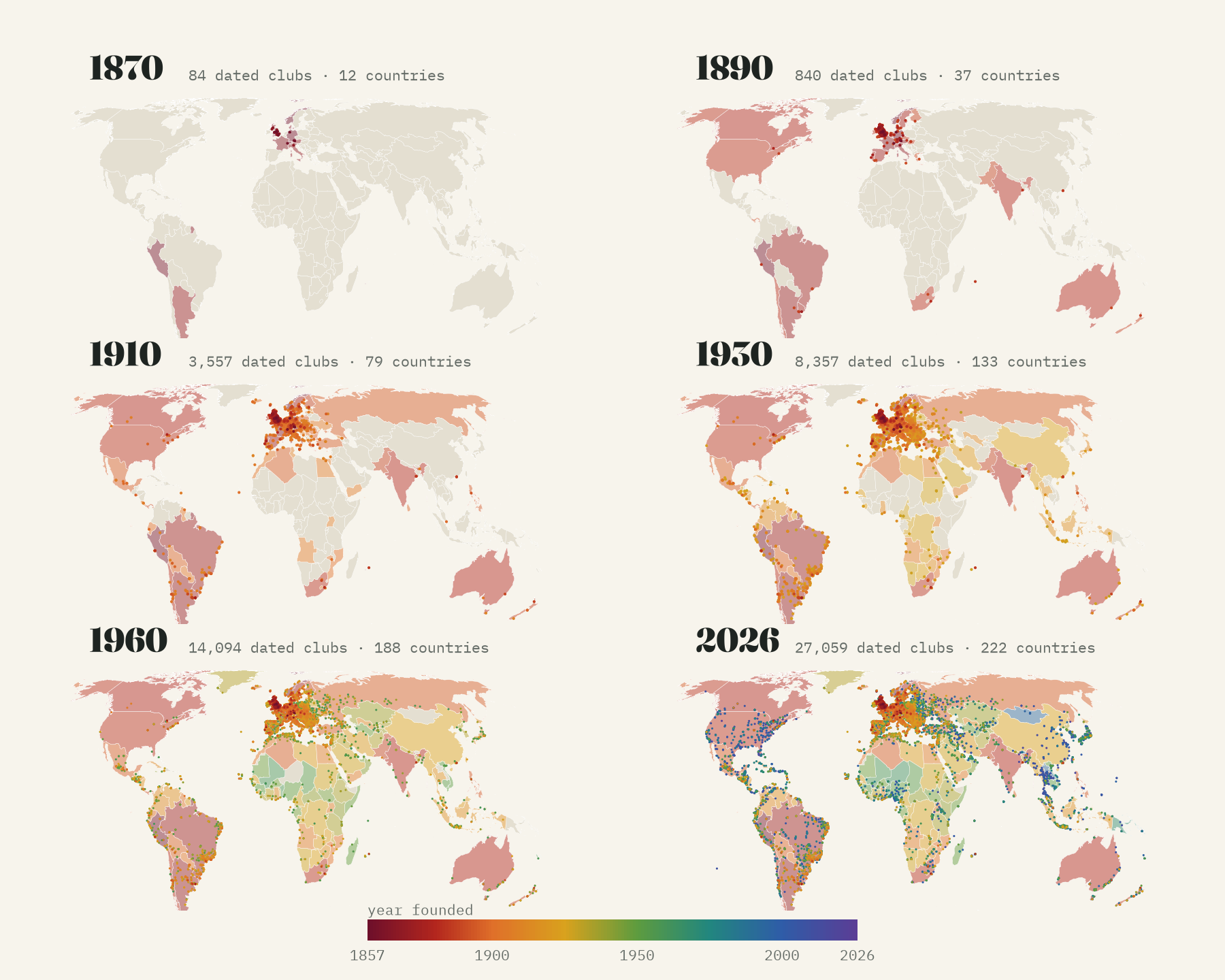
So I put them on a map in order. The interactive version has a time slider and a play button: press it and watch dots appear, one year at a time, from 1857 to today.
Out of Sheffield
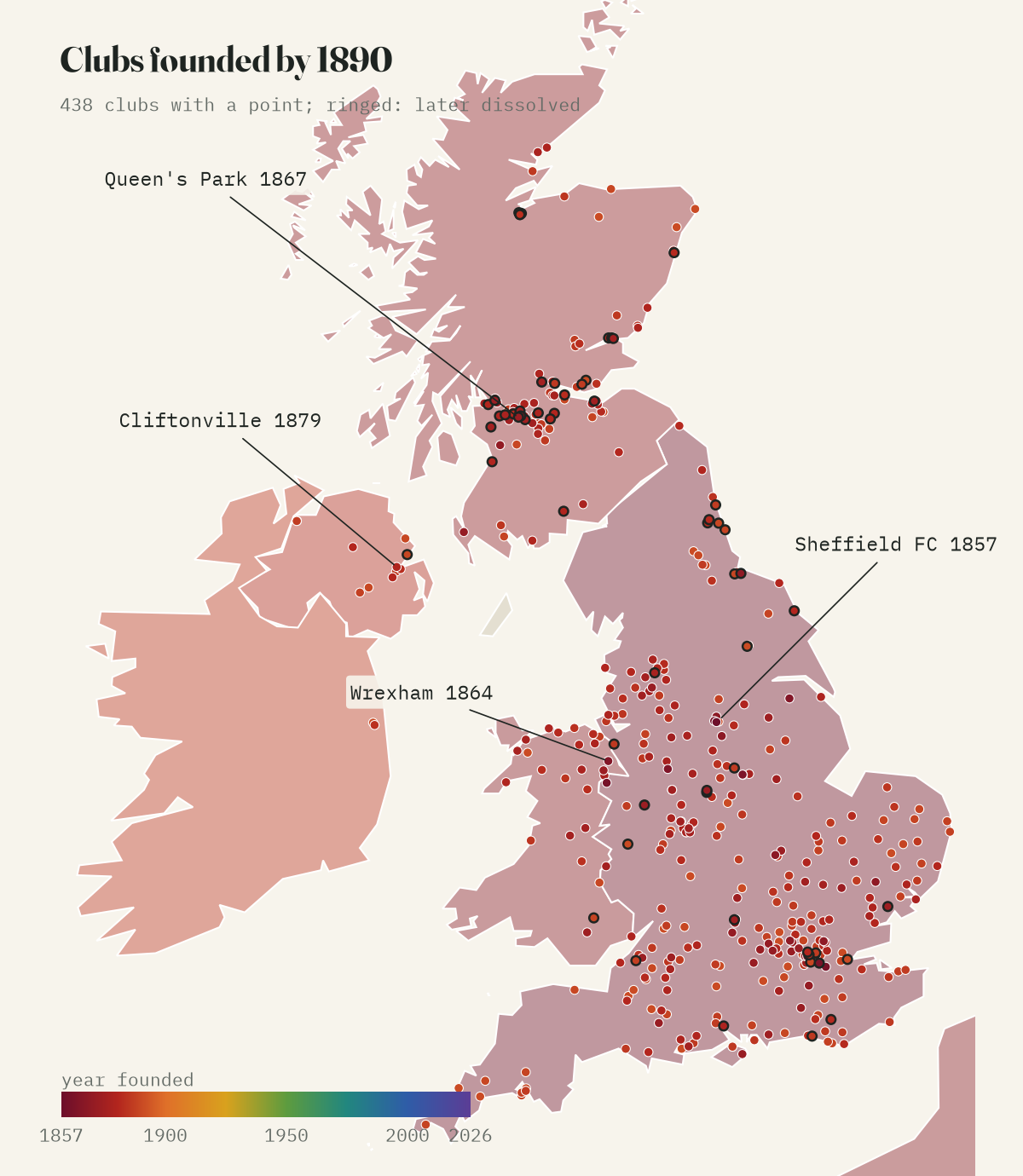
The early map is a British one. Of the 314 clubs Wikidata dates before 1880, 258 are in the United Kingdom. Sheffield FC comes first, then Hallam, Notts County, Stoke, Nottingham Forest and Sheffield Wednesday, and a string of London clubs from the early FA Cup that no longer exist. Wales gets its first club in the record with Wrexham (1864), Scotland with Queen’s Park (1867) and Northern Ireland with Cliftonville (1879).
The first club in every country
The most satisfying thing to pull out of the data is the oldest club Wikidata knows in each country. By 1900, 55 countries and territories had one; by 1914, 87; by 1950, 173. The last place to join the record is Gibraltar, in 2021.
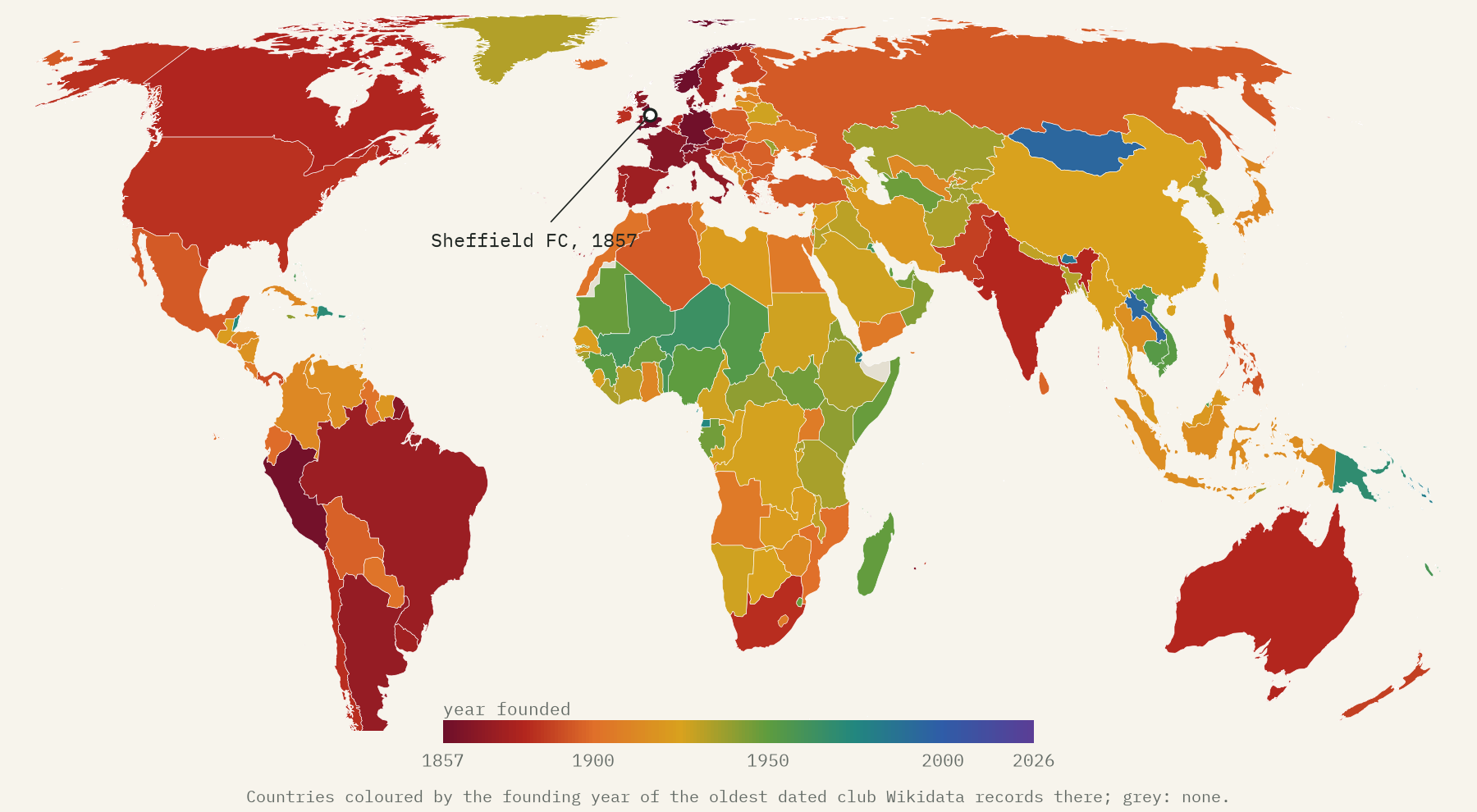
Football did not spread like a ripple on a pond. It jumped by sea. Countries whose first club came before 1900 are a median 1,966 km from Sheffield; those whose first club came after 1950, 6,894 km. But Peru, Argentina, Uruguay, India and Australia all have clubs in the record before Hungary, Poland or Russia. The first in South America is the Lima Cricket and Football Club, in 1859.
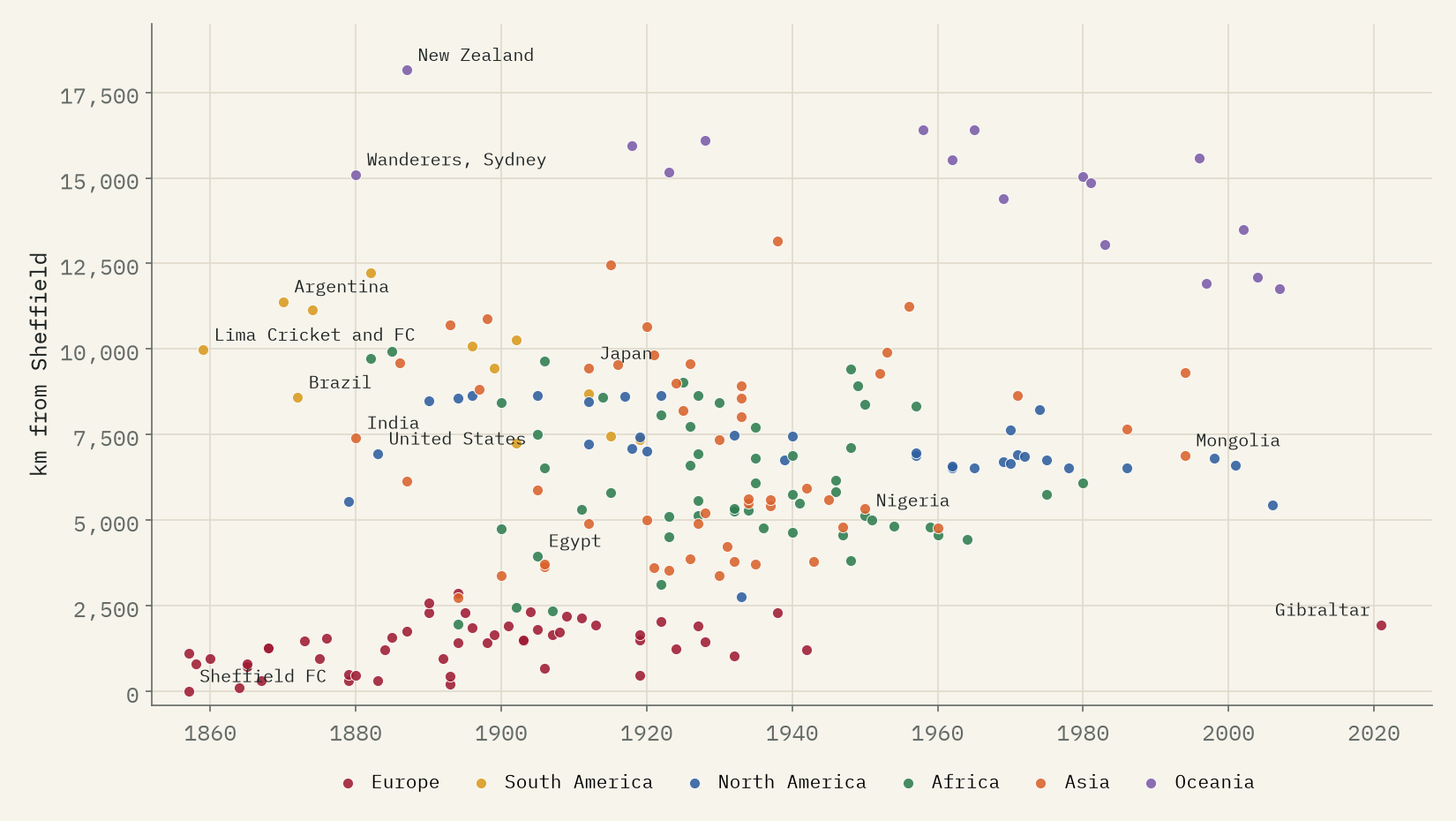
A word of caution about those first clubs: many began as something else. Lima’s was a cricket club, Lausanne’s a football and cricket club, Montevideo’s a rowing club, and Norway’s and Italy’s gymnastics societies. Wikidata records when the club was founded, not when it first kicked a ball. And it cannot tell us who founded them. The British engineers, sailors and students of football folklore may be behind many of these clubs, but nothing in the data says so, so I have not counted them.
Waves of new clubs
Before 1900, 93% of new clubs were European. The single busiest year is 1919, with 475 new clubs, as the First World War ended, and Europe’s busiest decade is the 1920s. Every other continent peaks in the 2000s; since 2000, Europe’s share of new clubs is down to 38% and Asia’s is 26%.
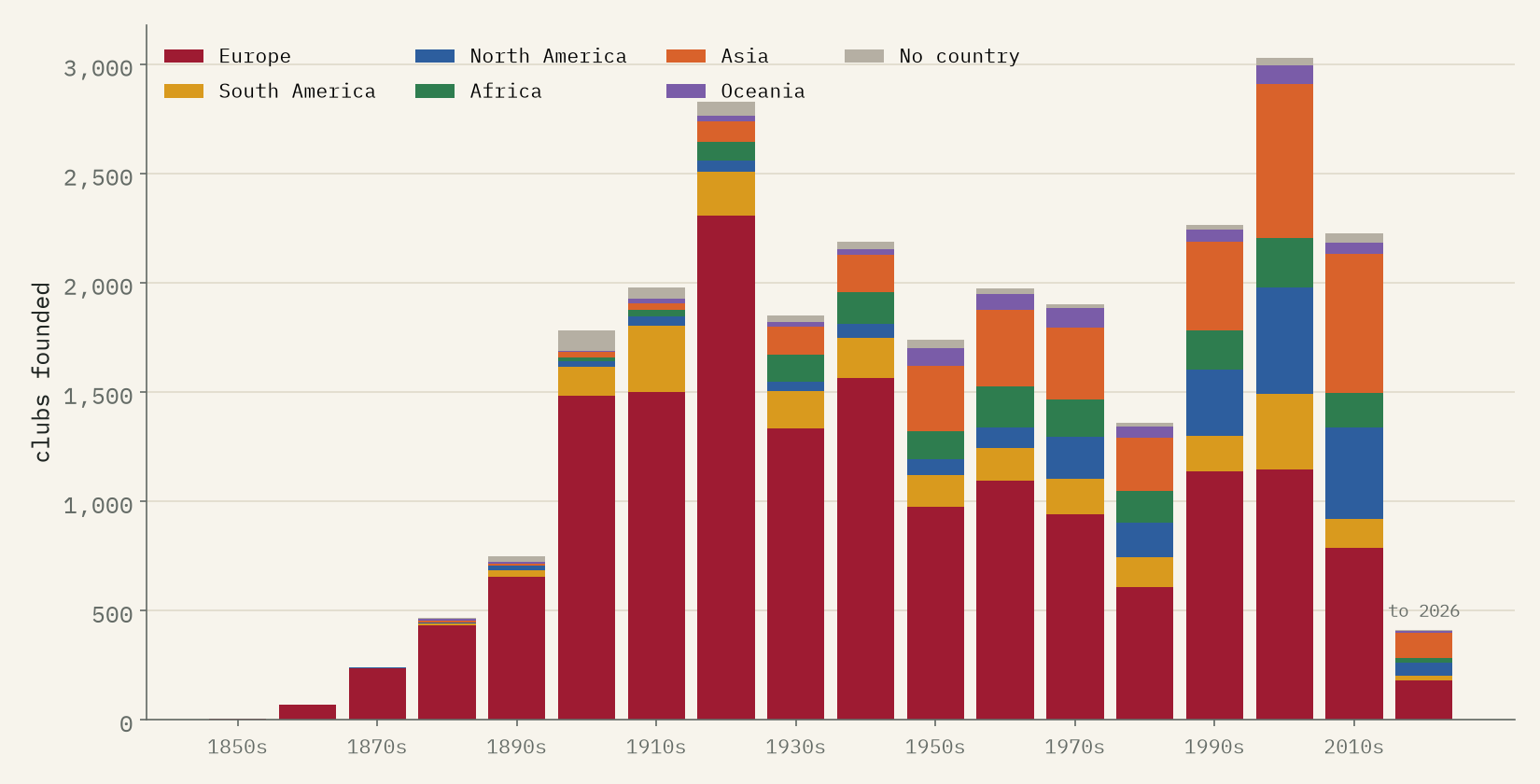
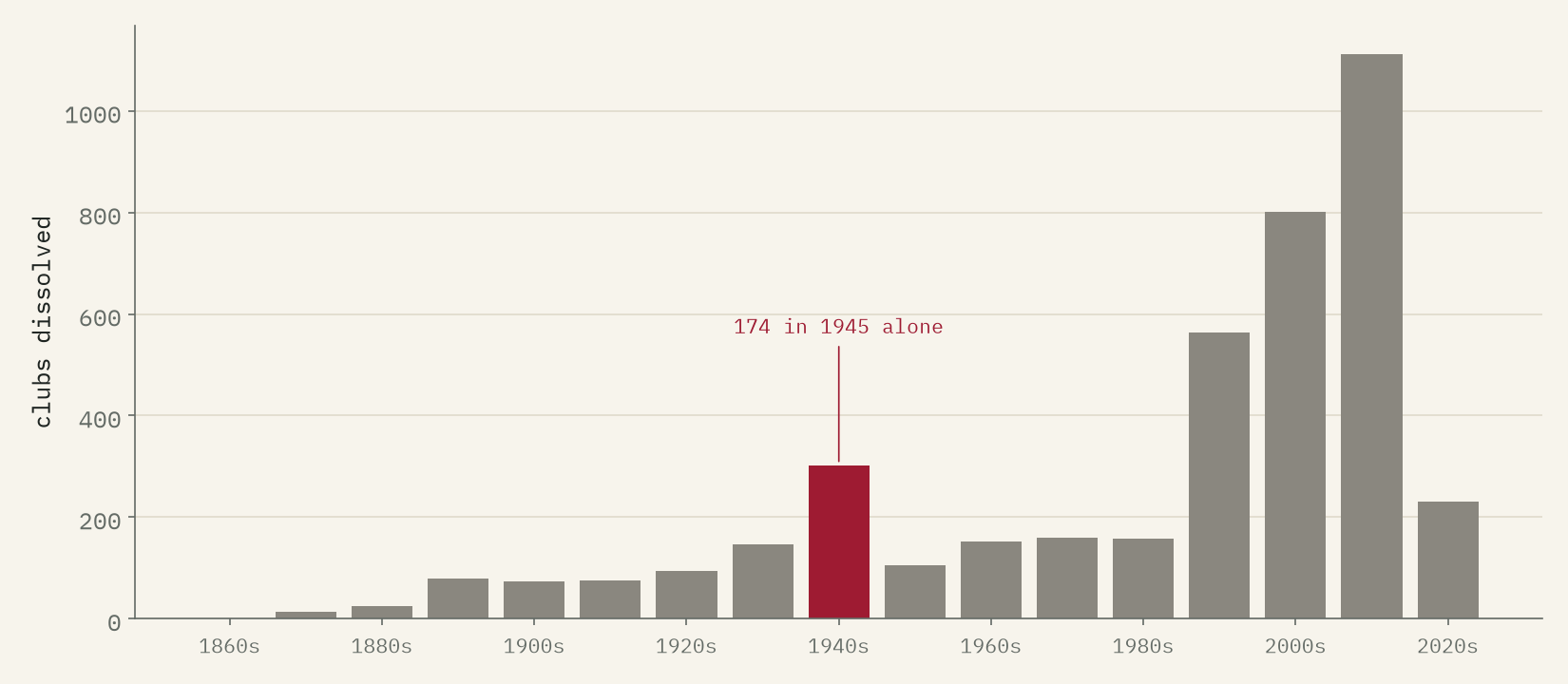
The busiest year for new clubs was 1919. The busiest year for dead ones was 1945.
The clubs that died
Wikidata records a dissolution date for 4,091 clubs. The worst single year is 1945: 174 clubs ended, 143 of them German, as the Allies dissolved German sports clubs after the war and clubs in the lost eastern territories ceased to exist. The oldest club that died is the Wanderers (1859 to 1887), five times FA Cup winners. More than half of all recorded deaths are since 2000, which is partly bankruptcies and mergers and partly just easier record keeping.
A map of who keeps records
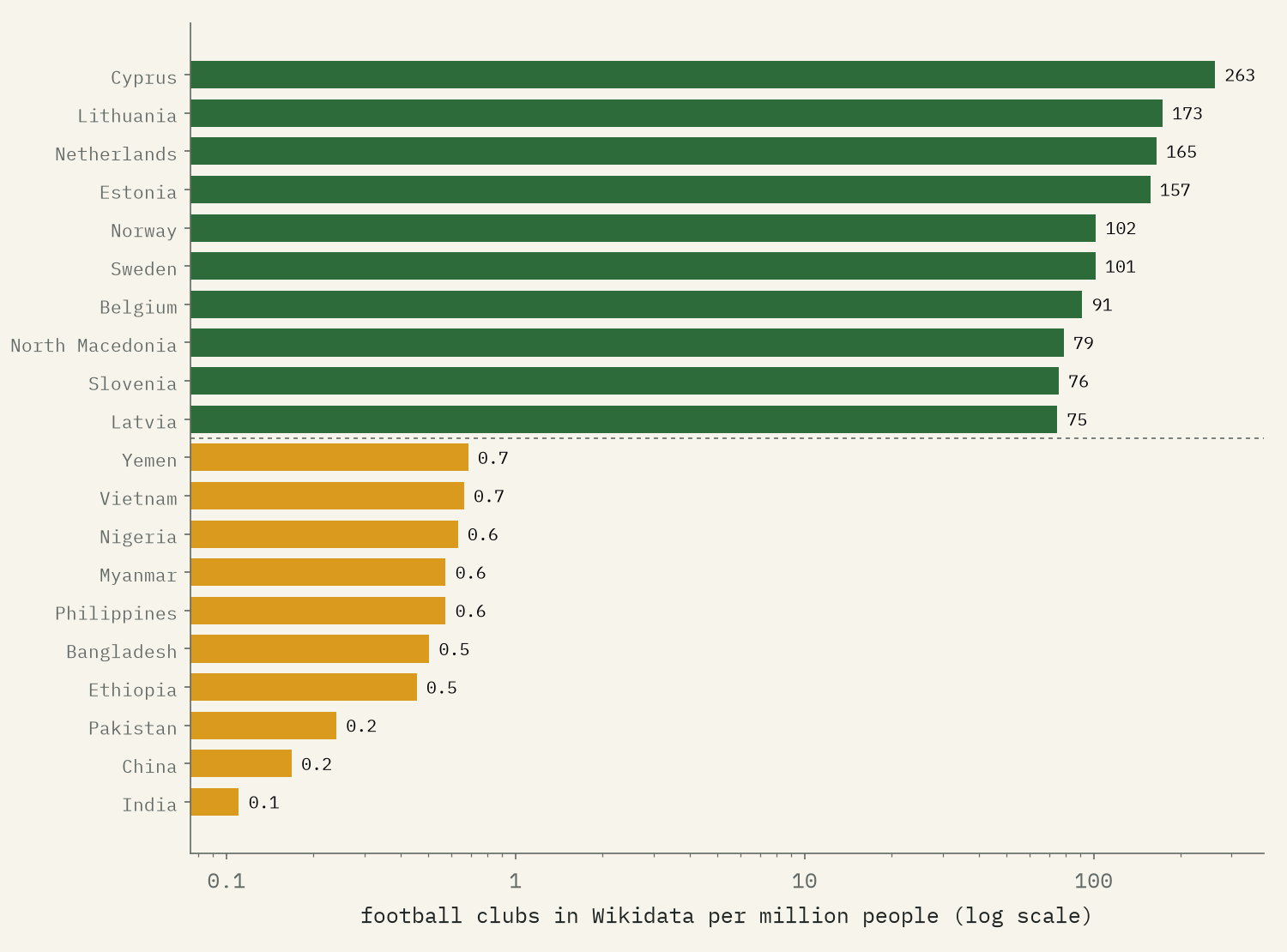
None of this is a census of football. The Netherlands has 2,857 clubs in Wikidata, more than Germany, and 165 per million people; Nigeria has 0.6 per million and India 151 clubs in all. That reflects Dutch, Swedish, Belgian, Baltic and Cypriot editors who have catalogued their village clubs, not where football is loved. A country’s first club is more trustworthy than its number of clubs, but even that is only as early as the oldest club someone thought to enter.
How I did this
One query to Wikidata, through QLever, returned every item that is an association football club or a subclass of one, with its founding and dissolution dates, coordinates, home ground and country. I kept one record per club and took out national teams, beach soccer and futsal sides, reserve and youth teams, and Australian clubs whose names mark them as Australian rules football clubs, which Wikidata often files as football clubs. Founding dates stored as 1 January are treated as a bare year. Each club sits at its own coordinates, else its ground’s, else the town in its name, and is counted in the present-day country its point falls in (the UK split into its four nations). The paper sets out every step and caveat.
Notes and sources
- Wikidata, via QLever. CC0.
- Natural Earth countries, states and provinces, and populated places (public domain).
- engsoccerdata (James Curley, GPL-3), used only to check the locations of English clubs.
- I wrote the text, with drafting and editing assistance from Claude (Anthropic), which also helped prepare the analysis code. I reviewed and checked all text and results.

