
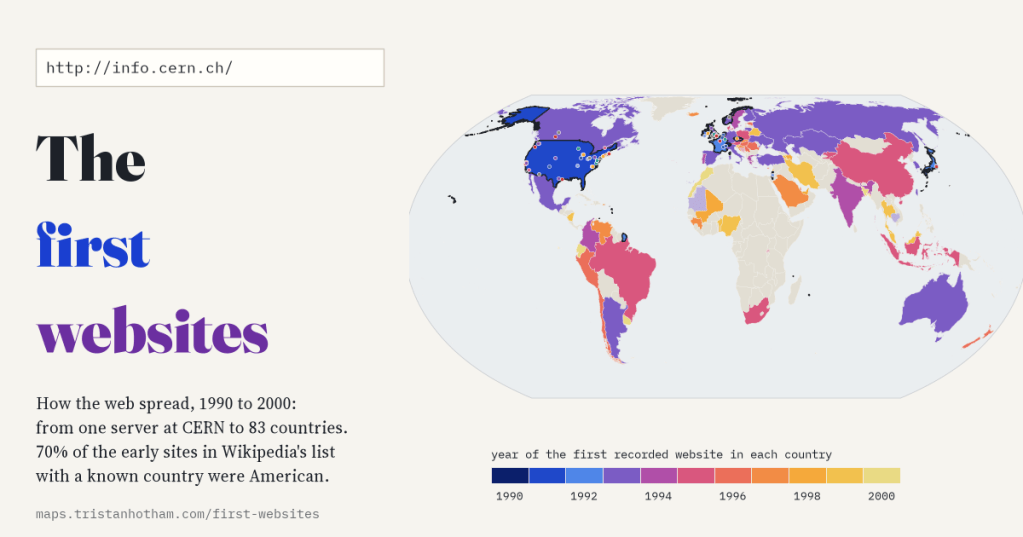
On 20 December 1990 a computer at CERN began serving the world’s first website. I mapped how the web spread from there, using Wikipedia’s list of 119 websites founded before 1995, the founding dates of 2,208 more in Wikidata, and the dates of every country’s internet domain.
The address was info.cern.ch, and the pages described the World Wide Web project itself. Tim Berners-Lee had written the first web server and the first browser at CERN, the European particle physics laboratory, and in January 1991 the first servers outside CERN were switched on. That December, after a visit to CERN, the Stanford Linear Accelerator Center in California launched the first web server outside Europe. By the end of 1993 there were 623 websites in the world. By June 1995 there were some 23,500.
Nobody kept a complete record of those early sites. But Wikipedia keeps a list of the notable ones founded before 1995, and Wikidata records founding dates for thousands more. Neither is a census, and both have quirks I will come to. Put together, though, they show the shape of the web’s first decade.
First the physicists
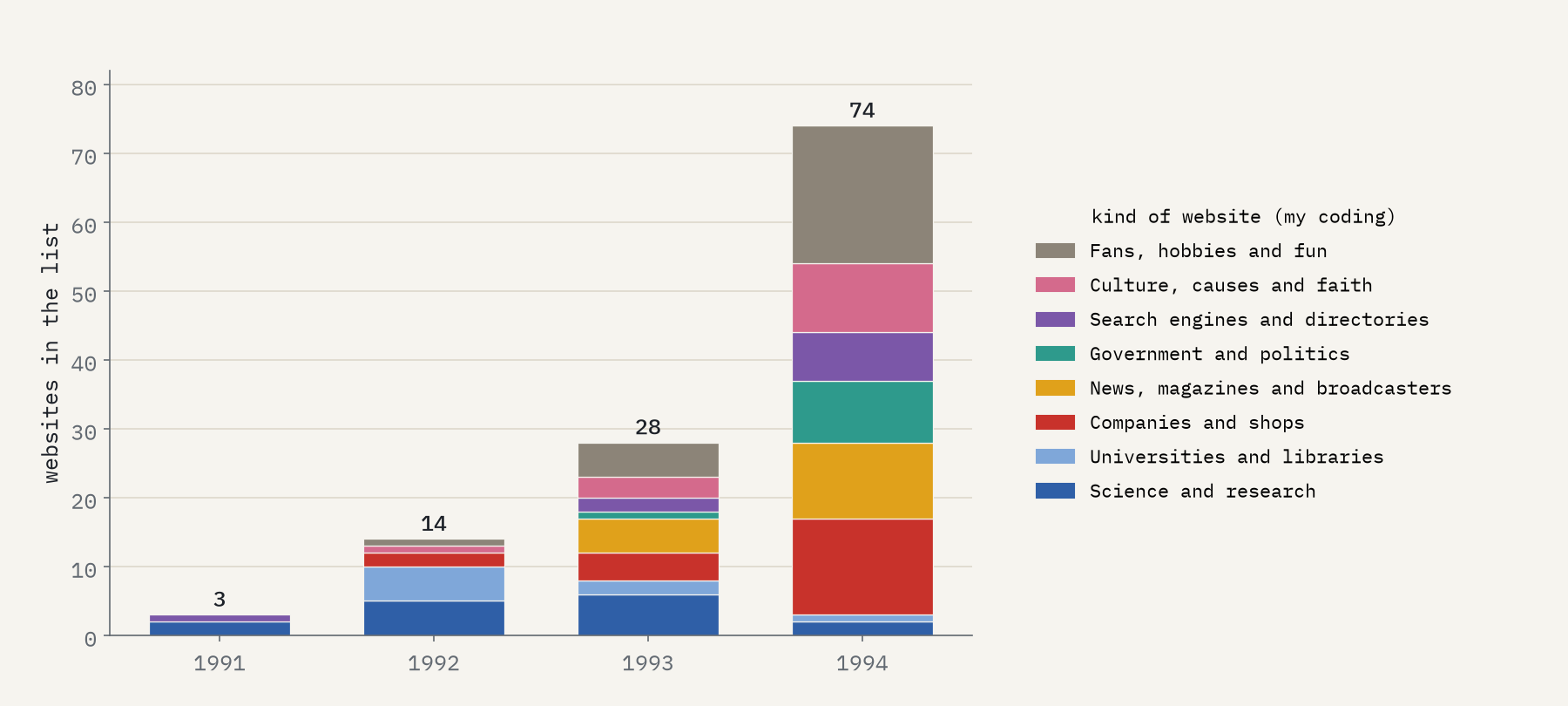
Wikipedia’s “List of websites founded before 1995” turns out not to be a table but a set of short paragraphs, one per website, under a heading for each year. I split it into entries and coded each one: where it was, what kind of site it was, and whether the text says it still exists. It holds 119 websites: 3 from 1991, 14 from 1992, 28 from 1993 and 74 from 1994.
The first two years belong to science. Of the 17 sites from 1991 and 1992, 12 were laboratories, universities or libraries: CERN and SLAC, Fermilab in Illinois, Nikhef in Amsterdam (the third website in the world, by the list’s count), University College Cork (the first in Ireland), the Hebrew University of Jerusalem (the first website written right to left) and KEK, which put up the first web page in Japan in September 1992.
Then everybody else
In April 1993 CERN put the web’s code in the public domain, and the graphical Mosaic browser made it easy to use. By 1994 only 3 of the 74 listed sites belonged to laboratories or universities. The rest were Apple, IBM and Microsoft; the BBC, The Economist and The Irish Times; the White House and HM Treasury; Lycos, WebCrawler and Yahoo!; and, the biggest group in the whole list, sites for fans, hobbies and fun. There was the first webcam (the Trojan Room coffee pot, connected to the web in November 1993), the Internet Movie Database (first hosted at Cardiff University), the Simpsons Archive, and a page that let you attack a drawing of Barney the Dinosaur.
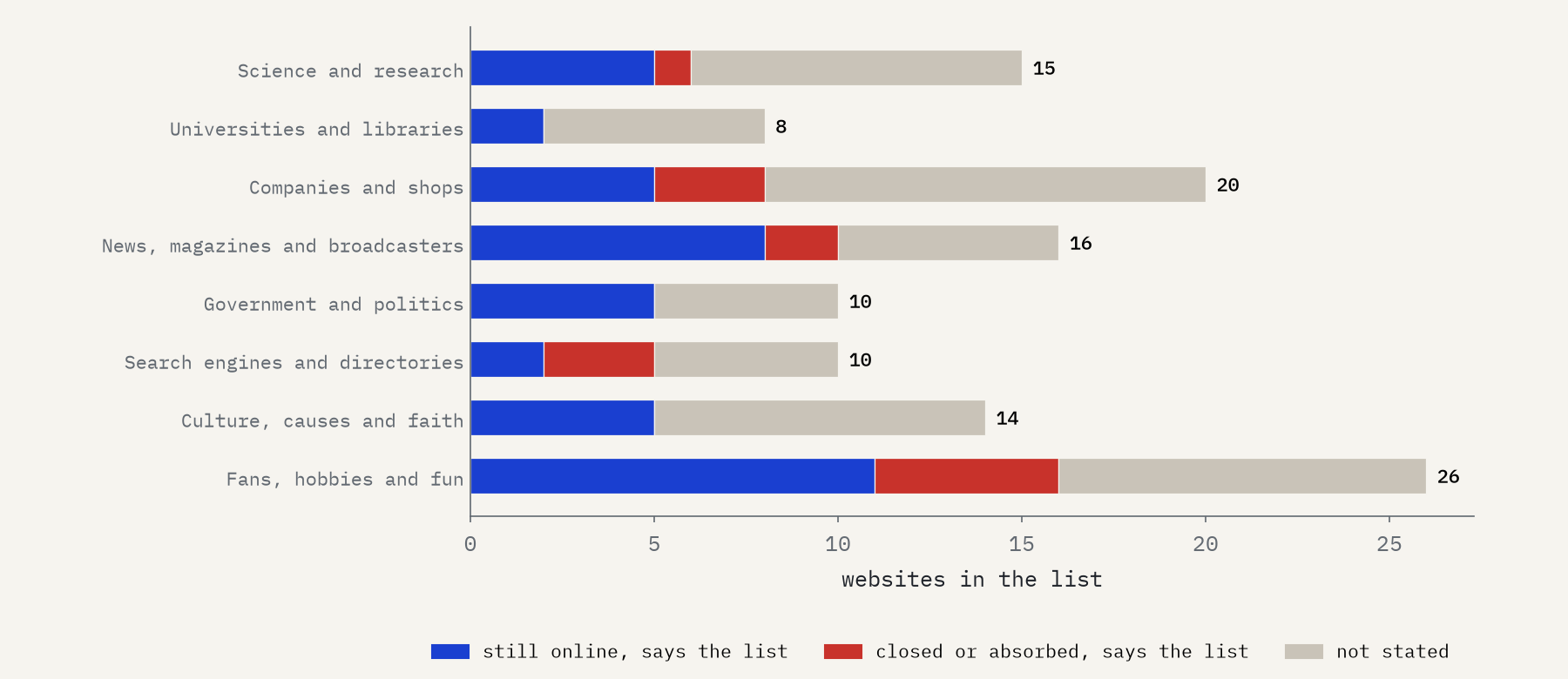
How many survive? The list’s own text says 43 are still online, sometimes at a new address, and 14 have closed or been absorbed. For the other 62 it does not say, so both numbers are floors. The survivors include arXiv, which began at Los Alamos in April 1993, and FogCam in San Francisco, which the list calls the oldest webcam still running.
An American web?
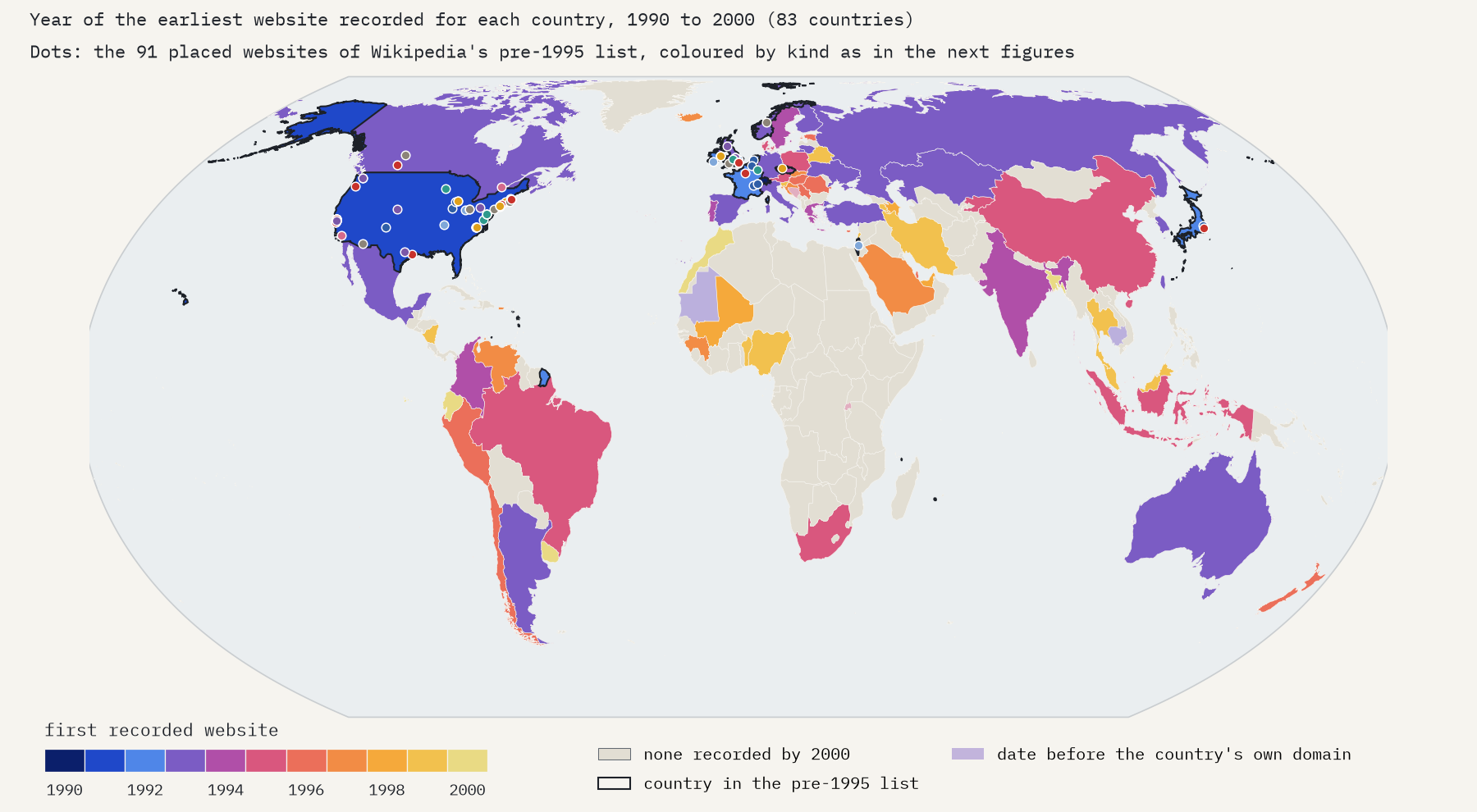
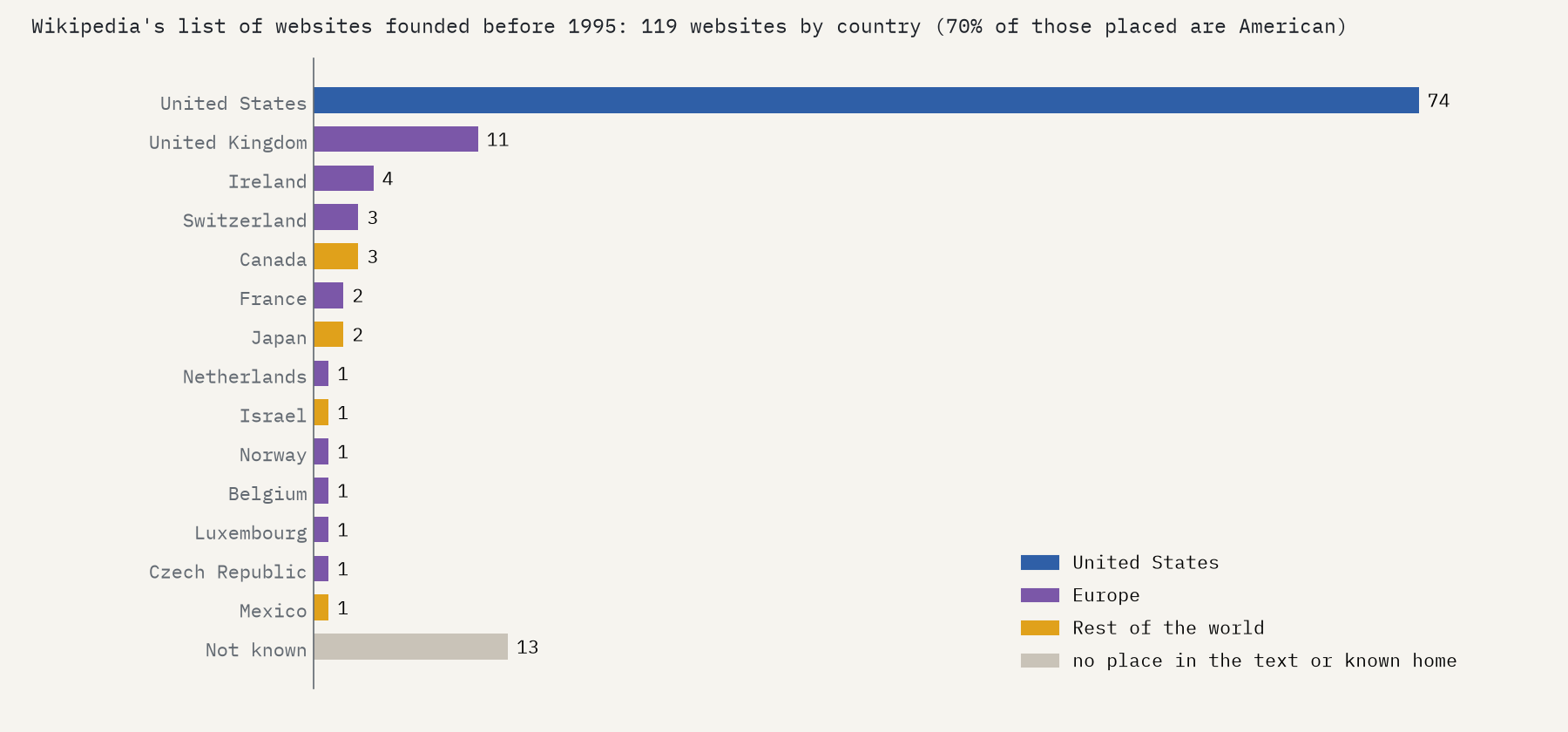
The web was invented in Switzerland, but in the list it is overwhelmingly American. Of the 106 websites I could place, 74 (70%) were in the United States, 25 in Europe and only 7 anywhere else: Canada, Japan, Israel and a site about the Zapatista uprising in Mexico. The United Kingdom had 11 and Ireland 4.
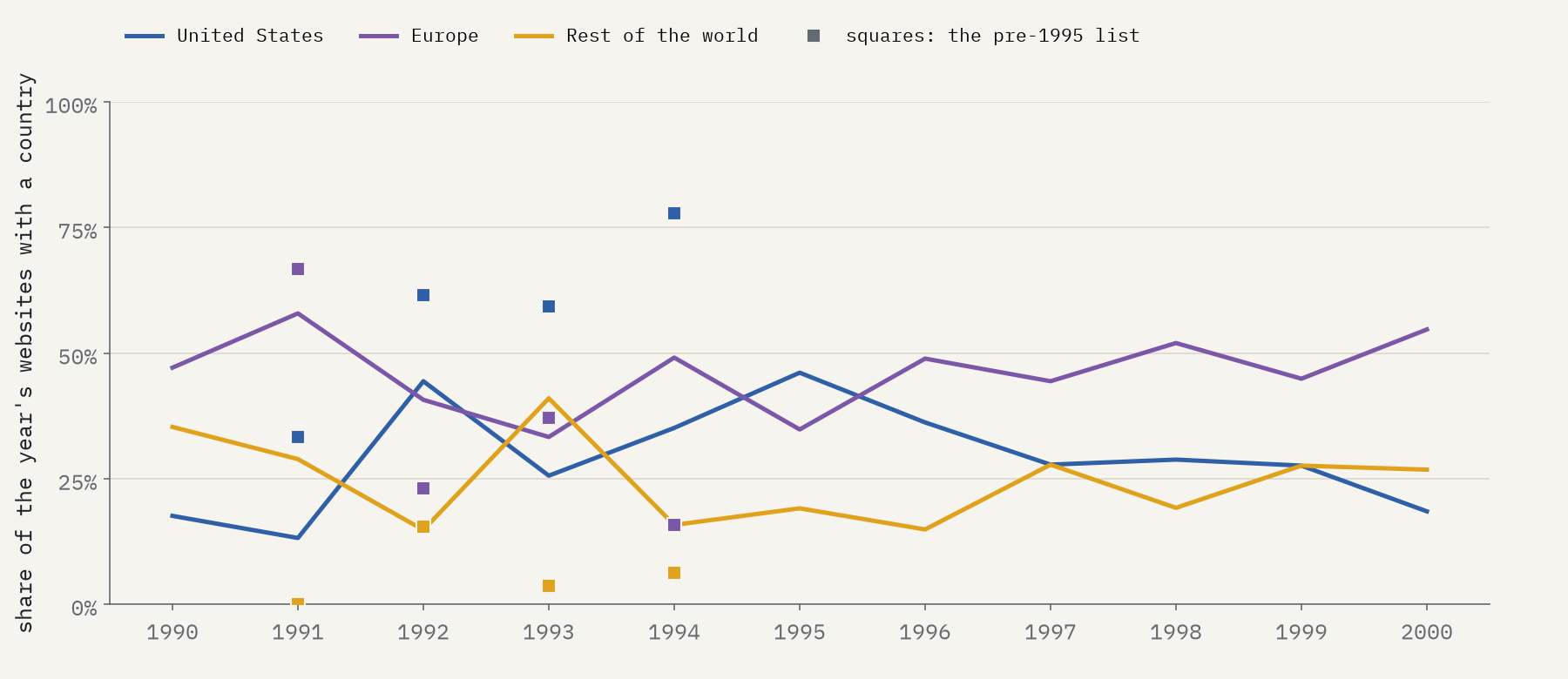
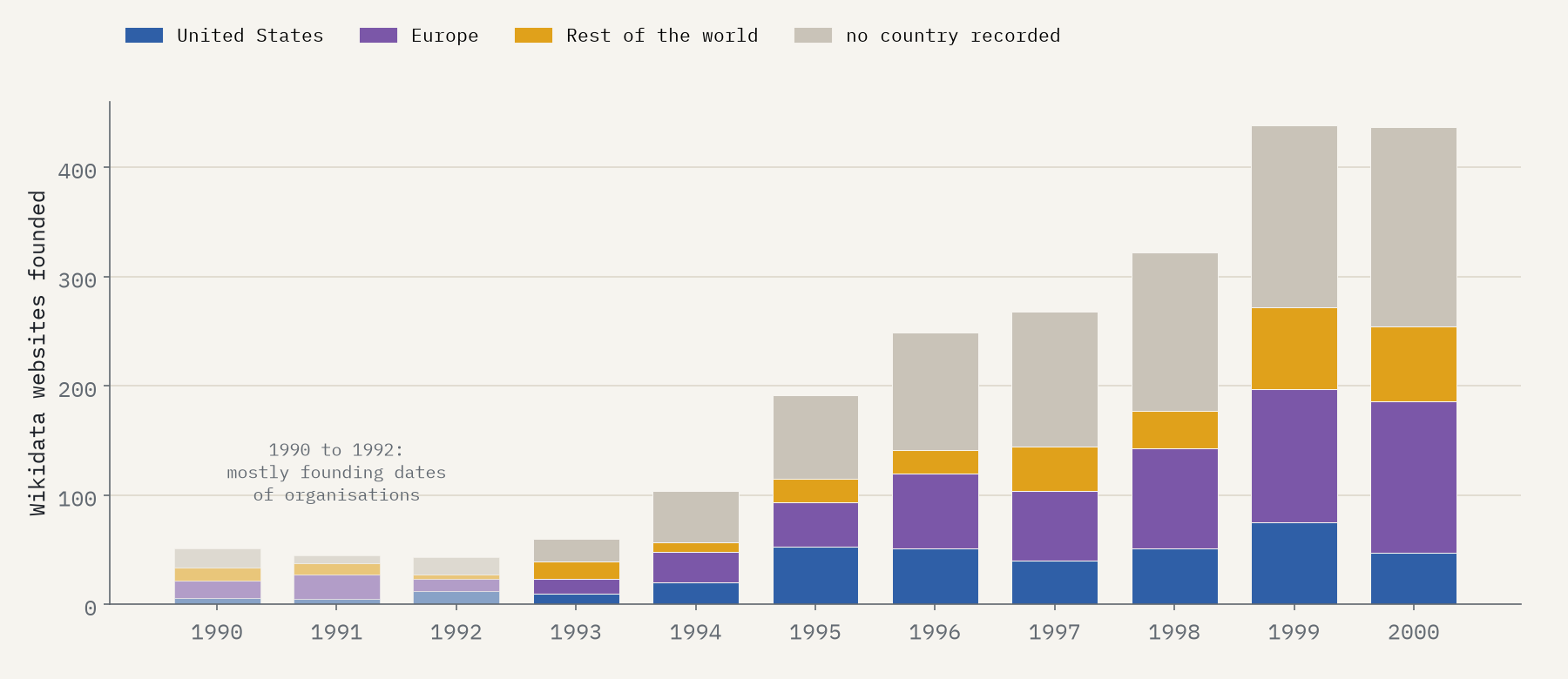
Wikidata tells a different story. Of its 1,298 websites founded from 1990 to 2000 with a known country, only 28% are American and 48% European, with Russia, the United Kingdom, Germany and France next after the United States. Each source has its bias. The list is written in English, largely from memory, and remembers the American web. Wikidata is built by editors everywhere and records far more local newspapers and companies, but 910 of its 2,208 websites have no country at all, and the many American sites on .com are probably among them. The truth is somewhere in between, and the data cannot say exactly where.
Country by country
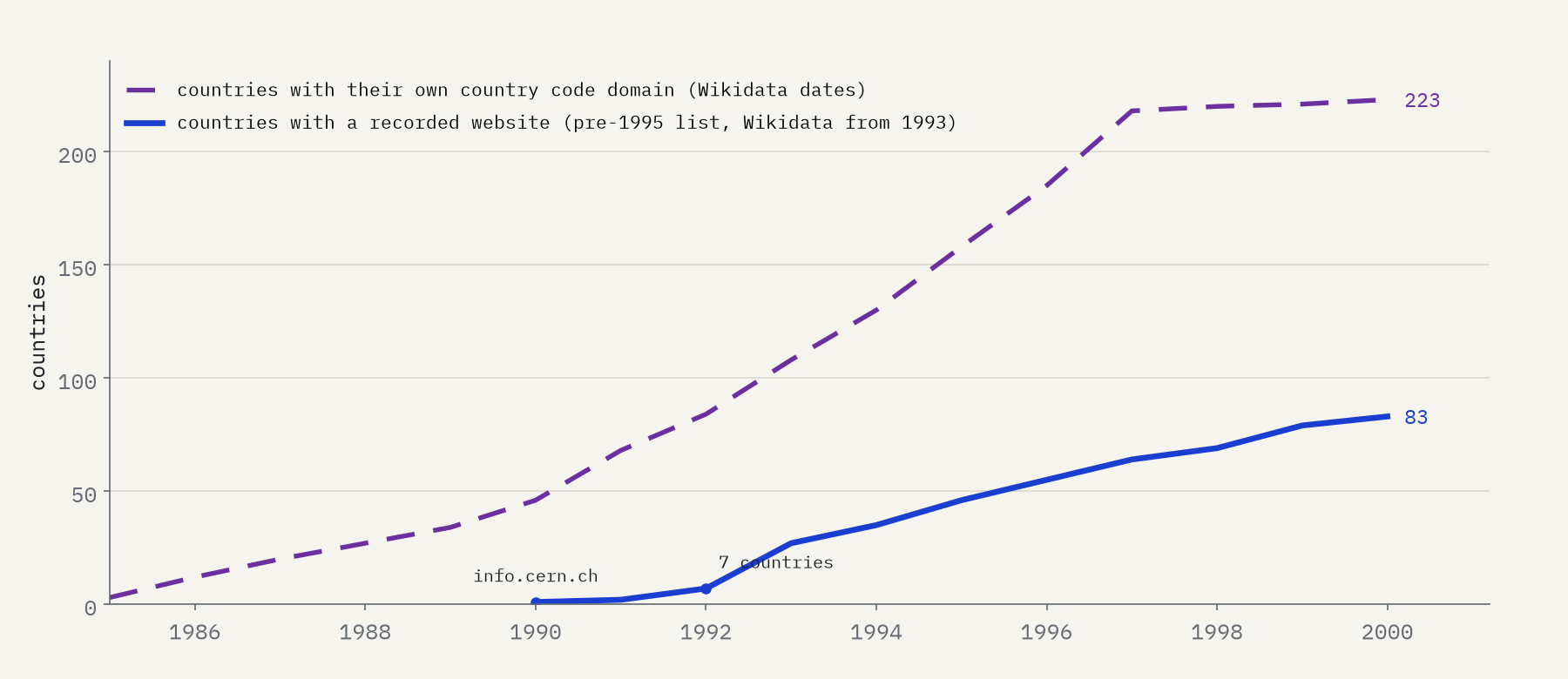
Wikidata’s founding dates need care. It lists 915 “websites” founded before 1990, such as the Buenos Aires Herald, founded as a newspaper in 1876: those are organisations, not web launches, and I leave them out. Even its 1990 to 1992 dates are suspect, because Wikidata has 139 websites founded in those years, more than twice as many as existed in the whole world at the end of 1992. So for the earliest website in each country I use the list, plus Wikidata only from 1993.
By that measure the web reached 7 countries by the end of 1992, 35 by the end of 1994 and 83 by 2000. That is “earliest recorded in these sources”, not the true first: most early websites left no trace, and some countries’ first record is a newspaper whose founding year has been copied onto its website. Country code domains such as .ch and .jp came first, often years earlier: 46 existed by the end of 1990 and 223 by 2000.
How I did this
I split Wikipedia’s list into its entries and coded each by hand from its text: the place where the text names one, otherwise the well-known home of the organisation behind the site; its kind; and its status only where the text states it. From Wikidata I took every item typed as a website with a founding date up to 2000, its country (or the country of its headquarters), and the dates of country code domains. Wikidata dates before 1990 count as the founding of the organisation, not the website. The paper sets out every step and caveat, and the interactive map lets you play the decade year by year and click any site for its address and Wikipedia article.
Notes and sources
- Wikipedia, List of websites founded before 1995, History of the World Wide Web and Country code top-level domain, CC BY-SA 4.0.
- Wikidata: websites and country code top-level domains, CC0.
- Natural Earth country outlines (public domain).
- I wrote the text, with drafting and editing assistance from Claude (Anthropic), which also helped prepare the analysis code. I reviewed and checked all text and results.

