
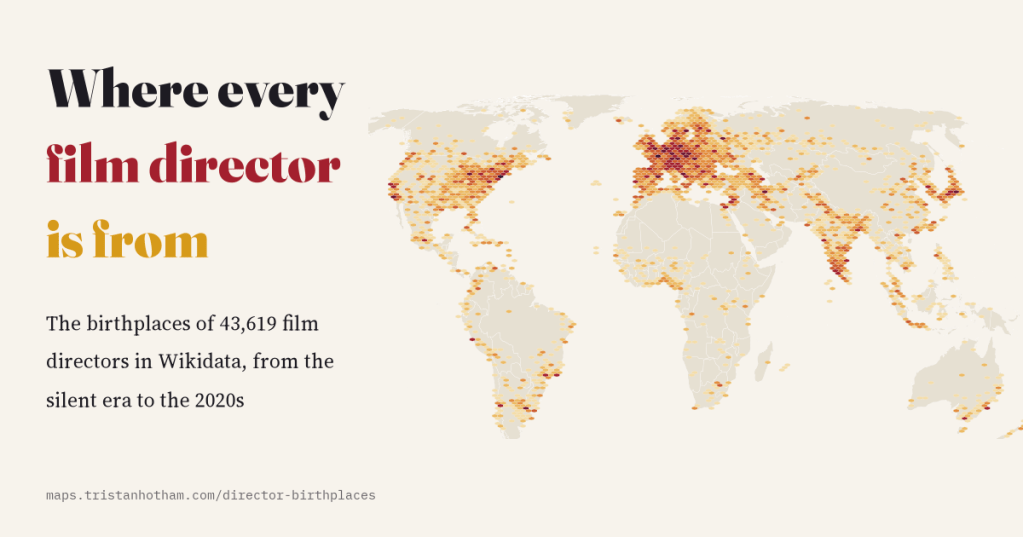
Every film has a director, and every director was born somewhere. I mapped the birthplaces of 43,619 film directors in Wikidata to see which cities made them, how the map has moved since the silent era, who left home to make films, and how long it took for women to appear.
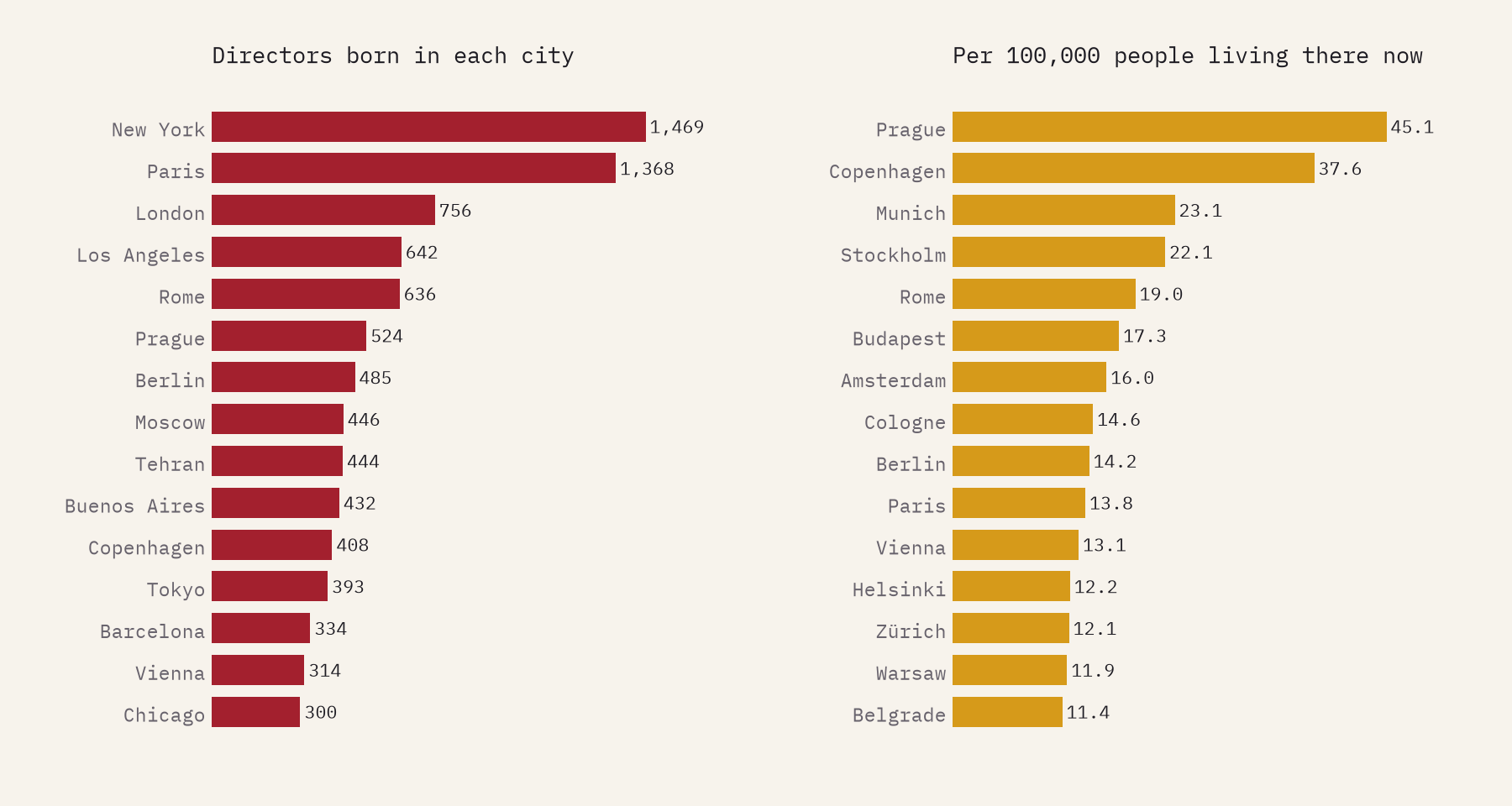
Wikidata, the open database behind Wikipedia, knows 78,729 people who have directed at least one film. Some are household names, most are not: silent-era directors of one-reel comedies, documentary makers, television people who made a single feature, actors and musicians who tried directing once. For 43,619 of them it records where they were born, and for 41,753 that birthplace has coordinates.
So I put them all on one map. The interactive version has a decade slider, a filter for women and for well-known directors, a search box, and lines showing who made their films in another country. Click any hexagon and you get the directors born there, best known first.
A city of directors
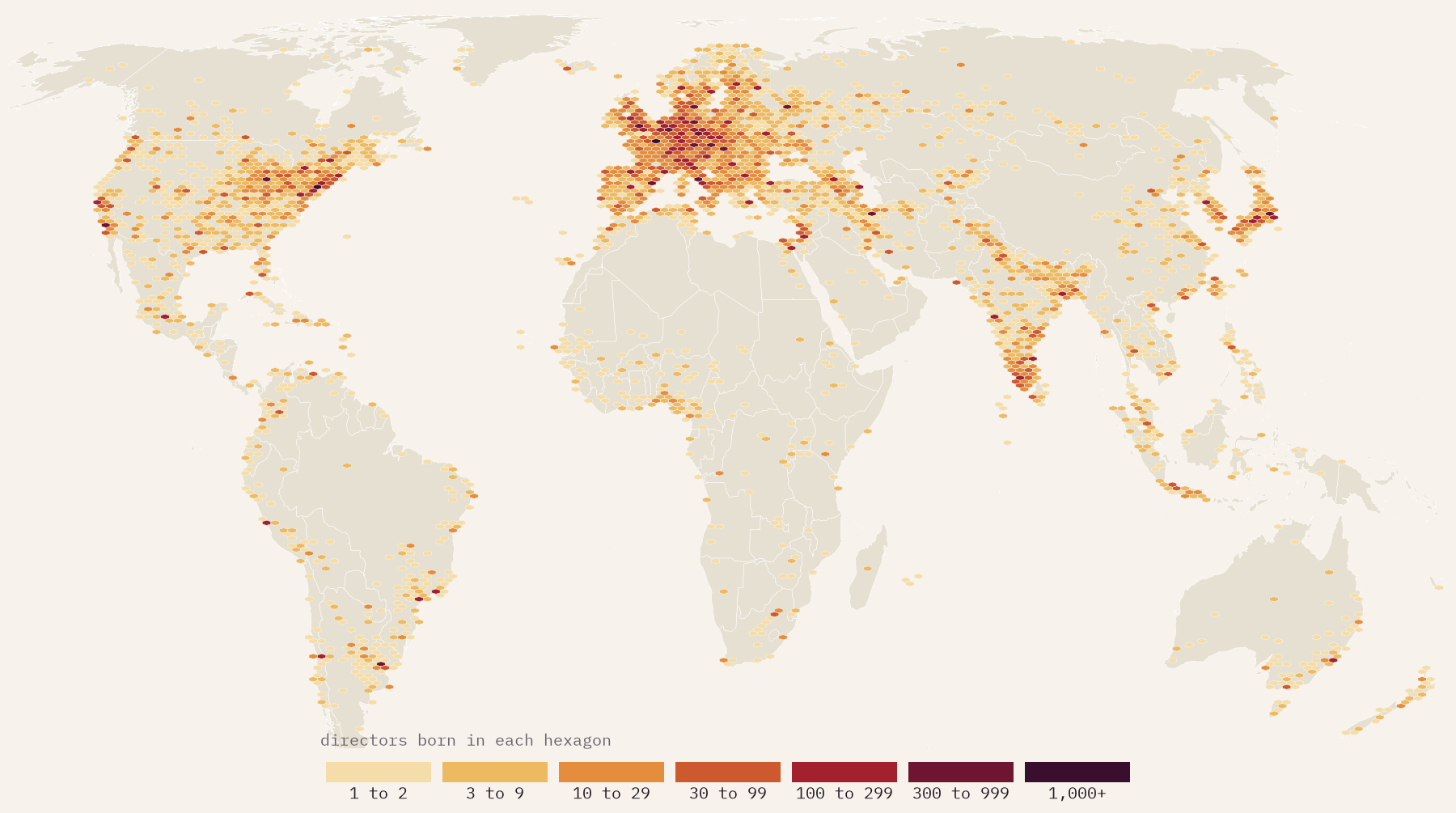
Wikidata often records a district rather than a city: Brooklyn, a Paris arrondissement, Neuilly-sur-Seine. So I grouped every birthplace within 30 km of a big city. New York comes first, with 1,469 directors, then Paris (1,368), London (756), Los Angeles (642) and Rome (636). Tehran (444) is the first city outside Europe and the Americas, ahead of Tokyo.
Per head, the list turns over. Prague has 45.1 directors in Wikidata for every 100,000 people living there now, and Copenhagen 37.6. Tokyo has 1.1 and Mumbai 1.1. That is partly history, because a director born in 1930 was born in a much smaller city, and partly the record: some countries’ film archives have been copied into Wikidata much more thoroughly than others.
From Europe and America towards Asia
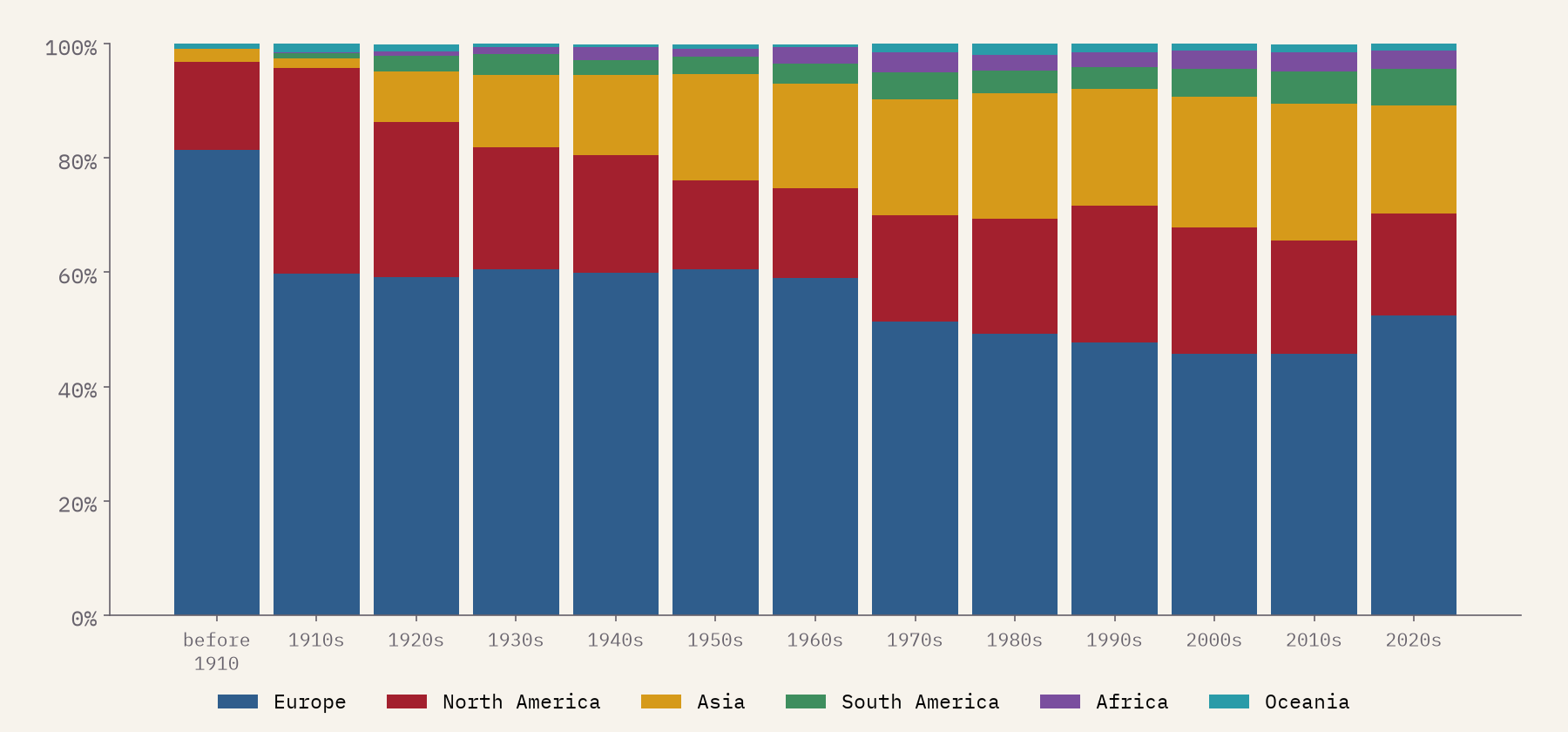
The United States is the birthplace of 7,243 directors, about one in six of those with a birth country, followed by Germany, France, Italy and India. But the map moves if you sort directors by the decade of their first film. Of those who debuted by the 1950s, 83% were born in Europe or North America and 12% in Asia. Since 2000, the figures are 67% and 23%. India’s share doubles, and South Korea and Iran, almost absent in the early decades, each now account for about 1.9% of new directors.
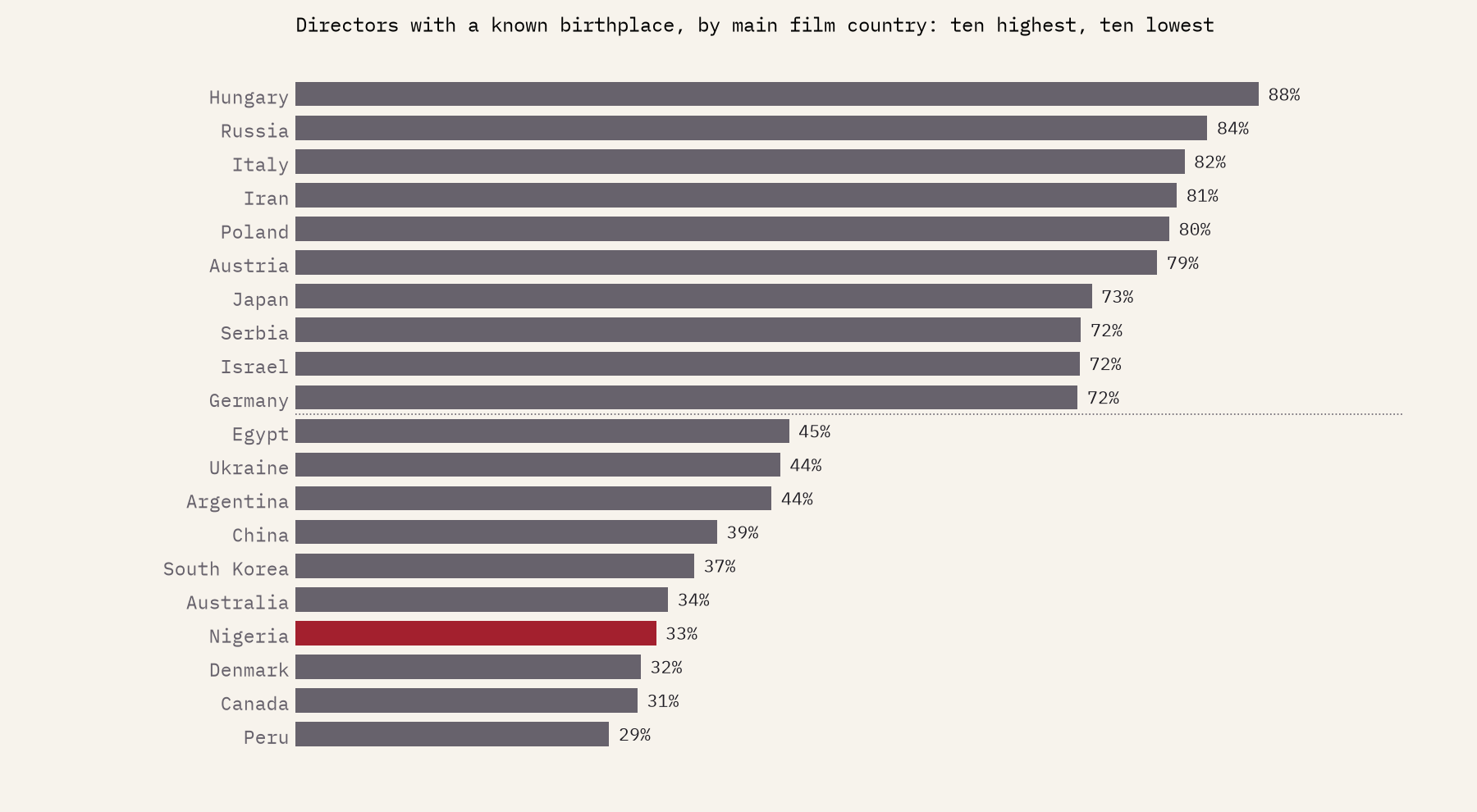
One industry is missing from that story. Nollywood makes more films than almost anyone, yet Wikidata has a birthplace for only 33% of the 372 directors whose films are mainly Nigerian, so Nigeria barely appears on the map. Its directors are there in the films, just not in the biographies.
Born here, made films there
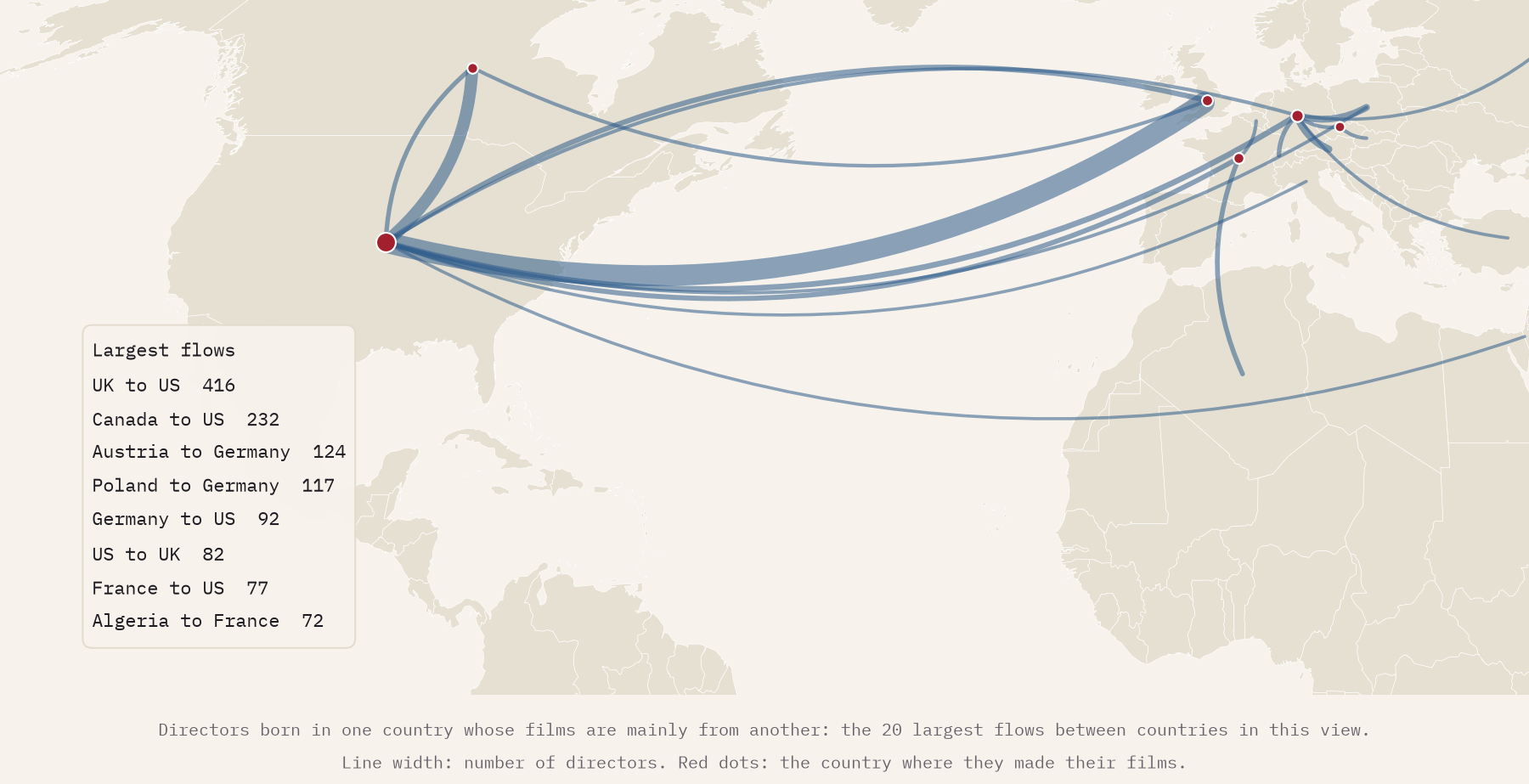
For each director I took the country that produced most of their films and compared it with where they were born. 15%, about one in seven, made their films mainly in another country, and that share has hardly changed in a hundred years. The biggest flow is from the United Kingdom to the United States (416 directors, from Charlie Chaplin to Ridley Scott), then Canada to the United States (232), and Austria and Poland to Germany. Of directors whose films are mainly American, 20% were born abroad, and 24% of those who debuted in the 1930s, when Hollywood was full of directors from Berlin, Vienna and Budapest.
Where the women went
The first film director in this data who was a woman is also one of the first directors of all: Alice Guy-Blaché, who made her first film in Paris in the 1890s. Lois Weber, Mabel Normand and Gene Gauntier directed in America in the 1910s, Anna Hoffman-Uddgren in Sweden and Luise Fleck in Vienna. Then the door closed. Women were 3.1% of directors who debuted in the 1920s, and stayed below 5% in every decade until the 1970s. Since then the share has climbed: 24% in the 2010s and 32% in the 2020s so far.
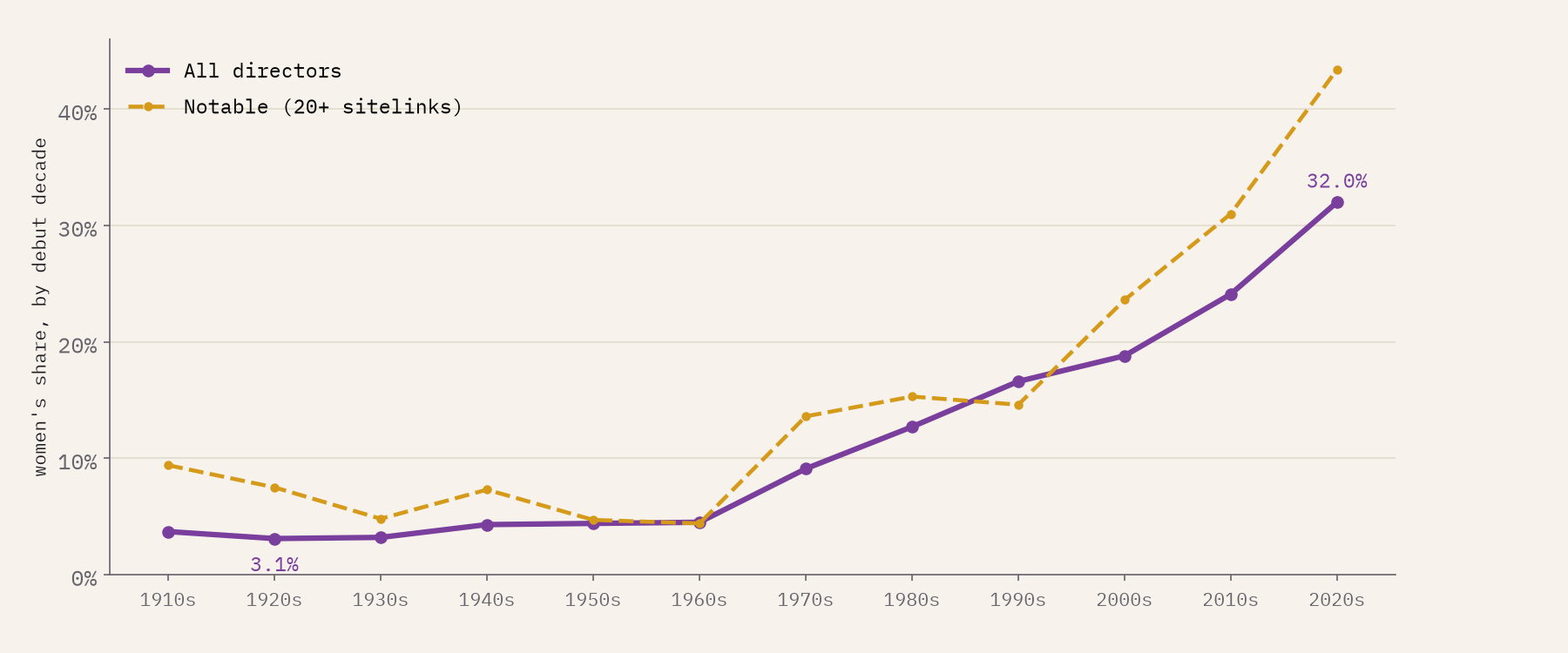
Women were 3.1% of directors who debuted in the 1920s. In the 2020s they are 32%.
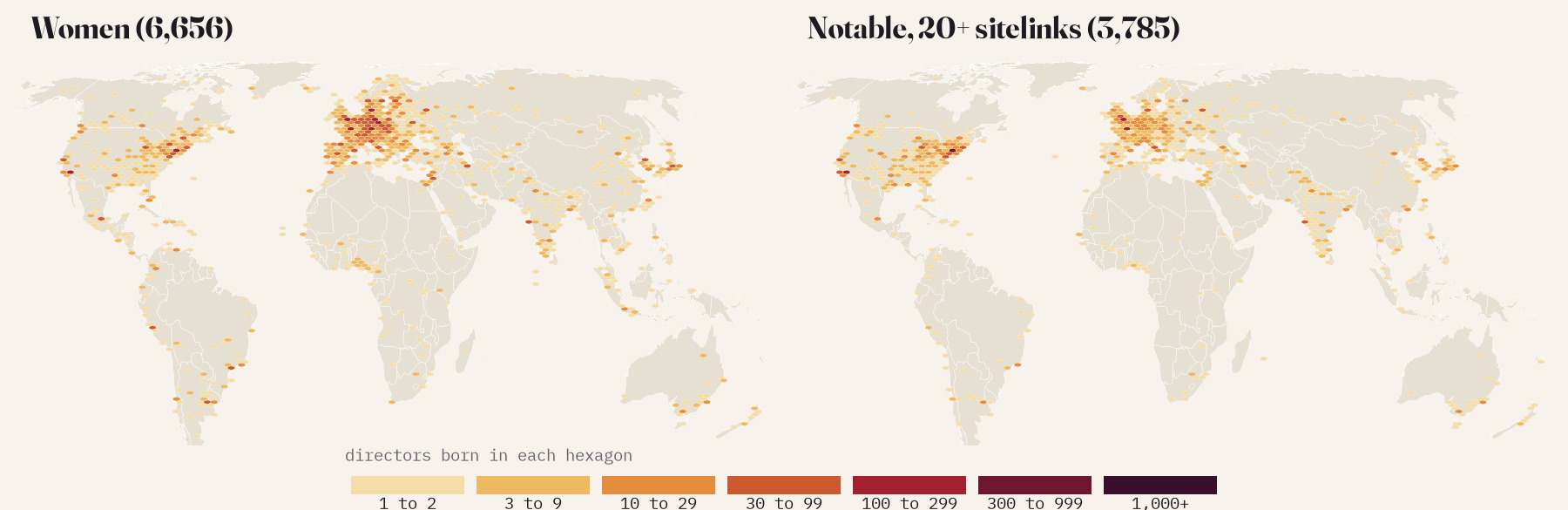
Women’s birthplaces follow the same broad map as men’s, and so do the birthplaces of the best-known directors, those with 20 or more Wikipedia and other Wikimedia pages, except that fame is even more American: the United States is the birthplace of 38% of notable directors, more than twice its share of all.
A map of who keeps records
All of this rests on what Wikidata happens to know. Almost every notable director has a birthplace (99.5%), but only 25% of those with one sitelink or none. Directors whose films are mainly Russian, Italian or Iranian usually have one; Canadian, Danish or Nigerian directors usually do not. So the map is best read as the open record of film, rich where archives have been copied in and thin where they have not.
How I did this
Two queries to Wikidata through the QLever service gave every person who directed an item classed as a film, with their birthplace, birth date, gender and number of sitelinks, and every film credit with its release date and countries of origin. I placed each birthplace in its present-day country with Natural Earth outlines, grouped birthplaces within 30 km of cities of a million or more, took each director’s first dated film as their debut, and took the country of most of their films as their country of work, treating the Soviet Union, Yugoslavia and other former states as covering all their successors. Everything is in the paper, with the code and data on GitHub.
The usual caveats apply, and here they matter a lot. Wikidata is not a census of film-makers. It includes actors and musicians who directed one film, it records gender for 90% of directors and mostly as a binary, and its coverage depends on which national film databases have been imported. Country of birth uses today’s borders, so a director born in Lviv in 1900 counts as Ukrainian.
Notes and sources
- Wikidata, via QLever (qlever.cs.uni-freiburg.de), retrieved 2026. CC0.
- Natural Earth countries and populated places, with population estimates. Public domain.
- Paper: Hotham, T. (2026) Where every film director is from: the birthplaces of 43,619 film directors in Wikidata. Zenodo. https://doi.org/10.5281/zenodo.23847840
- I wrote the text, with drafting and editing assistance from Claude (Anthropic), which also helped prepare the analysis code. I reviewed and checked all text and results.

