
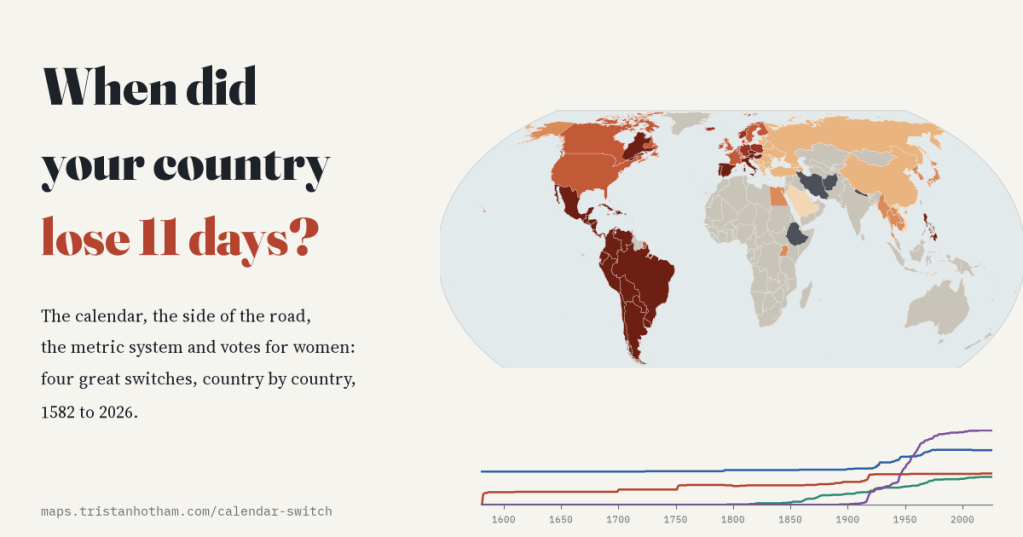
In September 1752 Britain went to bed on Wednesday the 2nd and woke on Thursday the 14th. I mapped when every country the sources date made that jump, and three other great switches: the side of the road, the metric system and votes for women.
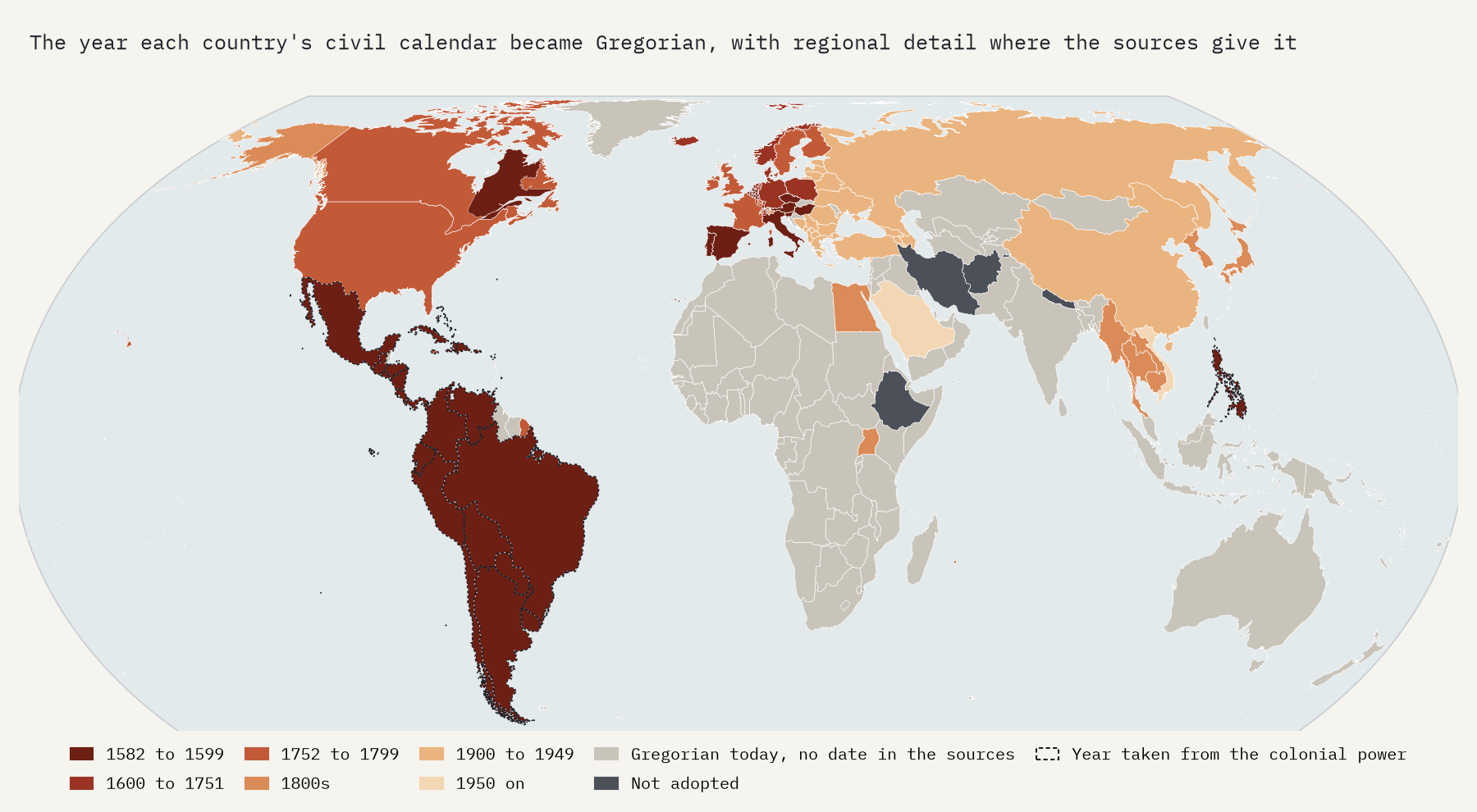
Ask when your country lost eleven days and the answer tells you a surprising amount about its history. Catholic Spain, Portugal, Italy and Poland made the jump first, when Thursday 4 October 1582 was followed by Friday 15 October. Protestant Britain held out for 170 years, partly because nobody wanted a calendar from the Pope. Orthodox Russia waited until 1918, Greece until 1923. Saudi Arabia moved its public sector pay to the Gregorian calendar only in 2016.
I built the map from the tables in English Wikipedia’s articles on the calendar, driving side, metrication and votes for women (for the calendar, a list of 146 historic areas from Carinthia to Kovno, each with its last old and first new day), read cell by cell and matched to today’s 197 countries, with provinces and cantons where the sources go that far.
Ten, eleven, twelve or thirteen days
The Julian calendar has a leap day every fourth year, which makes it about eleven minutes a year too long. By 1582 that had added up to ten days, and every century the switch was put off cost another day, because the old calendar kept leap days in 1700, 1800 and 1900 that the new one dropped. So parts of 45 of today’s countries dropped ten dates, parts of 19 dropped eleven, including Britain and its American colonies, and 19 in the Orthodox east and the Caucasus dropped thirteen. Only two dropped twelve: Switzerland, whose last communes, Schiers and Grüsch, went straight from 25 December 1811 to 7 January 1812, and Uganda, which switched under British rule in January 1894. Denmark and Norway, switching on 1 March 1700, lost eleven, because the old calendar’s 29 February 1700 went too.
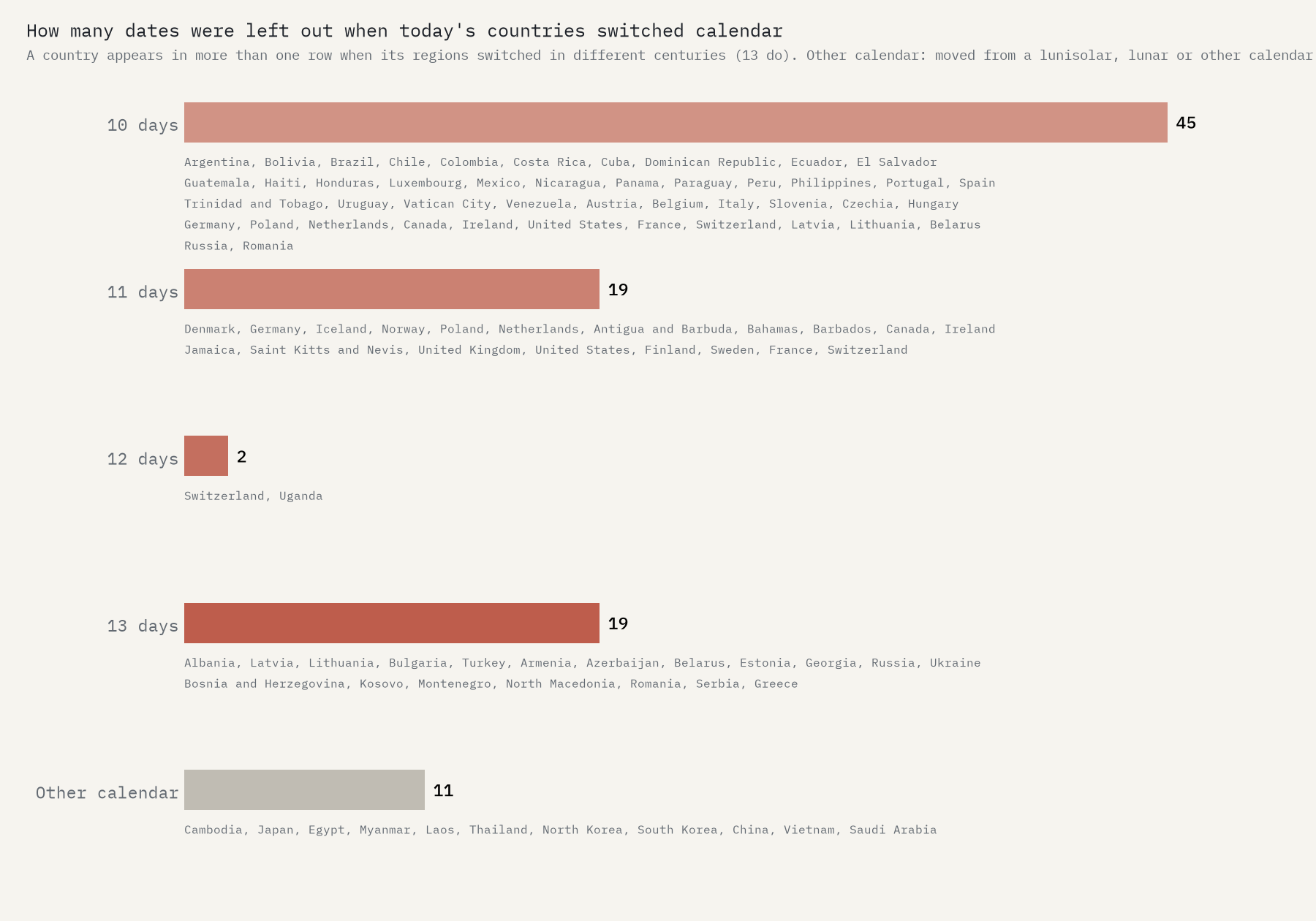
Sweden’s switch is my favourite. In 1700 it decided to skip eleven leap days one at a time over forty years. It skipped the first, forgot the next two, gave up, and returned to the Julian calendar by inserting a 30 February in 1712, the only one there has ever been. It finally jumped in 1753. It was not alone in going back: the list records 8 returns to the old calendar, from the city of Groningen in 1594 to Lorraine in 1735 and the Lithuanian lands under Russia in 1800. And France dropped the Gregorian calendar entirely for its Republican calendar from 1793 to 1805.
Britain’s Act never mentions the Pope, and the famous riots demanding “give us our eleven days” are very likely a myth.
The slow drift to the right
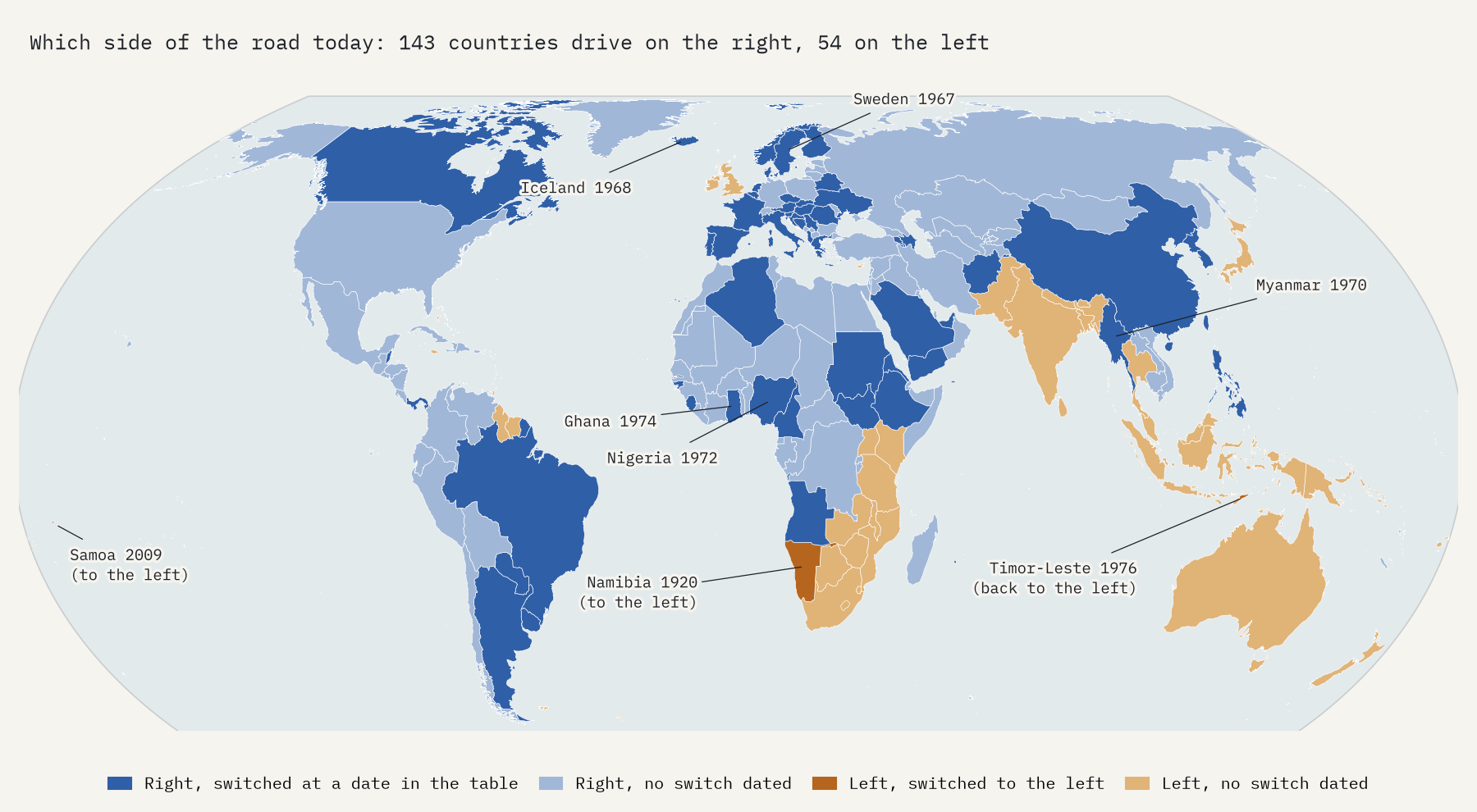
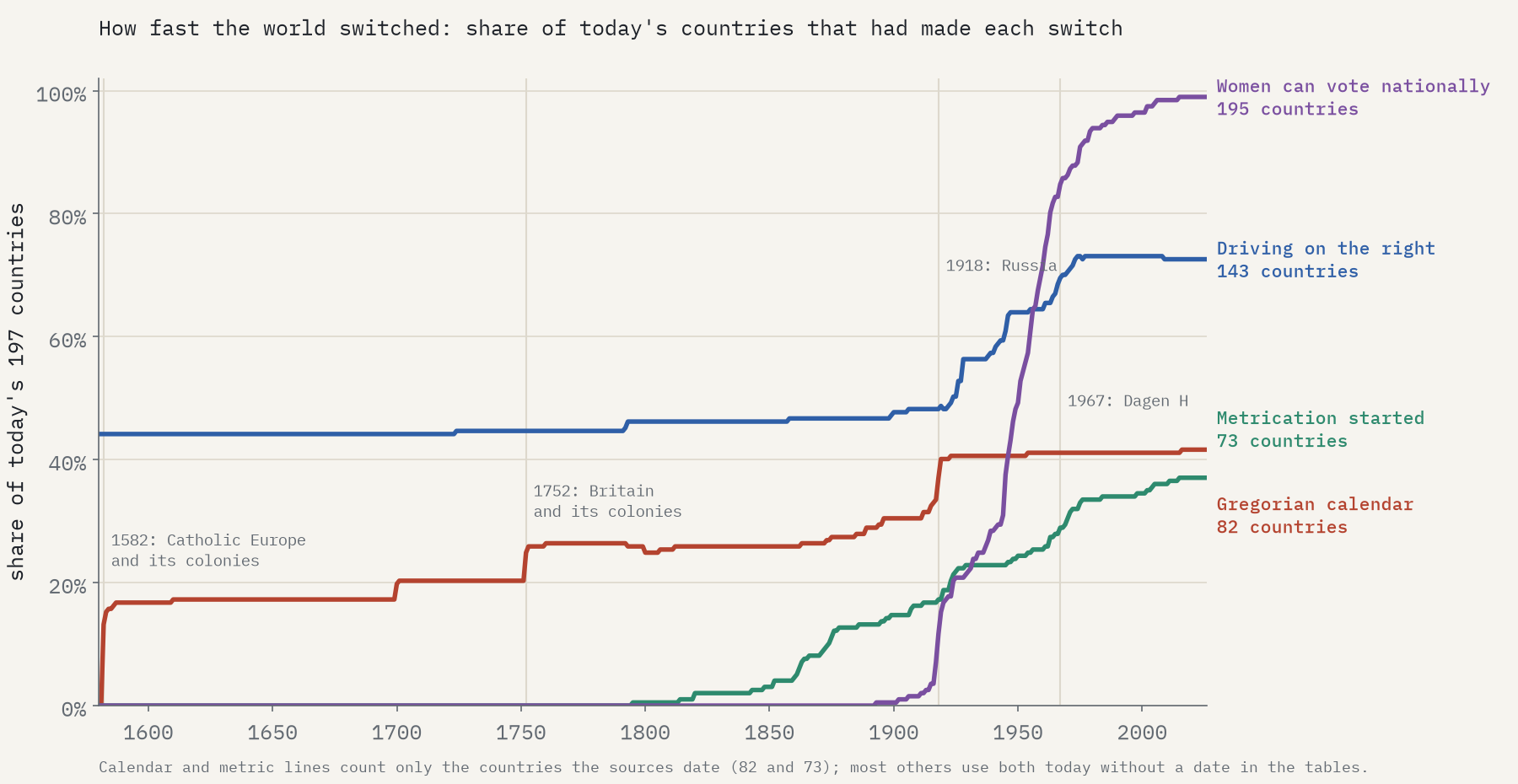
The driving table records 62 of today’s countries changing side at a known date. All but 3 went from left to right. The 1920s were the busiest decade, as the countries carved out of Austria-Hungary, and Italy, Spain and Portugal, all moved right. Then in the 1960s and 1970s Britain’s former colonies in West Africa joined their French speaking neighbours: Gambia in 1965, Sierra Leone in 1971, Nigeria in 1972, Ghana in 1974.
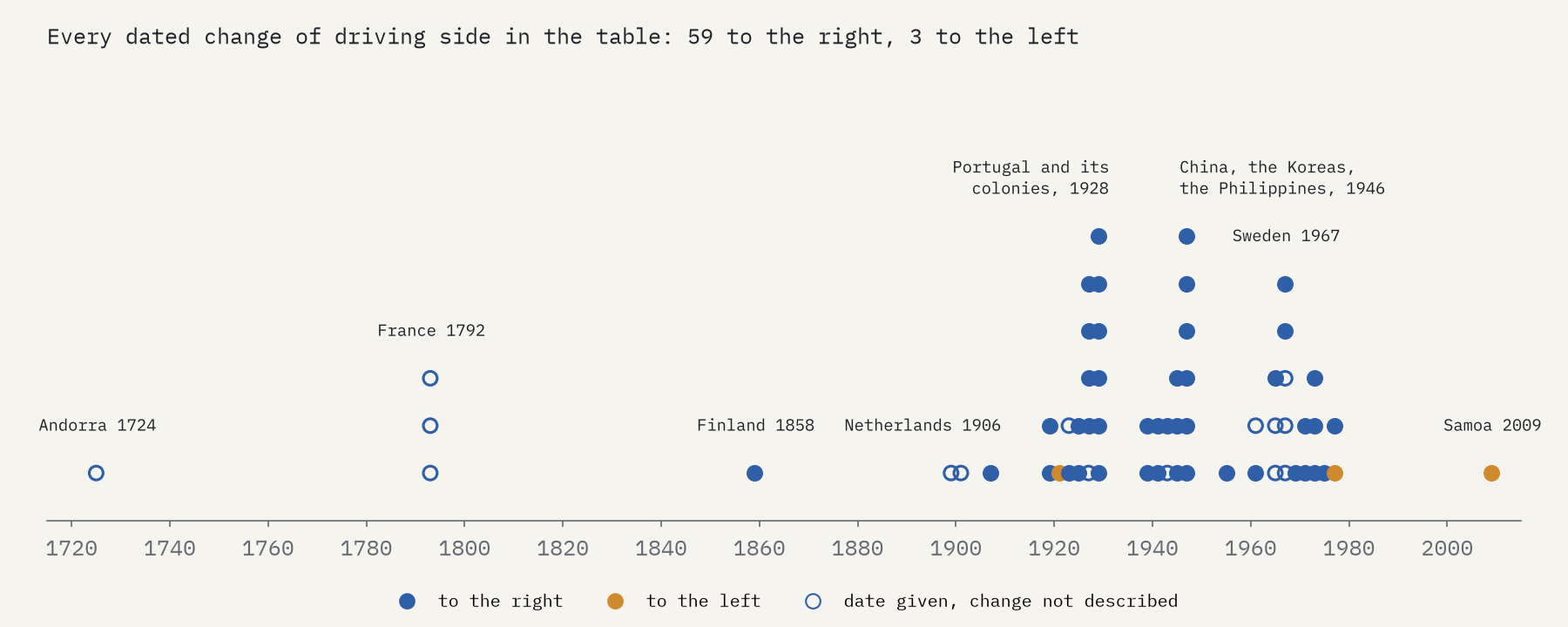
The most famous is Sweden’s Dagen H. In a 1955 referendum 83% voted to keep left, but on Sunday 3 September 1967 the whole country stopped at 04:50, changed sides and set off again at 05:00. Only Namibia, Timor-Leste and Samoa went the other way; Samoa switched to the left in 2009 so it could import cheaper cars from Australia, New Zealand and Japan. Today 54 countries, with 36% of the world’s people, still drive on the left.
Going metric, mostly
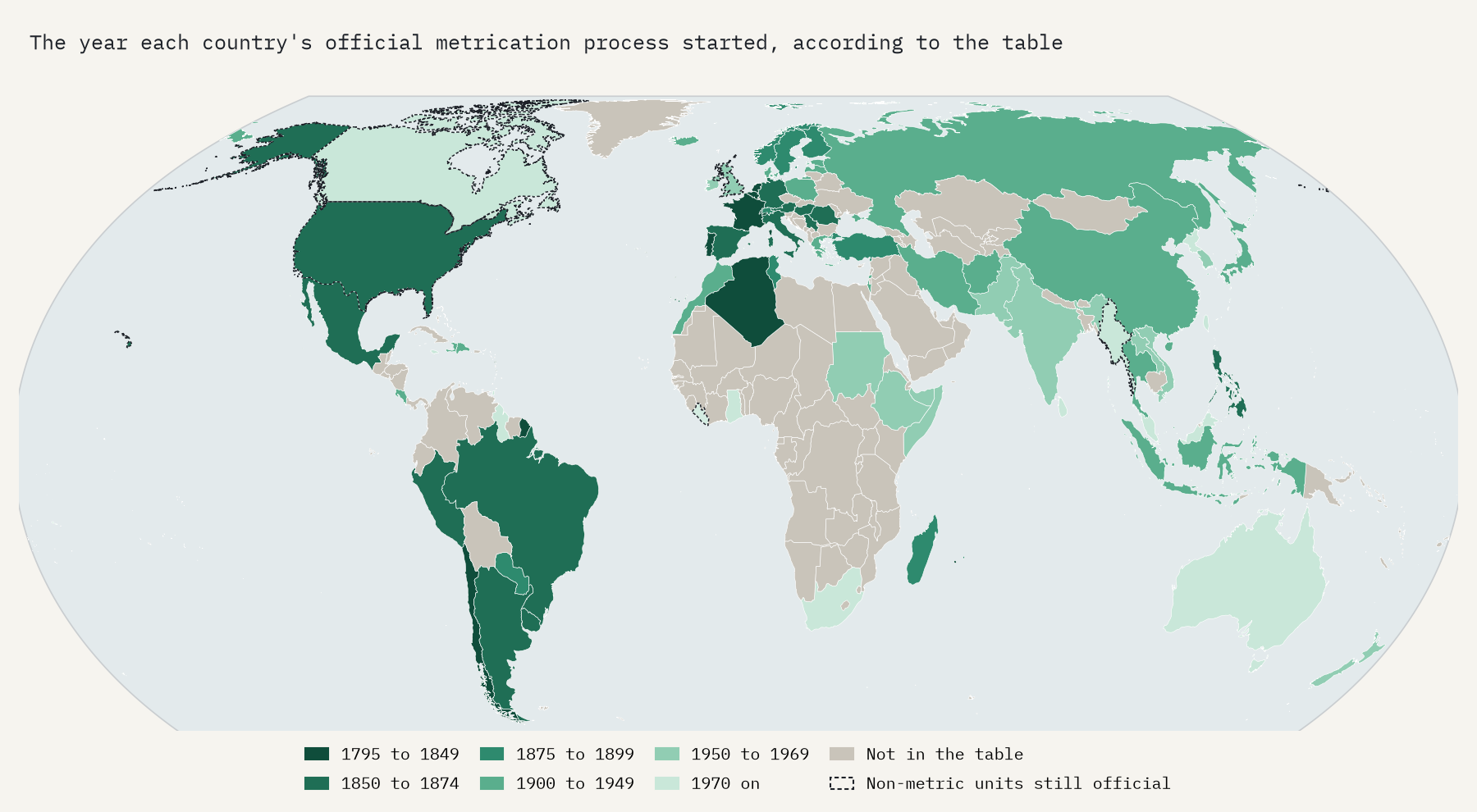
Revolutionary France started metrication in 1795. Portugal followed in 1814, the Low Countries in 1820, most of Latin America by the 1860s, the new German Empire in 1872. In the table the median country started in 1920, and the latest was Samoa in 2015. Starting is not finishing: the United States made metric units legal in 1866 and never made them compulsory, and the United Kingdom began in 1965, gave up compulsion in 1979, and still sells beer by the pint and signs roads in miles.
Votes for women
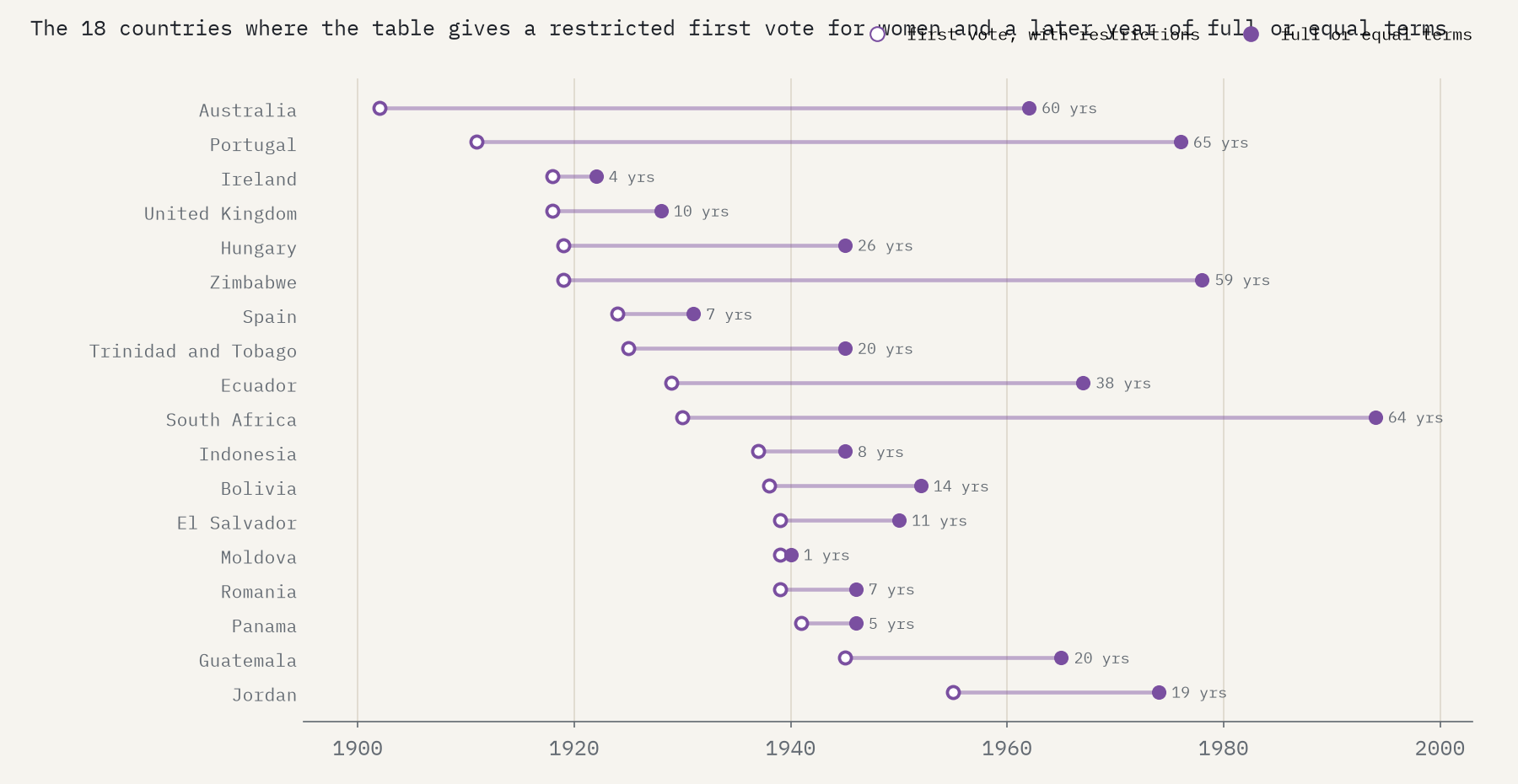
New Zealand was first, in 1893. By 1918 women could vote in 23 of today’s countries, and the biggest wave came in the 1940s and 1950s, with the end of the Second World War and independence from empire. For 18 countries the table gives two years: a restricted first vote and a later one on equal terms. British women over 30 with property voted from 1918, but on the same terms as men only from 1928; South African white women from 1930, all women from 1994.
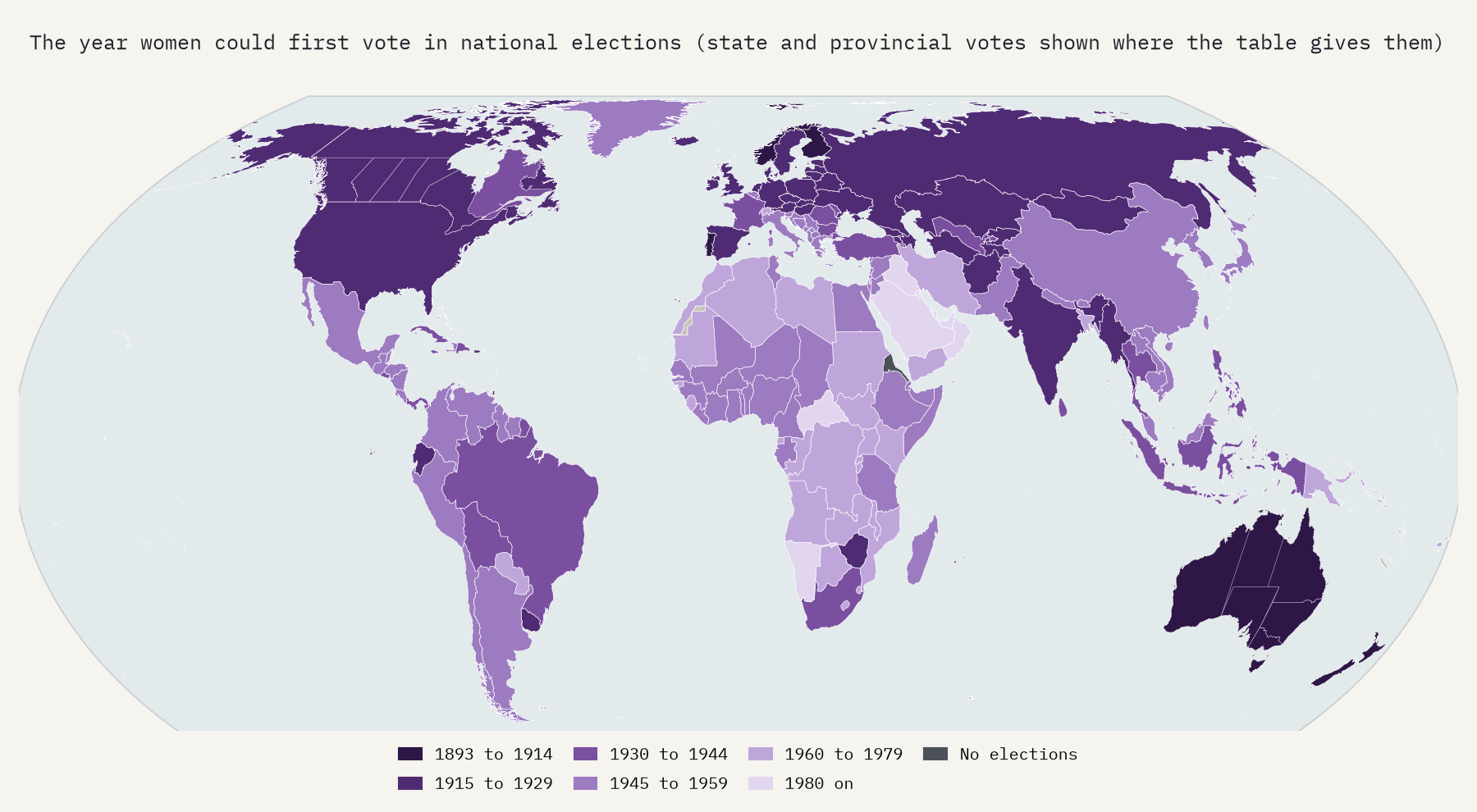
The stragglers were small democracies and Gulf monarchies: Liechtenstein in 1984, Qatar in 1997, Kuwait in 2005, and Saudi Arabia in December 2015, where women first voted in municipal elections; there are no national ones. Switzerland’s federal vote came in 1971, and the canton of Appenzell Innerrhoden held out until 1990.
How the world caught up
Put the four switches side by side and each has its own rhythm: the calendar in great religious blocs, driving and metrication in waves of empire and neighbourliness, votes for women in two great rushes after the world wars. The United Kingdom turns up as a straggler in three of them.
How I did this
Everything comes from 19 English Wikipedia articles, saved in 2026 with their revision numbers. I read each table cell by cell and matched every row to one of today’s countries, drawing old states with the modern country that covers most of them, and saying so on the map. For the calendar the main source is the list of adoption dates by country, checked against two other tables and the prose of the main article; I note 19 places where they differ, mostly finer regional detail in the list. A country’s year is when the whole of today’s country had switched, so France counts from 1760, when Lorraine followed. The 1582 rows cover Spain, Portugal and France “and colonies thereof”, so I date 27 former colonies in the Americas and the Philippines by the power that then ruled them. Even so, 111 countries, including most of Africa and South Asia, have no date, though they use the Gregorian calendar today. For driving, where the table gives no date, I assume today’s side throughout. The metric year is when the process started, not when it finished. For votes, where the table gives a restricted year and a full year, I keep both. The paper sets out every decision.
Notes and sources
- English Wikipedia: List of adoption dates of the Gregorian calendar by country, Adoption of the Gregorian calendar, Gregorian calendar, Julian calendar, Calendar (New Style) Act 1750, Left- and right-hand traffic, Dagen H, Metrication and Women’s suffrage, among others, revisions of 2026, CC BY-SA 4.0. The tables derived from them are shared under the same licence.
- Natural Earth country and province outlines (public domain).
- I wrote the text, with drafting and editing assistance from Claude (Anthropic), which also helped prepare the analysis code. I reviewed and checked all text and results.

