
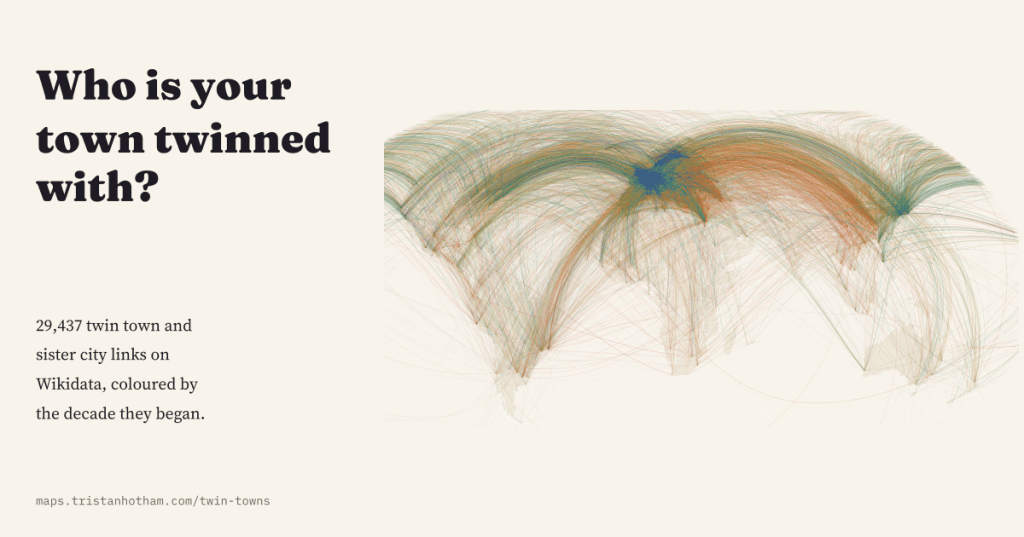
I drew every twin town and sister city link on Wikidata, 29,437 of them, as arcs on one map. The web shows a continent making peace after 1945, quiet links across the Iron Curtain, a rush when the Wall fell, Japan and China reaching out, and the links cut after 2022.
Drive into almost any town in Europe and a sign at the edge tells you its twins. Coventry, Cheltenham, Keighley: each has a small list of places abroad it has promised friendship to, usually signed decades ago by a mayor nobody now remembers. Most of us could not name our own town’s twins. But add them all up and you get one of the densest webs of everyday international contact in the world.
Wikidata, the open database behind Wikipedia, records twinnings with a single property, “twinned administrative body”. I took every one of its 55,634 statements, merged the two directions of each link, and ended up with 29,437 pairs between 19,976 places in 208 countries and territories. About a third of them, 10,292, also say when the link began.
The web
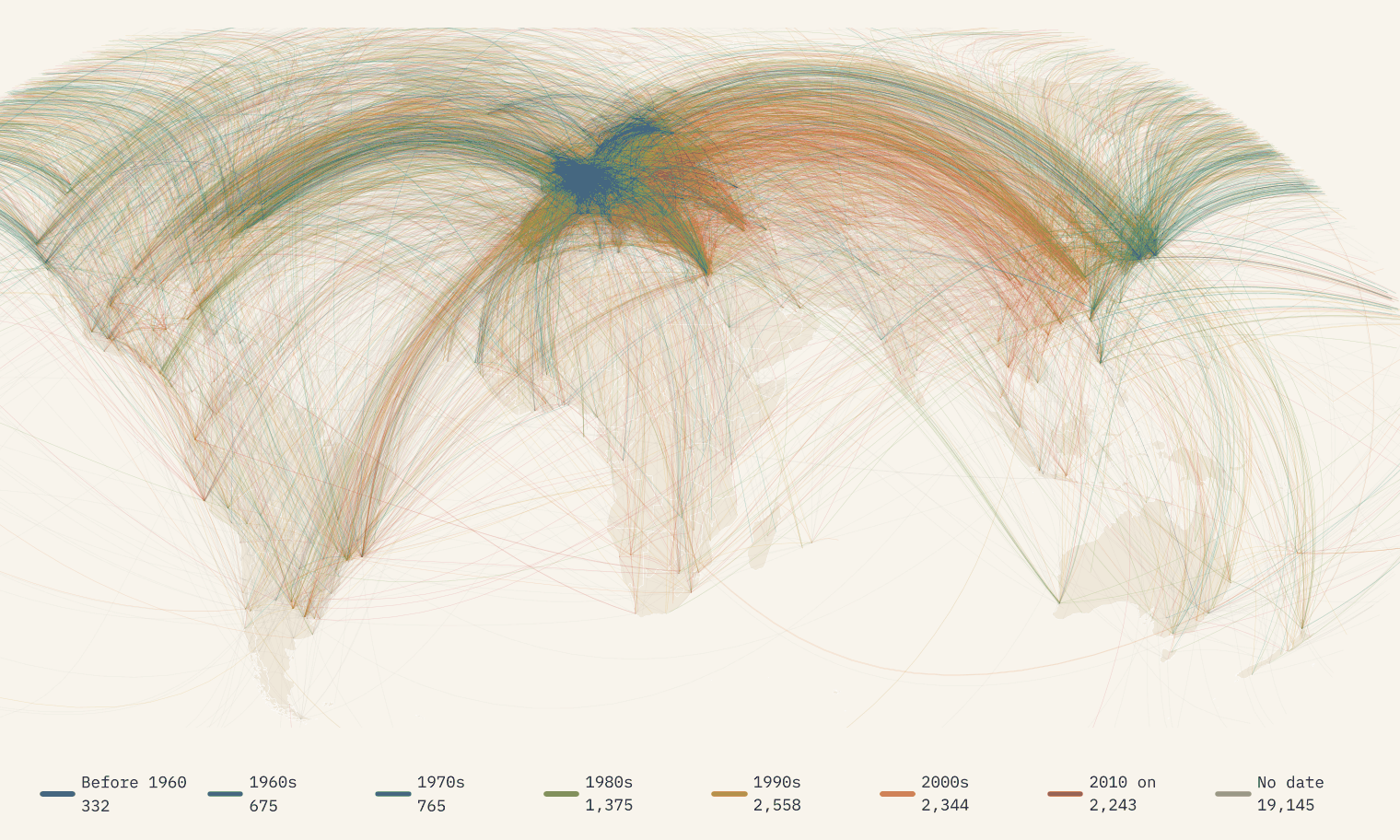
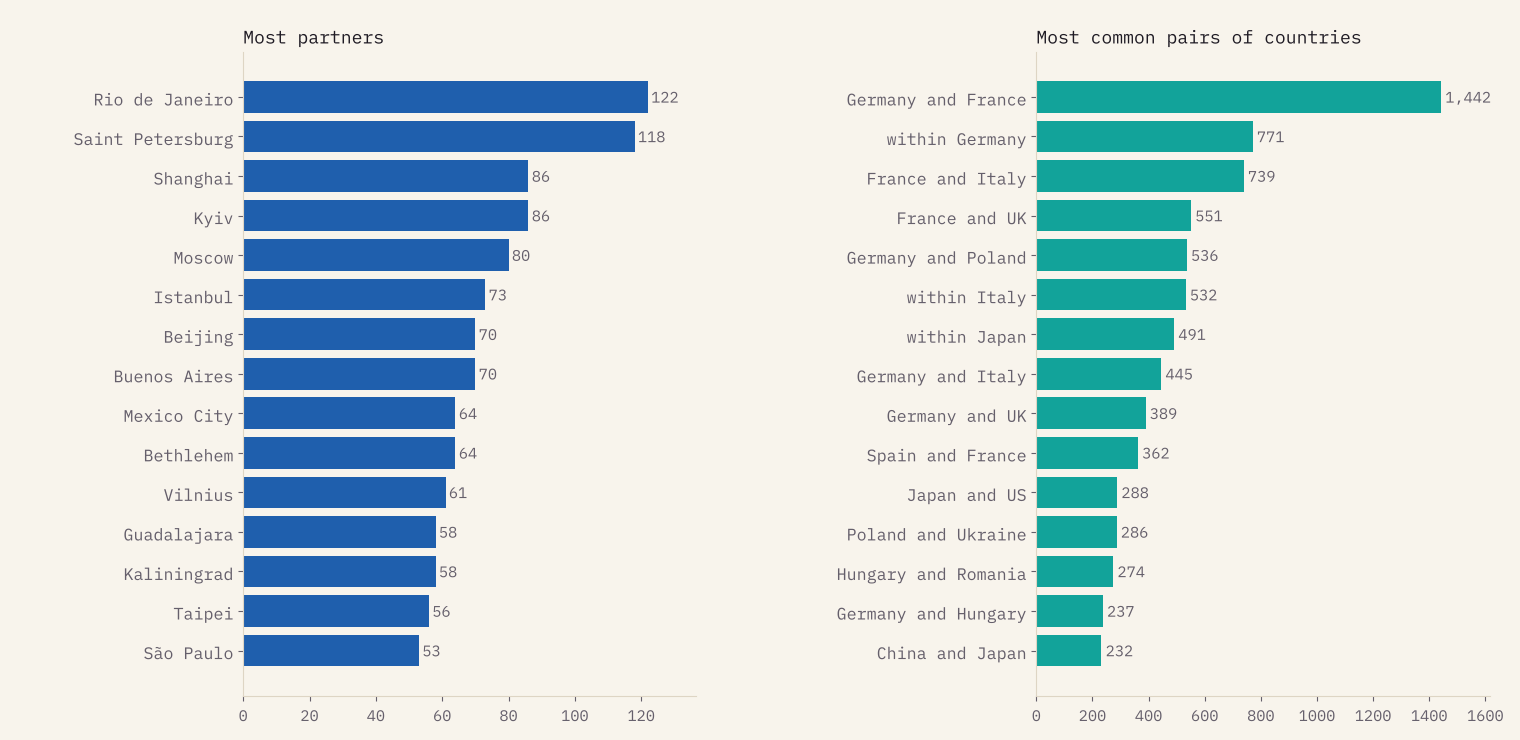
Europe is the knot in the middle. 59% of all pairs join two European places, and the median twin lives just 1,009 km away. The most common pair of countries is France and Germany, with 1,442 town pairs, more than any country has with itself. Then come towns within Germany (771), France and Italy (739) and France and the UK (551).
A post-war idea
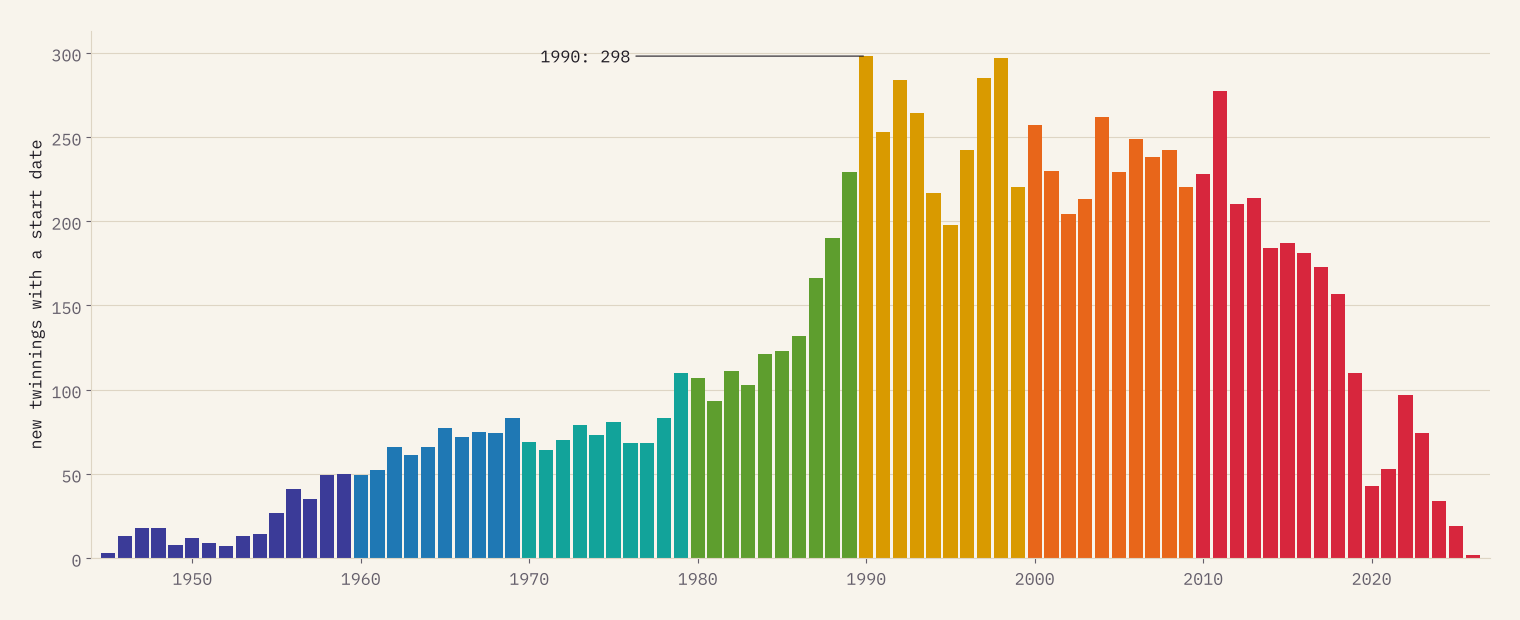
Twinning took off after the Second World War. Only 75 dated pairs began before 1950. The 1950s added 257, the 1960s 675, and the numbers kept climbing until the busiest single year of all: 1990, with 298 new links. More than two thirds of all dated twinnings (69%) began in 1990 or later.
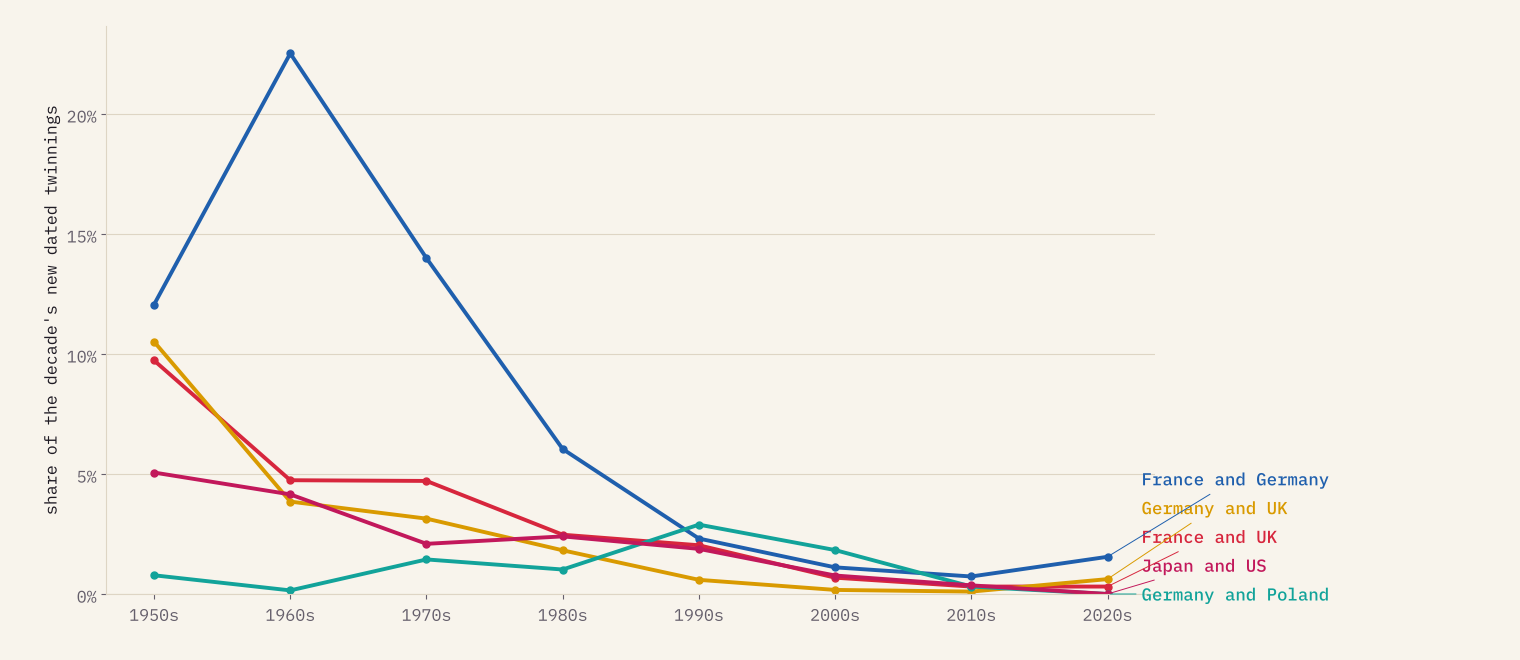
The early years belong to France and Germany. Links involving a French town were 42% of all new dated twinnings in the 1950s, and links involving a German town 43% in the 1960s. Franco-German pairs alone peaked in the 1960s, when they were 23% of everything new. Britain followed on a smaller scale: of the 1,619 links involving a UK place, 34% are with France and 24% with Germany.
Coventry is a good example of how early and how political this could be. Its first dated link on Wikidata is with Volgograd, the former Stalingrad, in 1944, while the war was still on. By 1963 it had added Warsaw, Belgrade, Sarajevo, Ostrava, Caen, Graz, Kiel and Dresden.
Across the Iron Curtain
To look at the Cold War I put each place into one of two camps by its present country: an Eastern bloc (the Warsaw Pact and the Soviet republics, plus the five eastern German states) and a West (NATO as it stood in 1989, western Germany and the western neutrals). It is a rough proxy, but it shows something clear. Of dated twinnings that began before 1990, 15% crossed between the camps. In the 1990s that share nearly doubled, to 28%, as towns in Poland, eastern Germany, Russia and Hungary signed up with partners in the West.
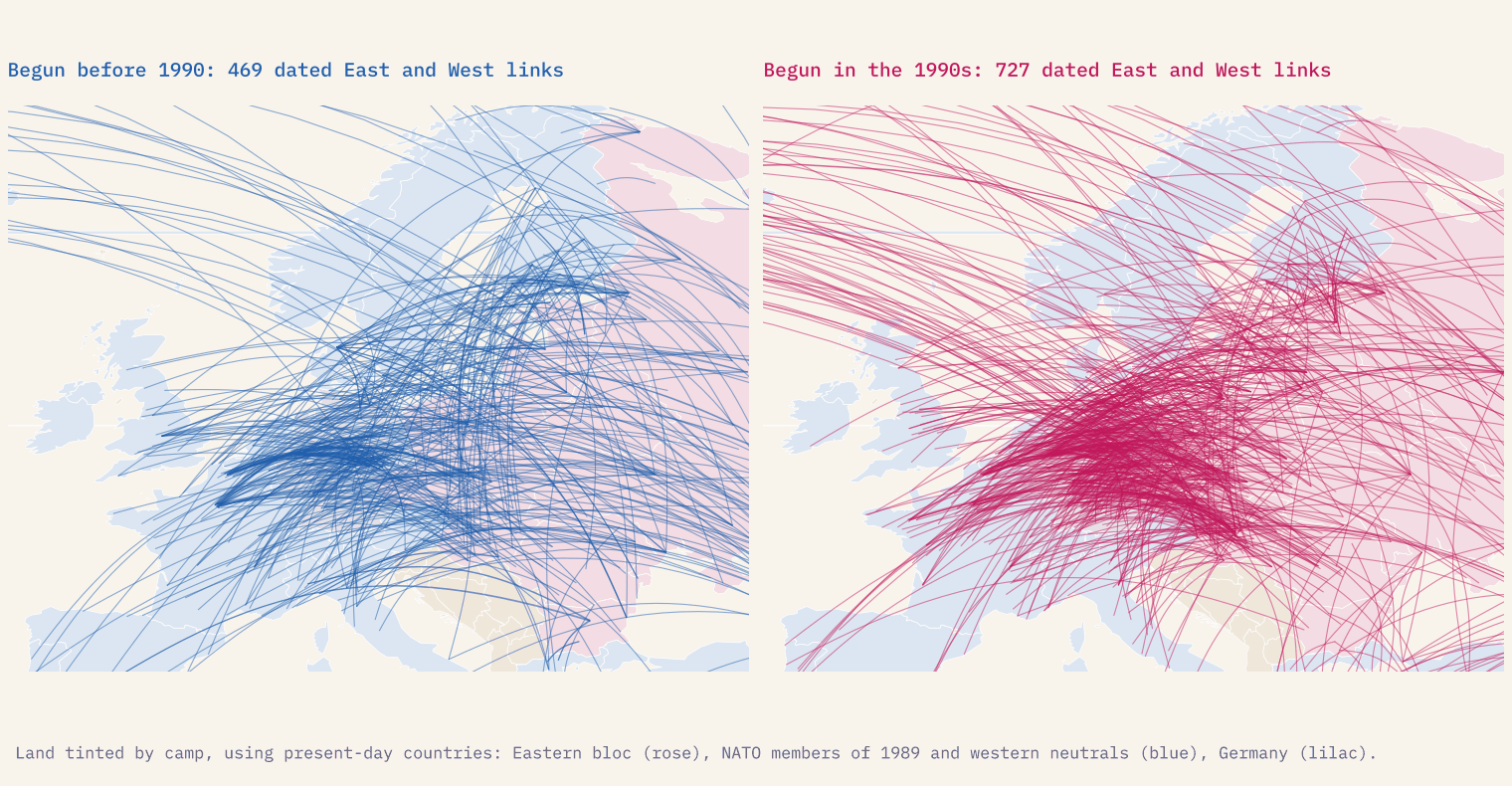
Before 1990 the Western side of those links was most often French (101), West German (97) or, strikingly, Finnish (81). The sharpest story is inside Germany. Of 771 pairs of German towns, 654 join a town in the old East with one in the old West. Only 117 of those have a date, but 52 of them were made in 1990 alone, the year of reunification, and 36 even before 1990, most of them from 1987 to 1989, after Saarlouis and Eisenhüttenstadt led the way in 1986.
The busiest year for twinning was 1990, the year after the Berlin Wall fell.
Further apart
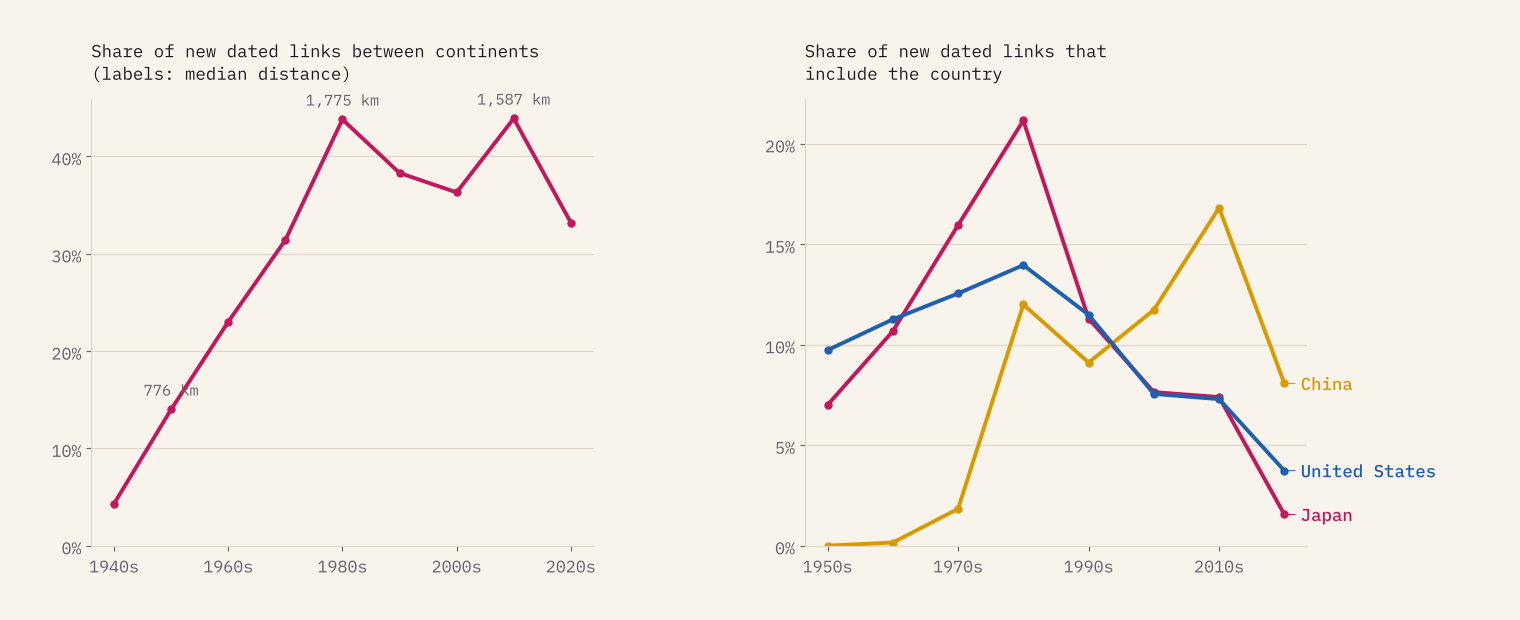
The first twins were neighbours. Of the pairs dated to the 1950s, only 14% crossed between continents. By the 1980s it was 44%, and the median distance had more than doubled, from 776 km to 1,775 km. Japan led that reach. It has 1,751 twinnings, 288 of them with American towns, and in the 1980s it was part of 21% of all new dated links. China came later: its median start year is 2004, and its partners are most often in Japan (232), the United States (146) and Russia (113).
Champions and namesakes
Most places are modest twinners: 54% have exactly one partner. A few are collectors. Rio de Janeiro has 122, Saint Petersburg 118, and Shanghai and Kyiv 86 each. My favourite is Bethlehem, a town of about 36,000 people, with 64 partners: more than London (33), Berlin (32) or Paris (24).
Some towns twin with their own name. I found 130 pairs of namesakes in different countries, most often British and American (20 pairs): Boston and Boston, Cambridge and Cambridge, Plymouth, Portsmouth, Worcester. Perth in Scotland is twinned with both Perth in Australia and Perth in Canada, and Coventry with three American Coventries. Best of all, the four Trujillos in Spain, Peru, Venezuela and Honduras are all twinned with one another.
The links that were cut
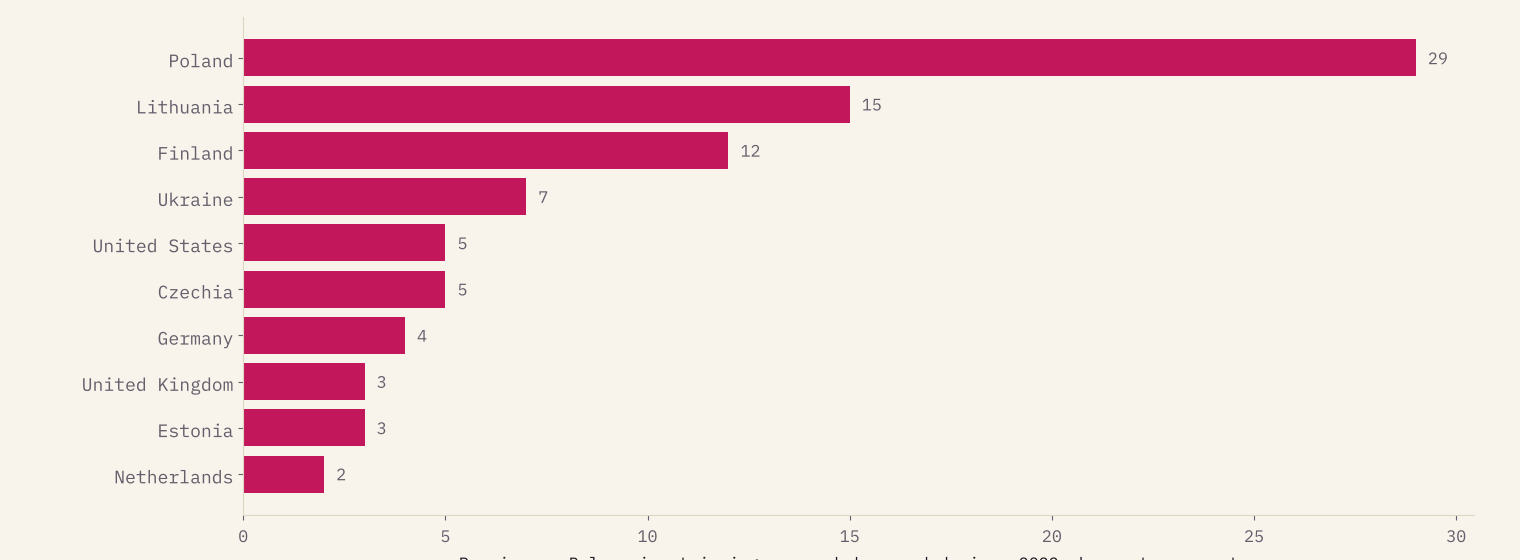
After Russia’s full-scale invasion of Ukraine in 2022, many councils suspended or ended their links with Russian and Belarusian towns. Wikidata records 115 twinnings as ended in 2022 or later, and 90 of those involve a Russian or Belarusian place. Their partners were most often in Poland (29), Lithuania (15) and Finland (12). This is surely an undercount: 1,650 Russian twinnings carry no end date at all, and an end only appears when someone adds it.
How I did this
I queried every Wikidata twinning statement, with its start and end dates where given, through the QLever SPARQL endpoint on 2026-10-29. I merged the two directions of each link, gave every place a present-day country from its coordinates, and dropped items with no coordinates, whole countries, and a few schools and parks. On the map, each link follows the great-circle route, bowed slightly so short links read as arcs. Where the two sides gave different start years I used the earlier.
The big caveat is coverage. As a check I read all 85 of English Wikipedia’s “List of twin towns and sister cities” pages, and only 56% of their partner lines matched a Wikidata pair by name. Name matching misses some real matches, but Wikidata is clearly a large sample of the world’s twinnings, not a full list, and coverage varies by country. Only about a third of pairs have a start date, so treat the timing patterns as shapes rather than exact counts.
Notes and sources
- Twinnings, places, coordinates and dates: Wikidata property P190 (twinned administrative body) with start and end time qualifiers, queried through QLever on 2026-10-29 (CC0).
- Coverage check: English Wikipedia’s 85 “List of twin towns and sister cities” pages (CC BY-SA 4.0).
- Countries and continents: Natural Earth (public domain). Place names on the interactive map: GeoNames (CC BY 4.0).
- Paper, data and code: Zenodo and GitHub. Text, figures and data CC BY 4.0; code MIT.
- I wrote the text, with drafting and editing assistance from Claude (Anthropic), which also helped prepare the analysis code. I reviewed and checked all text and results.

