
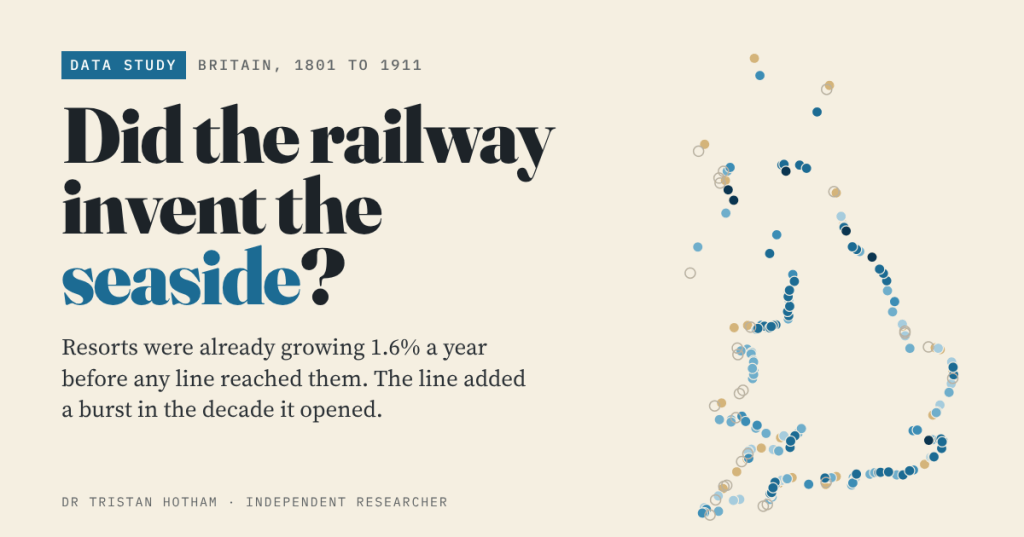
The Victorian seaside is usually told as a railway story: the line arrives, the excursion trains pour in, and a fishing village becomes Blackpool. I followed 68 British resorts through every census from 1801 to 1911 to see whether they boomed after the trains came, or were already growing.
In 1801 Weston-super-Mare was a village of 138 people. By 1911 it held 23,235. Blackpool went from 473 to 58,371. It is hard to look at numbers like that and not think of the railway: the cheap excursion ticket, the mill towns emptying onto the sands for a week every summer.
But the seaside is older than the railway. Brighton, Margate and Scarborough were bathing places in the eighteenth century. So which came first? In my last post I asked the same question about canals and found the canal towns were already rising before the canals arrived. This time I used a sharper test: line up each resort’s census growth, decade by decade, before and after the year its railway opened. If the railway invented the seaside, growth should jump when the line arrives, and not before.
The lines reach the sea
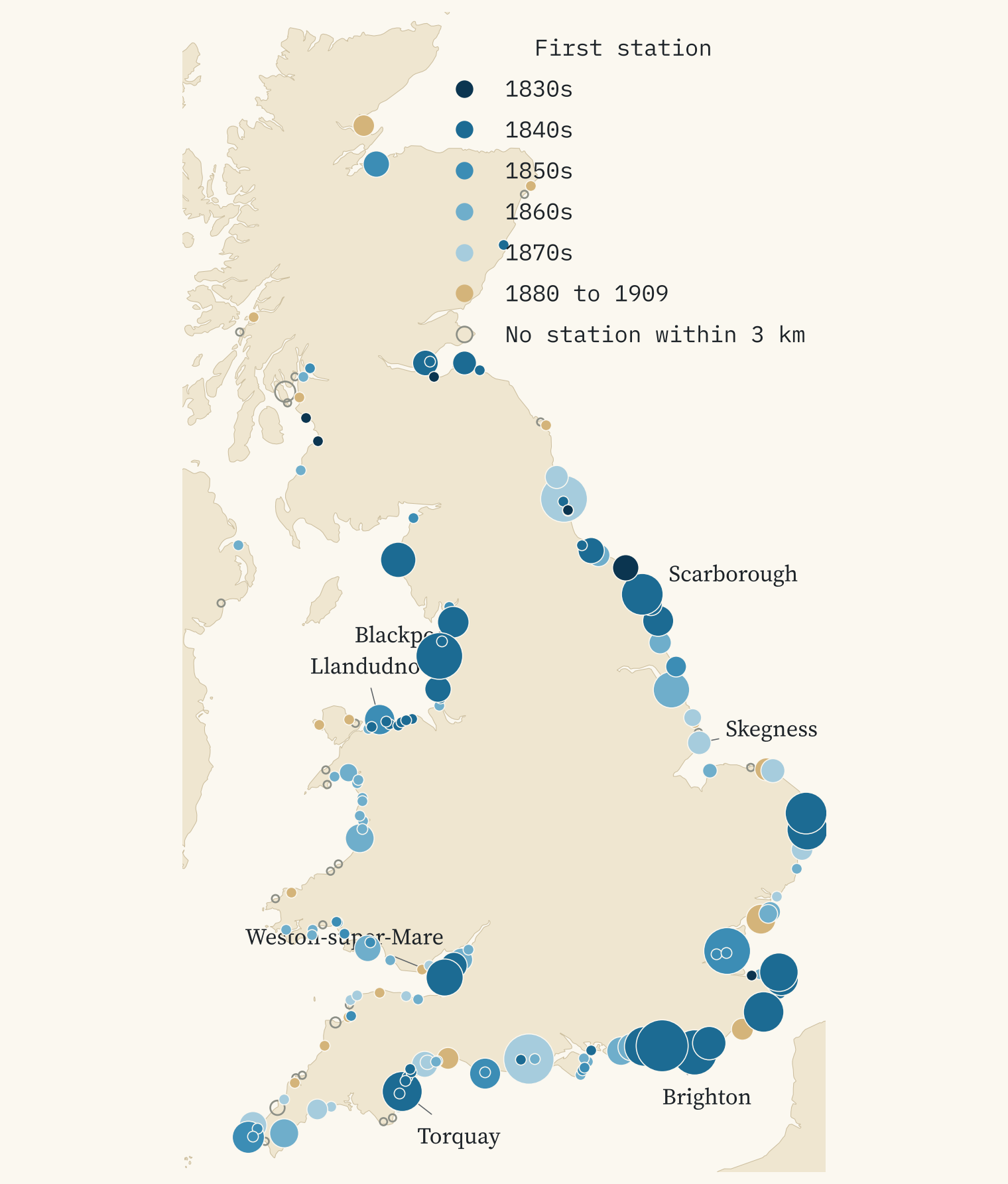
I started with the 205 places on Wikipedia’s list of seaside resorts in the United Kingdom and dated the railway at each one: the earliest opening of any station within 3 km, from Wikidata, checked against the resort’s own Wikipedia article. That check mattered. Wikidata gives 1974 for Blackpool North, while Blackpool’s article puts the town’s first station in 1846. In the end 177 resorts had a station by 1911.
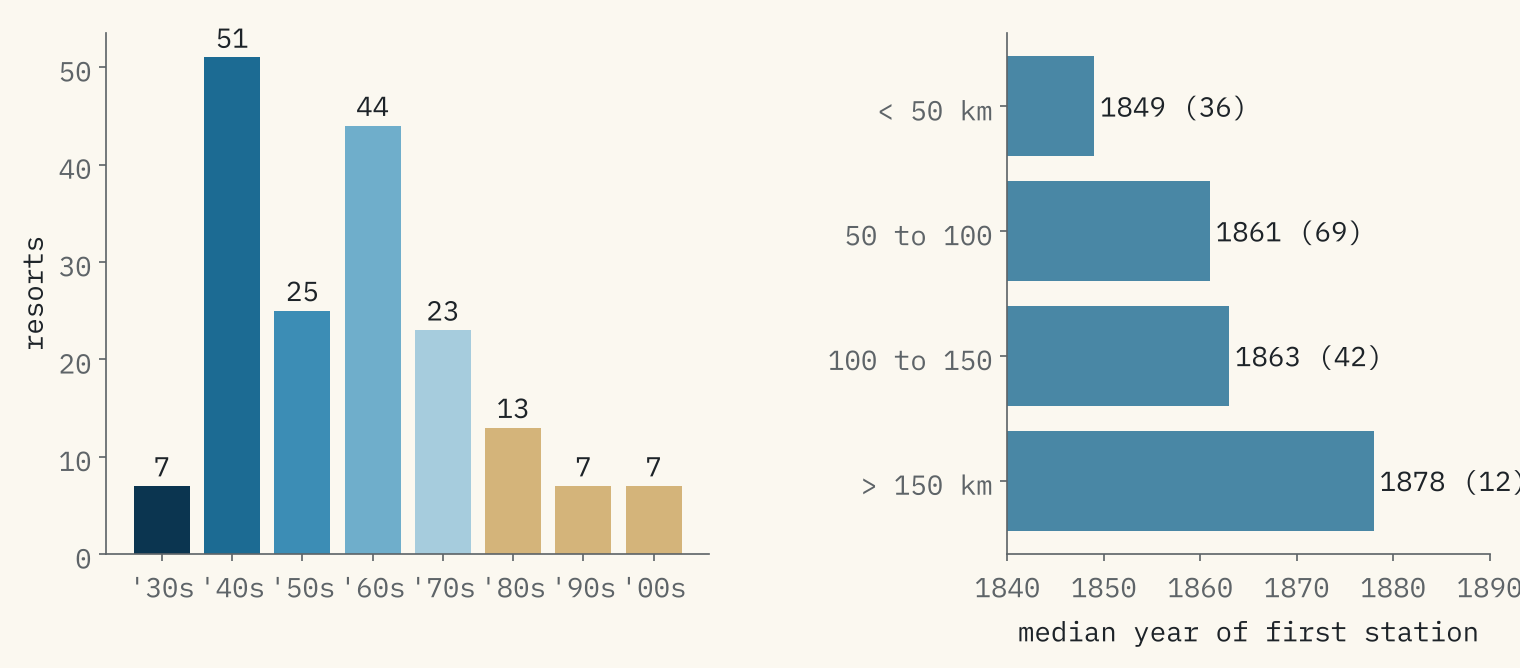
The rush came early. 51 resorts got their first station in the 1840s, the decade of the railway mania, and half had one by 1861. The order was not random. Resorts within 50 km of one of England’s ten biggest towns of 1861 got their line in a median year of 1849; those more than 150 km away waited until 1878. The railway went first where the crowds were nearest.
Already growing before the trains
For census figures I went to A Vision of Britain through Time, which reproduces the population of every census parish and township from the original reports. I found usable series for 68 resorts, and for comparison I drew a random sample of 60 inland towns, at least 25 km from the sea, and found series for 20 of them.
The cleanest test is the three decades from 1801 to 1831, before any line in my sample opened. The typical resort grew 1.63% a year. The typical inland town grew 1.43%, a difference well within chance, and a set of inland villages from Wikidata grew 1.09%. Some resorts were racing: Weston-super-Mare grew 7.5% a year, Brighton 5.7% and Torquay 4.8%, decades before their lines opened.
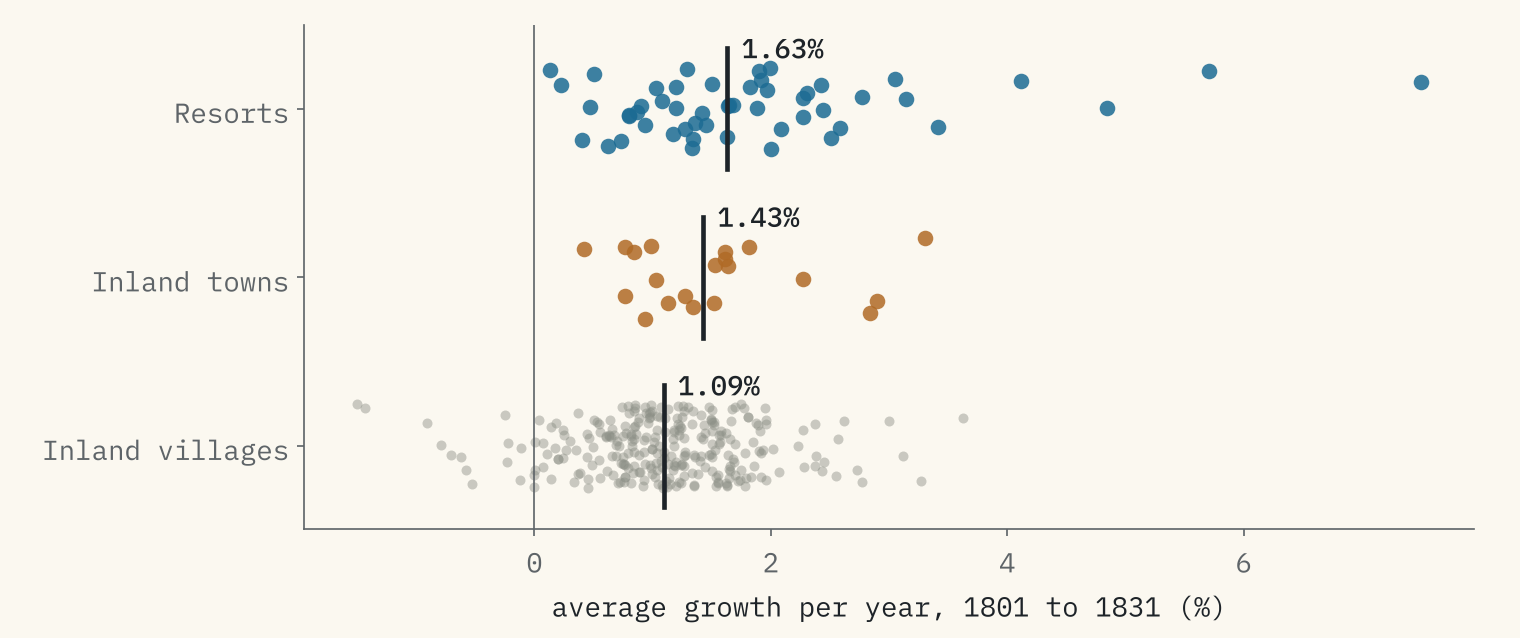
The railway did not find empty beaches. It found towns that were already growing.
What happened when the line opened
Now the main event. For each resort I counted census decades from the railway: decade 0 is the one in which the line opened, minus 1 the decade before, plus 1 the decade after. Then I compared each resort with itself, allowing for the national ups and downs of each decade.
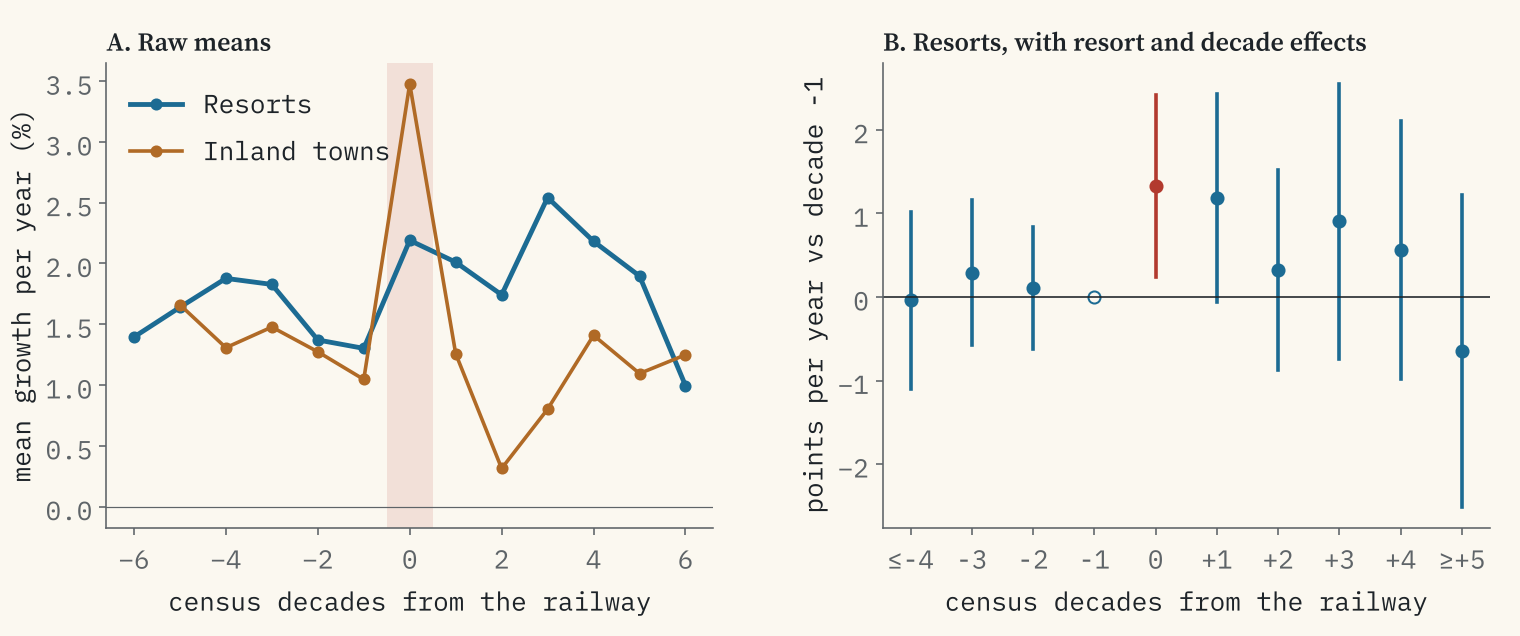
There is a real bump. In the decade the line opened, resort growth was 1.33 points a year higher than in the decade before, and 1.18 points higher in the decade after that. Before the railway there is no sign of growth building up in anticipation. That burst is the railway’s clearest fingerprint.
But it is not a seaside fingerprint. Inland towns got a lift from their own lines too, and when I put the two groups in one model the resorts’ extra gain after the railway was just 0.08 points a year, with an interval from -1.20 to 1.36. I cannot tell the two apart.
Winners and losers
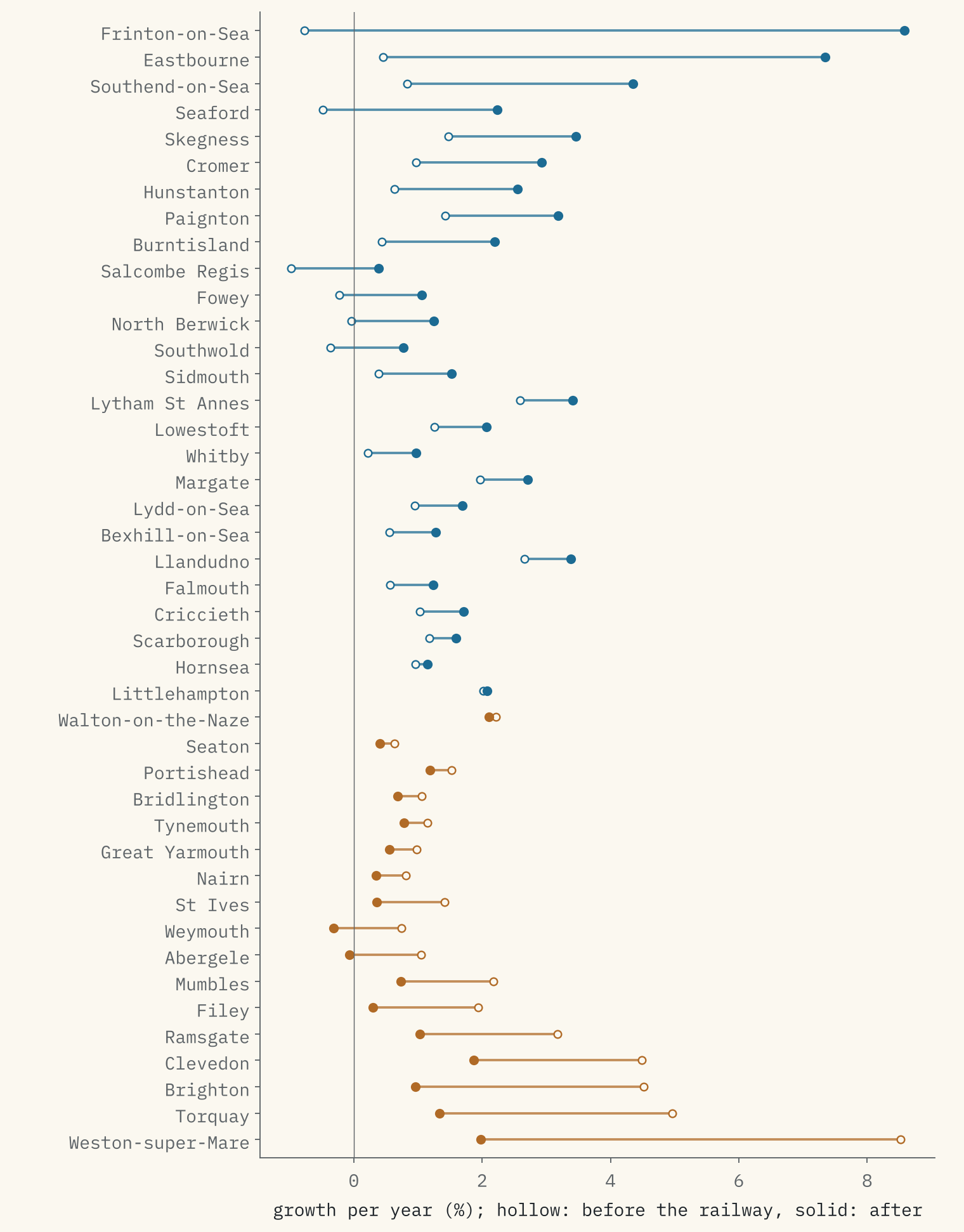
Resort by resort, 26 of 43 grew faster in the three decades after their railway than in the three before. The two ends of the list are the most revealing. At the top are the places the railway really did transform, like Frinton-on-Sea, Eastbourne, Southend-on-Sea and Seaford, most of them sleepy before the line. At the bottom are the pre-railway boom towns: Weston-super-Mare grew 8.5% a year before its railway and 2.0% after, and Torquay, Brighton, Clevedon and Ramsgate tell the same story. For them, the railway came after the boom.
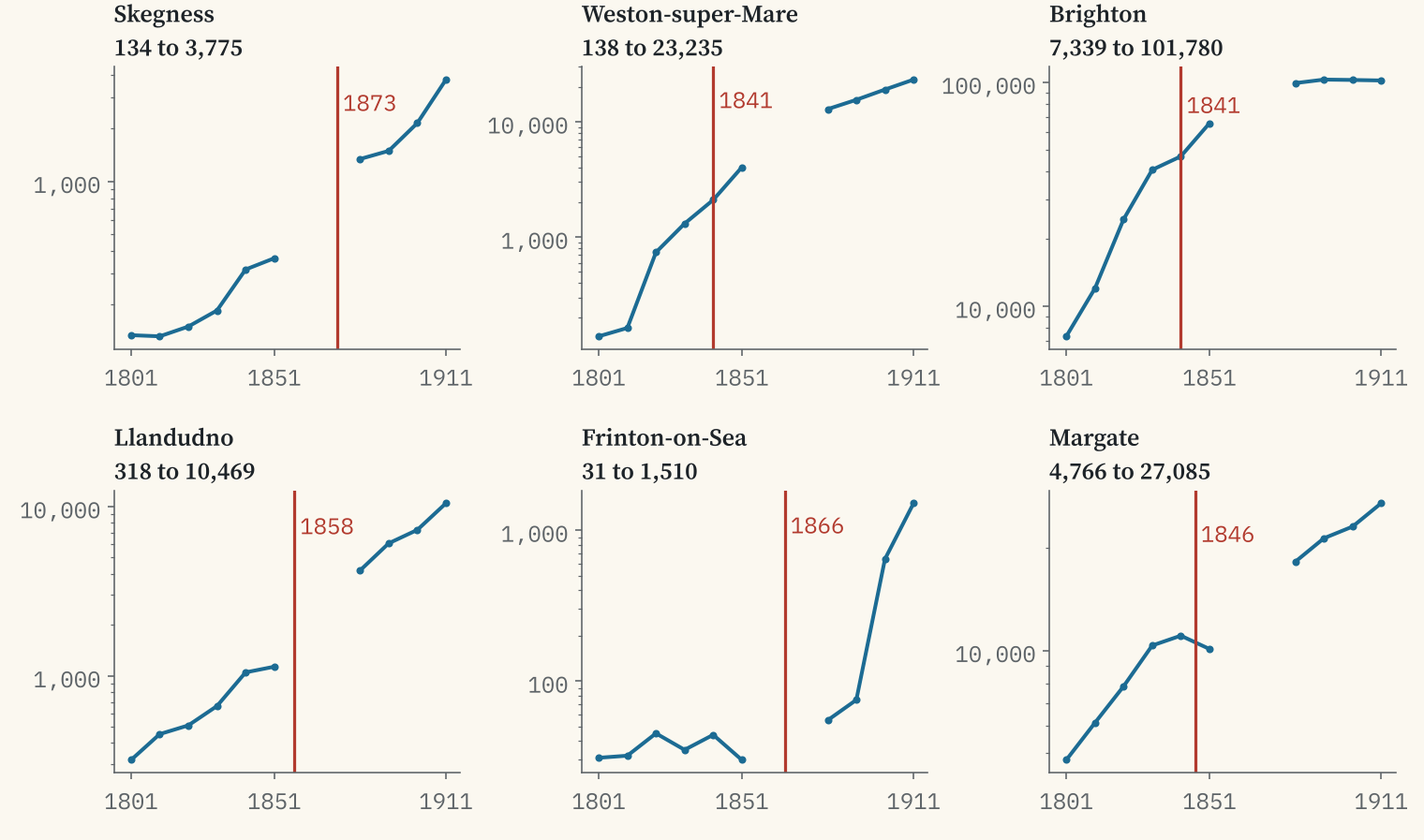
Over the long run the resorts did outgrow inland towns, though by less than the famous cases suggest. Over the nine census decades I can compare on unchanged boundaries, the typical resort grew 3.9 times and the typical inland town 3.0 times. Paired with an inland town of the same size in 1801, the resort grew more in 27 of 40 cases.
So did the railway invent the seaside?
On these figures, no. The resorts were already growing as fast as any inland town before the first train ran. The railway reached the resorts nearest the industrial towns first, gave a clear burst in the decade it arrived, and did most for places that had been slow before. It spread the seaside rather than inventing it. The sea, the holiday and the money of the towns at the other end of the line were there already.
How I did this
Resorts come from Wikipedia’s list; the railway year is the earliest Wikidata opening date of a station within 3 km, corrected from the resort’s own article for 7 resorts. Census figures are parish or township totals from A Vision of Britain through Time, read with an automated web reader and stored with the page each came from; all 5 that I could check against Wikipedia matched. Each decade’s growth uses figures on the same boundary where the census printed them, and I do not bridge 1851 to 1871 in England and Wales because the parish tables skip 1861.
The caveats are real. Only 68 of 201 resorts in Great Britain have usable series, leaning towards England and towards resorts that were separate parishes; suburb resorts and towns split between parishes are missing. A parish is not a town. The inland sample is small. A station 3 km away says nothing about fares or services. And railways were built where promoters expected traffic, so all of this is association, not proof of cause.
Notes and sources
- Census populations 1801 to 1911: census reports for England and Wales and for Scotland, as tabulated by A Vision of Britain through Time (University of Portsmouth). Every figure is linked to its page in the data.
- Resorts: Wikipedia, List of seaside resorts in the United Kingdom and the linked resort articles; town ranking from List of towns and cities in England by historical population (CC BY-SA 4.0).
- Station opening dates and village census figures: Wikidata (CC0).
- Town points: OS Open Names. Contains OS data © Crown copyright and database right 2026 (Open Government Licence v3.0). Coastline: Natural Earth.
- The earlier study: Canal Mania. Background: John K. Walton, The English Seaside Resort: A Social History 1750-1914 (Leicester University Press, 1983).
- Paper, data and code: Zenodo and GitHub.
- I wrote the text, with drafting and editing assistance from Claude (Anthropic), which also helped prepare the analysis code. I reviewed and checked all text and results.

