
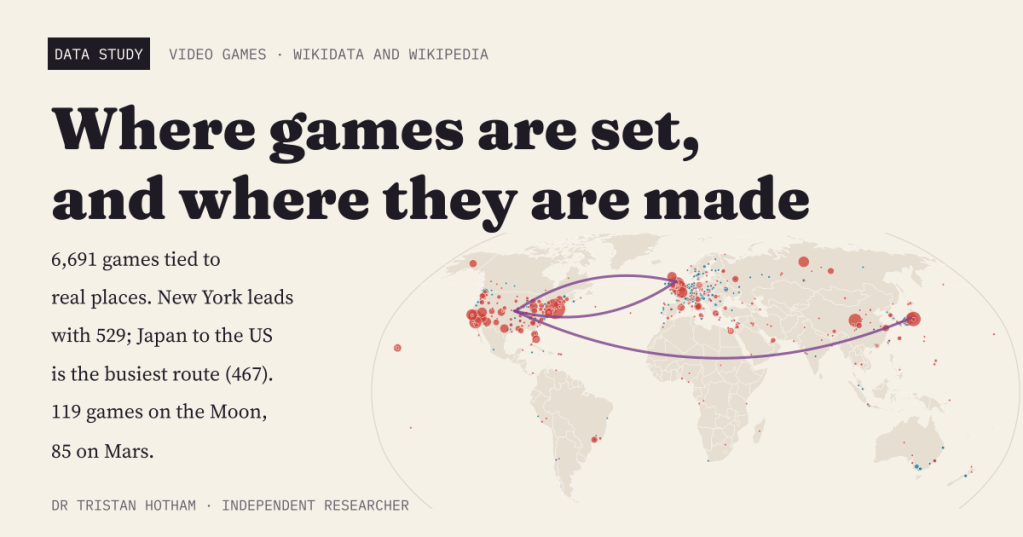
Games love real places. I mapped 6,691 video games tied to somewhere real: where each one is set, where the studio that made it is based, and the 595 that leave Earth altogether. New York wins, Japan to America is the busiest route, and the Moon beats Mars.
Someone asked me for a world map of every game ever made that is set in a real place: where it was made, and where it was set. Oh, and a separate category for space, please. Nobody keeps a list of every game ever, so I could not quite do that. But two open sources come close enough to be interesting. Wikidata records a “narrative location” for some games, and English Wikipedia sorts thousands of game articles into categories like “Video games set in Tokyo”.
Put together, they tie 6,198 games to a real place on Earth and 595 to somewhere real in space. That is only 3.5% of the 189,453 video games in Wikidata, and it leans towards famous games from North America, Europe and Japan. So read everything below as “among games that someone has written up”. Within that, the pattern is very clear.
New York, and then everyone else
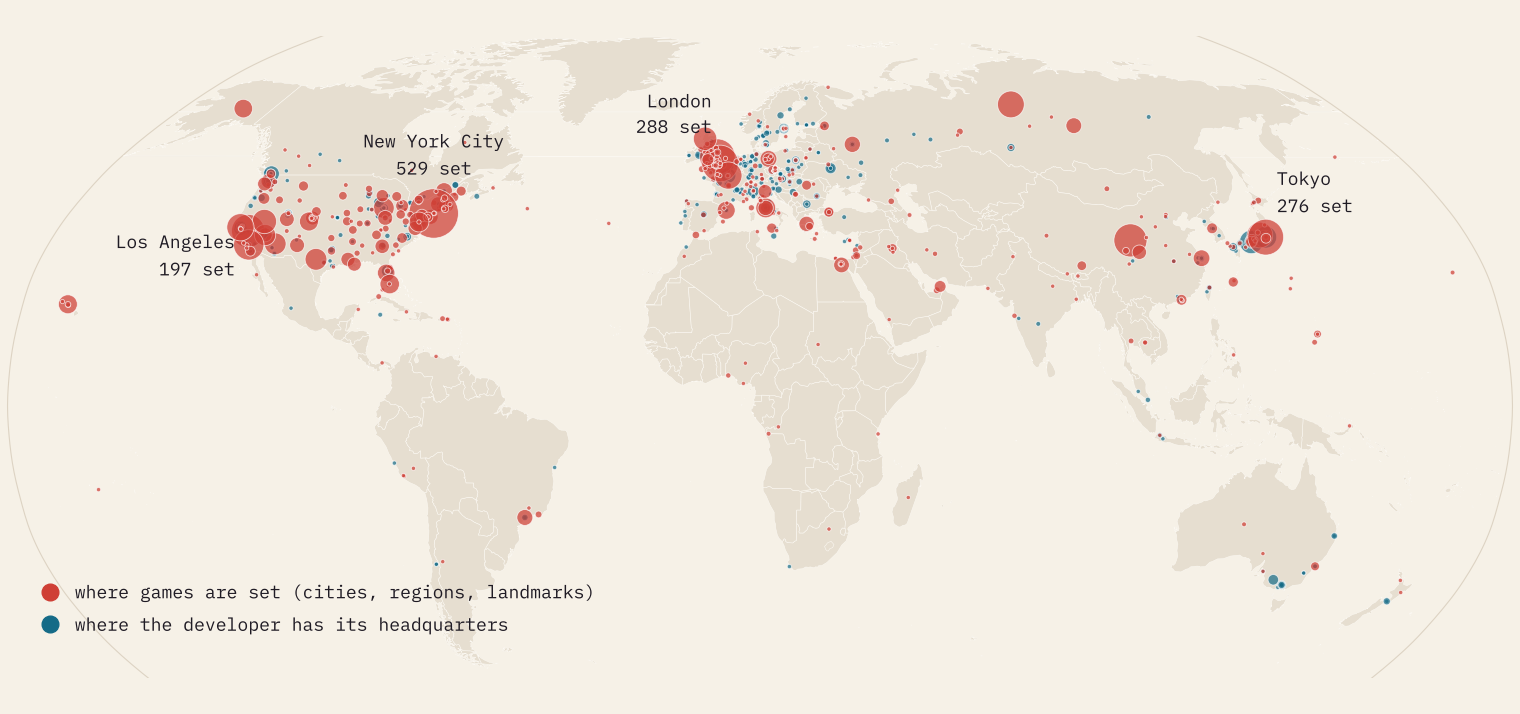
New York City is the setting for 529 games, nearly twice as many as London (288) or Tokyo (276). Los Angeles (197), Paris and San Francisco (158 each) come next. If you have played games for any length of time, you have probably been to all of them.
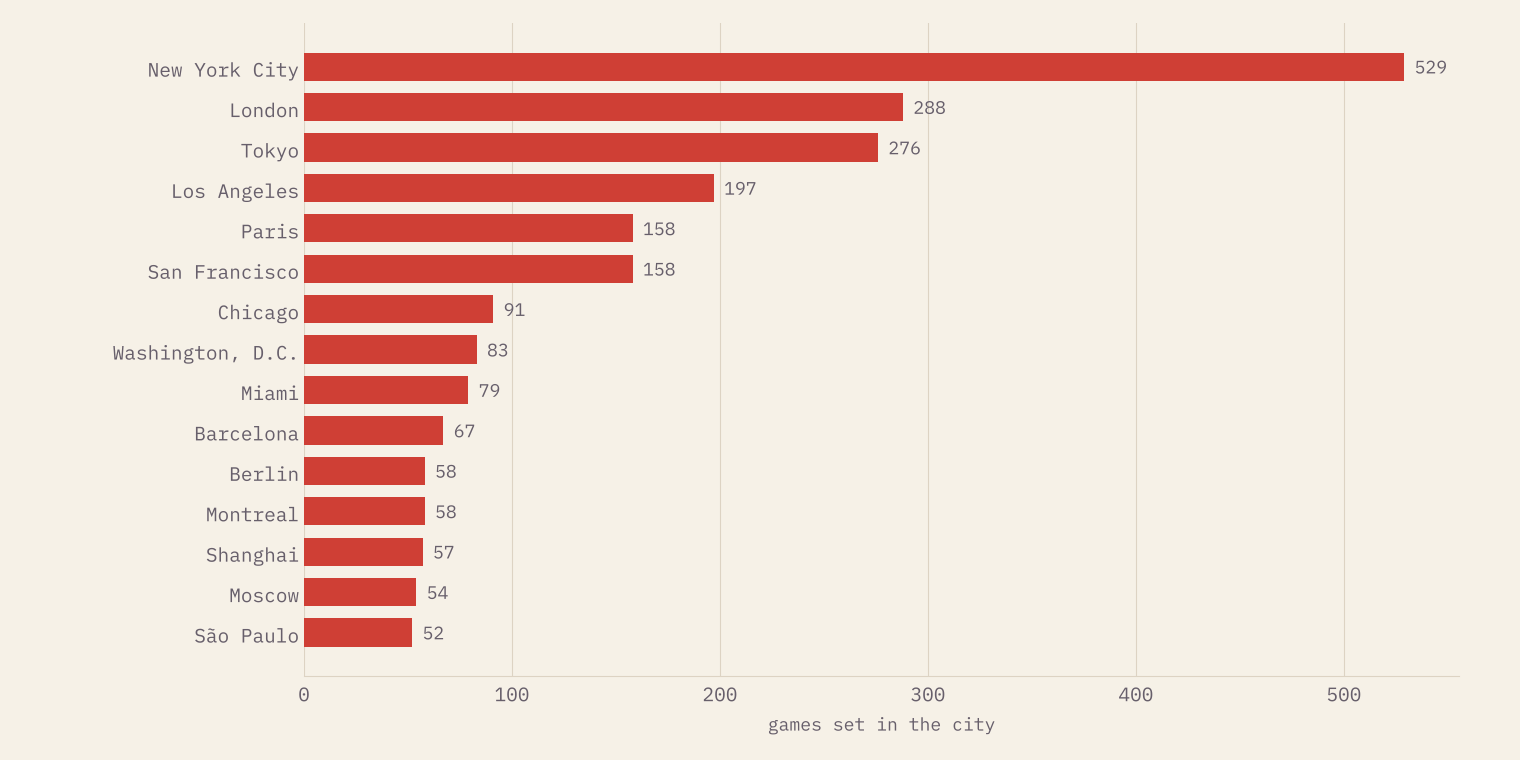
Washington, D.C. very nearly fooled me. In the raw data it came third, until I looked at the games: about two hundred American football, hockey and baseball games, Madden after Madden, all tagged with Washington as their only “narrative location” in Wikidata. No Wikipedia category agreed with any of them, and nobody would call Washington the setting of NHL 97. It looks like a bulk error, so I set those links aside. With them gone Washington has 83 games, a respectable eighth.
By country, the United States is a setting for 43% of all the Earth-bound games. Japan and the United Kingdom follow, then France, Italy, Russia, Germany and China. Egypt, with 309 games of pyramids and tombs, is the most used setting in Africa or the Middle East.
Made in three countries
For 92% of the games I could also say where they were made, mostly from the coordinates of the developer’s headquarters. Making is even more concentrated than setting. The United States made 1,817, Japan 1,361 and the United Kingdom 738: between them 69% of the games with a known maker. France and Canada are next, and nobody else passes 150.
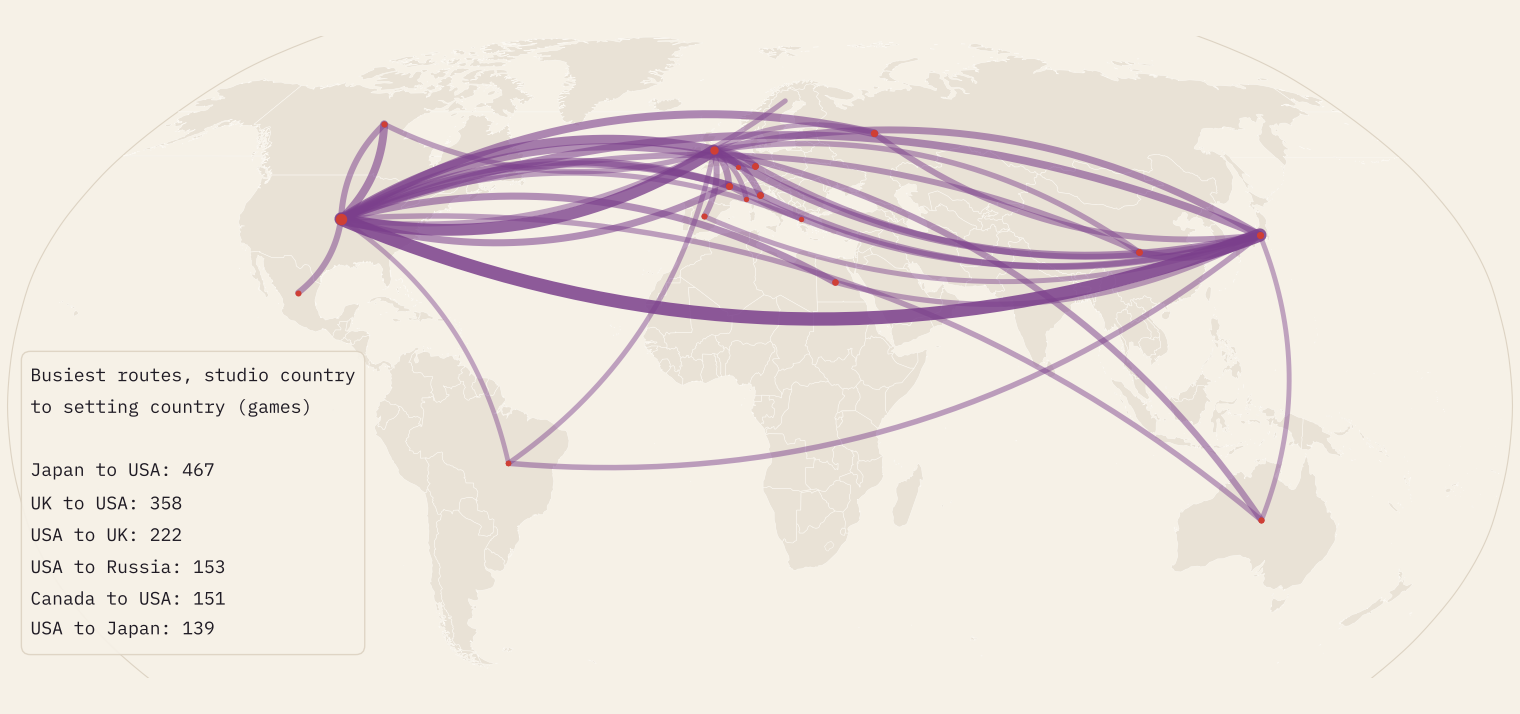
Draw a line from each studio to each setting and the busiest route crosses the Pacific: 467 games made in Japan are set in the United States. British studios sent 358 games to America, and American studios sent 222 back. Then comes the United States to Russia (153, counting the Soviet Union), the Cold War still doing good business.
Who stays at home
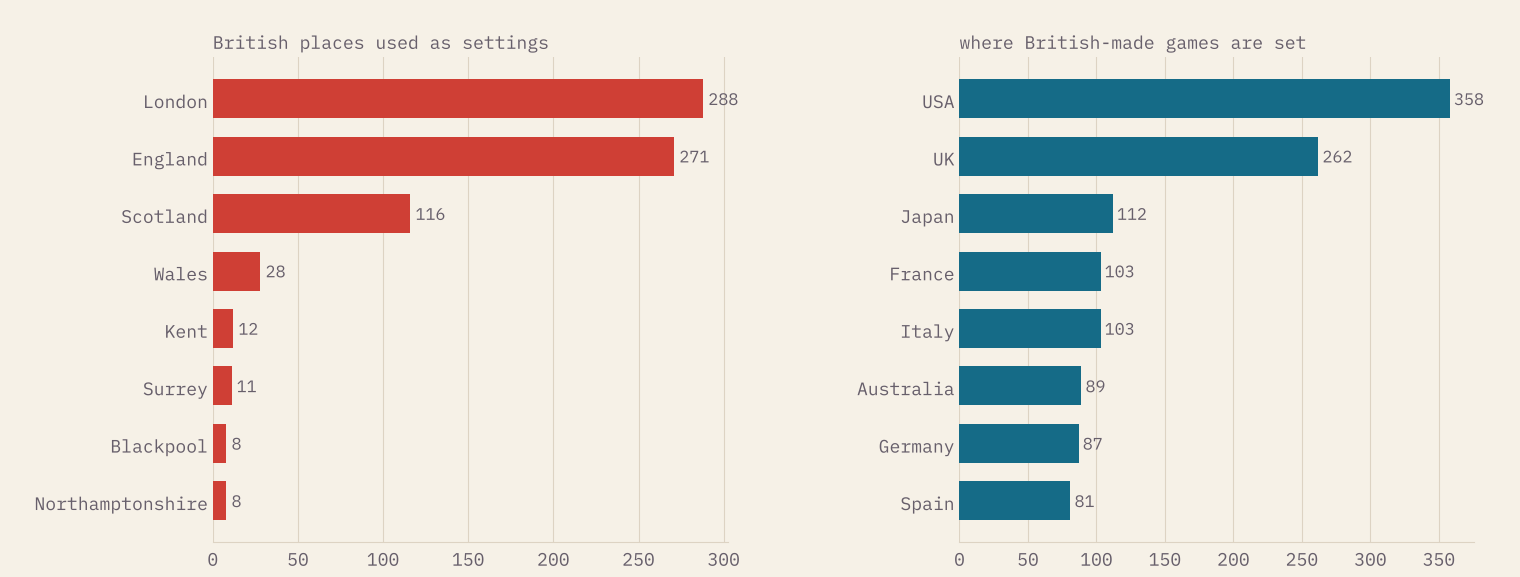
American studios set 63% of their placed games at home, and Japanese studios 55%. Almost everyone else looks abroad, and above all to America. British studios set 38% of their games at home, French 29%, Canadian 23% and Swedish 22%. British studios have set more games in the United States (358) than in Britain (262).
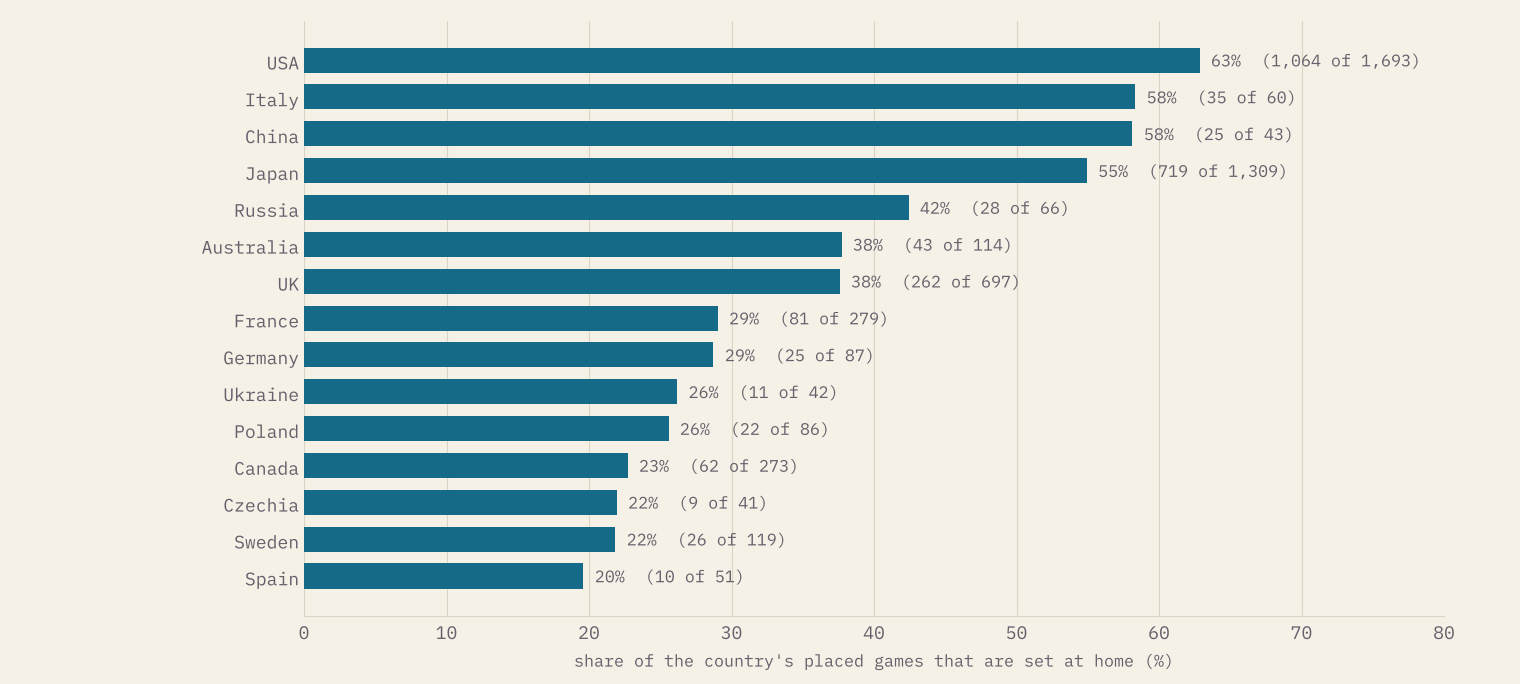
Turn it round and the picture is starker. Of the 295 games set in Egypt whose maker I could place, not one was made in Egypt. Monaco has 118 games, nearly all Formula One, and none made there. Mexico made 2 of the 235 games set in it. Even Italy, Germany, Russia and China made less than a tenth of the games set in them. For most of the world, games are something that happens to your country, made by somebody else.
For most of the world, games are set there and made somewhere else.
Fashions change
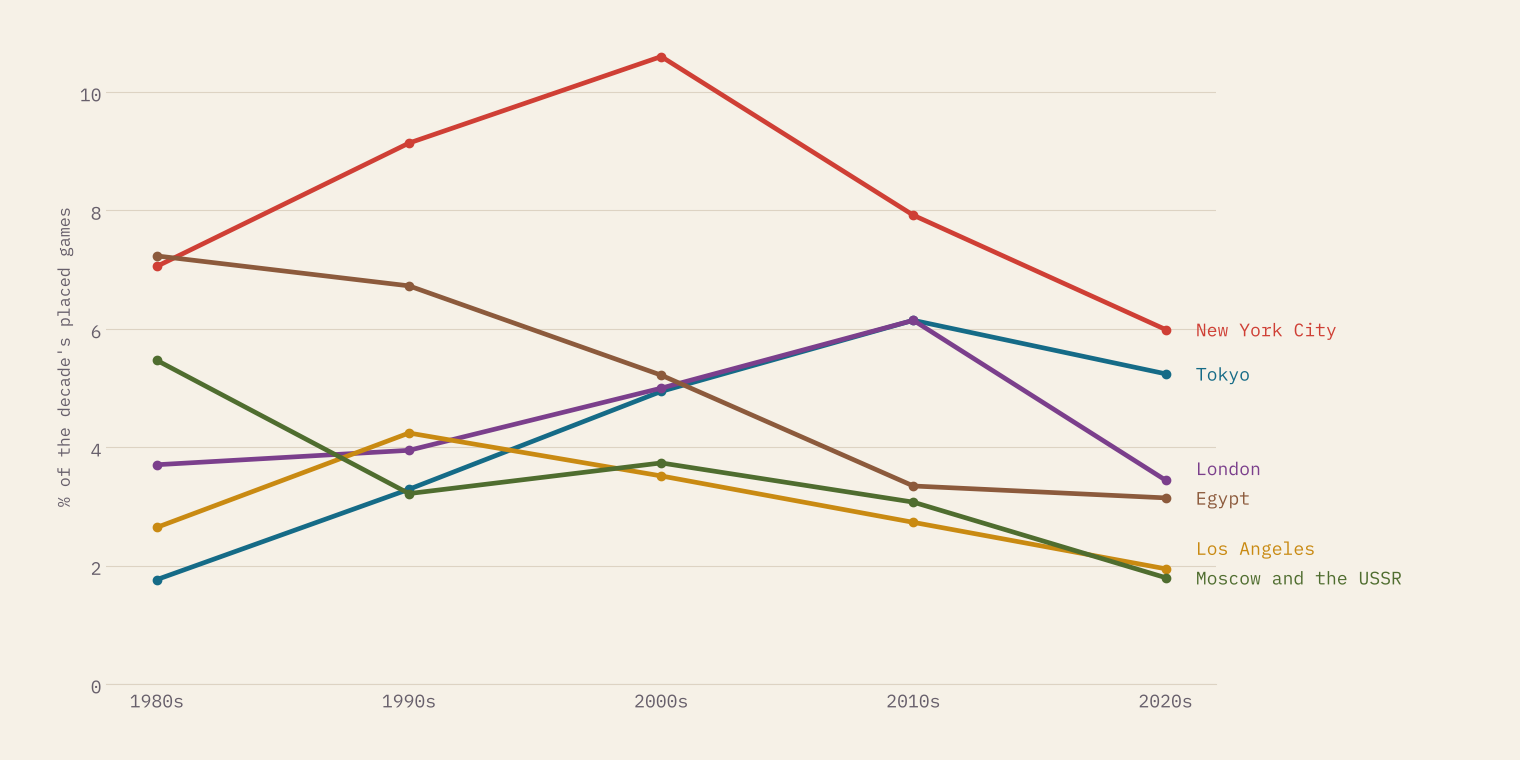
The American setting is slowly loosening its grip: 46% of placed games released in the 1990s were set at least partly in the United States, 35% of those released so far this decade. Tokyo’s share nearly doubled between the 1990s and the 2010s. Los Angeles peaked in the 1990s. Egypt has faded steadily since the 1980s, and Moscow and the Soviet Union were at their most popular in the 1980s, while the Cold War was still on.
Britain
904 games are set somewhere in the United Kingdom. London has 288 of them, Scotland 116 and Wales just 28. British studios made 738 placed games, and their studio towns are a tour of the English games industry: London, the Coventry area (home of Codemasters’ racing games), Derby (Core Design, of Tomb Raider, and Eurocom), Manchester and Liverpool.
And beyond
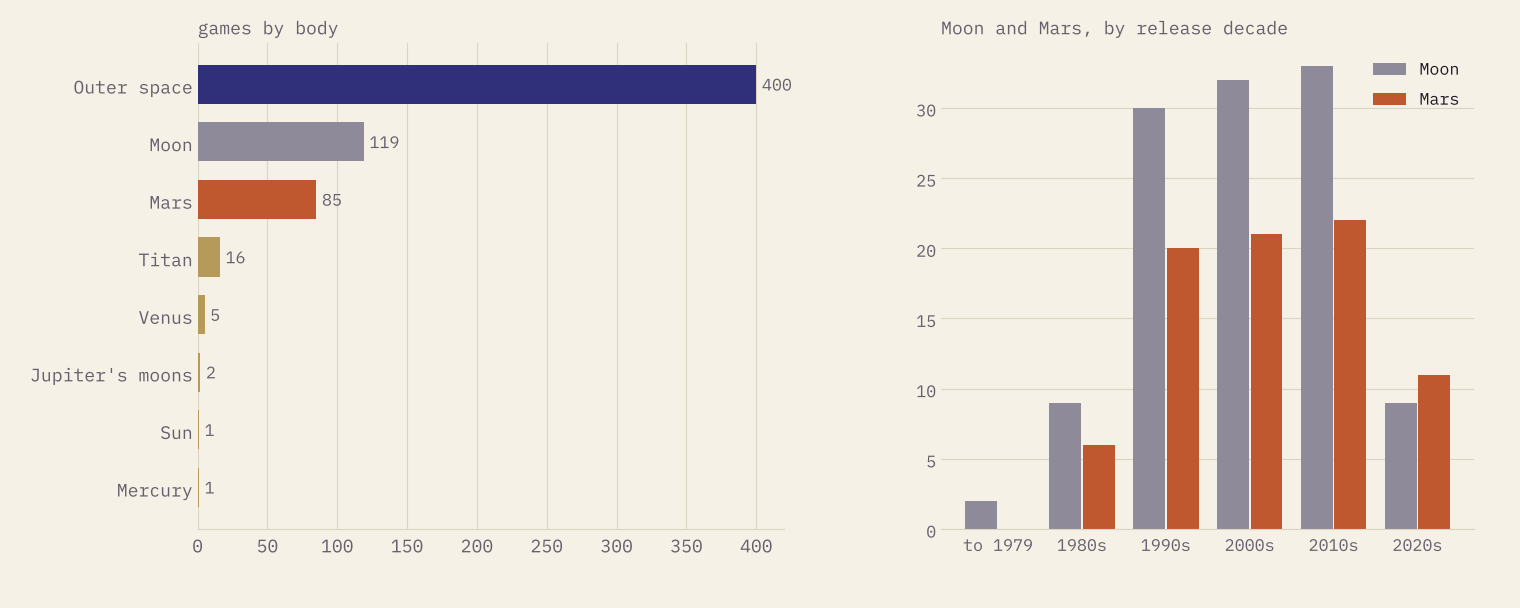
595 games are set somewhere real off Earth. Most are just in “outer space”, but among actual worlds the Moon beats Mars, 119 games to 85. Saturn’s moon Titan has 16, Venus 5, Jupiter’s moons two (Io and Callisto), and the Sun and Mercury one each. Nothing in either source is tagged with the International Space Station. The interactive version has a little spinning globe for each world, with its games listed.
How I did this
I took every video game in Wikidata (189,453 items) with its narrative locations, developers and country of origin, and every “set in” category under English Wikipedia’s “Video games by setting”. Category names were sorted into real places, dates, places in space and kinds of place (castles, hotels), and the real places were matched offline to Wikidata places, Natural Earth countries, GeoNames towns and a short hand list. Fictional places such as Raccoon City and Black Mesa are left out. Where a game is set in a city and also its country, I count the city. “Where made” is the developer’s headquarters as recorded today, or its country, or the game’s country of origin.
The limits matter. Most games have no setting recorded anywhere; sports games add a lot of links (a Formula One game is filed under most of that season’s countries); headquarters move; and English Wikipedia’s interests shape the whole map. Every link, its source and every link I set aside are in the published data, so you can check or extend them.
Notes and sources
- Games, places and developers: Wikidata (CC0), queried through QLever on 28 October 2026.
- Settings: English Wikipedia, Category:Video games by setting, English Wikipedia contributors (CC BY-SA 4.0).
- Countries: Natural Earth (public domain). Towns: GeoNames cities15000 (CC BY 4.0).
- Paper, data and code: Zenodo and GitHub. Text, figures and data CC BY-SA 4.0; code MIT.
- I wrote the text, with drafting and editing assistance from Claude (Anthropic), which also helped prepare the analysis code. I reviewed and checked all text and results.

