
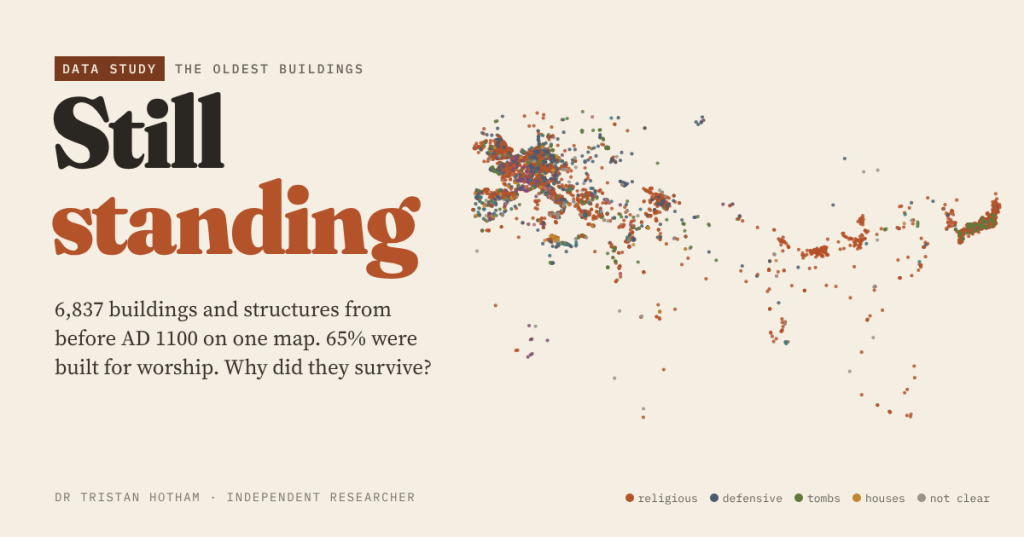
Most of what people built a thousand years ago has gone. So I put every surviving building and structure in Wikidata from before AD 1100 on one map, 6,837 of them in 94 countries, and asked what they have in common. The answer: they are either indispensable or forgotten.
Houses rot. Walls get robbed for their stone. Towns are rebuilt on top of themselves, again and again. Of everything built before the Normans finished conquering England, only a sliver still stands. Lists of “the oldest buildings” are everywhere, but they rarely ask the obvious question: why these ones?
So I took every building and structure in Wikidata, the open database behind Wikipedia, that has a construction date before 1100 and a place on the map. I removed statues, inscriptions, streets and other things that are not buildings, which left 6,837. For each I worked out what it was built for, what state it is in, and what it is used for today. Then I compared them with 40,200 structures built between 1100 and 1599, to see what the filter of time has kept.
A world of temples and churches
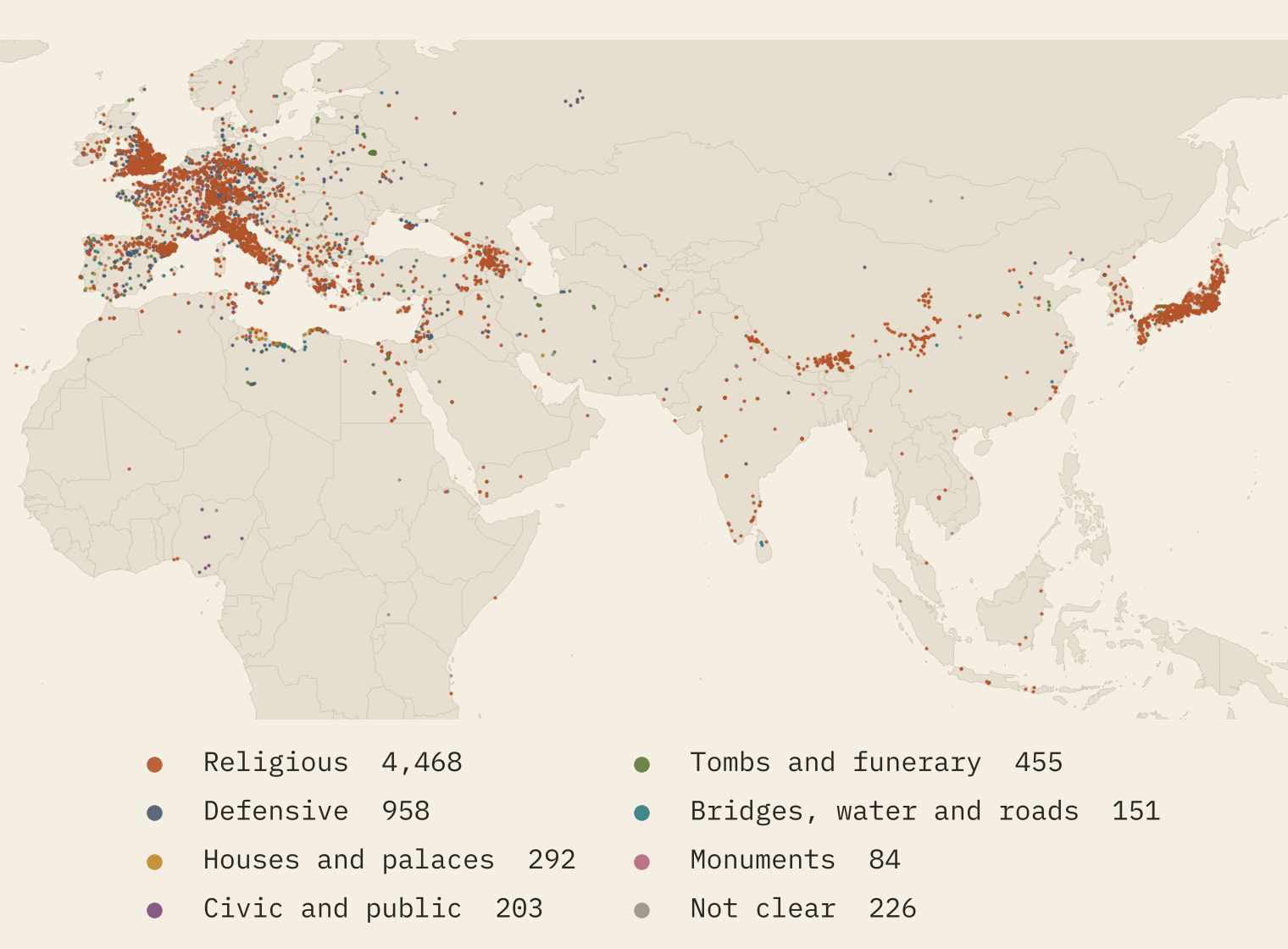
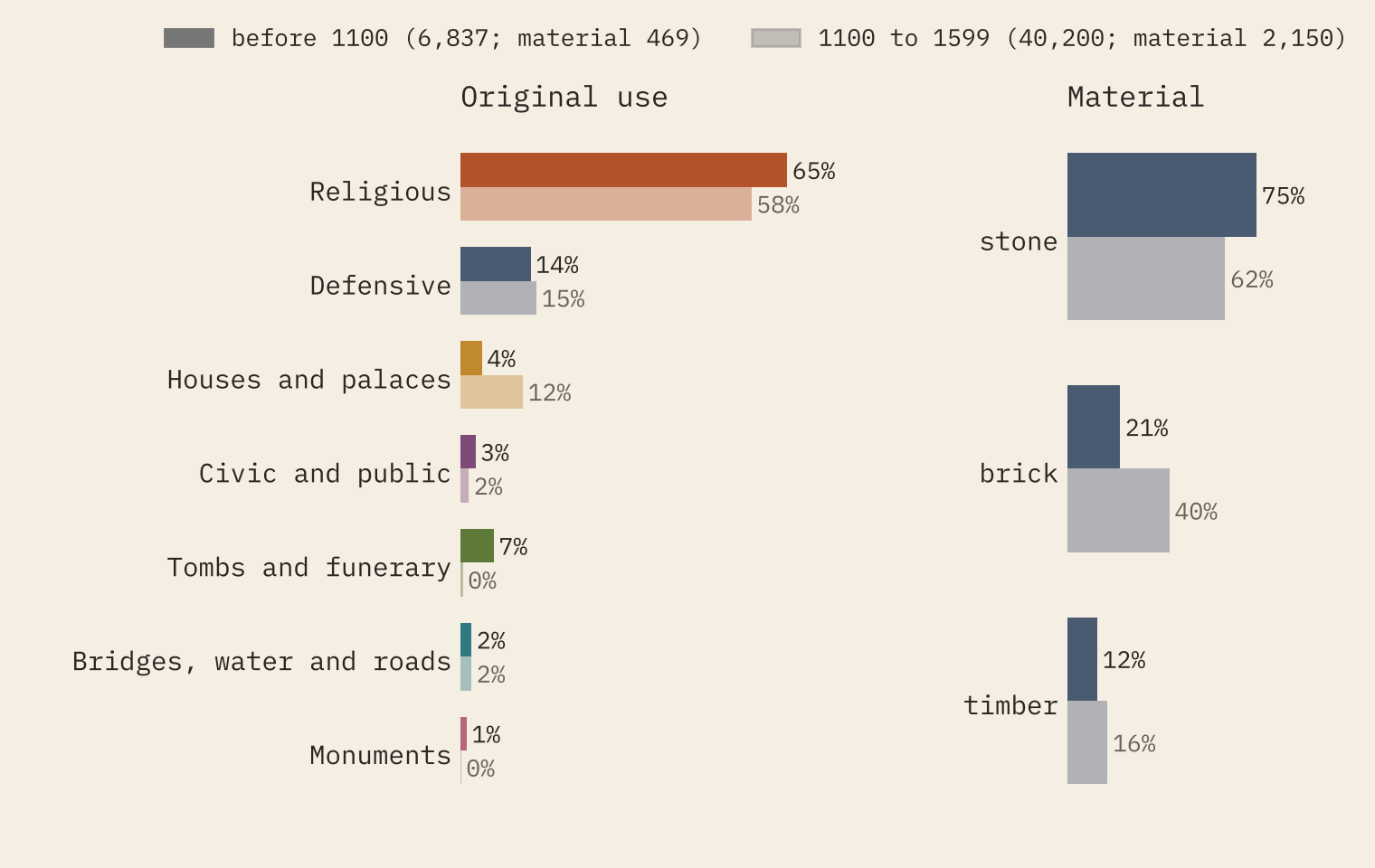
The first thing the map shows is how holy the survivors are. 65% were built for worship: churches, monasteries, mosques, synagogues, and Buddhist, Hindu and Shinto temples and shrines. Castles, forts and walls make up 14%, tombs and burial mounds 7%. Houses and palaces, the buildings people actually lived in, are just 4%.
A health warning before going further. Wikidata is uneven: Japan (1,380), Italy (947) and the United Kingdom (785) hold 46% of the records, and much of the world is thin. So everything below is about shares within the data, not a census of the planet’s old buildings.
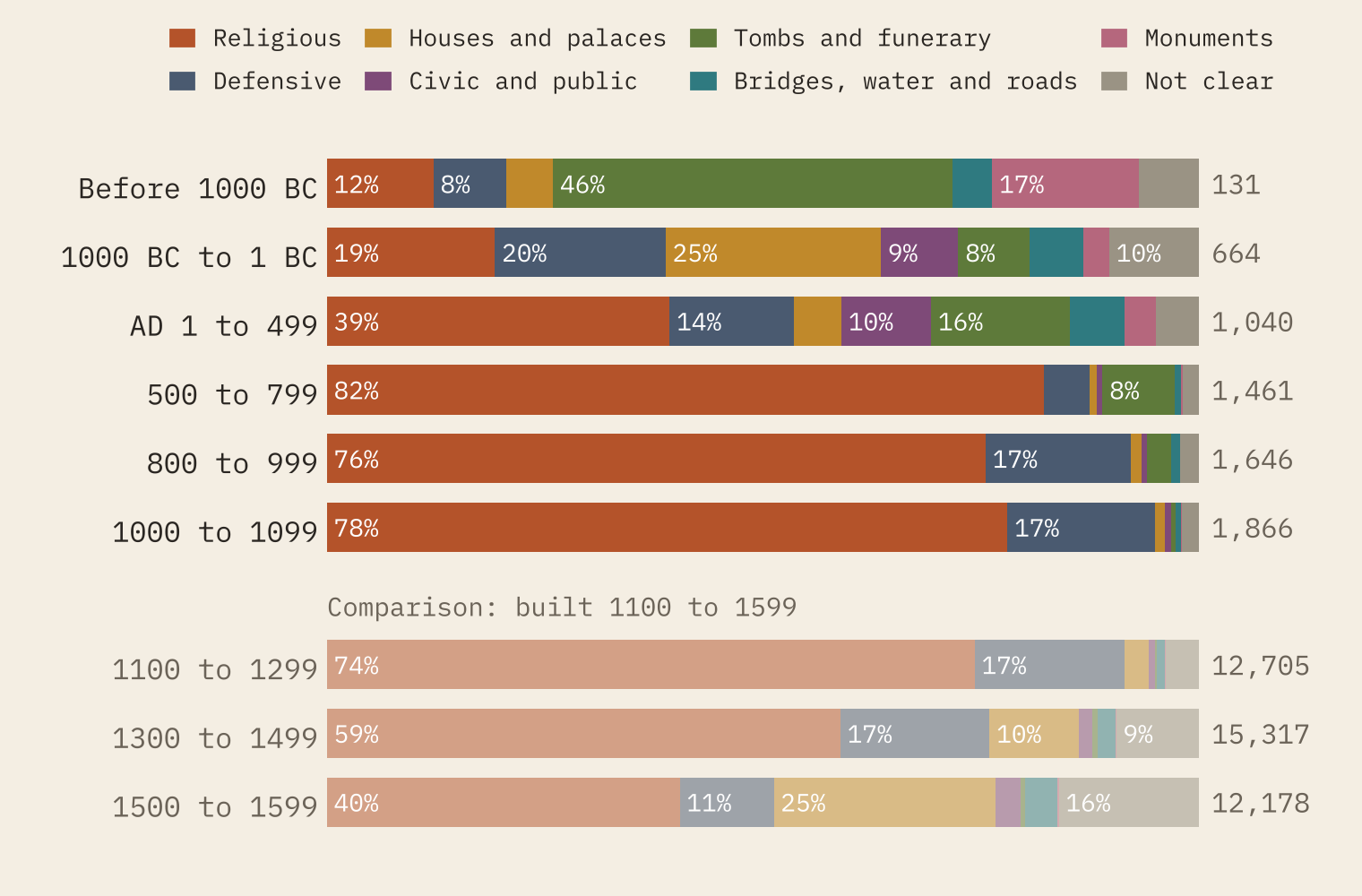
The mix changes with age. The very oldest survivors are mostly tombs and monuments: pyramids, mastabas, obelisks. In the last thousand years before Christ, houses, palaces and forts appear, most of them now ruins. From AD 500 onwards, three quarters or more of everything that survives from each century is religious.
Still doing the job
58% of the survivors still seem to do the job they were built for, and almost all of those (99%) are places of worship. 88% of religious buildings are still in religious use, and only 8% are ruins. Castles almost never still defend anything: 30% are ruins. Houses and palaces fare worst: 72% are ruins or excavated sites.
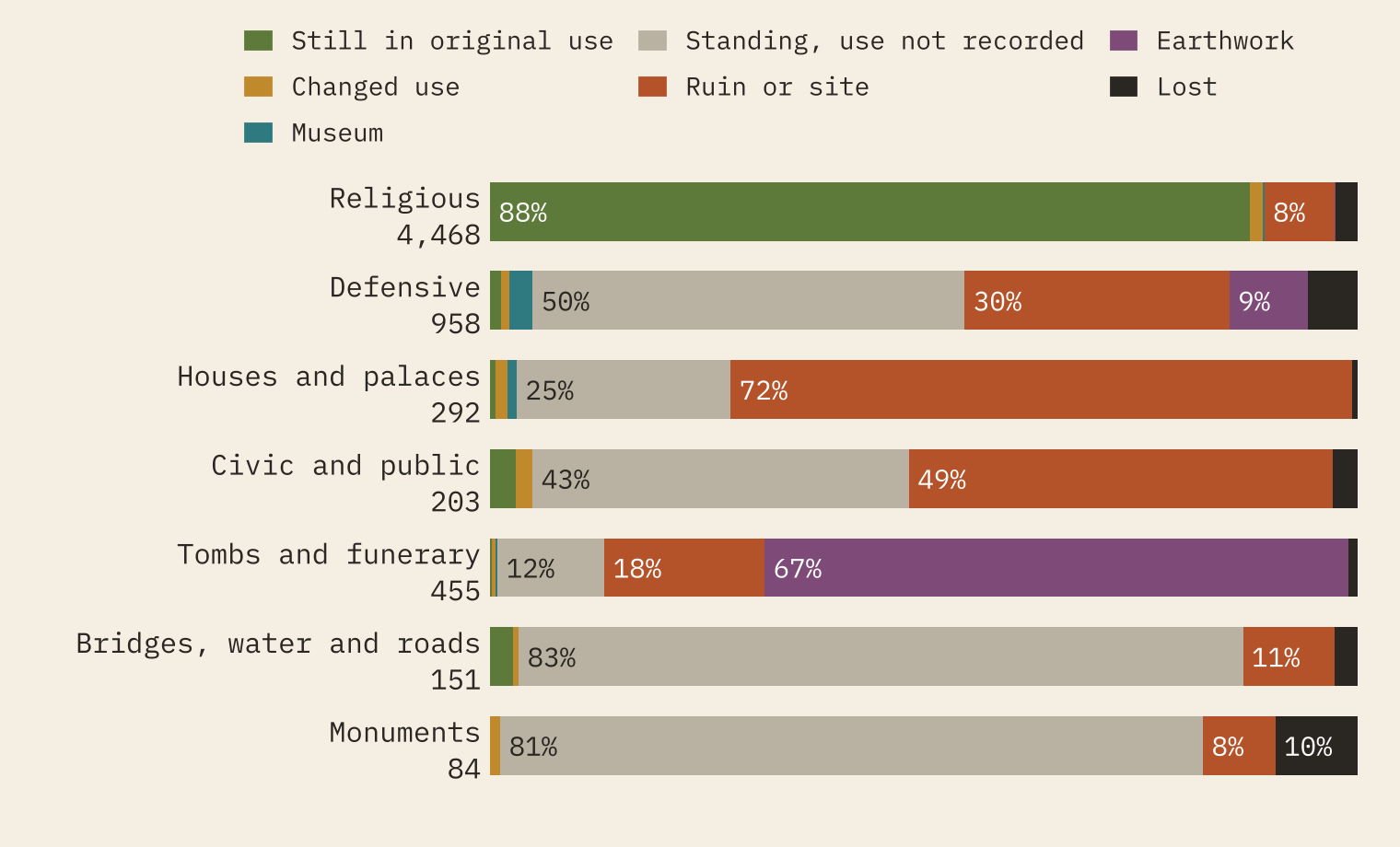
Much of “still in use” is my inference: where Wikidata records no change and no ruin for a religious building, I count it as still in use. A hand check of a random sample, below, supports that for most buildings but not all.
The filter of time
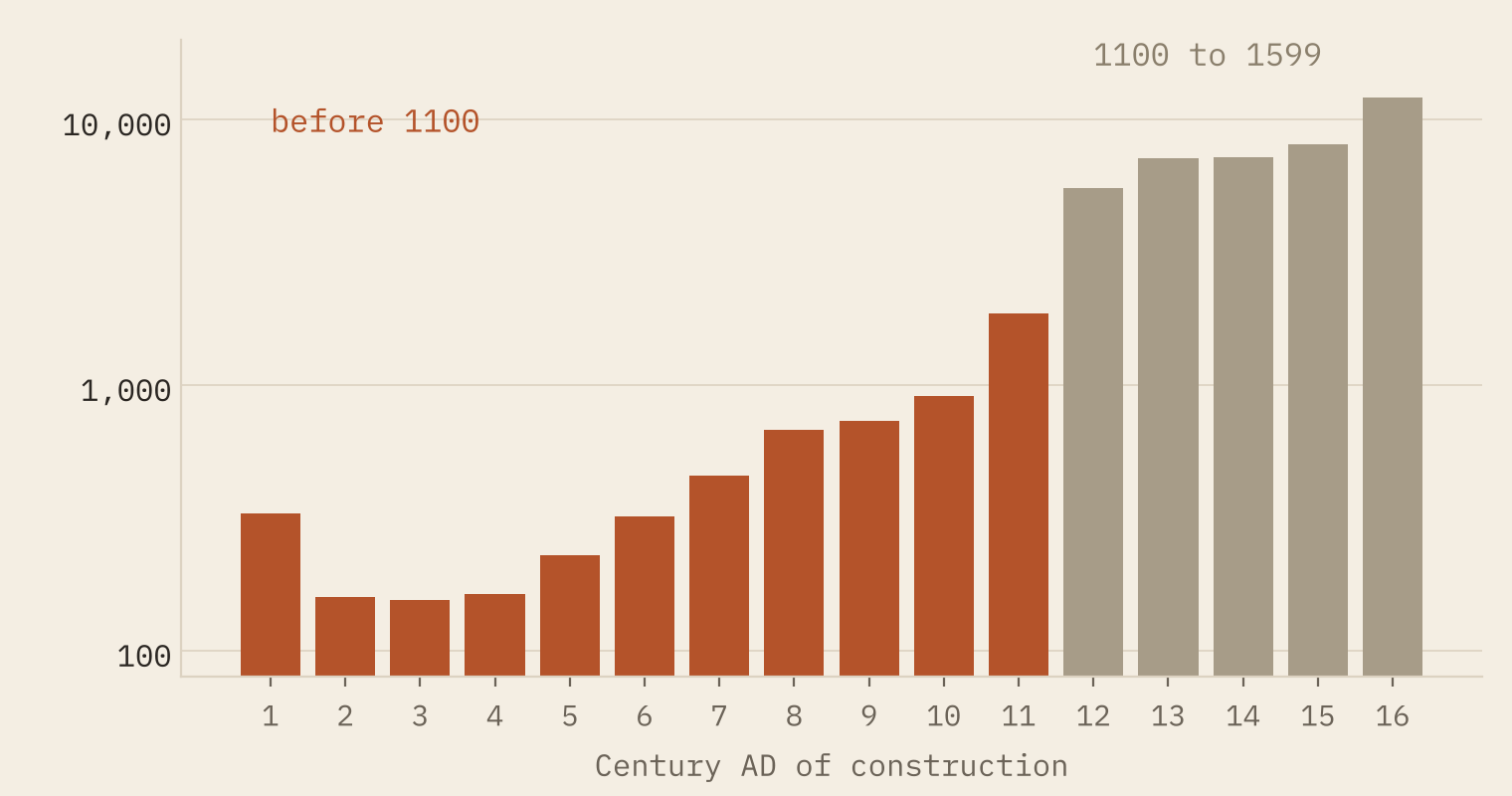
Each older century leaves fewer survivors behind. Wikidata has 12,178 structures begun in the 16th century, 5,526 from the 12th, 1,866 from the 11th and only 330 from the 1st century AD. Some of that slope is people building more, and later buildings being better documented. But the shape is the shape of attrition.
Compare the oldest survivors with the next five centuries and you can see what the filter keeps. Before 1100, 73% of survivors are religious, funerary or commemorative; for 1100 to 1599 it is 59%. Houses and palaces fall from 12% of the later set to 4% of the old one. Where a material is recorded, 75% of the old buildings include stone, against 62% of the later ones, though only 7% of the old set record a material at all.
Indispensable or forgotten
I can only see survivors, so I cannot prove why anything lasted. But comparing them suggests two routes, and they are opposites.
The first is to keep a job that never ends. A church, temple or mosque has a community that needs it every week, mends its roof and stops anyone carting off its stone. A congregation is the best maintenance plan ever invented.
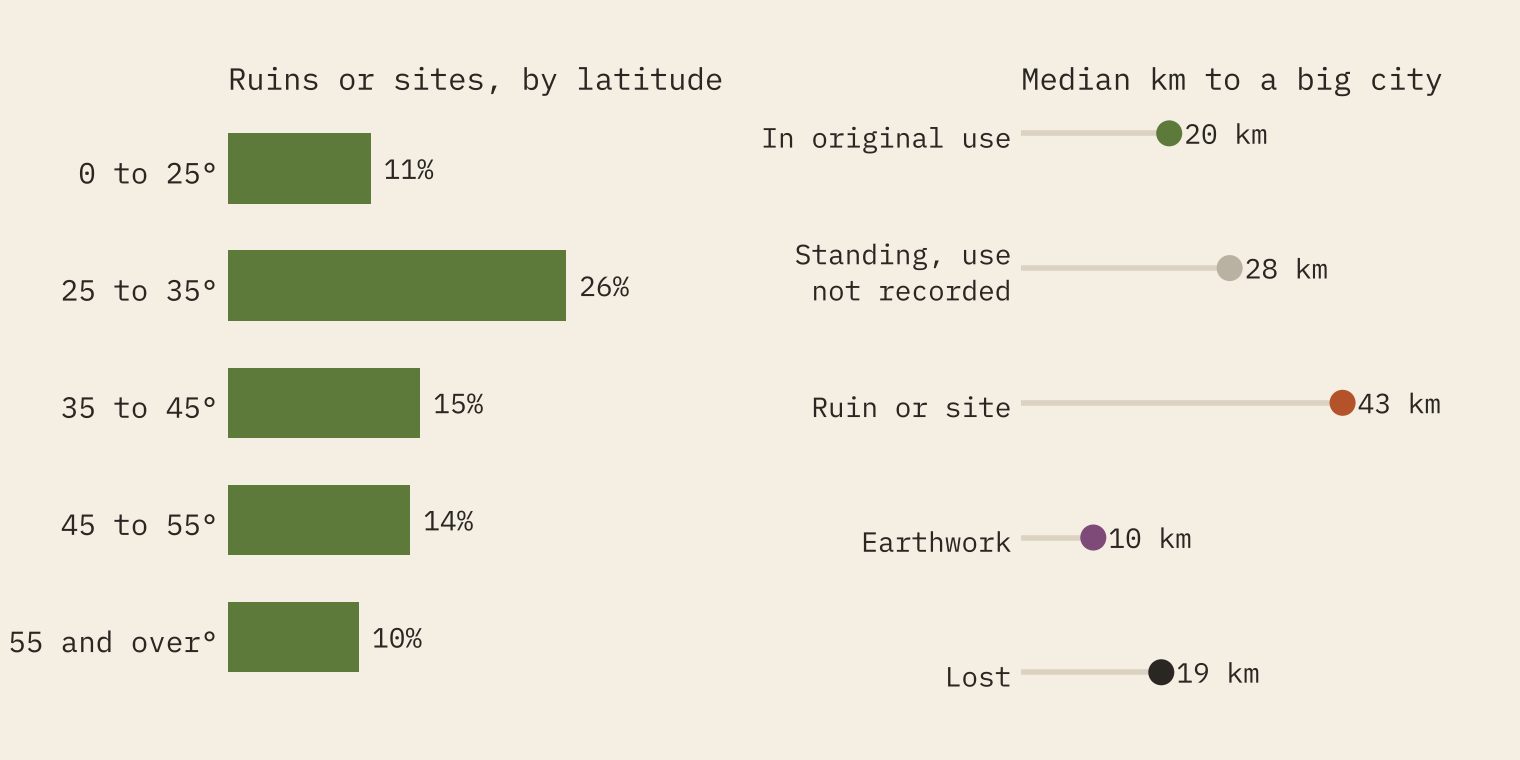
The second is to be left completely alone, somewhere nobody wants your stone. Ruins sit a median 43 km from a modern city of 100,000 people, against 20 km for buildings still in use. In the dry belt between 25° and 35° north, from Morocco to Iraq, 67% of survivors are ruins or sites, against 14% between 45° and 55° north. (One excavated Syrian city, Dura-Europos, inflates that figure; without it, the share is 41%.)
The dangerous place is in between: useful enough to be quarried, not useful enough to be repaired. That is where most of the houses, palaces, forts and public buildings of the ancient world went.
A building survives a thousand years if it is either indispensable or forgotten.
Old names, younger walls
There is a catch. A Wikidata date is often the year a church, monastery or castle was founded, not the date of the walls you can touch. So I drew a random sample of buildings with an English Wikipedia article and checked 32 of them by hand. 14 still have substantial fabric from before 1100. 10 are mostly later buildings standing on an older foundation. For 8 the article does not say.
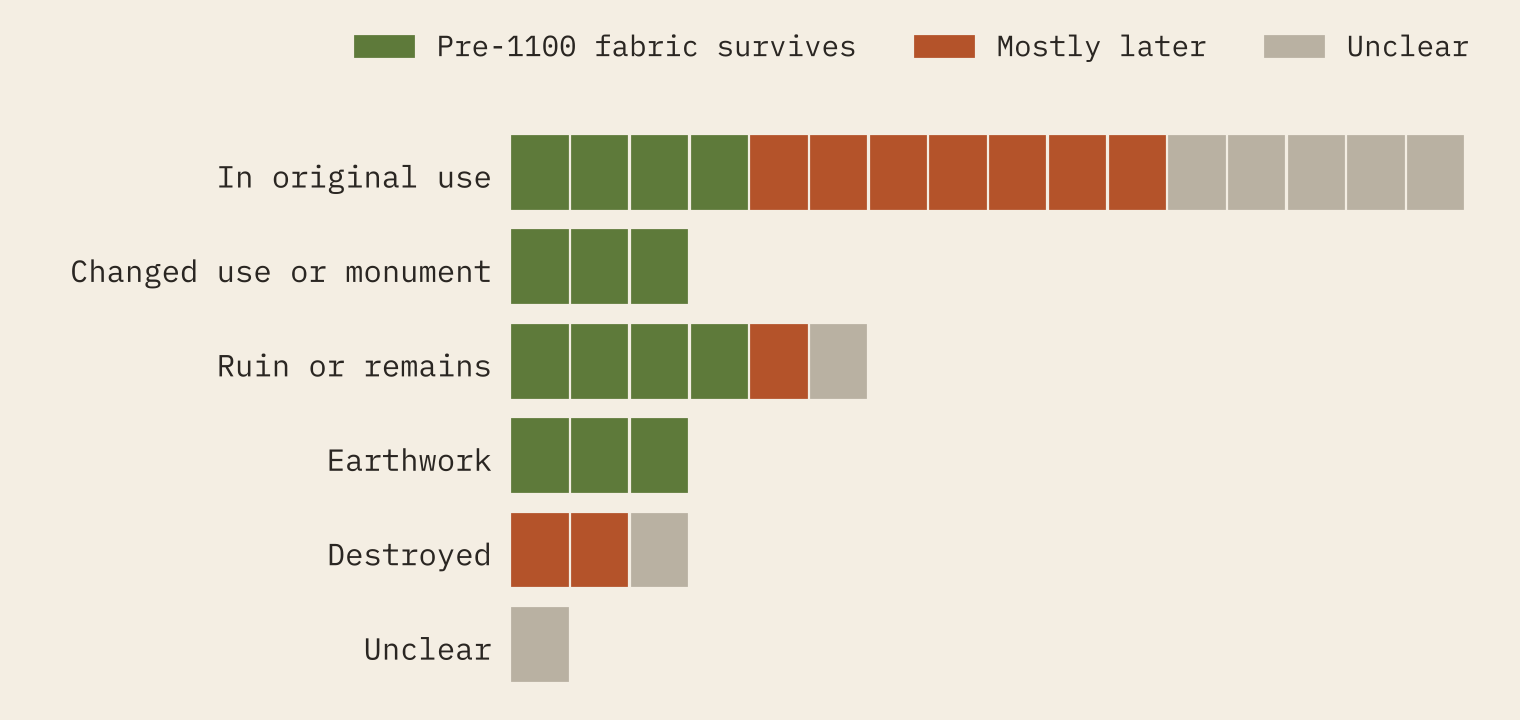
The split is telling. Of the 16 buildings still in their original use, only 4 clearly keep their pre-1100 walls. Of the 12 ruins, earthworks and monuments, 10 do. Use keeps a place alive, but often by replacing the building: Japanese temples rebuilt in timber, English parish churches enlarged in every century, abbeys that burned and rose again. Abandonment keeps the original stones, but as a ruin.
Closer to home
The United Kingdom has 785 records, 661 of them religious, and 62% dated to the 11th century, most only to the century. In north-west England the map is thin: 18 records across Lancashire, Cumbria, Merseyside, Greater Manchester and Cheshire, 5 of them in Lancashire. They include the Roman fort at Ribchester, Lancaster Castle, and the two early churches on the headland at Heysham above Morecambe Bay. One of those shows the limits of the data nicely: Wikidata gives no condition for St Patrick’s Chapel, so my rules count it as standing, but it is a ruin of the 8th or 9th century.
How I did this
I pulled from Wikidata every item classed as an architectural structure with a construction date before 1100 and coordinates, plus a comparison set for 1100 to 1599, using the QLever endpoint on 27 October 2026. I removed 221 items that are objects, places or routes, or have impossible dates. Original use, form, condition and use today come from rules applied to Wikidata’s classes, conservation states, current uses and labels, plus two rules of thumb (classical public buildings and buildings from before Christ count as ruins unless a use is recorded; religious buildings with no sign of change count as still in use). Countries come from Natural Earth and distances from GeoNames. 45% of the dates are only to the century or millennium. Every rule, every item and the full hand check are in the data files.
Notes and sources
- Buildings: Wikidata (CC0), via the QLever endpoint, pulled on 27 October 2026.
- Cities: GeoNames (CC BY 4.0). Countries: Natural Earth (public domain). UK counties: Office for National Statistics (Open Government Licence v3).
- UK comparison: Wikipedia, List of oldest buildings in the United Kingdom, and the Wikipedia articles used in the hand check and for St Patrick’s Chapel, Heysham (CC BY-SA 4.0).
- Paper, data and code: Zenodo and GitHub. Text, figures and derived data CC BY 4.0 (two files with Wikipedia material CC BY-SA 4.0); code MIT.
- I wrote the text, with drafting and editing assistance from Claude (Anthropic), which also helped prepare the analysis code. I reviewed and checked all text and results.

