
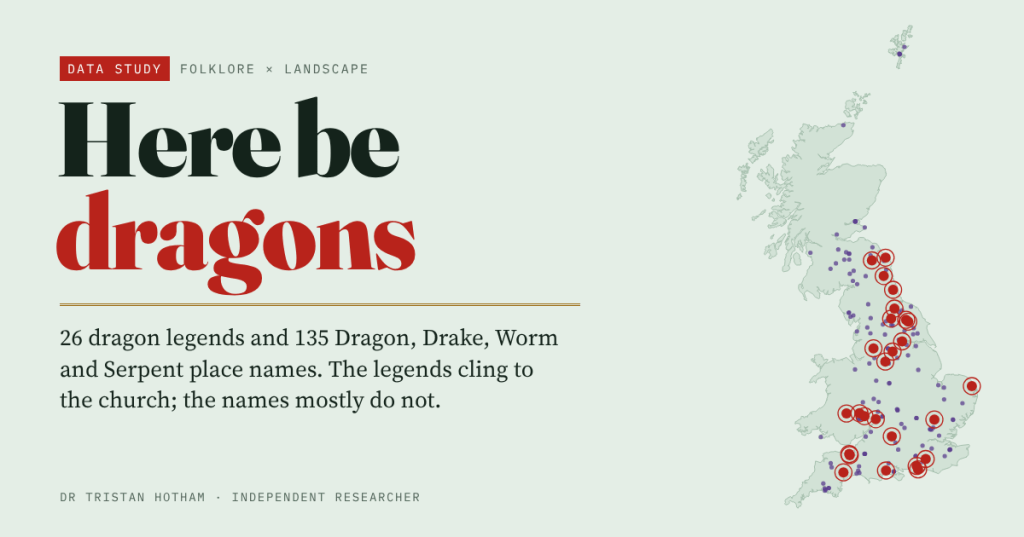
Britain is full of dragons: worms coiled round hills, knuckers in bottomless pools, serpents in the marsh. I put 26 named dragon legends and 135 dragon-word place names on the map to ask a simple question. Does every dragon sit next to a church, a barrow, a hillfort or a river?
Every county seems to have a dragon. The Lambton Worm wrapped itself round a hill above the River Wear. The Knucker of Lyminster lived in a pool so deep that the villagers tied the church bell-ropes together and still could not find the bottom. The Dragon of Mordiford was painted on the wall of the village church until 1811. And the old words are still on the map: Old English draca may lie behind some Drake names and wyrm, which meant dragon as well as serpent and worm, behind some Worm names.
Dragons in these stories keep familiar company. The dragon in Beowulf guards treasure in a burial mound, and two places called Drakelow are explained as “dragon’s mound”. Dragon-slayers end up buried or carved in the parish church. St George and St Michael, the Church’s two great dragon-killers, have churches all over Britain. So I asked the map whether the dragons really do cluster round churches, barrows, hillforts and rivers, or whether that is just how the stories feel.
Two kinds of dragon
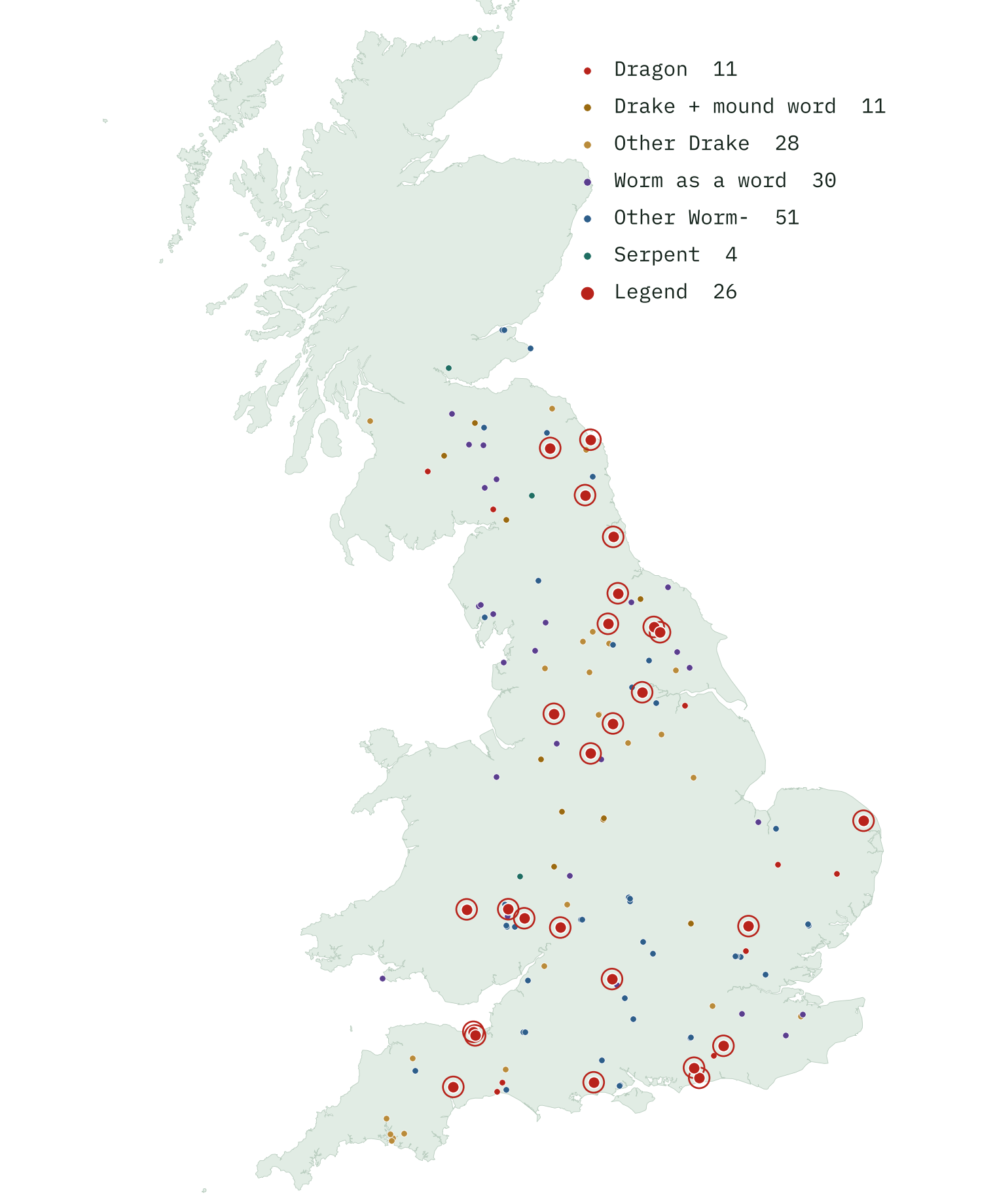
The first kind is the legend: a named story that a written source ties to a place. I collected 29 from Wikipedia and from D. L. Ashliman’s collection of old British dragon texts, and placed 26 of them at the village, hill or wood the source names, from Worm Hill at Fatfield to Shervage Wood in the Quantocks. They are an English crowd (24 of the 26), which says more about my sources than about the dragons.
The second kind is the name: every place in the Ordnance Survey’s open gazetteer whose name contains Dragon, Drake, Worm or Serpent, once the dragonflies, Serpentine lakes and wormwood are set aside. There are 135. Here I had to be careful. A Drake may be a duck or a surname, and many Worm- names may come from a personal name or something else entirely. I sorted them by form only, and counted a name as a real dragon name only when a source said so. Just five names, at four places, passed that test.
To keep the test fair, I compared every legend and name with fifty ordinary places of the same kind (villages with villages, hills with hills) from the same 50 km square, and with fifty random points of land, using 2,000 replicate draws.
The dragon lives by the church
The legends cling to the church. 77% of the legend places lie within 1 km of a church, against 55% of matched places and 34% of random land. The typical legend sits 303 m from a church; the typical matched place, 824 m.
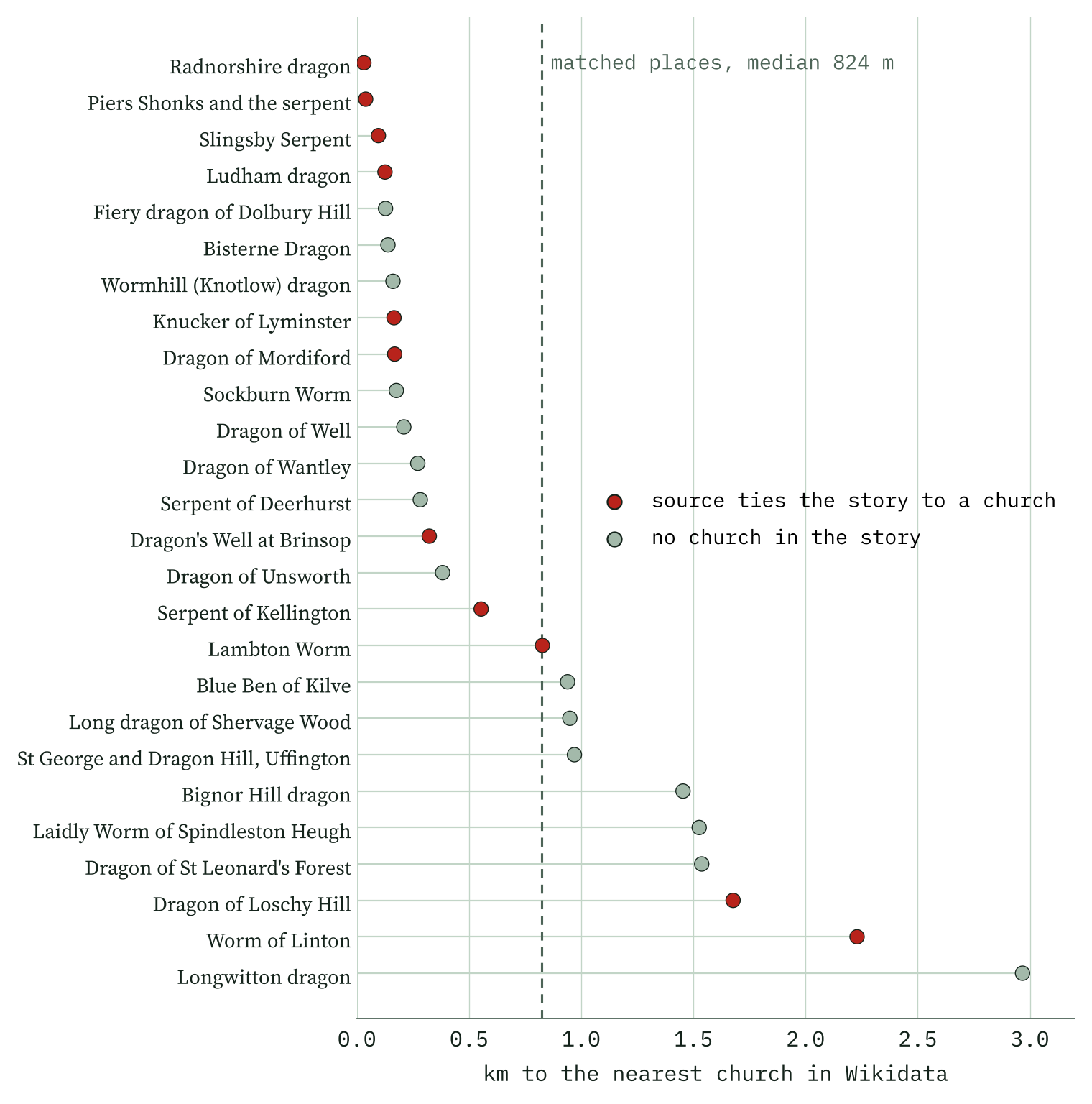
Some of this is how the stories reached us. In eleven of the 26 the source points to a church: the slayer’s tomb at Nunnington, the Slayer’s Slab at Lyminster, the carved stone at Linton Kirk, the dragon that slept on the church tower at Llandeilo Graban. A tomb or a carving is exactly the kind of thing that keeps a story alive long enough for someone to write it down. But the legends with no church in the story sit close to churches too (73% within 1 km, against 51% for their matched places).
The dragons in the stories live where the people lived: in the parish, a short walk from the church.
No closer to the mound, the fort or the water
The other three companions do not turn up. 23% of the legends lie within 2 km of a recorded barrow or burial cairn, against 20% of matched places. For hillforts it is 23% against 18%, and for a named river within 500 m, 19% against 16%. None of those gaps is bigger than luck gives.
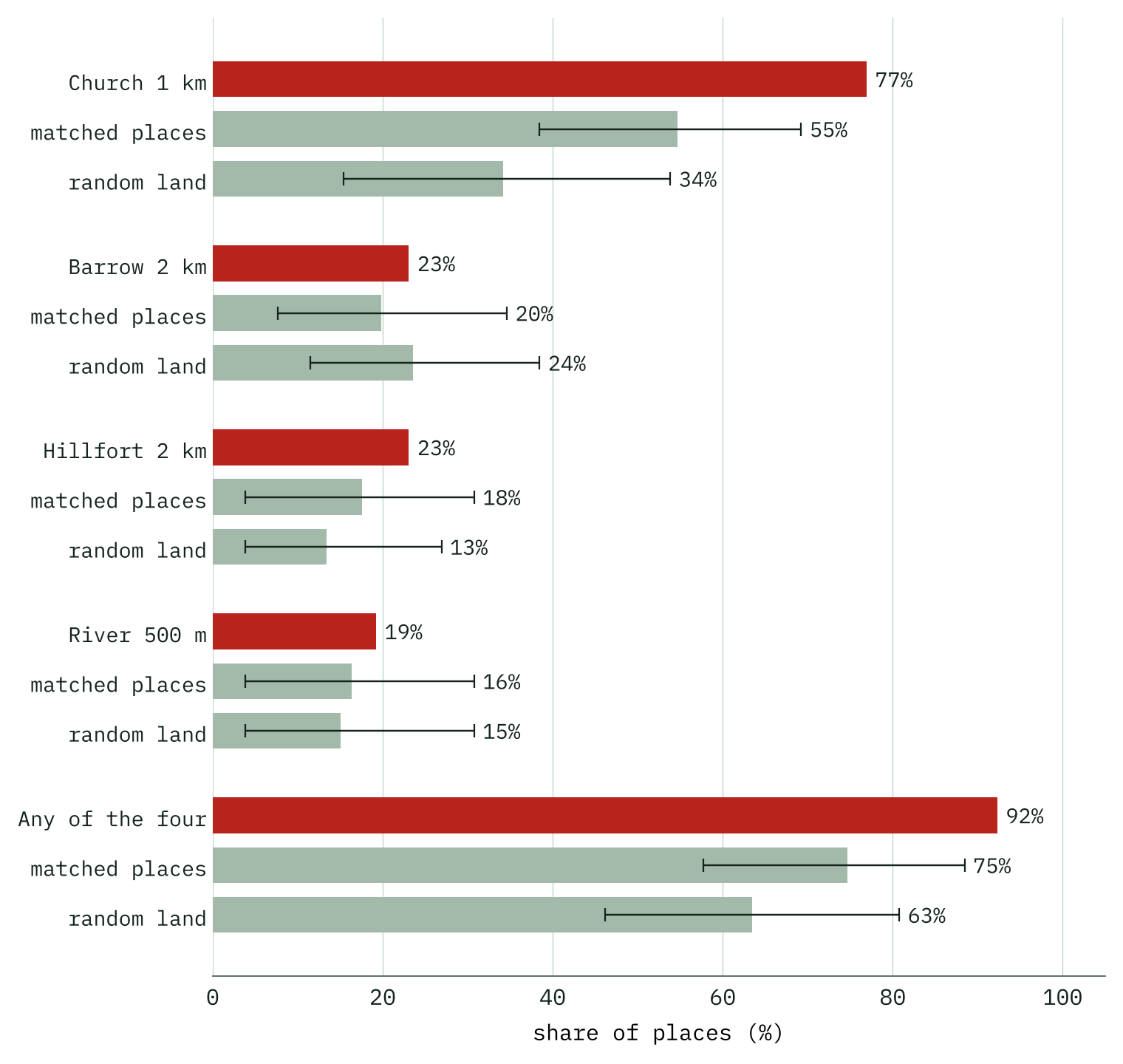
So does every dragon sit next to something? Nearly: 92% of the legends are next to at least one of the four. But 75% of ordinary places are too. Britain is simply crowded with churches, mounds, forts and rivers, and almost all of the dragons’ edge comes from the church.
The names, and a northern barrow
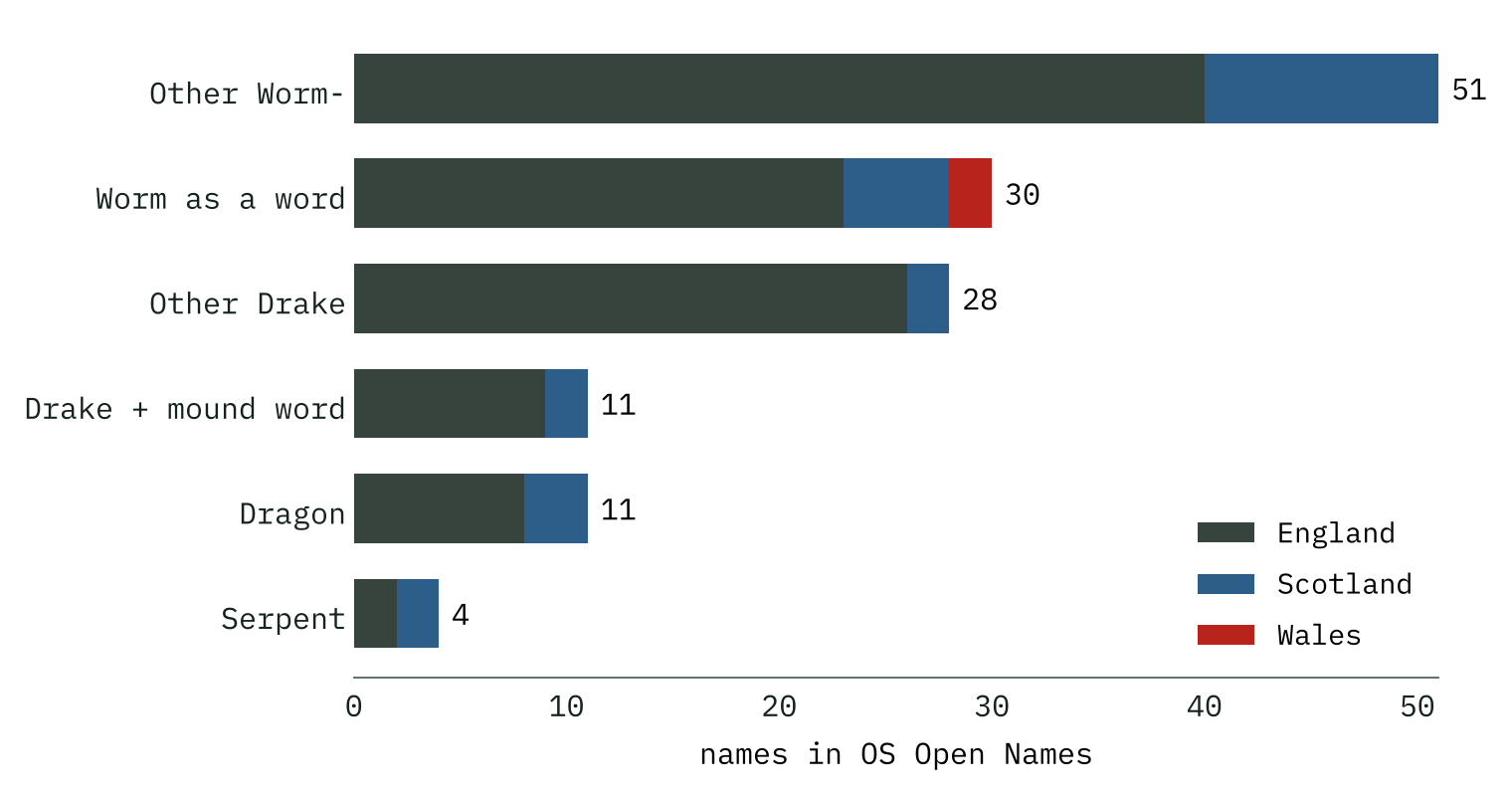
The place names behave differently. As a whole they sit no nearer churches, hillforts or rivers than ordinary names of the same kind, which is what you would expect if many of them have nothing to do with dragons. Their one signal is barrows, and it comes from the north. In the north of England and in Scotland, 33% of the names lie within 2 km of a recorded barrow or cairn, against 16% of matched names. In the south it is 20% against 22%.
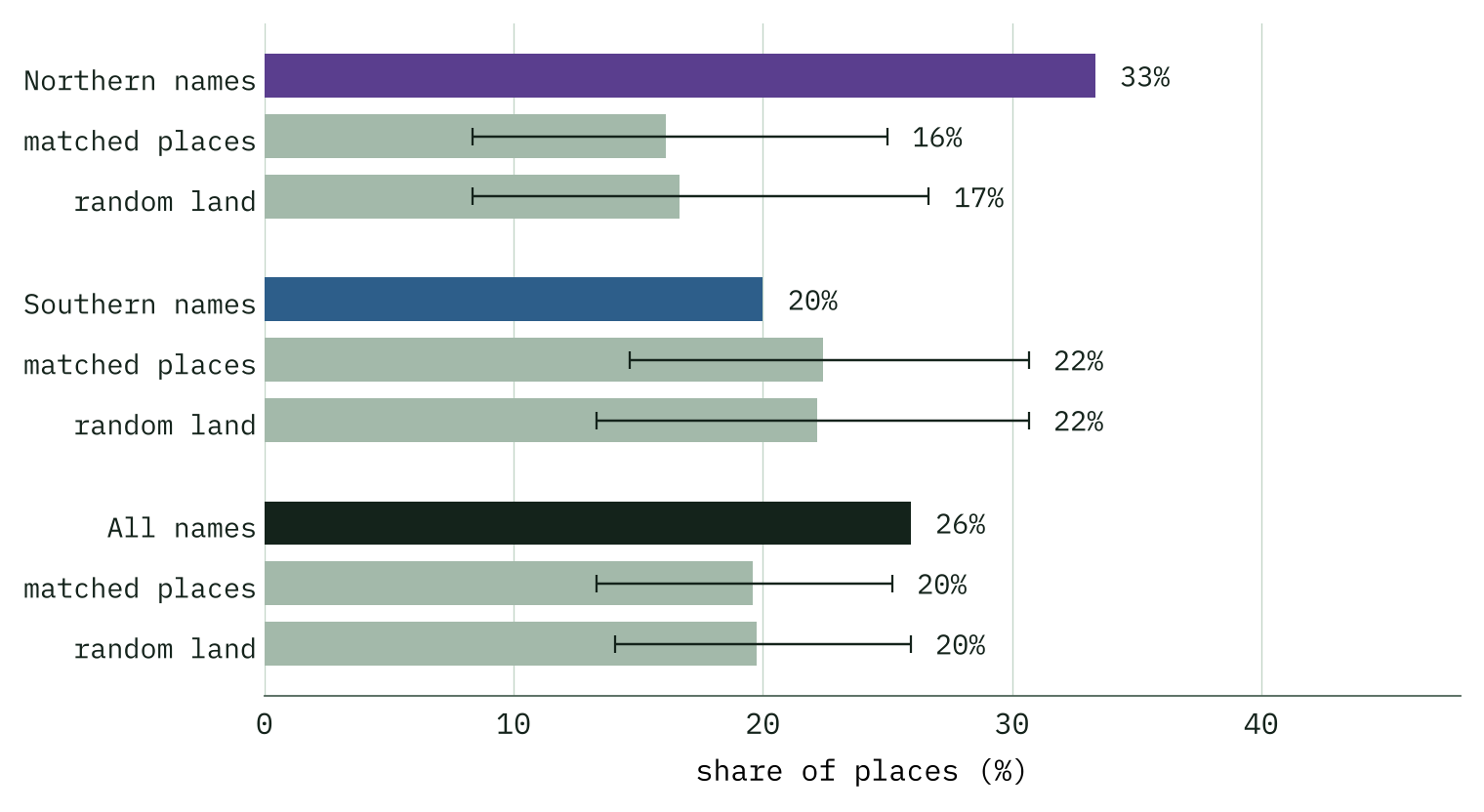
I would not lean on that too hard. Many northern dragon names are hills on high ground, where cairns survive and get recorded. The best single case is lovely, though: Drake Howe on Cringle Moor in North Yorkshire, where the nearest recorded barrow, “Round barrow at Drake Howe”, is 10 m away. And the most famous dragon’s mound of all lets the side down. The Derbyshire Drakelow is 7.3 km from the nearest recorded barrow, and the Worcestershire one 13.8 km. Their mounds, if they were barrows, may have been ploughed away long ago.
Worms of the north, and St George
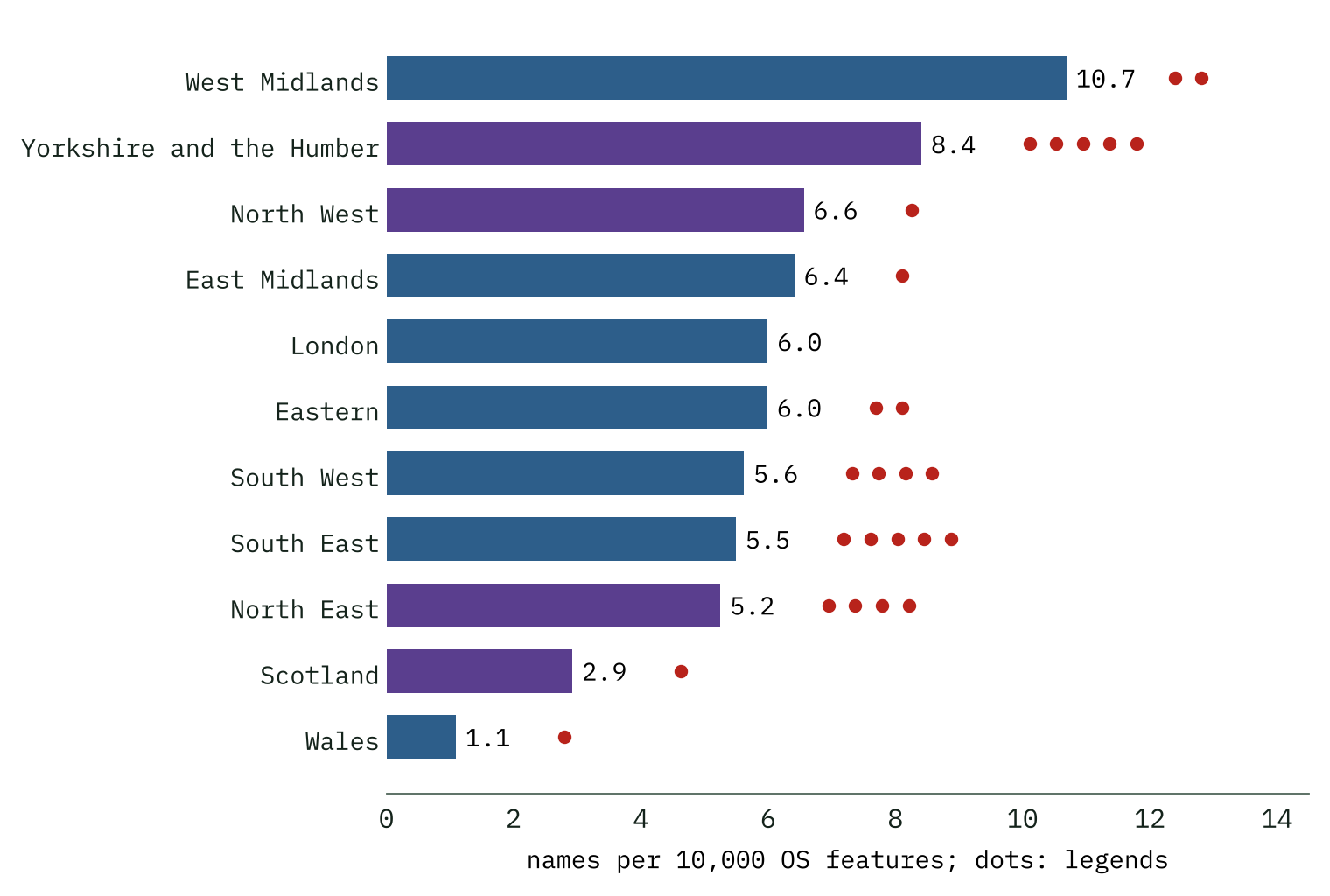
The north-east is famous for worms rather than dragons, and my legends agree: of the five stories whose creature is a worm, four are northern (Lambton, Sockburn, Spindleston Heugh and Linton). The names do not follow. Worm names are about as common in the south as in the north, and the densest region for dragon-word names is the West Midlands, thanks to a cluster of Worm- names in Herefordshire.
And St George? Of the churches within 5 km of a legend, 7.3% are dedicated to St George or St Michael, against 5.4% near the matched places and 3.9% of all churches in Britain. That is a small tilt, not a rule. The best case is one the source spells out: at Brinsop in Herefordshire, the Dragon’s Well lies on the south side of the church, and the church is dedicated to St George. Most British dragons, though, were killed by local knights and heroes, not by saints.
How I did this
Legends come from the English Wikipedia list of dragons and the articles on individual legends, and from D. L. Ashliman’s British Dragons texts; for each I recorded the phrase that names its place and placed it with OS Open Names. Names are OS Open Names features with words beginning Dragon, Drake, Worm or Serpent. Churches are the 36,435 church buildings in Wikidata, barrows the 12,387 OpenStreetMap and Wikidata records from my barrows study, hillforts the 3,610 sites in the Atlas of Hillforts, and rivers come from OS Open Rivers.
The caveats matter. The legends are few, mostly English, and favour stories with a church monument. A legend placed at a village shares its church, which is why the controls are villages too. The names are not etymologies: most may have nothing to do with dragons. Wikidata’s churches are of every date, and barrow records vary a lot from place to place. River crossings, which matter in several stories, could not be tested. And I ran 13 measures on many groups, so a single borderline result should be taken lightly. The church result for the legends is the one I would put money on.
Notes and sources
- Legends: Wikipedia, List of dragons in mythology and folklore and the articles on individual legends (CC BY-SA 4.0); D. L. Ashliman, British Dragons, Folklore and Mythology Electronic Texts, University of Pittsburgh.
- Place names and rivers: OS Open Names and OS Open Rivers. Contains OS data © Crown copyright and database right 2026, Open Government Licence v3.0.
- Churches: Wikidata, CC0, with dedications as parsed in Whose Church Is It?
- Barrows: © OpenStreetMap contributors, ODbL, and Wikidata, via Is the Barrow a European Thing?
- Hillforts: Lock, G. and Ralston, I. (2017) Atlas of Hillforts of Britain and Ireland, CC BY-SA 4.0, as used in Within Sight.
- The same matched-name method: Gallows Hill.
- Paper, data and code: Zenodo and GitHub.
- I wrote the text, with drafting and editing assistance from Claude (Anthropic), which also helped prepare the analysis code. I reviewed and checked all text and results.

