
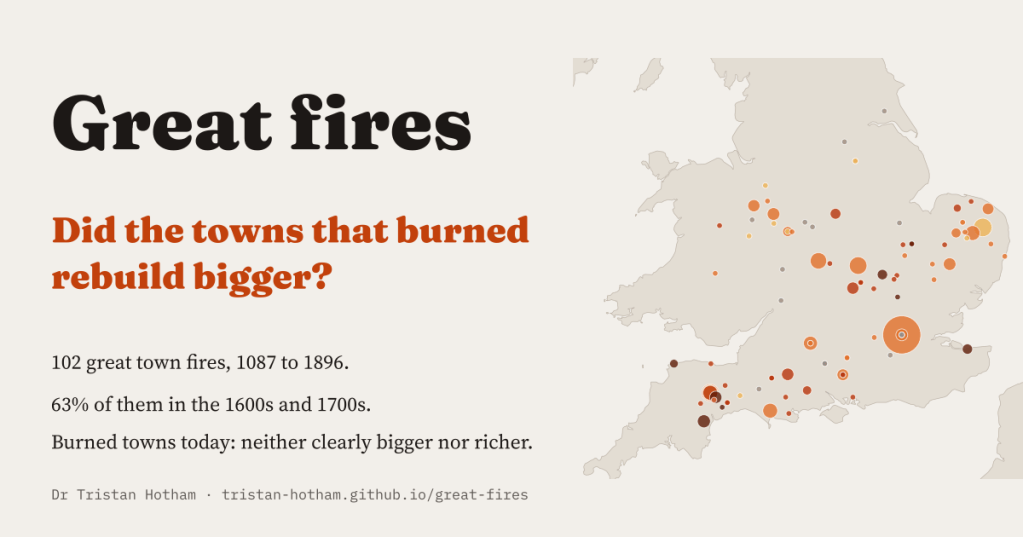
Before 1900, town after town in England burned. Several rose again as the handsome Georgian towns we admire today. I read every fire in Wikipedia’s town articles to ask a blunt question: did the towns that burned end up bigger?
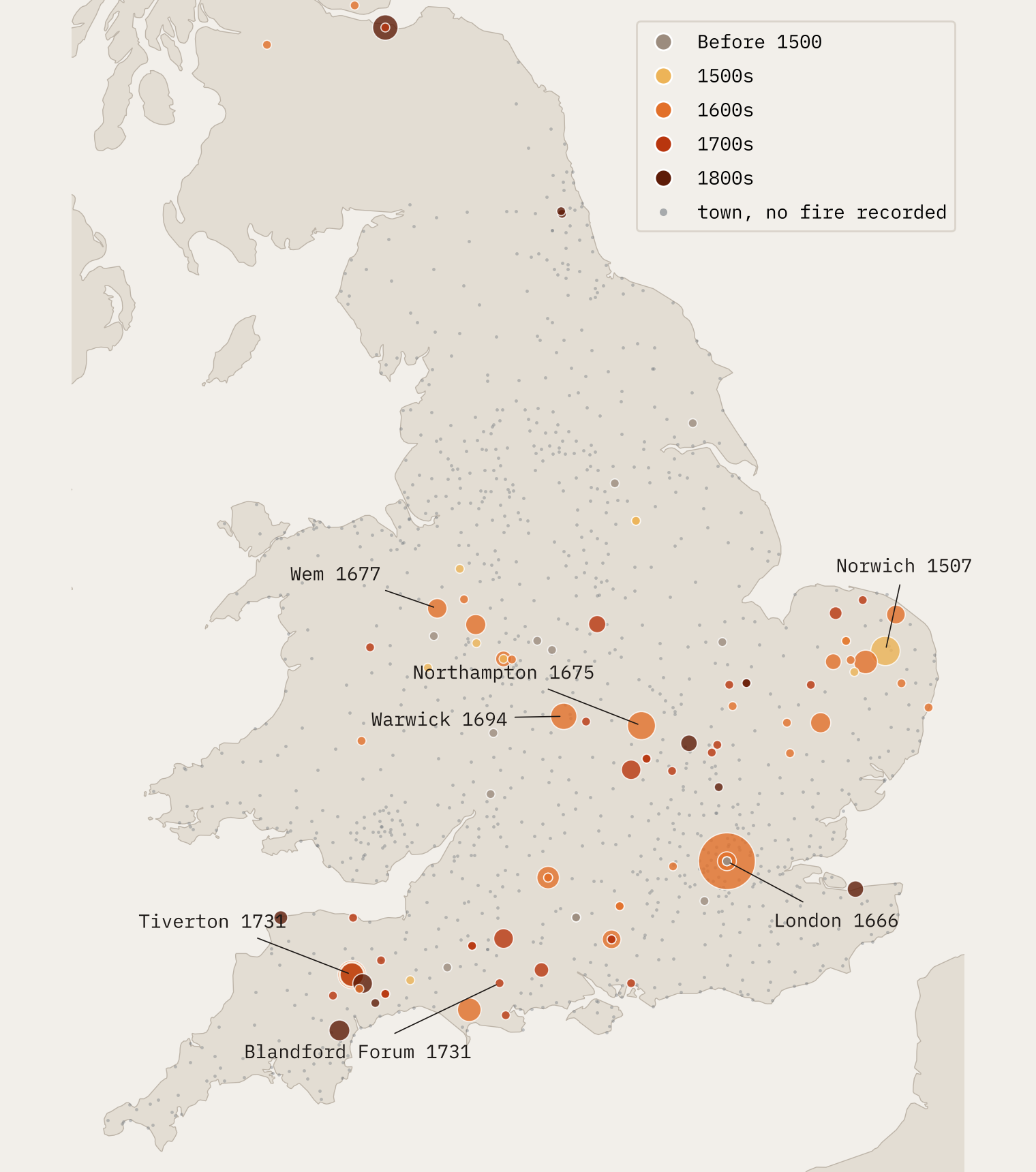
Walk down the main street of Blandford Forum and almost everything you see dates from after 4 June 1731, the day the town burned. Warwick, Northampton, Wareham and Tiverton tell a similar story: a dry summer, a spark in a thatched roof, a strong wind, and a town gone in an afternoon. Then an Act of Parliament, a public appeal, and a new town in brick and tile.
It is tempting to think the fire did these towns a favour. They got wide streets, fireproof houses and fine public buildings. So I wanted to know whether, three centuries on, the towns that burned are any bigger or richer than towns that never did.
A record of fires remembered
There is no open list of English town fires, so I made one. I took the 1,681 Wikipedia articles linked from the lists of towns in England and Wales and of UK cities, pulled out every sentence that mentions fire or burning (2,213 of them), and read the 457 that carry a year before 1900. I counted a fire only if the text gives a year and describes damage to the town as a whole: most of the town, a third of it, the “Great Fire of” the town, or 20 or more houses. Burnings by French raiders, Scottish armies and Civil War soldiers went into a separate pile, as did single churches, mills and inns.
That gave me 102 great fires in 81 towns, 97 of them in England and Wales, from London in 1087 to Ilfracombe in 1896.
The age of fire
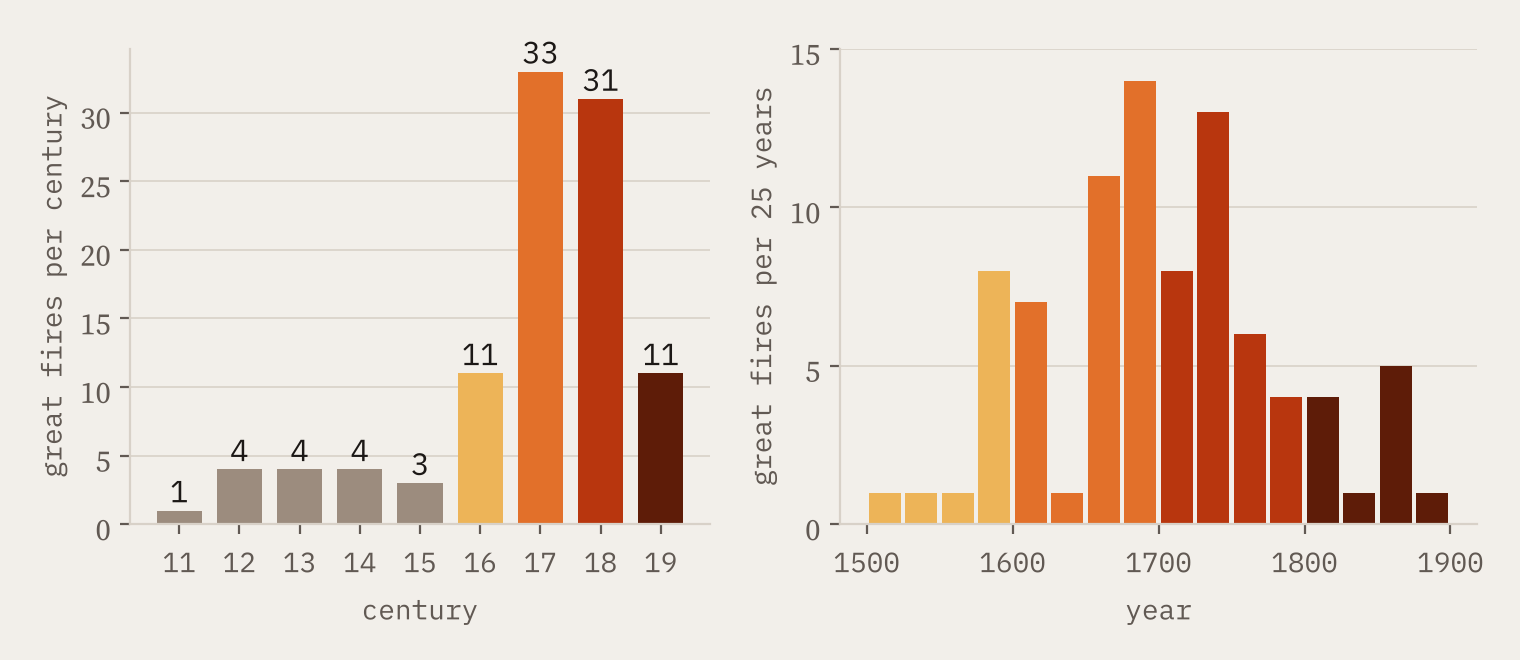
The record peaks in the 1600s, with 33 great fires, and the 1700s are close behind with 31. Between them the two centuries hold 63% of all the fires. The busiest stretch is 1675 to 1699, with 14. After 1800 the fires fade, as brick, tile and slate replaced timber and thatch and towns bought engines and insurance.
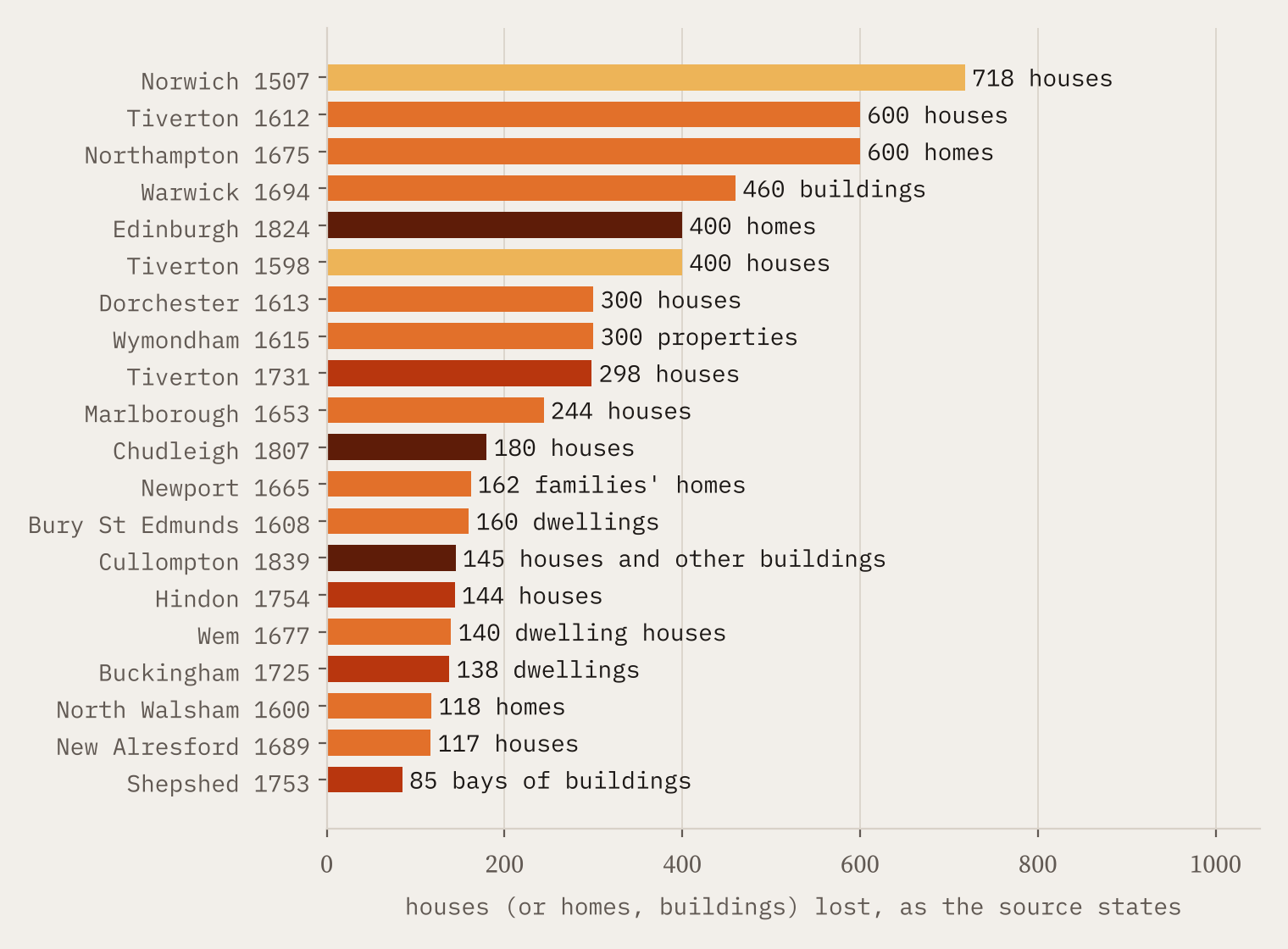
Some of the numbers are staggering. London lost about 13,200 houses in 1666. Norwich lost 718 in 1507, by one historian’s count about 40% of the city. Northampton lost about 600 homes in 1675, and Tiverton burned three times, losing 298 houses in 1731 alone. At Wem in 1677 a fourteen-year-old girl dropped a candle while fetching fuel and 140 dwelling houses burned.
A southern disaster
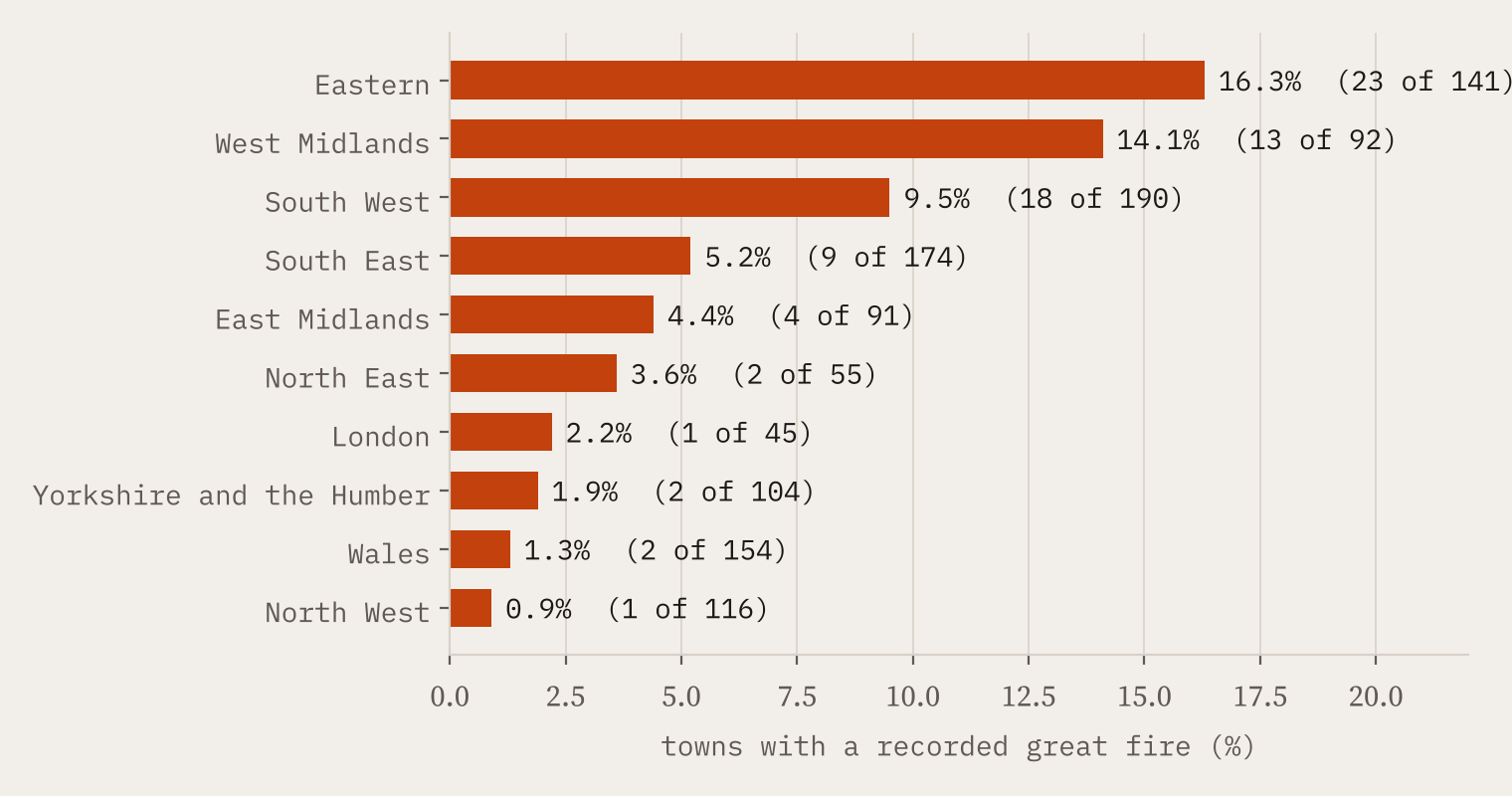
The fires belong to the old market towns of the South, the Midlands and East Anglia. In the Eastern region 16% of towns have a great fire in the record. In the three northern regions it is just 5 of 275 towns. That makes sense: before the mills, the North had few towns big enough to burn, and many of its towns today were villages in the age of the great fires.
Did they rebuild bigger?
At first sight, yes. The 71 burned towns I could compare (outside Greater London) have a median 2021 population of 13,816, against 12,248 for the 1,008 towns without a great fire. But the burned towns were different long before any fire. 92% of them sit on or next to a place in Domesday Book, against 63% of the others, many of which are mill towns, resorts and new towns. Old towns burned because they were old towns.
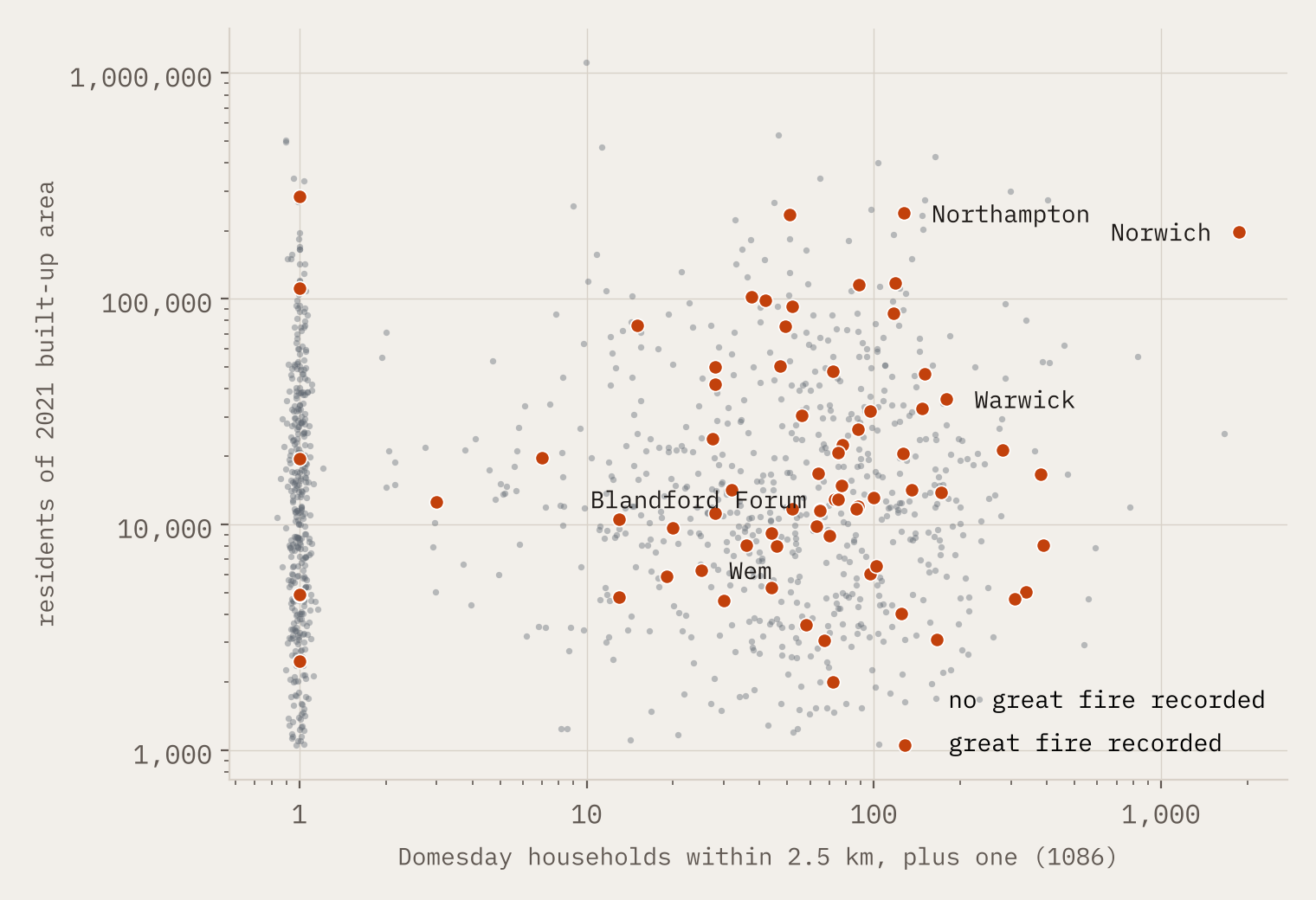
So I compared each burned town with similar towns: same region, similar Domesday footprint. The burned towns come out about 24.8% bigger, but the uncertainty runs from -6.4% to +66.4%, which comfortably includes no difference at all. Paired one to one with their closest match, 40 of 71 burned towns are bigger: about what you would get by tossing a coin.
And there is a catch. The burned towns have Wikipedia articles 1.50 times as long. Better known towns get longer articles, and longer articles are more likely to mention a fire. Allow for that, or compare only towns described as market towns, and the burned towns’ edge disappears (-6.1% and -2.9%).
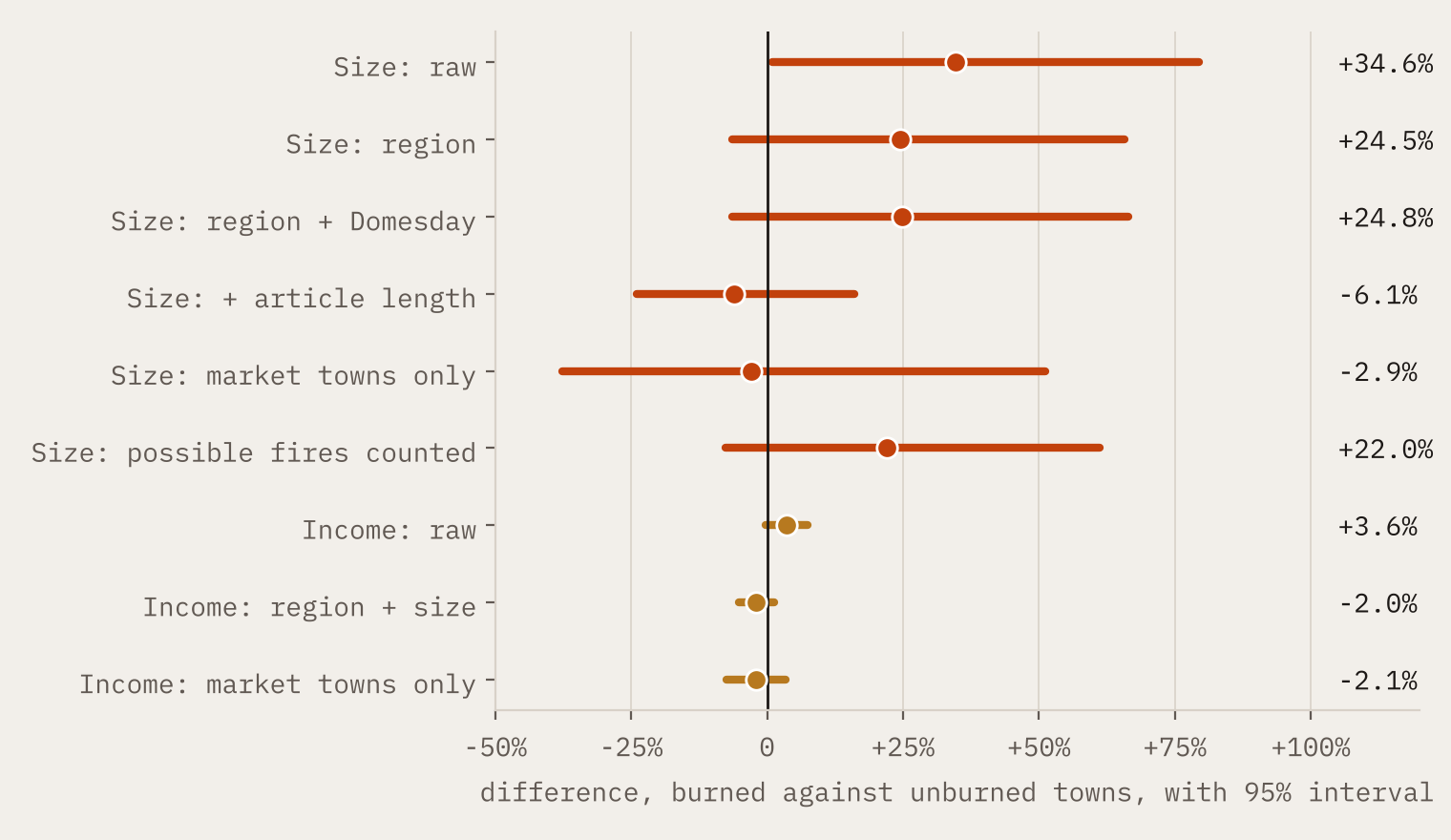
Household income tells the same story. Allowing for region and size, burned towns differ by -2.0% (95% interval -5.2% to +1.3%). If anything they are a touch poorer than their matches, but not reliably so.
The fires made some of England’s loveliest streets. They did not, on this evidence, make the towns that burned any bigger.
That fits what economists have found for far bigger shocks: cities flattened by wartime bombing tended to return to their old place in the urban ranking. A great fire destroyed a town’s houses, but not the reasons it was there: the market, the river crossing, the road. What the fire changed was the look of the place. In 14 burned towns, the Wikipedia fire sentences themselves link today’s streets to the rebuilding.
How I did this
This is a record of fires remembered in Wikipedia articles, not a complete list of the fires that happened. Many town fires will be missing, and the record leans towards well documented towns. I read every dated fire sentence and applied a written rule, keeping a review note for each fire; 25 fires whose scale was unclear and 30 war burnings are in the data but not counted. Town sizes come from Census 2021 built-up areas, income from the ONS small area estimates for the financial year ending 2023, and the early baseline from Domesday Book. The comparisons leave out Greater London. These are associations, not causes. The paper sets out every step and check.
Notes and sources
- Fires: English Wikipedia town articles, List of urban fires, Early fires of London and articles on individual great fires (CC BY-SA 4.0), retrieved 27 October 2026.
- Historical town populations: Wikipedia, List of towns and cities in England by historical population (CC BY-SA 4.0).
- Domesday households: Hull Domesday Project (Professor J.J.N. Palmer, George Slater and the University of Hull, CC BY-NC-SA).
- 2021: Office for National Statistics, Census 2021 and income estimates for small areas, financial year ending 2023 (Open Government Licence v3.0); built-up areas and lookups from the ONS Open Geography Portal; OS Open Names. Contains OS data © Crown copyright and database right 2026.
- Listed buildings: Wikidata (CC0). Coastline: Natural Earth.
- Paper, data and code: Zenodo and GitHub.
- I wrote the text, with drafting and editing assistance from Claude (Anthropic), which also helped prepare the analysis code. I reviewed and checked all text and results.

