
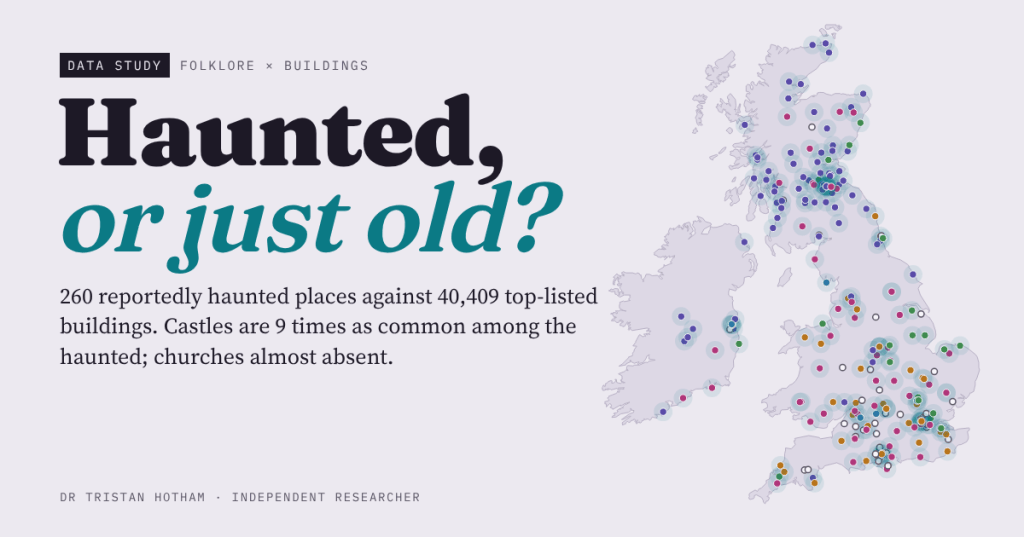
Britain is said to be the most haunted country on earth, and the usual explanation for any haunting is that the place is old. I put 260 reportedly haunted places on the map and set them against Britain’s most important old buildings. Is a haunted place just an old place?
Ask why a place is haunted and you will usually be told that it is old. Old walls have seen more deaths, more grief and more secrets; old stairs creak and old rooms are cold. If that were the whole story, the places people call haunted should look like a fair sample of the country’s old buildings: the same kinds of building, of the same age, spread across the map in the same way.
So I tested it. English Wikipedia files 260 places in Britain and Ireland as “reportedly haunted”, in its categories and lists. I placed each one, sorted it by kind (castle, house, inn, church, theatre, gaol, airfield, road, wood) and dated it where I could. Then I set them against the 40,409 Grade I, Grade II* and Category A listed buildings in Wikidata, the buildings the heritage lists rank highest, and against Britain’s pubs and castles.
One thing first. Wikipedia’s list is a record of stories that someone told, wrote down and added to an encyclopedia with a source. It tells us about ghost stories and the people who write them down. It says nothing about whether ghosts exist.
Where the ghosts are
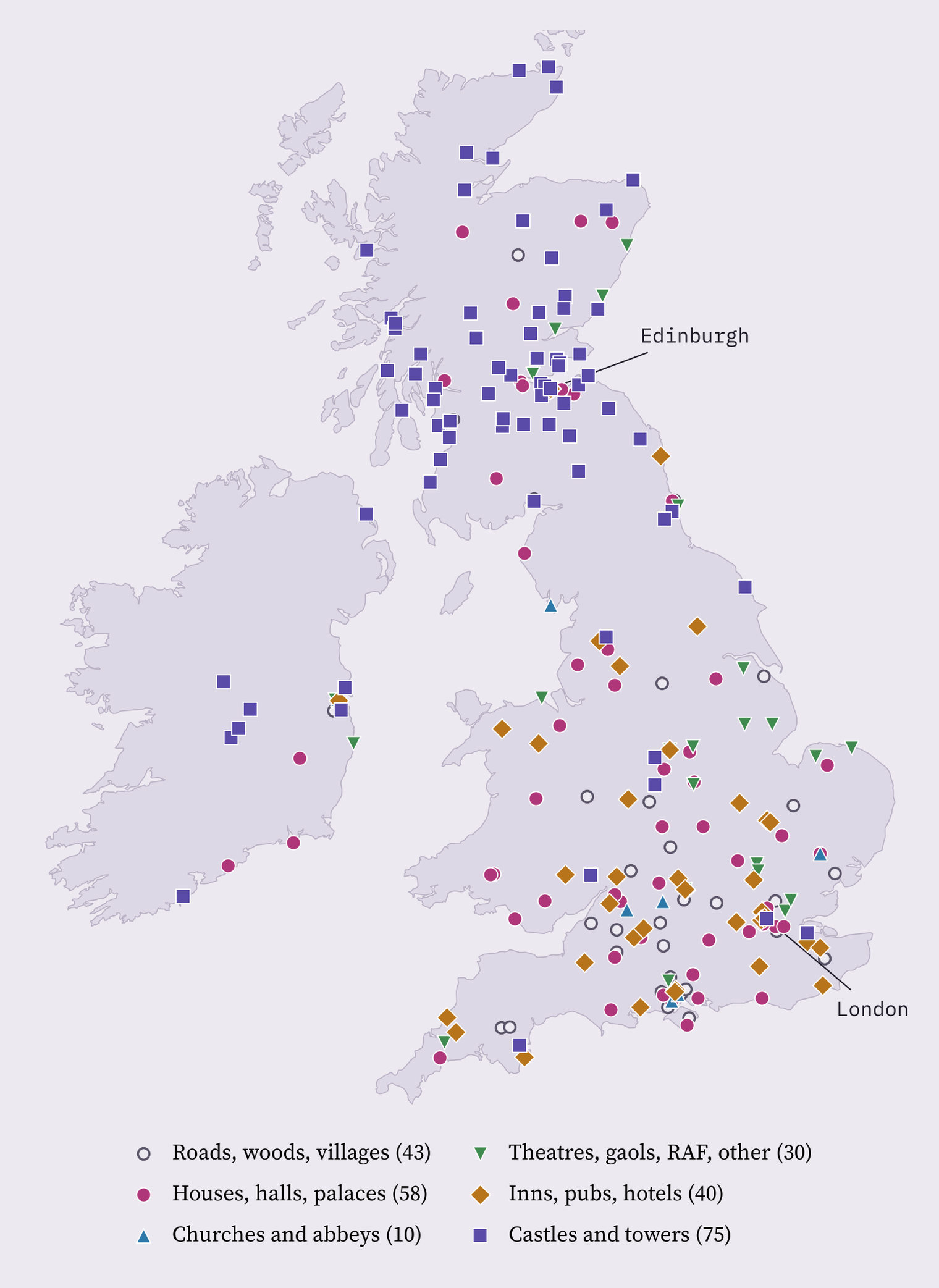
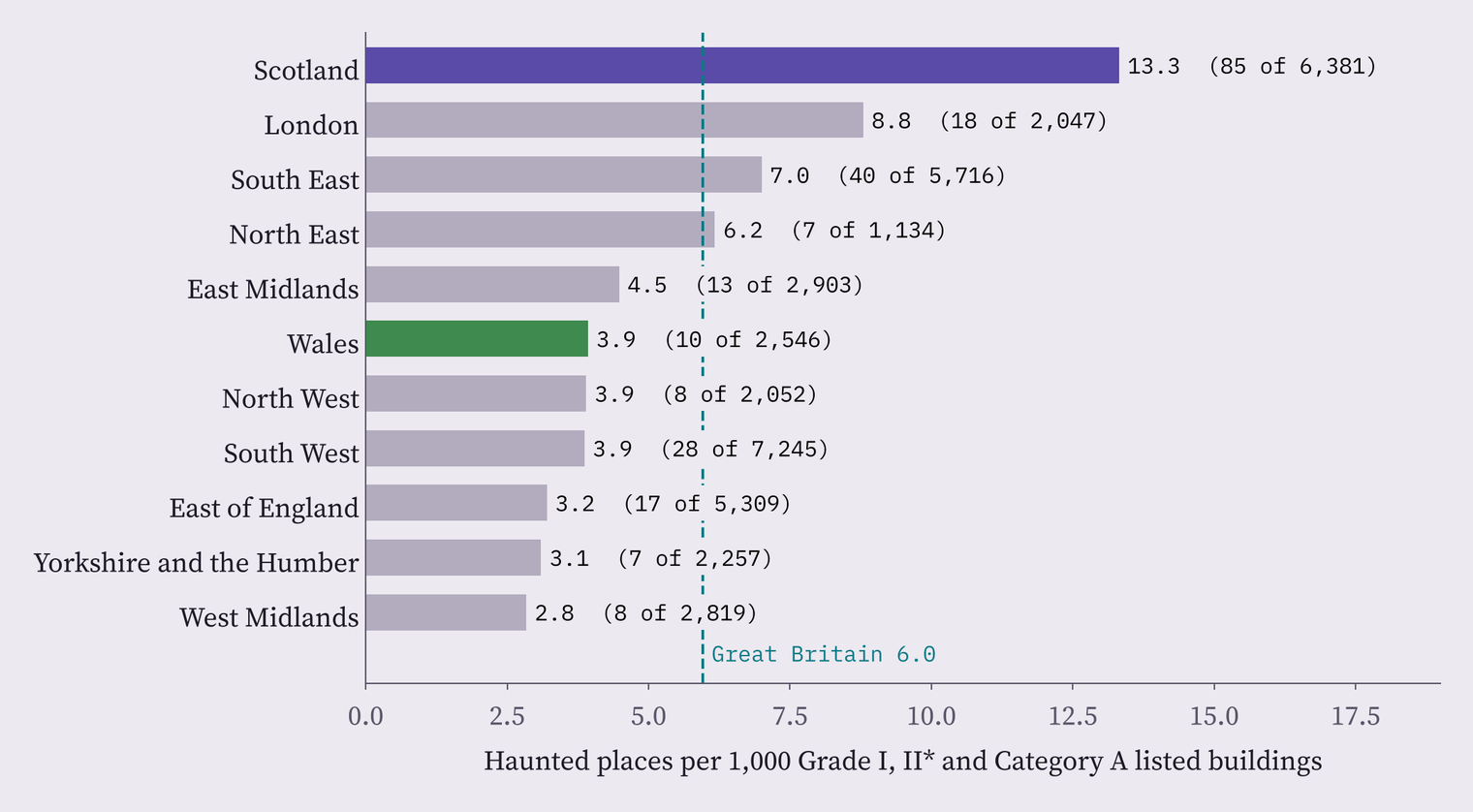
The first surprise is Scotland. It has 85 of the 241 haunted places in Great Britain, 35%, but only 16% of the listed buildings, and most of its places are castles and tower houses. England’s ghosts crowd into the south, around London, Hampshire, Wiltshire and Oxfordshire. Wales has just ten.
Castles and inns, not churches
Here is where “it’s just old” starts to fail. Of the 199 haunted buildings in Great Britain, 34% are castles or towers, against 3.7% of listed buildings: 9.0 times as common. Inns, pubs and hotels are 20% of haunted buildings and 2.4% of listed ones, 8.5 times as common.
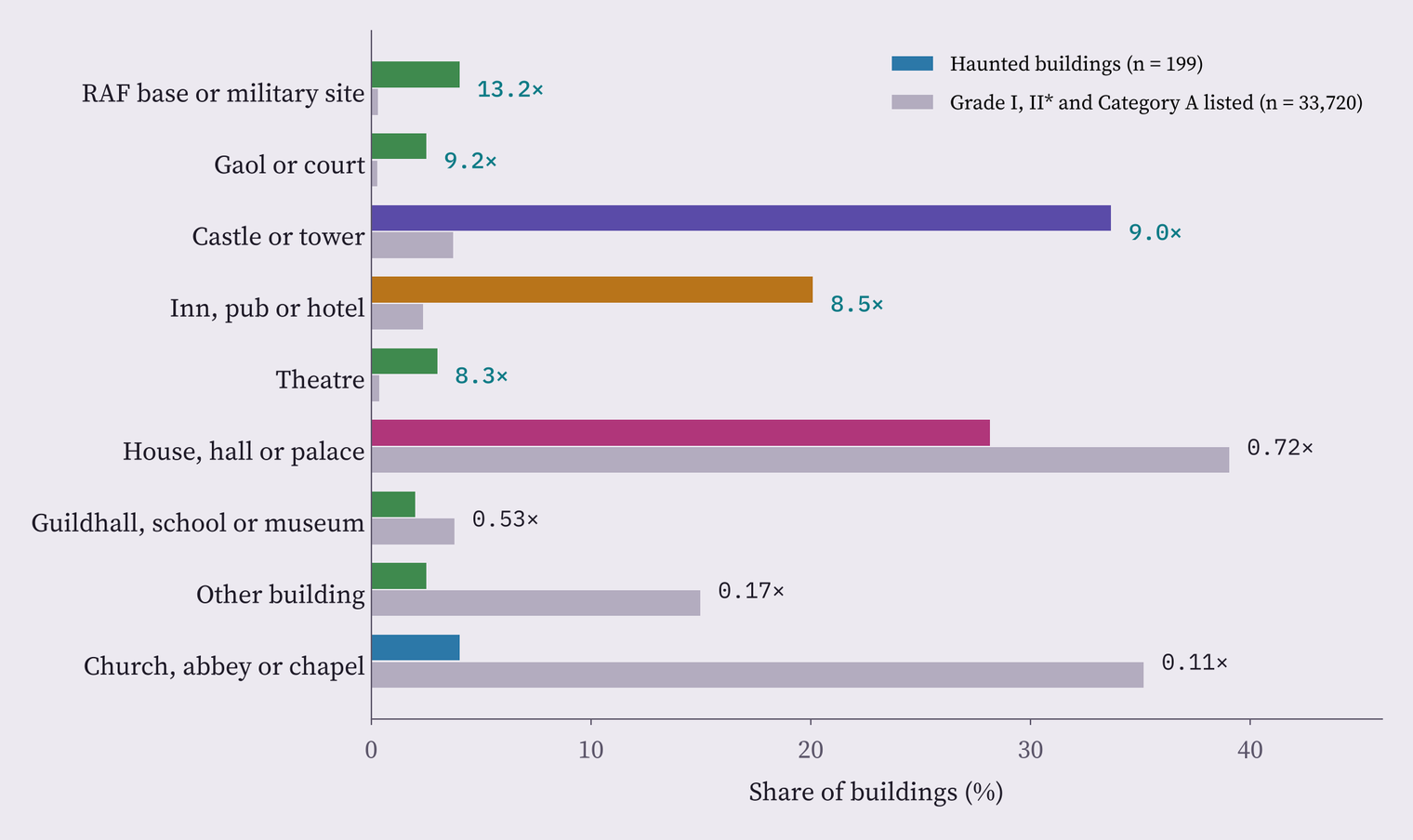
The church is the great absentee. Churches, chapels and abbeys are 35% of all listed buildings, the biggest single group, and they have the oldest fabric of all. Yet only eight haunted buildings are churches, 4%, and half of those are abbeys, such as Furness and Netley.
The ghost story belongs to the castle and the inn: places with a host, a visitor and a night to get through.
Castles and inns are places where strangers spend the night, and places that have every reason to tell, keep and sell a good story. Theatres, gaols and RAF stations, small groups in this list, follow the same line.
Older, but only a little
Comparing raw dates would be unfair, because castles are older than houses whether or not they are haunted. So for each of the 83 dated haunted buildings I asked what share of dated listed buildings of the same kind are older.
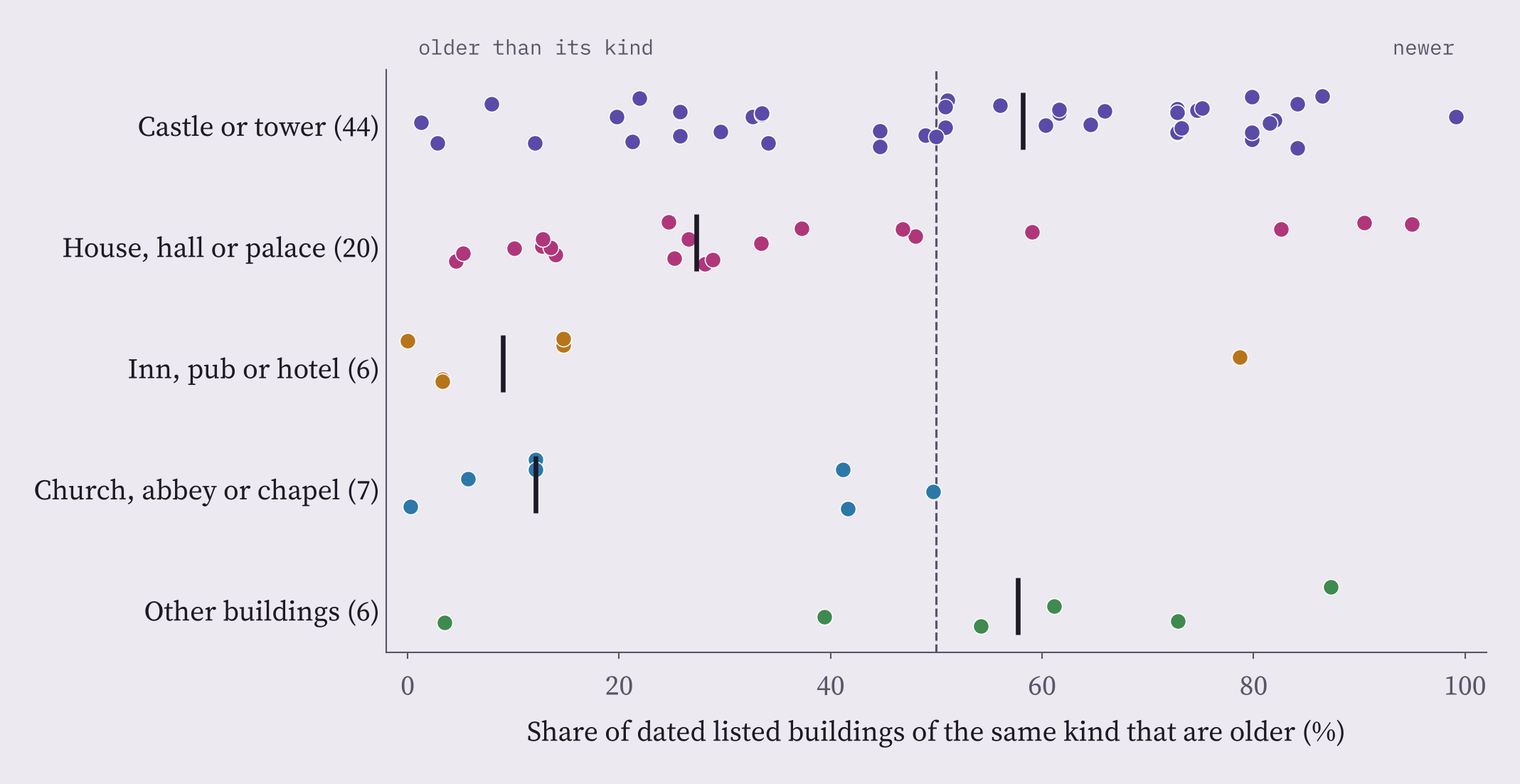
The median haunted building sits at the 45th percentile of its kind: a touch older than typical, but not by more than chance could produce. Houses are the exception, with a median date of 1678 against 1757 for listed houses. Haunted castles are no older than other castles at all. Many are Scottish tower houses of the fifteenth and sixteenth centuries rather than the oldest Norman keeps.
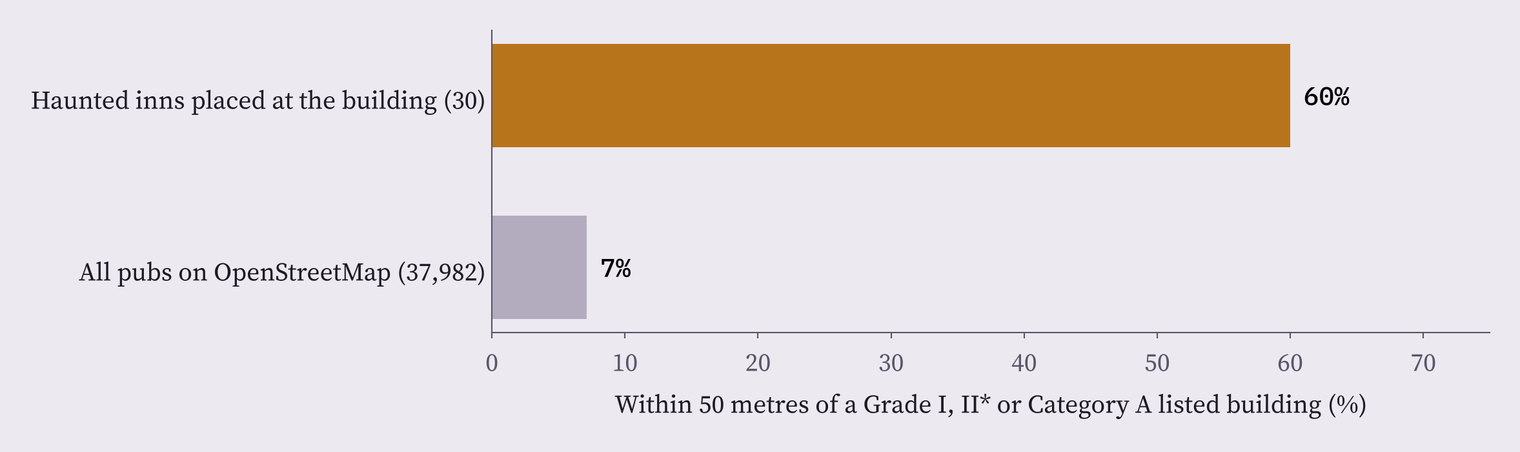
Inns are the one place where heritage really shows. Only 7% of Britain’s 37,982 pubs stand within 50 metres of a top-listed building. Of the haunted inns I could place exactly, 60% do. The haunted pub is the old coaching inn on the market square, not the estate pub on the bypass. (A caveat: an old, listed pub is also far more likely to have a Wikipedia article in the first place.)
Scotland’s tower houses, and an editor’s city
Per 1,000 listed buildings, Great Britain has 6.0 haunted places. Scotland has 13.3, 2.9 times England’s rate. That is a castle effect: 71% of Scotland’s haunted buildings are castles or tower houses, against 10% of England’s. Wales has 826 castles in Wikidata and not one of them is on the list.
The self-styled ghost capitals do not stand out. Edinburgh has 16 places, but so many listed buildings that it is about where it should be. York, often called England’s most haunted city, has just two. The real outliers are Oxford, with five (including a lane, a footpath and a shoe shop), and Southampton, with four. That looks like the work of keen local editors, which is exactly what this data records.
Who haunts where
Finally, I searched the ghost passages for the stock characters of British ghost lore and read every match, throwing out 33 false hits (a “Queen Anne style” house is not haunted by Queen Anne).
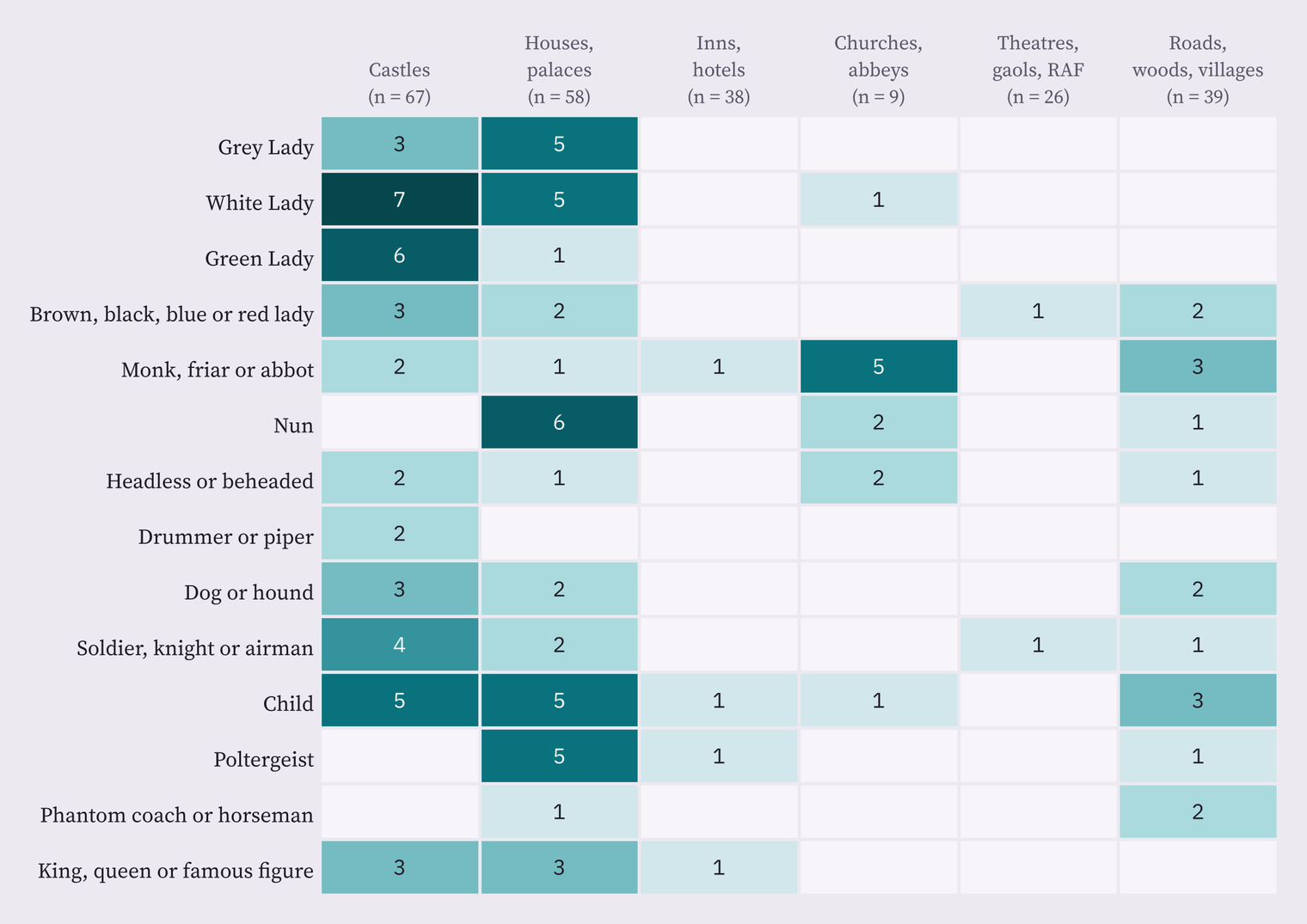
The ghosts follow the buildings. Grey, White and Green Ladies haunt castles and great houses: 17 of 67 castles with a ghost story have one, and not a single inn does. The Green Lady is Scottish, with six of the seven in Scottish castles, and so are the two phantom drummers and pipers. Monks and nuns are English (15 of 19) and gather at abbeys and the houses built beside them. All six headless or beheaded ghosts are English, and poltergeists, true to their name, live in houses.
So a haunted place is not just an old place. It is a particular kind of old place, a castle, a great house or an old inn, with its own cast of characters. And the map of Britain’s ghosts is also a map of who wrote them down.
How I did this
Haunted places come from the English Wikipedia categories of reportedly haunted locations in the United Kingdom, England, Scotland, Wales and Ireland, and from its lists for the United Kingdom, Scotland, Ireland and Wiltshire (October 2026), with 30 non-places removed by hand. 188 are placed at the building, the rest at the town, village or road their source names; four could not be placed. The baseline is every Grade I, Grade II* and Category A listed item in Wikidata (33,720 of them buildings), with Wikidata’s inception dates, plus OpenStreetMap pubs and Wikidata castles. Kinds come from names and descriptions, with hand corrections.
The caveats matter. This is Wikipedia’s record, shaped by notability and by editors. Places with articles are often listed already. The baseline leaves out Grade II and Category B buildings and covers Great Britain only, so Ireland is mapped but not compared. Wikidata dates only about a fifth of listed buildings, and infobox dates are cruder. The ghost search was checked for false hits, not for misses, and several groups are small.
Notes and sources
- Haunted places: Wikipedia, List of reportedly haunted locations in the United Kingdom, Reportedly haunted locations in Scotland, List of reportedly haunted locations, List of paranormal events reported in Wiltshire, England and the category of reportedly haunted locations (CC BY-SA 4.0).
- Listed buildings, castles and inception dates: Wikidata, CC0.
- Pubs: © OpenStreetMap contributors, ODbL.
- Places and regions: OS Open Names. Contains OS data © Crown copyright and database right 2026, Open Government Licence v3.0.
- Irish sites: Sites and Monuments Record, National Monuments Service, Department of Housing, Local Government and Heritage, CC BY 4.0.
- Roger Clarke (2012) A Natural History of Ghosts: 500 Years of Hunting for Proof, cited by Wikipedia for the “most haunted” claim.
- Paper, data and code: Zenodo and GitHub.
- I wrote the text, with drafting and editing assistance from Claude (Anthropic), which also helped prepare the analysis code. I reviewed and checked all text and results.

