
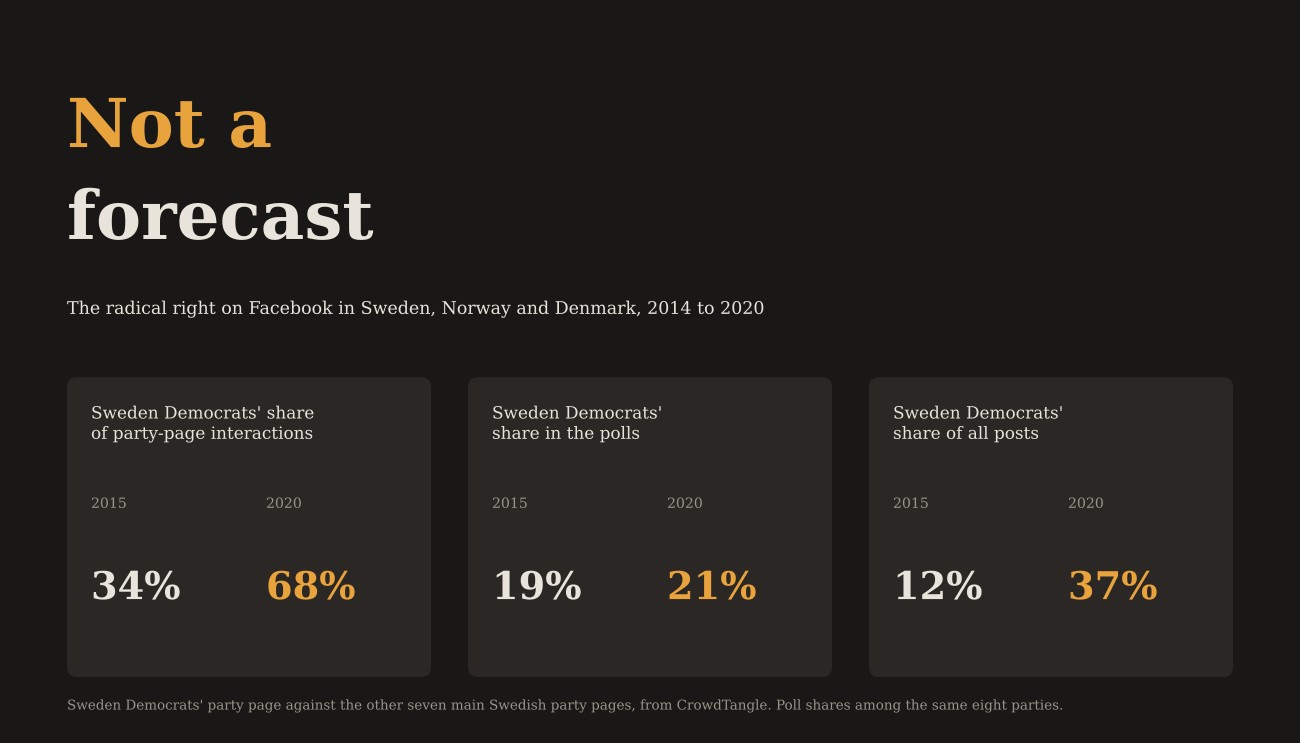
The last two papers were about parties on the way up: Sinn Féin in Ireland, and Podemos and Vox in Spain. In both cases Facebook engagement ran well ahead of the vote, and sometimes ahead of the polls. So the obvious next test was parties that were already established, and whose support rose, held steady or fell.
Scandinavia has three: the Sweden Democrats, Norway’s Progress Party and the Danish People’s Party. I took 61,081 posts recorded by CrowdTangle from 2014 to October 2020, from the main parties’ pages in Sweden and Norway and, because the Danish export only had politicians’ pages, from the pages of the main Danish party leaders. Then I compared each party’s share of the engagement with its share in 1,733 polls and at five elections. The paper is Not a Forecast: The Radical Right on Facebook in Sweden, Norway and Denmark, 2014 to 2020, free on Zenodo.
The preprint
Open access, free to read, share and cite. 11 pages, 2 figures. Not peer reviewed. Monthly shares by party, the poll medians used, the election comparisons and yearly summaries are in the record.
Cite as: Hotham, T. (2026). Not a Forecast: The Radical Right on Facebook in Sweden, Norway and Denmark, 2014 to 2020. Zenodo. https://doi.org/10.5281/zenodo.23303335
Sweden and Norway: always above their support
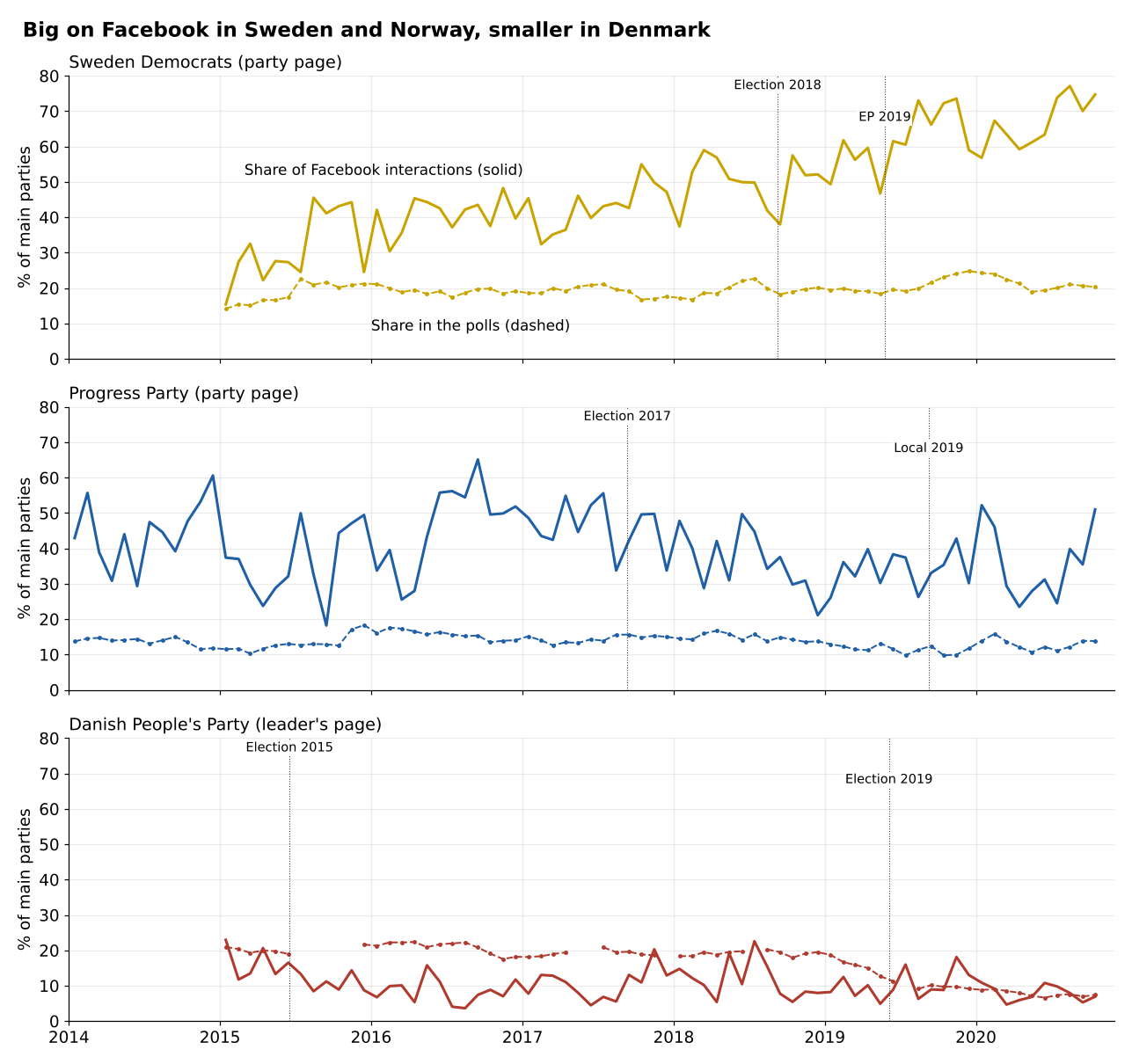
In Sweden and Norway the radical right drew more Facebook engagement than its poll share in every single month, usually two to three times as much. The Sweden Democrats’ page drew 34% of all the engagement on the eight main Swedish party pages in 2015, and 68% in 2020. Over the same years their share in the polls went from about 19% to 21%. Norway’s Progress Party drew 34% to 49% of party-page engagement while polling at 12% to 16% of the vote for those parties.
The Swedish surge was mostly posting more
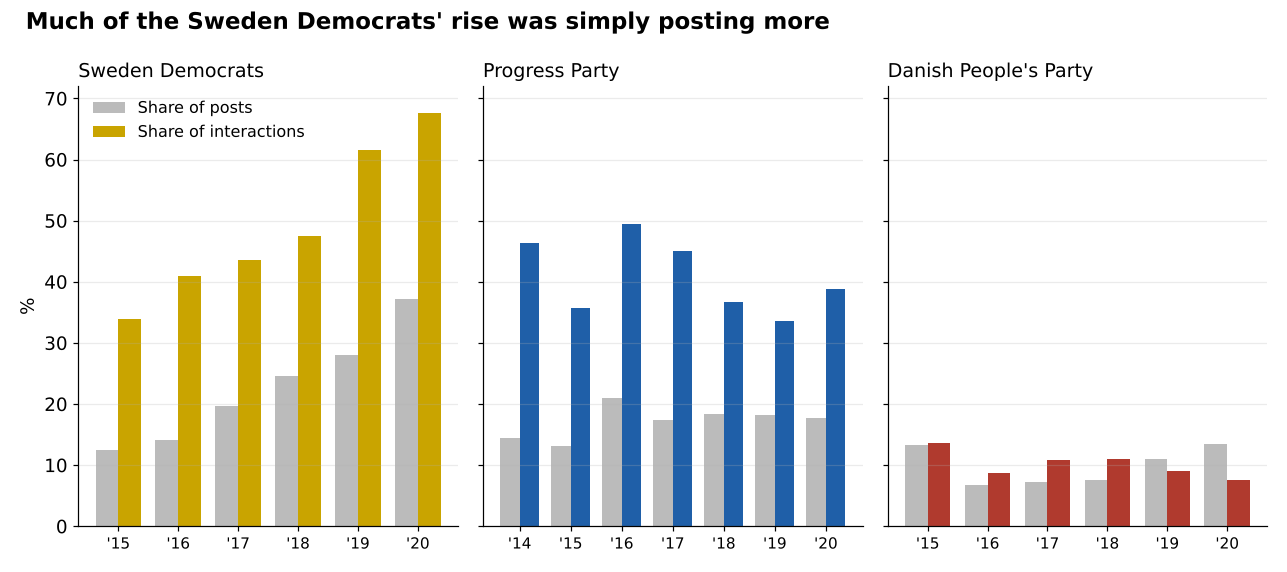
Why did the Sweden Democrats’ share double while their support barely moved? Their posts always drew three to four times as much engagement as the average post from the other parties, but that ratio didn’t grow. What grew was how much they posted: from 12% of all the posts on those eight pages in 2015 to 37% in 2020. Do the arithmetic and almost all of the rise in their share comes from volume. If you measure parties by their share of engagement, the one that posts most wins.
One other difference stood out: in 2019 and 2020 nearly a fifth to a quarter of all the interactions on the Sweden Democrats’ posts were angry reactions, against 2% to 3% for the other Swedish parties.
Denmark: it depends whose page you count
Denmark looked different, at first. The Danish People’s Party leader, Kristian Thulesen Dahl, drew less engagement than his party’s support: about 9% to 14% of the engagement on the main leaders’ pages, while DF was polling at 19% to 21% of the vote for those parties. But add the page of DF’s parliamentary group leader, Peter Skaarup, who posted a lot more, and DF jumps to 30% to 31% in 2015 to 2017, above its support. So the Danish answer depends on which pages you pick.
And when DF collapsed, from 21% in 2015 to 8.7% in 2019, Facebook didn’t give a clear warning. The leader’s share did dip in late 2018, before the polls fell, but it bounced back, it had been that low before, and with Skaarup’s page included the dip mostly disappears.
So does Facebook lead the polls?
Barely. Across all 24 parties in the three countries, when a party’s share of Facebook engagement went up, its poll share did tend to tick up a little afterwards. But a typical three-month swing on Facebook was followed by about a tenth of a percentage point in the polls, when polls typically moved by one and a half points over the same time. For the Sweden Democrats and the Progress Party there was no link at all.
Put that together with Spain and Ireland and a pattern emerges. For brand-new parties, a huge share of Facebook attention can be a sign that something is building. For established parties, it’s mostly just how they use the platform: how much they post, how big their audience is, how strongly people react. It’s a measure of attention, not a forecast.
The usual caveats
The Danish data only had politicians’ pages, not party pages, and some of those politicians stopped leading their parties during the period. CrowdTangle doesn’t show whether posts were boosted with ads. Engagement isn’t support, and some of it comes from opponents. The poll figures come from the compilations on Wikipedia. An independent review of the first draft caught several errors about Danish party leaders and pushed me to make the timing tests stricter, and I’ve fixed both. All of this is in the paper.
Read it
Hotham, T. (2026). Not a Forecast: The Radical Right on Facebook in Sweden, Norway and Denmark, 2014 to 2020. Preprint, Zenodo. https://doi.org/10.5281/zenodo.23303335
For the new-party version of this story, see Launched the same week: what Facebook showed about Podemos and Vox.
The views in this post and the paper are my own.

