
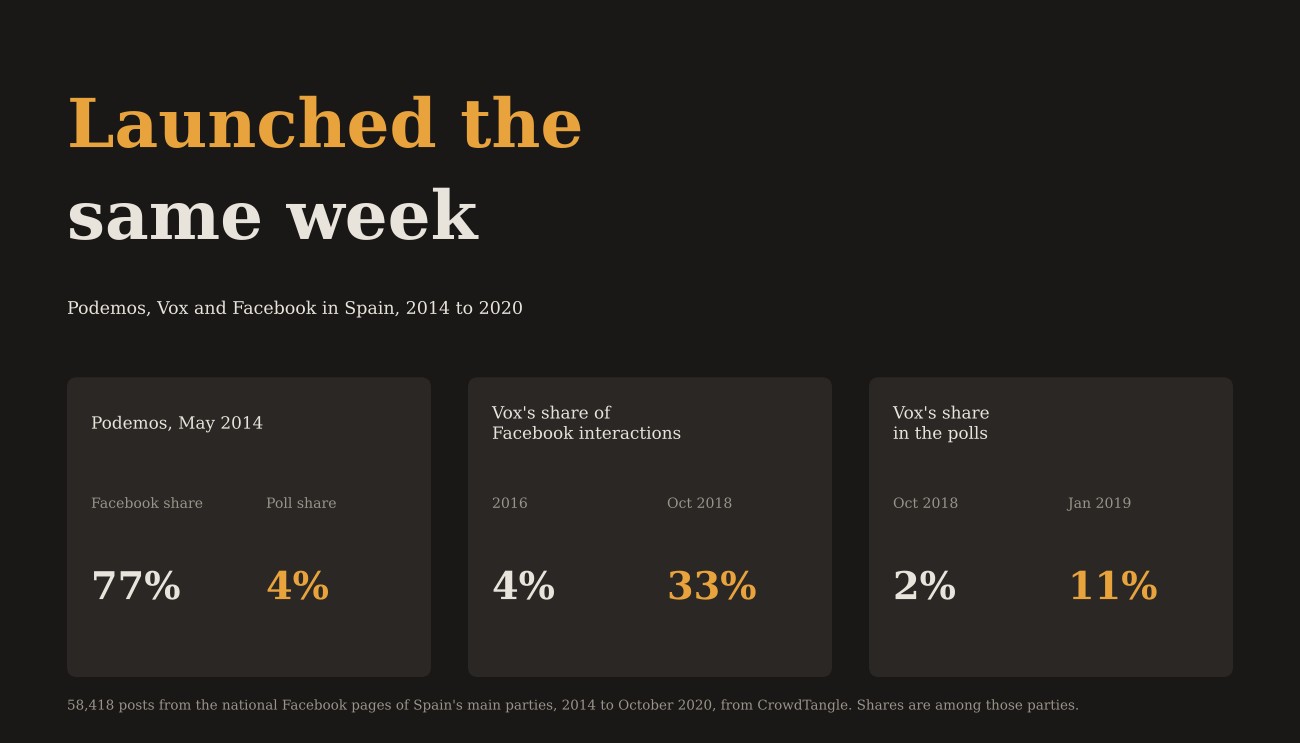
In the same week of January 2014, two new parties were presented to the press in Madrid. One was Podemos, on the left. The other was Vox, on the right. Podemos took off almost at once: 8% at the European election that May, top of some polls by Christmas, 21% (with its regional allies) at the December 2015 general election. Vox took five years. It got 0.2% in 2015 and 2016, then 11% in the Andalusian regional election in December 2018 and 15% at the general election in November 2019.
After the Sinn Féin paper, the obvious next question was whether Facebook saw either of them coming. I went back to the CrowdTangle data I exported in October 2020 for my PhD: 58,418 posts from the official national Facebook pages of Spain’s main parties, January 2014 to October 2020. I compared each party’s share of the interactions on those pages, month by month, with its share in 1,155 national polls and at seven elections. The paper is Launched the Same Week: Podemos, Vox and Facebook in Spain, 2014 to 2020, free on Zenodo.
The preprint
Open access, free to read, share and cite. 12 pages, 3 figures. Not peer reviewed. Monthly shares by party, the poll medians used, the election comparisons and quarterly medians are in the record.
Cite as: Hotham, T. (2026). Launched the Same Week: Podemos, Vox and Facebook in Spain, 2014 to 2020. Zenodo. https://doi.org/10.5281/zenodo.23303346
Podemos owned Spanish party Facebook from week one
In its first two months, before any national poll even asked about it, the Podemos page drew more than half of all the interactions on the main parties’ pages. In May 2014, the month of the European election, it drew 77%, when it had 4% of the poll share. By late 2014 it was getting 84% to 86% of everything.
So far, so prophetic. The catch is that it never stopped. Podemos’s support fell by about half over the next six years, but its page kept drawing between a third and nearly nine-tenths of all the engagement. Before each general election it drew two to three times its share of the vote.
Vox took off on Facebook a year before the polls moved
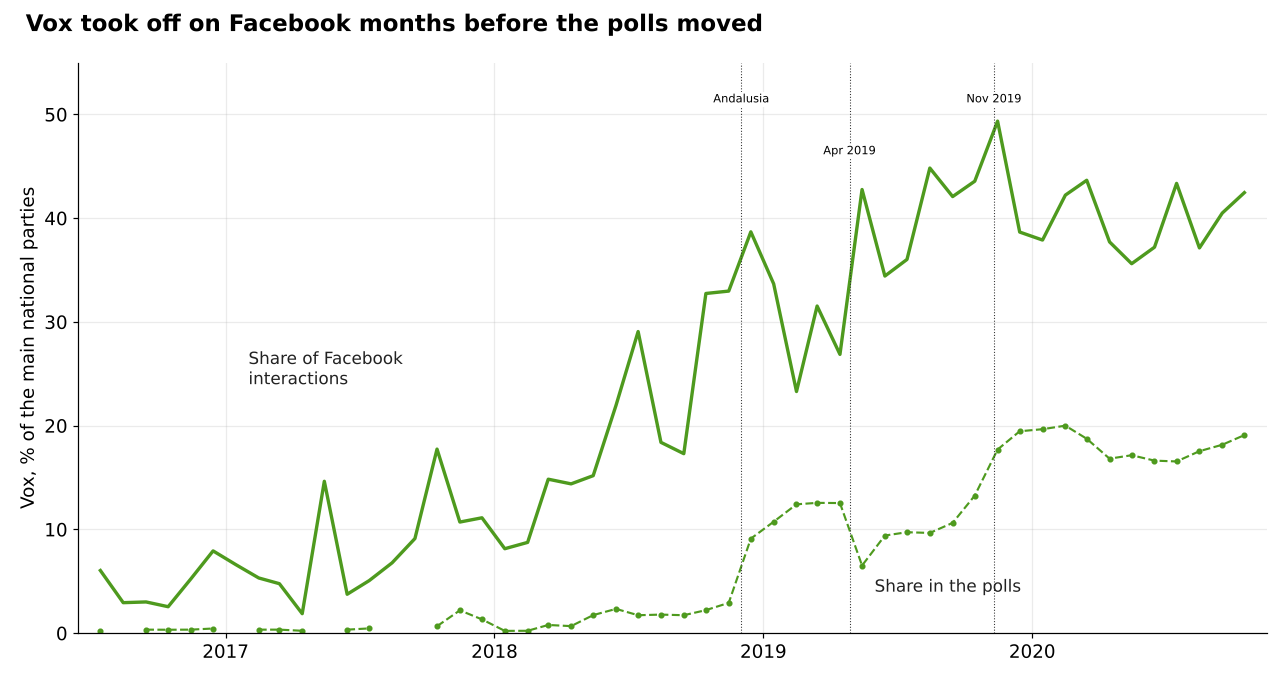
Vox is the more interesting case. It barely registered on Facebook for three years: about 4% of the engagement in 2016. Then it climbed: about 15% in spring 2018, 29% in July, a third in October and November, 39% in December. All that time it was polling at 1% to 3%. By October 2018, two months before Andalusia, Vox was drawing more engagement than the PP, the PSOE and Ciudadanos put together.
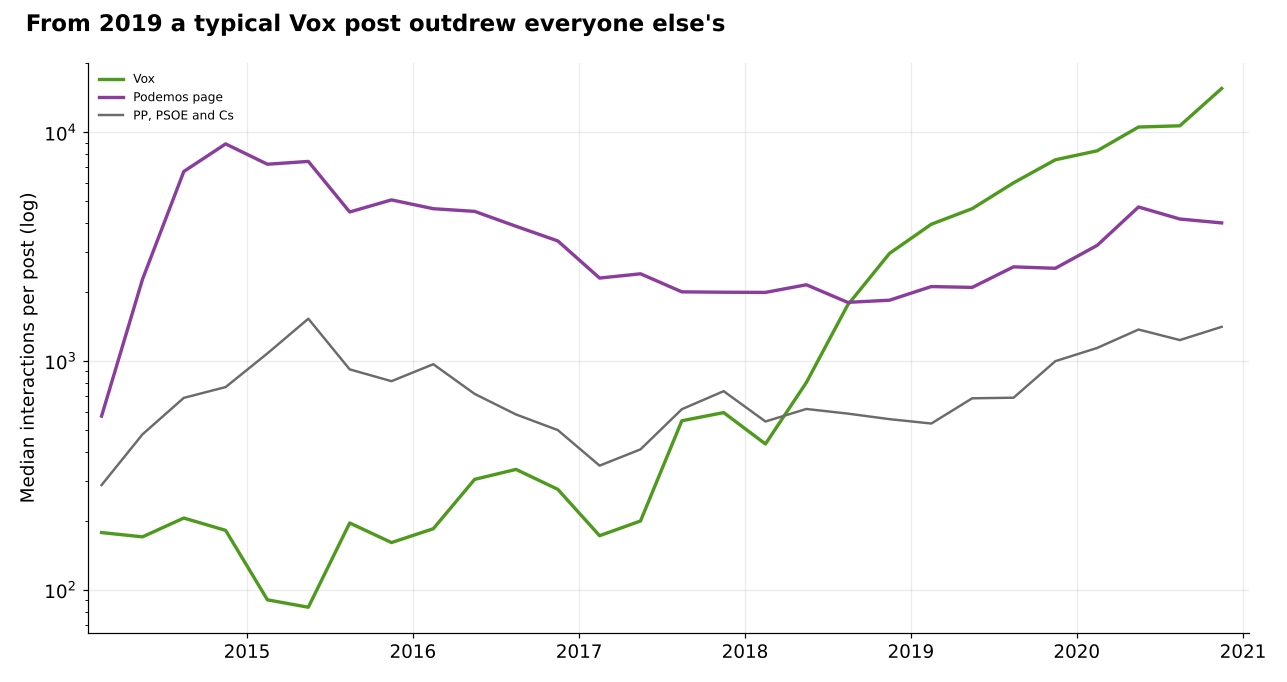
It wasn’t just a bigger page. In mid-2018 Vox had fewer page likes than the PP or the PSOE. Its typical post drew about as much as everyone else’s in 2018, and nearly six times as much in 2019 and 2020.
So, a crystal ball? Not really
An independent review of the first draft took a lot of the shine off this, and rightly. (It also caught that one page I’d counted as Unidas Podemos was actually a supporters’ page, so I took it out and reran everything.) The problems:
- It overstates support, a lot. Once they’d broken through, both parties drew roughly two to five times their share of the vote. Read the levels in 2016 and you’d have badly misjudged Spanish politics.
- It cried wolf. Vox’s share jumped several times in 2017 and 2018 with little or nothing happening in the polls. One of those jumps was basically two viral videos.
- The timing link only shows up around elections. Month to month, a rise in Vox’s Facebook share was followed by a rise in its poll share. But that comes from the Andalusian and 2019 campaigns. Before the breakthrough there’s no link at all, and take the campaigns out and it disappears. For Podemos there’s only a small one-month link.
- The early Vox polls are thin. Before December 2018 a lot of polls didn’t even ask about Vox, so some months rest on a single poll.
The pattern that does look meaningful is the same one as with Sinn Féin: the rises that came before real gains were broad, spread over dozens of posts, and lasted months, rather than one-month spikes driven by a couple of videos. But with two countries that’s a hunch, not a rule. Facebook was a good guide to which parties were pulling in attention, and a poor one to how many votes they’d get or when.
The usual caveats
This covers official national party pages only, not leaders, regional pages or the many unofficial supporter pages. There’s no page for Vox’s leader in the data. Engagement isn’t support, and some of it comes from opponents. CrowdTangle doesn’t show whether posts were boosted with ads. All of this is in the paper.
Read it
Hotham, T. (2026). Launched the Same Week: Podemos, Vox and Facebook in Spain, 2014 to 2020. Preprint, Zenodo. https://doi.org/10.5281/zenodo.23303346
For the Irish version of this story, see Ahead of the polls? What Facebook showed before Sinn Féin’s 2020 surge.
The views in this post and the paper are my own.

