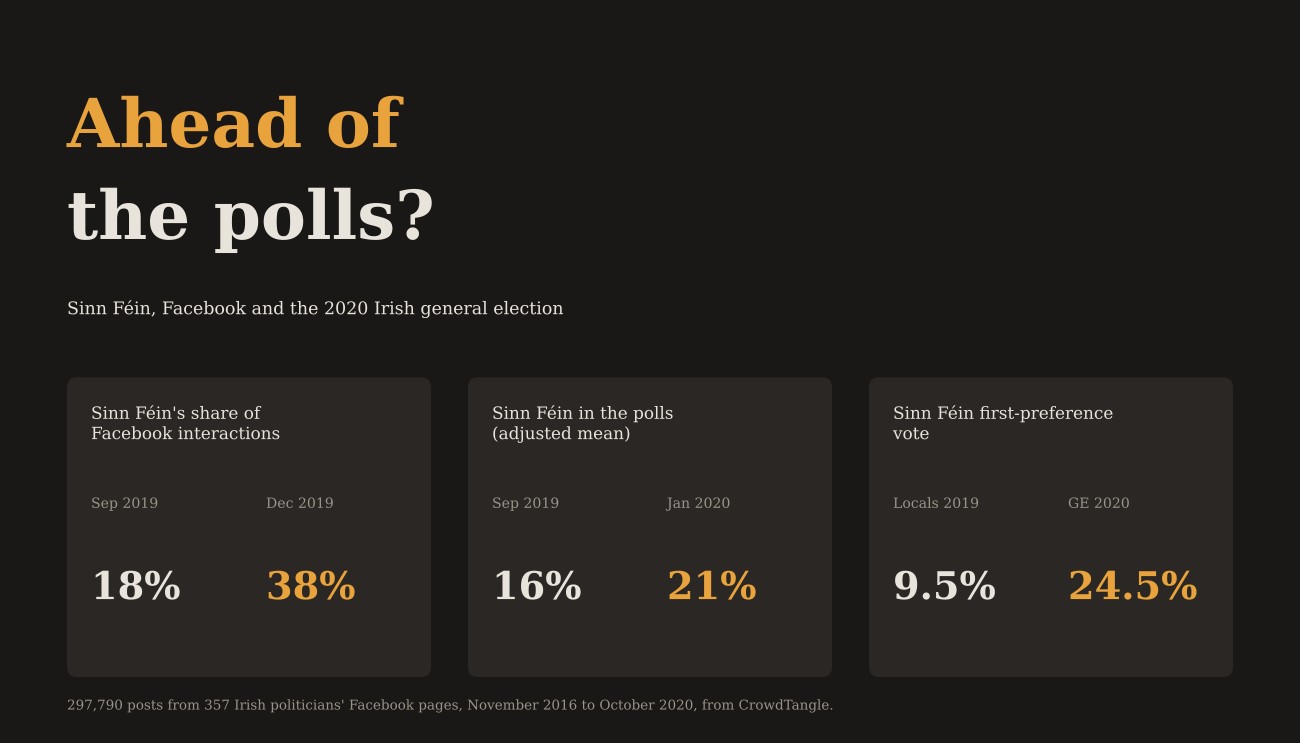
In May 2019 Sinn Féin had a bad local election: 9.5% of the vote and about half its council seats gone. Nine months later it topped the poll in the general election with 24.5%. Most of that surge showed up in the polls only in December and January, during the campaign itself.
So the obvious question for someone who spent a PhD staring at political Facebook: did Facebook see it coming? Back in October 2020 I exported every post from CrowdTangle’s list of Irish politicians’ pages: 357 pages of TDs, senators, MEPs, councillors and candidates, nearly 300,000 posts from late 2016 to late 2020. The paper is Ahead of the Polls? Sinn Féin, Facebook and the 2020 Irish General Election, free on Zenodo.
The preprint
Open access, free to read, share and cite. 12 pages, 3 figures. Not peer reviewed. Monthly totals by party, the page list with its party coding and the polls used are in the record.
Cite as: Hotham, T. (2026). Ahead of the Polls? Sinn Féin, Facebook and the 2020 Irish General Election. Zenodo. https://doi.org/10.5281/zenodo.23300888
Sinn Féin always did well on Facebook
First, the boring bit that matters. Sinn Féin politicians drew a big share of Irish political Facebook engagement for years: about a fifth of all interactions in 2018 and early 2019. That’s roughly in line with where the party was polling (16% to 18%), but way above what it actually got in the 2019 locals.
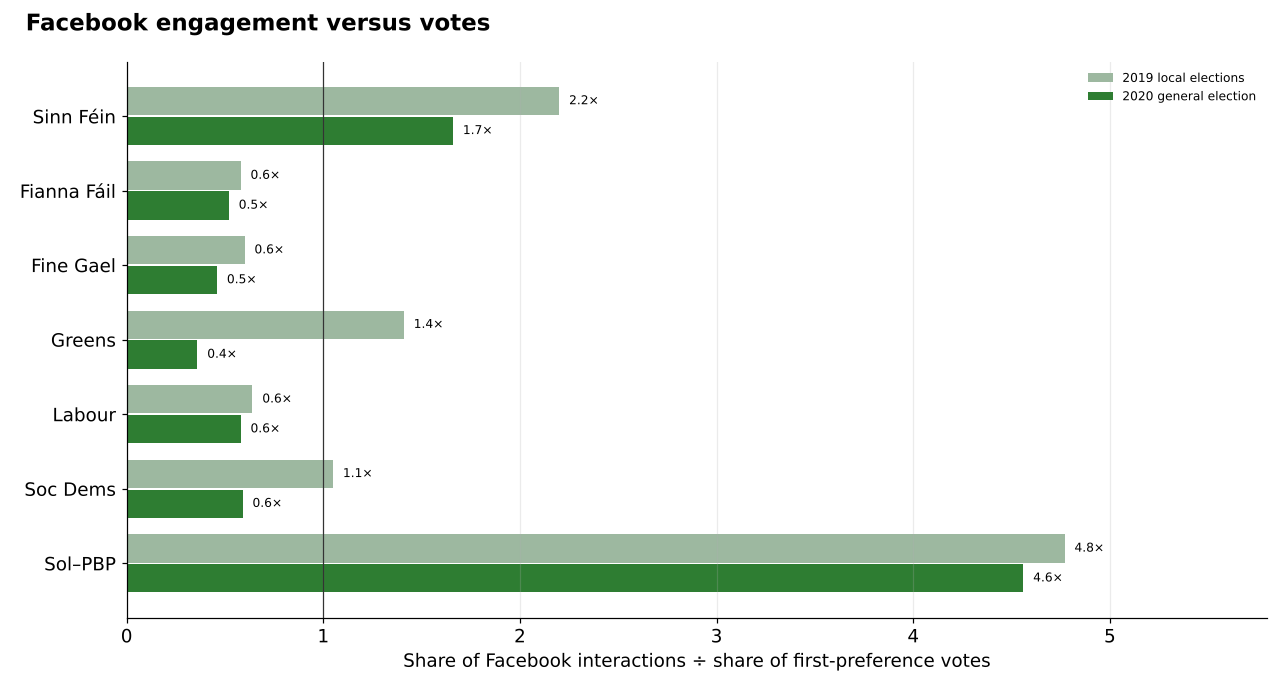
The bigger pattern is across parties. Compared with their votes, Solidarity–People Before Profit drew more than four times the engagement, Sinn Féin about twice, and Fianna Fáil and Fine Gael about half. Irish political Facebook leans towards the left opposition. If you’d used the level of engagement as a forecast, you’d have got 2019 badly wrong.
Then something changed in the autumn
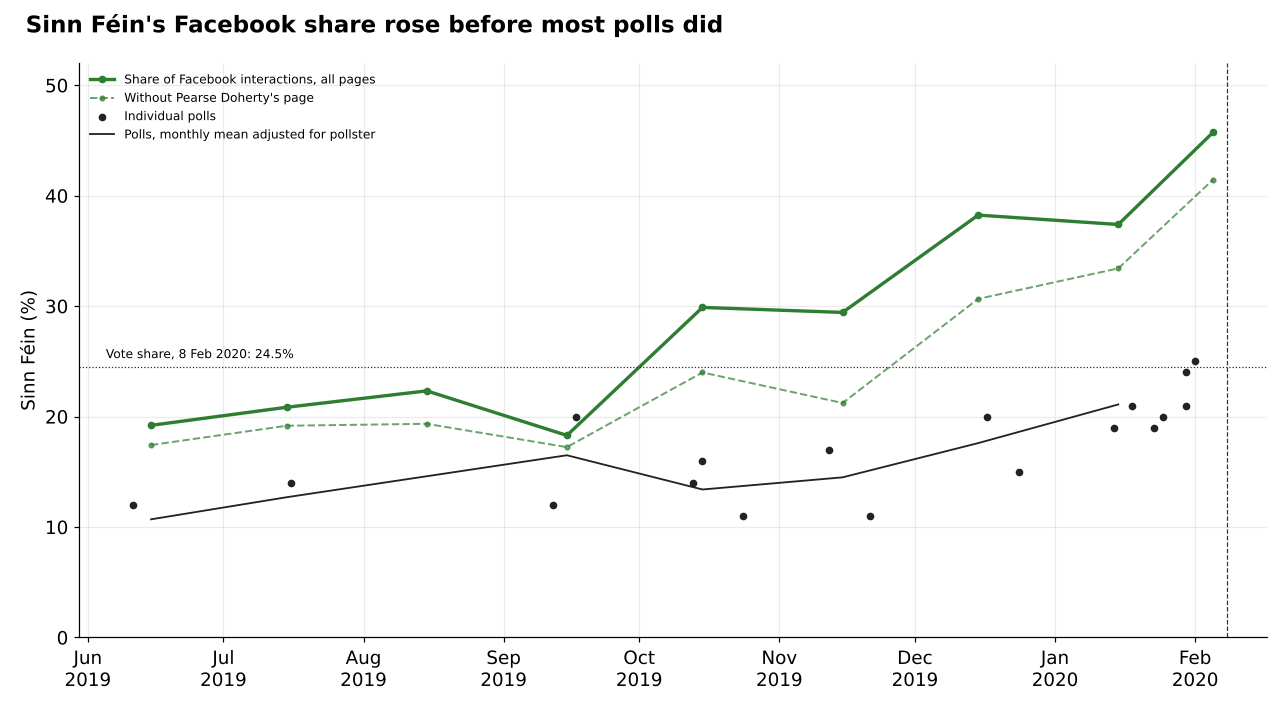
In September 2019 Sinn Féin drew 18% of the engagement on Irish politicians’ pages. In October, 30%. In December, 38%. In the first week of February, 46%. Nothing else in the series looked like it: the three-month jump of 12 points was more than twice as big as any earlier one. It holds on pages that had been around since 2017, so it isn’t just new candidates’ pages being added to the list.
Most polls moved later. Adjusting for the differences between pollsters, Sinn Féin averaged about 13% in October, 15% in November, 18% in December and 21% in January. Red C had it at 11% in October and November. So on the face of it, Facebook was a month or three ahead.
Before anyone gets excited
When I got an independent review of the first draft, it took a lot of the shine off, and rightly. A few things:
- One page did a lot of the work. Pearse Doherty’s page drew 30% of all Sinn Féin engagement in October to December, with budget, insurance and Brexit content. Take it out and the share falls back in November. The broad rise across lots of pages really starts in December.
- It has cried wolf before. Sinn Féin’s share jumped ten points or more in a single month three times in 2017–19. Only one of those was followed by a (small) poll rise. Across those years, changes on Facebook didn’t predict changes in the polls at all.
- The pollsters didn’t agree. Behaviour & Attitudes had Sinn Féin at 16% to 20% all autumn, with no January surge. The “polls only caught up in January” story is mostly a Red C story.
- October is budget month. Sinn Féin’s share rose between September and October in 2017 and 2018 too, just by less.
So the honest answer to “did Facebook see it coming?” is: sort of. A big, sustained change in a party’s share of attention came before most pollsters picked up the surge. But the same measure had produced false alarms before, and the level of engagement was a poor guide to the vote. It’s one election. The interesting test would be whether shifts this large ever happen without a surge following.
The usual caveats
Engagement isn’t support, and some of it comes from opponents. The page list was put together in 2020, so it may favour that year’s winners. CrowdTangle doesn’t show whether posts were boosted with ads. And I coded each page’s party myself with AI help, so that coding is published with the paper for anyone to check. All of this is in the paper.
Read it
Hotham, T. (2026). Ahead of the Polls? Sinn Féin, Facebook and the 2020 Irish General Election. Preprint, Zenodo. https://doi.org/10.5281/zenodo.23300888
For the British version of this story, see Facebook loved Corbyn and Farage; the polls had other ideas.
The views in this post and the paper are my own.

