When Jeremy Corbyn became Labour leader in September 2015, his following arrived with a reputation. Energetic, online, and, according to plenty of critics, angry. The story went that the new crowd brought abuse and factional fights into Labour’s own spaces.
I had a way to check part of that story. During my PhD I collected every comment I could retrieve from the Labour Party’s own Facebook page for the same fourteen weeks in two years: 1 January to 12 April 2015, under Ed Miliband, and the same weeks of 2016, under Corbyn. That’s 234,579 comments. The paper is New Leader, New Crowd: Labour’s Facebook Comment Section from Miliband to Corbyn, free on Zenodo.
The preprint
Open access, free to read, share and cite. 13 pages, 3 figures. Not peer reviewed. Weekly totals and topic shares are in the record; no comment text is shared.
Cite as: Hotham, T. (2026). New Leader, New Crowd: Labour’s Facebook Comment Section from Miliband to Corbyn. Zenodo. https://doi.org/10.5281/zenodo.23298976
It got a little calmer, not angrier
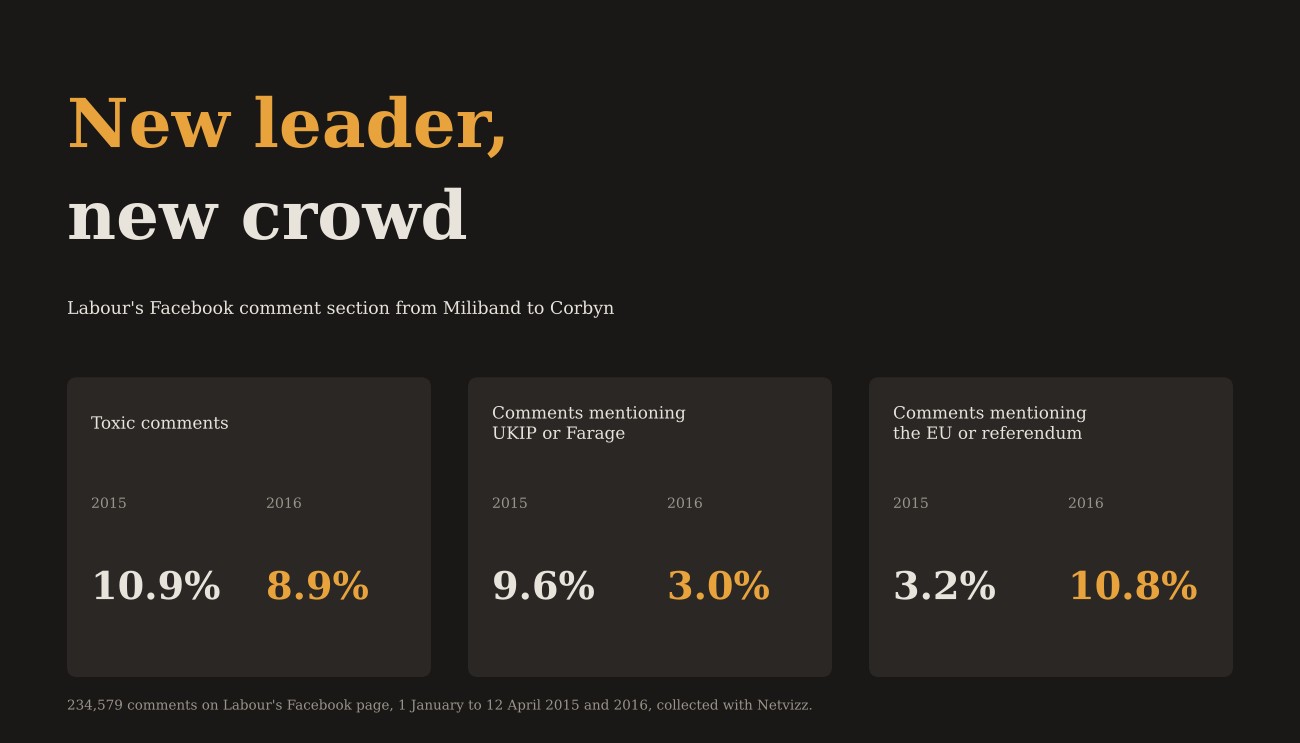
I ran every comment through Detoxify, an open toxicity classifier. In 2015, 10.9% of comments were toxic. In 2016, 8.9%. Not a revolution, but the opposite direction from the story. The gap shows up in every month, with controls for comment length and replies, and when you drop the 2015 election campaign weeks.
The section also changed shape. The page posted far less under Corbyn (131 posts against 461), each post drew more comments, and far more of them were replies to other commenters: 67% against 55%. Fewer, busier, chattier threads.
Who left, who arrived
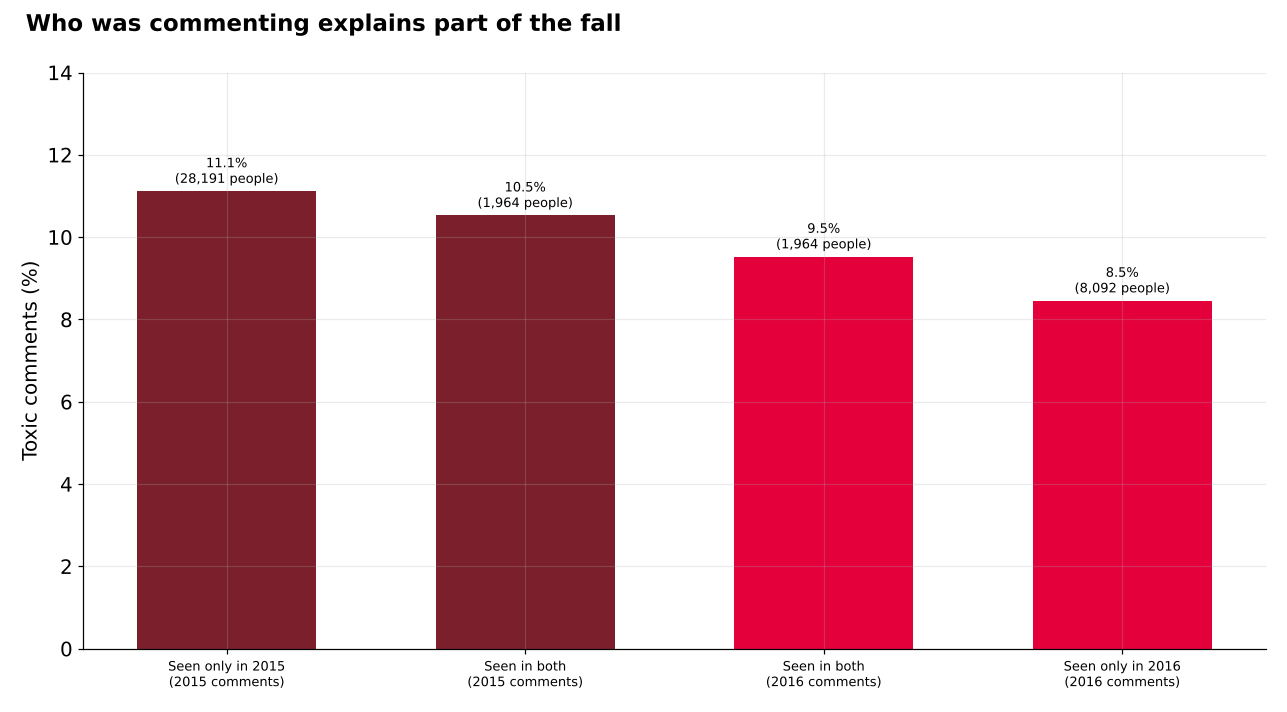
Netvizz hashed commenters’ identities, but consistently, so I could follow accounts across the two years without knowing who anyone was. Only 1,964 accounts commented in both windows. Around 28,000 seen in 2015 weren’t seen in 2016, and about 8,000 new ones turned up.
The accounts that didn’t come back had been the most toxic group (11.1%), and in a small sample they were also the most critical of Labour. Think less “Miliband’s loyal supporters” and more “people who turn up on a party’s page in an election year to have a go”. The newcomers were the least toxic group (8.5%). The accounts that stuck around calmed down a bit too, by about a point.
Put that together and roughly half of the fall comes from a change of crowd and half from something about the period that touched everyone. I can’t pin it down more precisely than that, and the paper says so.
The argument moved
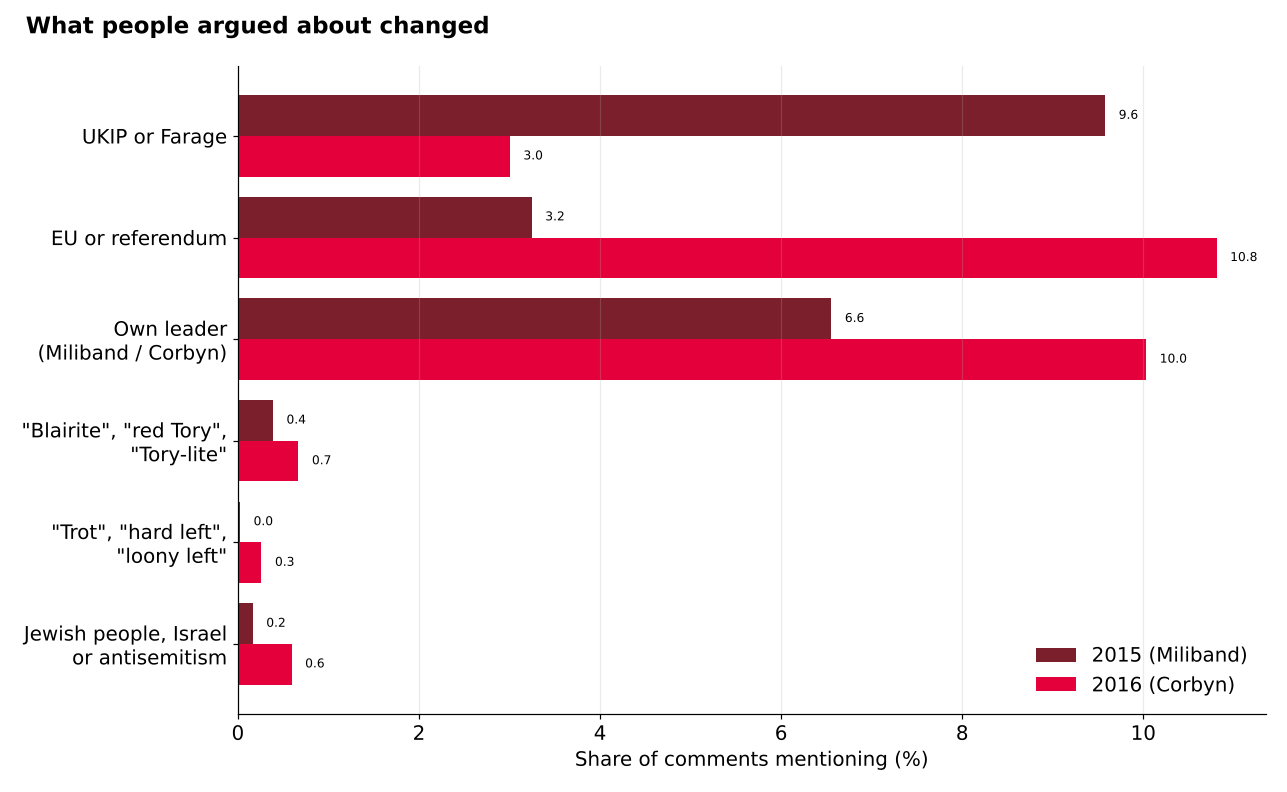
The tone shifted a little. The topics shifted a lot. In 2015 almost one comment in ten mentioned UKIP or Nigel Farage. In 2016, three in a hundred. Comments about the EU and the coming referendum more than tripled, and comments about the leader went up. Insults aimed at Labour’s own factions, “Blairite” and “red Tory” on one side, “Trot” and “hard left” on the other, rose too, but stayed rare: well under 1% of comments.
Mentions of Jewish people, Israel or antisemitism also rose, from 0.16% to 0.59% of comments, in the weeks when antisemitism in Labour was becoming a national story. I looked closely at the handful the classifier flagged as identity attacks. In 2016 most of them were arguments about whether Labour had an antisemitism problem, or people pushing back against antisemitic remarks, rather than antisemitic comments themselves. But there were only 18, two accounts wrote nearly half, and the classifier is bad at this. They can’t tell us how common antisemitism was on the page, and I don’t claim they do. The Equality and Human Rights Commission’s later findings against the party stand on their own.
The caveats
This is two periods on one page, so it can’t separate the new leader from the calendar: early 2015 was the run-up to a general election, early 2016 the start of the EU referendum. The 2015 comments were collected a year after they were written and about a quarter had gone. I tested how much that could matter and it would take implausibly toxic missing comments to reverse the result, but deleted comments can’t be scored. Toxicity classifiers are blunt. The stance coding was done on a small sample with AI help and needs independent checking. And this is Labour’s main page only, not Corbyn’s page, Momentum or the hundreds of local groups.
So the fair summary is narrow: on Labour’s own Facebook page, in the first months of 2016, the comment section did not get nastier under Corbyn. It got a partly different crowd and a very different argument.
Read it
Hotham, T. (2026). New Leader, New Crowd: Labour’s Facebook Comment Section from Miliband to Corbyn. Preprint, Zenodo. https://doi.org/10.5281/zenodo.23298976
For another comment section from the same spring, see One city, two comment sections, on Sadiq Khan’s and Zac Goldsmith’s pages in the 2016 London mayoral race.
The views in this post and the paper are my own.

