Scotland voted No in September 2014, and the losing side won the aftermath. The SNP’s membership roughly quadrupled, and eight months later it took 56 of Scotland’s 59 Westminster seats. If any party should have come out of a referendum with a permanent Facebook advantage, it was this one.
So I went back to the CrowdTangle data I exported in October 2020 for my PhD: 195,268 posts from 82 pages, covering the UK party pages, the SNP and Plaid Cymru leaders, 46 SNP MPs elected in 2015 and 24 Welsh MPs. Plaid Cymru is the comparison: another nationalist party seeking independence, but one that never had a referendum. The paper is After the Referendum: The SNP, Plaid Cymru and Facebook, 2014 to 2020, free on Zenodo.
The preprint
Open access, free to read, share and cite. 10 pages, 3 figures. Not peer reviewed. Quarterly and yearly totals by party and group of pages, and page-level summaries for the MPs’ pages, are in the record.
Cite as: Hotham, T. (2026). After the Referendum: The SNP, Plaid Cymru and Facebook, 2014 to 2020. Zenodo. https://doi.org/10.5281/zenodo.23303342
The surge was real. The lead wasn’t permanent
Through 2014 the typical SNP post went from about 260 interactions to nearly 1,600. That’s the referendum. But CrowdTangle’s coverage of the big parties before 2014 is too patchy to say exactly where the SNP started from, so I compare the typical post from 2014 onwards.
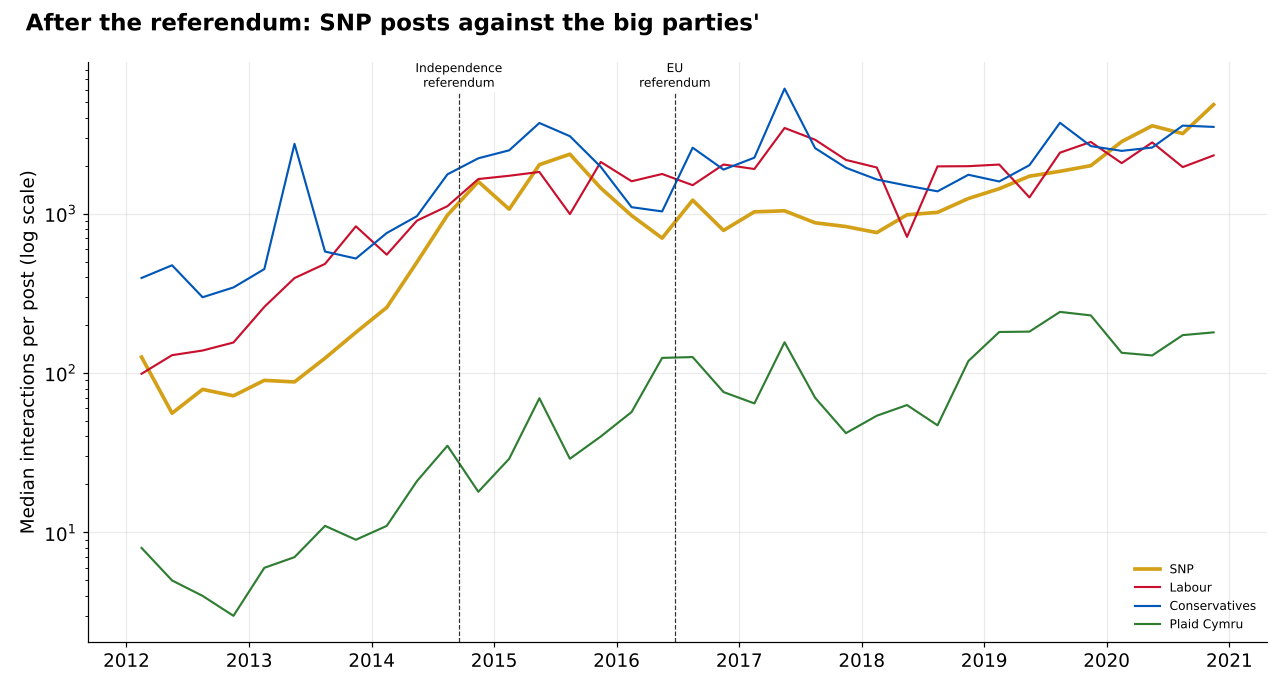
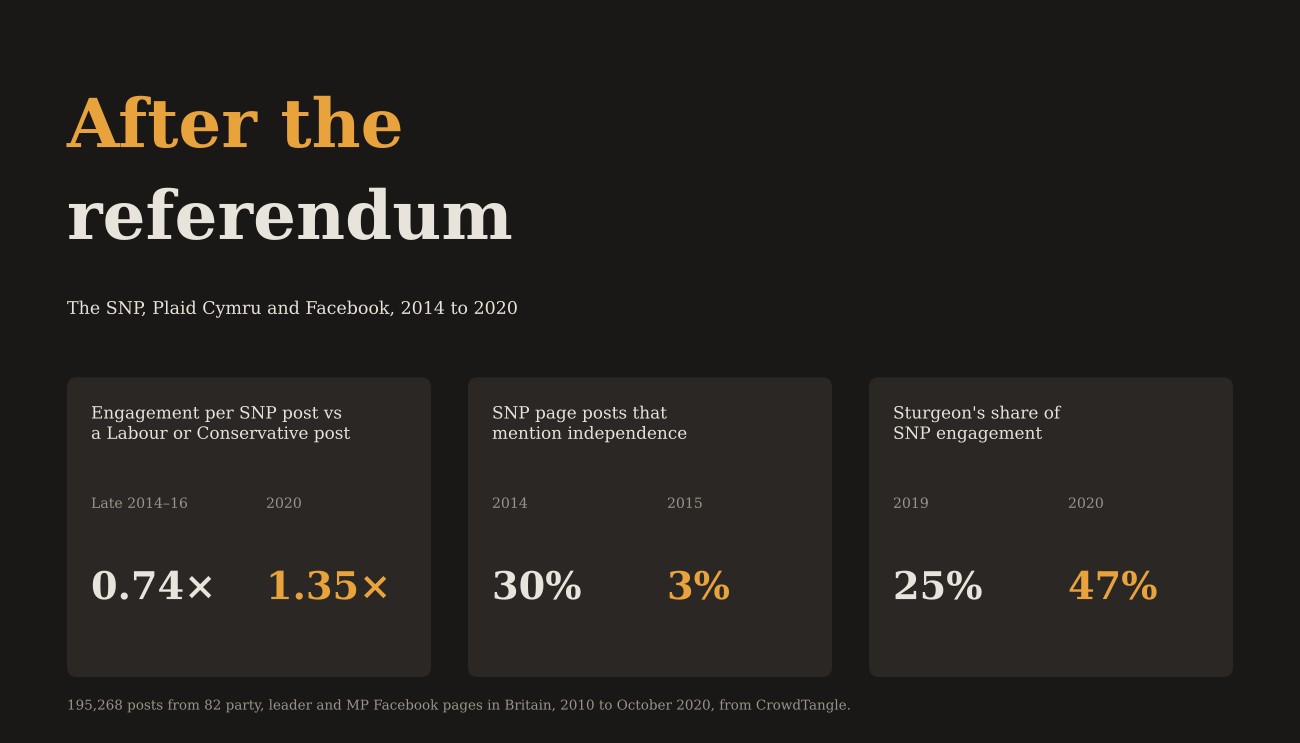
Here’s the surprise. From late 2014 to mid-2016, a typical SNP post drew about three-quarters of what a typical Labour or Conservative post drew. From mid-2016 to 2018, about half, mostly because the SNP’s own numbers fell. Only in 2019 (0.8) and 2020 (1.35) did it climb back. So no, the referendum didn’t hand the SNP a lasting lead over the big UK parties on raw engagement.
Per follower it’s a different picture: SNP posts beat the big parties’ in every period. The SNP’s audience was smaller but much more active.
The 56 spread it out
What the referendum and the 2015 landslide did leave was a much bigger SNP presence. From 2015 to 2019 the pages of SNP MPs drew 26% to 35% of all engagement on SNP pages. That was concentrated: Mhairi Black’s page alone drew between a quarter and a third of the MPs’ total from 2015 to 2017. In 2020, during the pandemic, Nicola Sturgeon’s page drew 47% of everything, as the First Minister’s briefings took over.
Were SNP MPs unusually good at Facebook? Not really. Their pages drew more engagement per post than Welsh MPs’ pages, but once you account for followers, the difference disappears. They had bigger audiences, not better posts.
SNP versus Plaid: it depends what you count
The SNP drew far more Facebook engagement than Plaid Cymru, which is no surprise given the SNP won six to eight times as many Westminster votes. Whether its Facebook lead was bigger or smaller than its vote lead depends entirely on which pages you compare. Party page against party page, the SNP drew 11 to 22 times as much. Add every page, including MPs and leaders, and it was 5 to 10 times. Plaid’s engagement sat mostly with Leanne Wood’s page, even after she stood down as leader in 2018, so leader changes moved the comparison a lot.
Independence went quiet, then came back
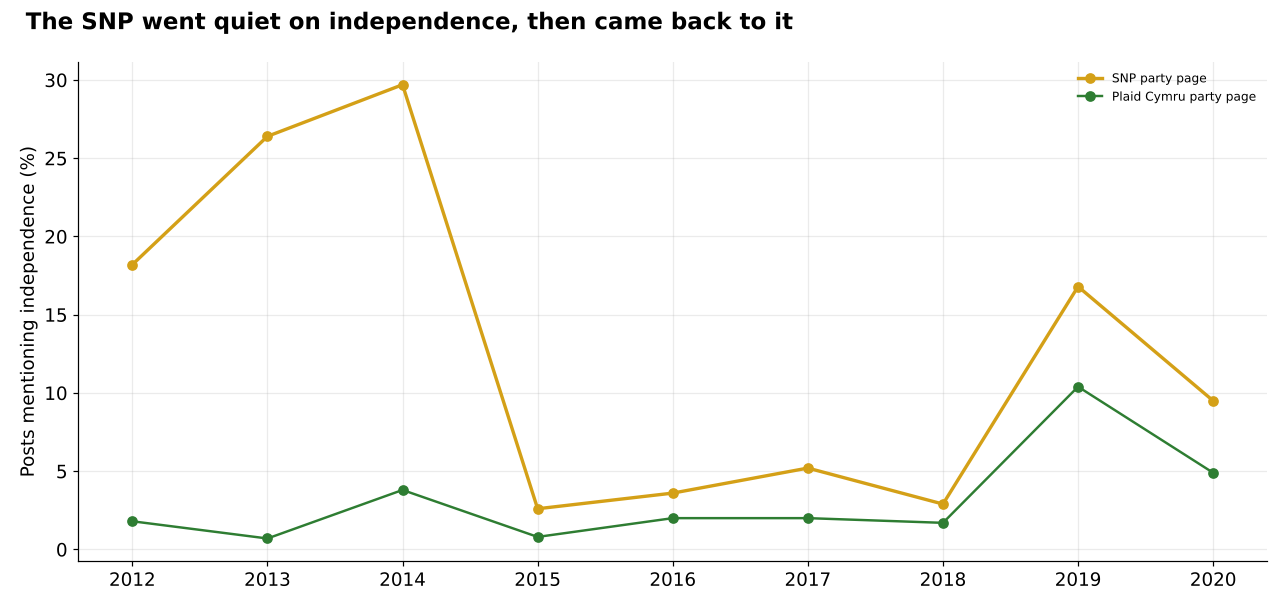
In 2014 about 30% of posts on the SNP’s page mentioned independence or the referendum. In 2015 it was 3%, and it stayed between 3% and 5% until 2018. In 2019 it came back to 17%. The odd thing is that independence posts drew about 40% more engagement than the page’s other posts in every period, even when the party was barely posting about it. That’s a description, not a cause: the topics differ in other ways too.
The usual caveats
CrowdTangle’s coverage before 2015 is incomplete, so I don’t lean on early totals. The list of SNP MPs was built from those elected in 2015, so it doesn’t cover all SNP politicians. Engagement isn’t support, and some comes from opponents. The independence flag is a keyword search, so it will miss some posts and catch a few it shouldn’t. All of this is in the paper.
Read it
Hotham, T. (2026). After the Referendum: The SNP, Plaid Cymru and Facebook, 2014 to 2020. Preprint, Zenodo. https://doi.org/10.5281/zenodo.23303342
For the wider British picture, see Facebook loved Corbyn and Farage; the polls had other ideas.
The views in this post and the paper are my own.

