In spring 2020 everyone seemed to be watching the government. The daily press conferences, the “stay home” slogan, the Thursday clapping. Surveys picked up a classic rally round the flag: trust in government jumped as lockdown began. I wanted to see what that looked like on Facebook, where people choose for themselves what to engage with.
Back in October 2020 I exported every post from CrowdTangle’s list of British political Facebook pages: 437 pages, from the Prime Minister and government departments to party pages and hundreds of MPs, running from June 2018 to October 2020. The paper is A Pause in the Mockery: Government, Party and Politician Pages on Facebook in Britain’s First Covid-19 Wave, free on Zenodo.
The preprint
Open access, free to read, share and cite. 11 pages, 3 figures. Not peer reviewed. Weekly totals and the list of pages with their classification are in the record.
Cite as: Hotham, T. (2026). A Pause in the Mockery: Government, Party and Politician Pages on Facebook in Britain’s First Covid-19 Wave. Zenodo. https://doi.org/10.5281/zenodo.23297887
The government took the attention
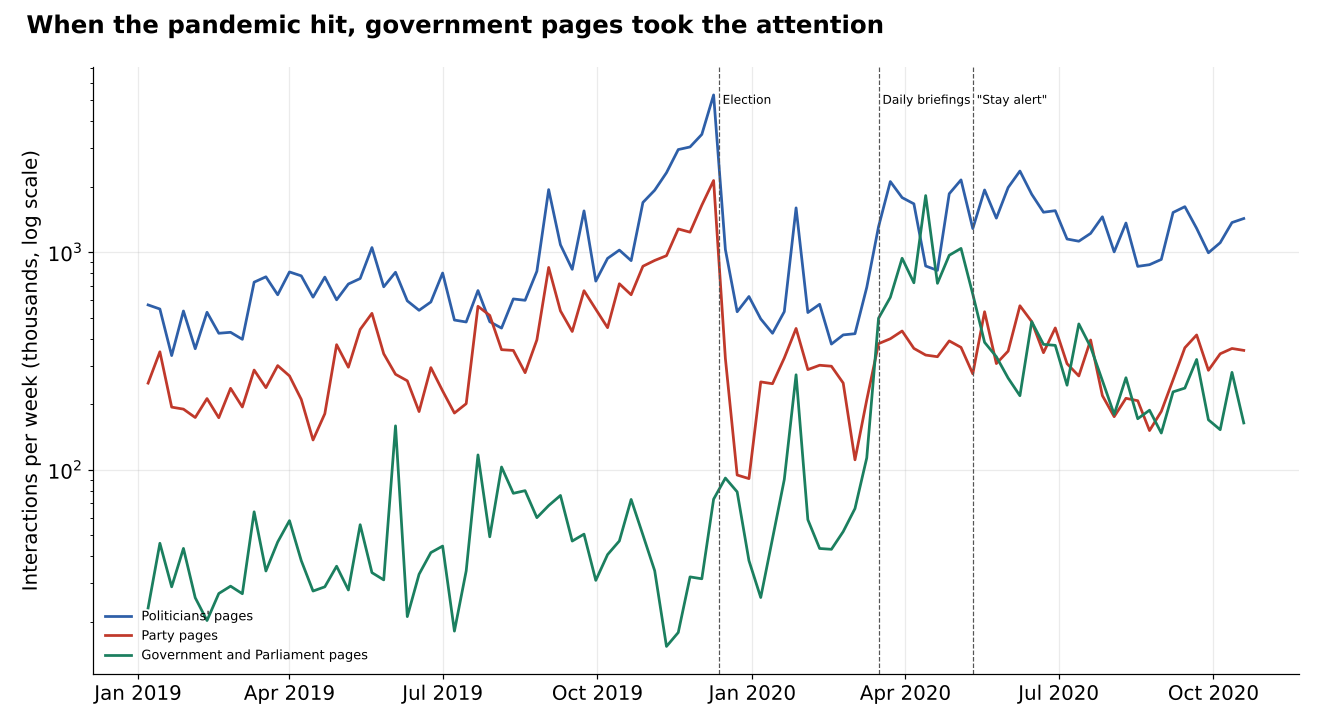
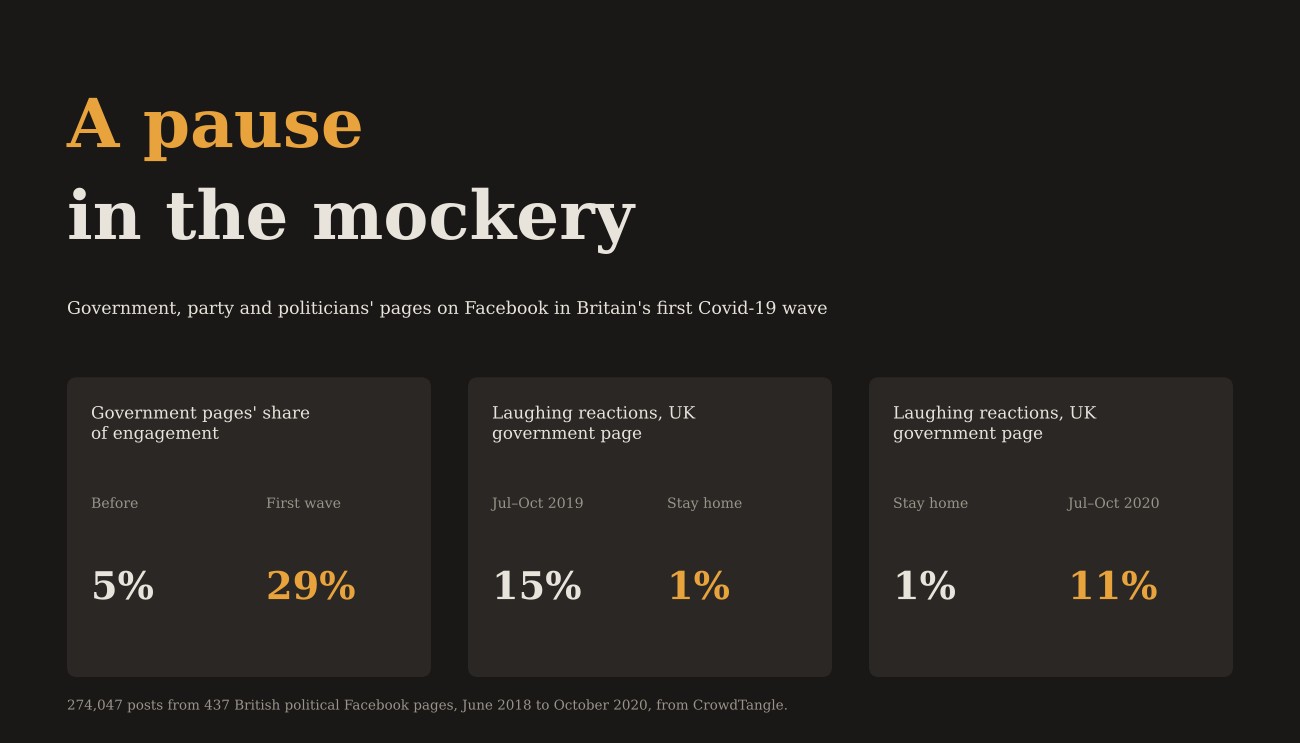
Normally government pages are a sideshow on political Facebook. Before the 2019 election they drew about 5% of the engagement on government, party and politicians’ pages. During the election campaign, under 1%. Then the pandemic hit and, from mid-March to the end of May 2020, government pages drew 29%. Weekly engagement rose about twelvefold. The government posted three times as often, and each post drew three to four times as much engagement. The single biggest post was the Army marking Captain Tom Moore finishing his 100 laps: nearly a million interactions on its own.
The parties got little out of it. Engagement with party pages showed no clear jump, apart from Labour’s page around Keir Starmer’s election as leader, and the typical post by a party or an MP drew less engagement than before. The attention went to the state, and to Boris Johnson personally, whose page drew almost as much engagement in April and May as during the election.
It didn’t last. Attention to government pages fell by about 5% a week, and by autumn they were drawing around 12% of the engagement.
The mockery stopped, then came back
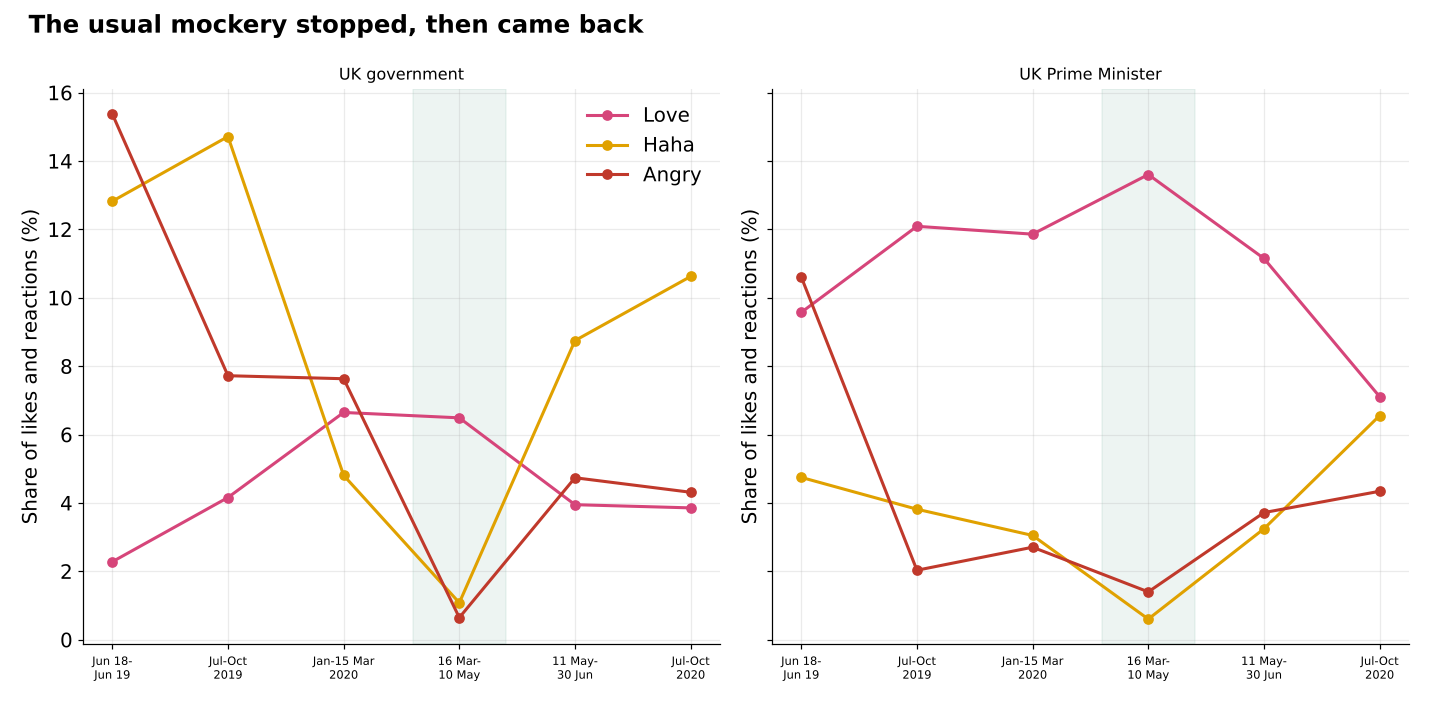
This was the part that surprised me. I expected the rally to show up as love. It didn’t really. What it showed up as was the absence of mockery.
The UK government’s Facebook page is normally laughed at. In 2018 and 2019, more of its reactions were laughing faces and angry faces than hearts. During the “stay home” weeks both almost disappeared: about 1% laughing, under 1% angry. Then, in the week of 11 May, when the advice changed to “stay alert”, they came back. That was two weeks before the Dominic Cummings story, which is usually seen as the end of the rally. The laughter rose again after Cummings, and by the summer it was back near its normal level.
So on Facebook the rally wasn’t a wave of new affection for the government. It was a two-month ceasefire.
The caveats
Engagement isn’t support, and much of the spring surge was surely people looking for information. The page list was CrowdTangle’s, not mine, and some government posts were probably boosted with paid ads. I’m reading laughing reactions to official health advice as mockery, but I haven’t coded what people were laughing at. And the timing of the change can’t prove what caused it. All of this is in the paper.
Read it
Hotham, T. (2026). A Pause in the Mockery: Government, Party and Politician Pages on Facebook in Britain’s First Covid-19 Wave. Preprint, Zenodo. https://doi.org/10.5281/zenodo.23297887
For the longer story of how parties and leaders compete for attention on Facebook, see Facebook loved Corbyn and Farage; the polls had other ideas.
The views in this post and the paper are my own.

