
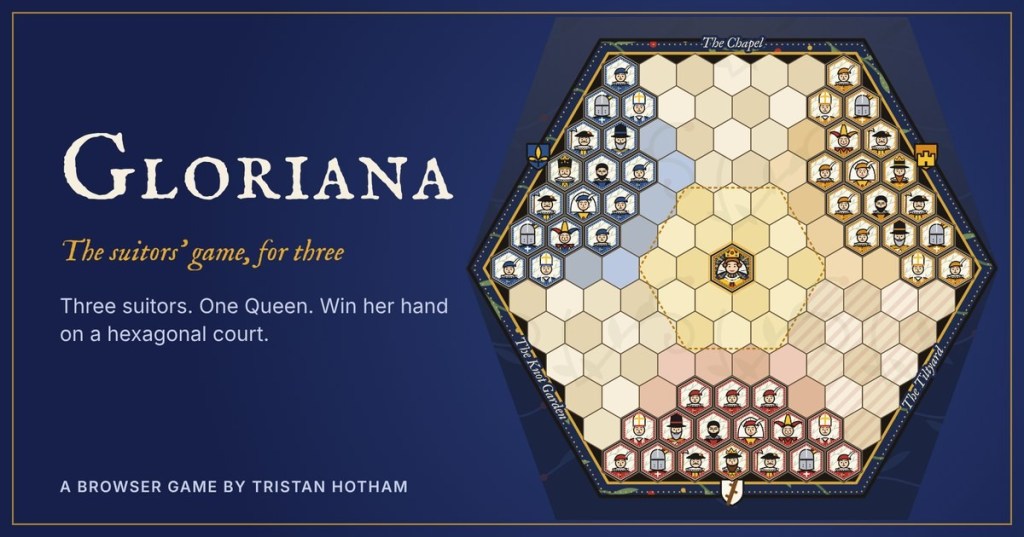
Robert Dudley, Philip II of Spain and the Duke of Anjou all wanted to marry Elizabeth I. None of them managed it. In Gloriana you get to try again: three suitors, one Queen, and a hexagonal court where she can change hands several times before anyone wins her.
Most chess variants for more than two players are the same game on a bigger board: take the other side’s king. I wanted one where the objective sits in the middle of the board and belongs to nobody. So nobody has a queen of their own. The Queen starts free in the Presence Chamber at the centre, and the game is about who can get to her, keep her, and stay beside her long enough to win her hand.
How it plays
The board is a hexagon of 127 hex cells. Each suitor has a home ground on one edge, and the open court between them is the Chapel, the Knot Garden and the Tiltyard. From round 3, any of your pieces can step onto the Queen from a touching cell and take her into its keeping. Her keeper is slowed to one step at a time and cannot take, so the other two suitors will come for it: take the keeper and she is yours.
To win, start three of your turns in a row with the Queen in your keeping and your Suitor beside her. That is the twist. The Suitor is the piece you cannot afford to lose (lose him and your whole court turns to stone), so courting her means walking him into the open. Bring your Favourite to her side as well and each turn counts double.
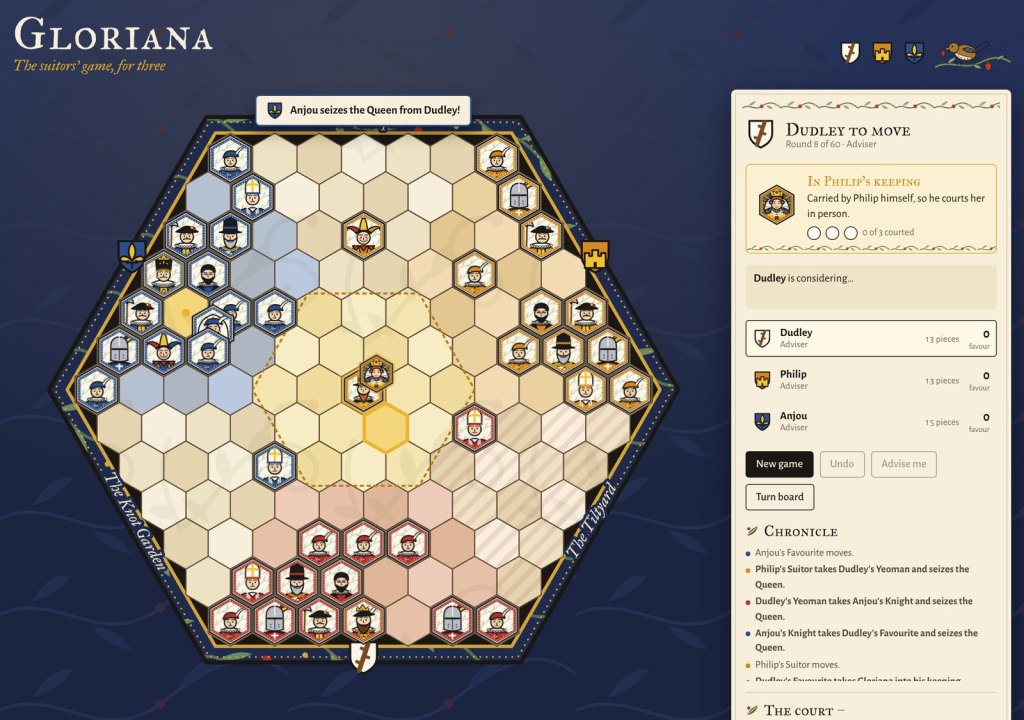
The court
Each suitor has 16 pieces. Some move like their chess cousins, adapted to hexagons; others are new, and each special power can be explained in one sentence:
- Suitor: one cell in any of twelve directions. He can never be held still.
- Favourite: up to three cells in a line, and doubles your courtship when she stands with the Queen.
- Yeomen, Chaplains and Knights: rook, bishop and knight moves on the hex grid. A Knight in the striped Tiltyard can charge any distance.
- Jester: borrows the move of any piece beside him, friend or foe, or mocks an enemy so it cannot move on its next turn.
- Spymaster: short leaps, and can turn an enemy Page, or whoever is keeping the Queen, to your side.
- Ambassador: can never be taken, and holds still any enemy piece beside him. He may not enter the Presence Chamber.
- Pages: step forward, and are knighted on reaching a rival’s home ground.
The pieces are drawn like the court cards in a pack of playing cards, with ruffs and Tudor bonnets, and the board and tokens borrow willow boughs, pomegranates and a Strawberry Thief bird from William Morris.
Making three players fair
Three-player games are hard to balance: one seat often has a built-in edge, and two players can gang up on the third. I tested every rule by having computer players play each other hundreds of times, and kept only what kept the seats even. A few things that testing changed:
- The first version made you carry the Queen home and hold her there. Leaders simply turtled, so the win now depends on your Suitor standing beside her, wherever she is.
- An untakeable Ambassador parked next to a rival Suitor was close to a guaranteed kill. Now nothing can hold a Suitor still, and the Ambassador works as a bodyguard instead.
- The last player in each round kept a small but steady edge. Reversing the direction of play removed it.
In the final rules, 1,200 games between computer players split 31%, 36% and 33% between the three seats, about 97% were won through the Queen, and a typical game lasts around 22 rounds.
You can play against computer advisers at three levels, or pass and play with friends at one screen, on a computer or a phone. Your game is saved as you go.
Notes
- The whole game is one web page with no downloads. The code is on GitHub under the MIT licence.
- Every rule has its own automated test, and 2,000 random games were run with checks after every move.
- I made this with coding and drafting help from Claude (Anthropic). I reviewed and checked the game and text.

