
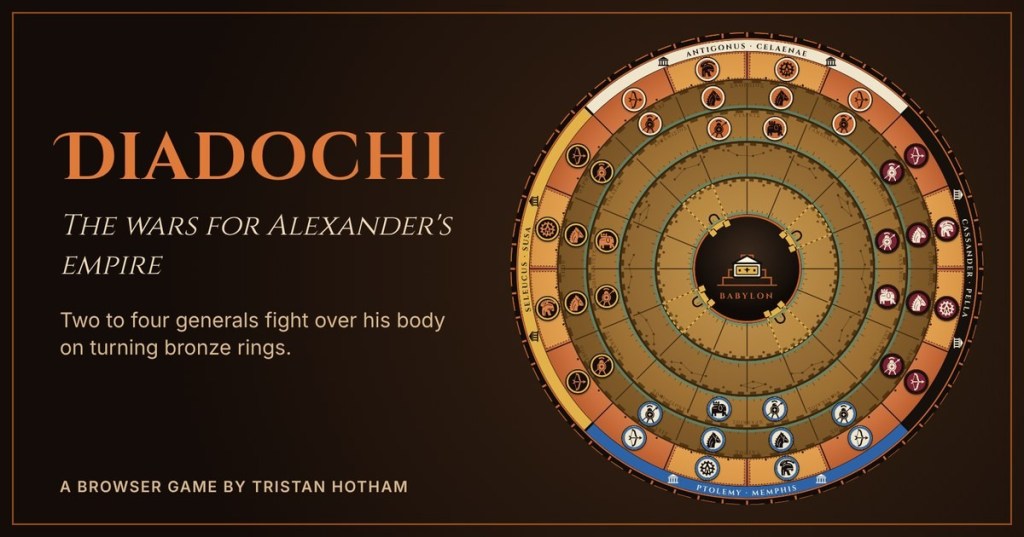
Babylon, 323 BC. Alexander the Great is dead, with no grown heir, and his generals are about to spend forty years tearing his empire apart. One of them, Ptolemy, even hijacked the funeral cart carrying Alexander’s body and took it to Egypt. Diadochi turns that scramble into a board game, on a board whose rings turn.
The Diadochi, the “successors”, were Alexander’s generals. Two to four of them take part: Ptolemy against Perdiccas in a two-player game, with Seleucus, Antigonus and Cassander joining for three or four. Each starts on his own stretch of the rim, with his capital marked by a small temple, and Alexander’s body lies in Babylon at the centre.
A board that turns
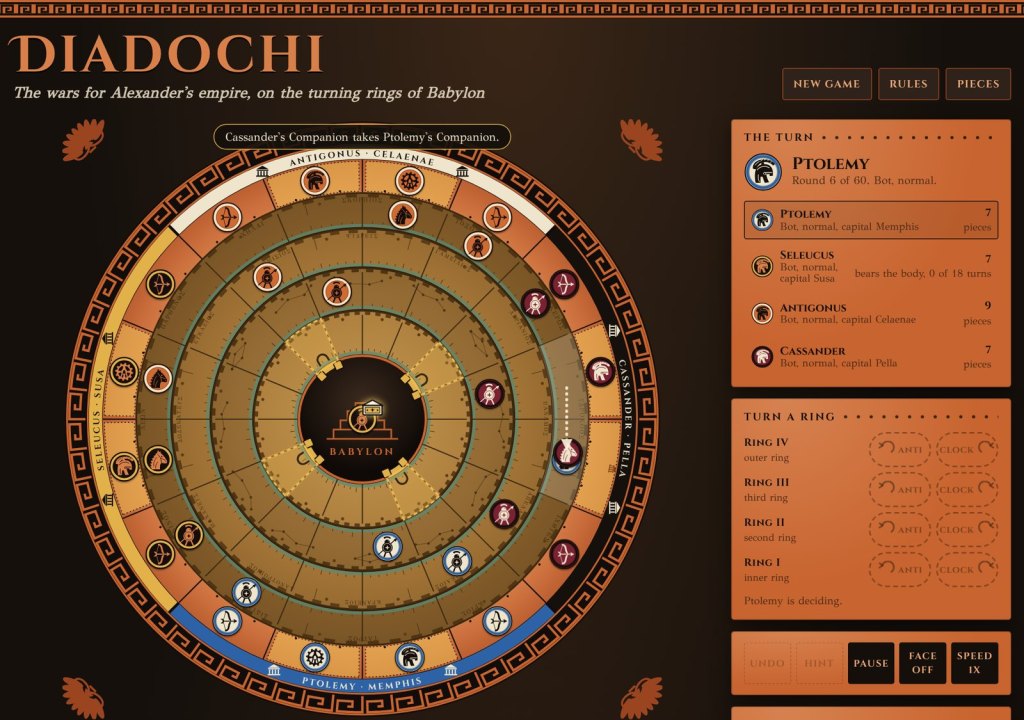
The board is a bronze astrolabe: four rings around Babylon, inside a fixed rim. On your turn you either move a piece or turn one ring a notch, clockwise or anticlockwise, which carries every piece on it round with it. A turn can line up your archers on an enemy, swing a rival’s general into reach, or carry the body’s bearer away from his escort. To stop players spinning the same ring back and forth, the last ring turned stays locked until someone turns another, and you can only turn rings while your Engineer is alive.
The rings are engraved with the Greek names of the zodiac and the Corinthian months, as on the dials of the Antikythera mechanism, and each army is painted in a different style of Greek pottery: black-figure, red-figure, white-ground and added-red.
Winning the empire
Any piece that steps onto the body becomes its bearer. Outside Babylon the bearer can only move with another of your pieces beside it as escort, so the body travels with an army round it, the way a funeral cart would. There are three ways to win: carry the body onto your capital; bear it for 18 of your turns, at which point your army proclaims you king; or be the last general standing. Capture a general and his whole army falls with him.
Each army has six kinds of piece. The General steps one cell any way. The Engineer steps one cell straight and lets you turn rings. Companion cavalry ride any distance in a straight line but shy away from elephants. War elephants charge one or two cells, trampling every enemy in their path. Archers shoot along their line of the board without moving. Phalangites strike forward with the long sarissa pike, reaching two cells.
Testing it
I balanced the rules by having computer players play thousands of games against each other and changing whatever the numbers showed was broken. Elephants once charged into Babylon in the second round and took the body from each other, so Babylon became a sanctuary entered by gates. Players once spent most of their moves turning rings back and forth, so the lock was added. And for a while a side could lose a whole type of piece and barely notice, until the escort rule made every piece matter. With turning switched off, the first player in a two-player game wins 59% of the time; with it, the seats are even.
In the final rules, across 800 games for each number of players, each seat won 47 to 53% of two-player games, 32 to 37% of three-player games and 23 to 27% of four-player games. A typical game lasts 22 to 25 rounds.
You can play against computer opponents at three levels, or pass and play at one screen, on a computer or a phone. Tips guide you through your first turns.
Notes
- The whole game is one web page with no downloads. The code is on GitHub under the MIT licence.
- The history is simplified: Perdiccas, for one, was dead by 321 BC, long before the wars were settled.
- Every rule has its own automated test, and over 2,000 random games were run with checks after every move.
- I made this with coding and drafting help from Claude (Anthropic). I reviewed and checked the game and text.

