
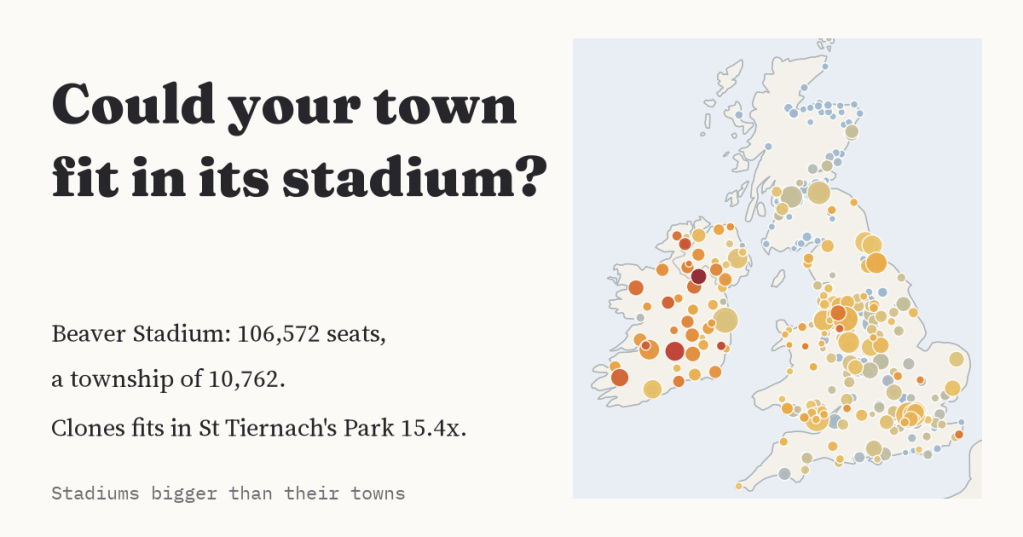
On a home game Saturday, Penn State’s stadium could seat its whole township 9.9 times over. Clones, a County Monaghan town of 1,885, could fit in its Gaelic football ground 15.4 times. I went looking for every stadium in the world that is bigger than its town, and found that half the cases I checked were not what the data first said.
Every football fan knows a ground that seems too big for its town. I wanted to find them properly, so I took 11,658 sports venues of 1,000 seats or more from Wikidata, the open database behind Wikipedia, and divided each one’s capacity by the population of the place it stands in. If the answer is more than one, the whole town could sit in the stands.
Camp Nou is not bigger than its town
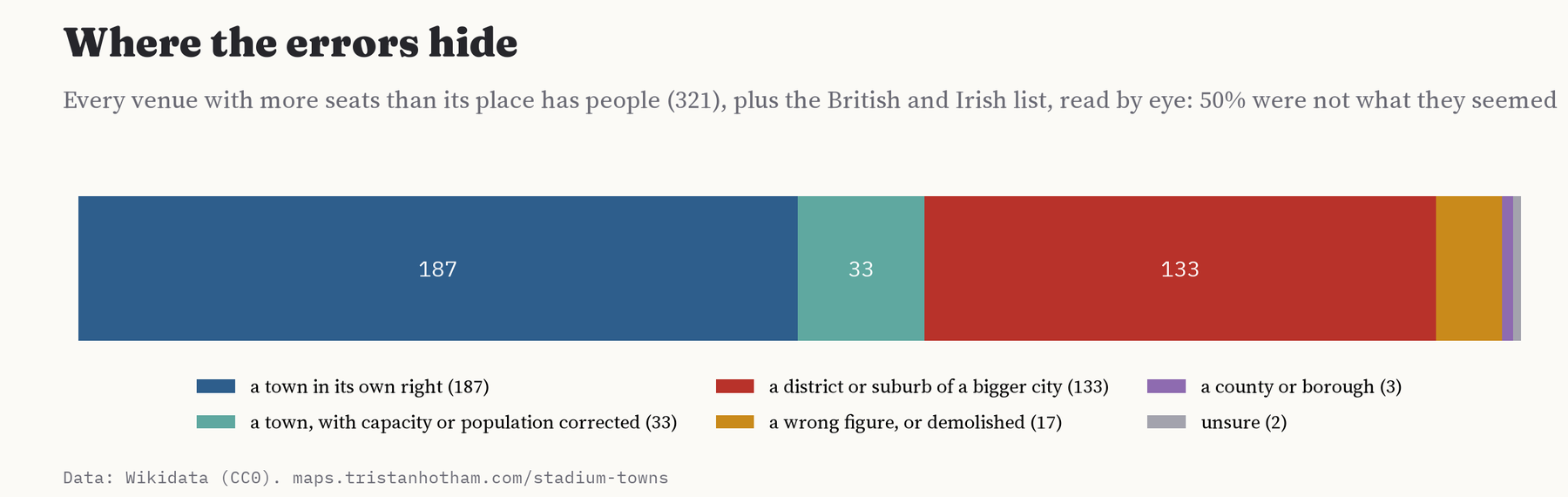
The first pass gave 321 venues bigger than their town. Then I read every one of them, and most fell away. Wikidata often places a stadium in a district or a suburb rather than the town: Camp Nou in one neighbourhood of Barcelona, Anfield in the district of Anfield, the Sydney Showground in Moore Park, which has 28 residents. Others had a wrong population, were stadiums that were never built, or were knocked down long ago, like Giants Stadium in New Jersey. Of 375 venues I checked by eye, 133 stood in a district or suburb of a bigger city, 17 had plainly wrong figures or are gone, and 33 were real towns but needed today’s capacity or a census population. In all 50% were not what they first seemed.
Where the whole town really fits
What is left is still a lot: 190 venues in 48 countries that are bigger than their town, and 73 that could seat it twice. The champion is a minor league baseball park, GCS Ballpark, in the industrial village of Sauget, Illinois, which has 141 residents and 6,000 seats. Second is an Irish county ground, St Tiernach’s Park in Clones, with 29,000 places for 1,885 townspeople. Then come a football ground in the Andorran hamlet of Aixovall, Xanthi’s stadium in the Greek village of Pigadia, unused since 2022, and the giants of American football: Beaver Stadium, 106,572 seats in a township of 10,762, and MetLife Stadium, home of both New York teams, in the borough of East Rutherford.
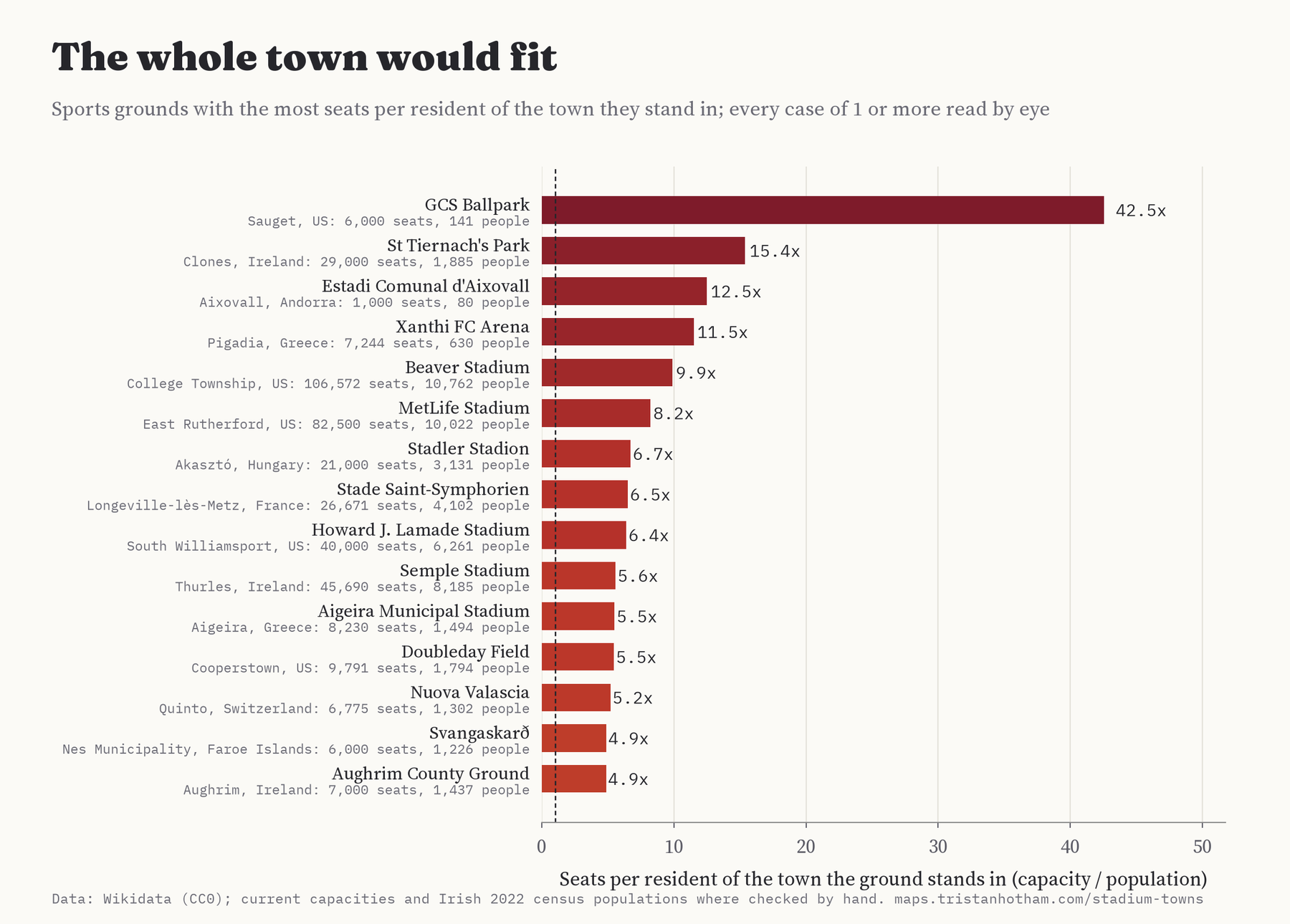
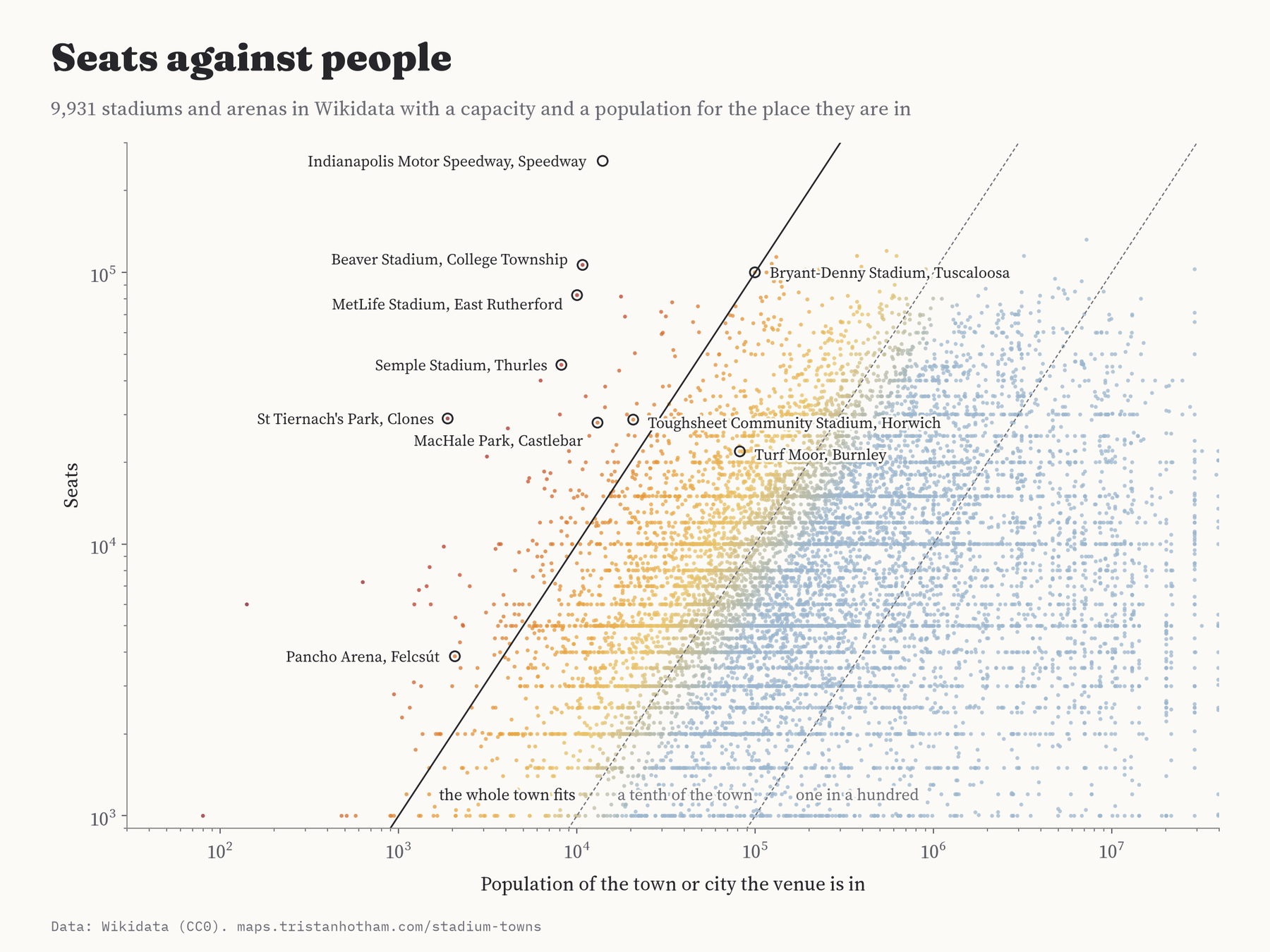
College towns are the classic case. Clemson could fit in its stadium 4.6 times, Notre Dame’s township 2.3 times. Alabama’s Bryant-Denny Stadium would just about hold the whole of Tuscaloosa. In European football the record holders are grounds built in small communes and villages just outside a city: FC Metz play in Longeville-lès-Metz, a commune of 4,102, in a stadium for 26,671.
Clones could sit in St Tiernach’s Park 15.4 times over.
The county grounds of Ireland
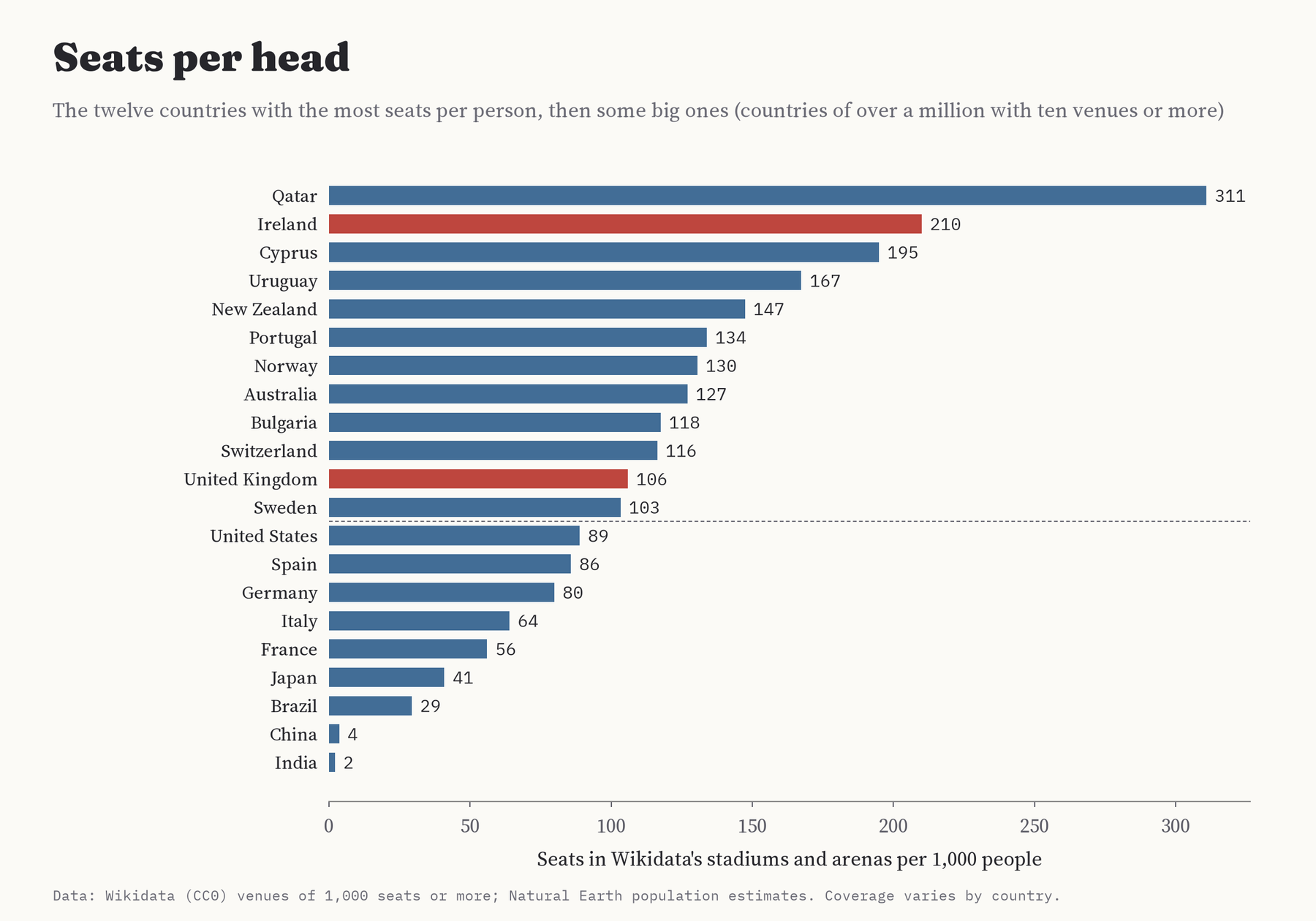
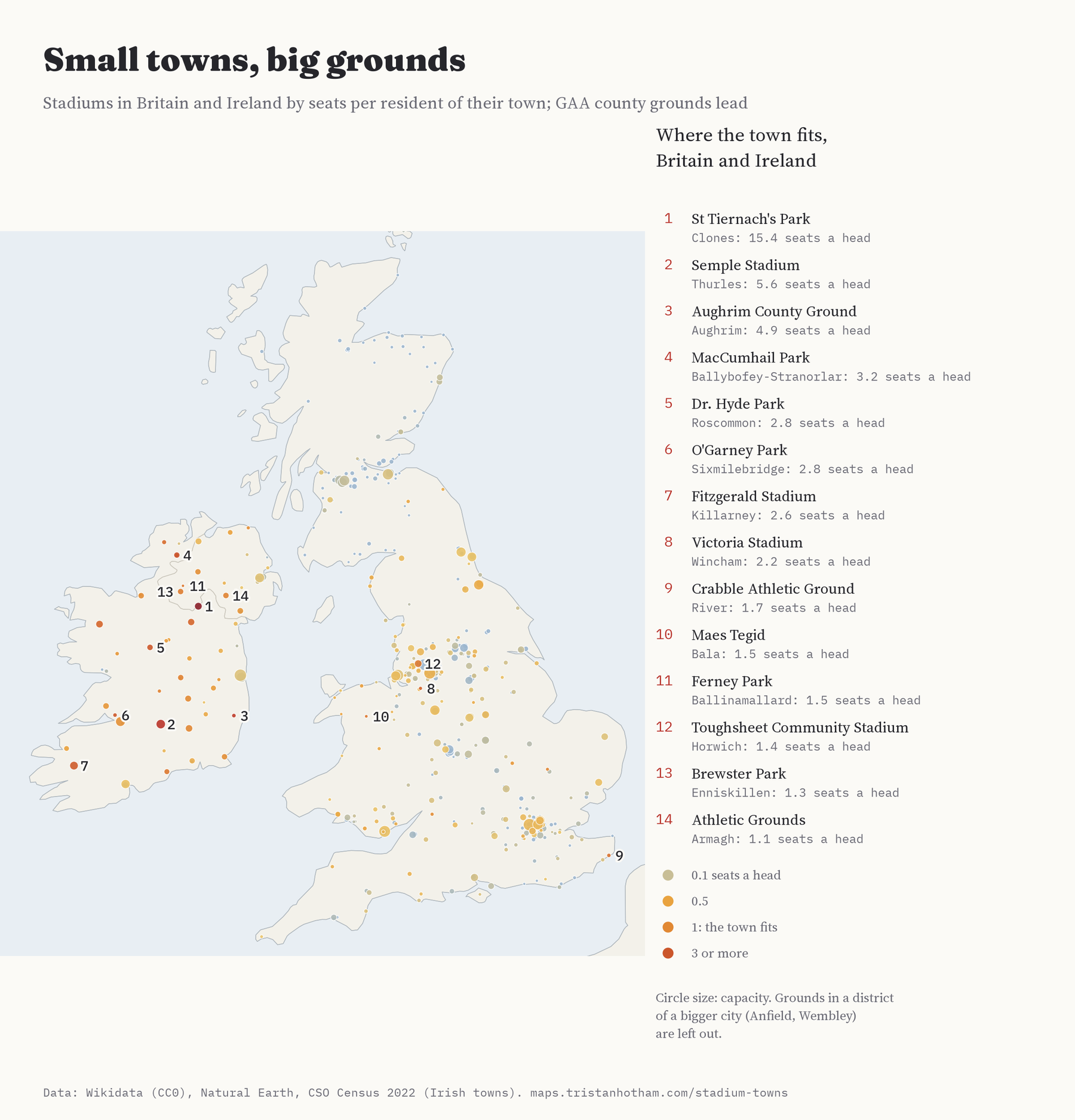
Closer to home, Ireland is where the town fits most often, thanks to the Gaelic games county grounds, built for big championship crowds in small county towns. Clones could fill St Tiernach’s Park 15.4 times, Thurles could fill Semple Stadium, the home of hurling, 5.6 times, and the village of Aughrim could fill Wicklow’s county ground 4.9 times. Ballybofey, Roscommon, Sixmilebridge, Killarney, Castlebar and Cavan could each fit in theirs at least twice. Wikidata has no population for many Irish towns, Thurles and Clones among them, so here I used the 2022 census. Brewster Park in Enniskillen and the Athletic Grounds in Armagh do the same in Northern Ireland. Ireland also comes second in the world for seats per head in the data, with 210 for every 1,000 people, behind only Qatar and its World Cup stadiums.
In Britain the list is short. Northwich Victoria’s Victoria Stadium in Wincham, Dover’s Crabble ground and Bala Town’s Maes Tegid lead. The only English league club whose town fits is Bolton Wanderers: their stadium is in Horwich, which it could seat 1.4 times. Most famous grounds stand in districts of big cities, so they have no town to fill, and Burnley, the classic small Premier League town, has a ground for about a quarter of its people.
One weekend a year
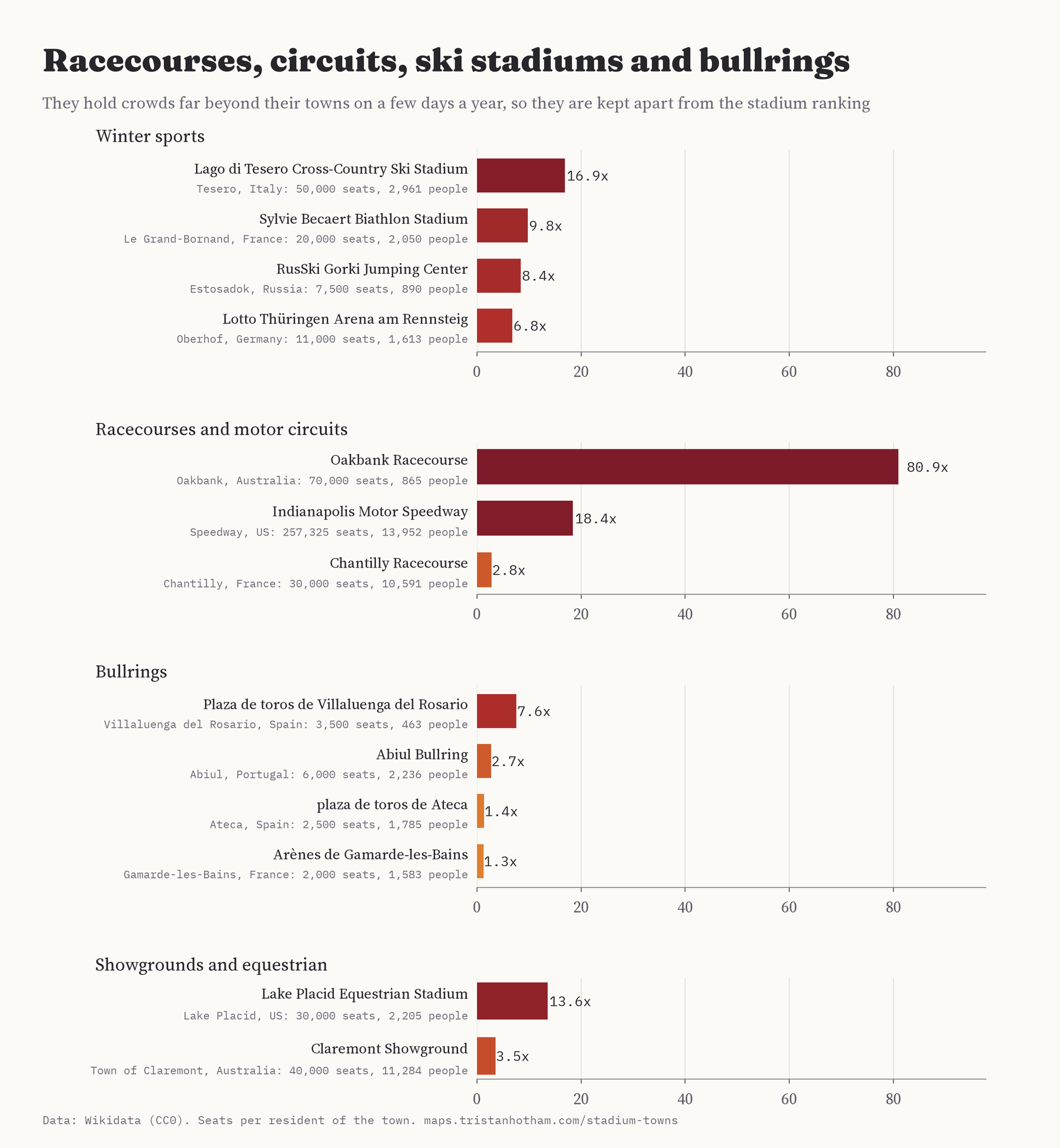
Some venues are built for one huge weekend, and they win easily. Oakbank in the Adelaide Hills has 865 residents and a racecourse for 70,000 at its Easter meeting. The Indianapolis Motor Speedway seats 257,325 in a town actually called Speedway. The ski stadium at Lago di Tesero holds nearly seventeen times its village for the World Championships. I kept these apart from the stadiums, since a racecourse full once a year is a different thing from a football ground every other Saturday.
How I did this
Where Wikidata gives several capacities I took the largest, often an old record crowd, and where it gives several populations I took the largest too. For the grounds at the top of each list I checked the capacity against today’s figure, and for Irish towns I used the 2022 census. Where a stadium sits in several places I used the one with the fewest people, usually the town rather than the county. I counted a place as a town if it is a municipality, township, commune or village in its own right, even if it lies right next to a big city, so East Rutherford and Foxborough count but a suburb that is only part of Sydney does not. The kind of venue and the sport are guessed from names. And Wikidata knows far more about European and American venues than Asian or African ones, so the country comparison measures the data as much as the stadiums. If your town fits in its ground and is not on the map, I would love to hear about it.
Notes and sources
- Venues, capacities, locations, populations and tenants: Wikidata (CC0), queried with QLever. Country populations: Natural Earth (public domain).
- Irish town populations: Central Statistics Office, Census of Population 2022. Current capacities of the grounds I checked: Wikipedia and club pages.
- Every decision made by hand is in the overrides file with the data and code.
- I wrote the text, with drafting and editing assistance from Claude (Anthropic), which also helped prepare the analysis code. I reviewed and checked all text and results.

