
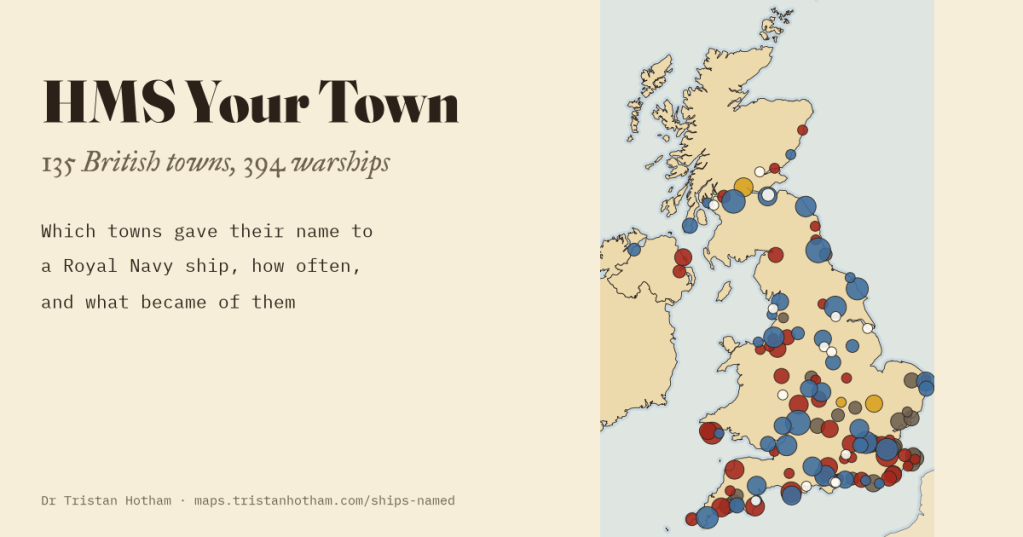
Gloucester and Newcastle have each given their name to nine Royal Navy warships. Lancaster has had four, Barrow none. I matched every Royal Navy ship in Wikidata to the British towns they are named after and found 394 ships for 135 towns, a naming fashion that has come and gone for three and a half centuries.
In plenty of British towns there is a ship’s bell in the church or a crest in the town hall, a gift from HMS Something, the warship that carried the town’s name to sea. I wanted to know which towns have had one, how often, and what became of the ships.
Wikidata lists 6,006 Royal Navy ships named HMS. It says what a ship was named after for only 261 of them, so for the rest I matched the name to a British town or city, strictly: an exact match to a real town, and nothing named after a person, a battle, a river, a fox hunt or a foreign port that happens to share a British town’s name. That leaves 394 ships named after 135 towns and cities.
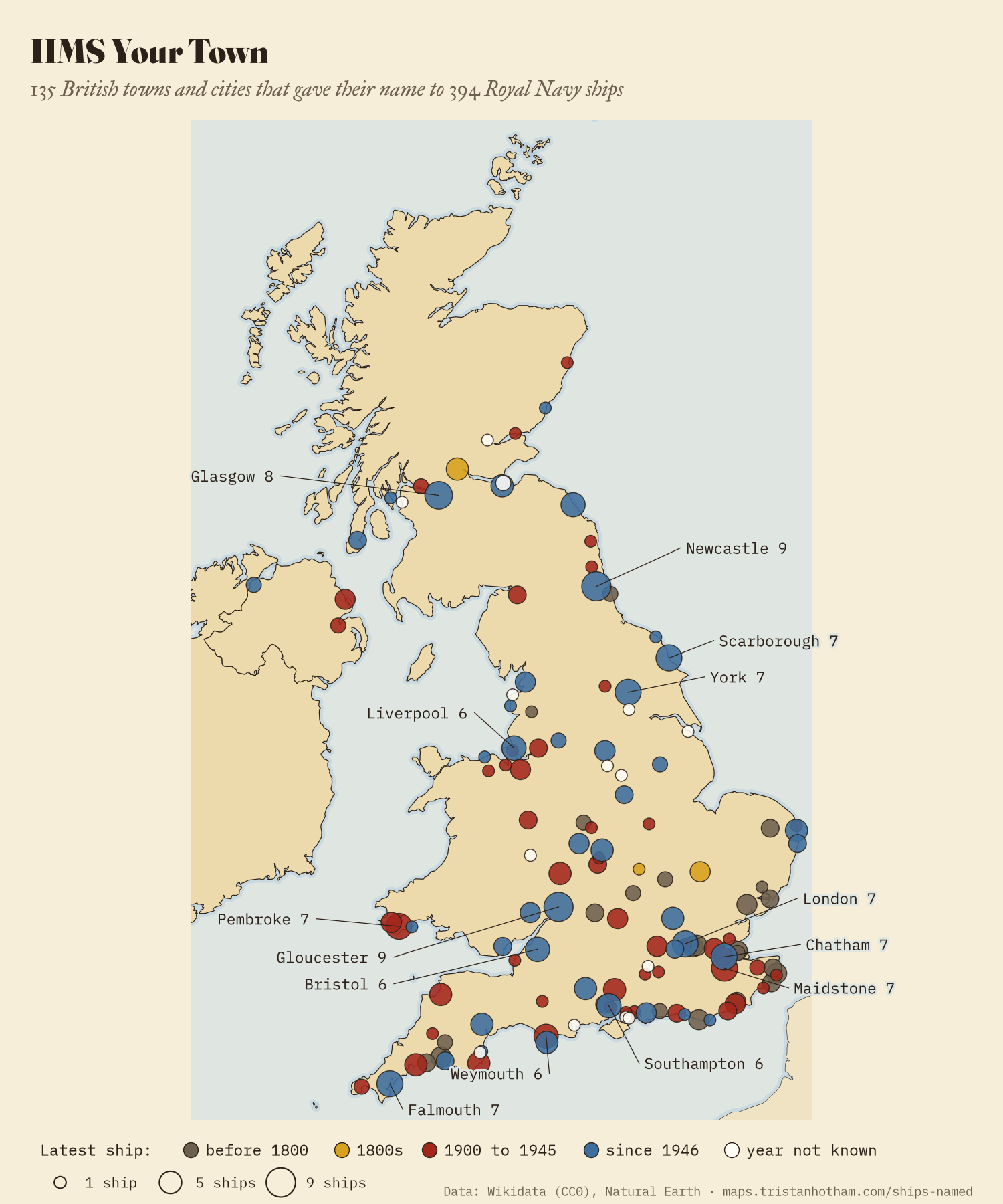
Ports, cathedral cities and dockyard towns
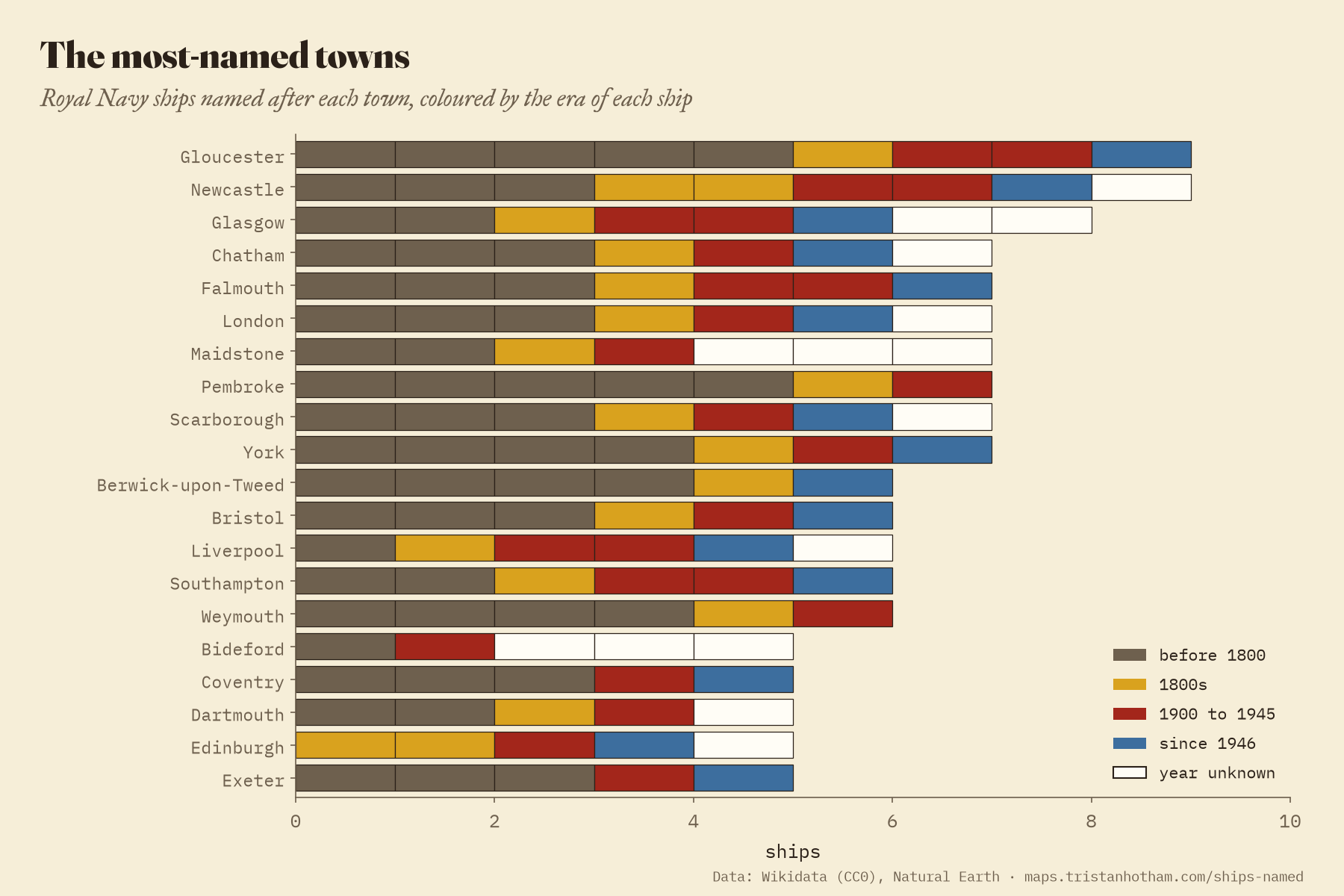
The most honoured are Gloucester and Newcastle, with nine ships each, then Glasgow with eight and Chatham, Falmouth, London, Maidstone, Pembroke, Scarborough and York with seven. They are the old ports, the cathedral cities and the dockyard towns the Navy lived in. 63% of the towns are within 10 km of the open sea. 28 towns have had five ships or more, and 50 just the one.
A fashion that came and went
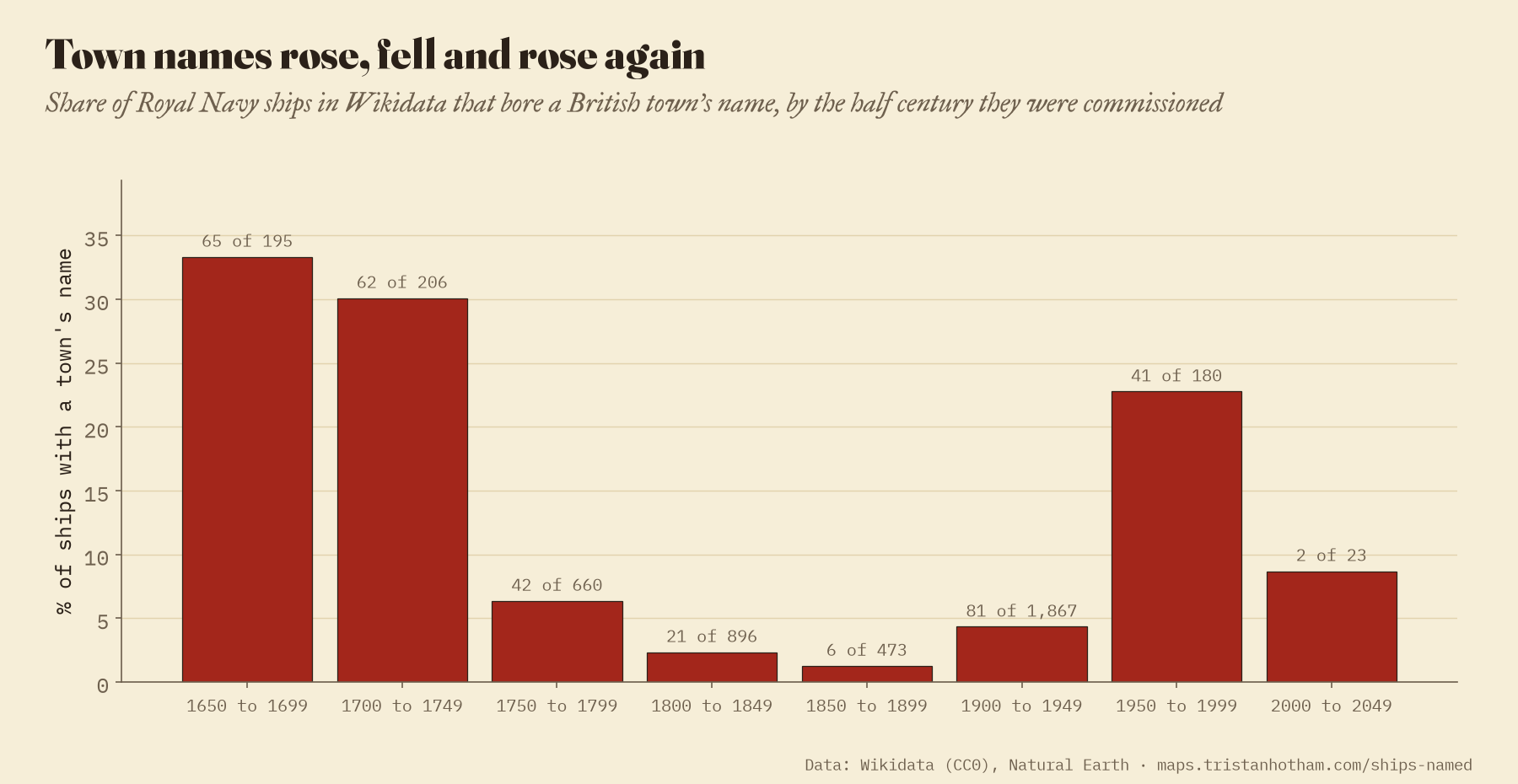
Naming warships after towns is old. In the later 1600s about a third of the Navy’s ships carried a town’s name, though many of those names, York, Gloucester, Newcastle, were also the titles of royal dukes and earls, so some of those ships may honour the duke rather than the town. In all 42% of the matched ships carry a name that is also a noble title; leave them out and 227 ships and 93 towns remain. From the middle of the 1700s town names became rare, lost among a fleet of classical heroes, virtues, animals and battles. They came back in the 20th century: the Town-class cruisers, the Castle-class corvettes of 1944 named after town castles, the frigates of the 1950s and the Type 42 destroyers named after cities. The Type 23 frigates of the 1990s look like towns (Lancaster, Richmond, St Albans) but are named after dukedoms.
Lancaster and Barrow
Close to home, Lancaster has had 4 ships in the data: HMS Lancaster of 1694 and 1797, the corvette HMS Lancaster Castle in 1944 and the Type 23 frigate of 1992, though that frigate, like the rest of its class, takes its name from a dukedom, the Duke of Lancaster being the monarch. Wikidata misses the Town-class destroyer HMS Lancaster of 1940, and I left out the armoured cruiser of 1902, one of a class named after counties. Barrow-in-Furness, which has built so many of the Navy’s ships, has never had one of its own name in the data.
The open data can say which towns gave a ship its name. It mostly cannot say what happened to the ship.
What happened to them?
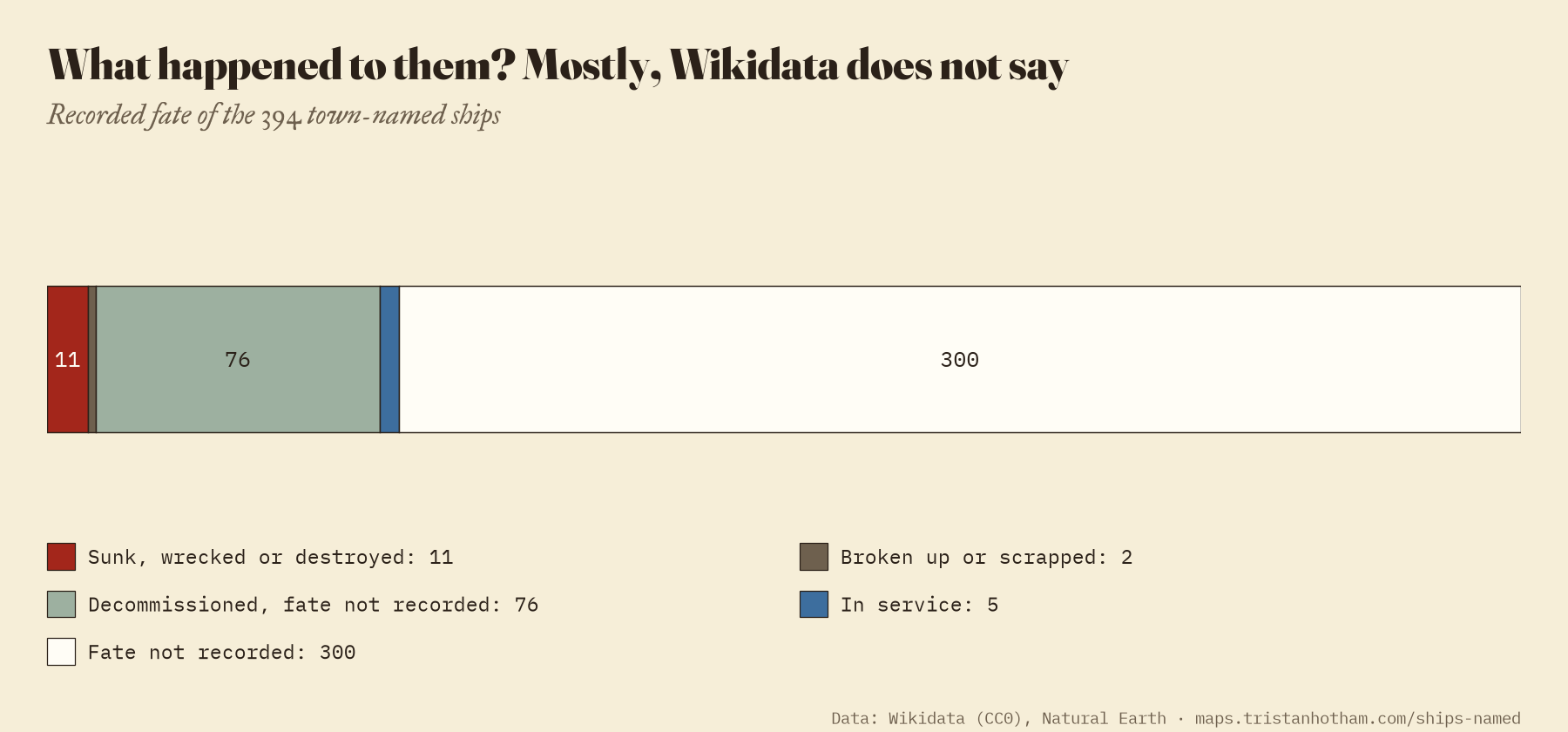
This is where the data runs thin. Only 24% of the ships have any recorded end in Wikidata, and most of those are just a decommissioning date. 11 are recorded as sunk, wrecked or destroyed, among them HMS Gloucester, sunk off Crete in 1941, and HMS Sheffield and HMS Coventry, lost in the Falklands in 1982. The rest is a gap waiting to be filled.
Other navies
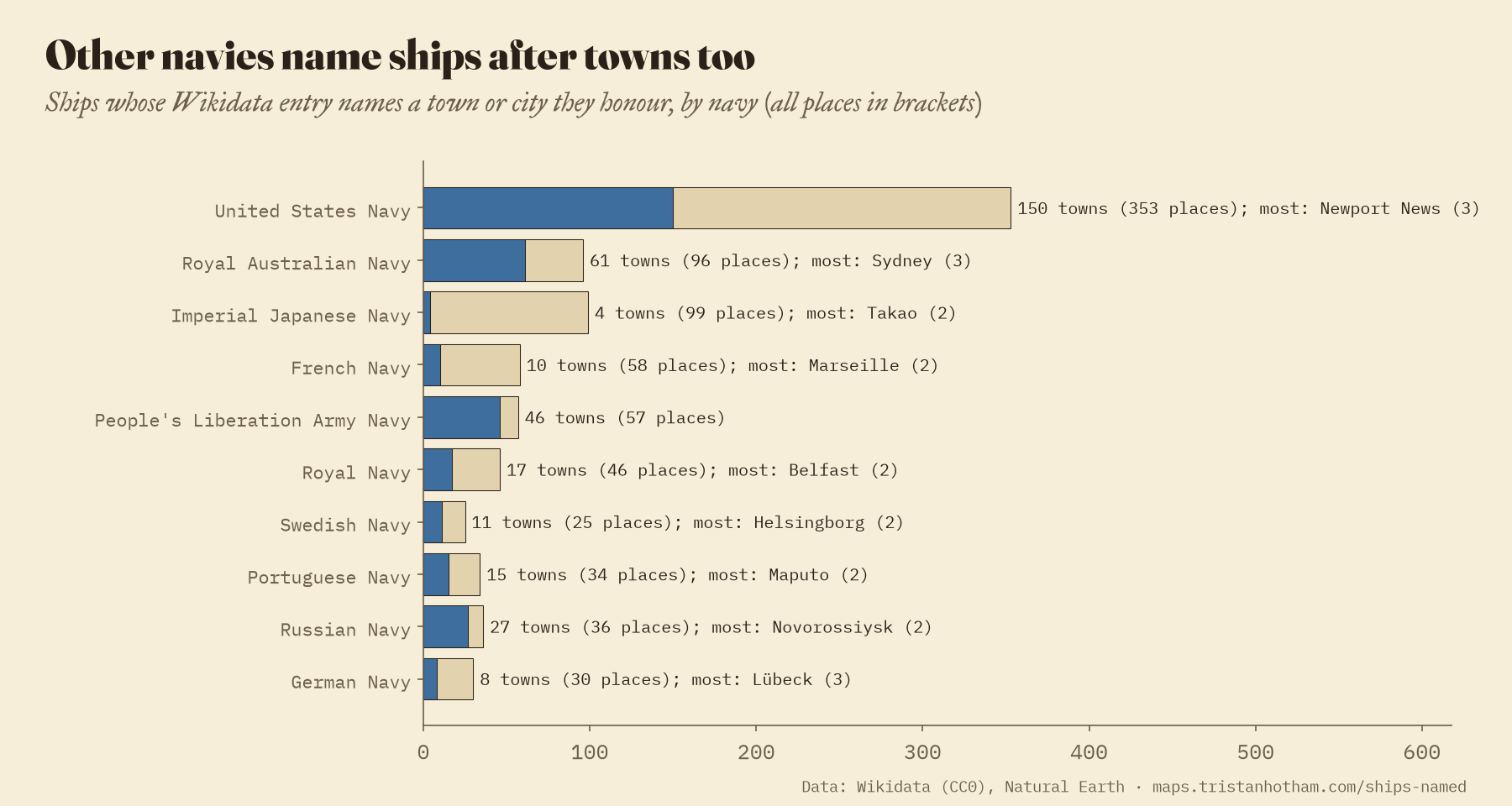
Other navies do the same. Where Wikidata says what a ship is named after, the United States Navy leads, with 146 ships named after American towns and cities, from Raleigh to Newport News; the Royal Australian Navy names ships after its cities; and the Imperial Japanese Navy, by contrast, named ships after mountains, rivers and provinces.
How I did this
Everything comes from Wikidata. I took every Royal Navy ship whose name starts with HMS and used its “named after” link where it had one. Otherwise I matched the name exactly to a British town or city, or a “Lancaster Castle” style name to its town, and left out classes named after other things (fox hunts, racecourses, rivers, flowers) and names that belong to people, battles, rivers or foreign places. Names that are also noble titles are counted but flagged on the map, and classes named after counties (the County-class cruisers and destroyers) are left out. Years are commissioning years, or the typical year of the ship’s class. Only 261 of the 6,006 ships (4%) say in Wikidata what they were named after, and the 394 matches are 7% of the Royal Navy ships in the data. Some ships are missing altogether: 43 of the 45 Town-class destroyers the United States handed over in 1940, all named after towns shared by Britain and America, appear only under their American names. A matching name is not proof, so treat the counts as a lower bound.
Notes and sources
- Wikidata (CC0): Royal Navy and other ships, classes, dates, events and namesakes; British towns and cities.
- Static maps use Natural Earth (public domain). The interactive map uses the Inked World style on OpenStreetMap data (© OpenStreetMap contributors, ODbL) served by OpenFreeMap.
- I wrote the text, with drafting and editing assistance from Claude (Anthropic), which also helped prepare the analysis code. I reviewed and checked all text and results.

