
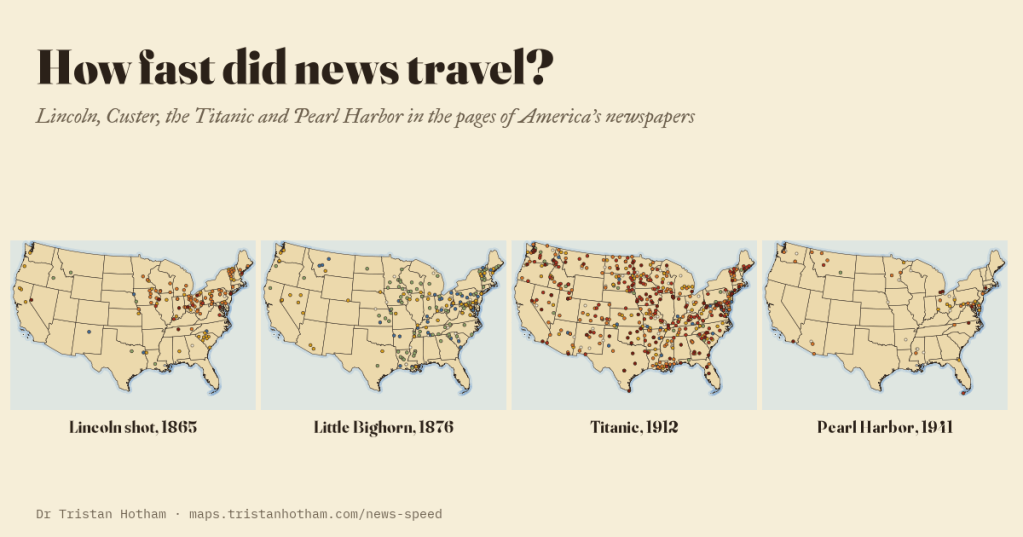
When Lincoln was shot, how long before a newspaper in Iowa, Texas or Nevada printed it? I followed four great American stories through 13,233 digitised issues of 936 newspapers, from 1865 to 1941. The answer surprised me: the telegraph had done almost all the work by 1865. What held news back was the weekly press day, and the last miles to the wire.
On the evening of 14 April 1865, Abraham Lincoln was shot at Ford’s Theatre in Washington. He died at about half past seven the next morning. By then the news was already set in type in Cleveland, Nashville, Indianapolis and New York, and the same day it was in print in Gold Hill, Nevada, 3,643 km away, at the far end of the transcontinental telegraph.
I wanted to know how typical that was. So I took four stories that every American newspaper would have printed: Lincoln’s assassination in 1865, Custer’s defeat at the Little Bighorn in 1876, the sinking of the Titanic in 1912 and the attack on Pearl Harbor in 1941. For each one I went through every digitised page in the weeks afterwards, in the Library of Congress’s Chronicling America archive, and found the first day each paper printed the news.
The next morning, then and later
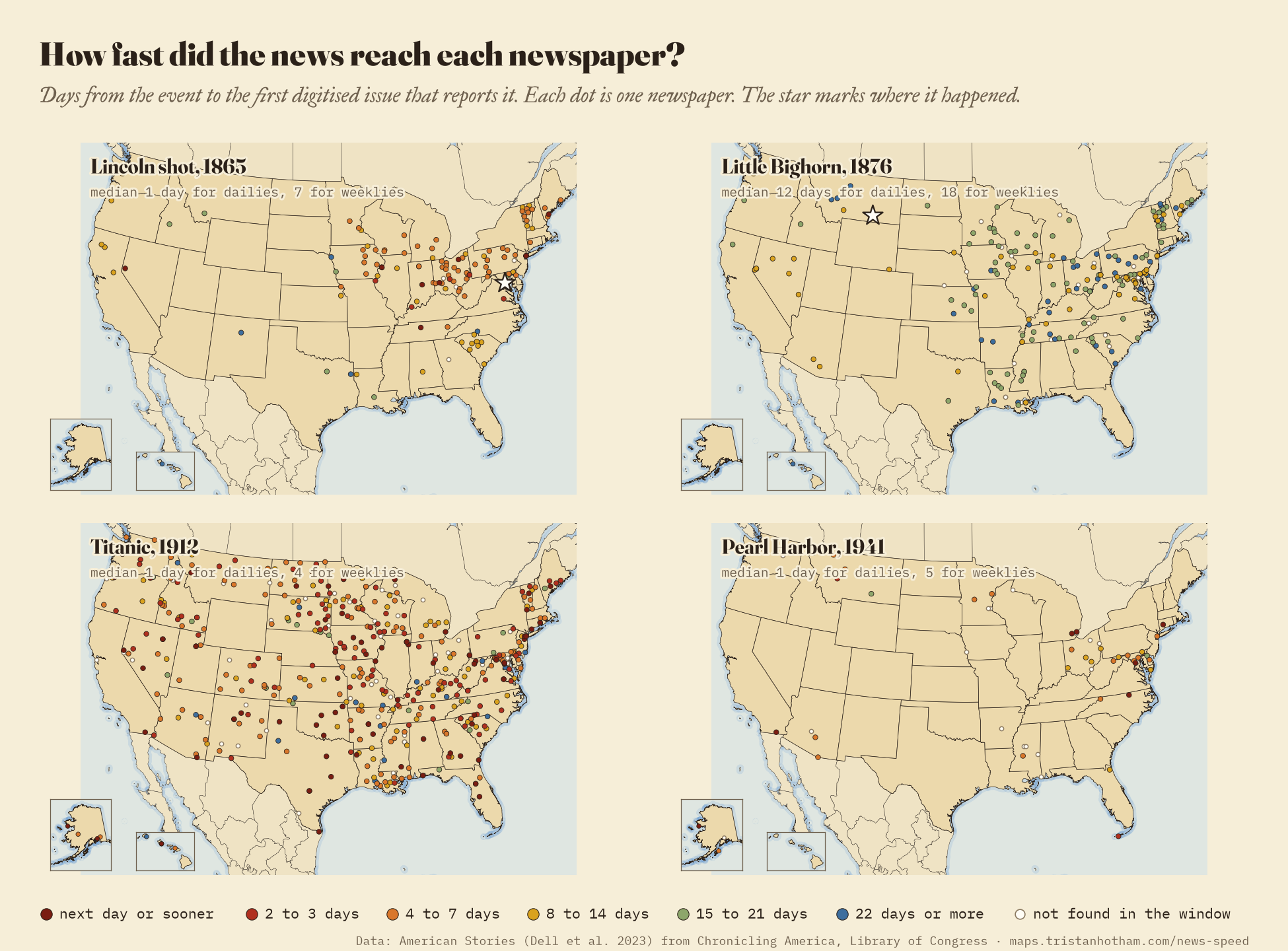
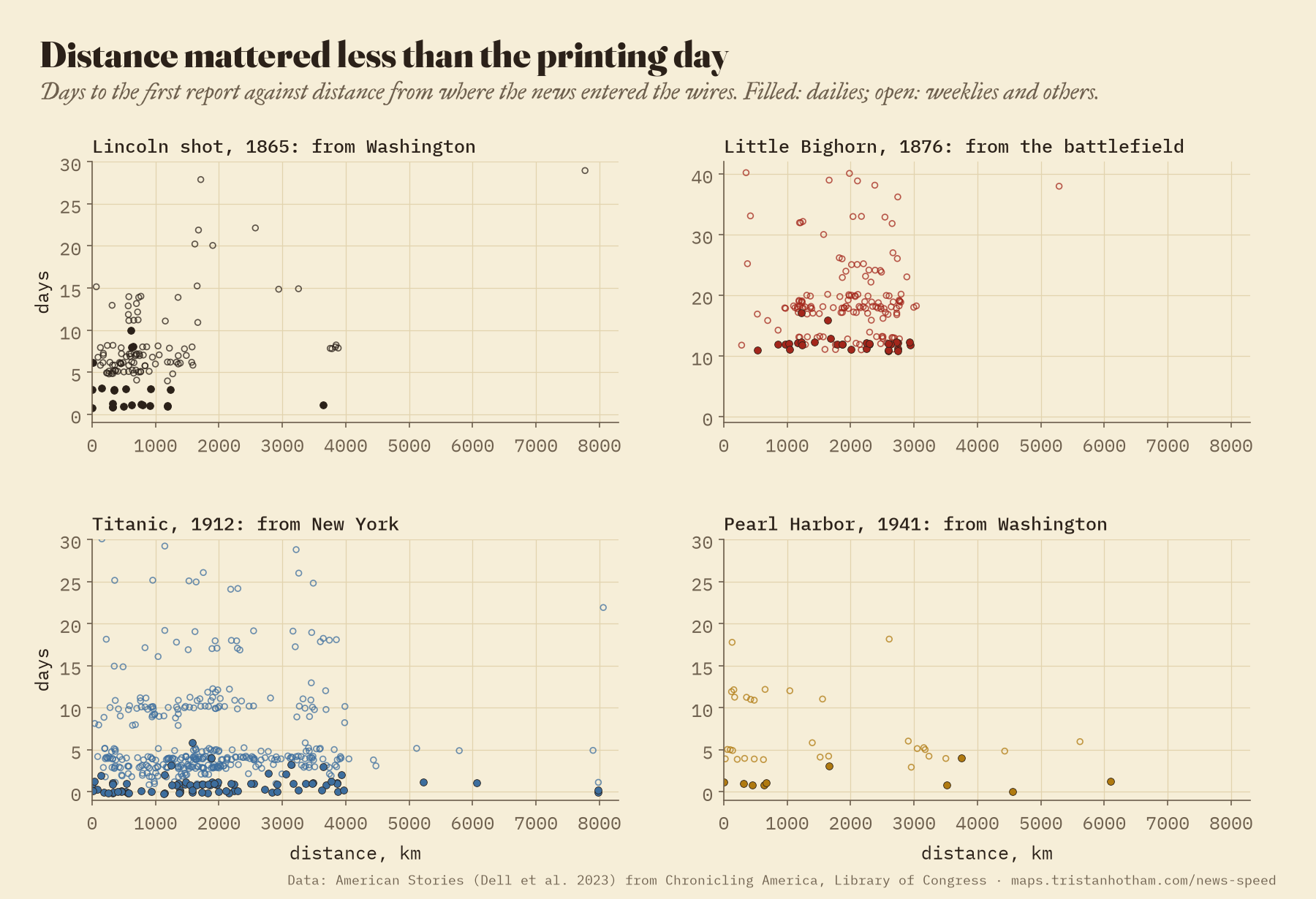
Here is the surprise. A daily paper that printed Lincoln’s death waited a median of 1 day. A daily printing the Titanic in 1912 waited 1 day. A daily printing Pearl Harbor in 1941, in the age of radio, waited 1 day. For the daily press, the telegraph had already won by the end of the Civil War. Wireless, the telephone and radio made the world faster in many ways, but they did not get a big story into a connected daily any sooner than the next edition.
What took time was the weekly paper. Most American papers came out once a week, and a weekly printed the news when its press day came round. Weeklies took a median of 7 days for Lincoln, 4 for the Titanic and 5 for Pearl Harbor. Most of them missed nothing: 62% of the papers that printed Lincoln’s death did so in their very next issue.
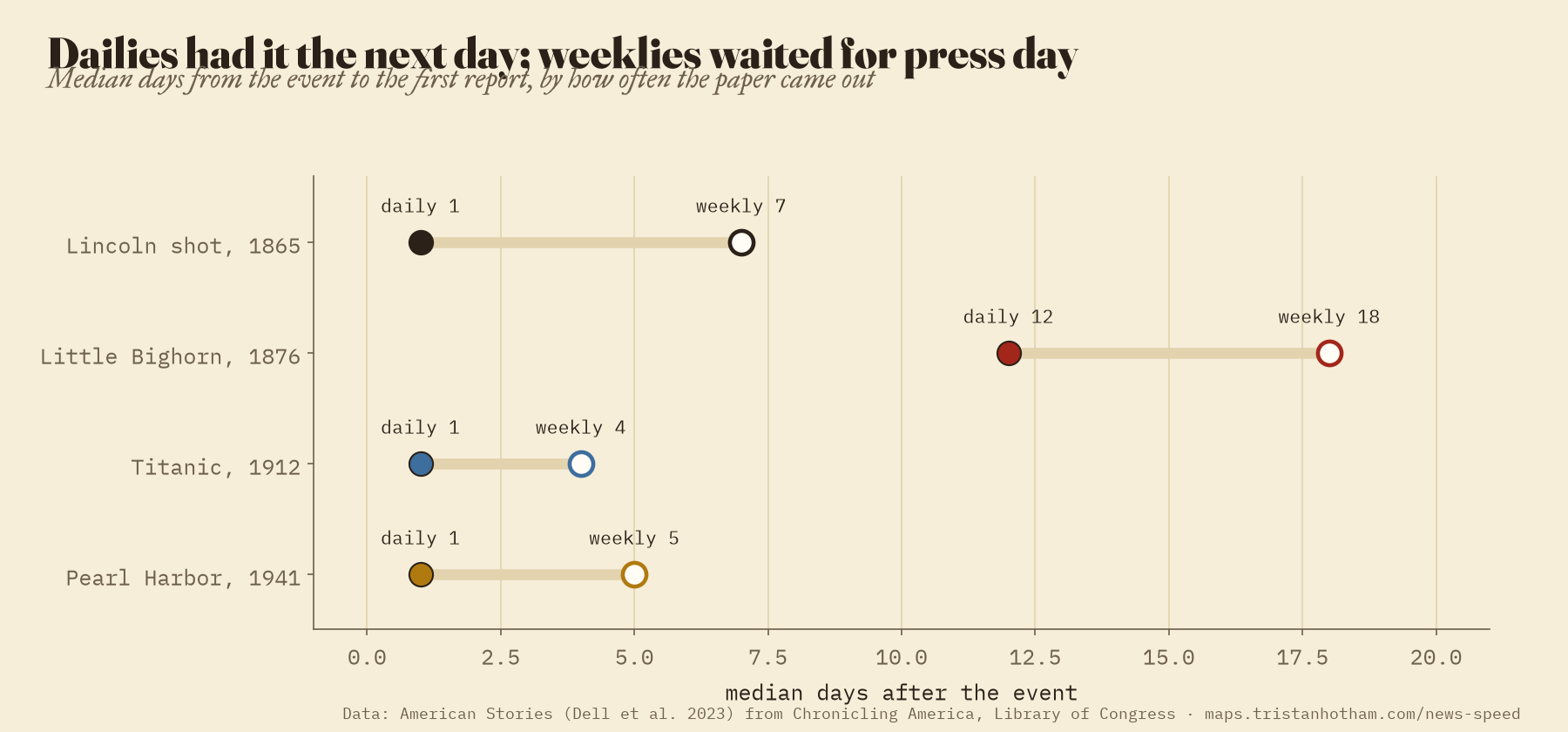
You can see the press days in the curves. Each one climbs in steps, a jump every few days as another batch of weeklies goes to press.
Far did not mean late
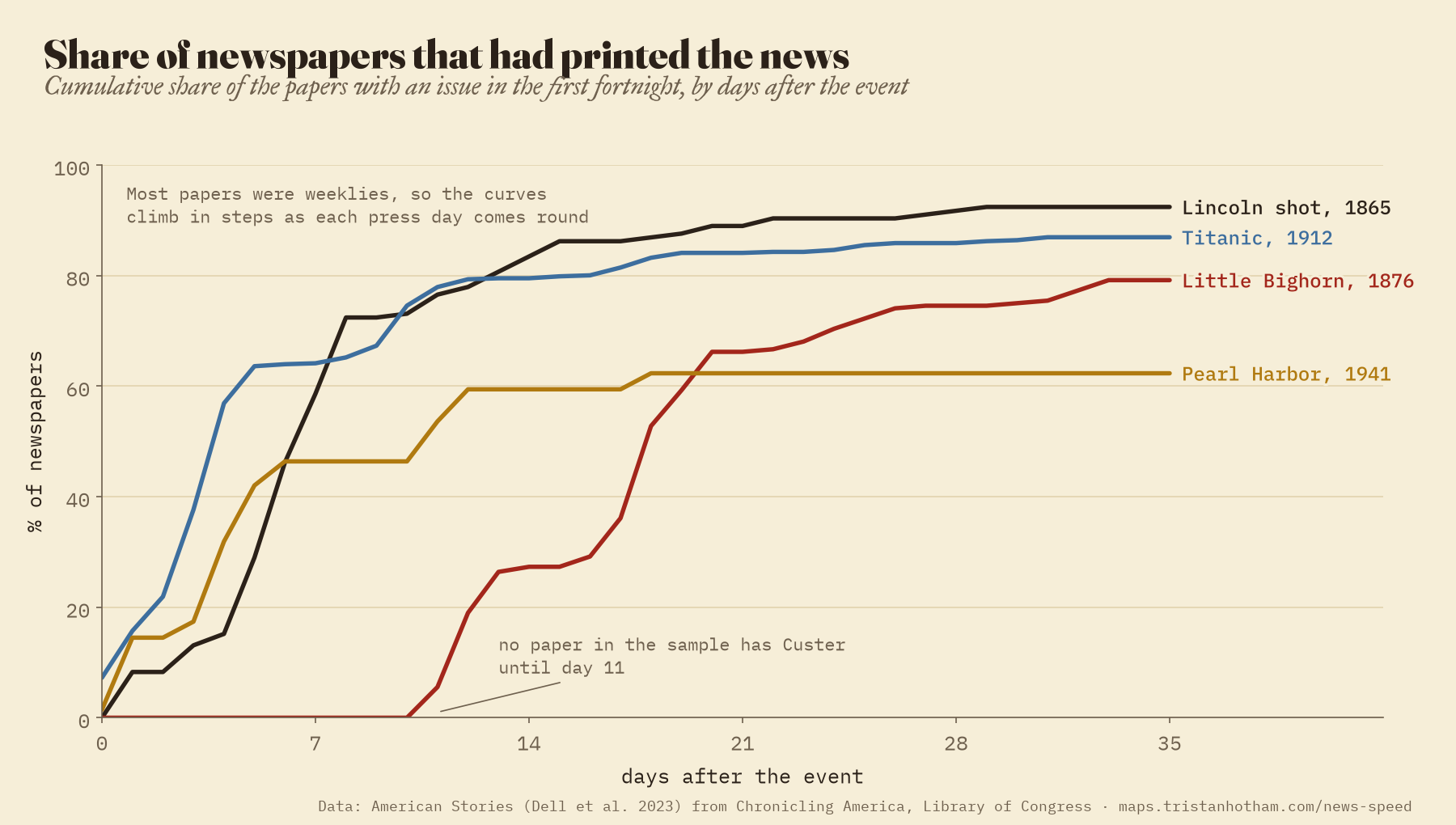
I expected distance to matter. It hardly did. Among daily papers there is no real relation between how far a paper was from where the news broke and how long it took to print it. The two Honolulu dailies printed the Titanic news on 15 April 1912, the day she sank, 7,982 km from New York, thanks to the Pacific cable. In 1941 the Daily Alaska Empire in Juneau had Pearl Harbor the same day.
1865: a country still at war
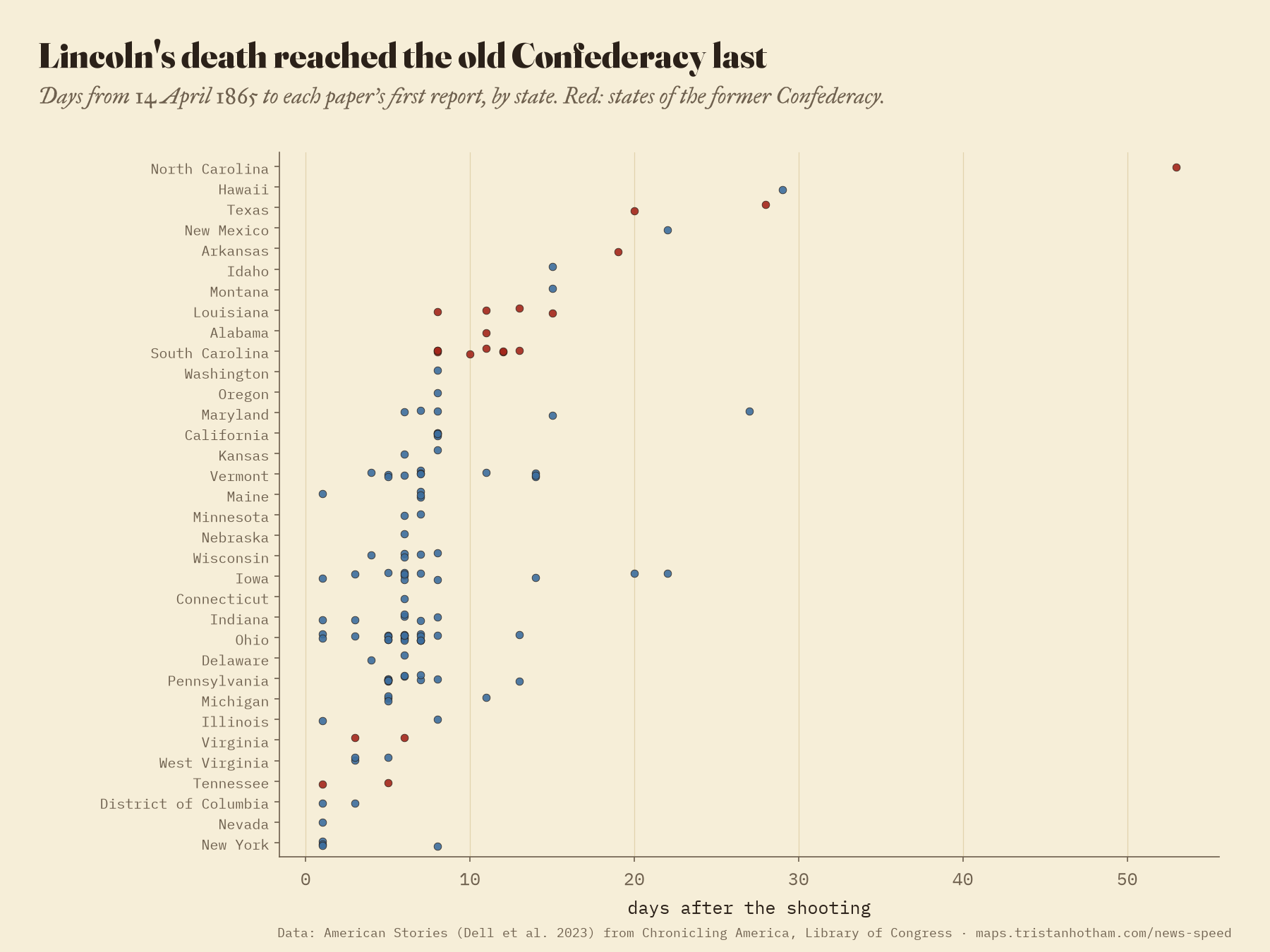
The exception in 1865 was the South. Lincoln died six days after Lee’s surrender, and much of the South’s telegraph and railway was wrecked. Papers in the states of the former Confederacy took a median of 11 days to print his death, against 6 elsewhere. Where the Union army was, the news was quick: Nashville had it on 15 April and Richmond, taken two weeks earlier, on the 17th. Inland South Carolina took over a week, and the Texas papers in the sample three to four weeks.
1876: eleven days of silence
Custer shows where the delay really lay. The battle was fought on 25 June 1876 in Montana Territory, days from the nearest telegraph office. A scout carried the first word to Bozeman on 3 July, and from Montana it went on the wire by way of Salt Lake City; the steamboat carrying the wounded only reached Bismarck late on 5 July. No paper in the sample printed it for 11 days. Then, on 6 July, it was everywhere at once: 12 papers in 9 states and territories printed it that day, from New York and Washington to Cheyenne and a mining town in Nevada.
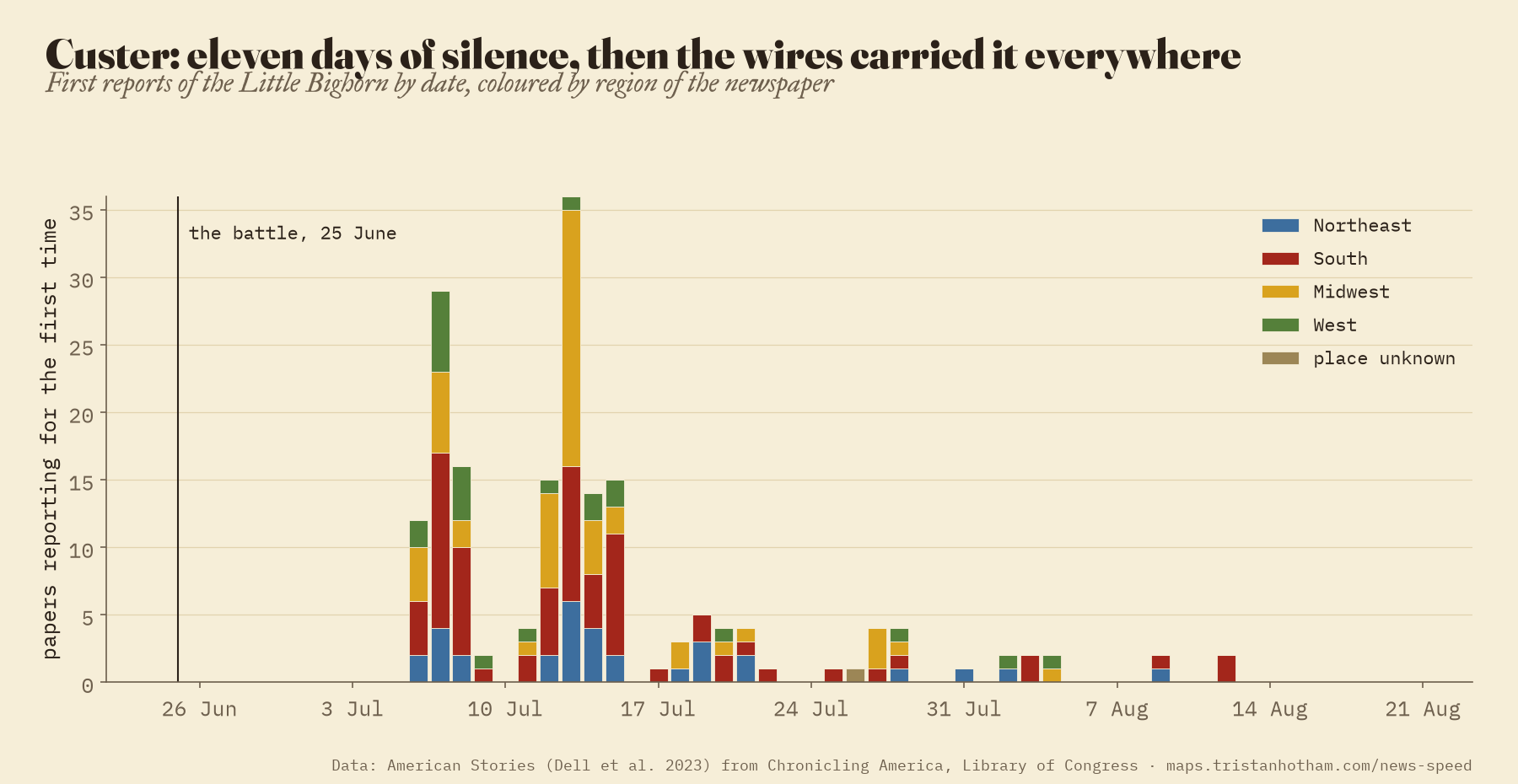
The slow part was never the thousands of miles of wire. It was the first mile to the telegraph office, and the last few days to press day.
How I did this
The pages come from American Stories, a dataset built at Harvard from the Library of Congress’s newspaper scans, which turns each page into articles and text. For each event I had every page in the weeks after it, with a flag where the text named the event and a short snippet round the name. A name is not a story, though: Lincoln County and Custer City were in the papers all the time. So a page only counted if it came after the news could have arrived and its snippet had a word about the event itself, like assassination, massacre, iceberg or attack. I read the snippet of every early or doubtful first report myself, 290 of them, and threw out 9. Each paper is placed at the town in its Library of Congress title.
There are caveats. The digitised papers are a sample, with far more small weeklies than big dailies, and few papers for 1941. OCR misses words, so a paper may have printed the news an issue earlier than I found; read every delay as “at most”. And Pearl Harbor was often reported simply as “Hawaii” or “war”, which a search for the name cannot see.
On the interactive map you can pick an event and press play to watch the news spread day by day, and tap any paper to read the first lines it printed.
Notes and sources
- Melissa Dell and colleagues, American Stories: a large-scale structured text dataset of historical U.S. newspapers (2023), CC BY 4.0, built from Chronicling America, Library of Congress.
- Places from Wikidata (CC0) and GeoNames (CC BY 4.0); state outlines from Natural Earth. The interactive map uses the Inked World style on OpenStreetMap data (© OpenStreetMap contributors, ODbL) served by OpenFreeMap.
- On the telegraph and the news: Menahem Blondheim, News over the Wires (1994); Tom Standage, The Victorian Internet (1998).
- I wrote the text, with drafting and editing assistance from Claude (Anthropic), which also helped prepare the analysis code. I reviewed and checked all text and results.

