
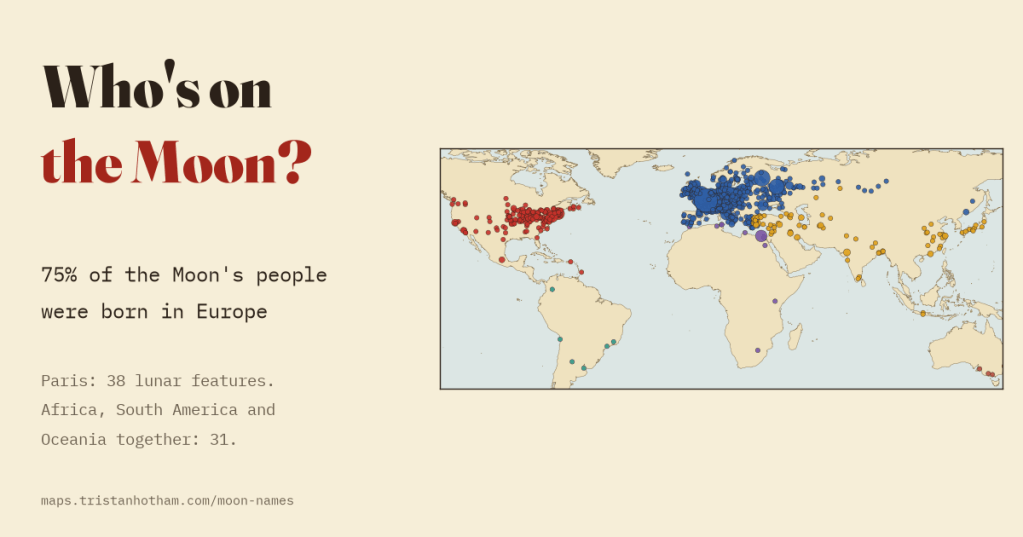
Copernicus, Tycho, Kepler, Plato: the Moon is covered in people’s names. I traced 2,718 of the names on the Moon, Mercury, Venus and Mars back to the towns where those people were born. Three in four of the Moon’s people were born in Europe, and Paris alone outnumbers three continents.
When you look at the Moon you are looking at a list of names. The big craters of the near side were mostly named in the seventeenth century by the Jesuit astronomer Giovanni Battista Riccioli, who honoured the astronomers and philosophers he admired, and we have kept on naming the features of other worlds after people ever since. Today the International Astronomical Union keeps the official list, with a theme for each world: astronomers and scientists on the Moon, artists, writers and composers on Mercury, women on Venus, scientists and small villages on Mars.
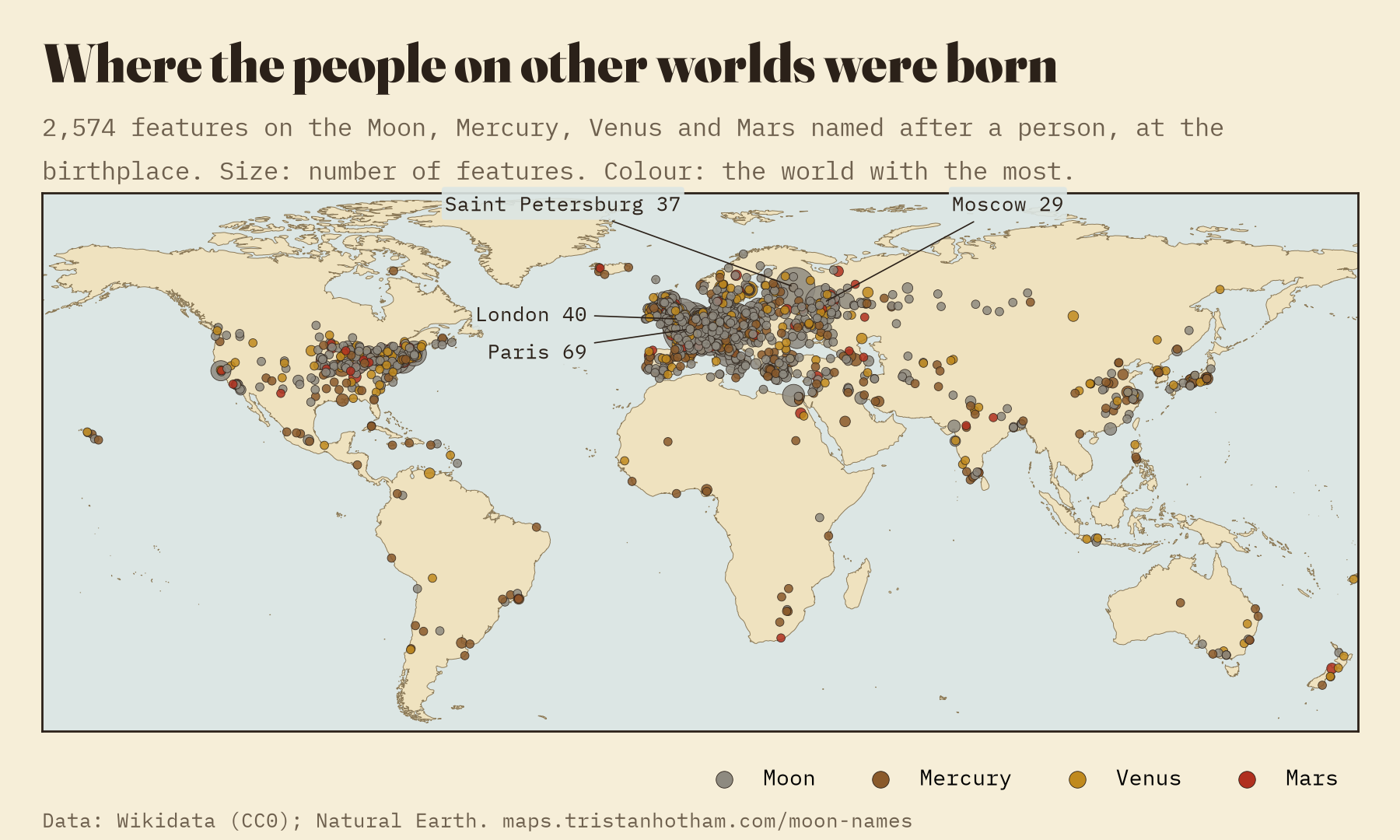
Those rules say what kind of person gets a crater. They do not say where the person came from. So I asked Wikidata, the open database behind Wikipedia, which records what most of these features are named after and where most of those people were born. Joined up, that gives 3,471 named features on four worlds, 2,718 of them named after 2,560 people, born in 1,661 places on Earth. On the interactive page you can click any crater and fly to its namesake’s home town, or click a town and see everything named after the people born there.
The Moon is European
Of the lunar features named after a person whose birthplace Wikidata knows, 75% honour someone born in Europe. North America has 16%. Asia has 102 features, more than half of them for people born before 1500: the Greek scholars of Anatolia and the astronomers of the Islamic world. Africa has 19, more than half of them scholars of ancient and medieval Egypt, above all Alexandria; South America has 6 and Oceania 6. Paris, with 38, beats all three put together.
More craters on the Moon honour people born in Paris than people born in Africa, South America and Oceania together.
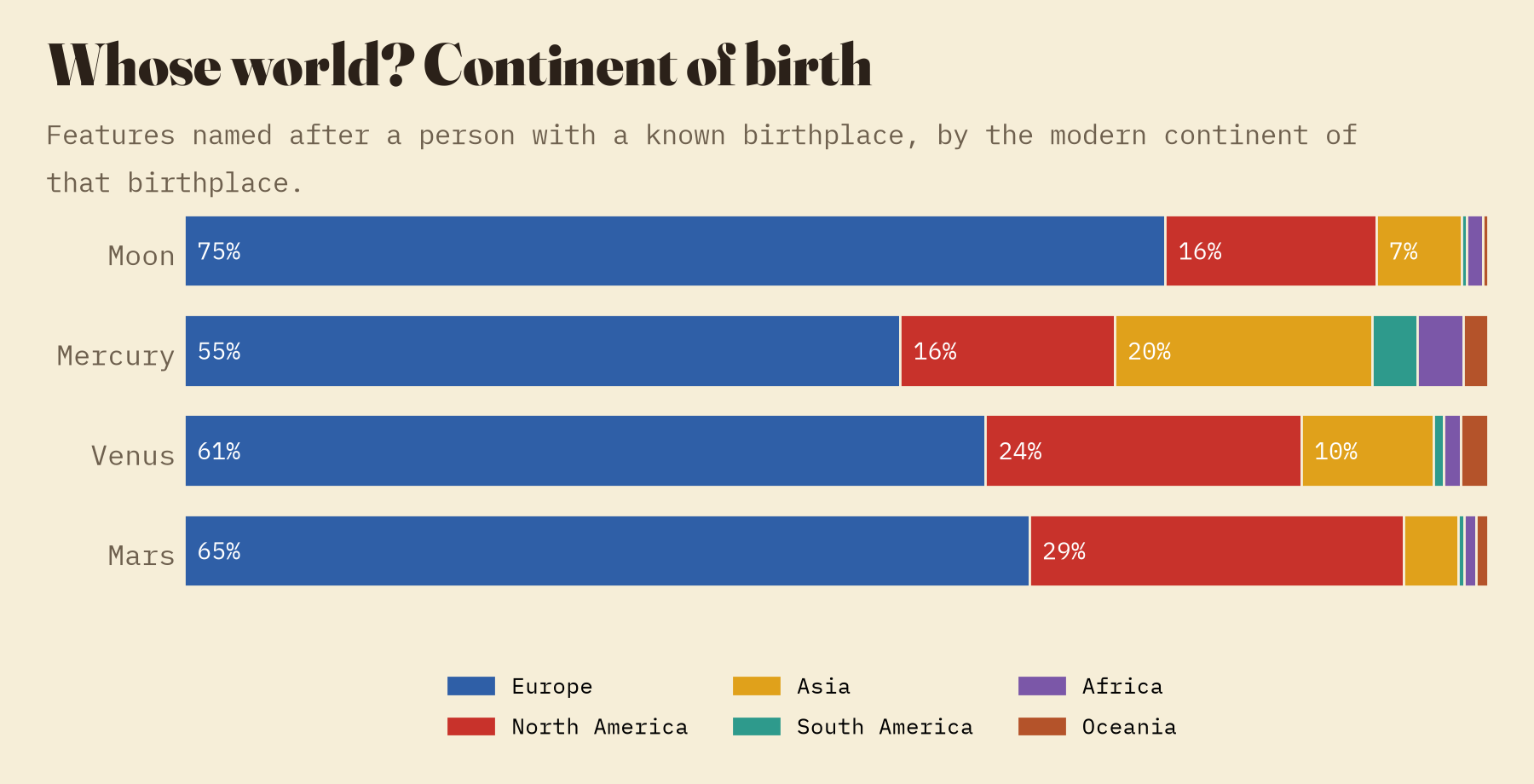
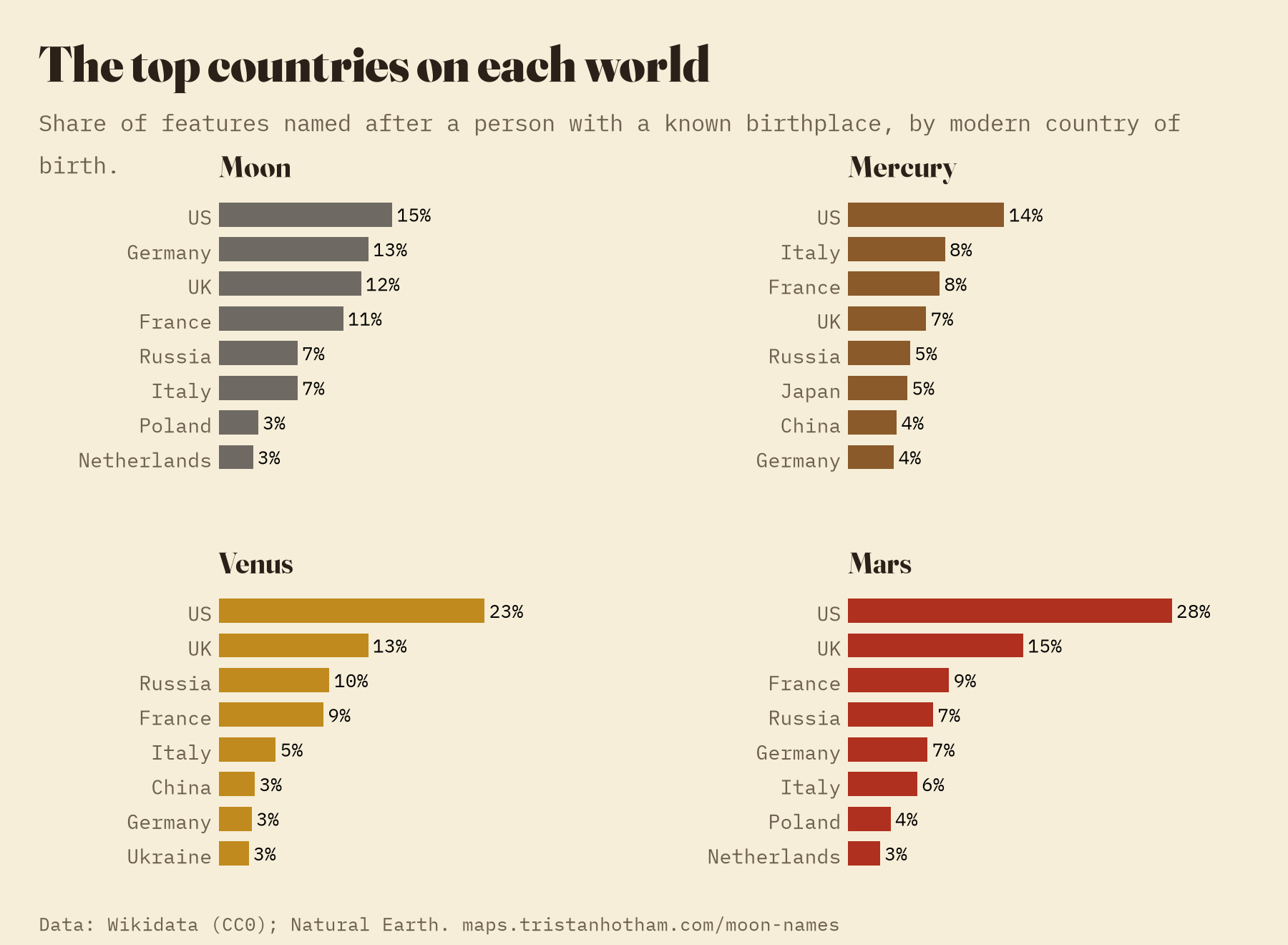
The newer worlds are wider. Mercury’s craters go to artists, writers and composers, and that rule reaches Japanese printmakers, Chinese poets and Indian musicians in a way that the history of Western astronomy never did: only 55% of Mercury’s people were born in Europe and 20% in Asia. Venus and Mars, named mostly in the space age, lean American: the United States leads on both, with 23% and 28%.
Astronomers on the Moon, artists on Mercury
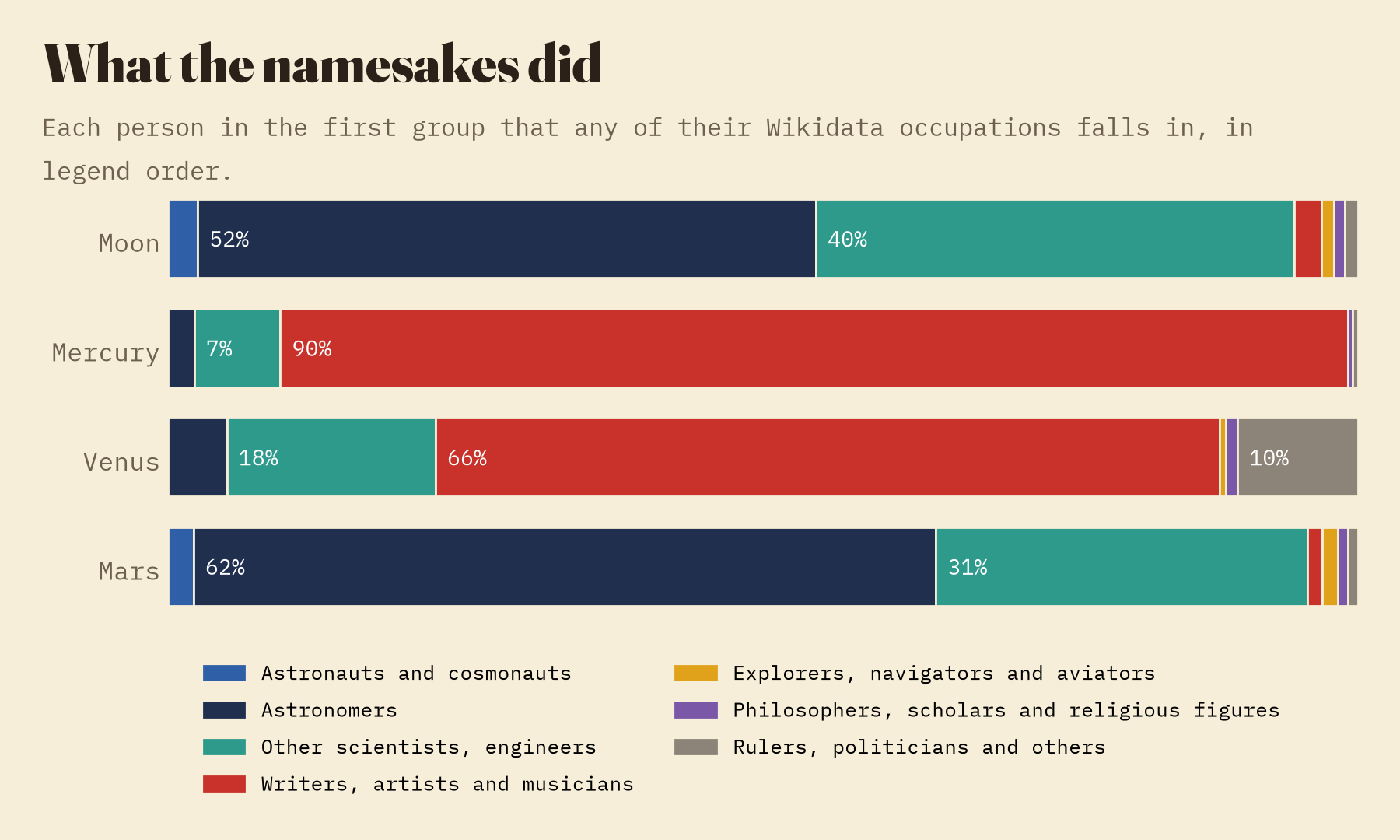
The rules show clearly in what the namesakes did. On the Moon 52% were astronomers and 40% other scientists, mathematicians or engineers. Mercury is the mirror image: 98% of its people had at least one artistic or literary occupation, from Bach and Beethoven to Tolstoy and Hokusai. Venus, whose features are all named after women, is the only world with queens, saints and politicians in any number.
Where are the women?
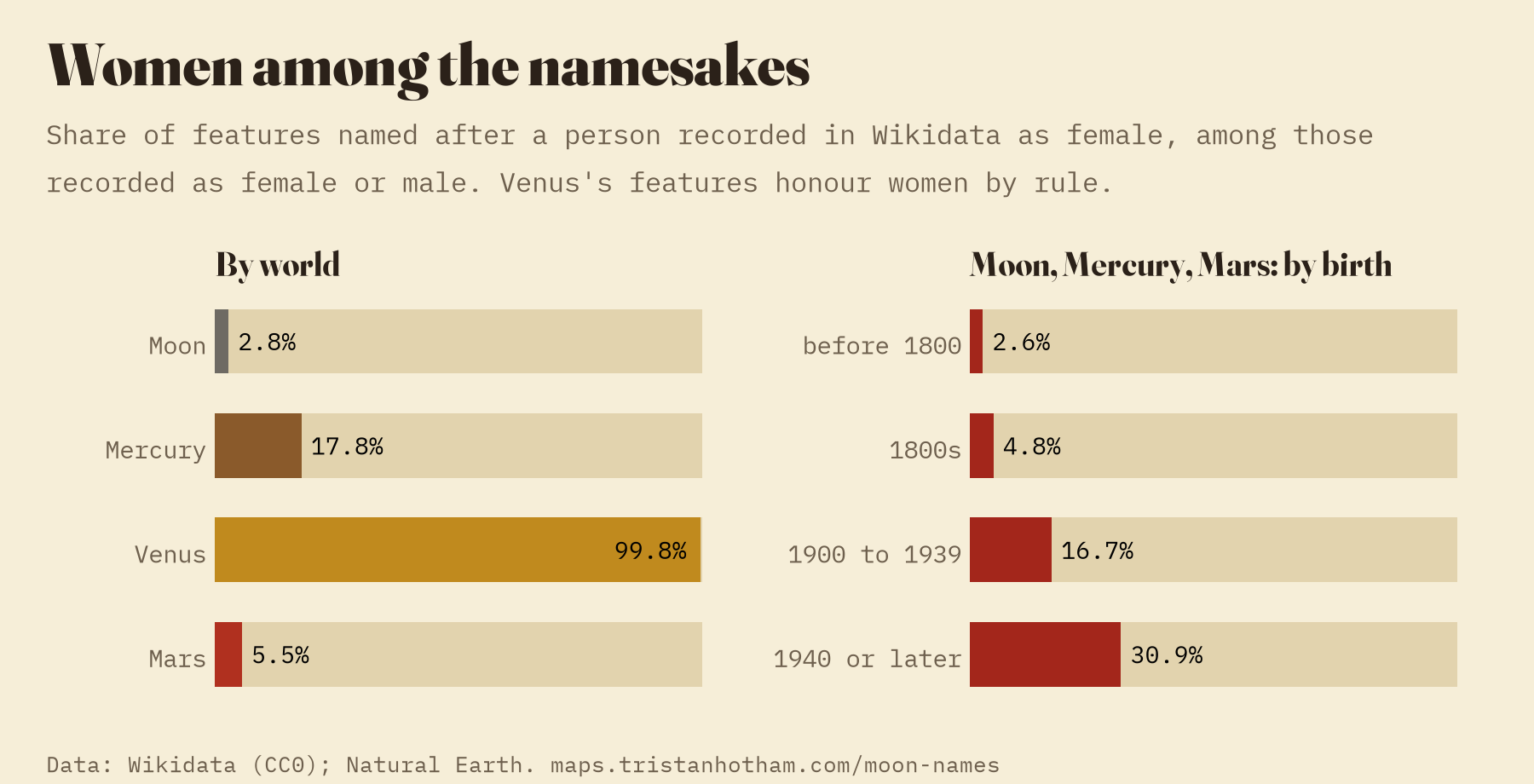
Venus is a world of women by rule: every one of its features named after a person honours a woman, except Maxwell Montes, named after James Clerk Maxwell before the rule was made. Everywhere else women are scarce. Only 45 of the Moon’s 1,614 people are women (2.8%): Hypatia, Hildegard of Bingen, Lise Meitner, Emmy Noether, Valentina Tereshkova and a few dozen more. Mars has 5.5% and Mercury, with its writers and artists, 17.8%. The share climbs with birth date, from 2.6% of the people born before 1800 to 30.9% of those born since 1940, among them the astronauts lost on Challenger and Columbia.
The Soviet far side
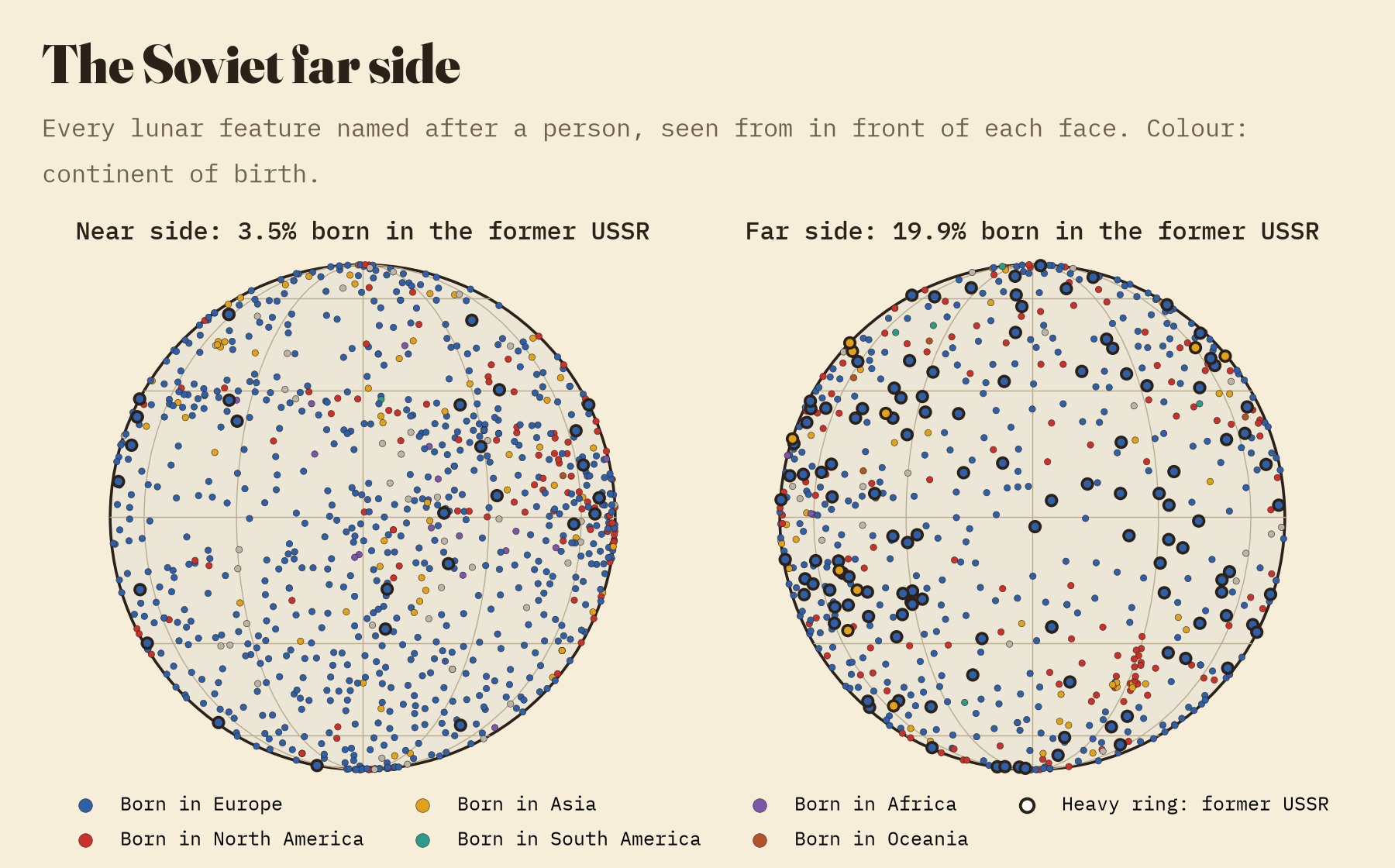
Nobody saw the far side of the Moon until the Soviet probe Luna 3 photographed it in 1959, and most of its features were named in the decades that followed, many after Soviet proposals. The birthplaces still show it. On the near side, 3% of namesakes were born in the former Soviet Union. On the far side it is 20%, about one in five. The far side’s people are younger too: the typical one was born in 1874, the typical near-side one in 1784. And it is where the space age is remembered: 35 astronauts and cosmonauts, from Yuri Gagarin and Valentina Tereshkova to the crews lost on Apollo 1, Challenger and Columbia.
The most lunar towns
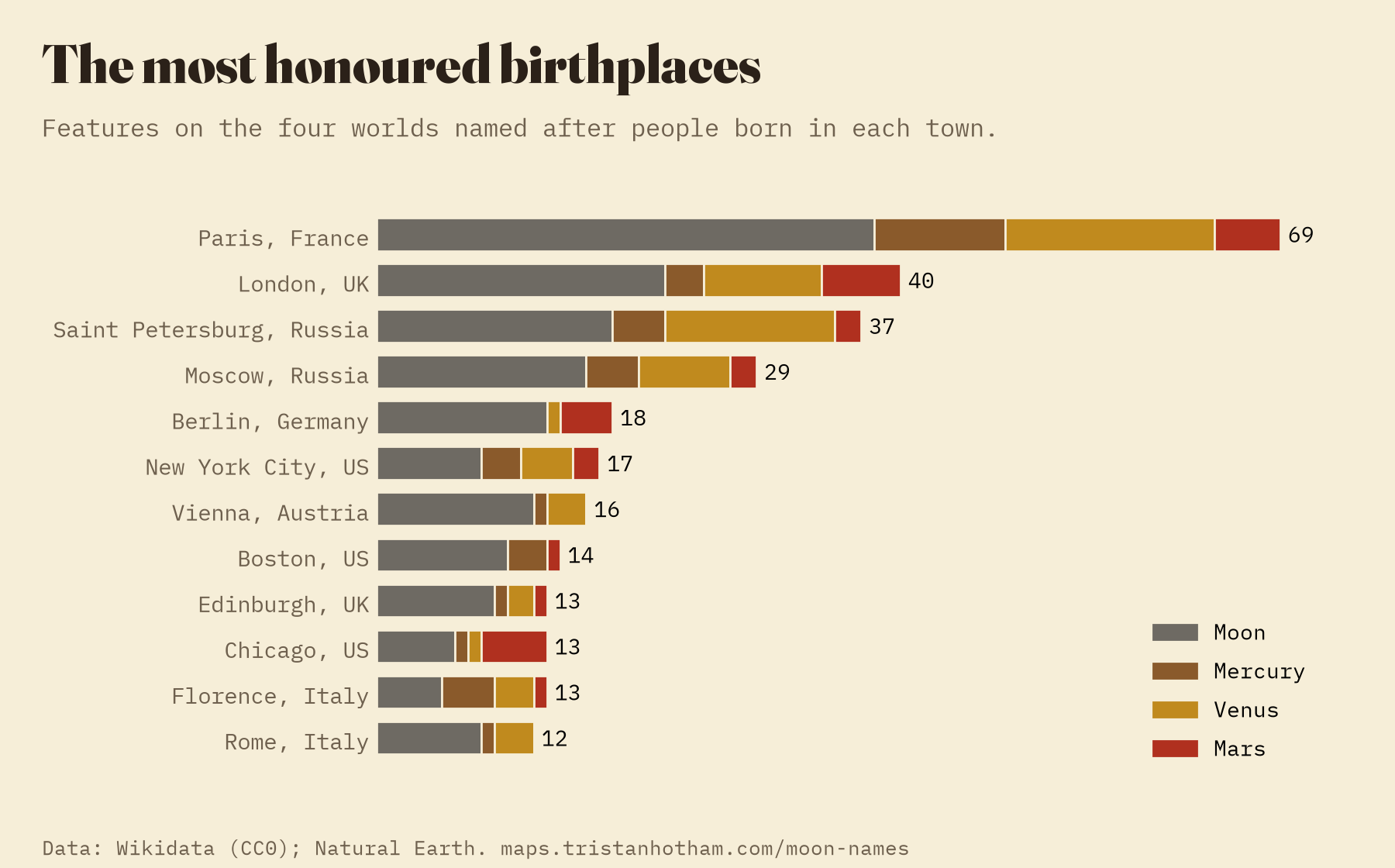
The birthplace with the most features across the four worlds is Paris, with 69 (38 of them on the Moon), from Foucault and Fizeau to Lavoisier and Cyrano de Bergerac. Then come London (40), Saint Petersburg (37) and Moscow (29). Only three people are honoured on three worlds: Giovanni Schiaparelli, Gerard Kuiper and E. M. Antoniadi, all of them astronomers who mapped the planets.
The villages of Mars
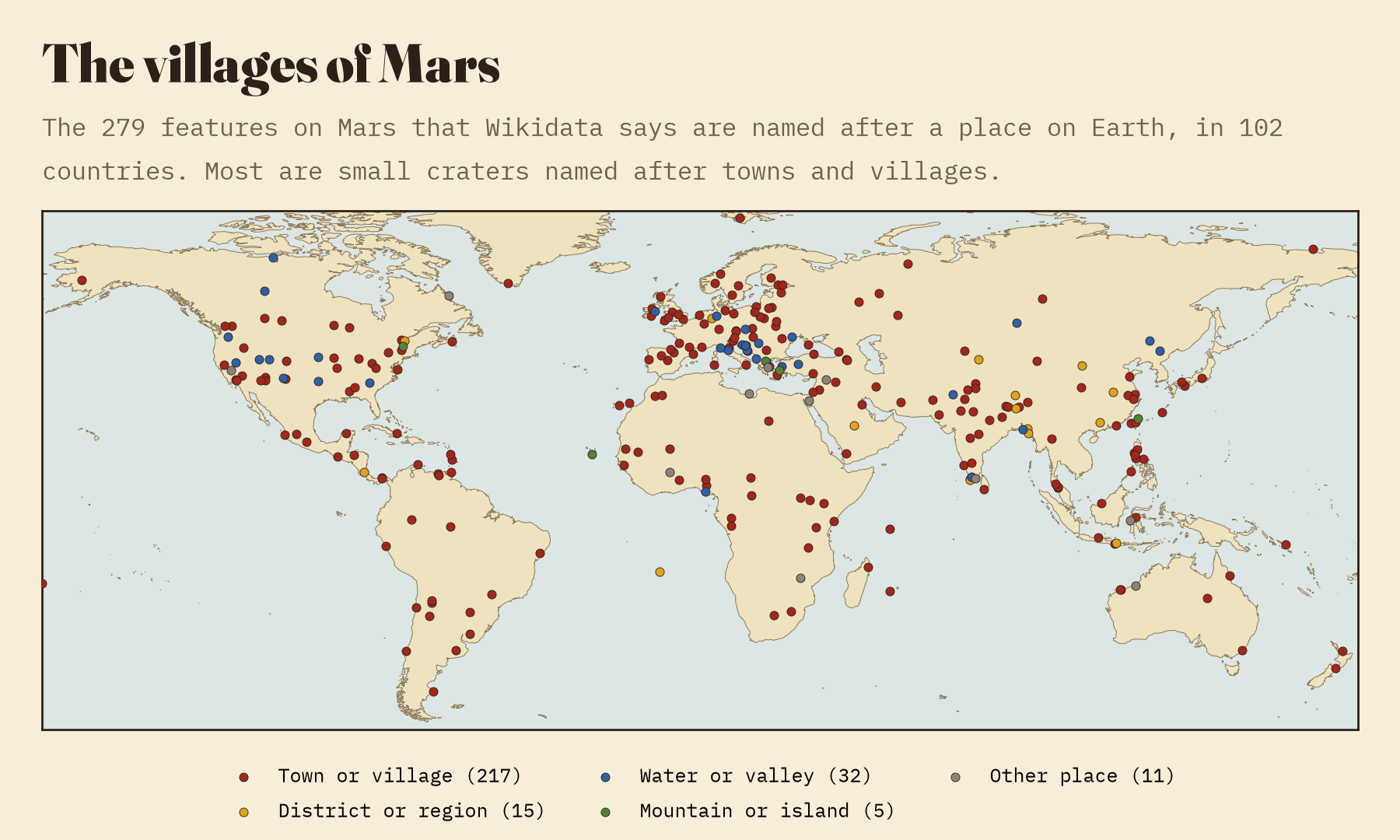
Mars has one more rule: its small craters are named after towns and villages on Earth of fewer than 100,000 people. Wikidata gives the place for 279 Martian features, in 102 countries, and they could hardly be more different from the people of Mars. Only 30% are in Europe, against 65% of Mars’s namesakes; 30% are in Asia and 11% in Africa. Britain has a few: Crewe, Corby, Maidstone and Kilkhampton all have a crater on Mars. On the interactive map you can click one and fly to the town.
How I did this
The data are Wikidata’s “named after” statements for every feature with coordinates on the Moon, Mercury, Venus or Mars, with each namesake’s birthplace, dates and occupations, queried through the QLever engine. I removed duplicate rows and map quadrangles, added each person’s sex and the places on Earth that features are named after from two more Wikidata queries, placed each birthplace in its modern country and continent with Natural Earth, and grouped occupations by keyword. A feature counts on the far side if it lies more than 90 degrees east or west.
There are caveats. Wikidata is not the IAU’s official gazetteer, and its coverage is uneven. Some birthplaces are wrong: it puts the Scottish mathematician Colin Maclaurin’s birth in Australia, which I corrected to Kilmodan in Argyll. I then checked every birthplace given only as a country, empire or region, every person whose recorded country did not match the map, every missing name and every Martian place name. That turned up more mistakes: the sculptor Edna Manley was born in Bournemouth, not Yorkshire, and the astronomer Gavriil Tikhov in Belarus, not Kazakhstan, and a few Martian craters were linked to ships or whole countries instead of towns. I fixed what I could confirm in small documented overrides files and left people off the map where only a country or empire is known, but some errors will remain. Modern borders put Ptolemy in Egypt and Hilbert, born in Königsberg, in Russia, and Crimea counts as Ukraine.
Notes and sources
- Wikidata contributors, Wikidata (CC0), queried with QLever (Bast and Buchhold, 2017). Vrandečić, D. and Krötzsch, M. (2014) Wikidata: a free collaborative knowledgebase. Communications of the ACM 57(10).
- IAU Working Group for Planetary System Nomenclature, Gazetteer of Planetary Nomenclature (USGS Astrogeology), for the naming rules.
- Whitaker, E. A. (1999) Mapping and Naming the Moon. Cambridge University Press.
- Natural Earth (public domain). Map style on OpenStreetMap data (ODbL) via OpenFreeMap. Moon and Mars imagery on the page: OpenPlanetaryMap, from NASA and USGS data.
- I wrote the text, with drafting and editing assistance from Claude (Anthropic), which also helped prepare the analysis code. I reviewed and checked all text and results.

