
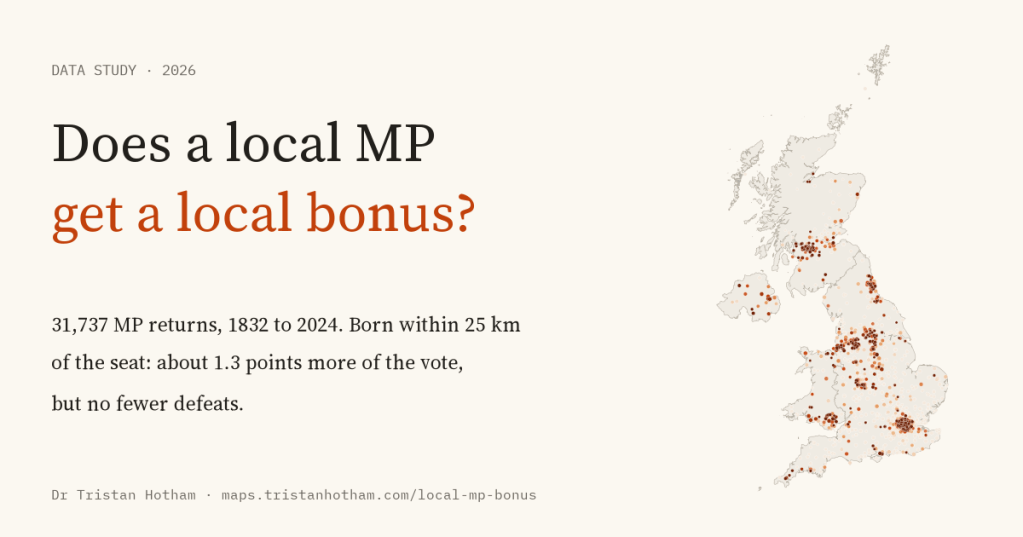
Voters say they want a local MP, and parties now pick far more of them. I took every MP elected since 1832, where they were born and how they did, to see whether local roots actually win votes. They do, but only by a little over one vote in a hundred, and it has not made local MPs any less likely to lose.
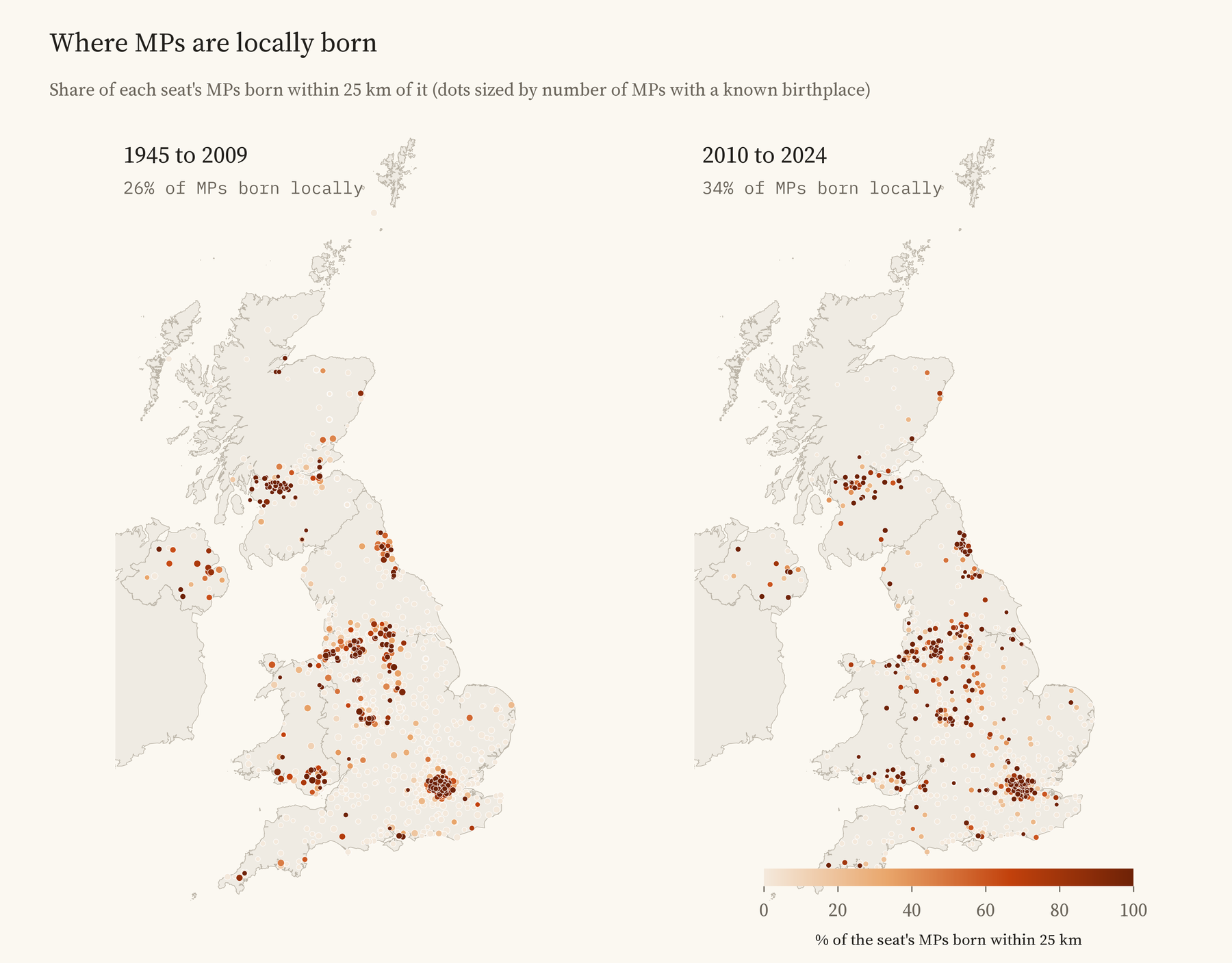
Every election leaflet seems to say it: born and bred here, one of us, a local voice. Ask people to choose between two imaginary candidates and the local one usually wins. Parties have noticed. For more than 170 years about a quarter of MPs were born within 25 km of the seat they represented. Then it started to climb, and in 2024 it reached 43%.
But liking the idea of a local candidate is not the same as voting for one. So I went back through every general election from 1832 to 2024, 31,737 times someone was returned as an MP, and asked a simple question. When a party’s MP in a seat was born nearby, did that party do better there than when its MP came from somewhere else?
One point, almost everywhere
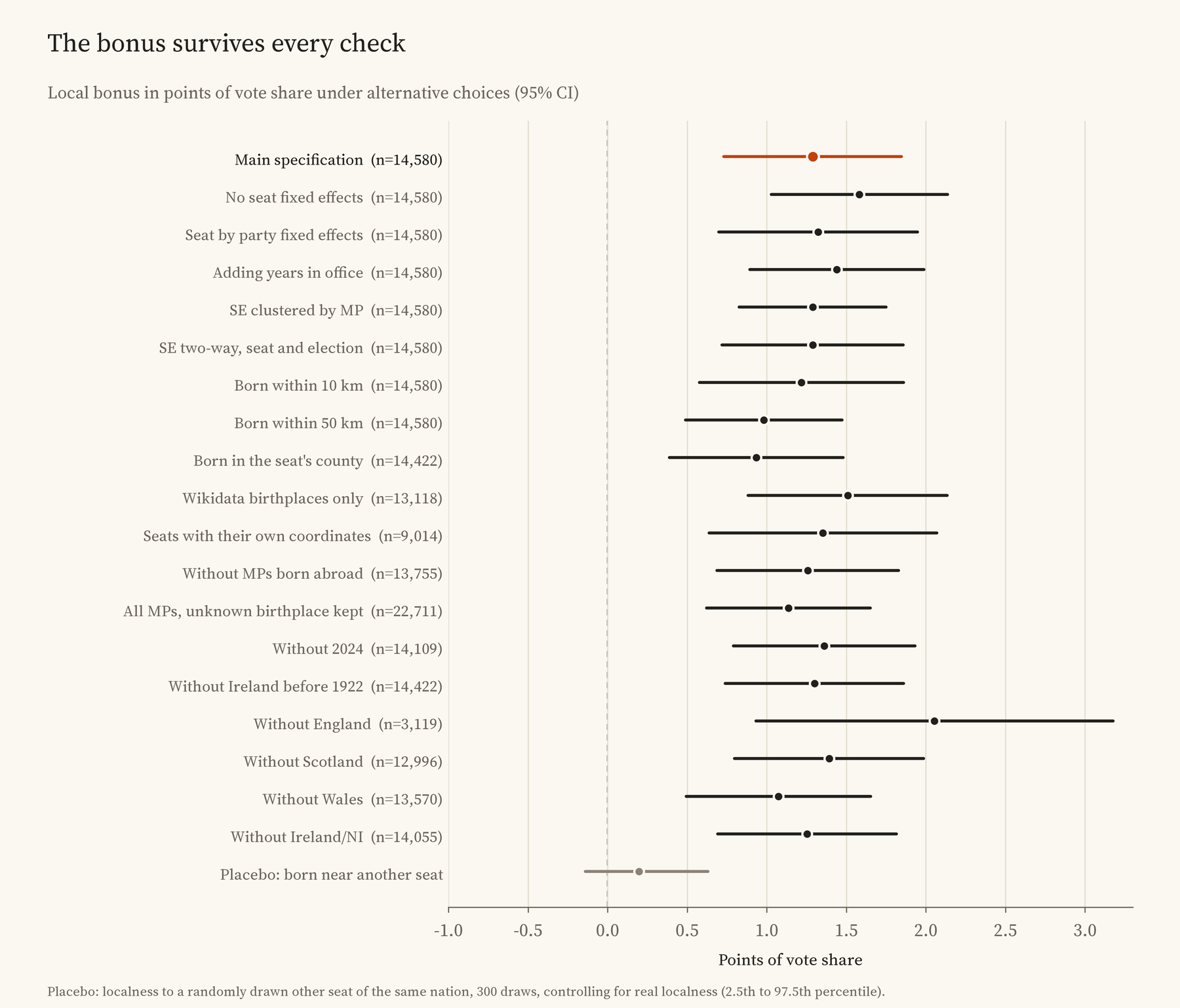
The fairest comparison keeps as much as possible the same: the same seat, different MPs over the years, each judged against how their own party was doing across the country at the time. On that test, an MP born within 25 km of the seat won 1.3 more points of the vote than MPs from elsewhere who sat for the same seat. The uncertainty runs from 0.7 to 1.8 points. Comparing only MPs of the same party in the same seat gives almost exactly the same answer, 1.3 points, and so does looking only at MPs winning a seat for the first time, 1.3 points, so this is not simply long serving MPs building up a following.
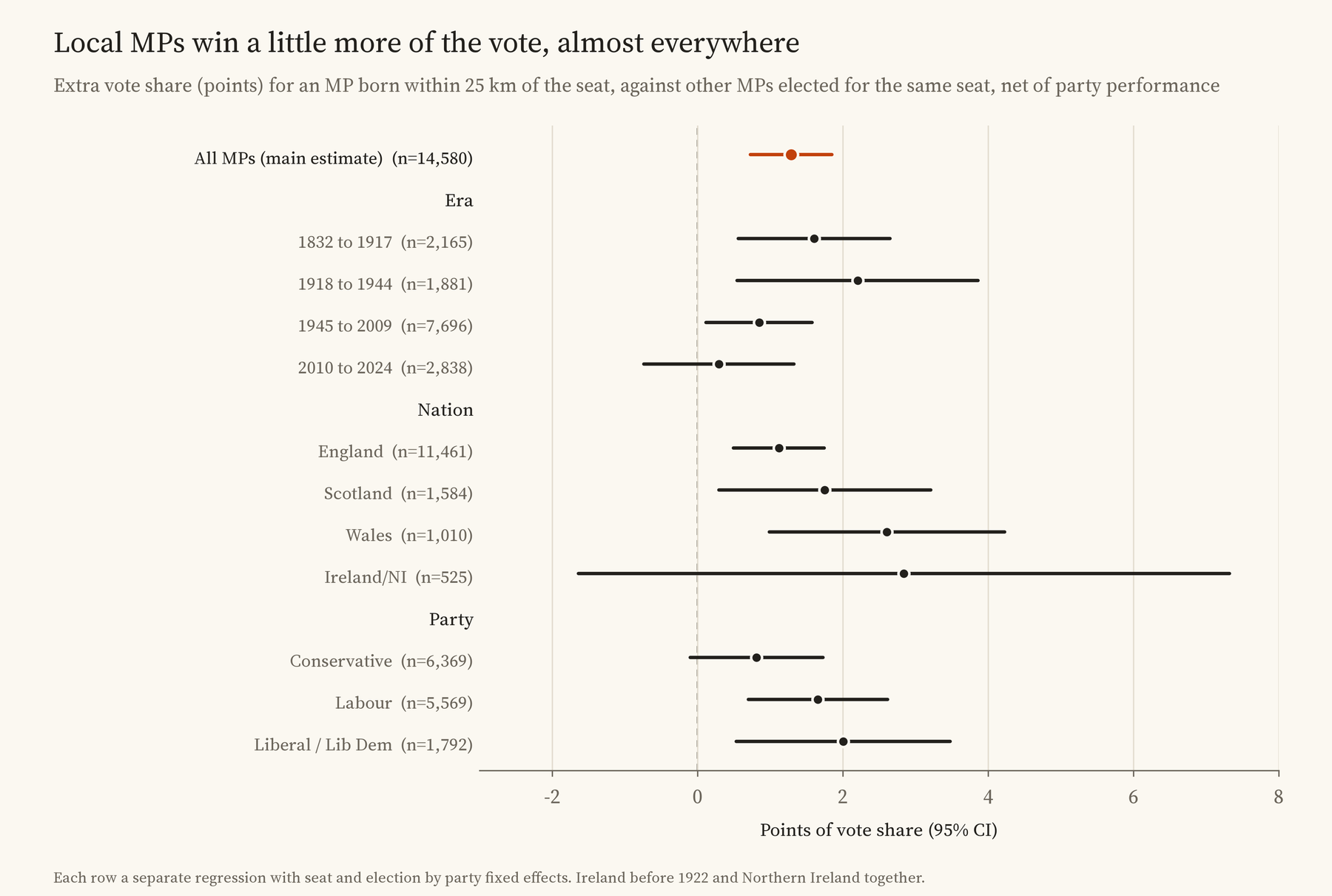
It is a small number, but a fairly steady one. It shows up in England, Scotland and Wales, for Labour and for the Liberals and Liberal Democrats, and a little less clearly for the Conservatives. It holds whether local means born within 10 km, within 50 km or in the same county, and it barely moves when I leave out one nation or one era at a time.
Local roots win about one voter in a hundred. That is real, and it is almost never enough to change who wins.
But no fewer defeats
Here is the twist. Local MPs who stood again were defeated just as often as anyone else: 14.6% of the time, against 14.5% for MPs from elsewhere. Taking their party, the election and their last result into account makes no difference. Nor did local MPs last longer in Parliament.
The reason is simple arithmetic. Most seats are won by a mile. The typical winning margin since 1832 is about 17 points, and only 7.2% of contests since 1945 were closer than twice the local bonus. A point here or there matters in a knife edge seat and nowhere else.
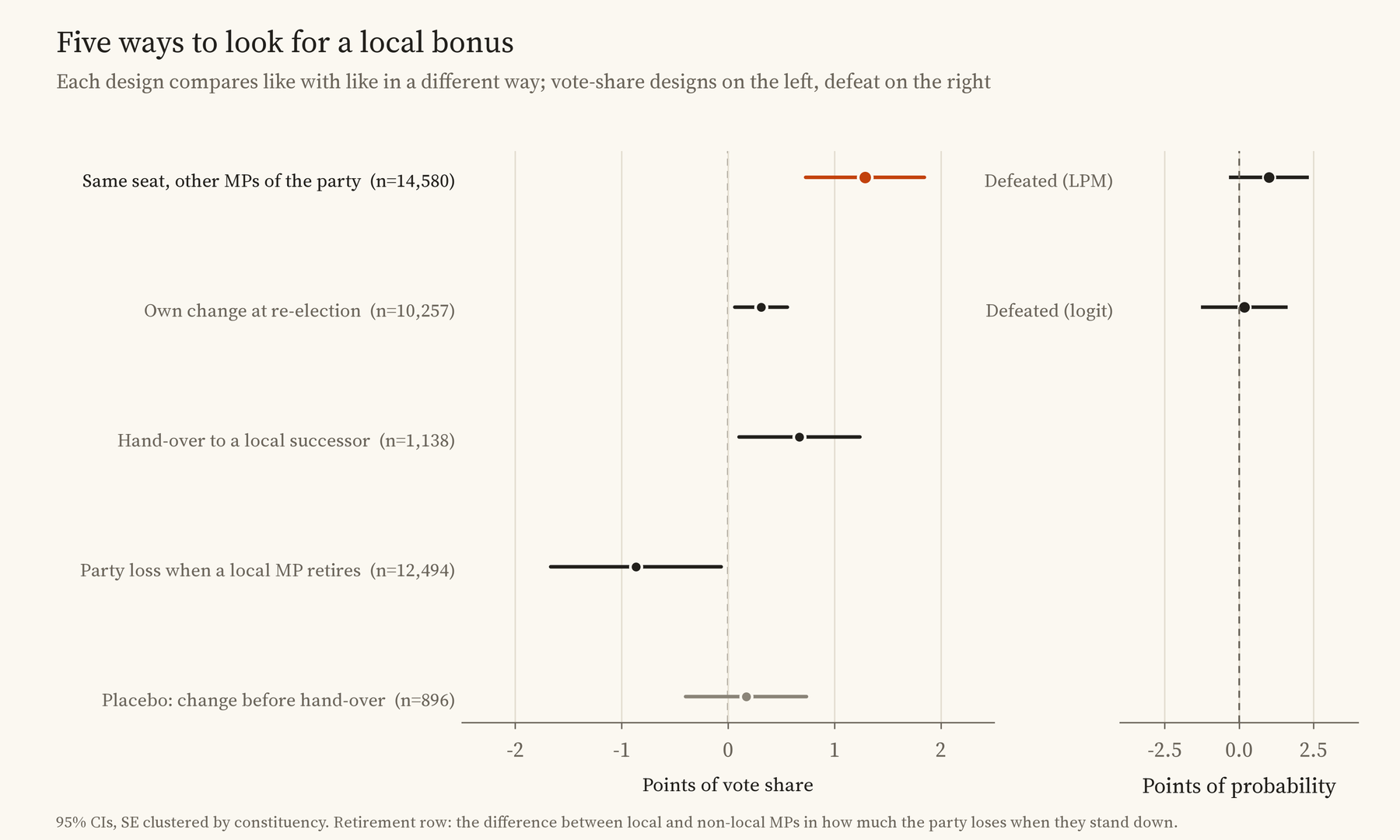
I looked for the bonus in other ways too, and they point the same way. Local MPs did slightly better than others when they stood for re-election, although this is the shakiest of the results. When a seat passed from one MP of a party to the next, the party did better when the newcomer was local and the old MP was not, while the newcomer’s roots said nothing about how the party had done in the election before they arrived, which is what you would hope to see. And when a local MP retired, their party lost about 0.9 points more than when an MP from elsewhere stood down, as if a slice of the vote had belonged to the person rather than the party.
More local MPs, no bigger bonus
If parties have been choosing local candidates because it wins votes, you might expect the bonus to be biggest now. It is not. The share of local MPs has shot up since 2010, but the bonus in that period is just 0.3 points, and the uncertainty runs from minus 0.7 to 1.3, so it could be nothing at all. The clearest bonuses were before 1945. A direct comparison puts the bonus since 2010 about 1.3 points below the earlier one, but that test was not part of my plan and only just clears the usual bar, so I would call a decline possible rather than proven.
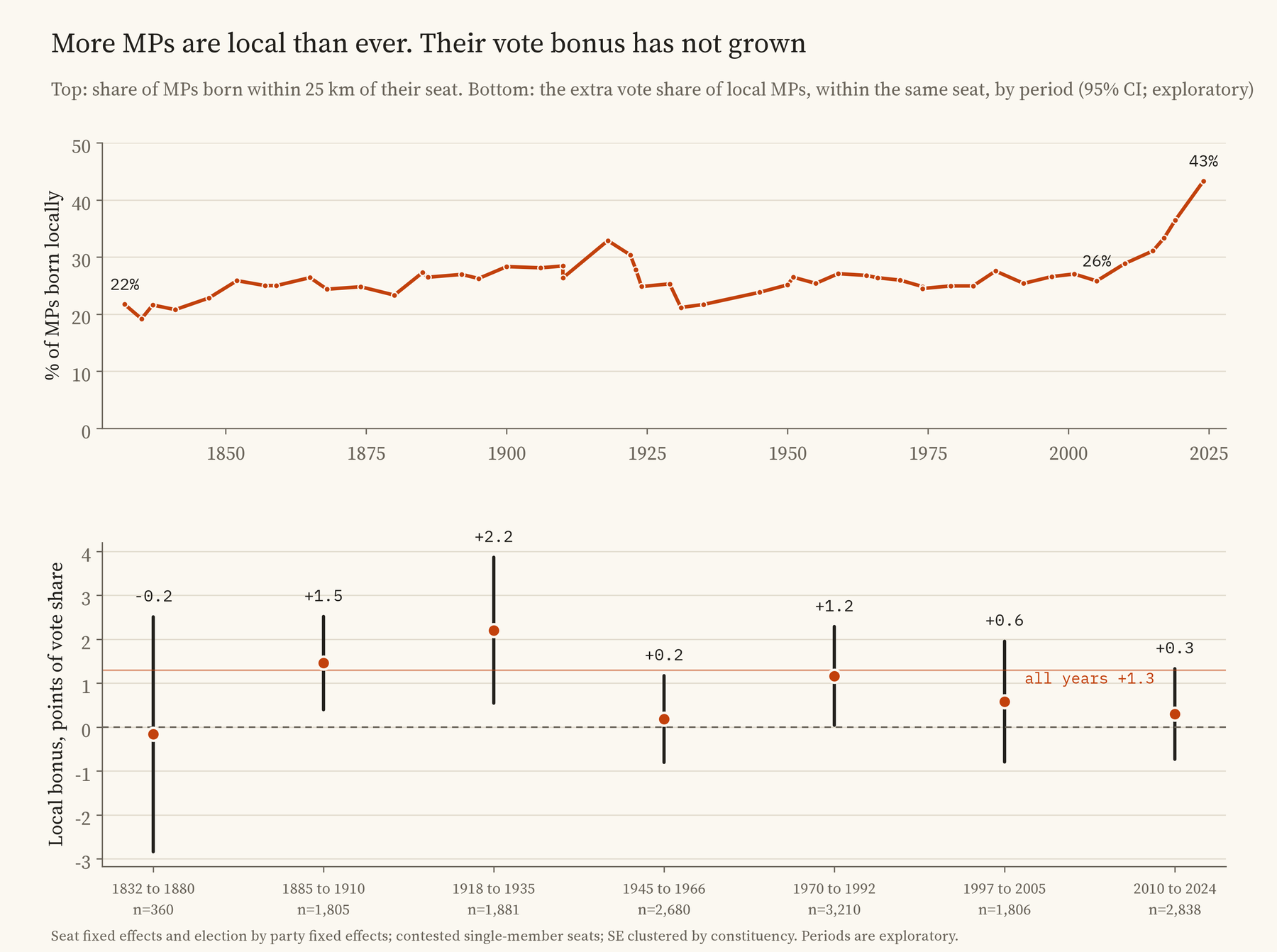
Perhaps when nearly half of all MPs are local, being local stops marking anyone out. Perhaps the recent figures are just too new: many of today’s MPs have faced only one election. Either way, the rise of the local MP looks more like a change in who parties select than a response to a growing reward at the ballot box.
How sure can we be?
I wrote down the tests, and what would count against a local bonus, before running any of them, and I report the planned ones first. The main result survives every check I planned: different ways of comparing seats, different ways of measuring the uncertainty, different definitions of local, leaving out MPs born abroad or with less reliable birthplaces. Two fake versions behave as they should. If I shuffle who counts as local within each party and election, the bonus vanishes. If I ask whether being born near some other, randomly chosen seat helps an MP, it adds only 0.3 points, and that small amount comes from random seats that happen to sit next door to the real one: for random seats at least 50 km away it adds nothing. (I added that second version after a first run, so it is a change from the plan.)
How I did this
The MPs and their birthplaces come from my earlier study, Born and bred?, built from Wikidata and Wikipedia, with a birthplace for 57% of MP returns. The results come from Who won here?, my map of every general election since 1832. I matched each MP to their own result, followed them to the next election in the same seat, and compared MPs within the same seat, net of each party’s national result. University seats and the Speaker are left out.
The limits matter. A birthplace is only a rough stand in for local roots: someone born in the nearest hospital town counts as local, someone who moved there as a toddler does not. Birthplaces are missing more often before 1900, and for less famous MPs. Constituencies are treated as points, and their boundaries changed. Everyone in the study won at least once, so this is about MPs, not every candidate. And it is not an experiment: a local MP may also be a sign of a strong local party, which would win votes anyway. The comparisons within seats make that less likely, but cannot rule it out.
Notes and sources
- Data: Hotham (2026) Born and bred? (Wikidata, CC0; English Wikipedia, CC BY-SA 4.0) and Who won here? (UK Parliament and House of Commons Library results, Open Parliament Licence v3.0). Base map: OpenFreeMap, OpenStreetMap contributors (ODbL).
- Related research: V. O. Key, Southern Politics in State and Nation (1949); K. Arzheimer and J. Evans, Political Geography (2012); J. Evans, K. Arzheimer, R. Campbell and P. Cowley, Political Geography (2017); R. Campbell and P. Cowley, Political Studies (2014); R. Campbell, P. Cowley, N. Vivyan and M. Wagner, Journal of Politics (2019); A. Eggers and A. Spirling, Journal of Politics (2017); A. Middleton, Politics (2019).
- I wrote the text, with drafting and editing assistance from Claude (Anthropic), which also helped prepare the analysis code. I reviewed and checked all text and results.

