
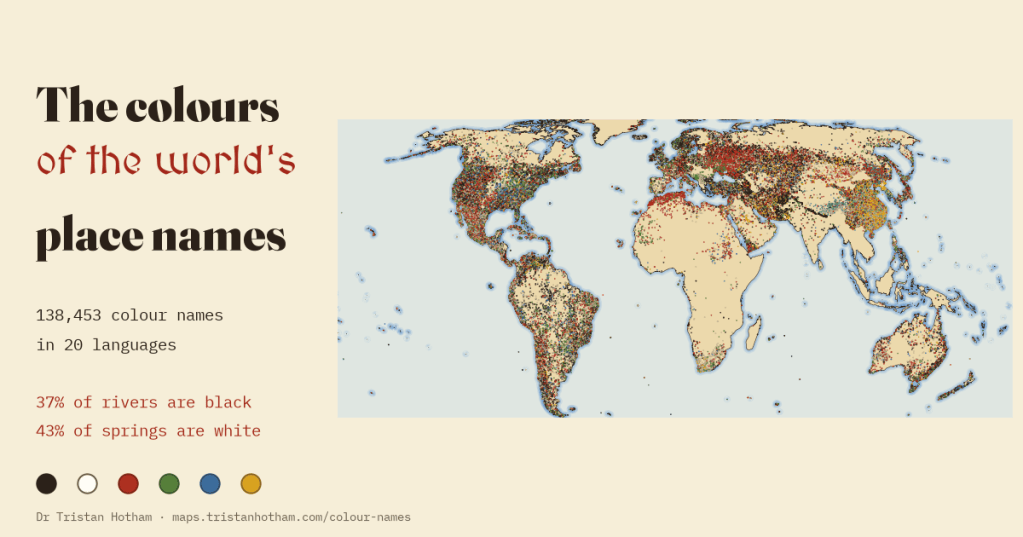
Black Creek, Río Blanco, Kara Su, Cerro Colorado, Baishui: people everywhere have named places after their colour. I went through the world’s largest open gazetteer and found 138,453 of them, in 20 languages. Rivers run black, springs run white, and a surprising amount of the red is political.
Some of the oldest names on any map are colours. A stream runs dark with peat, so it is the Blackwater. A spring rises out of chalk, so it is the White Well. A hill of iron-rich soil becomes Red Hill, or, a few thousand miles away, Cerro Colorado or Krasnaya Gorka. Colour names are about as plain as place names get: someone looked, and said what they saw.
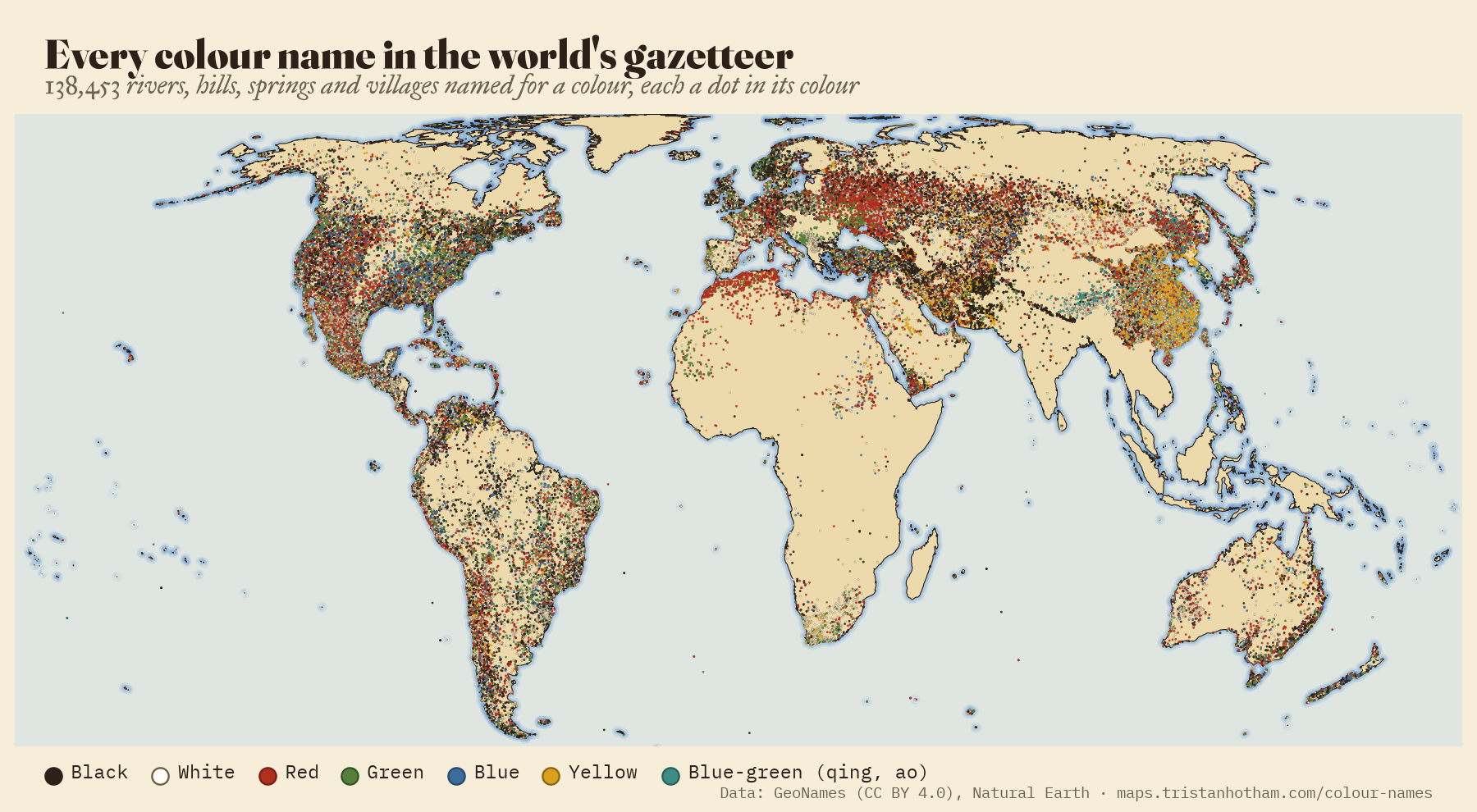
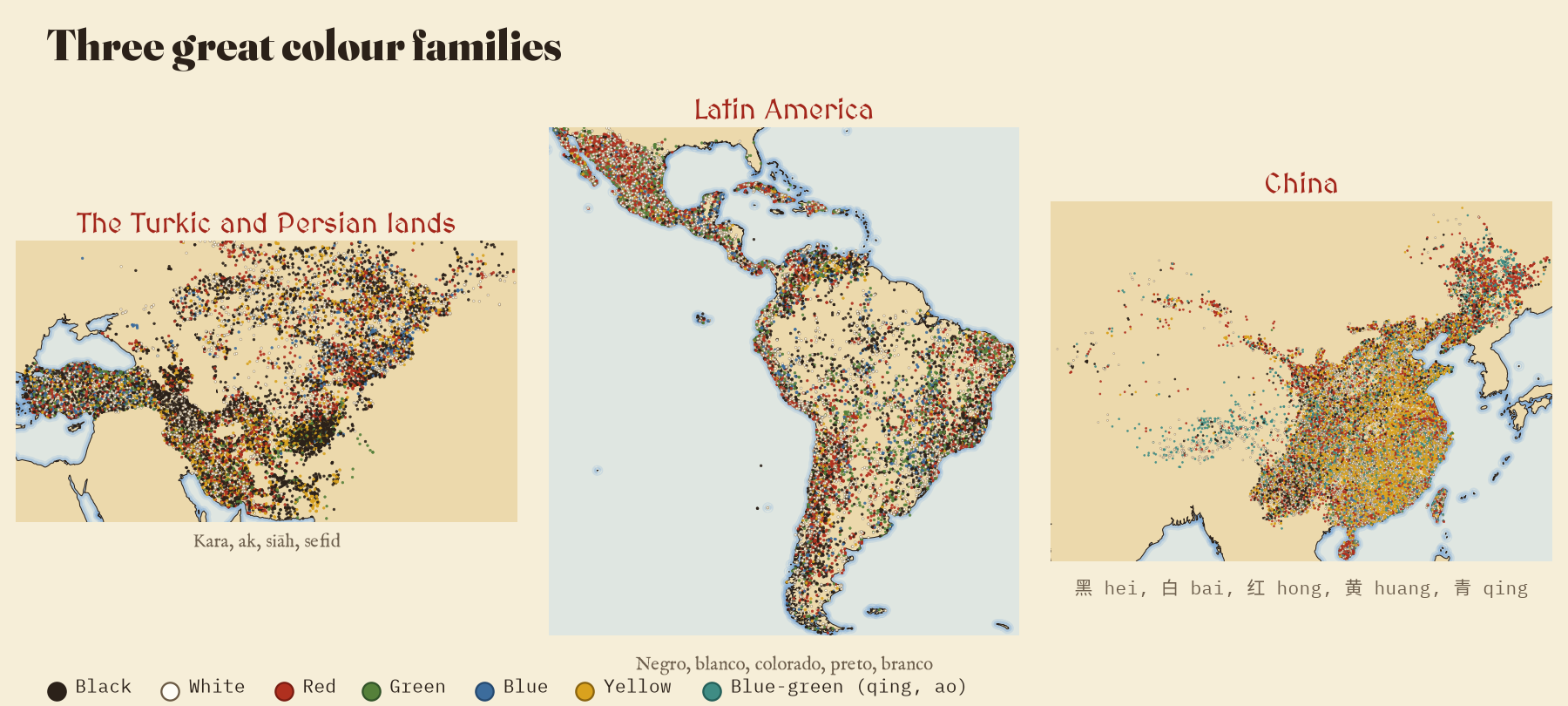
So I went looking for them. GeoNames, the big open gazetteer, lists about 13 million places. I took every name built on the word for black, white, red, green, blue or yellow in 20 languages, from English and Spanish to Turkish, Persian, Russian and Chinese, kept the rivers, lakes, springs, hills, rocks, valleys and villages, and put every one on a hand-inked map, each a dot in its own colour.
White first, then black and red
White is the commonest colour, 26.5% of all the names, then black (23.2%) and red (20.6%). Blue comes last, at 5.5%. China’s villages tilt the count towards white and yellow; leave out Chinese and Japanese and black just edges ahead. That order will be familiar to anyone who has read about colour words: linguists have long noted that languages tend to name dark and light first, then red, and blue last. Blue is rare on maps for a simpler reason too. Hardly anything on land is blue.
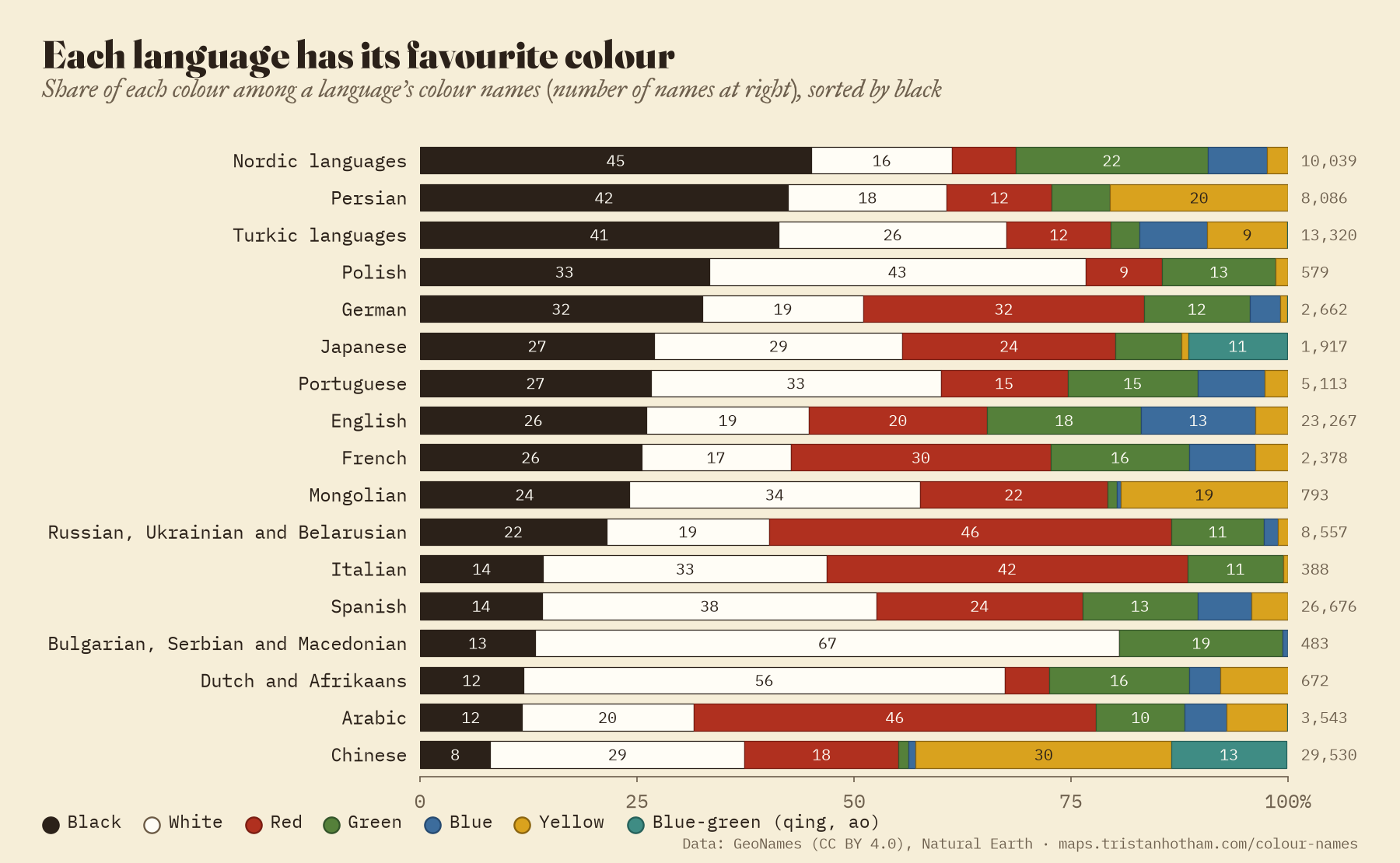
Each language has its favourite. Scandinavian maps are covered in svart, black: 45% of Nordic colour names, on every tarn and fell, though Norway’s kvit, white, is common too. In Persian it is siāh, and Kūh-e Sīāh, Black Mountain, turns up 284 times. The Turkic world, from Anatolia to the Altai, lives on kara and ak, black and white: Karasu, black water, 239 times, Aksu, Karakol. Mongolia prefers white, tsagaan. Arabic and Russian are the reddest. Spanish is the whitest of the big languages, and it owns the commonest colour name of all: Cerro Colorado, the red hill, 1,084 times.
Black rivers, white springs
The colour depends on what is being named. Counting every language equally, so that China’s huge lists do not drown out the rest, rivers are the blackest kind of place: 37% of river names are black, and rivers are blacker than their language’s average in 14 of 17 languages. Springs and wells are the whitest, at 43%. Red goes with rock and bare ground.
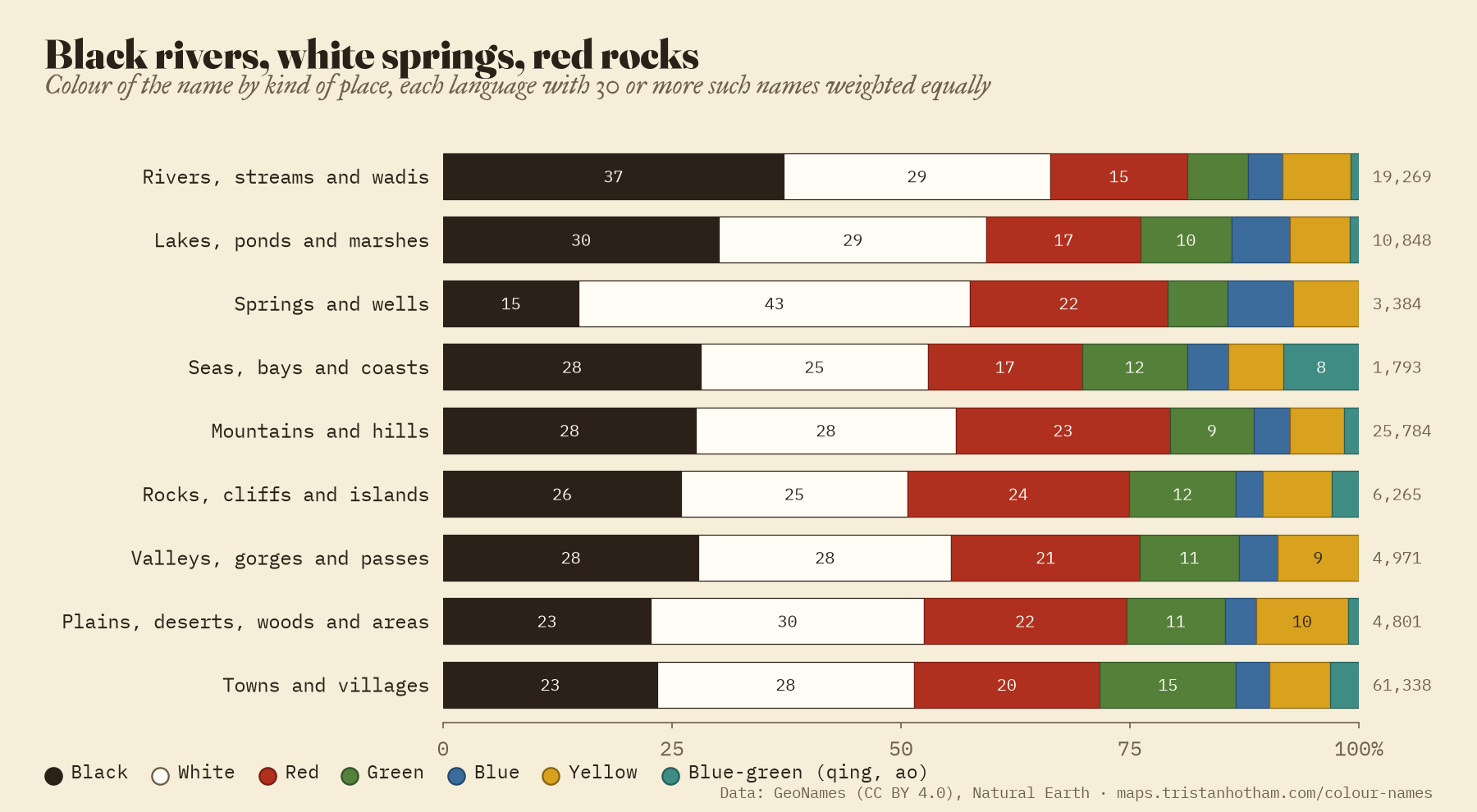
I expected mountains to be white, for snow. They are, a little: white leads on mountains, but only just ahead of black and red, and mountains are whiter than their language’s average in only 7 of 16 languages. A snowy peak is white, a forested hill is black and a bare one red.
Rivers run black, springs run white, and the commonest colour name in the world is a red hill: Cerro Colorado, 1,084 times.
Río Blanco and Kara Su
There are exceptions. In the Spanish and Portuguese world rivers are whiter, not blacker: 428 Río Blanco against 309 Río Negro. In China, bai (white) and huang (yellow) make up more than half of all colour names, yellow for the loess country of the Yellow River and white for sand, stone and water. And Chinese and Japanese have one character, 青, for both blue and green, so on the map it gets its own colour, a blue-green.
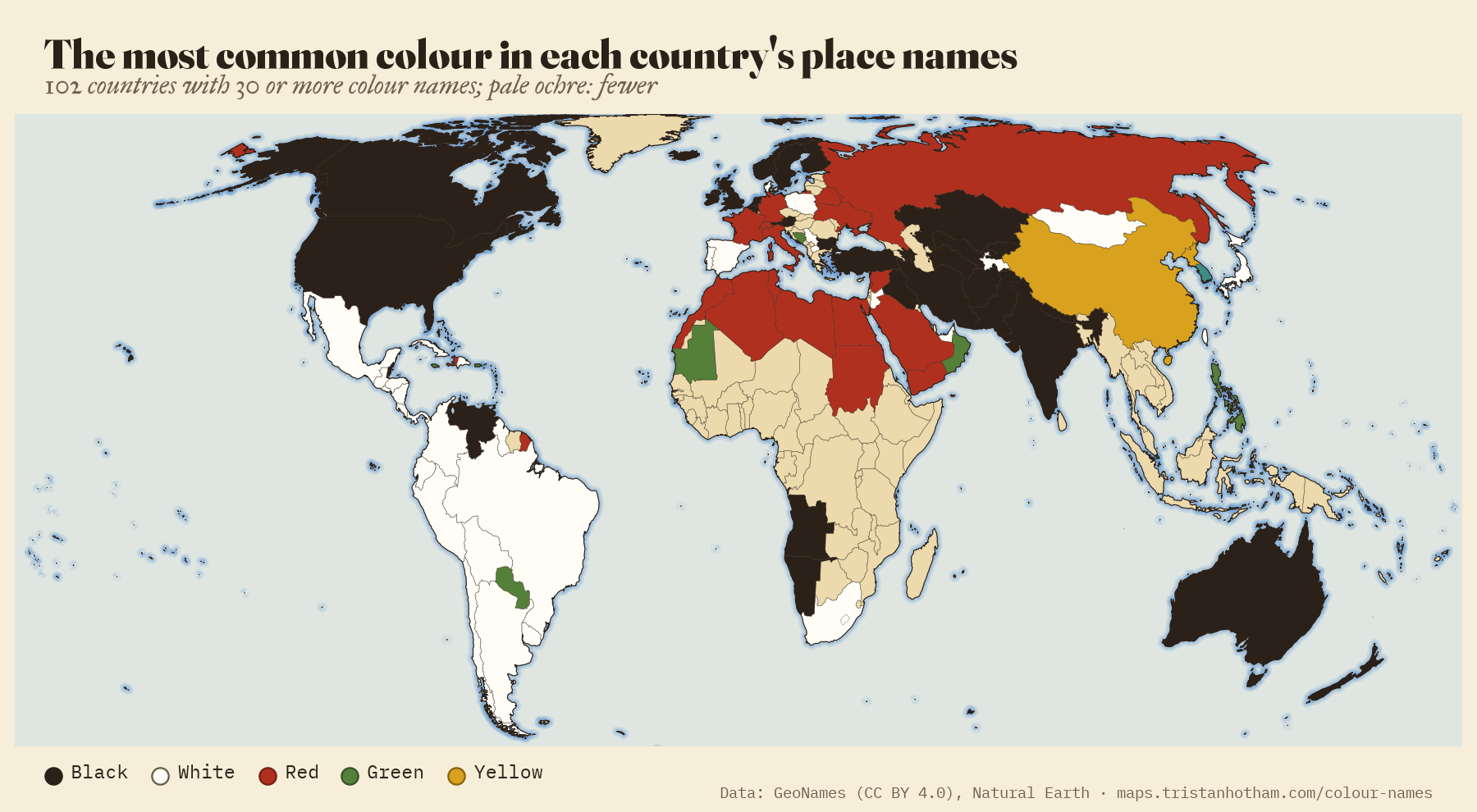
Country by country, the commonest colour is white in 35 of the 102 countries with at least 30 names, black in 35 and red in 21. Black runs through the English-speaking world, Scandinavia, Turkey, Central Asia, Iran and Afghanistan; white through Latin America, Mongolia, Serbia and South Africa; red through Russia and the Arab world.
Not every red is the ground
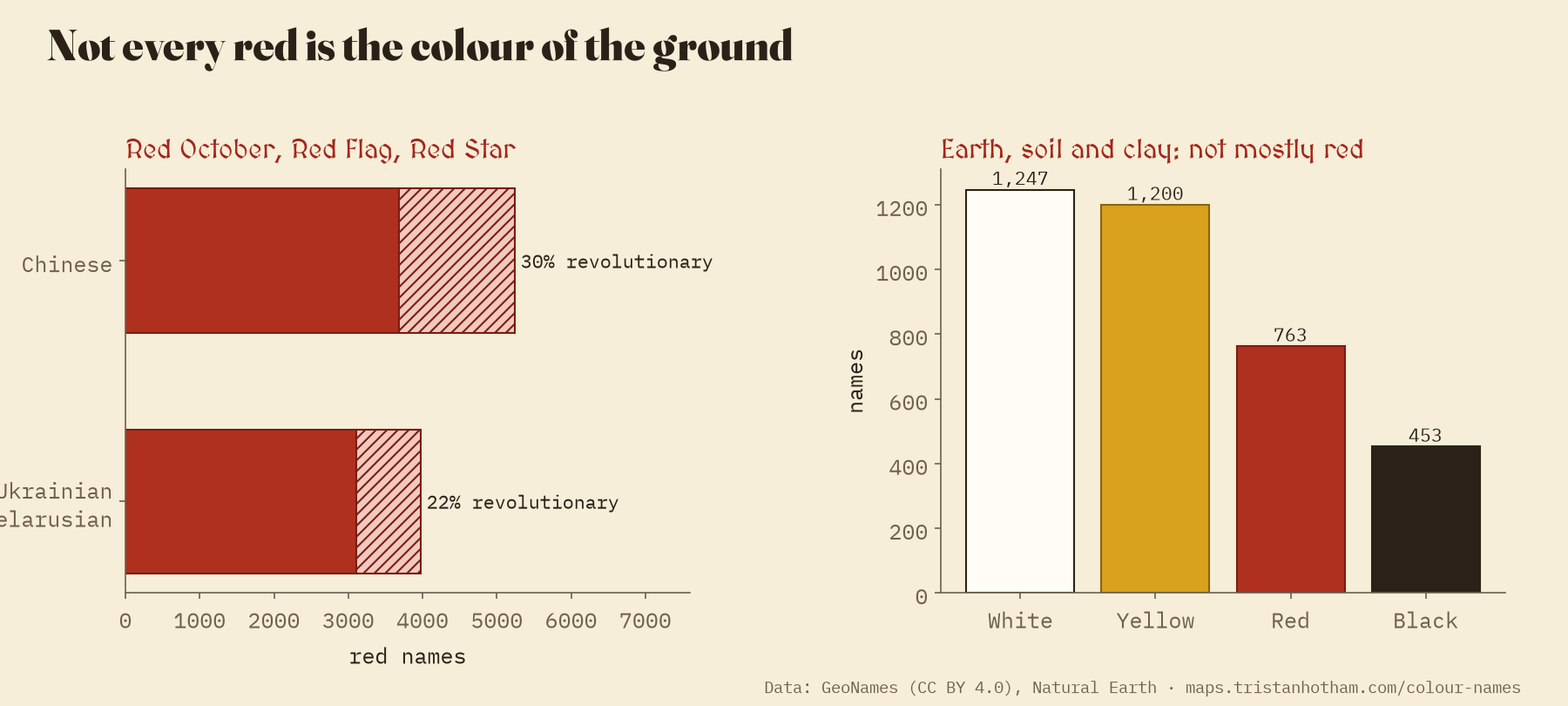
Red has a second life. In Russia, Ukraine and Belarus 22% of red names are revolutionary: Krasnyy Oktyabr’ (Red October), Krasnaya Zarya (Red Dawn), Krasnoarmeysk (Red Army town). In China 30% are, Hongqi (Red Flag) and Hongxing (Red Star) above all. And red earth turns out not to be special: of 3,735 names about earth, soil, sand or clay, only 20% are red, no more than names in general. White earth (Tierra Blanca, 406 times) and yellow earth are each more common.
How I did this
Most of the hard work is throwing names out. Rotterdam is not red. Belovo is named after a man called Belov. Negro Creek in the United States is named for people, not a colour, and Colorado Springs for a state. A Chinese Huang village usually belongs to the Huang family. So I wrote rules for each language: the colour word has to be in a form that language uses, in a country where it is spoken, and not on a list of saints, surnames, plants, animals and brands. Chinese and Japanese are read in their own characters. Then I read samples of up to 50 names for every colour in every language, 4,370 in all, and fixed the rules. About 99% of the samples were right in the end, though that is a little flattering, since the same samples taught me the rules.
Two big caveats. GeoNames is far fuller for some countries (the United States, Mexico, China, Norway, Iran) than others, so the dots show where the gazetteer is detailed as much as where colour names are common. And some languages are only partly in. A second search added English compounds (Blackburn, Whitby, Greenwich), Turkic ones (Aksu, Karakol), Norwegian kvit and Mongolian, but Korean, Hindi and Urdu count only where the meaning is clear, which in South Asia leaves mostly kala, black, and Hungarian, Finnish, Greek and the languages of Africa are not in at all. The paper has the details.
Notes and sources
- GeoNames, allCountries dump, CC BY 4.0: every place name, position and feature type.
- Country outlines from Natural Earth (public domain). The interactive map uses the Inked World style on OpenStreetMap data (© OpenStreetMap contributors, ODbL) served by OpenFreeMap.
- On the order of colour words: Brent Berlin and Paul Kay, Basic Color Terms (1969).
- I wrote the text, with drafting and editing assistance from Claude (Anthropic), which also helped prepare the analysis code. I reviewed and checked all text and results.

