
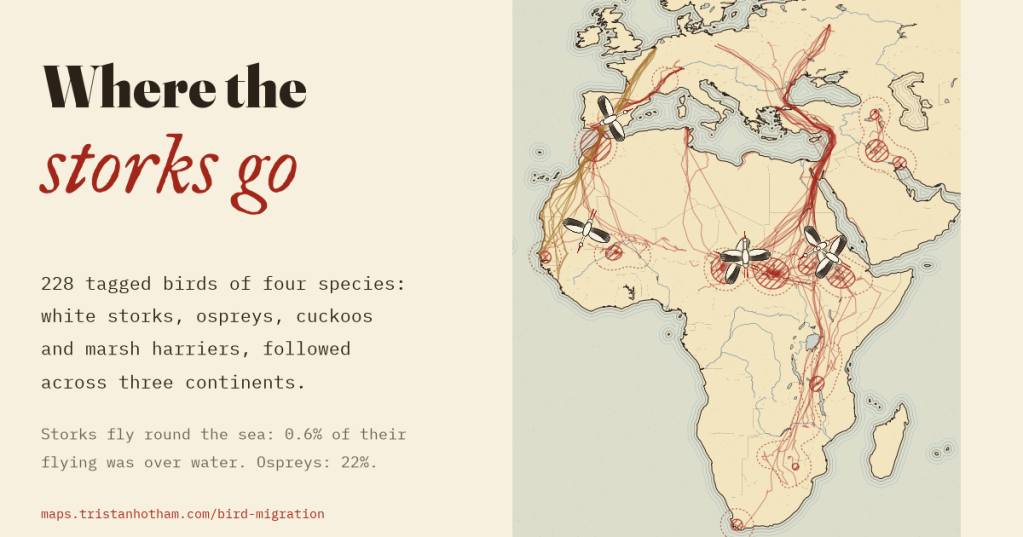
I followed 228 tagged birds across three continents: young white storks from eight countries, North American ospreys, Baltic cuckoos and Belgian marsh harriers. Storks will not cross the sea. Ospreys and cuckoos do it without a second thought.
Every autumn white storks leave the rooftops of Europe for Africa, and they do it in a peculiar way. They are big, heavy birds that hardly flap: they climb in rising warm air, circling, and glide to the next thermal. Thermals do not form over the sea, so storks go round it. That one fact shapes their whole map.
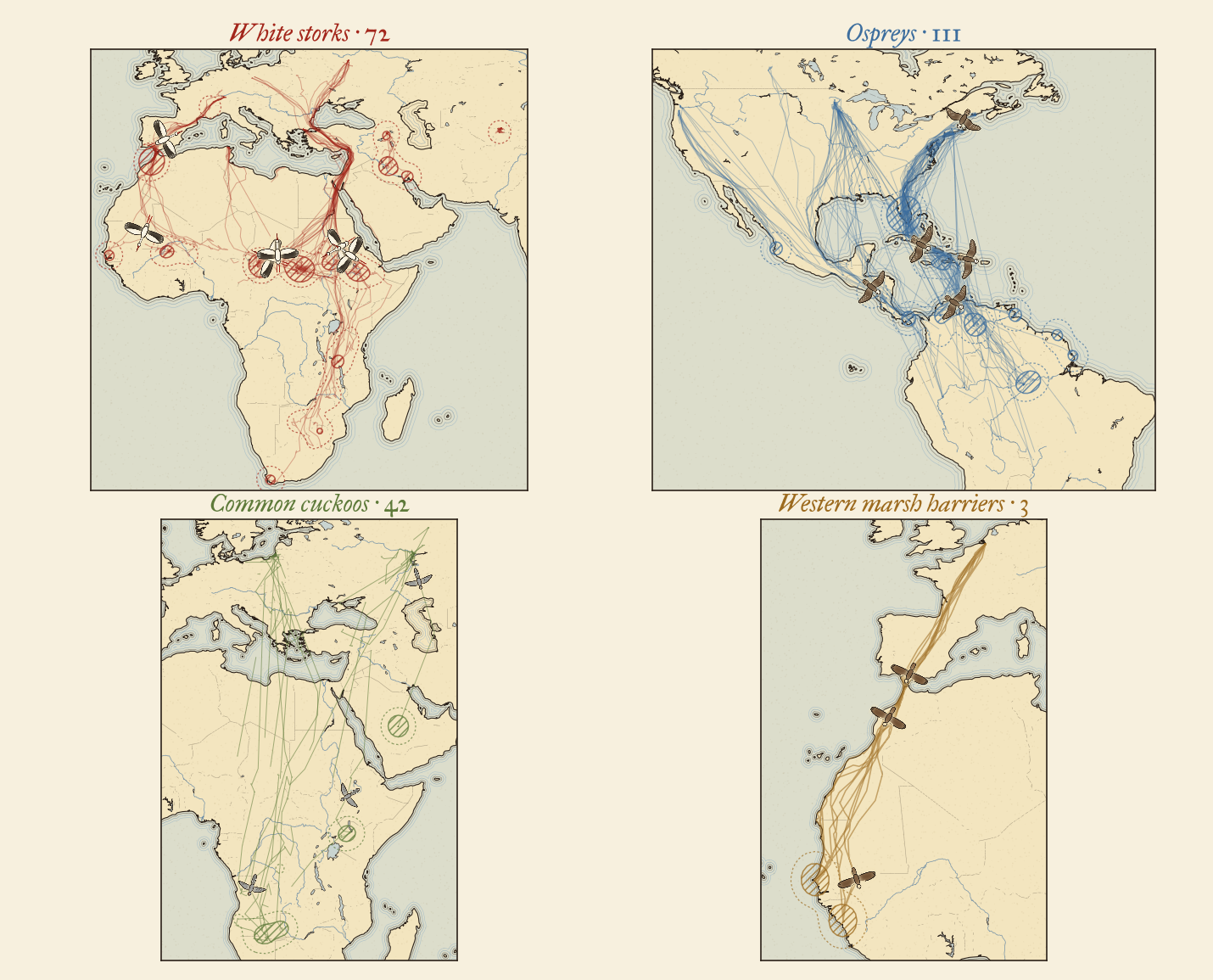
Since the 1990s, birds have carried tags that report where they are by satellite or GPS, and some of that data is published for anyone to use. I took four such data sets, all released into the public domain: 72 young storks tagged in their nests in 2013 by a team led by Andrea Flack, 111 ospreys tracked across the Americas by Mark Martell and colleagues between 1995 and 2002, 42 cuckoos from a Baltic experiment, and 3 marsh harriers from the marshes near Antwerp. I cleaned them all the same way and drew them on one hand-inked map, with a little pen-drawn bird for each, so you can press play and watch a year of migration.
Two roads to Africa
The young storks split along a line through central Europe. Of the 18 from Germany and Spain that left home, 13 crossed the Strait of Gibraltar, fourteen kilometres of water, into Morocco. Of the 23 from Poland, Greece and Moscow that left, 21 crossed the Bosporus or the Dardanelles and 20 flew down the narrow land bridge of Israel and Sinai into Africa. Not one bird used the other side’s crossing. The Tunisian storks simply set off across the Sahara, the Armenian ones went south into Iraq and Iran, and the young storks of Uzbekistan did not migrate at all.
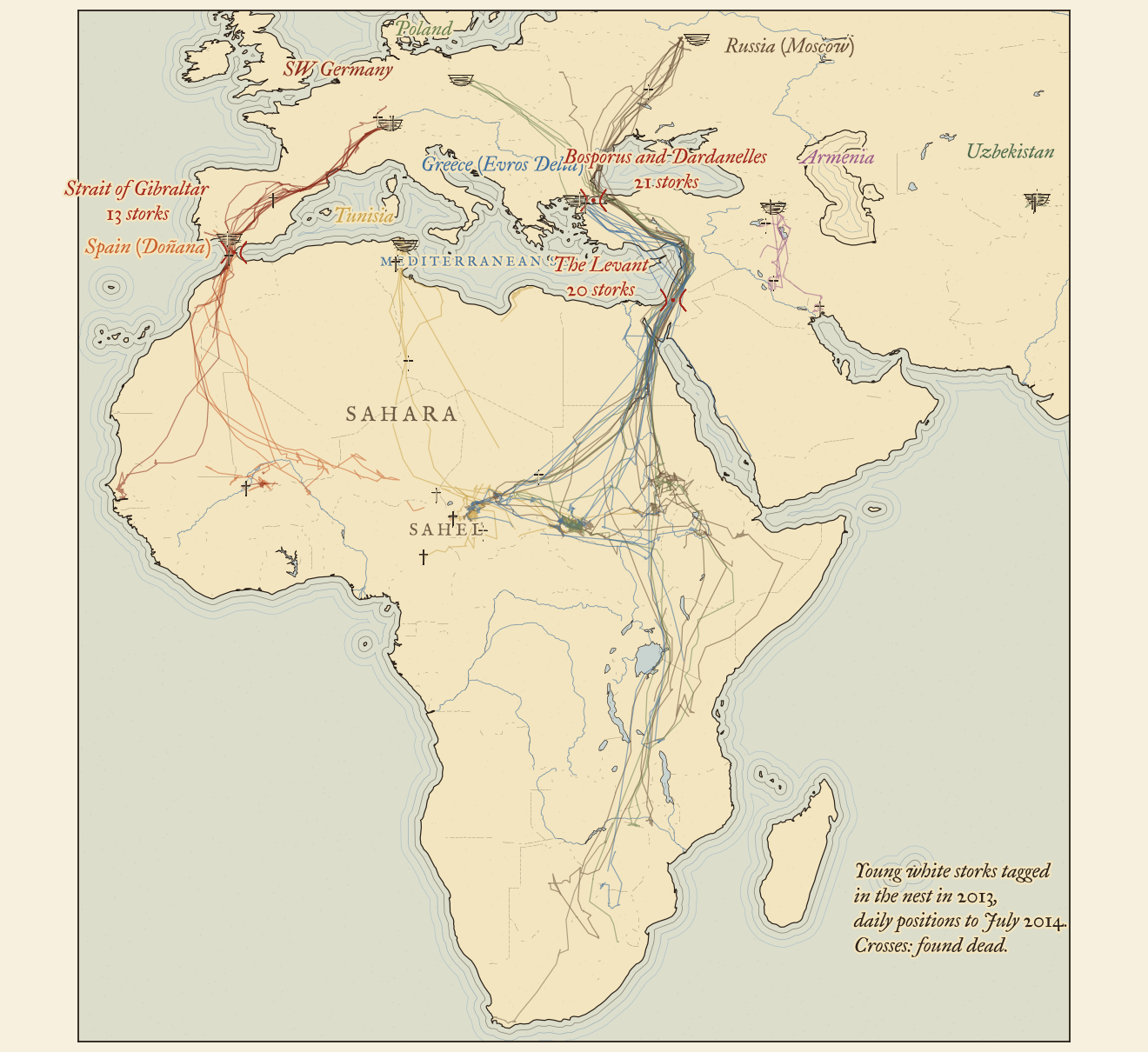
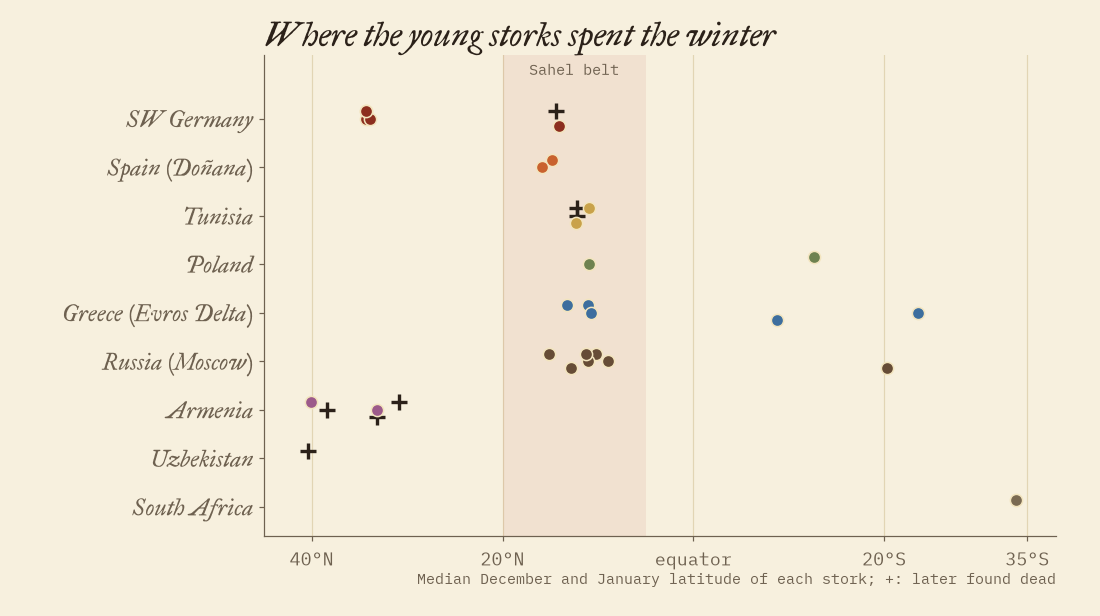
Most spent the winter in the Sahel, the dry savanna south of the Sahara: 18 of the 34 that had a winter position. 5 crossed the equator, and one young stork from Moscow ended up 9,186 km from its nest, in Zimbabwe.
The storks flew 389,086 km between them and only 2,360 km of it was over open water.
Around the sea or across it
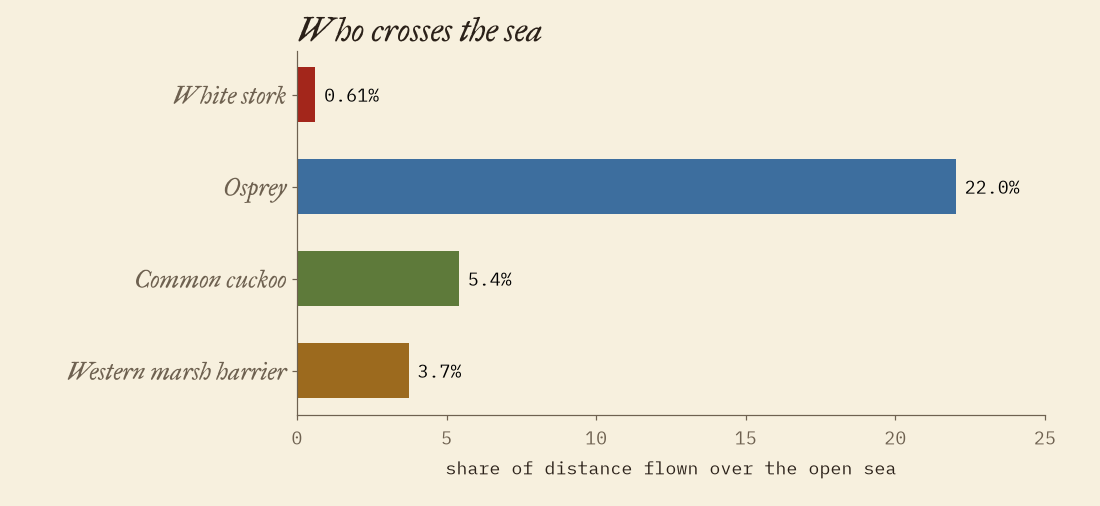
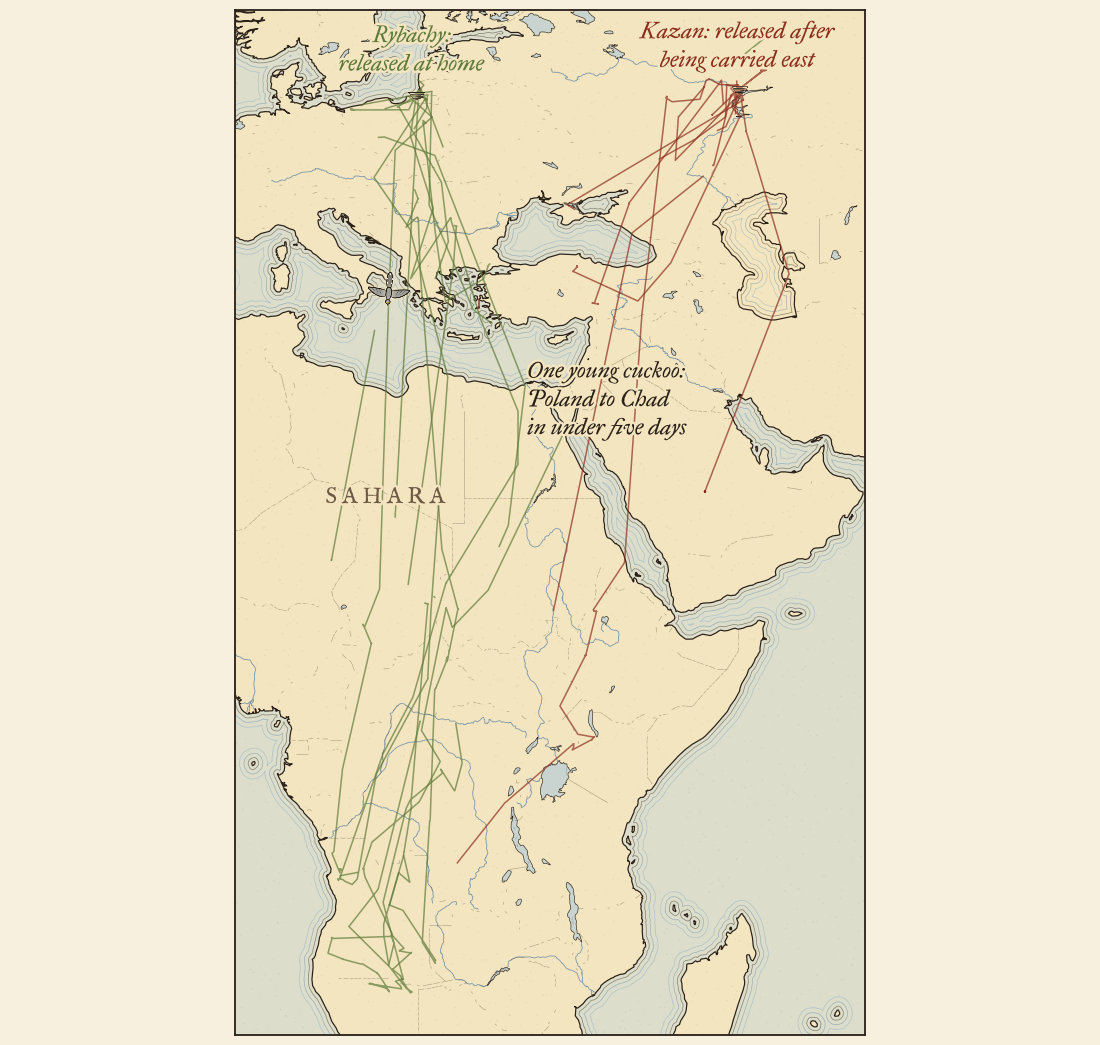
I measured how much of each species’ flying was over the sea. The storks: 0.6%, short hops over bays and straits, never more than 82 km at a stretch. The ospreys: 22%. They fish, they flap, and 4 of them flew 300 km or more of open sea in one go, typically from Cuba or Hispaniola straight over the Caribbean to Venezuela or Colombia. One, known only as KD, set off south from Hispaniola, spent 82 hours over the sea and came back to Haiti. The cuckoos fly at night and their tags report only every day or two, but the lines are unmistakable: one young cuckoo left Poland on 27 September 2017 and was in Chad 4.8 days later, 4,347 km away, having crossed the sea and the whole Sahara in between.
How fast, how far
A typical stork took 61 days over its autumn migration, 79 km a day once the rest days are counted in. Ospreys went 2.1 times as fast. On their best days they all go much further. The record in these data belongs to a marsh harrier called Lilla, who on 11 September 2019 left central Spain at midday, crossed the Strait of Gibraltar in the evening, flew on into the night, and by noon the next day was 871 km away in Morocco.
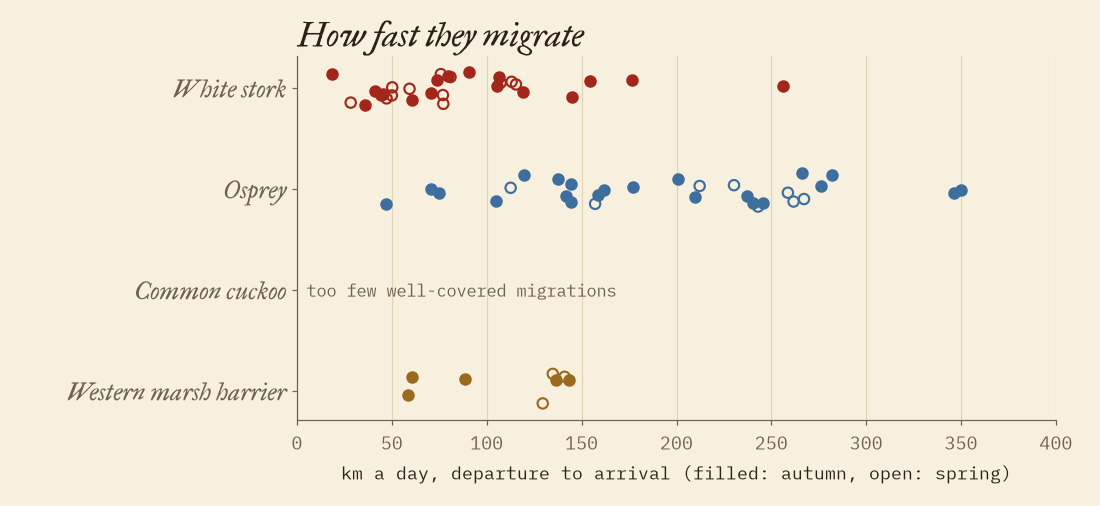
Over a year the totals are astonishing for birds a few months old. The median stork followed for a full year covered 12,724 km between daily positions, and one from Moscow at least 23,680 km. Those are lower bounds: measured hour by hour, the stork tracks are 41% longer.
The same bush every winter
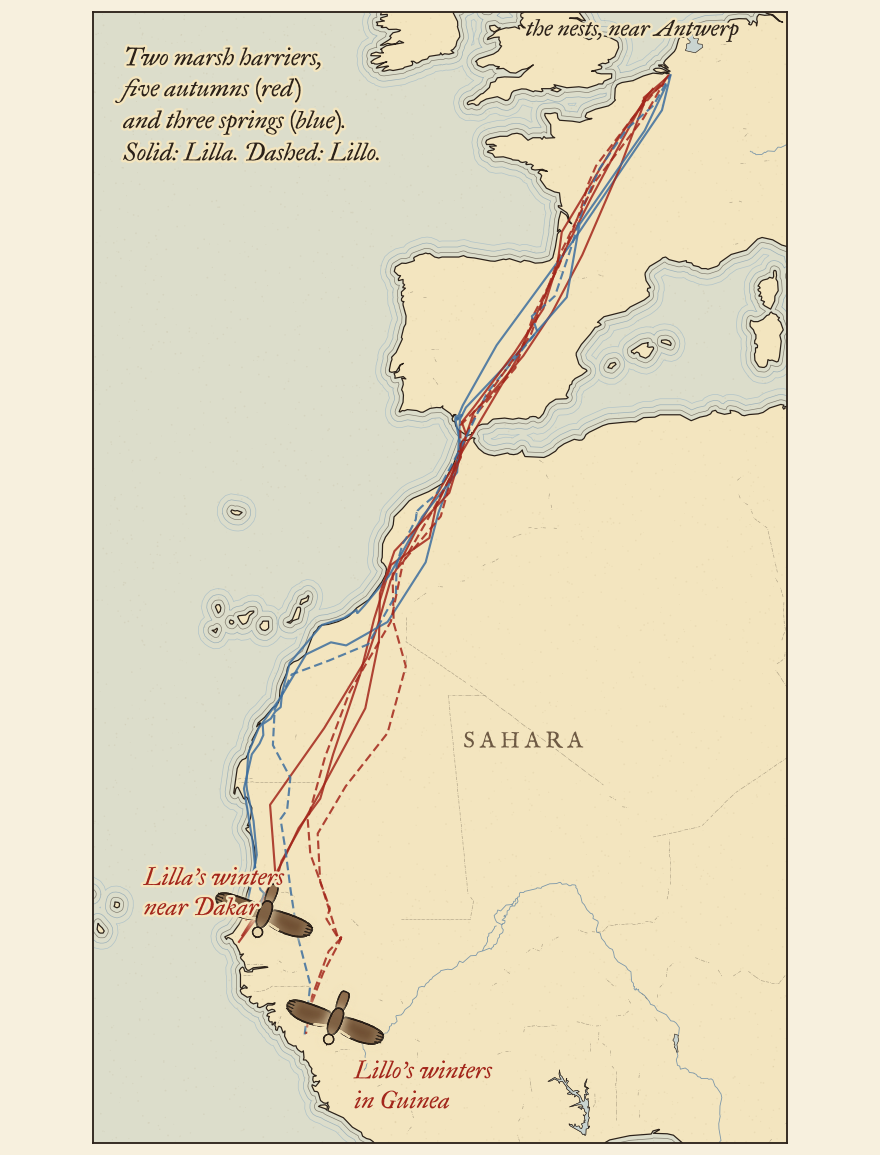
The marsh harriers were followed for years, and they show something the short tracks cannot. Lilla made 5 complete migrations between Antwerp and Senegal, and each winter she went back to the same place near Dakar: her winter centres in three winters lie within 2.6 km of each other. Lillo, a male from the same marsh, wintered twice in Guinea, 0.8 km apart.
The young storks spread out more. 18 wintered in the Sahel, but they ranged from Morocco and France to South Africa.
The cost of the journey
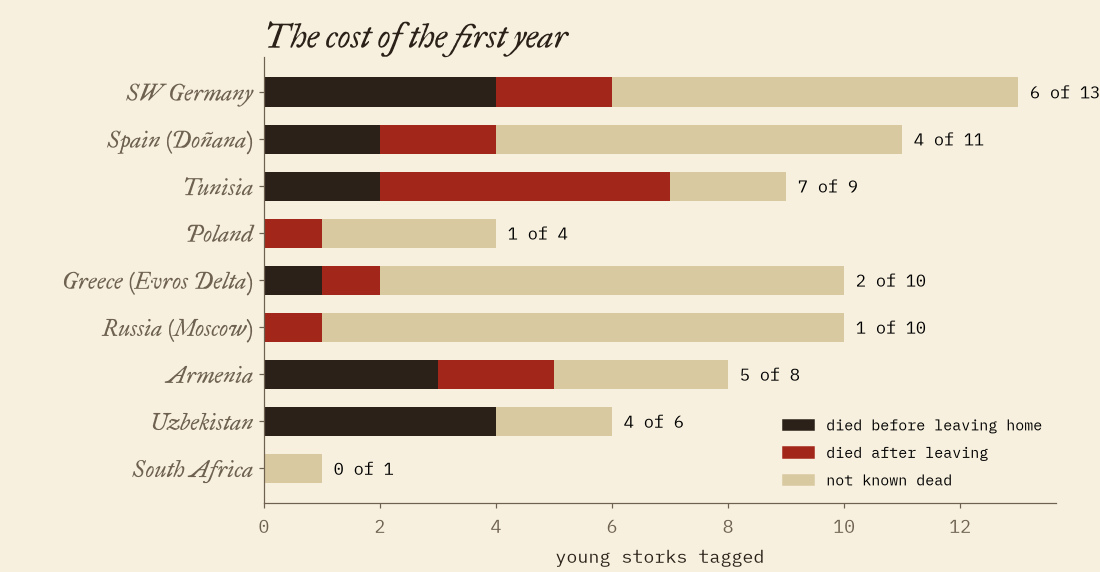
Of the 72 young storks, 30 (42%) were found dead within the year. Many never got going: 16 died before they had gone 300 km from home. After that the route mattered. Of the storks that left, 3 of 23 on the long eastern route died, 4 of 18 on the western one, and 5 of the 7 Tunisian birds that set out across the Sahara. The ospreys’ records are grim in a different way: 3 probably came down at sea and died on floating debris, and one was shot in Mexico.
The cuckoos come from an experiment. Young cuckoos are raised by other birds and never meet their parents, so how do they find Africa? Kasper Thorup and colleagues caught cuckoos on the Baltic coast and released some at home and others after carrying them about 1,800 km east to Kazan. 8 of the 9 displaced birds I could follow set off south-west, as if correcting for the move.
How I did this
The four data sets come from the Movebank Data Repository and Zenodo, all under CC0. I kept only the most accurate satellite positions, removed positions that would need impossible speeds, thinned every bird to one position a day, and measured distances as straight lines between positions, so every distance here is a lower bound. Funnels count a bird when it has positions on both sides, and the sea is Natural Earth’s coastline. These are a few hundred birds, mostly young storks of one year and ospreys of the late 1990s, so they describe these birds rather than whole populations, and a tag that stops is not a dead bird: I count only deaths the researchers confirmed. The paper has the details.
Notes and sources
- Flack et al. (2015), MPIO white stork lifetime tracking data (2013 to 2014), Movebank Data Repository, CC0; and Flack et al. (2016), Costs of migratory decisions, Science Advances.
- Martell and Douglas (2019), Osprey in North and South America 1995 to 2002, Movebank Data Repository, CC0.
- Thorup et al. (2020), Common cuckoos from Rybachy, Movebank Data Repository, CC0; and Flying on their own wings, Scientific Reports.
- INBO, MH_ANTWERPEN western marsh harriers, Zenodo, CC0. Natural Earth (public domain). Lettering in IM Fell (SIL Open Font License).
- I wrote the text, with drafting and editing assistance from Claude (Anthropic), which also helped prepare the analysis code. I reviewed and checked all text and results.

