
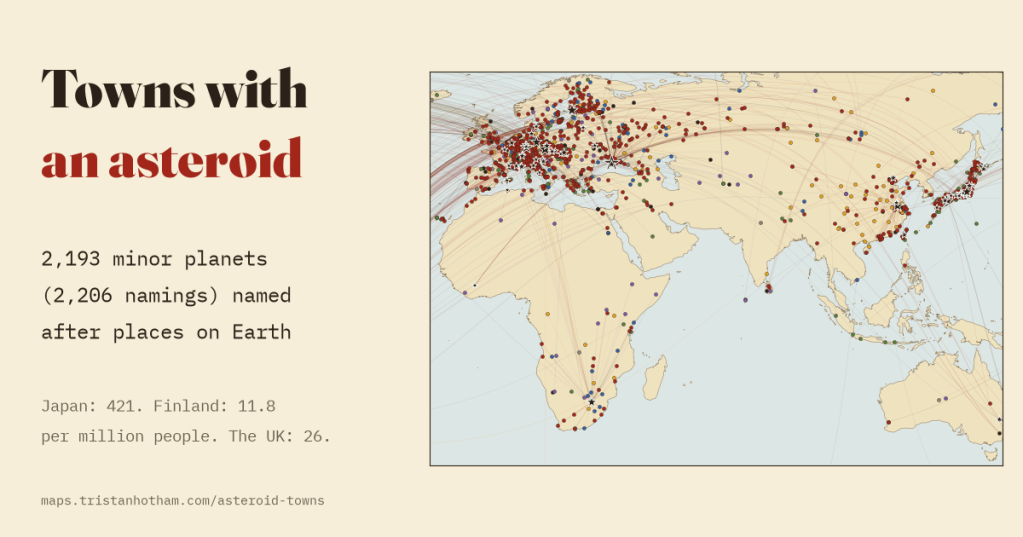
There is an asteroid called Midsomer Norton, another called Tooting and one called Church Stretton. I mapped 2,193 asteroids (2,206 namings) named after places on Earth, each with a line to the observatory that found it. Japan has the most, Finland the most per head, and the smallest observatories name the next valley.
Find an asteroid, track it long enough to pin down its orbit, and you get to suggest its name. Most astronomers honour people: colleagues, teachers, family, composers. But a good share name places, and that gives the solar system a strange geography of its own. Somewhere out past Mars there are rocks named after London and Brighton, after Tooting and Midsomer Norton, after rivers in Russia and villages in Bohemia.
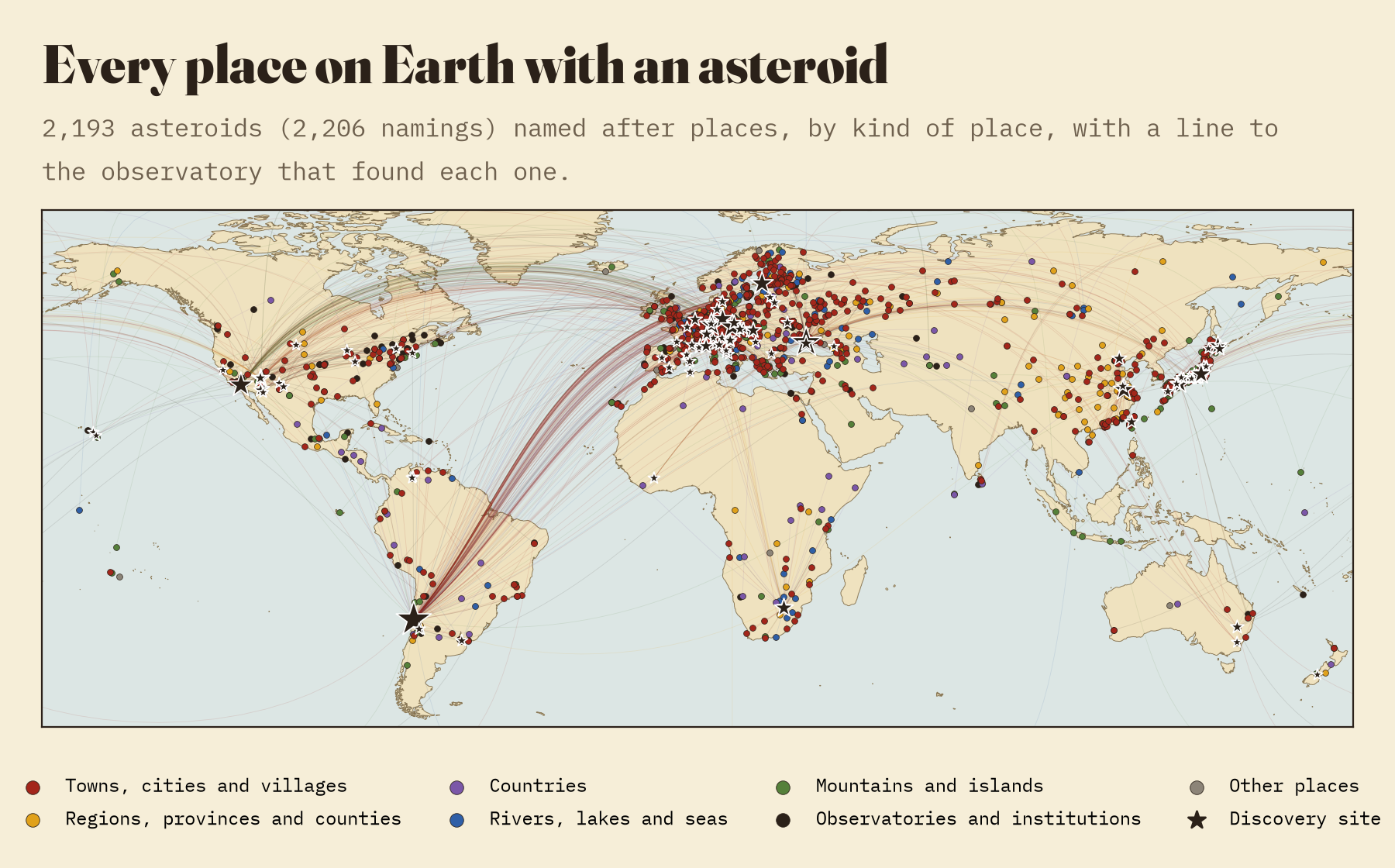
Wikidata, the open database behind Wikipedia, records what 11,268 asteroids are named after and where each one was discovered. 2,206 of those namings are of places with coordinates, about one in five. I mapped every one and drew a line from each place to the observatory that found its asteroid. On the interactive map you can click any town to see its asteroid, or click an observatory and watch its lines fan out across the world.
One in five is a place
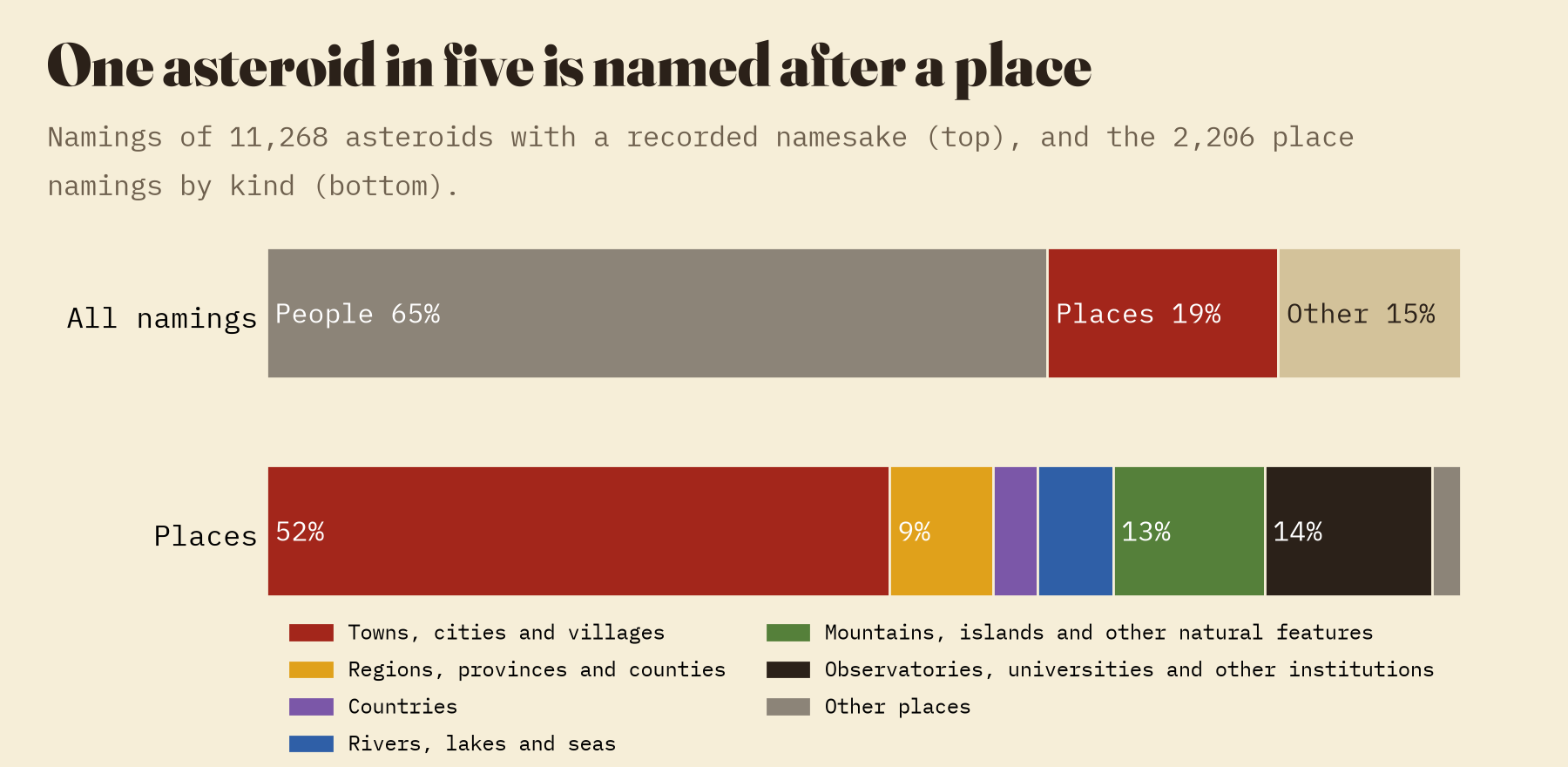
Of all the namings, 65% honour people and 19% honour places with coordinates; the rest go to gods, novels, bands, ships and the like. Among the places, towns, cities and villages make up about half (52%). Then come observatories, universities and other institutions, mountains and islands, regions and provinces, rivers and lakes, and 82 countries.
Japan has the most, Finland the most per head
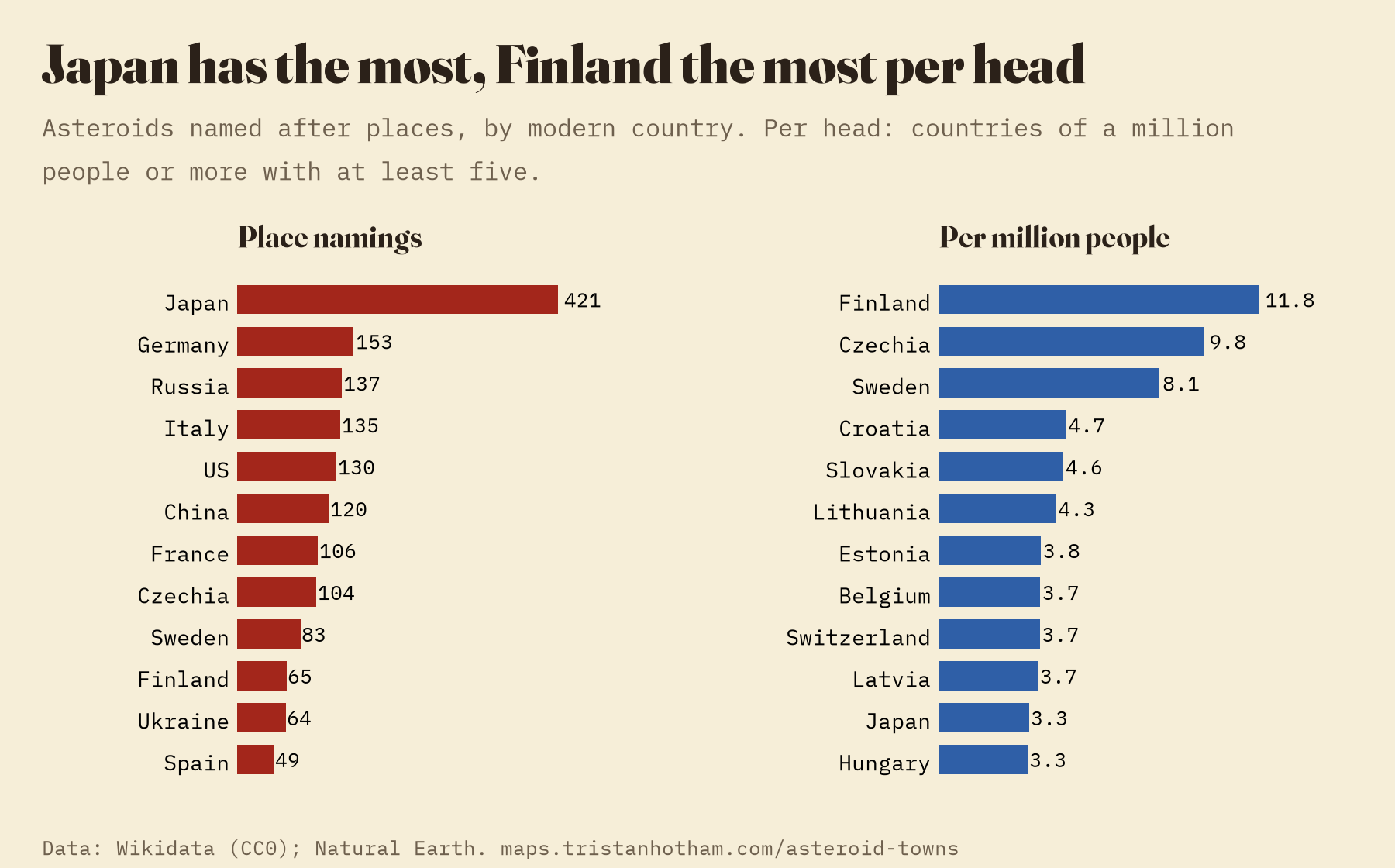
Japan has 421 places with an asteroid, almost a fifth of the total and nearly three times as many as Germany (153), Russia (137) or Italy (135). Japan’s many amateur and municipal observatories found thousands of asteroids in the late twentieth century and named a great many after Japanese towns, mountains and provinces. Per head, though, the leaders are smaller countries with famous asteroid hunters: Finland, with 11.8 per million people, the Czech Republic (9.8) and Sweden (8.1).
Telescopes in Chile, names from Belgium
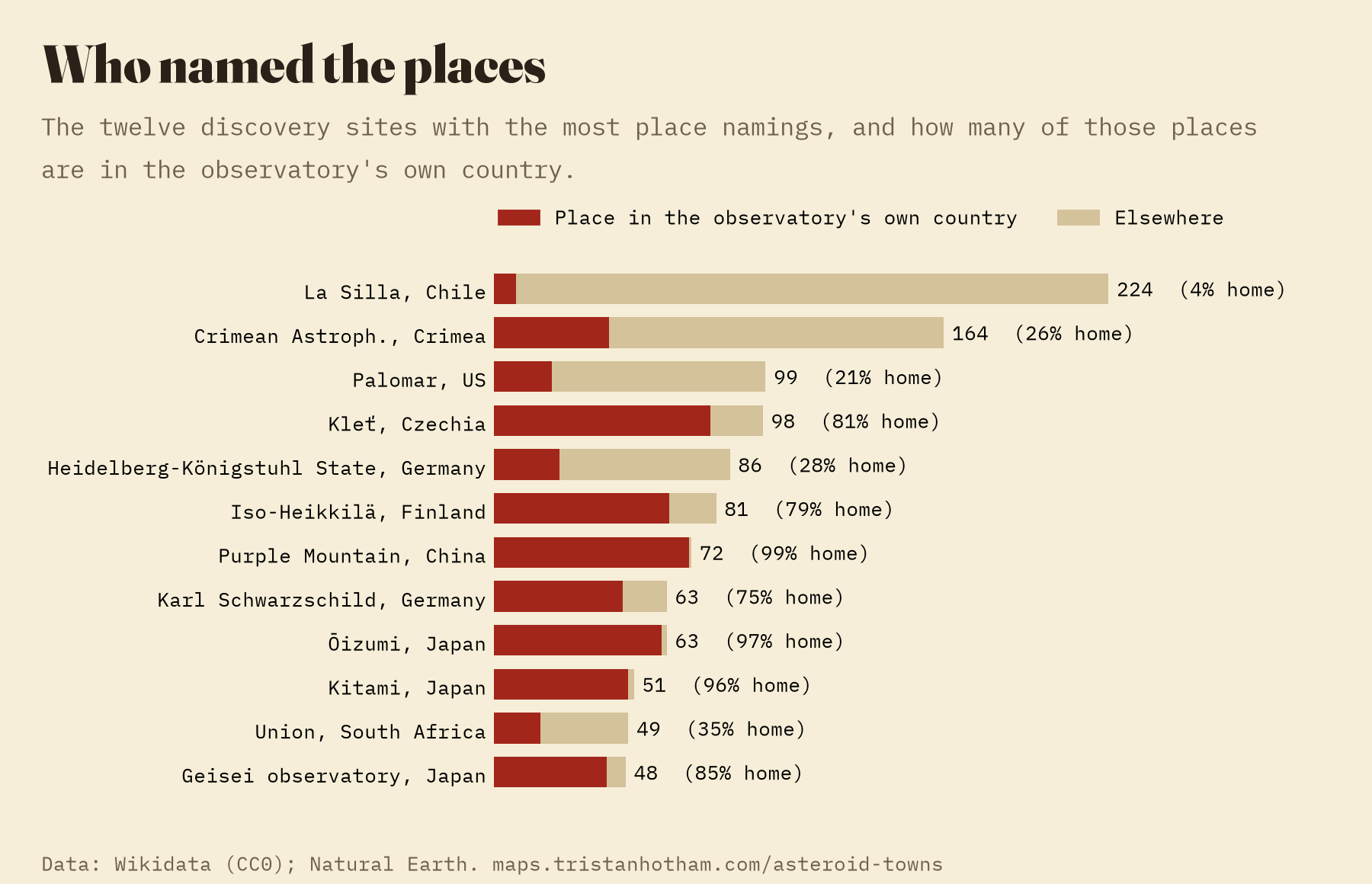
The observatory that found the most asteroids named after places is La Silla in Chile, with 224. Only 4% of them are Chilean. Big observatories host astronomers from everywhere, and the names go home with them. The Belgian Eric Elst, who found more place-named asteroids than anyone in the data (167), worked at La Silla and named 36 places in France and 16 in Belgium. A Swedish survey at La Silla named Swedish places, so that not one of Sweden’s 83 places in the sky was found in Sweden; most were found in Chile. Finland is the opposite: all 65 of its places were named from Finnish observatories, most from Yrjö Väisälä’s at Turku.
Naming the next valley
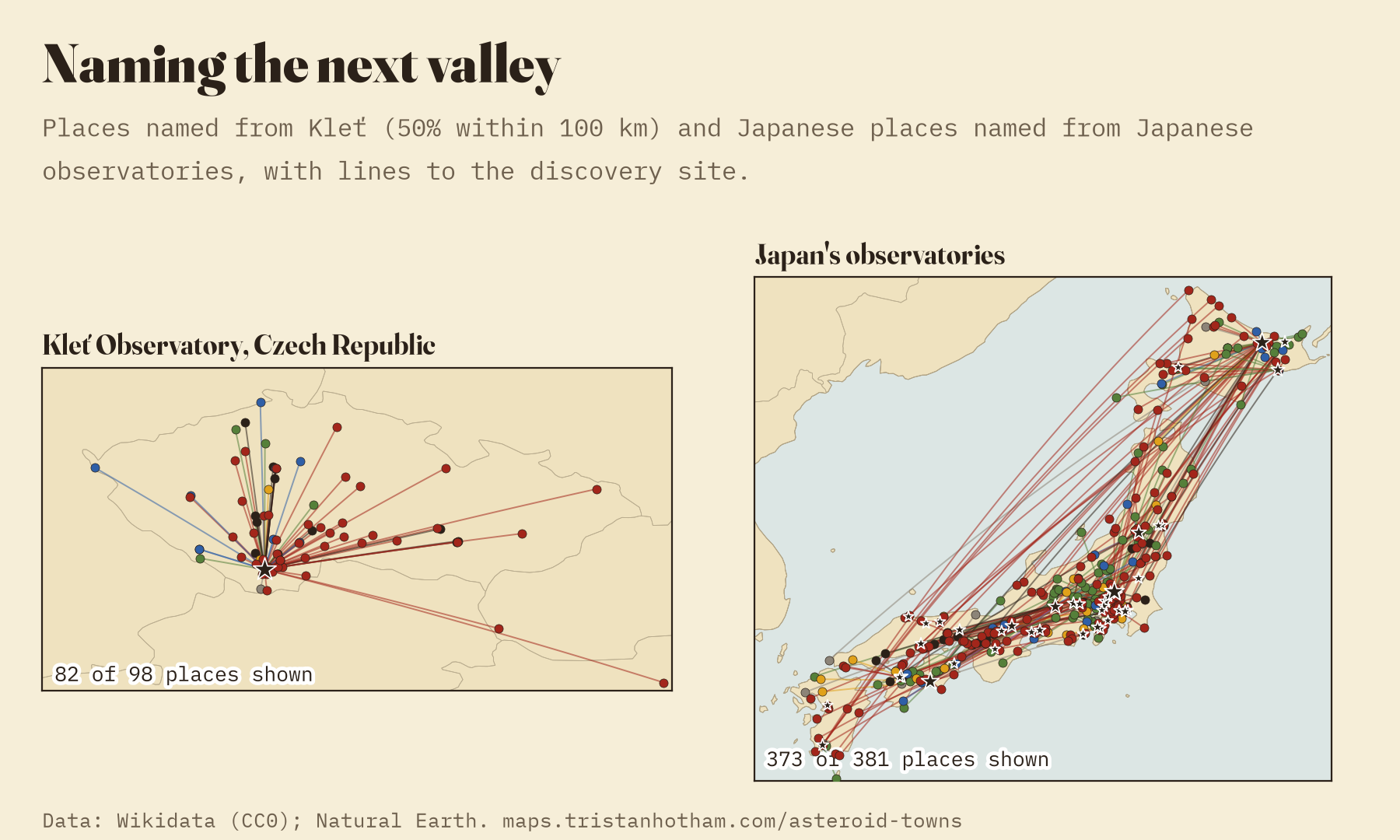
Half of all places lie within 508 km of the observatory that found their asteroid, and 27% within 100 km. The most local namers are small observatories with a devoted resident team. Kleť Observatory, on a mountain in South Bohemia, named 98 places, 81% of them Czech and half within 100 km of its dome: Český Krumlov, České Budějovice, the river Malše and dozens of villages in between. Japan’s observatories did the same at home: 92% of the asteroids named after Japanese places were found in Japan.
Big telescopes name the world. Small ones name the next valley.
Britain’s asteroids
Wikidata has 26 asteroids named after places in the United Kingdom, from 758 Mancunia (Manchester), found in South Africa in 1912, to London, Brighton, Edinburgh, Coventry, Tooting and Midsomer Norton. Almost all were found abroad. The home-grown exceptions are lovely: an amateur observatory at Church Stretton in Shropshire found the asteroids named Church Stretton and Salopia, the old name for the county, and a small observatory at Stakenbridge found Old Joe, named after the University of Birmingham’s clock tower.
How I did this
The data are Wikidata’s “named after” statements for asteroids, with each asteroid’s discovery site and discoverer and each namesake’s type and coordinates, queried through the QLever engine. A namesake that is not a person and has coordinates counts as a place, unless it is mythical or fictional or is not a place at all (a language, a species, a ship, a battle, a people, a television programme or an organisation with no site of its own); I checked the whole list by eye. I sorted places into kinds by keyword rules on their Wikidata types and gave each the modern country Wikidata records for it, falling back to Natural Earth’s borders where Wikidata is silent or names a historical state (Crimea is counted as part of Ukraine) and measured the great circle distance to the discovery site.
The big caveat is coverage. This is not every named minor planet, only the subset that Wikidata links to a namesake, so it is incomplete and not a random sample, and I have not compared it with the Minor Planet Center’s full catalogue of names. The discovery site is where the asteroid was found, not necessarily where the name was chosen. And a river, region or country is reduced to a single point, so its distance is rough.
Notes and sources
- Wikidata contributors, Wikidata (CC0), queried with QLever (Bast and Buchhold, 2017). Vrandečić, D. and Krötzsch, M. (2014) Wikidata: a free collaborative knowledgebase. Communications of the ACM 57(10).
- Minor Planet Center, How are asteroids named?, and the IAU Working Group Small Bodies Nomenclature, wgsbn-iau.org.
- Natural Earth (public domain) for countries and population estimates (mostly for 2019). Map style on OpenStreetMap data (ODbL) via OpenFreeMap.
- I wrote the text, with drafting and editing assistance from Claude (Anthropic), which also helped prepare the analysis code. I reviewed and checked all text and results.

