
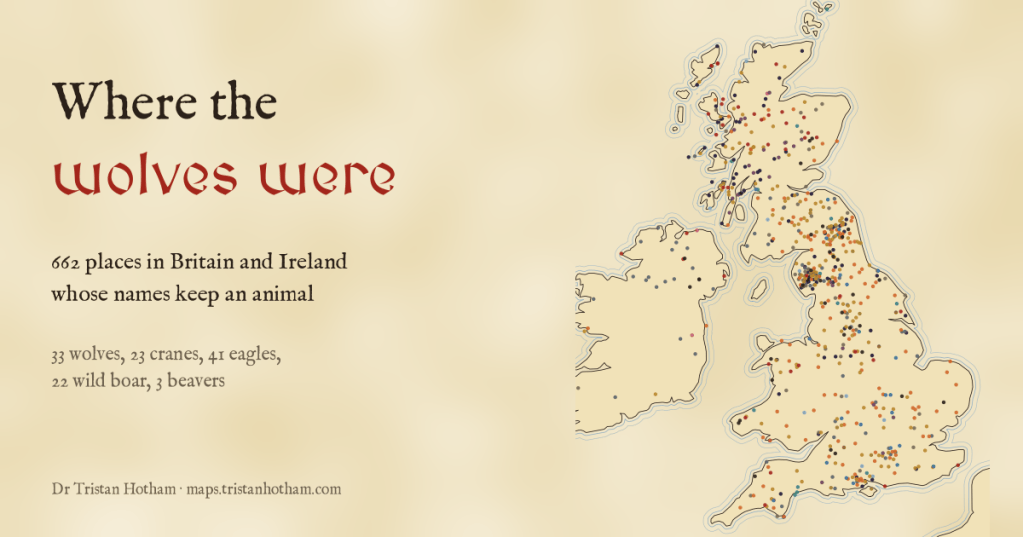
Wolves, beavers, cranes and wild boar vanished from these islands centuries ago, but their names did not. I searched every named place and hill in Britain and Ireland for the animals hiding in them, threw out the false friends one by one, and mapped 662 that are left.
Woolpit in Suffolk is a lovely village with a famous legend about green children. Its name is less cheerful. It comes from the Old English wulf-pytt, a pit for trapping wolves. Beverley in the East Riding was a stream full of beavers. Cranfield in Bedfordshire was open land where cranes stood. Arncliffe in the Yorkshire Dales was the eagles’ cliff. Every one of those animals was gone from England centuries ago: the wolf by about 1500, the beaver probably by the sixteenth century, the crane as a breeding bird around 1600, the wild boar from the wild by the thirteenth century. The names are a fossil record of the animals people lived beside.
So I went looking for them across the whole of Britain and Ireland. I took 145,934 named points from OpenStreetMap, from cities down to farms, crags, woods, springs and bays, and searched them for animal words in Old English, Old Norse, Welsh, Scottish Gaelic, Irish and later English and Scots.
Wolverhampton is not about wolves
The first job was throwing things out. Place names are full of false friends. Wolverhampton is named after a woman, Wulfrun. Eagle in Lincolnshire is an oak wood, and Eaglesham in Renfrewshire a church. Swanage is the farm of the herdsmen, not the swans. Roedean is a rough valley. Most Brockleys are brooks rather than badgers, and in Ireland a name beginning Cran is usually a tree, crann. Donnybrook is the church of Saint Broc. I removed known false friends by rule, then read every one of the 800 candidates by eye and dropped more by hand: 7% went in all. The rest I marked certain, where the dictionaries or the plain meaning of a Welsh, Gaelic or Irish word leave no doubt, or probable.
Wolves on the crags
I found 33 wolf names. A few are old and certain: Woolpit; Woolley near Barnsley, a wood with wolves; Ulpha in the Duddon valley, the Norse wolves’ hill; and Cwm Bleiddiaid in Gwynedd, the valley of the wolves. Most of the others are later English and Scots names for crags and gullies in the northern hills: Wolfhole Crag in the Forest of Bowland, Wolf Stones on the moors where Lancashire meets Yorkshire, Wolfcleugh in the North Pennines.
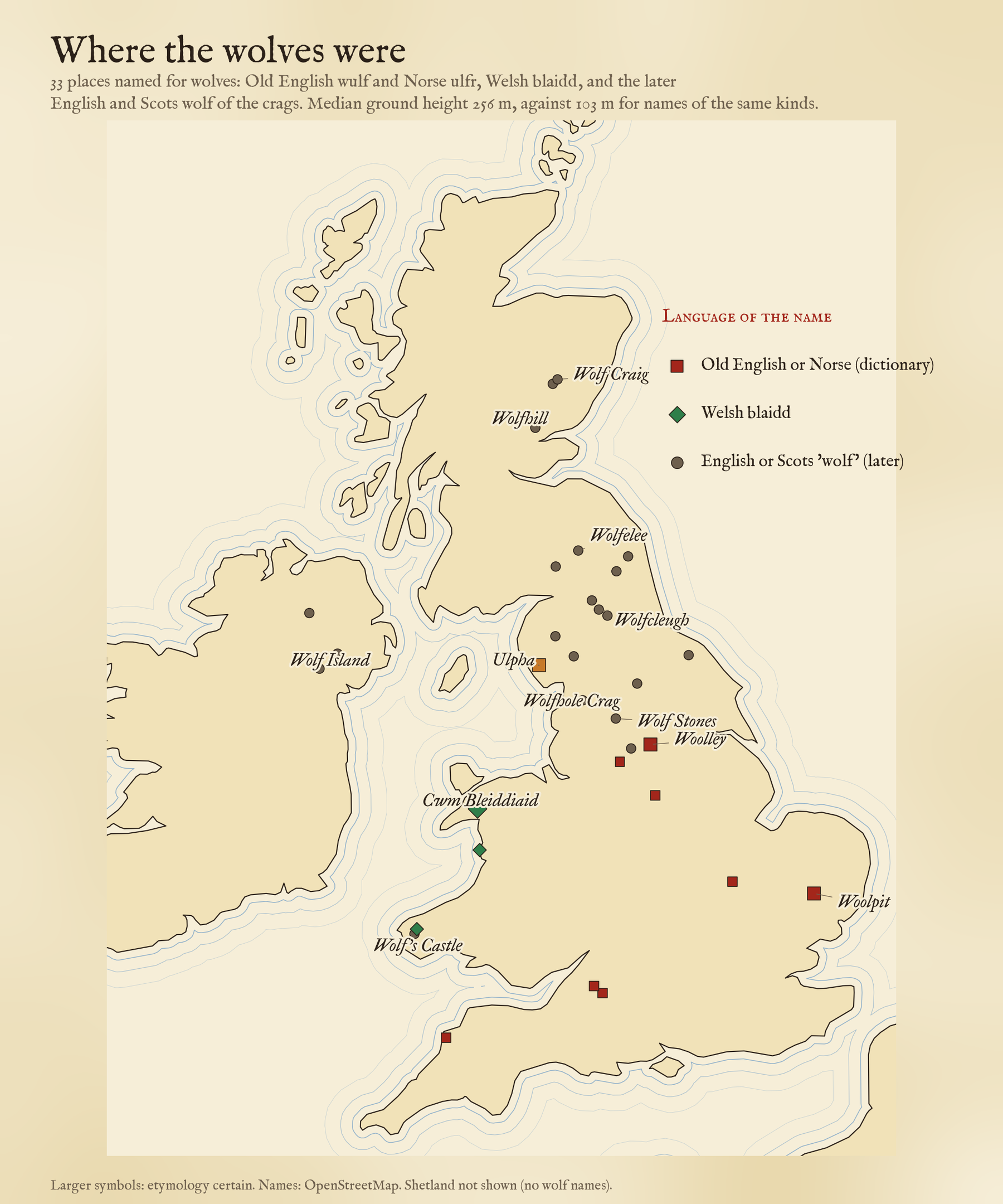
They sit high. The median wolf name lies 256 metres above the sea. Random names of the same kinds, the same mix of peaks, villages and localities, sit at 103 metres, and in 20,000 random draws not one came out as high. That fits what we know: wolves held on longest in the hills and the north.
The median wolf name stands 256 metres up. Random names of the same kinds stand at 103.
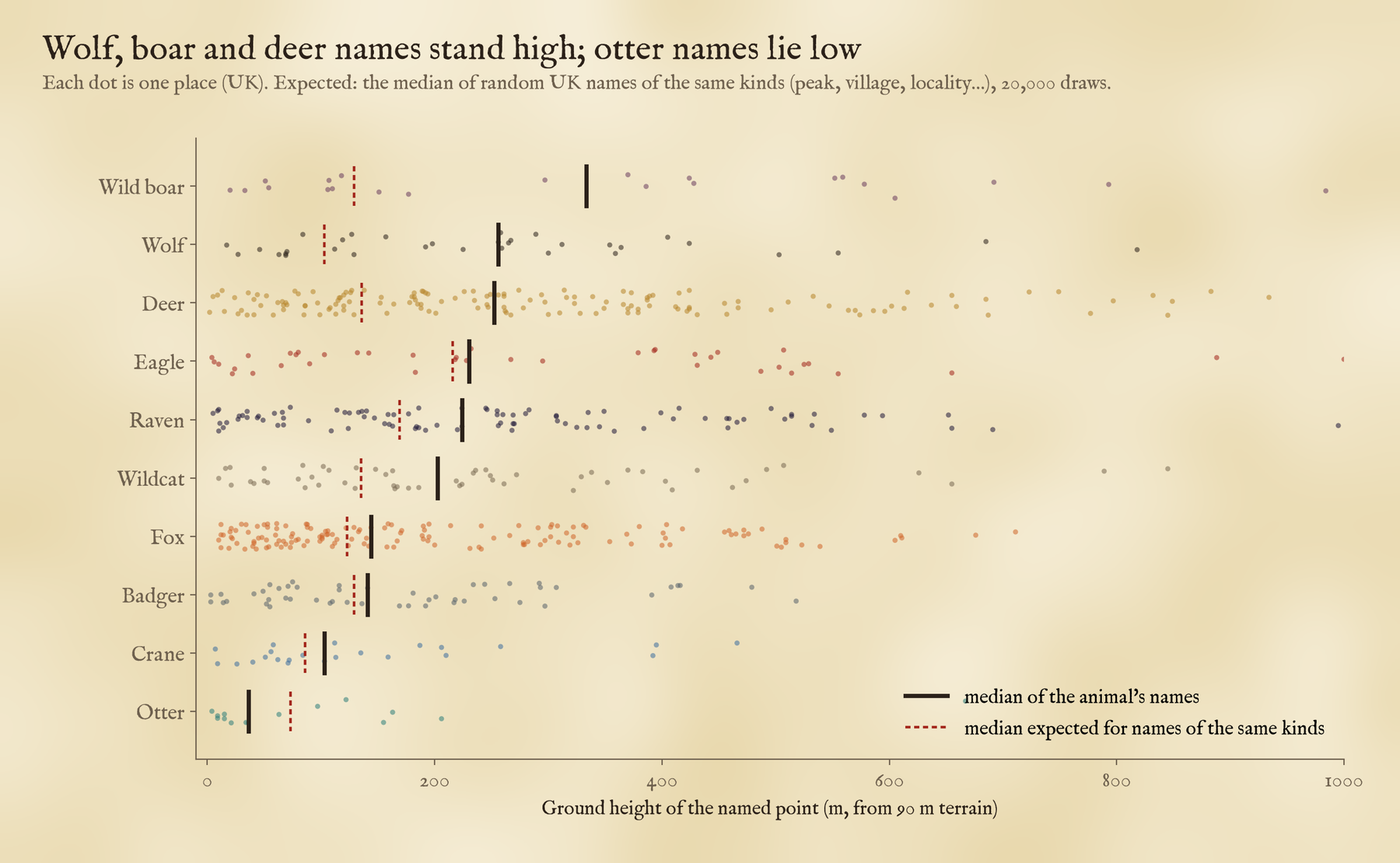
The same test works as a sanity check. Wild boar and deer names stand high too, and otter names lie low, at 36 metres against 73 expected, down by the rivers and the sea where otters belong, though with only 15 otter places that gap could still be chance.
Cranes, beavers and boar
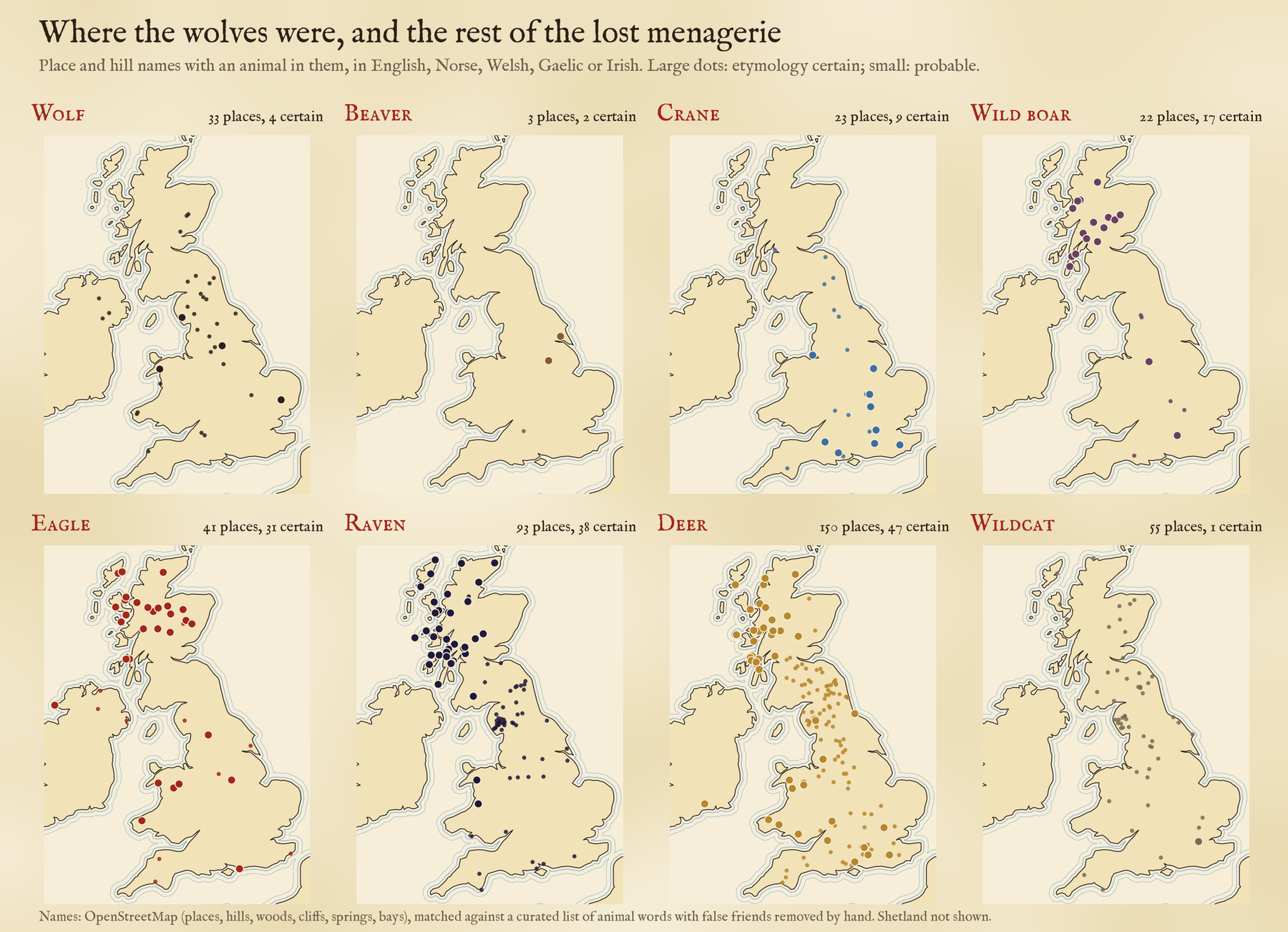
Cranes leave 23 names, almost all in England: Cranfield, Cranbrook, Cranborne, Cranford, Cranmore, Cranwell, Cranleigh, and Tranmere on the Wirral from the Norse word trani. The dictionaries often say “cranes or herons”, because the Old English word may have covered both. I expected to find them clustered in the Fens. They are not: only 1 is in the fen counties, and crane names sit no lower than ordinary names. Beavers leave just 3: Beverley, Bevercotes (the beavers’ lodges) and Beversbrook. Wild boar leave 22, a few old English villages like Eversley and Everdon, Wildboarclough in the Peak, and a scatter of Gaelic hills and fords with tuirc, the boar’s, from Beinn an Tuirc in Kintyre to Brig o’ Turk in the Trossachs.
Eagles speak Gaelic
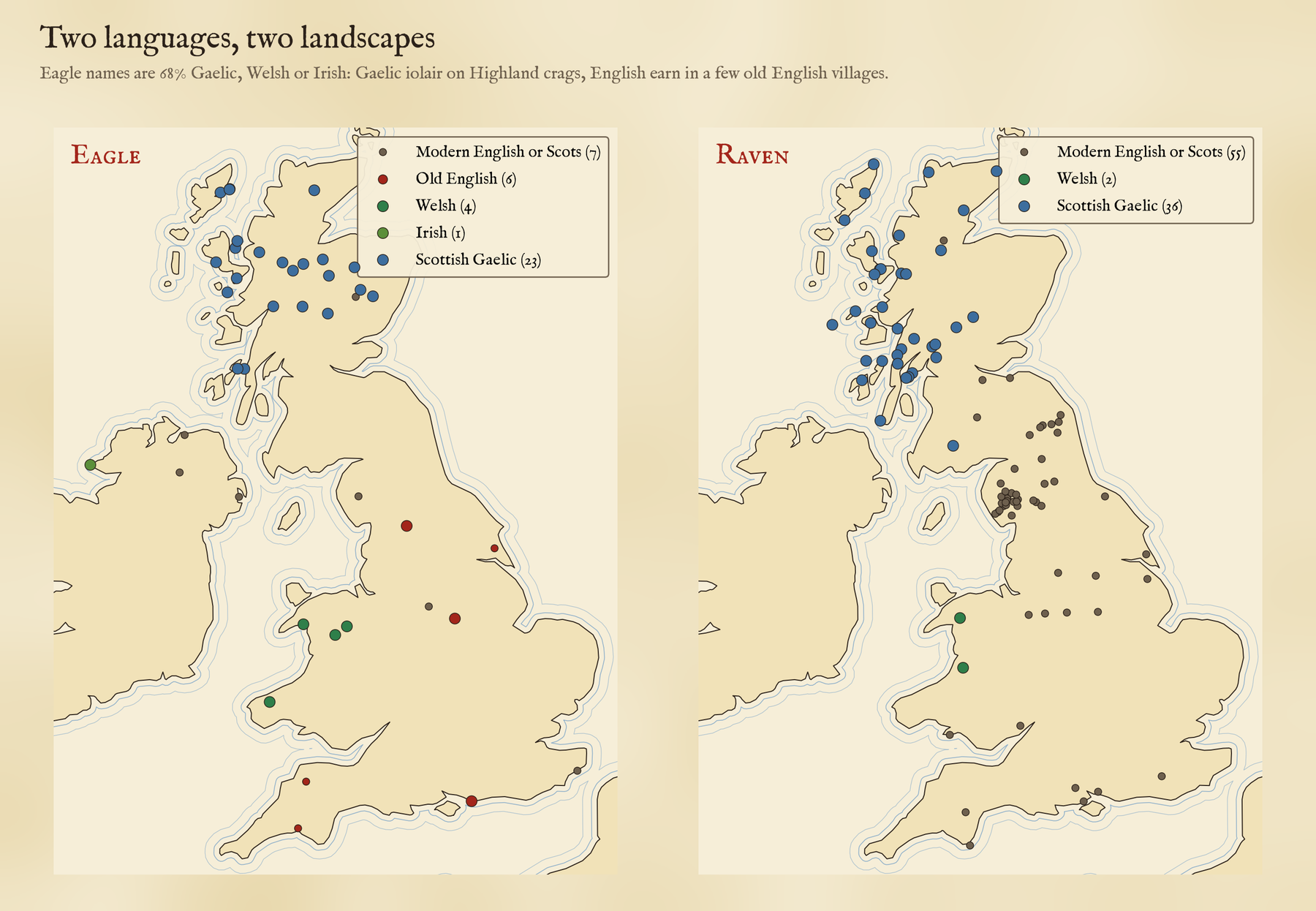
Each animal lives on in a different language. 68% of the eagle names are Gaelic, Welsh or Irish: Creag na h-Iolaire, the eagle’s crag, turns up on hill after hill in the Highlands, Carreg yr Eryr in Wales, Nead an Iolair, the eagle’s nest, in Ireland. Only 6 are Old English, from earn, like Arncliffe and Earnley. Ravens are Gaelic in the west Highlands and English crags in the Lake District and Northumberland. Foxes and deer, which never left, are named mostly in later English and Scots: Fox Hill, Tod Law (a tod is a fox in Scots), Hart Crag.
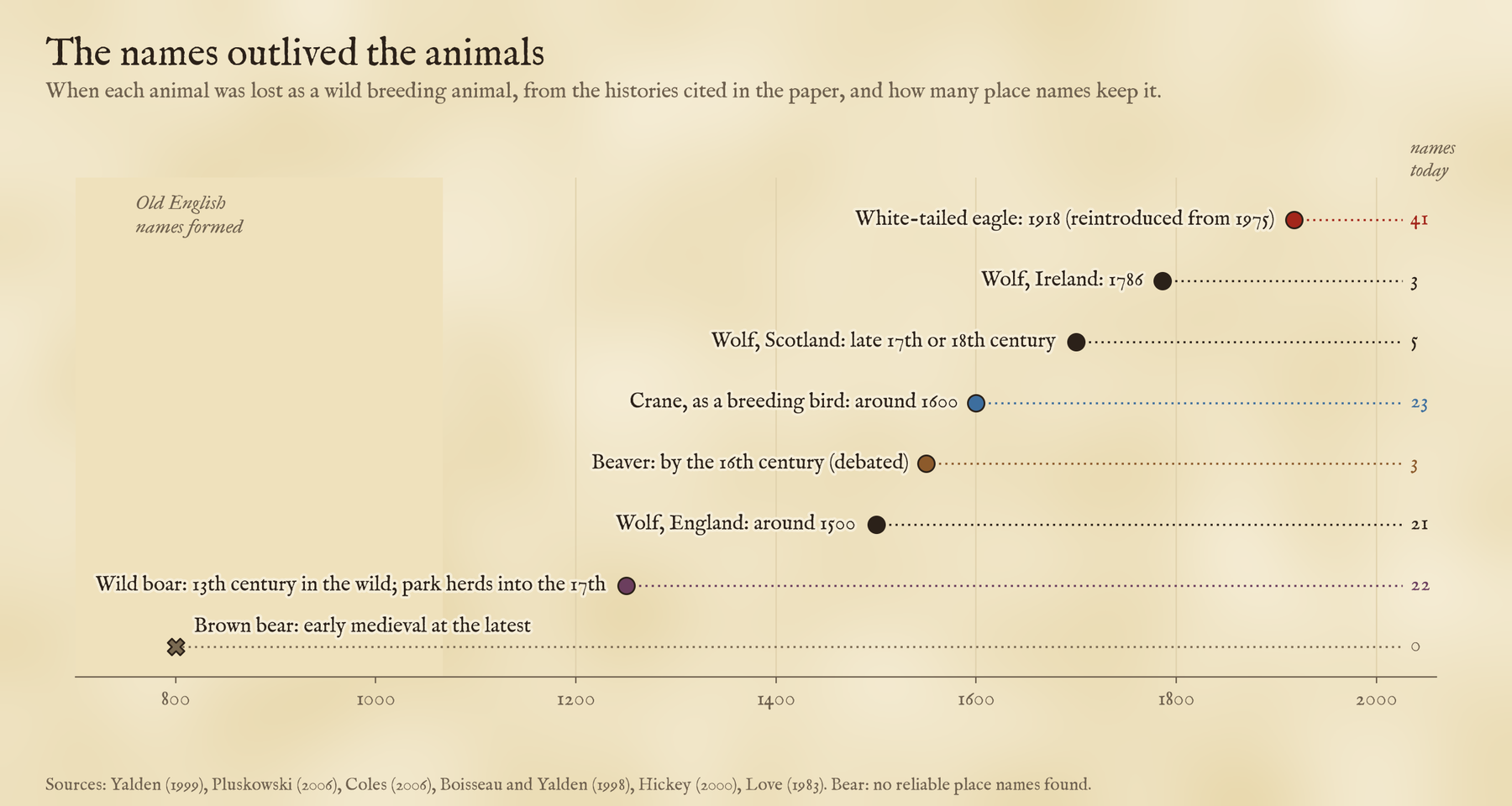
Most of the old English names on this map were given between the seventh and eleventh centuries, when these animals were part of ordinary life. They have outlived the wolves, beavers, cranes and boar by four to eight hundred years. Some of the animals are coming home: sea eagles were released on Rum from 1975, and cranes and beavers have returned to a few places since. Their names were waiting for them. The bear, gone before most of these names were given, left none that I could trust.
How I did this
The names come from OpenStreetMap: 106,905 places in the UK, 24,964 named hills, woods, cliffs, springs and bays, and 14,065 places in Ireland, with their Welsh, Gaelic and Irish names where they are tagged. I used three kinds of rule. English and Norse village names count only if the standard place-name dictionaries (Mills, Watts and Ekwall) explain them with an animal, and only as whole names in the right county, so a farm that borrowed the name Beverley does not count. Welsh, Gaelic and Irish names count if they contain the ordinary word for the animal, inside that language’s country. English and Scots animal words count only beside a landscape word, like Wolf Crag or Fox Knowe, never on houses or modern estates, and only as probable. Repeats of a name within 3 kilometres count once. Every rule, every hand decision and every candidate is published with the data.
The honest caveats. A name records what somebody noticed, feared or joked about when it was given, not a population. OpenStreetMap is today’s gazetteer, not the full record of field names where most wildlife names hide, so the earlier scholarly surveys found far more wolf and beaver names than I can. The descriptive English names may remember a surname, an inn sign or a story. And place-name scholars disagree about some readings. Treat any single dot as a lead to follow up, not a fact. If you know a name I have missed or misread, I would love to hear it.
Notes and sources
- Names: OpenStreetMap contributors (ODbL), queried with QLever. Ground heights: AWS Terrain Tiles.
- Place-name meanings: A. D. Mills, A Dictionary of British Place-Names (2011); V. Watts, The Cambridge Dictionary of English Place-Names (2004); E. Ekwall, The Concise Oxford Dictionary of English Place-Names (1960); H. W. Owen and R. Morgan, Dictionary of the Place-Names of Wales (2007); W. J. Watson, The History of the Celtic Place-Names of Scotland (1926).
- The animals: D. Yalden, The History of British Mammals (1999); C. Aybes and D. W. Yalden (1995) on wolf and beaver place names, Mammal Review; S. Boisseau and D. W. Yalden (1998) on the crane, Ibis; B. Coles, Beavers in Britain’s Past (2006); A. Pluskowski, Wolves and the Wilderness in the Middle Ages (2006); K. Hickey (2000) on the Irish wolf, Irish Geography; J. A. Love, The Return of the Sea Eagle (1983).
- I wrote the text, with drafting and editing assistance from Claude (Anthropic), which also helped prepare the analysis code. I reviewed and checked all text and results.

