
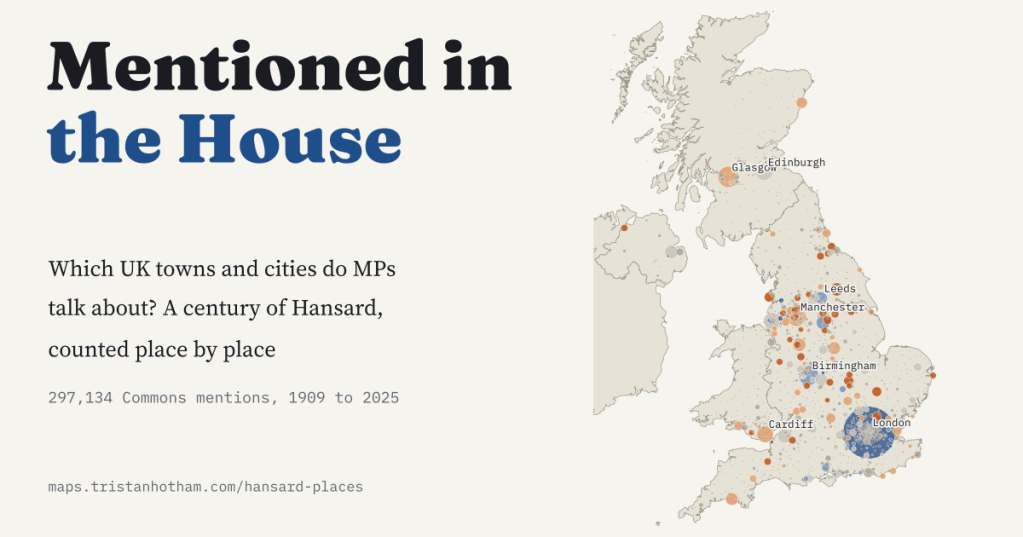
Every word spoken in the House of Commons ends up in Hansard. I counted which towns and cities MPs talk about, year by year since 1909: 297,134 mentions of 1,597 places, and who names each constituency.
My research has always been about attention: which parties, posts and politicians get seen. Parliament is a good place to ask the same question about places. When a factory closes, a town floods or a by-election comes round, MPs stand up and name the place. Over a century, Hansard becomes a record of which towns Westminster had on its mind, and which it hardly mentioned at all.
So I asked Parliament’s own Hansard search a very simple question, 7,279 times: in how many Commons speeches does someone say “in Barnsley”, “in Belfast”, “in Bath”, in each year? I never downloaded the speeches, only the counts. The result covers 1,661 town and city names across the UK from 1909, when Hansard became a full verbatim record, to 2025.
London first, then the big cities
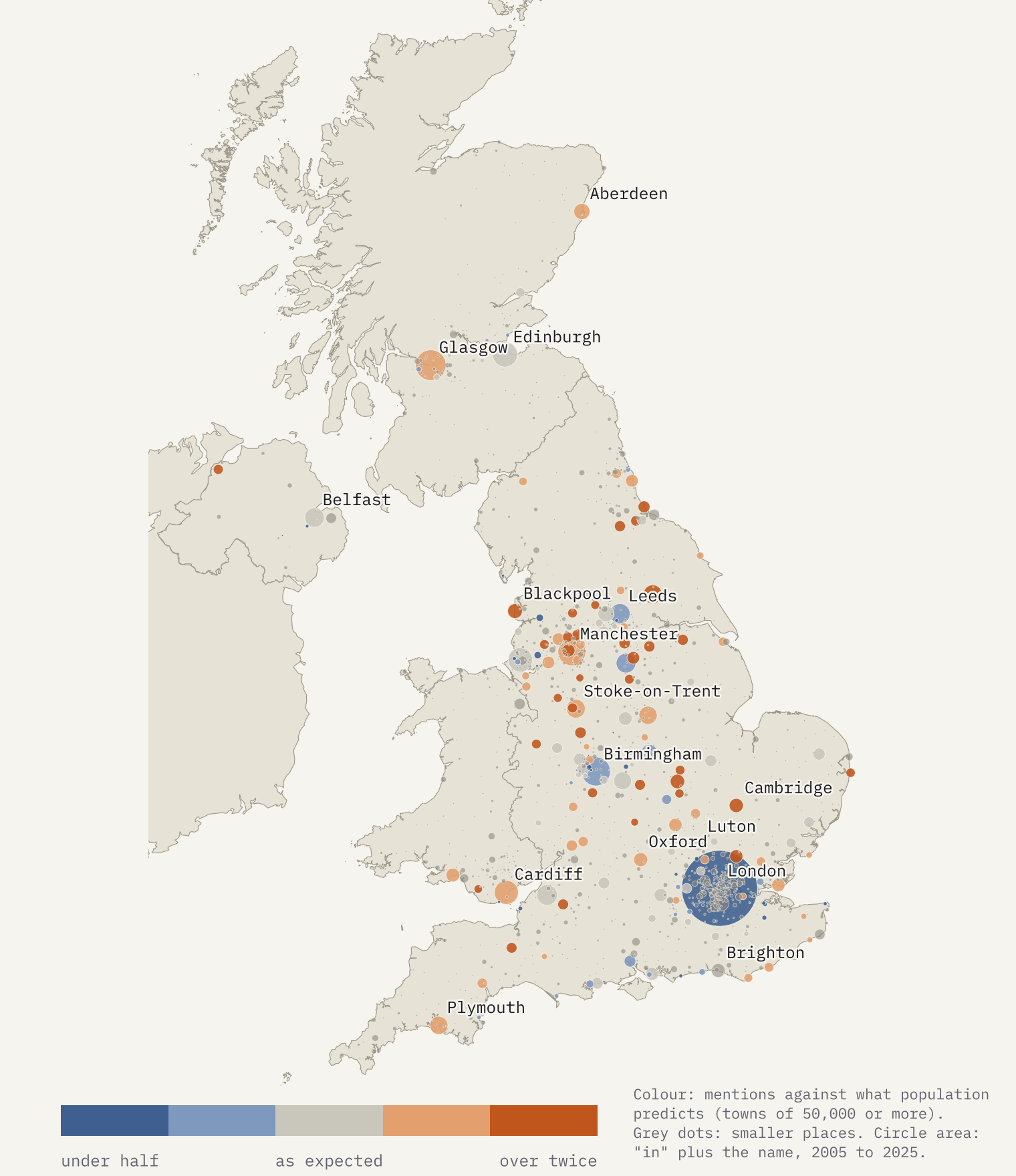
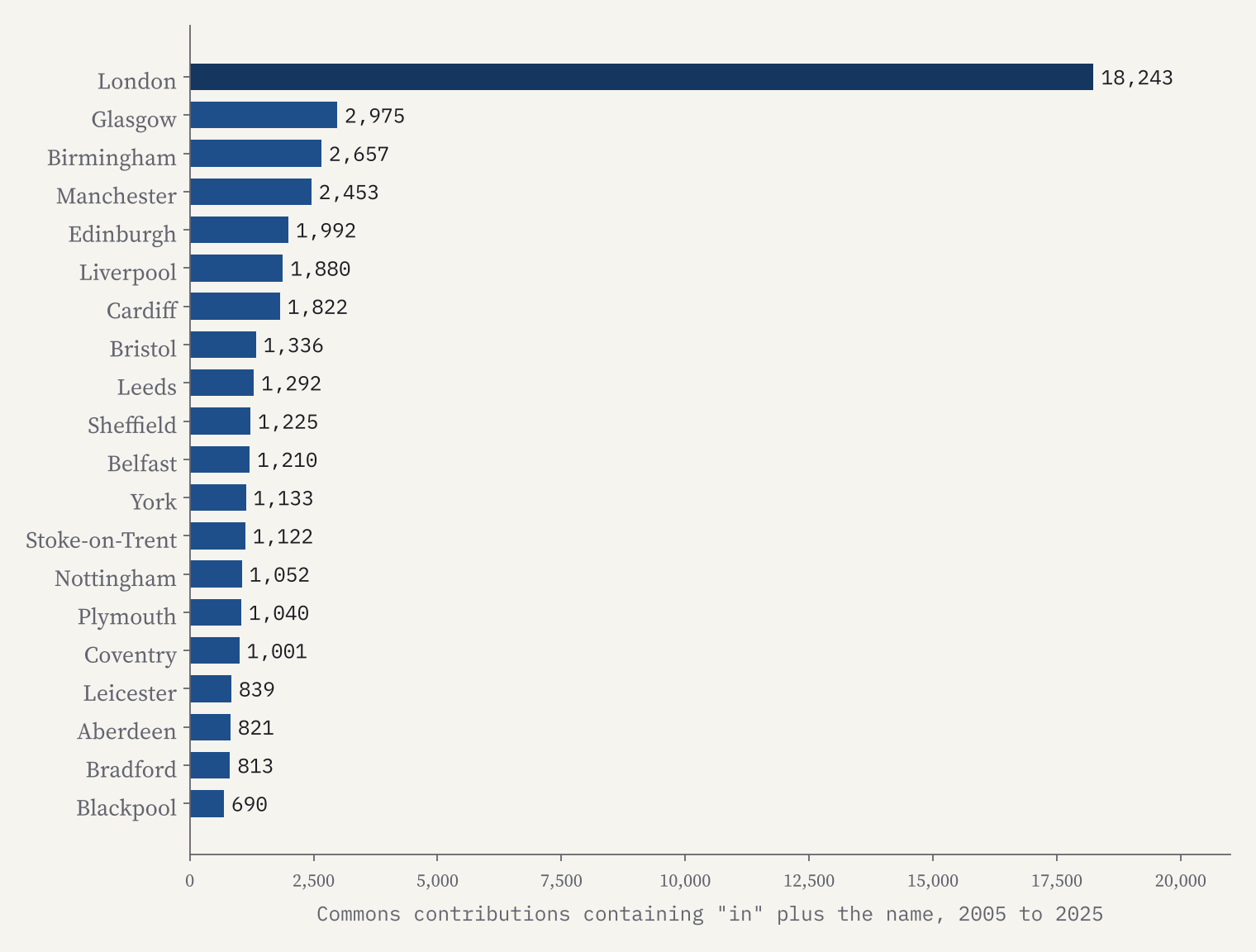
From 2005 to 2025, London came up in 18,243 contributions, 16.1% of all the town and city mentions I counted. Then come Glasgow (2,975), Birmingham (2,657), Manchester (2,453) and Edinburgh (1,992). Cardiff and Belfast are in the top dozen, as you would expect of capitals.
London’s grip has loosened, though. In the 1910s it took 48.8% of the place mentions; in the 1950s 28.4%; in the 2020s 11.2%.
Who punches above their weight
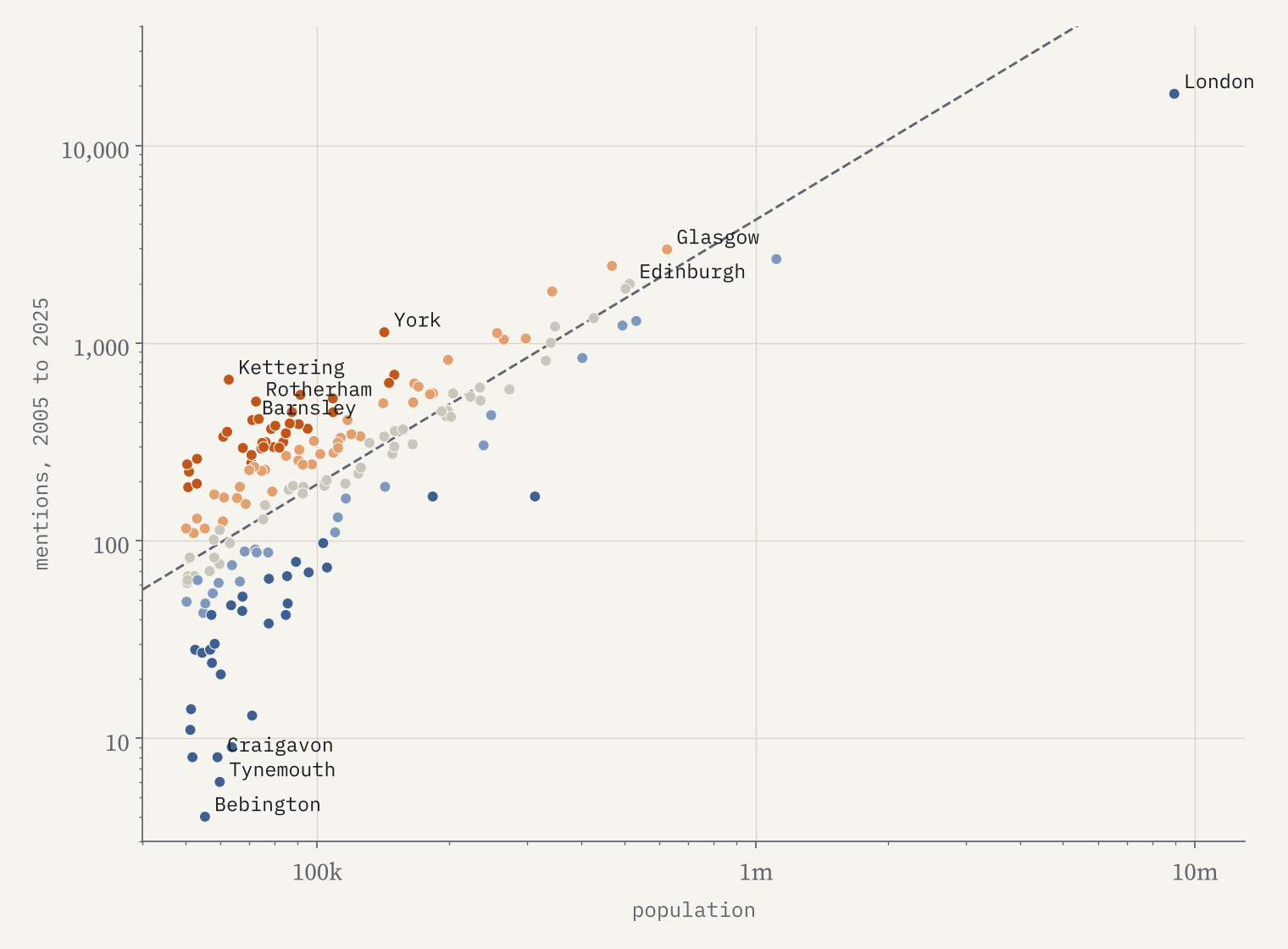
Bigger places get mentioned more, and more than in proportion: a town ten times bigger gets about 21.8 times the mentions. But the real surprises are medium-sized towns. Kettering was mentioned 652 times, 6.47 times what a town of 62,847 people would get on the national trend. Rotherham (4.14 times), York (3.78) and Taunton (3.56) follow.
Where does that come from? Partly from a town’s own MP. Where a town and its seat share a name, the seat’s member spoke 41% of the contributions naming Kettering since 2005, and 35% for Harlow. For Rotherham it was 9%: most of its mentions came from other members, and its biggest year was 2014.
When places had their moment
Most places tick along at a low, steady rate for decades. Then one year lifts them. For every place mentioned at least 150 times since 1909, I found the year in which its share of all town mentions was highest, compared with its usual year.
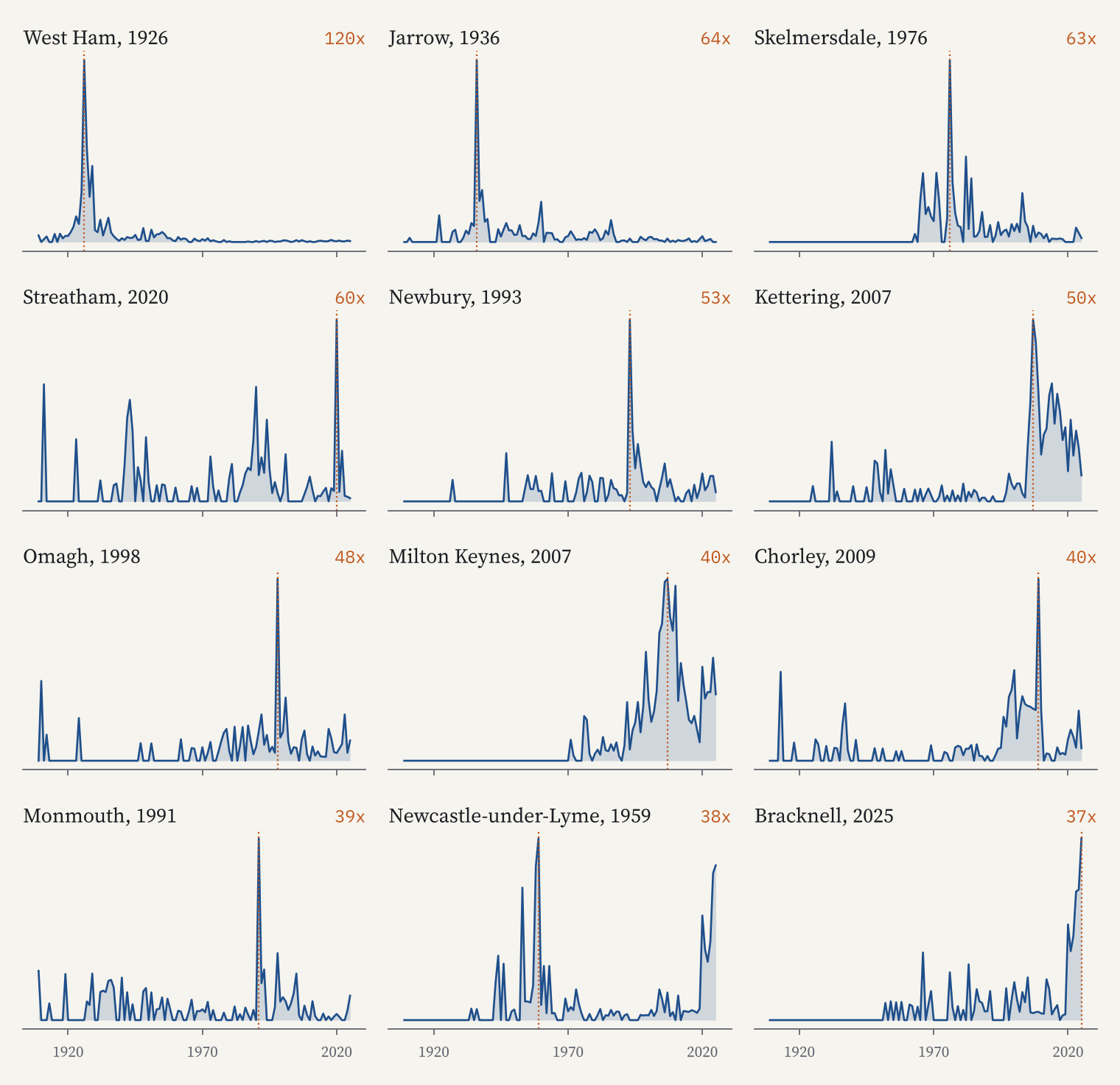
The biggest jump of all is West Ham in 1926, at 120.3 times its usual share, the year of the Boards Of Guardians (Default) Bill. Jarrow’s year was 1936. Skelmersdale’s was 1976, when the most frequent debate title was “Courtaulds Limited (Skelmersdale)”. Redcar’s was 2015, with debates on the steel industry and the Redcar steelworks, and Port Talbot’s was 2024. The interactive map has a year slider, so you can watch the attention move around the country.
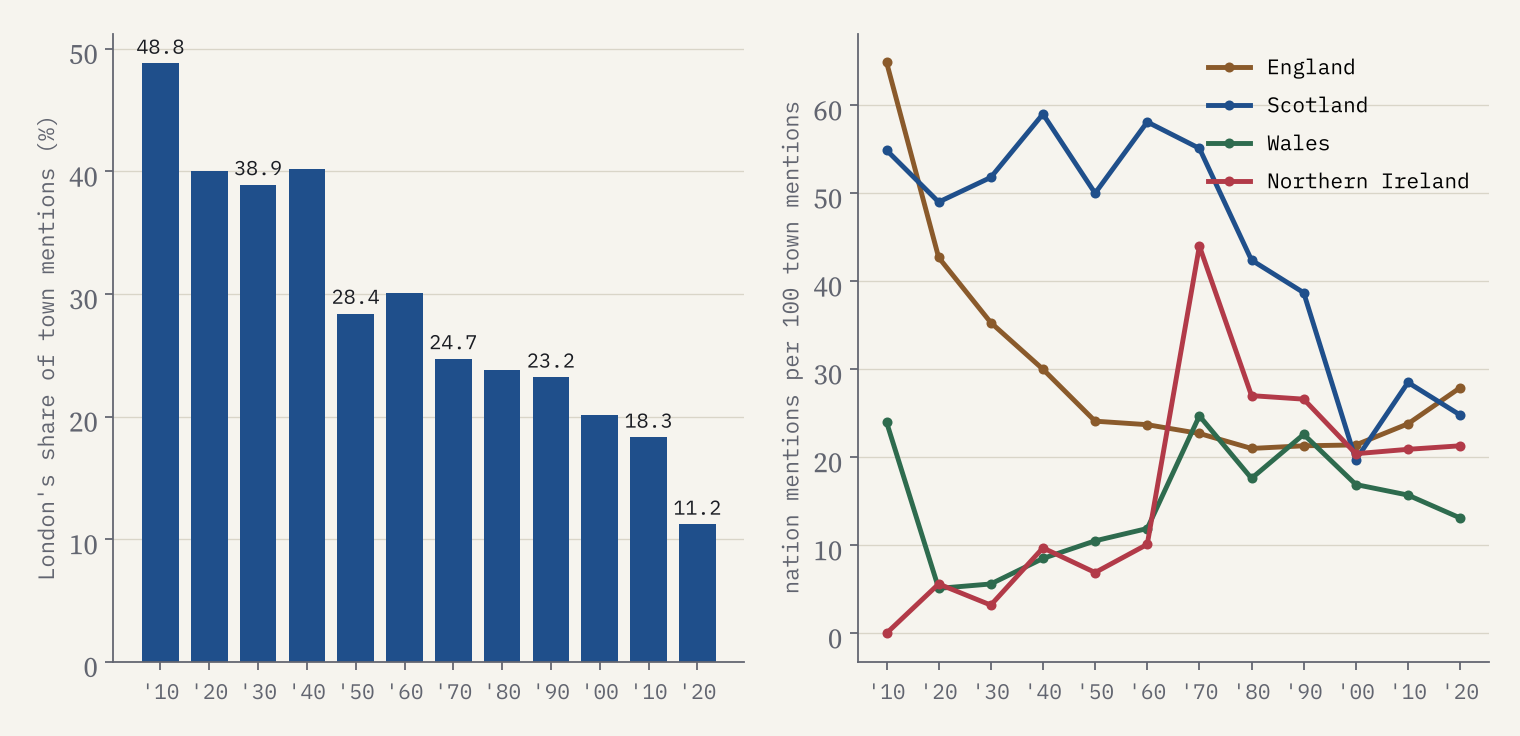
The nations follow politics. “In Northern Ireland” was said about 10.1 times for every 100 town mentions in the 1960s and 44.0 in the 1970s, the first decade of the Troubles. Scotland was steady at 49.0 to 59.0 per 100 until the 1970s, then fell to 19.7 in the 2000s, the first decade of the Scottish Parliament.
Your constituency’s name is mostly said by other MPs, not your own.
Who says your constituency’s name?
MPs refer to each other by seat: “the hon. Member for Barrow and Furness”. So I also took every MP who sat from 2005 to October 2026 (1,649 of them) and every seat they held (946 seat names), and counted who said each seat’s name. Across all seats, the seat’s own MP spoke 10.9% of the contributions naming it; for the median seat it is 8.5%. 423,109 of the 625,965 mentions contain “Member for”. Members seem to say “my constituency” rather than the full name.
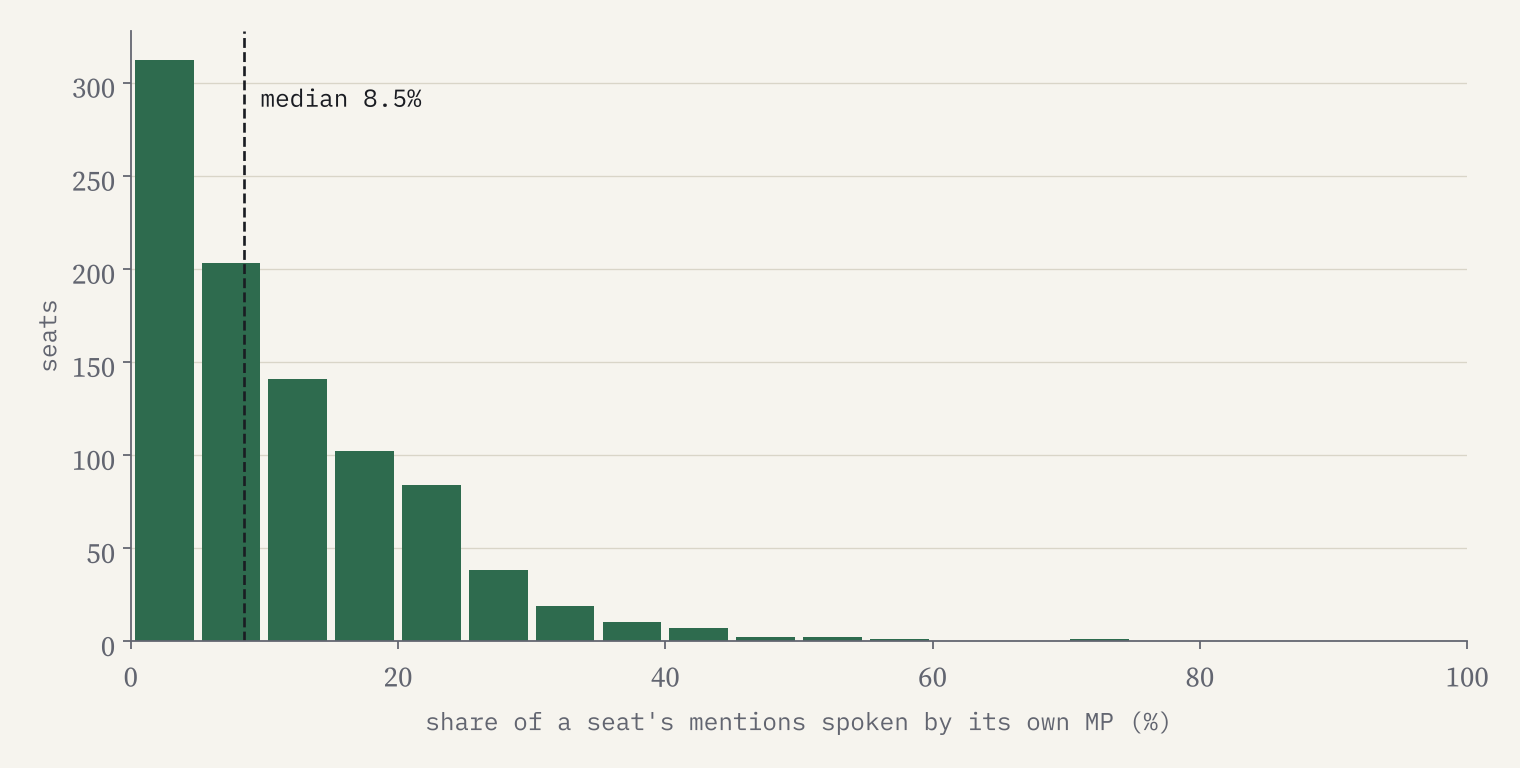
This is a count of words, not a score for anyone. A minister, a whip or the Speaker will speak less for their seat; a seat named often may simply have a member others keep replying to. Strangford is named in the “Member for” form about 246 times a year, the most of any seat.
Reading, Sale and Deal
The hard part is knowing which Reading is meant. “In reading the Bill” is not a town. For 59 names that are also ordinary words, I sampled up to 40 contributions and checked whether the name had a capital letter, then scaled the counts: Bath keeps 88%, Deal 90%, Reading 60%. Sale, at 59%, is left out, as are names like March (nearly always the month), Battle and Stone. Places that share a name (Newport, Bangor, Richmond) and names better known elsewhere (Perth, Boston, Washington, and Salisbury, which was also the capital of Rhodesia) are left out of the rankings too. Every decision is listed in the data.
How I did this
The UK Parliament Hansard API has a timeline search that returns how many Commons contributions match a phrase in each year. I searched for “in” plus each place name, in spoken contributions only, which avoids the “hon. Member for” formula and surnames, and avoids the division lists that the archive files as speech until 2004. Populations come from the 2021 Census for towns in England and Wales and from GeoNames elsewhere. Seats and members come from Parliament’s Members API. The method is described in full in the paper, and all the counts are open, so you can look up your own town.
Notes and sources
- Hansard API, UK Parliament: timeline statistics and contribution search, House of Commons. Contains Parliamentary information licensed under the Open Parliament Licence v3.0.
- Members API, UK Parliament: members and their seats since 2005. Open Parliament Licence v3.0.
- Census 2021 built-up areas, Office for National Statistics. Open Government Licence v3.0.
- GeoNames, cities with 15,000 or more people. CC BY 4.0.
- OS Open Names, Ordnance Survey. Contains OS data © Crown copyright and database right 2026. Open Government Licence v3.0.
- Who won here? Every UK general election since 1832 on one map (constituency points).
I wrote the text, with drafting and editing assistance from Claude (Anthropic), which also helped prepare the analysis code. I reviewed and checked all text and results.

