
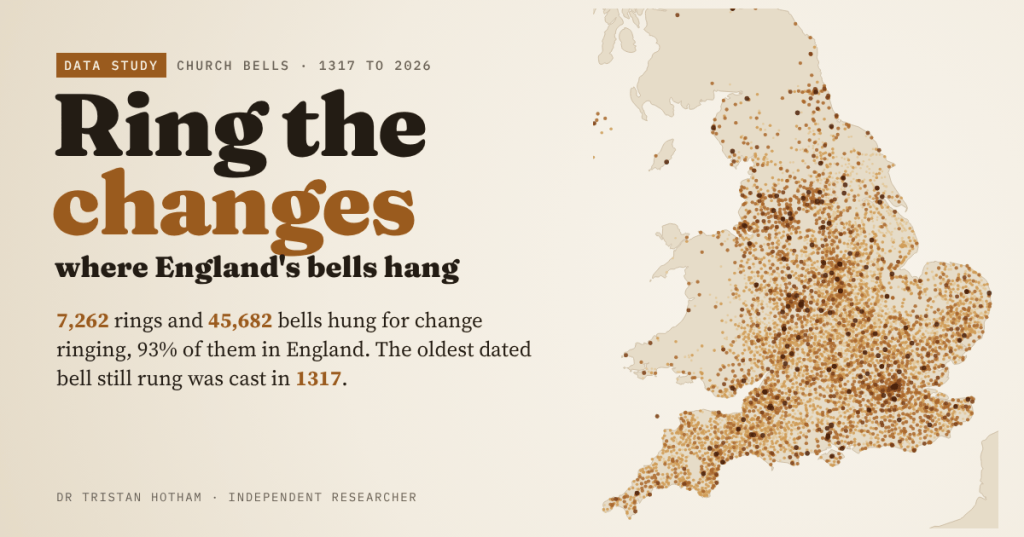
England has a musical instrument that almost nobody else plays: a ring of church bells swung full circle and rung in changes. Dove’s Guide lists 7,262 of them, holding 45,682 bells. I mapped every one, and found jubilees, wars and seven centuries of bell founding written into the dates on the bells.
In the tower of St Denys at Cold Ashby in Northamptonshire hangs a bell dated 1317. It is the fourth of a ring of six, and on practice night it is still swung right round, mouth up, by someone holding a rope in the room below. It is the oldest bell with a cast date in Dove’s Guide that still hangs in a ring.
Full-circle ringing began in England in the early seventeenth century, when ringers found that a bell swung through a whole circle could be held at the balance and timed to a fraction of a second. A band could then change the order of the bells at every pull. By 1668 Richard Duckworth and Fabian Stedman had published the first book of rules, Tintinnalogia. Since 1950 ringers have found their towers with Dove’s Guide, and today the Central Council of Church Bell Ringers publishes it as open data, down to the weight, note, founder and cast date of 45,974 bells. It is a superb record, and this post is what I found in it.
An English art, and a southern one
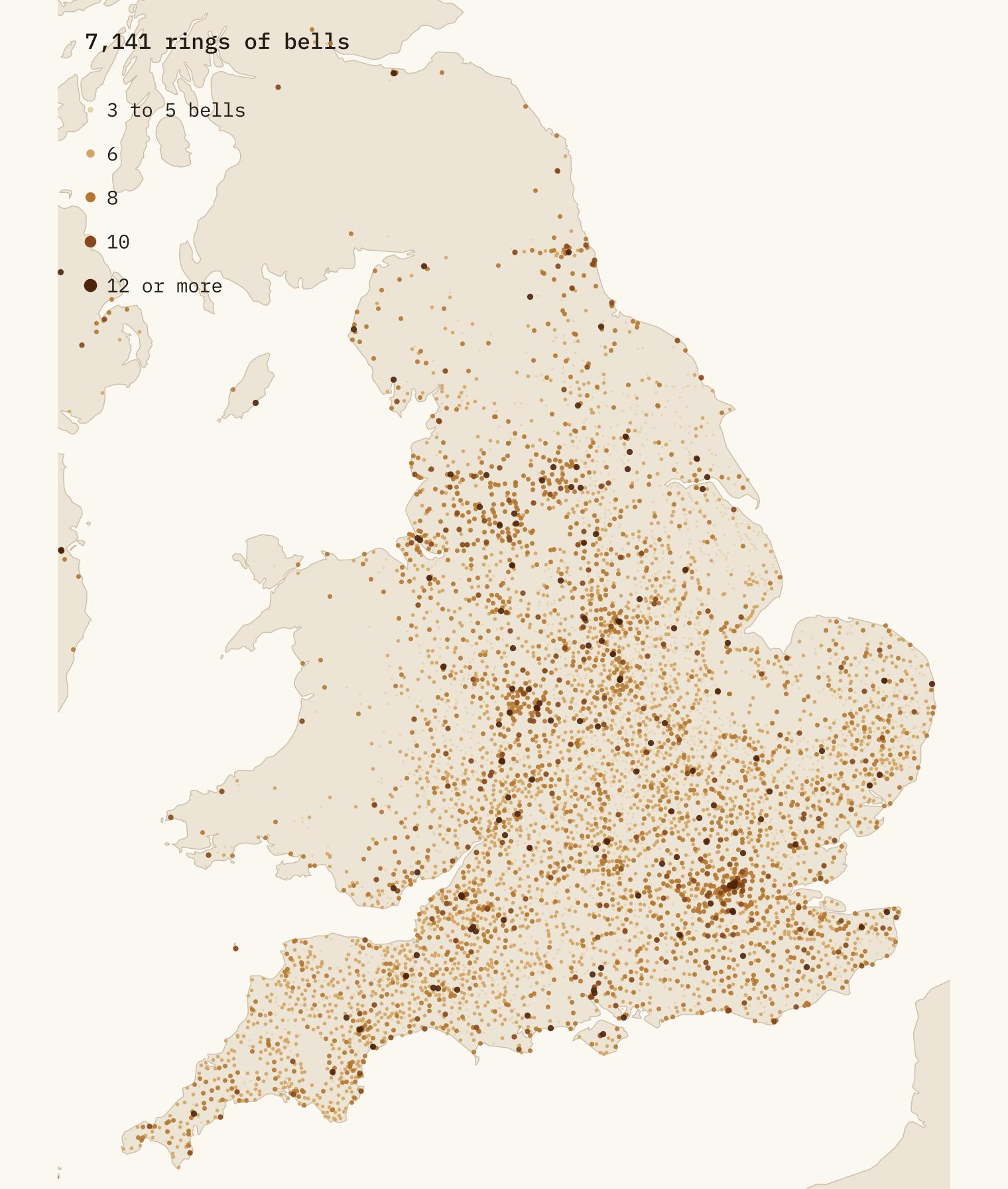
Of the 7,262 rings, 6,779 (93%) are in England. Wales has 230, the island of Ireland 43 and Scotland just 24. Devon has the most of any county (416), then Somerset (386) and Lincolnshire (347). They are packed close: half of the towers in England and Wales are within 2.3 km of another ring.
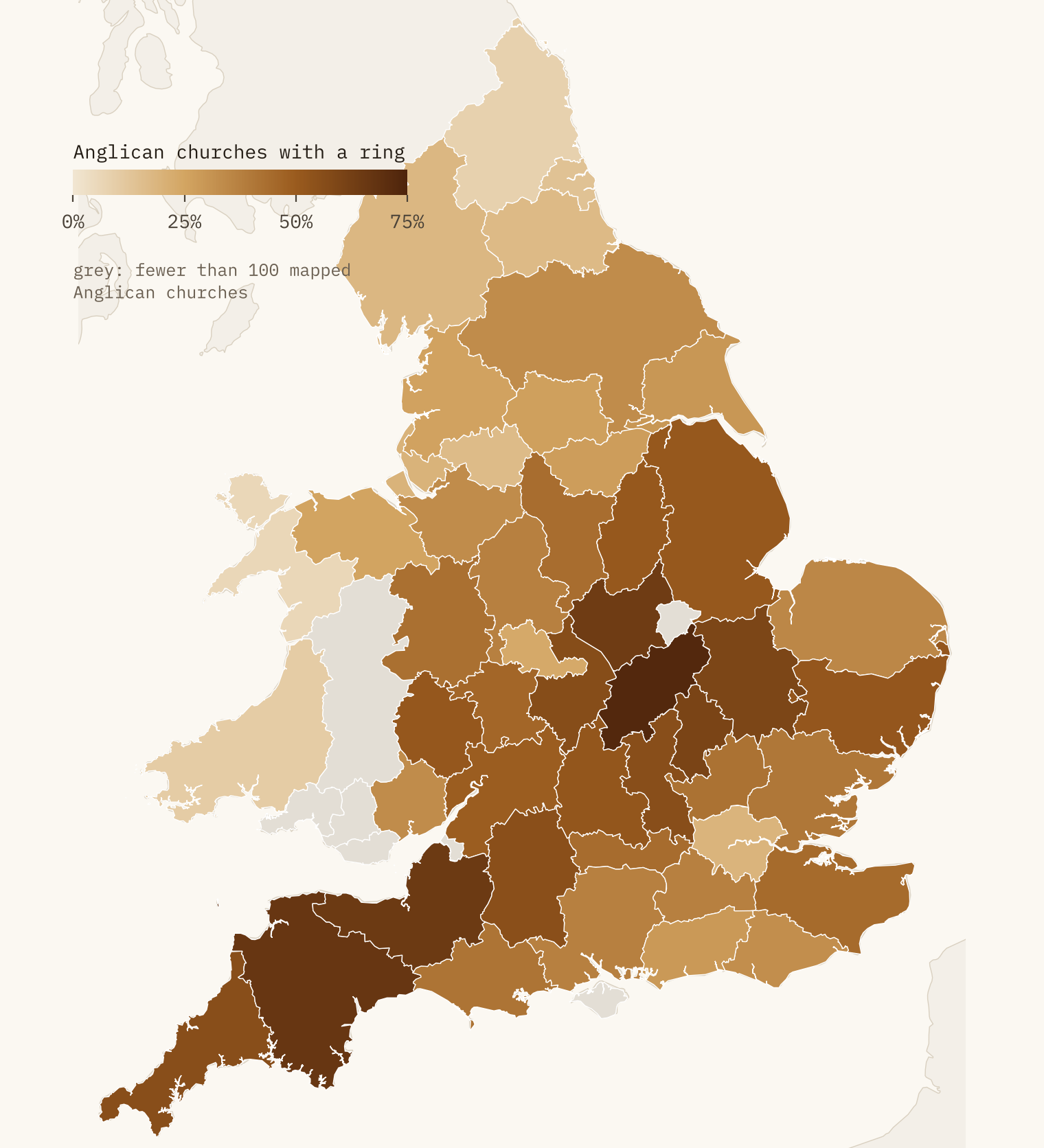
To compare like with like, I matched the rings to the 16,567 Anglican churches that volunteers have mapped in OpenStreetMap. 40% of them have a ring. In Northamptonshire it is 73% and in Devon 67%; in Northumberland it is 8% and in Gwynedd 6%. A village church in the south west or the south Midlands is more likely than not to have a ring. One in the far north or in north Wales almost never does.
Sixes, and the rise of the twelves
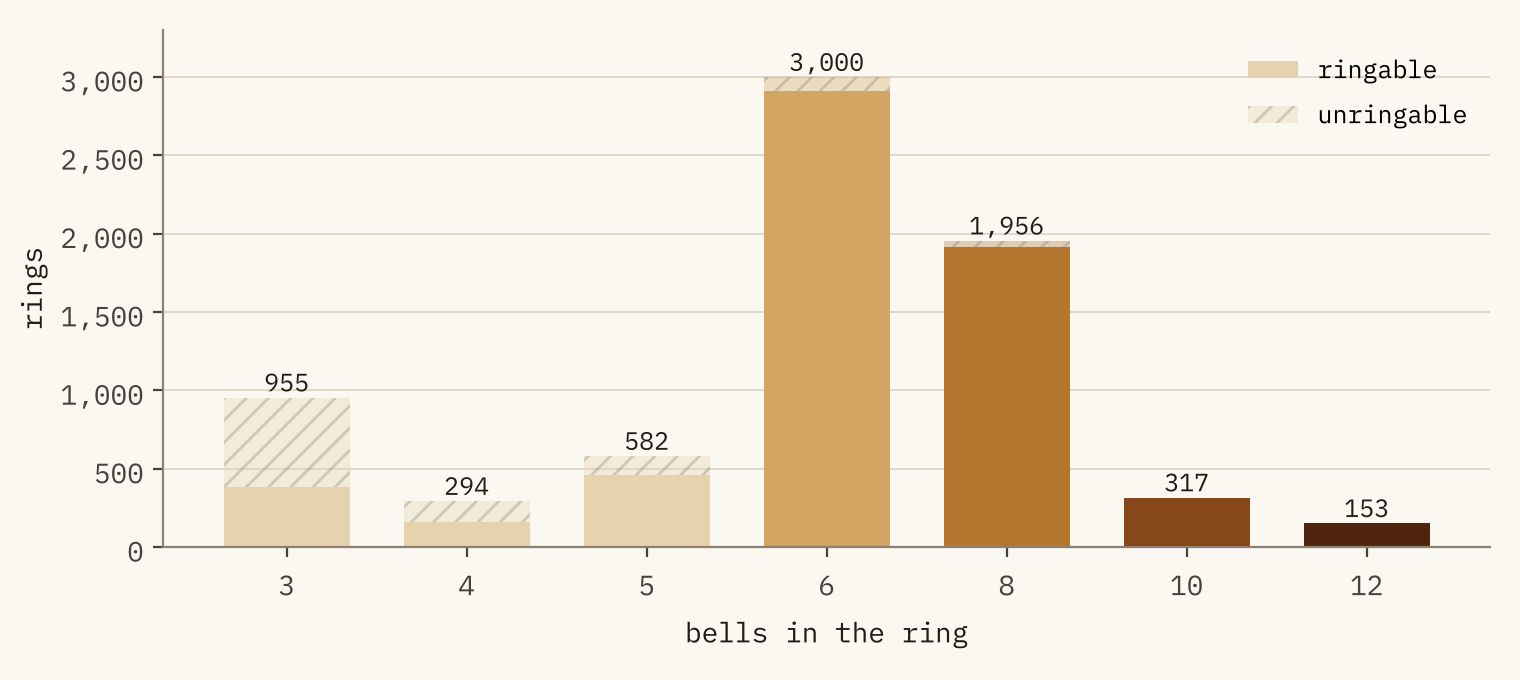
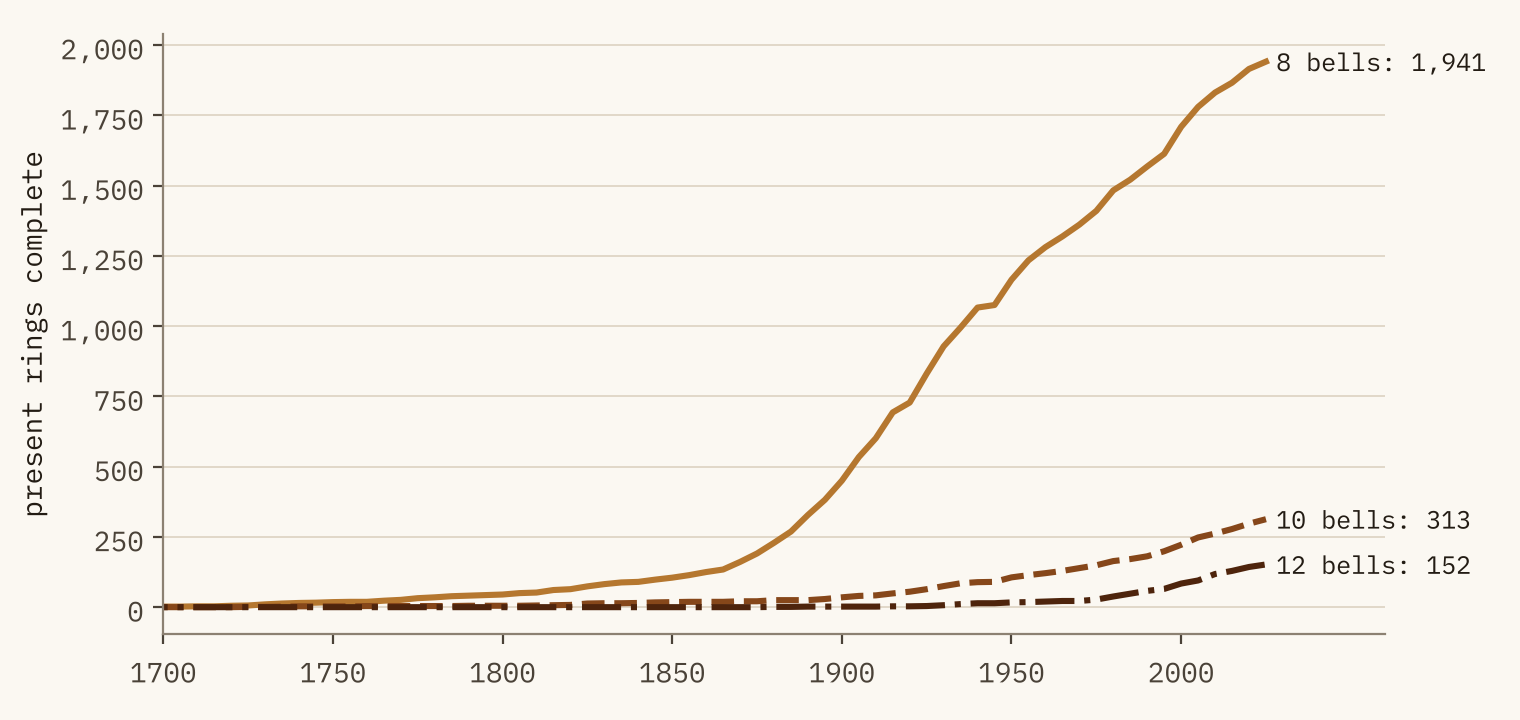
The typical English ring has six bells: 3,000 rings do. There are 1,956 eights, 317 tens and 153 twelves. At the small end the bells are often silent: Dove marks 59% of all rings of three as unringable, against 3.1% of sixes.
The big rings are new. Dove does not record when a ring was augmented, but a ring cannot be older than its newest bell. For the twelves, the median newest bell was cast in 1999, and 89% have a bell cast since 1950. The twelve-bell ring, the summit of the art, is mostly a creation of the last seventy years.
Who cast them
The median bell in a ring was cast in 1876, but 1,376 are medieval. Suffolk has the most (145), then Norfolk, Devon and Somerset. Before 1700 bells came from many small local founders. In the eighteenth century the Rudhalls of Gloucester cast thousands. Then two names took over: the Whitechapel foundry in London and the Taylors of Loughborough. Between them they cast 49% of all the bells now hanging in rings, and 79% of those cast in the twentieth century.
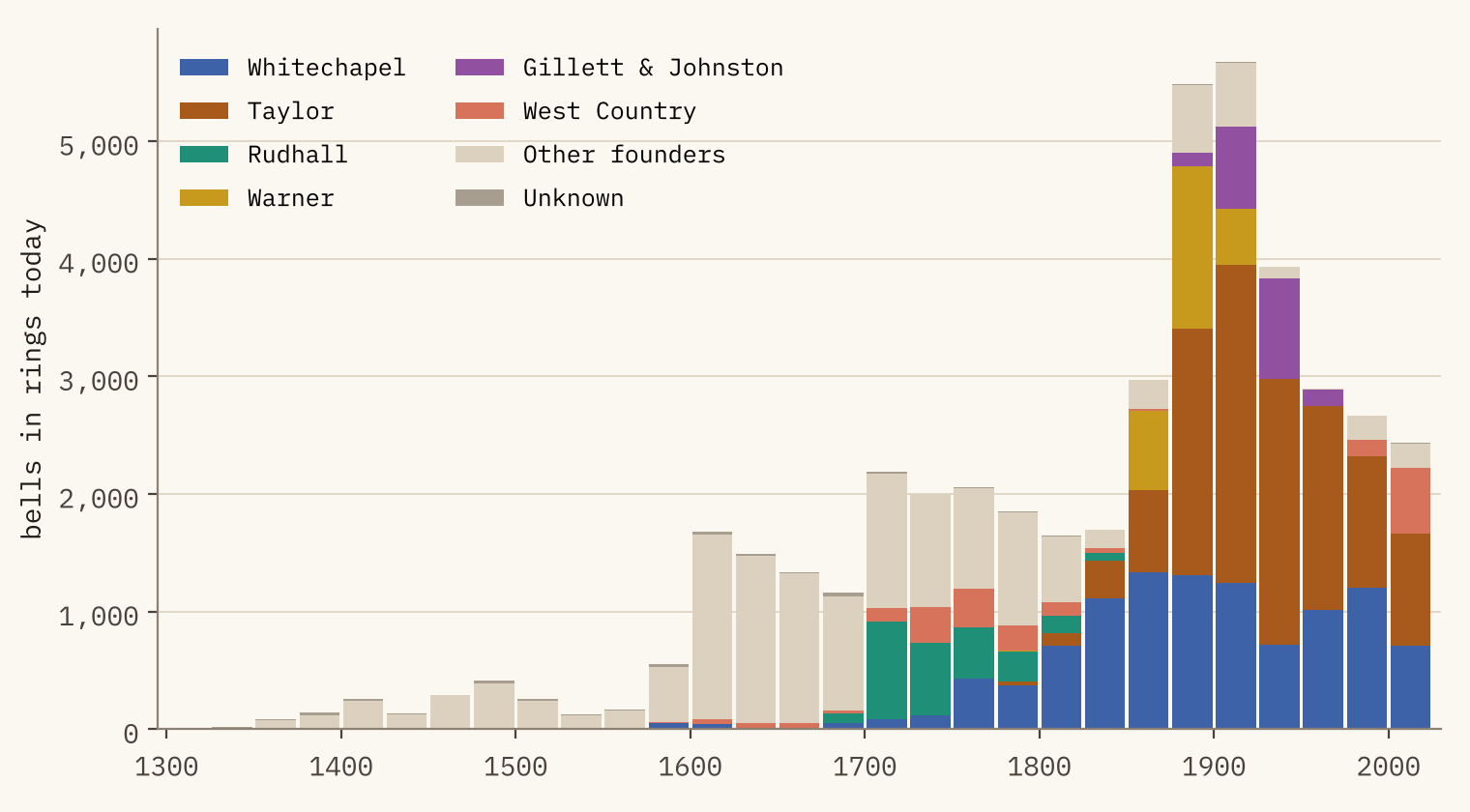
Whitechapel’s last bells in the data are dated 2017, the year the foundry closed. Since 2018, 47% of new bells in rings have come from Taylor’s.
Jubilees and wars
This is the part that surprised me. Count the bells by the year on them and the biggest single year is 1897, with 443 bells: Queen Victoria’s Diamond Jubilee. Second is 1887, her Golden Jubilee, with 388. Each is about twice the years around it. The coronation of George VI in 1937 doubles its neighbours too (314 bells), and 1902 and 1911, the coronations of Edward VII and George V, stand out clearly. Parishes, it seems, marked the nation’s great occasions with new bells.
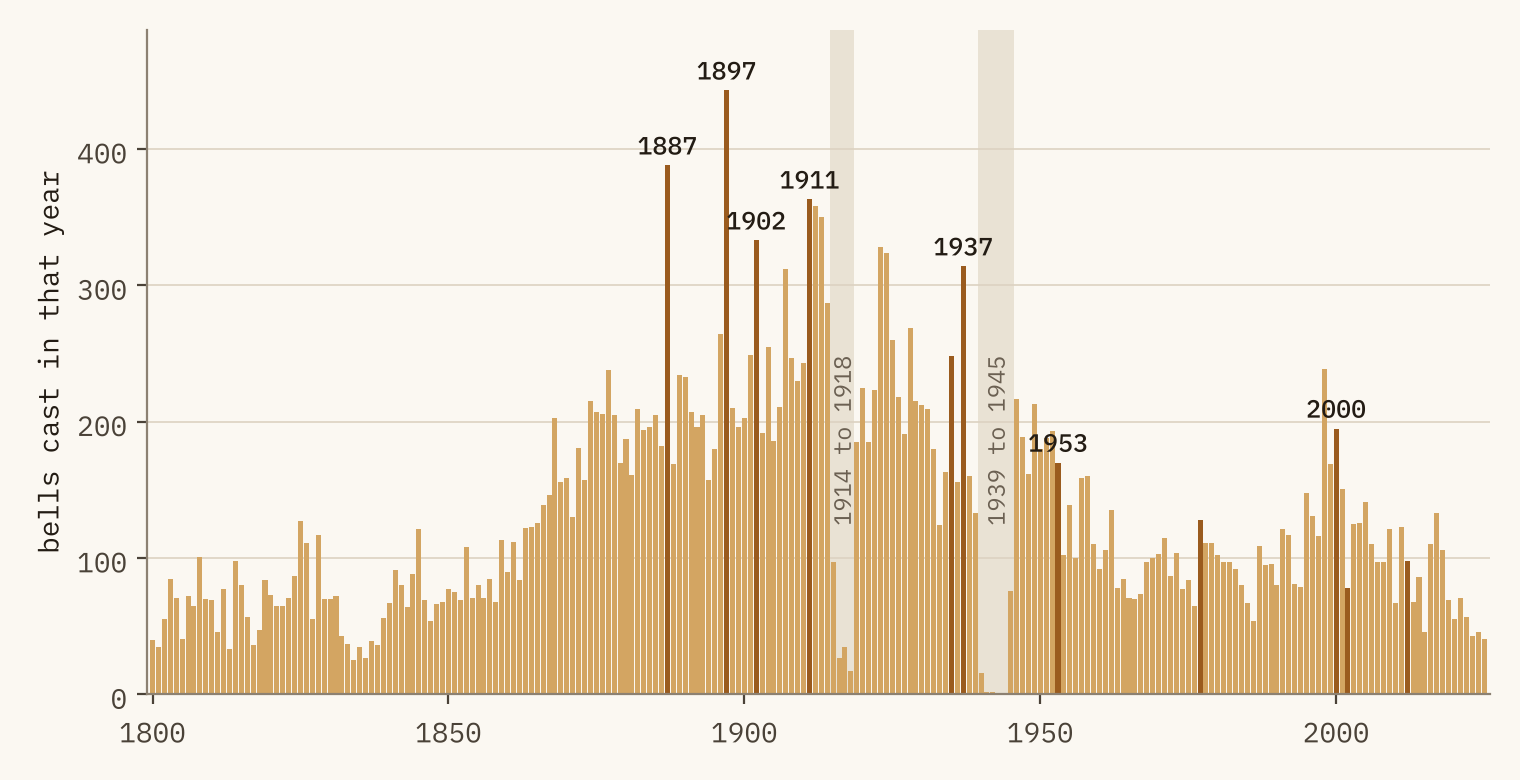
In 1943 and 1944, not one bell that hangs in a ring today was cast.
The wars cut the other way. In 1910 to 1914 an average of 320 surviving bells were cast a year; in 1915 to 1918, 44. In the Second World War the church bells fell silent, to be rung only to warn of invasion, and the record nearly stops: 2 bells in 1941, 2 in 1942, none in 1943 or 1944. Then in 1946, 217. The busiest decade of all was the 1920s, the decade of the war memorials. One honest caution: these are the bells that survive in rings today, not every bell ever cast, so the older years are thinned by recasting.
Beyond England
170 rings hang outside the British Isles: 74 in Australia, 50 in the United States, 12 in New Zealand and 10 in Canada among them. They are mostly big and young. The oldest bell in an American ring was cast in 1744 for the Old North Church in Boston.
How I did this
I downloaded Dove’s rings, bells, founders and frames tables on 28 October 2026, parsed every cast date into a year (single years as dated, “c” dates as approximate, ranges at their midpoint), grouped founders into the foundry families Dove itself defines, and placed each ring in a county with ONS boundaries. For the churches I counted an OpenStreetMap Anglican church as having a ring if a Dove ring lies within 150 metres. Everything is descriptive. Dove records the bells that exist now, so the past is seen through what survived, and an untagged church in OpenStreetMap is simply missing from the shares. The interactive version has a map of every tower with its practice night, a search for any town or village, and the full charts.
Notes and sources
- Bell data: Dove’s Guide for Church Bell Ringers, Central Council of Church Bell Ringers, dove.cccbr.org.uk, CC BY-SA 4.0. Changes were made (cleaning, parsed cast dates, summaries, counties). This post is not endorsed by the Central Council. My derived data are released under CC BY-SA 4.0.
- Churches: © OpenStreetMap contributors (ODbL), counts only. County boundaries: Office for National Statistics; place search: OS Open Names; contains OS data © Crown copyright and database right 2026, Open Government Licence v3.0.
- History: Wikipedia, Change ringing, Church bell, Whitechapel Bell Foundry, John Taylor & Co and Dove’s Guide for Church Bell Ringers (CC BY-SA 4.0).
- Paper, data and code: Zenodo and GitHub. Related: Saints and wells.
- I wrote the text, with drafting and editing assistance from Claude (Anthropic), which also helped prepare the analysis code. I reviewed and checked all text and results.

