
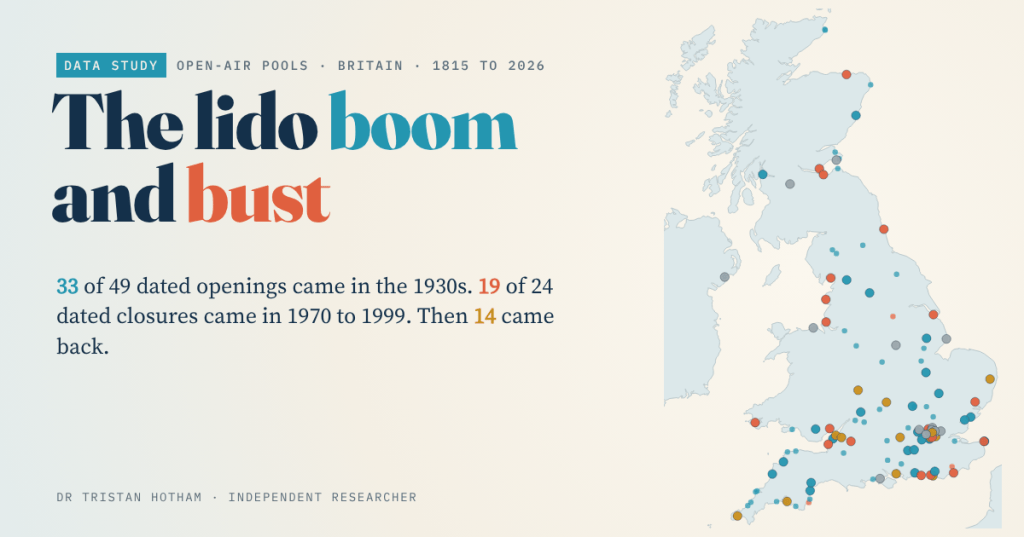
In the 1930s British towns built lidos the way they had once built town halls. From the 1970s they closed them by the score. Then, against the odds, some came back. I built an open register of every lido I could document and followed each one from opening day to today.
On 31 May 1935, Penzance opened a triangular sea-water pool on Battery Rocks, below the town, as part of the celebrations for George V’s Silver Jubilee. By August almost 60,000 people had been through the turnstiles. Jubilee Pool closed in 1992, reopened in 1994, was wrecked by storms in 2014, reopened again in 2016, and is now warmed by a geothermal well drilled into the rock beneath it.
That is the British lido story in one pool: a boom, a long decline and a stubborn comeback. Everybody knows the outline. Wikipedia says 169 lidos were built in the 1930s, that “hundreds” have closed and that 127 remain open in England. But there is no open list of lidos with dates that lets you check any of it. So I made one.
My register holds 73 lidos and open-air pools whose dates or fate I could document from open sources: English Wikipedia articles on lidos and on seaside towns and parks, Wikidata, and OpenStreetMap. Every entry carries a short quotation and a link to where it came from. On top of that I mapped every working open-air pool, lido and tidal pool that OpenStreetMap’s volunteers have tagged.
One decade built most of them
Outdoor bathing places are older than the word lido. Cleveland Pools in Bath date from 1815, and Clifton’s Victoria Baths in Bristol opened in 1850. The word itself probably came into English through “Lansbury’s Lido”, the newspapers’ nickname for the Serpentine bathing place in Hyde Park after it was revamped in 1930.
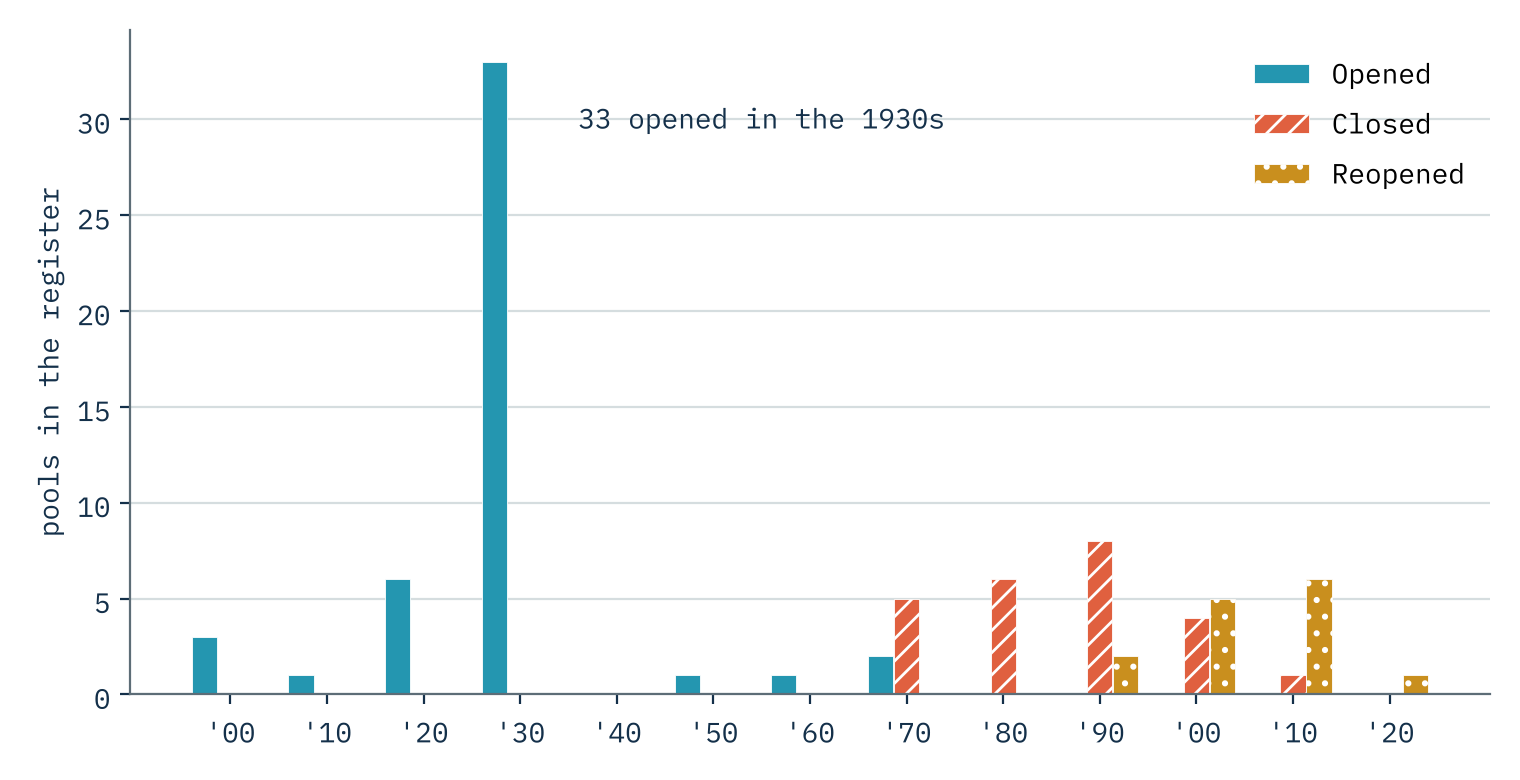
Then came the rush. Of the 49 pools in my register with a documented opening year or decade, 33 (67%) opened in the 1930s. Nine opened in 1935 alone, among them Jubilee Pool, Tinside in Plymouth, Hilsea in Portsmouth and Sandford Parks in Cheltenham. London County Council built 13 lidos between 1920 and 1939. New Brighton’s, opened in 1934, was the largest lido in Britain when it was built. Finchley Lido once took 11,962 swimmers in a single day.
Three decades of closures
The register has a closing date for 24 pools. 19 of them closed between 1970 and 1999, and the 1990s were the worst decade, with 8. The pools that closed had typically been open for 61 years. The sources blame cheaper foreign holidays, council cost-cutting, ageing pumps and plain neglect; at Cleethorpes in 1978 and New Brighton in 1990 the sea did the job.
Put the dates together and you can count how many of the documented pools were open each year. The number peaked at 37 in 1962 and bottomed out at 22 in 2002, with 17 standing empty.
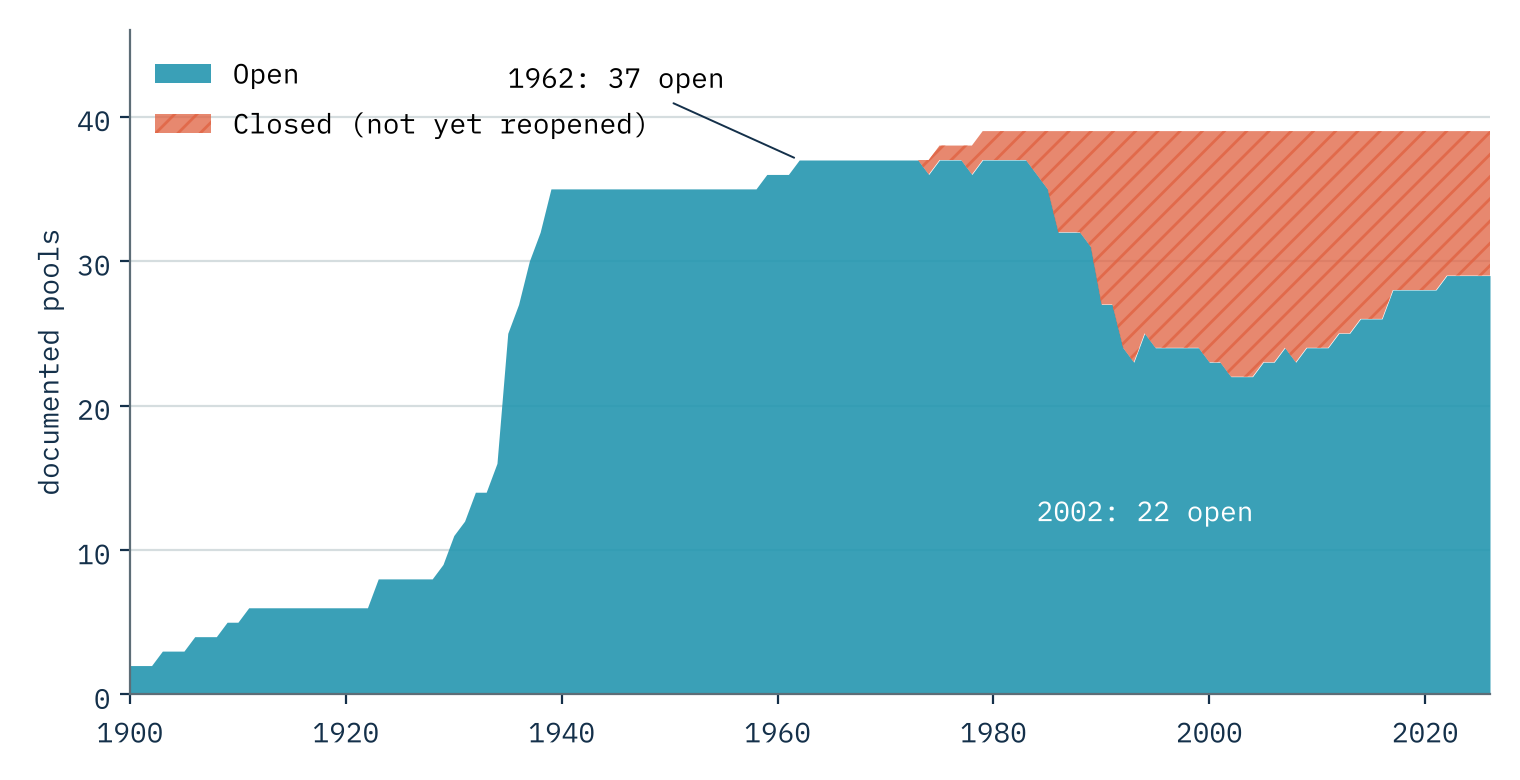
That curve is, if anything, too kind. A pool demolished in 1975 rarely gets a Wikipedia article; a rescued, listed one nearly always does. The real decline was certainly deeper than my sample can show.
The comeback
This is the part I did not expect to be so clear. Of the 33 pools in the register that closed at some point and whose fate I know, 14 have reopened. Only two of those comebacks happened before 2000: Brockwell and Jubilee Pool, both in 1994. The rest came after, and the typical pool was shut for 7 years first. Reading’s Thames Lido, an Edwardian ladies’ pool, closed in 1974 and reopened 43 years later.
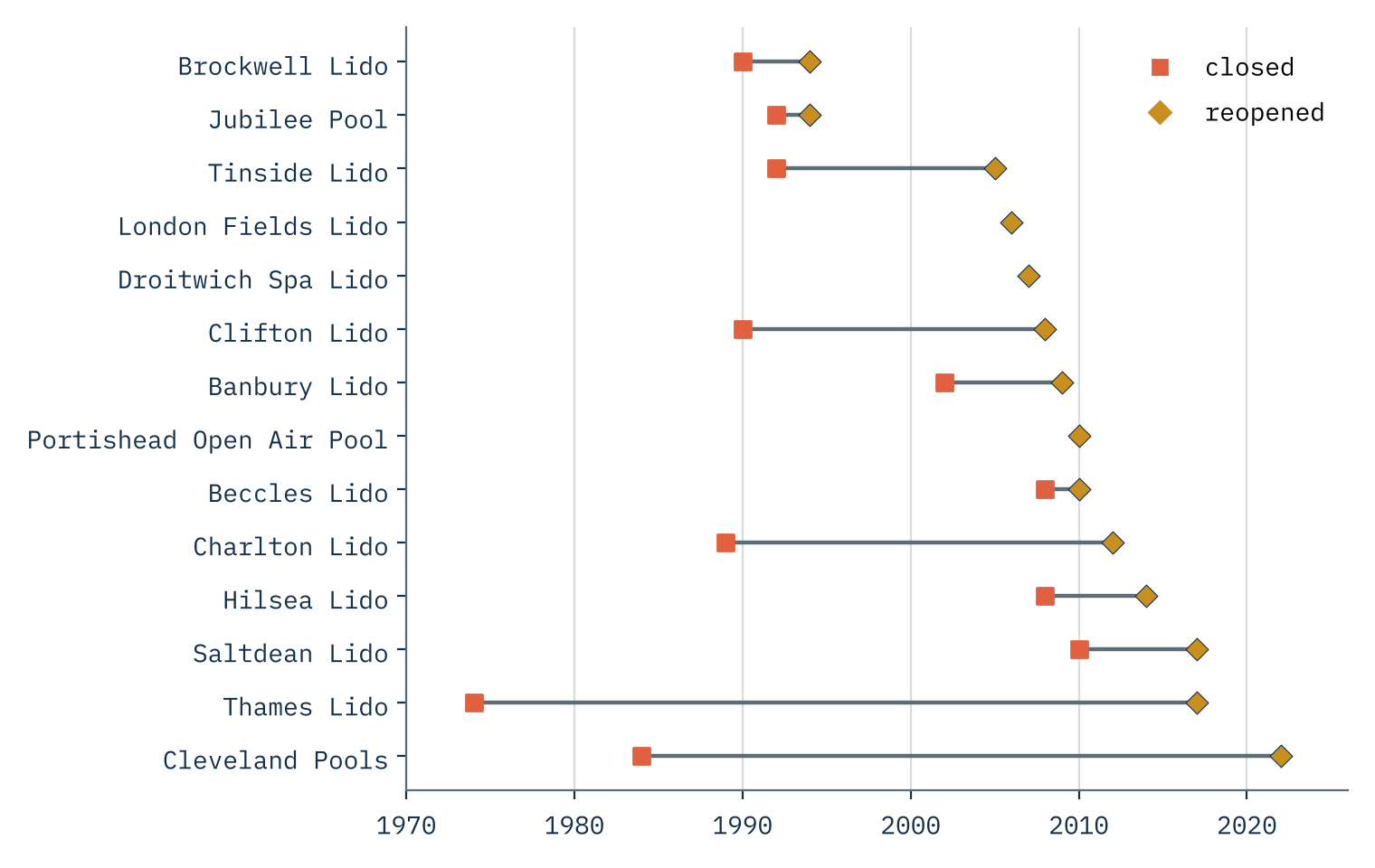
Behind most of these are campaigns with names like Save a Lido Today, the Brockwell Lido Users and the Friends of Beccles Outdoor Pool. Many pools are now run by trusts, community companies or, at Penzance, about 1,400 local shareholders. It is not a finished story: Cleveland Pools closed again after floods in January 2024, and Brockwell’s operator went into administration in April 2026.
Of the documented lidos that closed, 42% have come back, and almost all of them since 2000.
Where you can still swim outdoors
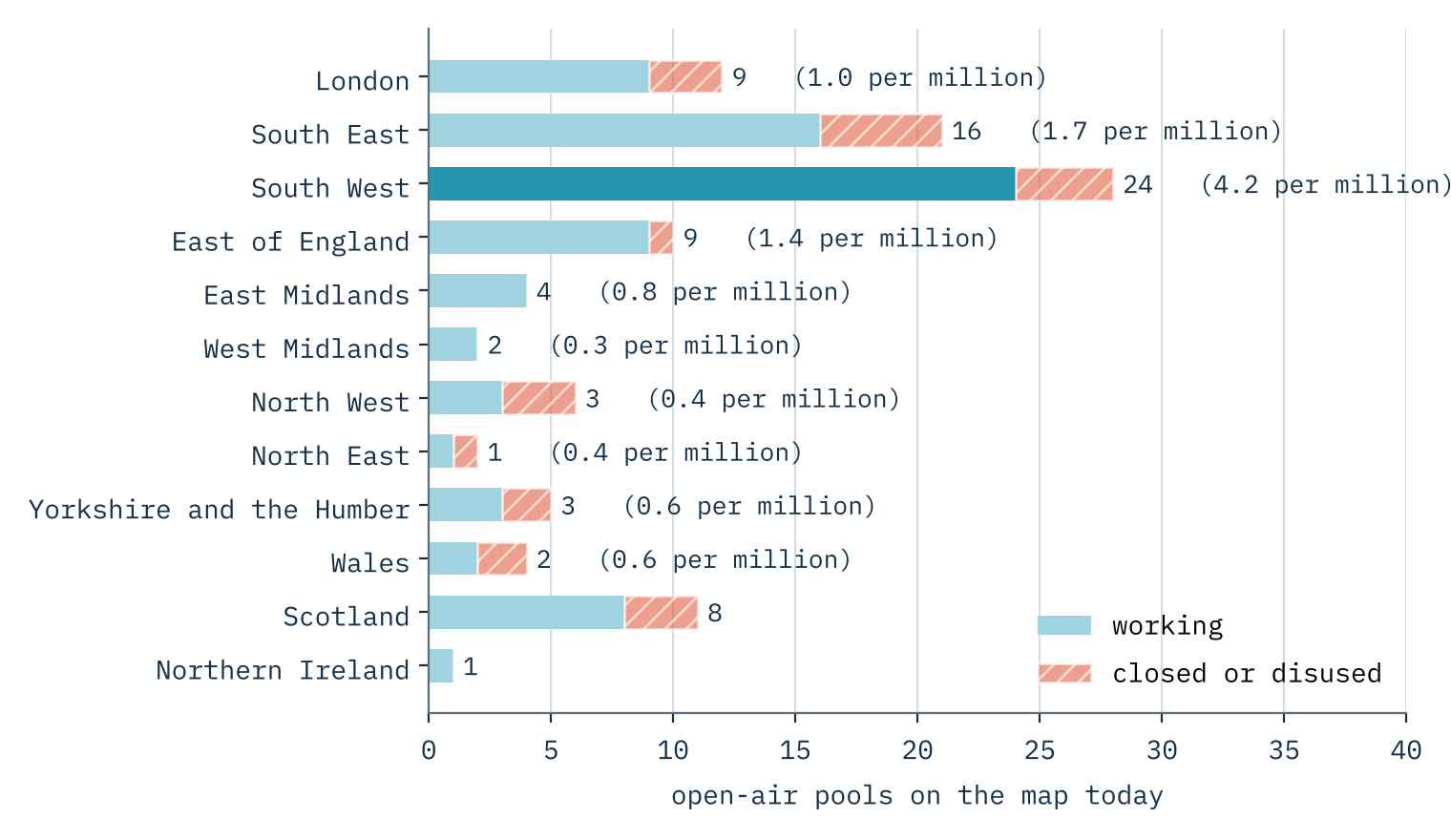
Combining the register with OpenStreetMap, I can place 82 working open-air pools, lidos and tidal pools in the UK. That is a floor, not a count: it finds 71 in England against the 127 Wikipedia gives. But the pattern is plain. 60% are in London, the South East and the South West, and 44% are within 2 km of the sea.
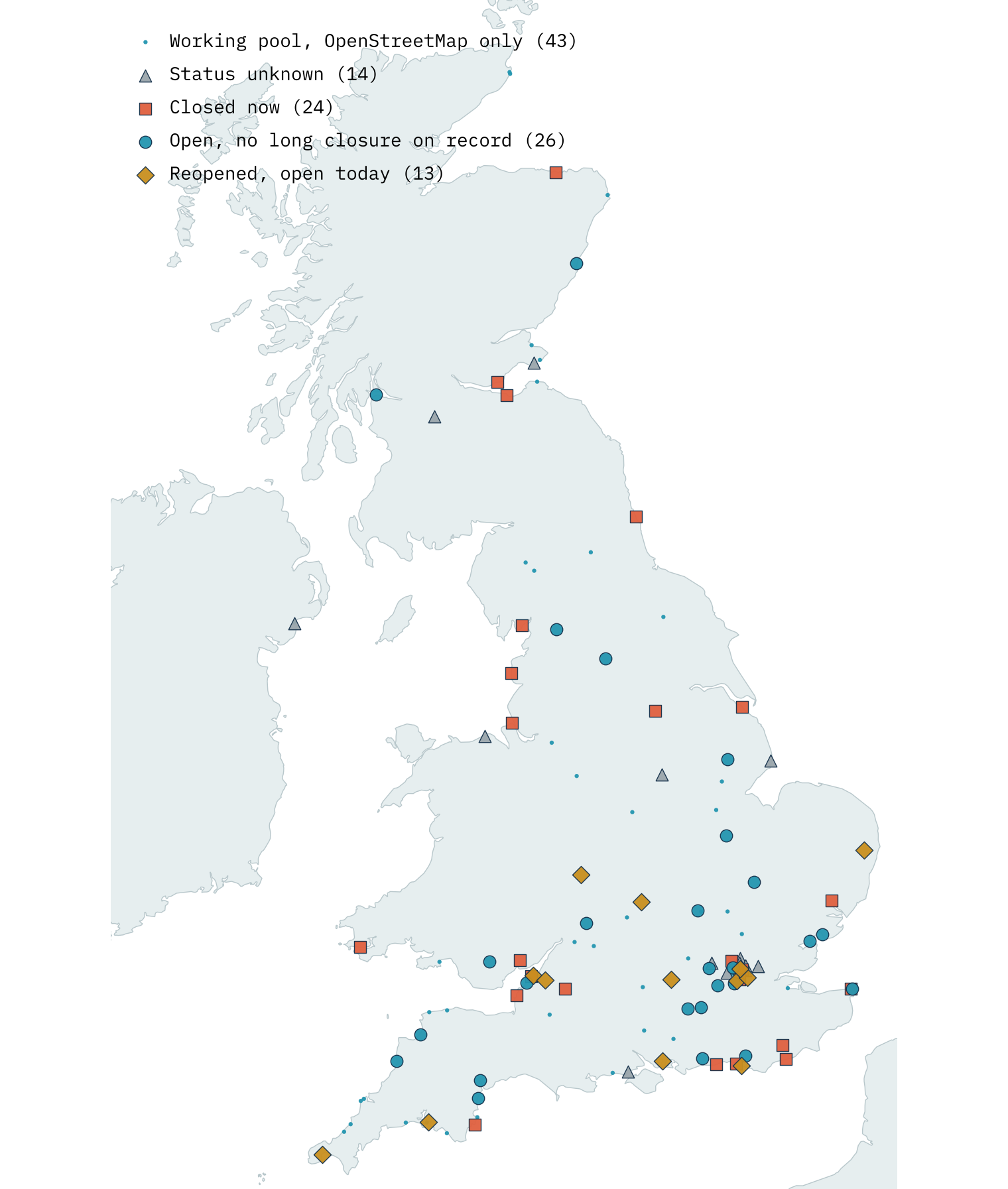
The South West leads by a distance, with 24 pools, 4.2 per million people, and that is mostly the sea. OpenStreetMap tags 12 working tidal and sea pools, basins on the shore that the tide refills, and 6 are in Cornwall: Bude, Chapel Rock at Perranporth, Millendreath, Porthtowan, Treyarnon and Trevone. The three northern English regions, by contrast, have 7 working pools on my map between them.
How I did this
I searched 1,083 English Wikipedia articles for lidos, open-air pools, bathing pools and tidal pools, read every mention, and wrote down each pool’s opening, closing and reopening years with a quotation as evidence. Wikidata and OpenStreetMap tags added positions and a few dates. “Closed” means the closure after which a pool stood empty longest. Separately, I took every OpenStreetMap feature named or tagged as an open-air pool, lido or tidal pool, dropped the cafés, car parks, streets and hotel pools, and merged features within 400 m.
The big caveat: this is a documented sample, not a census. It holds only about 20% of the 1930s lidos said to have been built, and it leans towards survivors. Trust the timing (when pools opened and closed) more than the shares. If you know a lido that is missing, the data are open and I would love to add it.
Notes and sources
- English Wikipedia, History of lidos in the United Kingdom, Lido (swimming pool) and the articles on individual lidos, towns and parks linked from each entry in the register (CC BY-SA 4.0), retrieved October 2026.
- Wikidata (CC0).
- OpenStreetMap, © OpenStreetMap contributors, Open Database Licence, via QLever.
- OS Open Names, Ordnance Survey, Open Government Licence v3.0. Contains OS data © Crown copyright and database right 2026.
- Census 2021, Office for National Statistics, Open Government Licence v3.0. Coastline: Natural Earth.
- Janet Smith, Liquid Assets: the lidos and open air swimming pools of Britain (English Heritage, 2005), the standard history, was not used as data because it is not open.
- I wrote the text, with drafting and editing assistance from Claude (Anthropic), which also helped prepare the analysis code. I reviewed and checked all text and results.

