
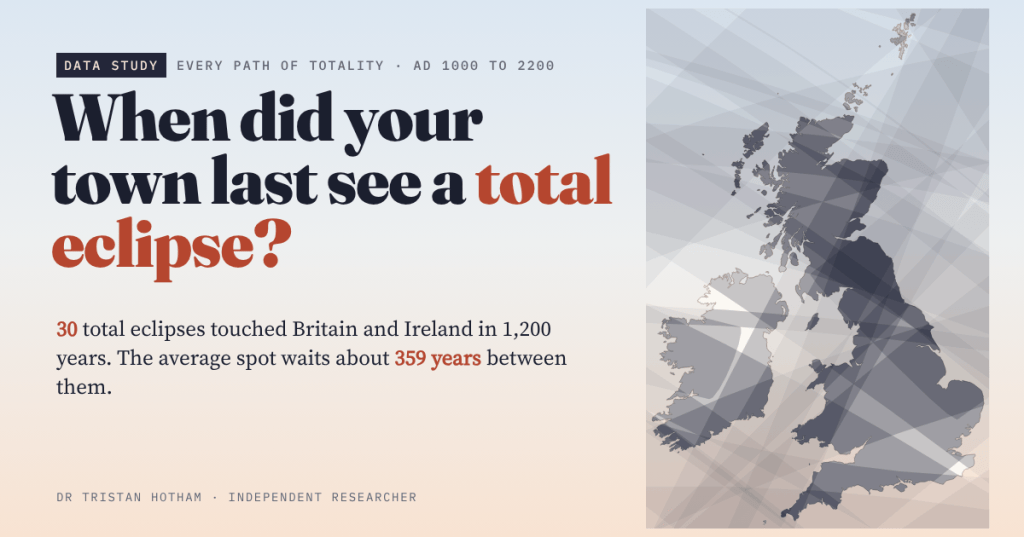
London has seen one total eclipse of the Sun in 1,200 years. I worked out every path of totality across Britain and Ireland from AD 1000 to 2200 and tested 17,103 places one by one, to find when your town last went dark, and when it will again.
On the morning of 3 May 1715 the sky over London went dark for about three and a half minutes. Edmond Halley had predicted it, and had a map printed showing where the shadow of the Moon would fall. It was a sensation. It was also, on my calculation, the only total eclipse London sees between AD 1000 and 2200.
I wanted to know what that looks like for everywhere else. So I took an open-source astronomy library, worked out the positions of the Sun and Moon for all 2,850 solar eclipses in those twelve centuries, and checked, second by second, which ones put each of 17,103 cities, towns and villages in Britain and Ireland into the Moon’s shadow. The answer for your own town is one search away in the interactive version.
Thirty shadows
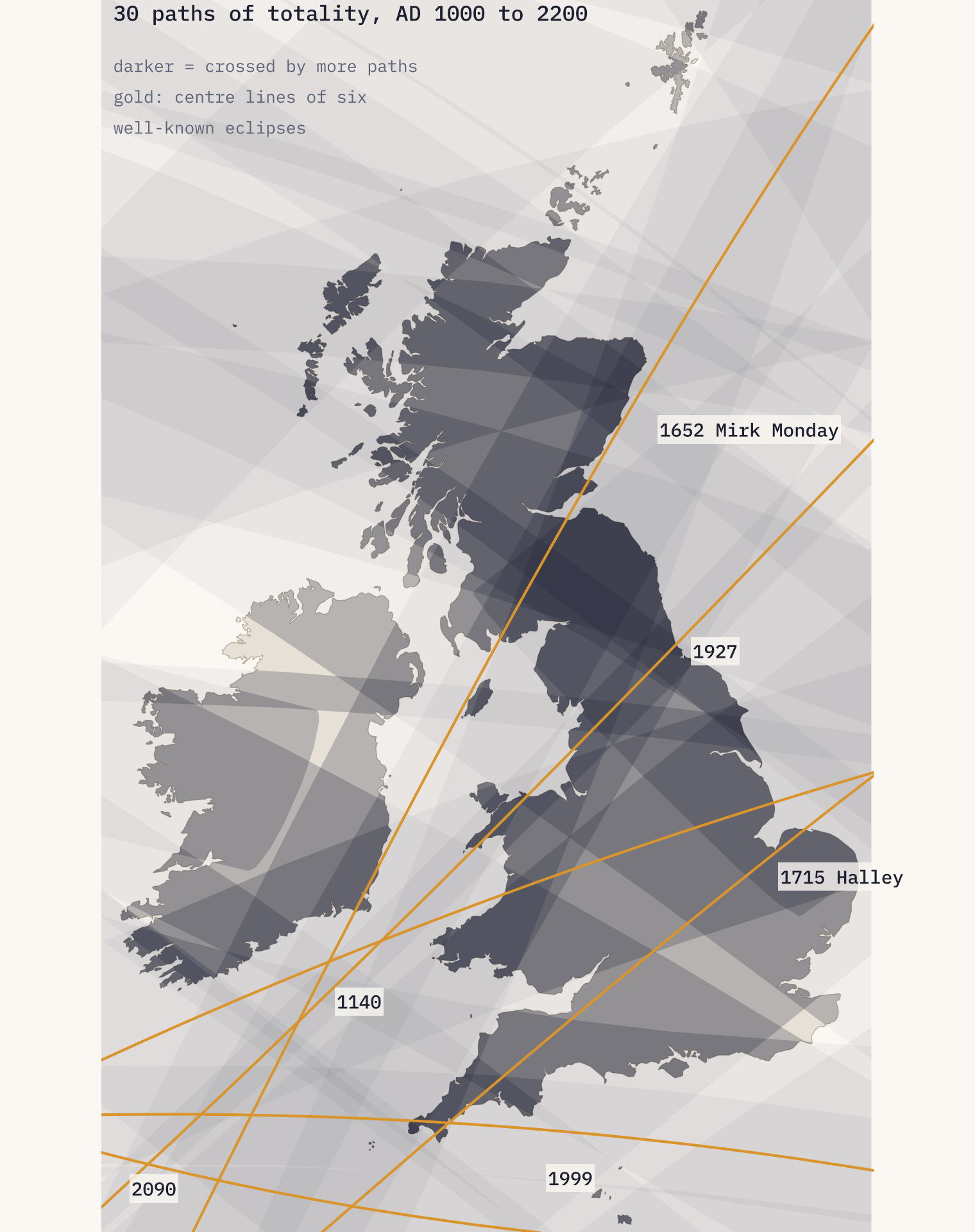
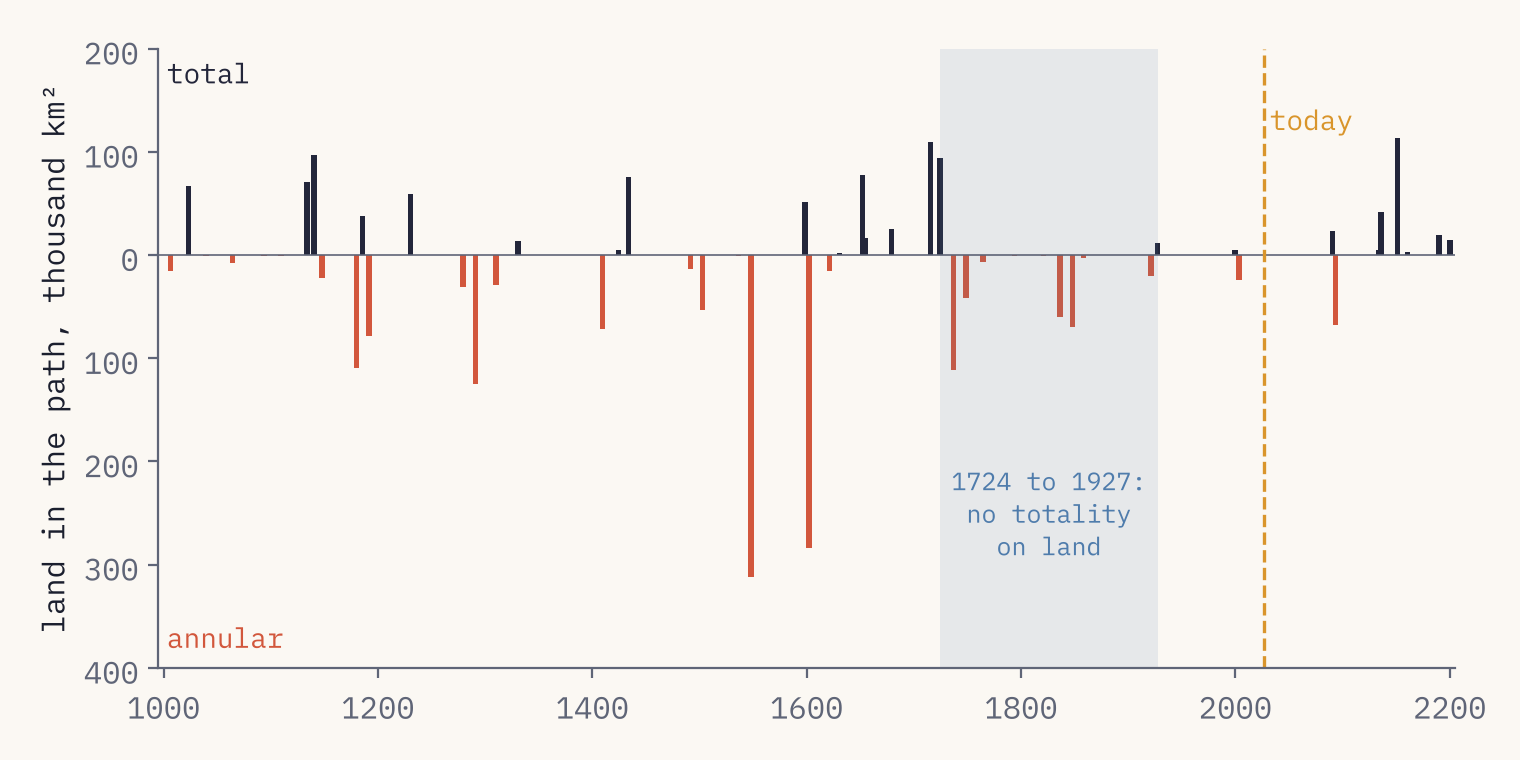
Between AD 1000 and 2200, 30 total eclipses touch land somewhere in Britain, Ireland, the Isle of Man or the Channel Islands: 21 before today and 9 still to come. Another 30 are annular, when the Moon is a little too far away to cover the Sun and leaves a ring of fire.
They do not arrive evenly. Halley’s eclipse of 1715 was followed nine years later by another, which crossed Galway, Wales and the south of England at sunset. Then nothing. No path of totality touched land here for 203 years, until a sliver of shadow crossed North Wales, Lancashire and Yorkshire for about 24 seconds early on 29 June 1927. The whole nineteenth century had none. The twenty-second century will have 7.
Once every 359 years
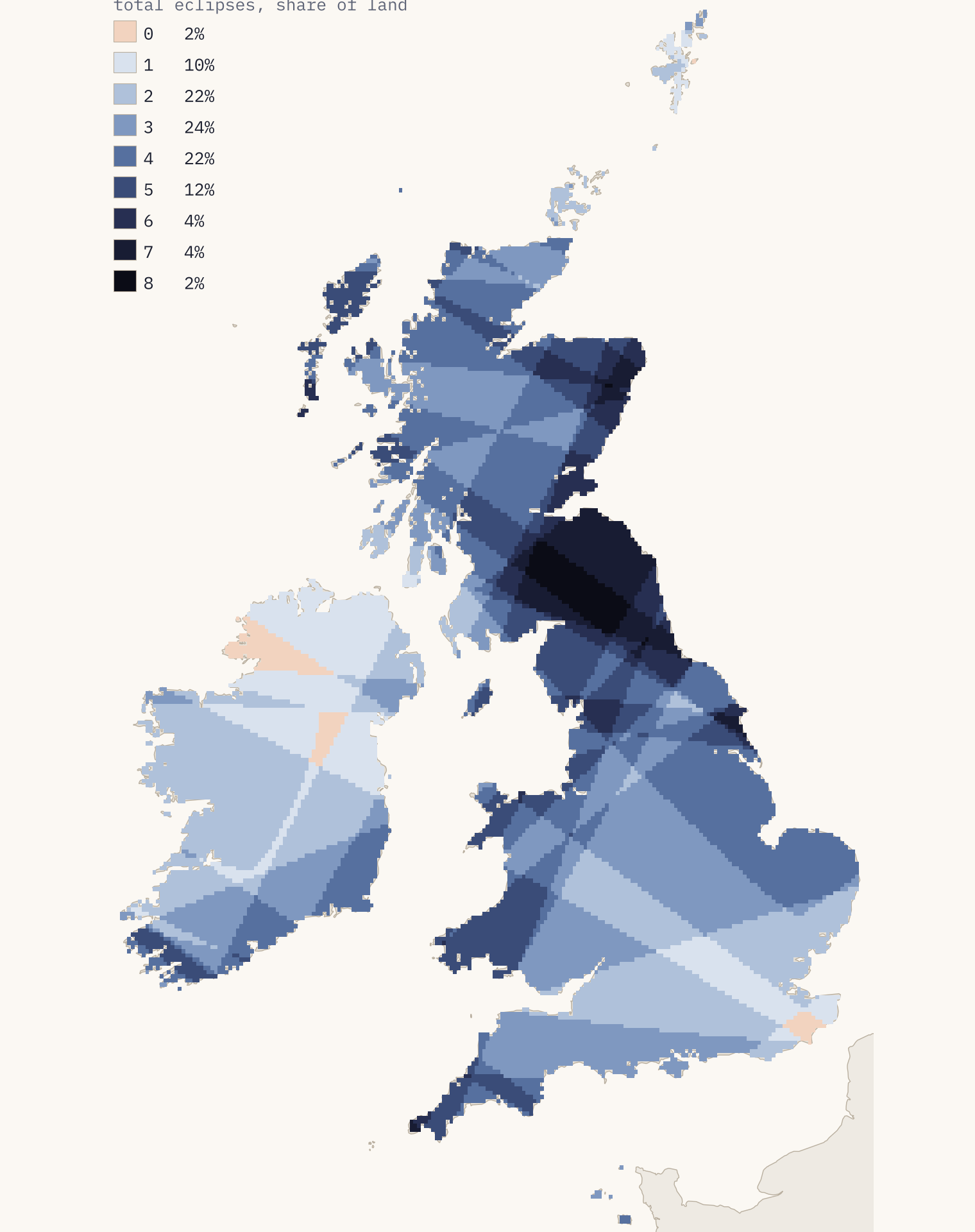
The Moon’s shadow is a narrow strip, so any one spot waits a long time. Averaged over the land, I get 3.3 total eclipses per spot in 1,200 years, or one every 359 years. That is close to the figure of about 375 years often quoted for the world as a whole, which is reassuring.
But luck varies. The towns with the most, 8 each, are Kintore, Moffat, Biggar, Hawick, Langholm and Haltwhistle. 15 towns get none at all: the corner of Kent around Tenterden, Hythe, Lydd and New Romney, and a belt across south Ulster and the Irish border counties, including Omagh, Dromore and Castlederg. The longest wait is 1,011 years, from 1140 to 2151, for 68 towns around Manchester. And some towns in the north-east of Scotland, such as Elgin and Fraserburgh, had two in two years, in 1652 and 1654.
For 54% of towns, the last total eclipse was in 1715 or 1724.
Your last eclipse was probably in 1715
Because those two big eighteenth-century eclipses covered so much ground, and almost nothing followed, they are the last totality for 981 of the 1,819 cities and towns, 54%. Only 161 had one in the twentieth century. The median town has waited 311 years. Edinburgh, Glasgow, Belfast and Dublin last saw one in 1652, on what Scots called Mirk Monday.
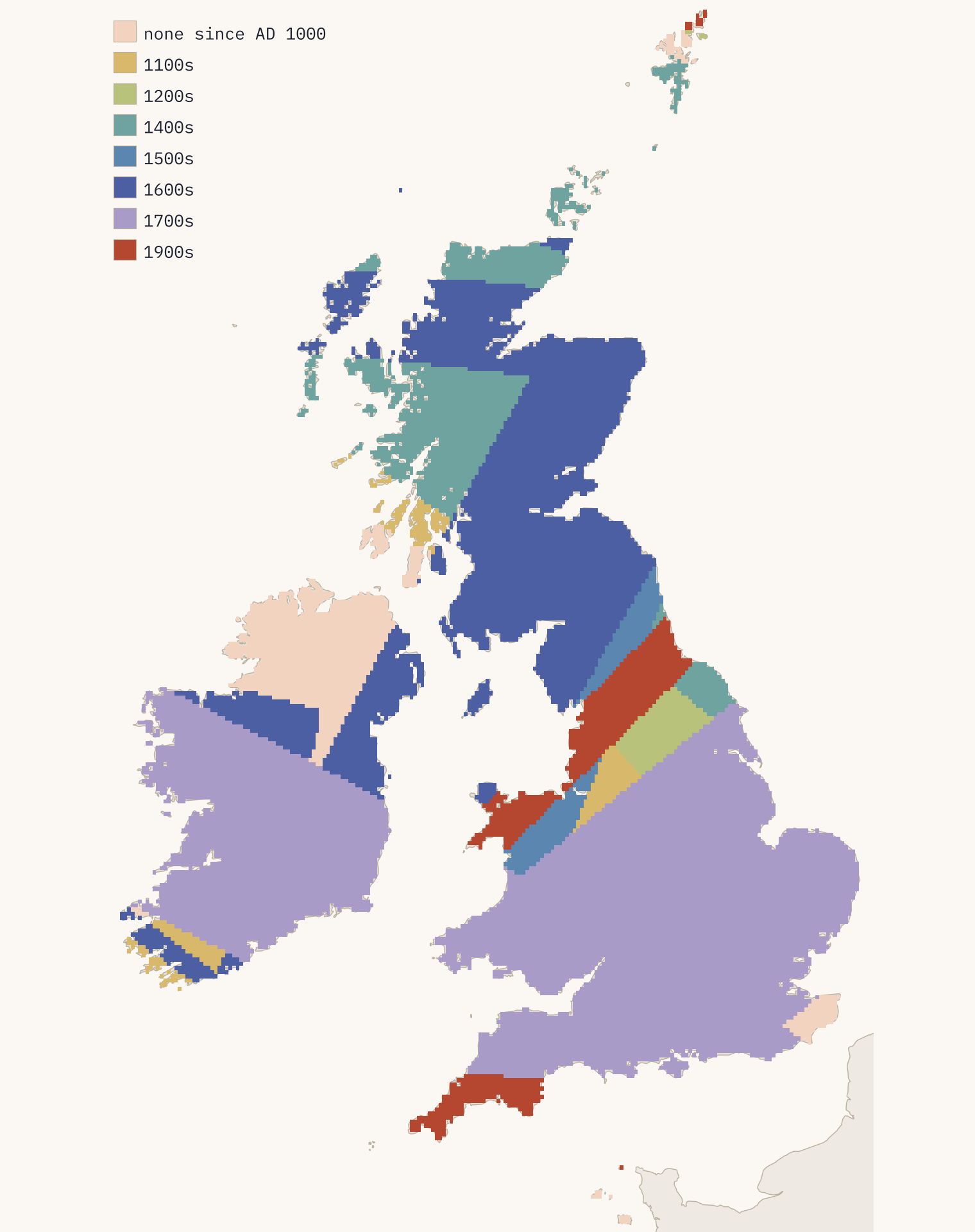
Looking ahead, the next on the mainland is on 23 September 2090, late in the afternoon, across south-west Ireland, Cornwall, Devon, Dorset, Hampshire and the Isle of Wight. For 165 towns that is the next one. The big one is 14 June 2151, which will cover more land than any other in the window, 113,350 km², from Northern Ireland and the Isle of Man across northern and eastern England. But 660 towns, 36%, will see none before 2200. London is one of them.
Does the maths match history?
I checked the calculation against eclipses people actually saw. London in 1715 comes out at 3 min 21 s of totality against a recorded 3 minutes 33 seconds. Southport in 1927 comes out at 25 s, against an observer’s “memorable 23 seconds”. Plymouth in 1999 comes out at 1 min 48 s against a published 1 minute 42 seconds. I also find 30 of the 31 eclipses in the standard British list, and a few it does not mention, including a big total over the Hebrides and the north of Scotland in 1185.
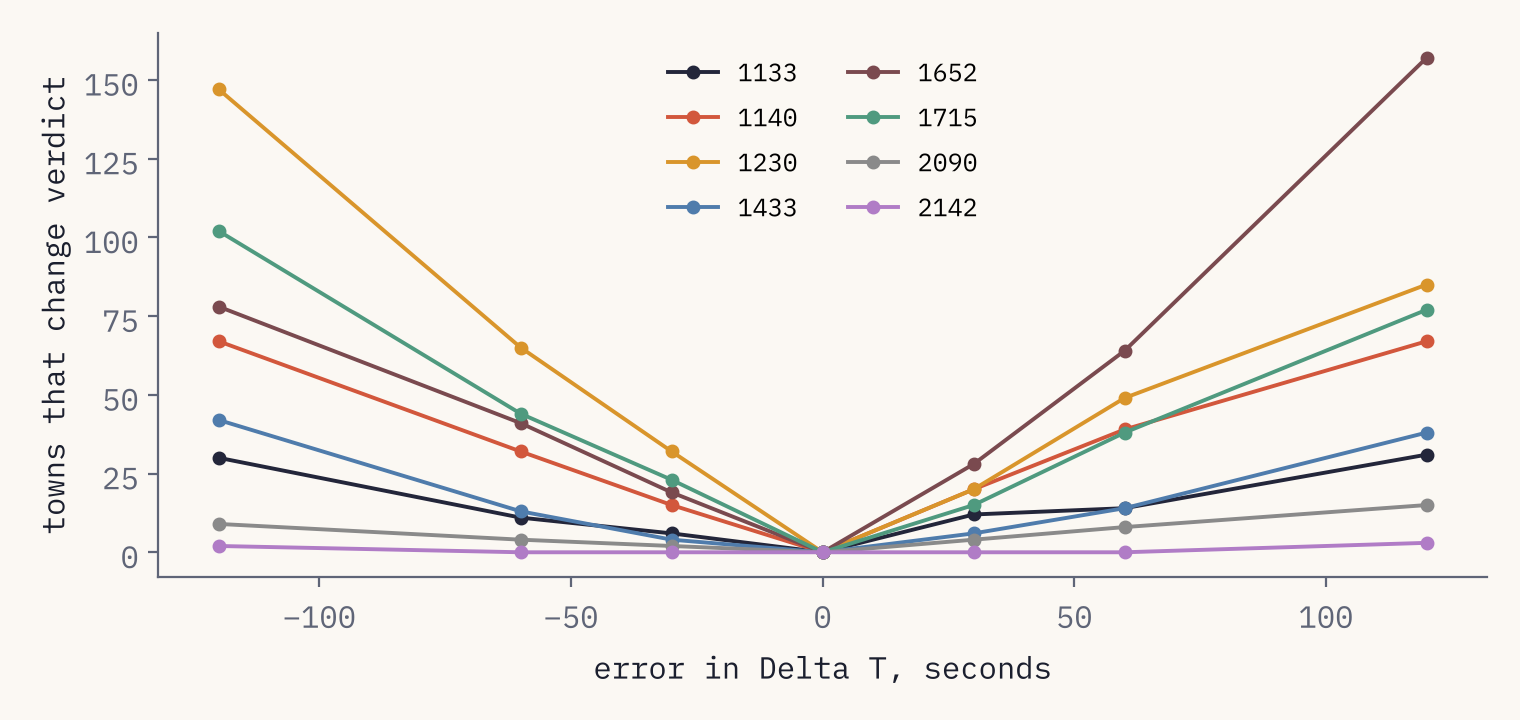
The Middle Ages are harder. The Earth’s spin has slowed, unevenly, and the correction for that, called Delta T, is only known approximately for the distant past and only forecast for the future. A one minute error moves a path about 16 km. For the eclipse of 1140, when the Peterborough Chronicle says people lit candles to eat their dinner, that changes the verdict for 32 to 39 of the 685 towns in the path. So for a medieval or far-future eclipse, a town near the edge of the shadow should read its answer as “probably”.
How I did this
I used Astronomy Engine, an open-source library for the positions of the Sun and Moon, to list every solar eclipse from AD 1000 to 2200. For each one that came near the islands I tested every place, and a 4 km grid of the land, every 30 seconds and then every 2 seconds, measuring how far the place was from the axis of the Moon’s shadow and whether it was inside the umbra with the Sun above the horizon. One fix was needed: over centuries the library’s Moon drifts ahead of the lunar theory that the standard Delta T formulas assume, by about 5 minutes of time by 1023, so I held it back by the right amount. Places come from the Ordnance Survey’s OS Open Names for Great Britain and from GeoNames for Ireland, Northern Ireland, the Isle of Man and the Channel Islands. Weather is ignored: many of these eclipses were clouded out, as 1927 and 1999 were for most people.
Notes and sources
- Eclipse geometry: Astronomy Engine by Don Cross (MIT licence), version 2.1.19, with its default Delta T model (the Espenak and Meeus formulas of the NASA Five Millennium Canon of Solar Eclipses) and my correction to the Moon’s long-term acceleration.
- Places: OS Open Names, Ordnance Survey, Open Government Licence v3.0 (contains OS data © Crown copyright and database right 2026); GeoNames cities1000 (CC BY 4.0) for Ireland, Northern Ireland, the Isle of Man and the Channel Islands. Coastline: Natural Earth (public domain).
- History: English Wikipedia (CC BY-SA 4.0): List of solar eclipses visible from the British Isles, Solar eclipse of August 2, 1133, Solar eclipse of April 8, 1652, Solar eclipse of May 3, 1715, Solar eclipse of May 22, 1724, Solar eclipse of June 29, 1927, Solar eclipse of August 11, 1999, Solar eclipse of September 23, 2090, Solar eclipse of August 21, 2017 (the 375-year figure) and ΔT (timekeeping).
- Paper: Hotham, T. (2026) When did your town last see a total eclipse? Every path of totality over Britain and Ireland, AD 1000 to 2200. Zenodo. https://doi.org/10.5281/zenodo.23729635. Data and code: github.com/Tristan-Hotham/eclipse-towns (data CC BY 4.0, code MIT).
- I wrote the text, with drafting and editing assistance from Claude (Anthropic), which also helped prepare the analysis code. I reviewed and checked all text and results.

