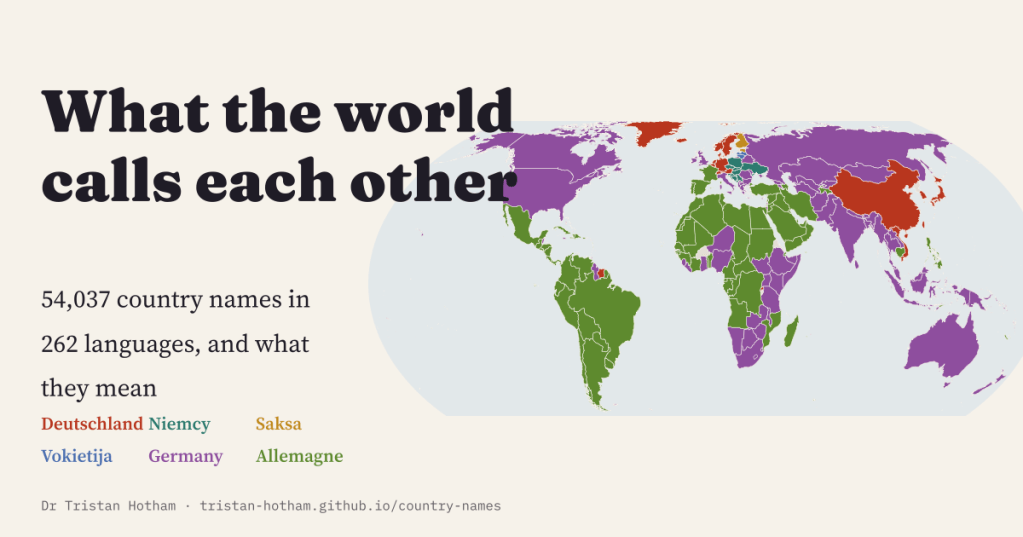
The Germans call their country Deutschland. The rest of the world calls it Germany, Allemagne, Niemcy, Saksa, Vokietija or “virtue country”. I mapped 54,037 country names in 262 languages to see what the world calls each other, and what the names mean.
Most of my maps are about places in Britain and the names we gave them. This one turns the question outwards. Every country has a name for itself and a name, or several, that the rest of the world uses. Sometimes they are the same: Kenya is Kenya almost everywhere. Sometimes they are wildly different, and the difference is a fossil of an old meeting: who heard of whom first, through which neighbours, and what they thought of them.
Wikidata, the open database behind Wikipedia, stores the name of every country in hundreds of languages. I took all 242 countries and territories on the Natural Earth world map in every language that names at least 100 of them: 262 languages, 32 writing systems, 54,037 names. The interactive version lets you pick any of those languages and see the whole world labelled in it, or pick a country and see what every language calls it.
Germany, six times over
Germany is the champion. I sorted its 261 names into the six families described in Wikipedia’s article on the names of Germany, and coloured each country by the family its own main language uses.
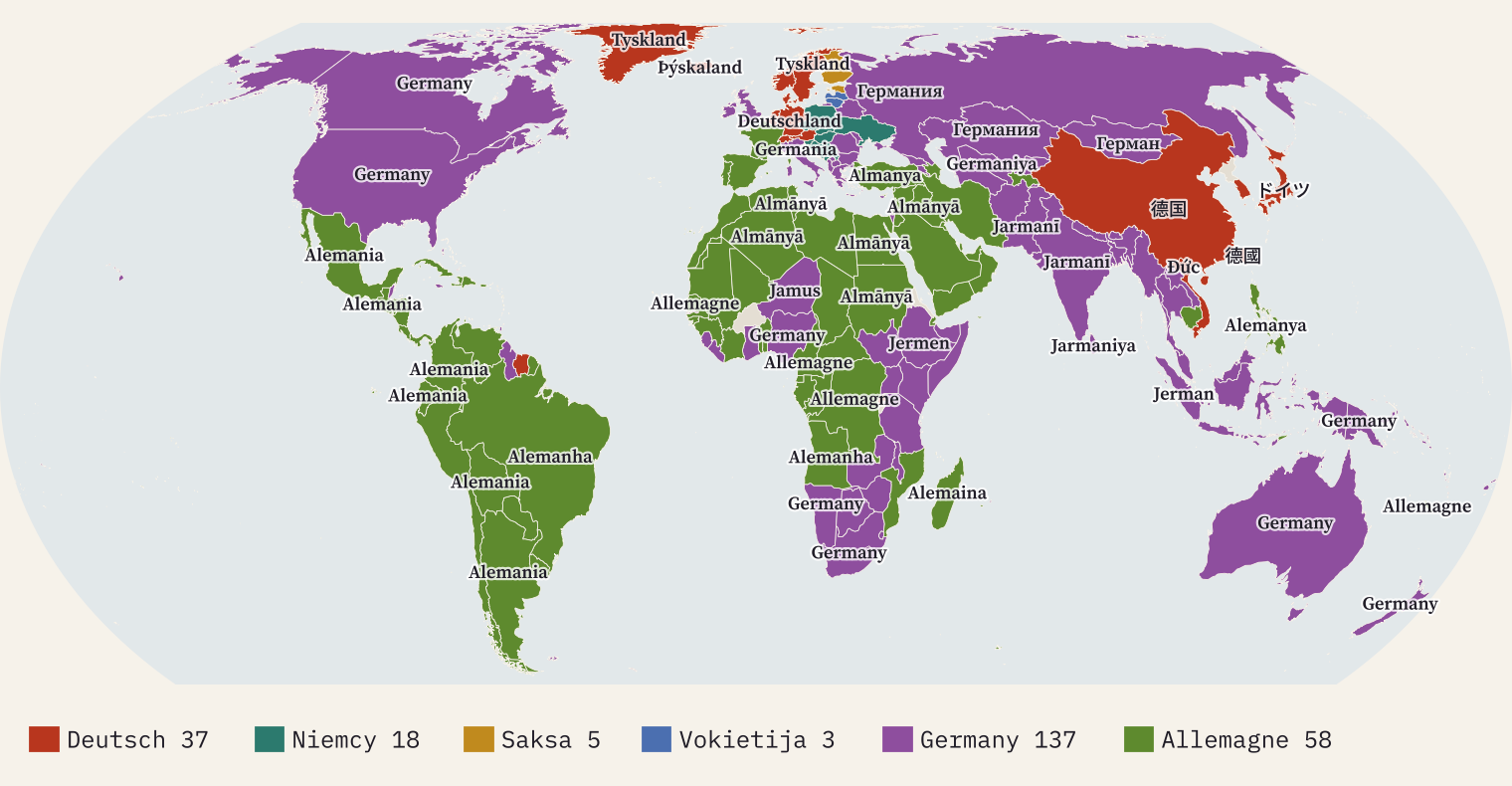
137 languages, English, Russian, Hindi and Indonesian among them, use a form of the Latin Germania, the Romans’ name for the tribes beyond the Rhine. 58 follow the French Allemagne, from the Alamanni tribe: Spanish Alemania, Arabic Almānyā, Turkish Almanya. That one family covers most of Latin America, North Africa and the Middle East.
Only 37 echo the Germans’ own word, Deutsch, from Old High German diutisc, “of the people”: Dutch, the Scandinavian languages, and, more surprisingly, Chinese 德国 Déguó, Japanese ドイツ Doitsu, Korean 독일 Dogil and Vietnamese Đức. 18 Slavic and neighbouring languages say Niemcy or Nemačka, from a Slavic word for the speechless, “the mute ones”, people whose language the Slavs could not understand. Finnish and Estonian name Germany after the Saxons (Saksa), and Lithuanian and Latvian have a word of their own, Vokietija and Vācija, of unclear origin.
Only 37 of Germany’s 261 names echo Deutsch, and they include Chinese, Japanese, Korean and Vietnamese.
Fourteen countries, many names
I built the same kind of families for thirteen more countries whose names are well documented. Each family comes with a quoted sentence from its Wikipedia source, and my build checks every quote word for word, so nothing here is my own etymology.
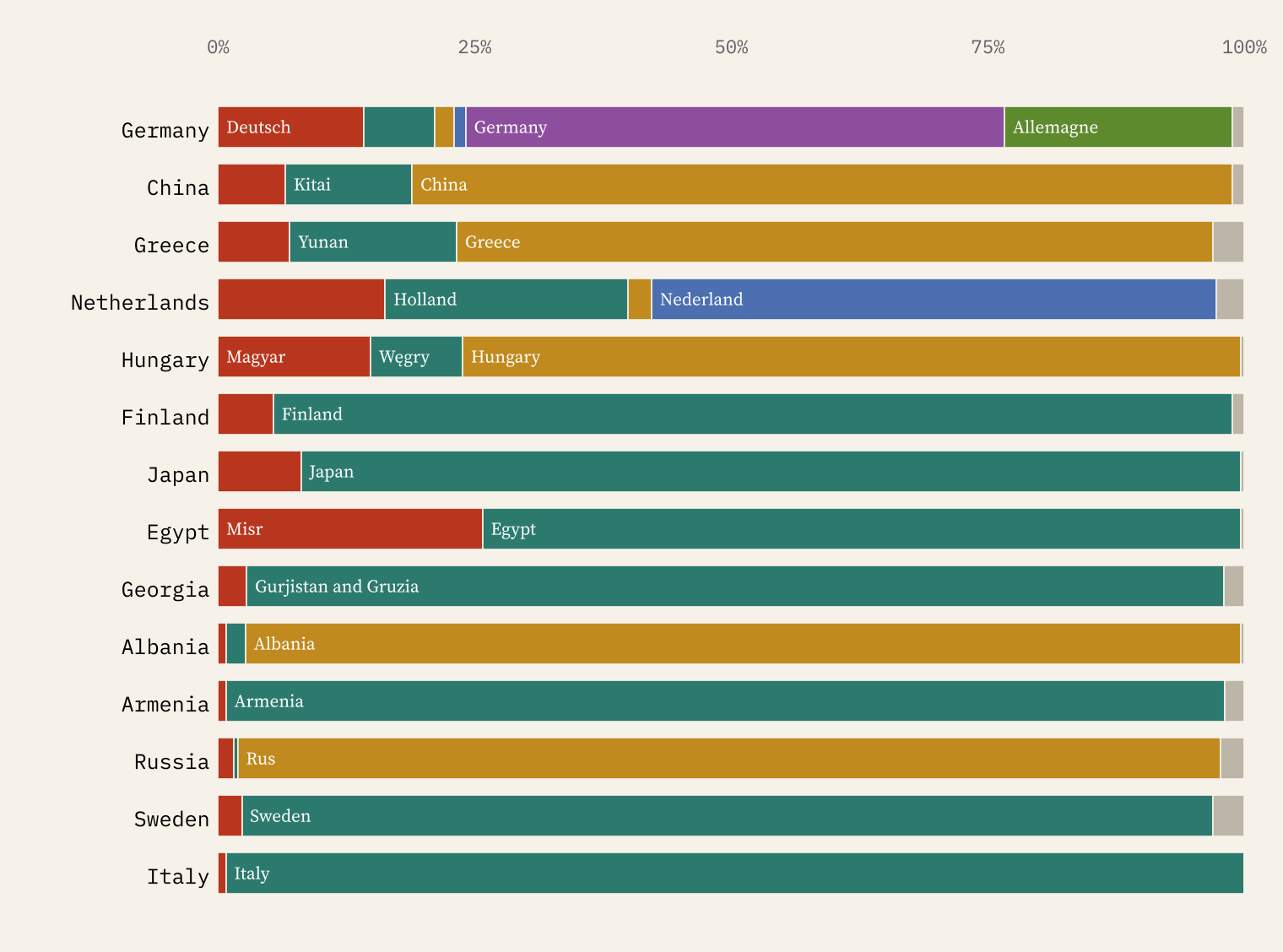
Some old names refuse to die. 32 languages, Russian (Kitai) and many in Central Asia among them, still call China after the Khitan people, the “Cathay” of Marco Polo. 42, from Turkish and Arabic to Hindi and Indonesian, call Greece Yunan, from the Old Persian name for the Ionians; only 18 follow the Greeks’ own Hellas. 61 languages call the whole of the Netherlands after one of its regions, Holland. And Finland, which calls itself Suomi, is “Finland” in 243 of its 260 names.
Others have gone. In 1935 the Shah of Iran asked foreign delegates to use “Iran” rather than “Persia” in formal correspondence. Of 256 Wikidata names for Iran today, only 2 still look like Persia: Amharic and Old English.
One family has a British twist. “Wales” comes from the Old English Wēalas, from a Germanic word first used for a Gaulish people and then for anyone from the Roman world. The same root gives Wallonia, Wallachia and Włochy, the Polish name for Italy. In my data Polish and Hungarian (Olaszország) still call Italy by it.
Which countries does the world rename?
To go beyond the famous cases, I needed a rough test for whether a name “sounds like” the country’s own name. Mine compares the first few consonant sounds of the romanised names. It is crude, but it agrees with my hand-built families for 95.8% of the 3,622 names I checked.
The answer: borrowing is the rule. For the typical country, 97% of the other languages use a name that sounds like its own, and 120 of the 196 sovereign states are echoed by 95% or more. But 17 are called something else by more than three languages in four.
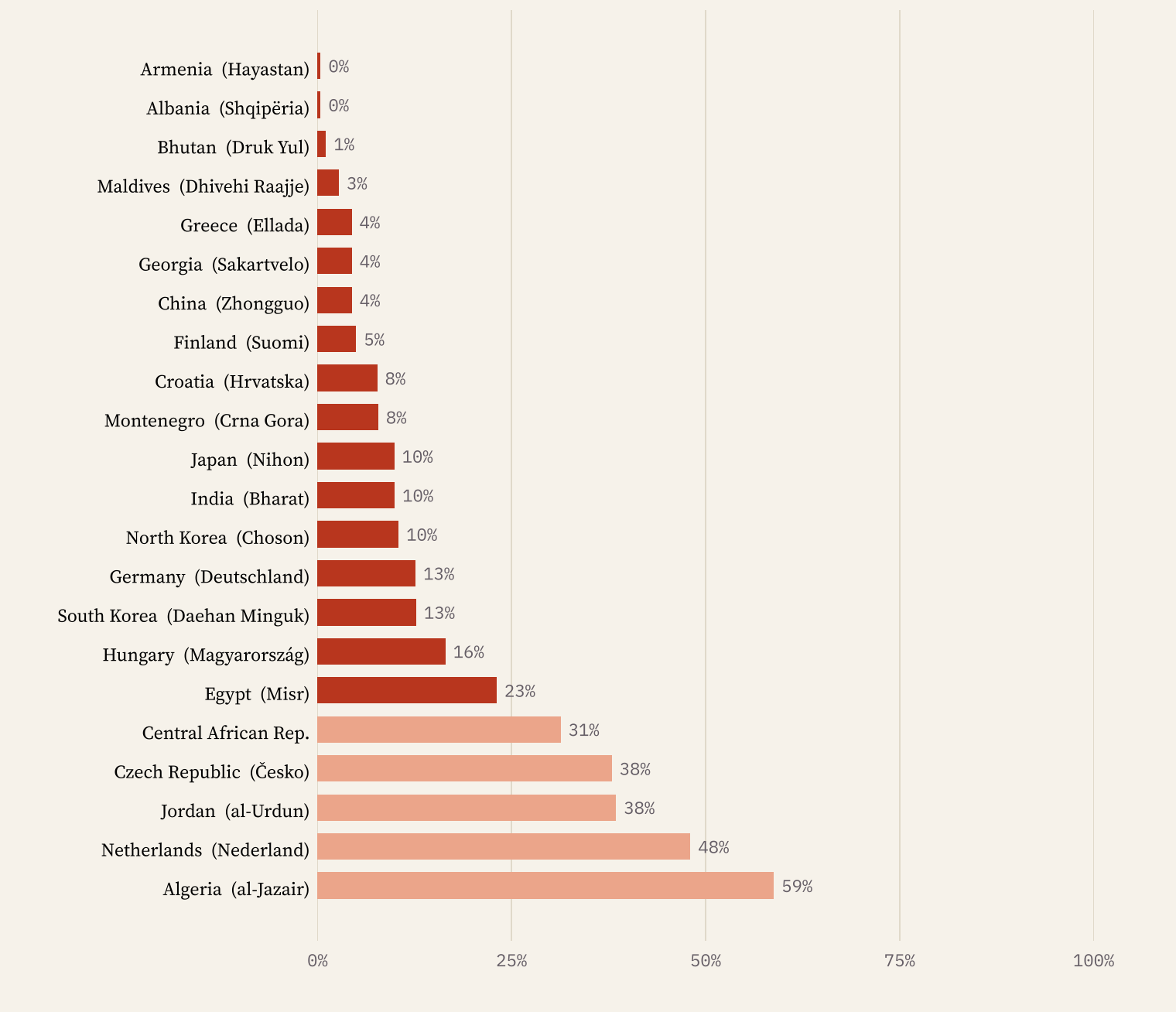
Armenia, which calls itself Hayastan, and Albania, Shqipëria, are echoed by no core language at all. Then come Bhutan (Druk Yul), the Maldives, Greece (Hellas), Georgia (Sakartvelo), China (Zhongguo) and Finland (Suomi). A few further down are there partly because of my test: Jordan (al-Urdun) and the Czech Republic (Česko, Tschechien) share roots with their foreign names that begin with different letters.
Virtue country, beautiful country
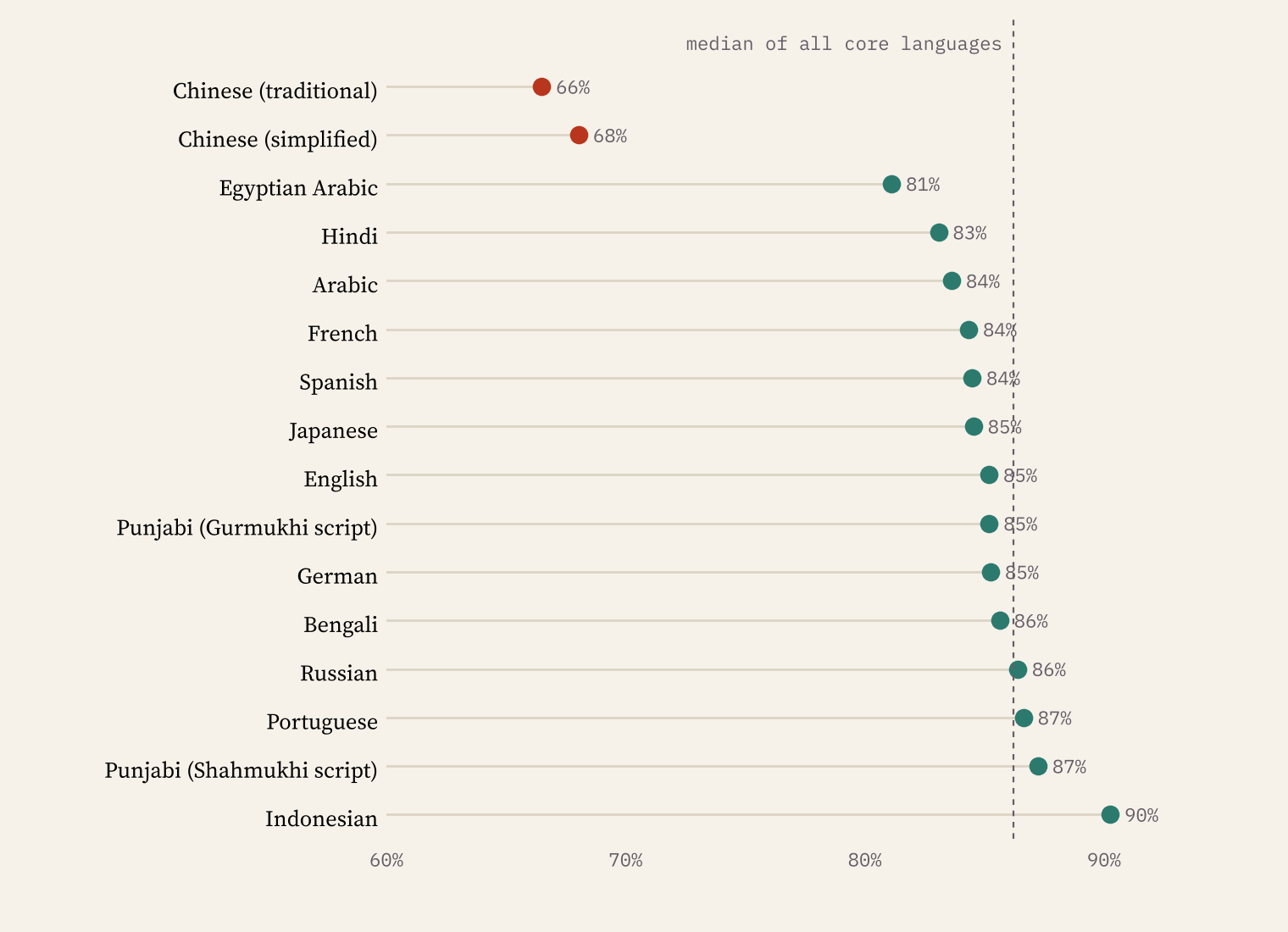
Turn it round and ask which languages rename the world most. Among the big languages, Chinese stands out by a distance: only 68% of its country names in simplified characters start with the same sounds as the countries’ own names, against a median of 86% for all the core languages.
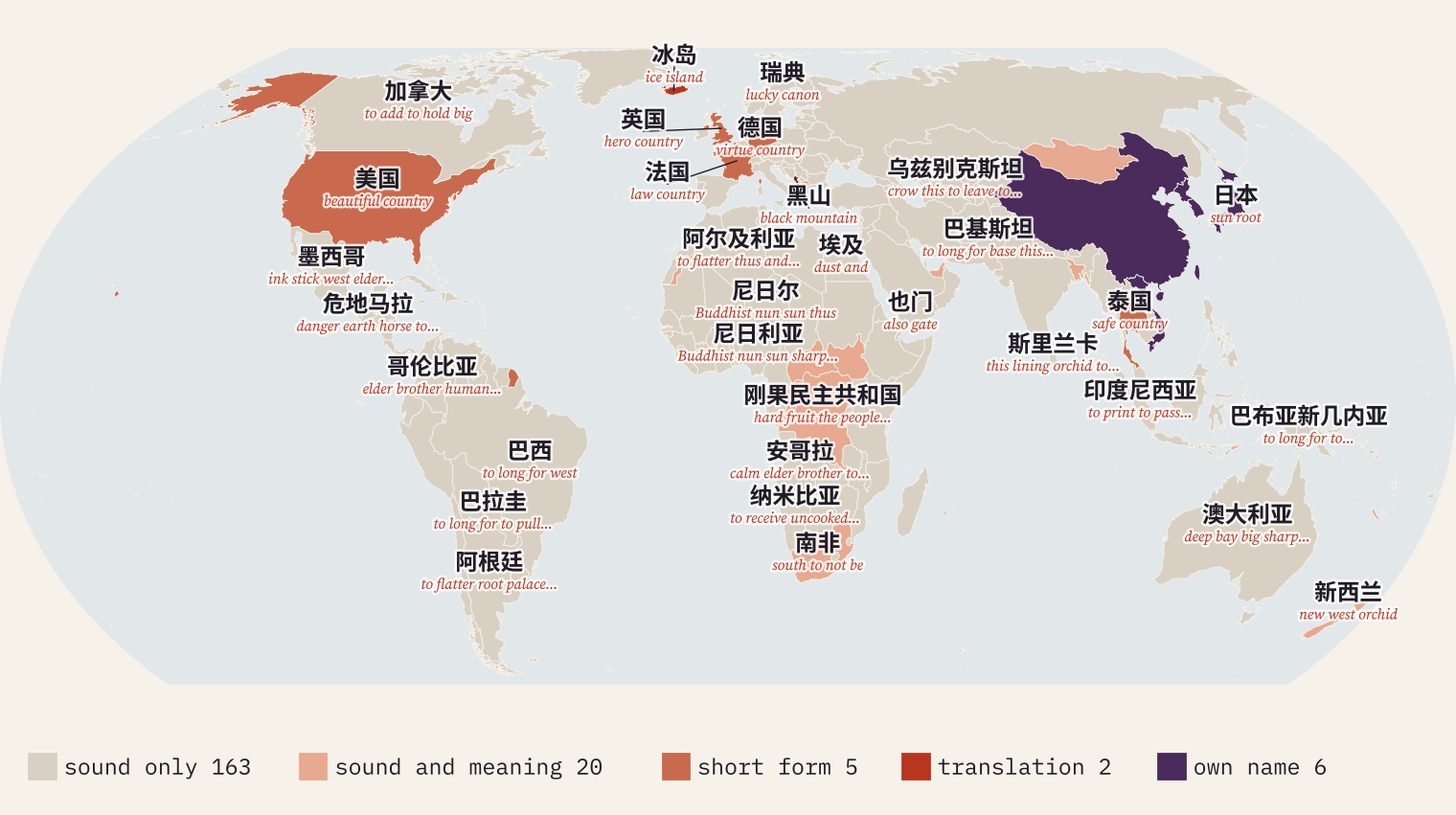
Chinese writes foreign names with characters, and every character has a meaning, so 美国 (the United States) can be read as “beautiful country” and 德国 (Germany) as “virtue country”. That reading is real for a Chinese reader, but it is not where the names come from. 美 is short for 美利堅, an early transcription of “America”, and 德 for 德意志, a transcription of “Deutsch”. Of 196 Chinese names for sovereign states, 163 (83%) are pure sound, and only 2 are true translations: 冰岛 Iceland, “ice island”, and 黑山 Montenegro, “black mountain”.
Japanese mostly sidesteps the question: 168 of 196 countries are written in katakana, which records sound only. But a few old kanji short forms survive, and Wikipedia notes that 米国 Beikoku, the United States, “literally translates to ‘rice country’”.
What your own name means
Finally, what countries call themselves. Wikipedia’s list of country-name etymologies covers 193 of the 196 sovereign states, and I sorted each entry into a rough kind.
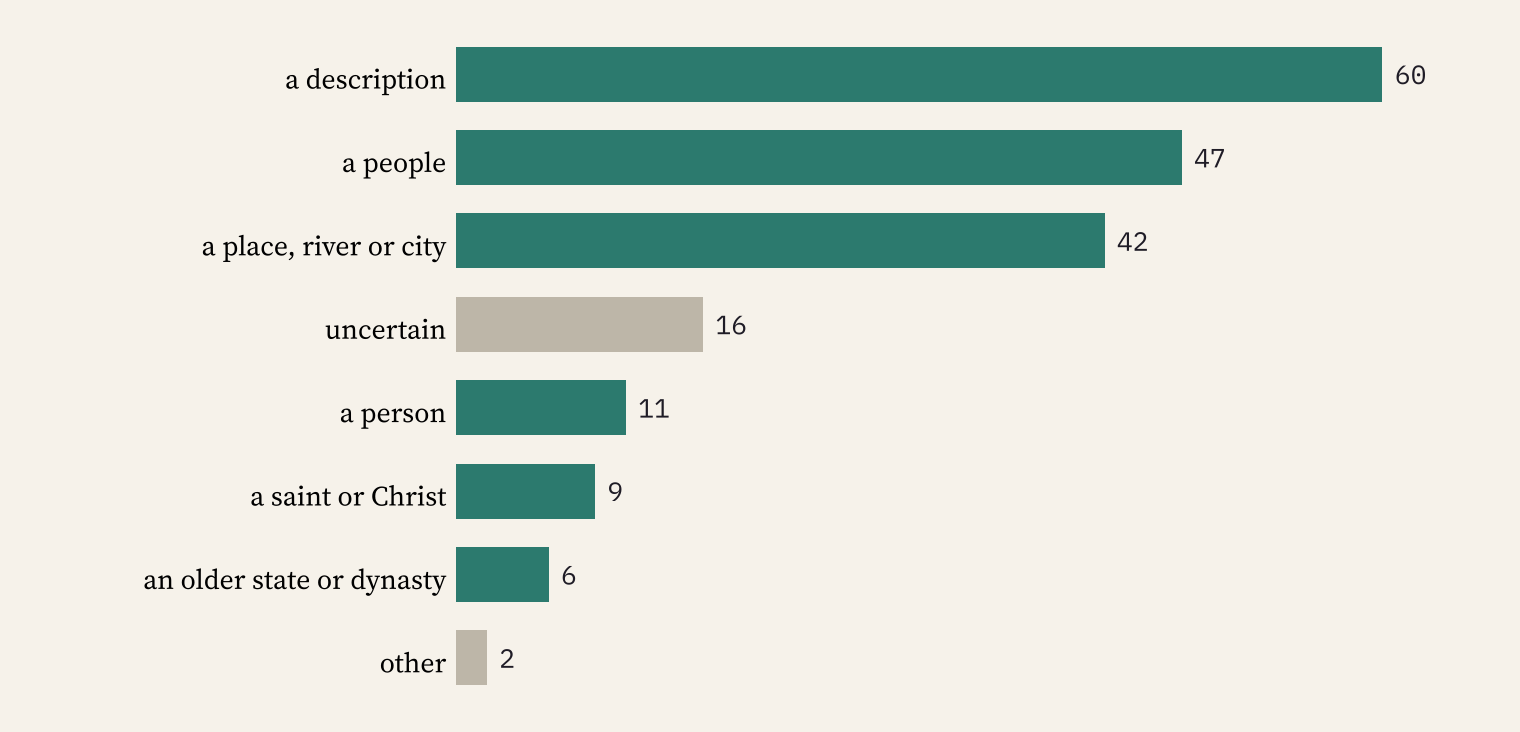
The biggest group, 60, describe the place: Costa Rica is the “rich coast”, Montenegro the “black mountain” in Venetian, Ecuador the equator and Ukraine the “edge” or “borderland”. 47 are named after a people, such as Poland after the Polans and France after the Franks, and 42 after a river or other place: India after the Indus, Zambia after the Zambezi. 11 carry a person’s name: Colombia (Columbus), Bolivia (Simón Bolívar), the Philippines (Philip II of Spain), Saudi Arabia (the House of Saud). For 16, among them Peru, Cuba and Syria, nobody is sure.
How I did this
The names are Wikidata labels, one per country per language, for the 242 countries and territories of Natural Earth’s 1:50m world map. A label is usually the standard modern name, but some languages have several names for a country and the label shows only one. “Language” here means a Wikimedia language edition, so Old English counts once, like Spanish: read the counts as counts of languages, not of people. Meanings come only from Wikipedia’s list of country-name etymologies and its articles on the names of Germany, China, Greece, Japan, Iran, Wales and others, and from two open dictionaries, CC-CEDICT for Chinese and KANJIDIC2 for Japanese. Where no source gives a meaning, the map shows the name and its sound, nothing more.
The “sounds like” test and the name families both work on automatic romanisations, which are rough for scripts that do not write vowels. The test is right for about 24 names in 25 in the set I checked by hand, so treat it as a guide to broad patterns, not a verdict on a single name.
Notes and sources
- Country names, official languages and speaker numbers: Wikidata (CC0), retrieved 28 October 2026.
- Meanings: English Wikipedia, List of country-name etymologies, Names of Germany, Names of Greece, Names of Japan, Names of Iran, Names of Wales, Transcription into Chinese characters and Ateji (CC BY-SA 4.0).
- Chinese glosses: CC-CEDICT, MDBG (CC BY-SA 4.0). Japanese glosses: KANJIDIC2, Electronic Dictionary Research and Development Group (CC BY-SA 4.0).
- Map: Natural Earth (public domain). Paper, data and code: Zenodo and GitHub; derived data CC BY-SA 4.0.
- I wrote the text, with drafting and editing assistance from Claude (Anthropic), which also helped prepare the analysis code. I reviewed and checked all text and results.

