
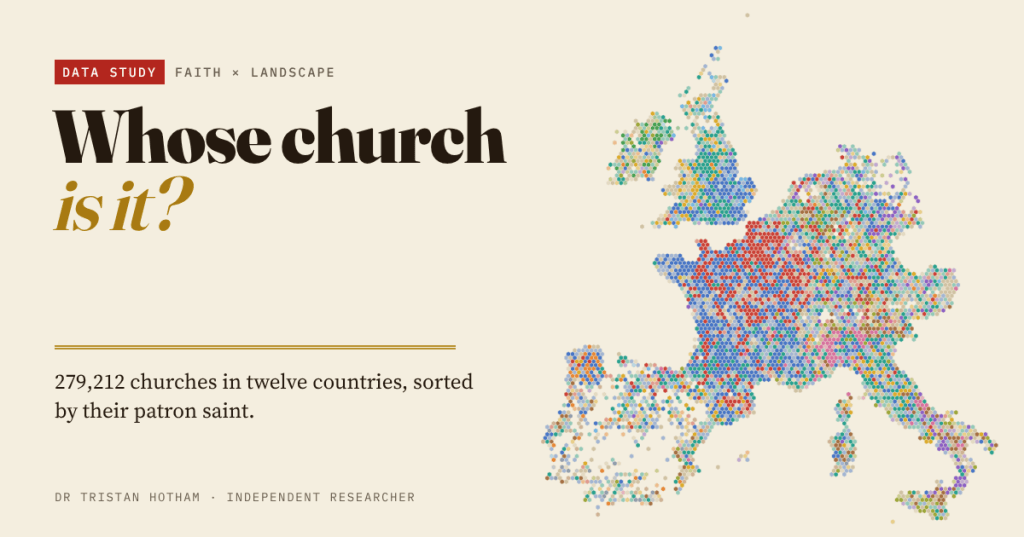
Saint Martin in France, Brigid at the holy well, James near Santiago, and a Cornish parish for almost every saint you have never heard of. I sorted 279,212 churches in twelve countries by the saint they belong to.
Almost every old church in Western Europe belongs to someone. The village church is St Peter’s, or Saint-Martin, or San Rocco, or Sankt Nikolaus. These names were given for all sorts of reasons: a relic, a founder, a local bishop, a passing fashion. Once given, they tended to stay for centuries. So the names of churches are a kind of fossil record of belief, and I wanted to see that record whole, across borders, on one map.
Wikidata, the open database behind Wikipedia, lists 279,212 church buildings in the United Kingdom, Ireland, France, the Low Countries, Germany, Switzerland, Austria, Italy, Spain and Portugal. Only 47,902 record their saint in a structured field, so I taught a parser to read the rest from the names, in eight languages: Pierre, Pietro, Pedro, Petrus and Pieter are all Peter. Where both exist, the parser agrees with the database 96% of the time. In all, 208,005 churches got a saint.
A mosaic of patrons
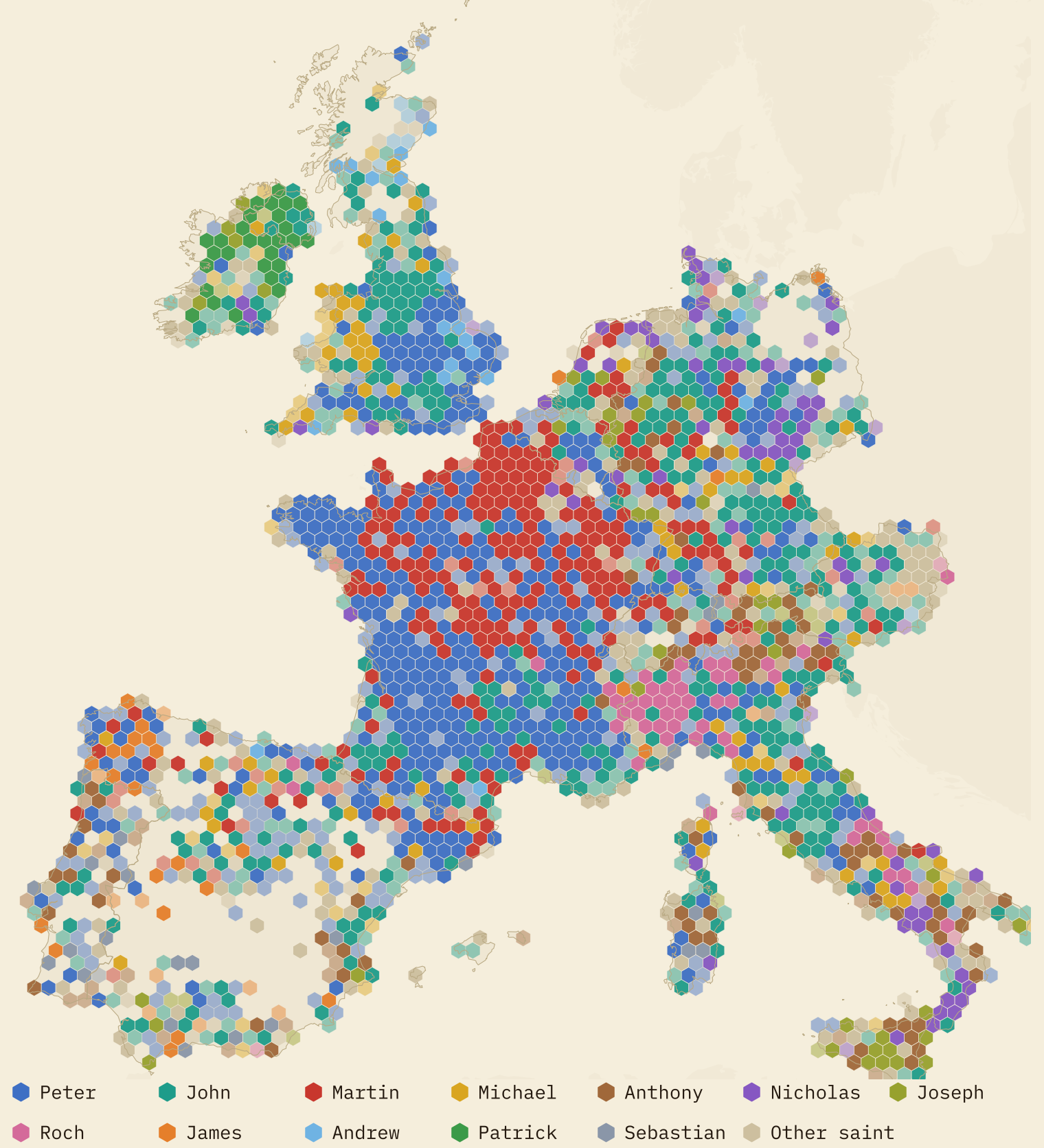
The first thing to say is that the map is really Mary’s. She is the most common dedication in every one of the twelve countries and leads in 85% of the hexagons. So for the map above I set her aside, along with Christ, the Trinity, the Cross and All Saints, to see who comes next.
Three names take most of the land. Peter leads in 30% of hexagons, John in 22% and Martin in 13%. Martin of Tours, the soldier who shared his cloak with a beggar, is the saint of France: 7.9% of French churches, rising to 15% in Picardie. Cross the Channel and he almost vanishes, to 1.1%.
The Virgin heads south
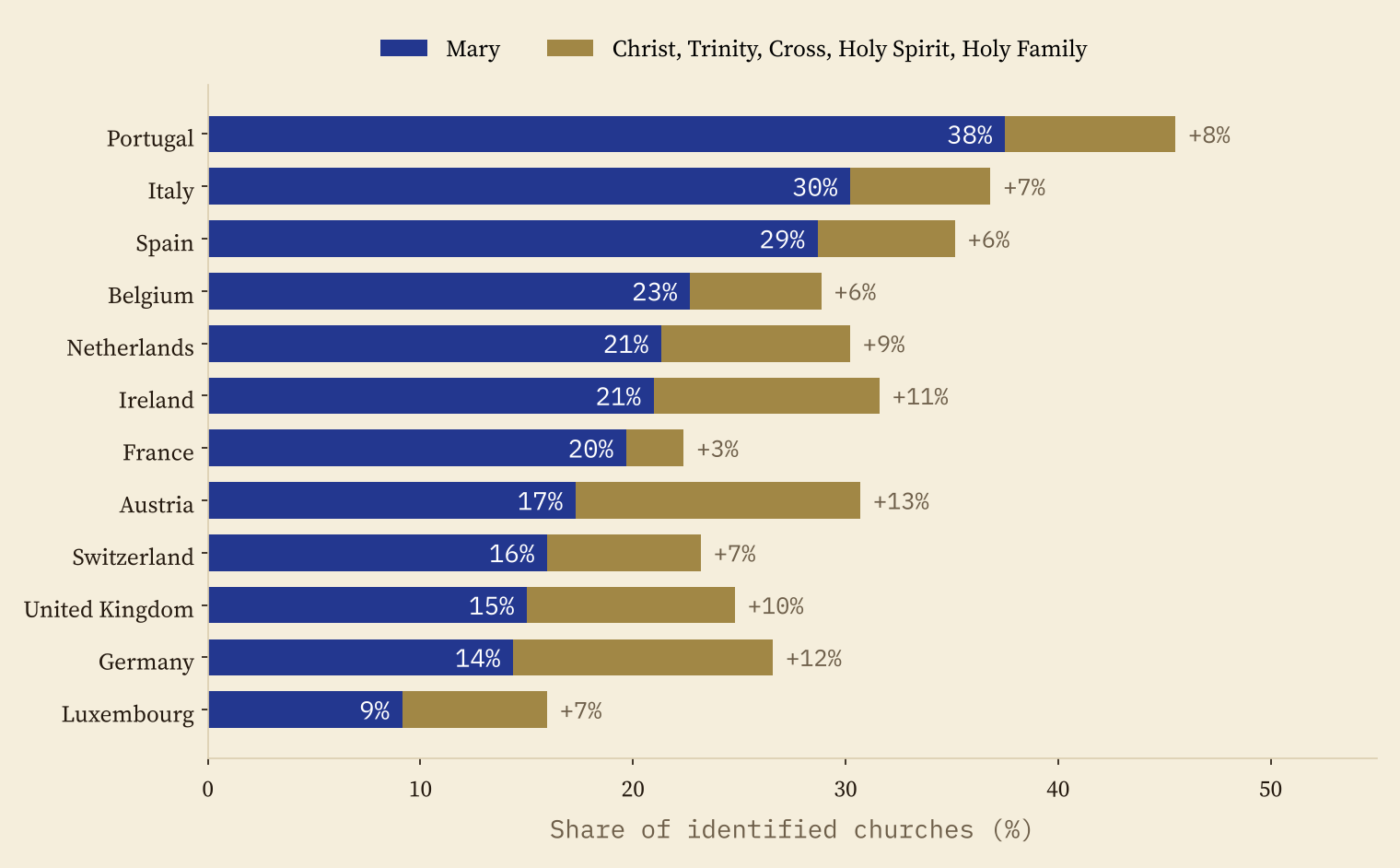
Mary’s share climbs as you go south: 9% of churches in Luxembourg, 15% in the UK and 14% in Germany, against 29% in Spain, 30% in Italy and 38% in Portugal. I count every Marian title as one, from Notre-Dame to Nuestra Señora del Pilar. Germany and Austria have the most churches dedicated to Christ or the Trinity, partly because Protestant churches built after the Reformation were often called Christuskirche or Erlöserkirche rather than after a saint.
Saints with a home
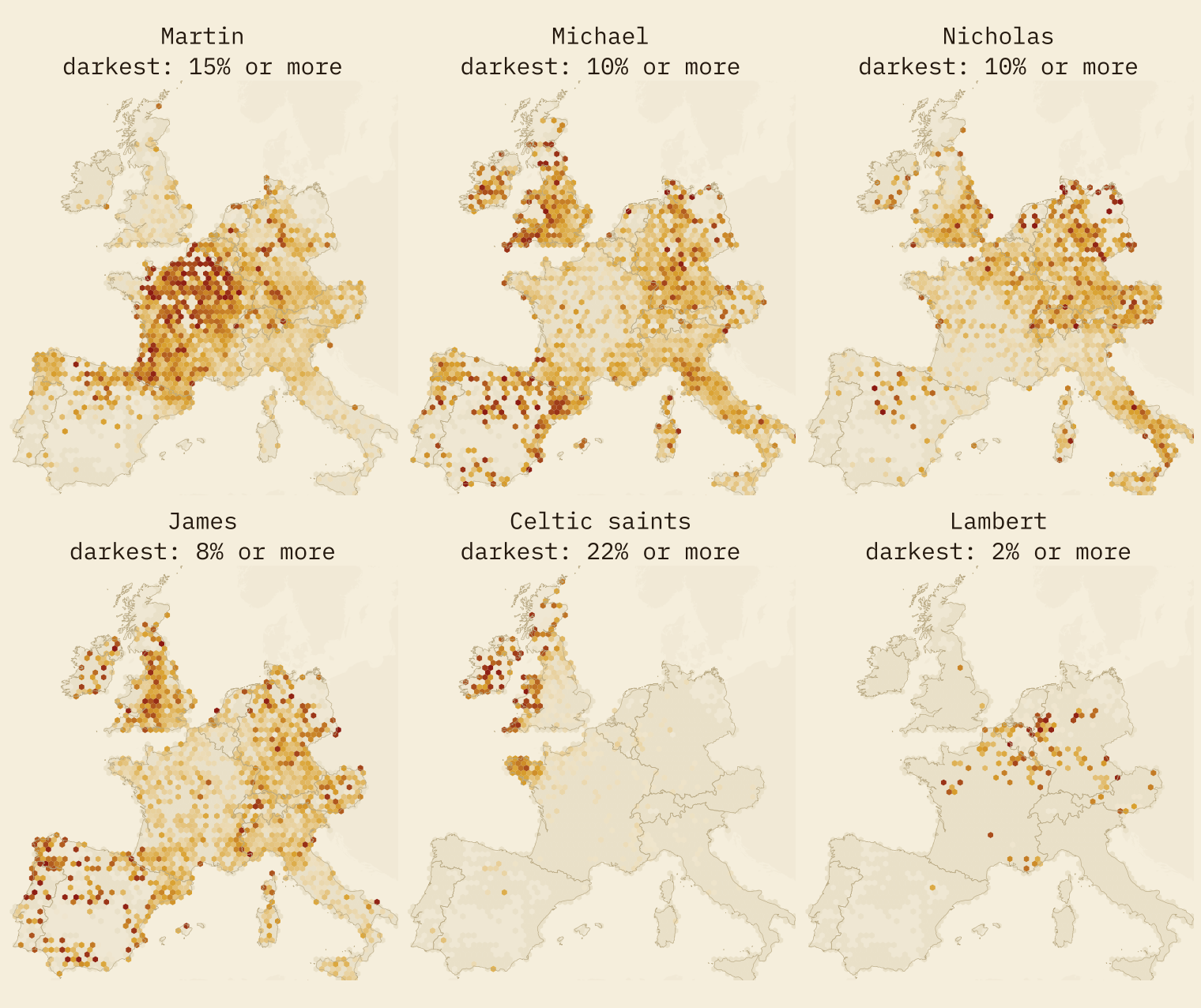
Some saints are a map of one region’s history. The early saints of Ireland, Wales, Scotland, Cornwall and Brittany (Patrick, Brigid, Columba, David, Piran, Samson and over a hundred more) hold 22% of Irish churches and 19% in Cornwall, but barely register in France outside Brittany. Nicholas, patron of sailors, is strongest along the North Sea coast, in Groningen and Friesland (NL). Lambert, the bishop of Maastricht killed at Liège, belongs to the Low Countries; Kilian, martyred at Würzburg, to Unterfranken; Ambrose to Ticino and Lombardia.
Go further down and the local saints appear: Arbogast in Alsace, Korbinian in Upper Bavaria, Fridianus in Tuscany, Ninian in the south of Scotland, Magnus in the Highlands and Islands. For many of them, every church of that name in the country stands in a single region.
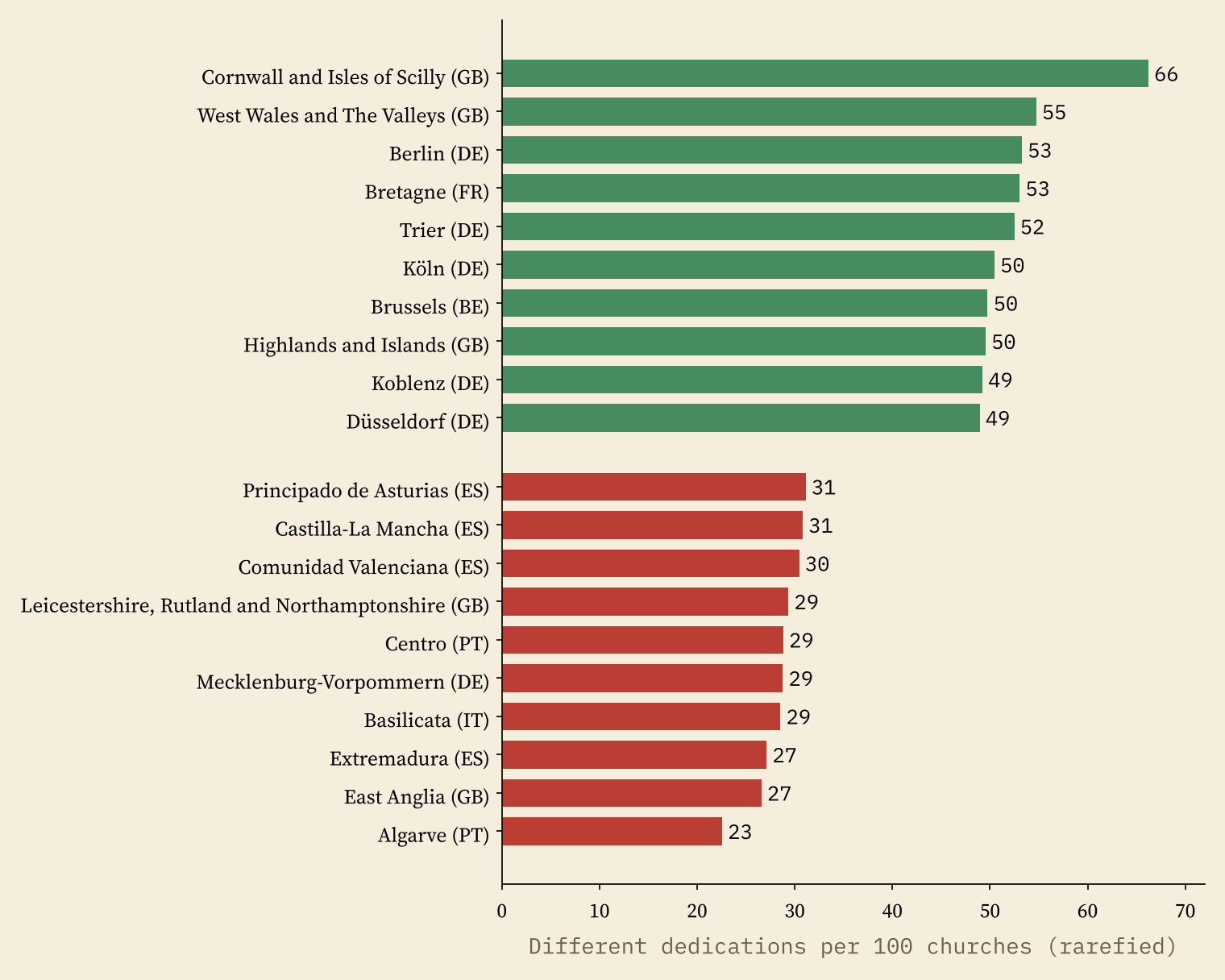
Cornwall has 66 different saints in every 100 churches. The Algarve has 23.
The most varied corner of Europe
If you picked 100 churches at random in a region, how many different saints would you meet? In Cornwall and Isles of Scilly the answer is 66, the highest of 176 regions, because so many parishes keep the name of their own early saint. West Wales and The Valleys (55) and Brittany (53) are close behind. At the other end come regions where Mary or a few great saints dominate, down to 23 in the Algarve.
Two good stories, tested
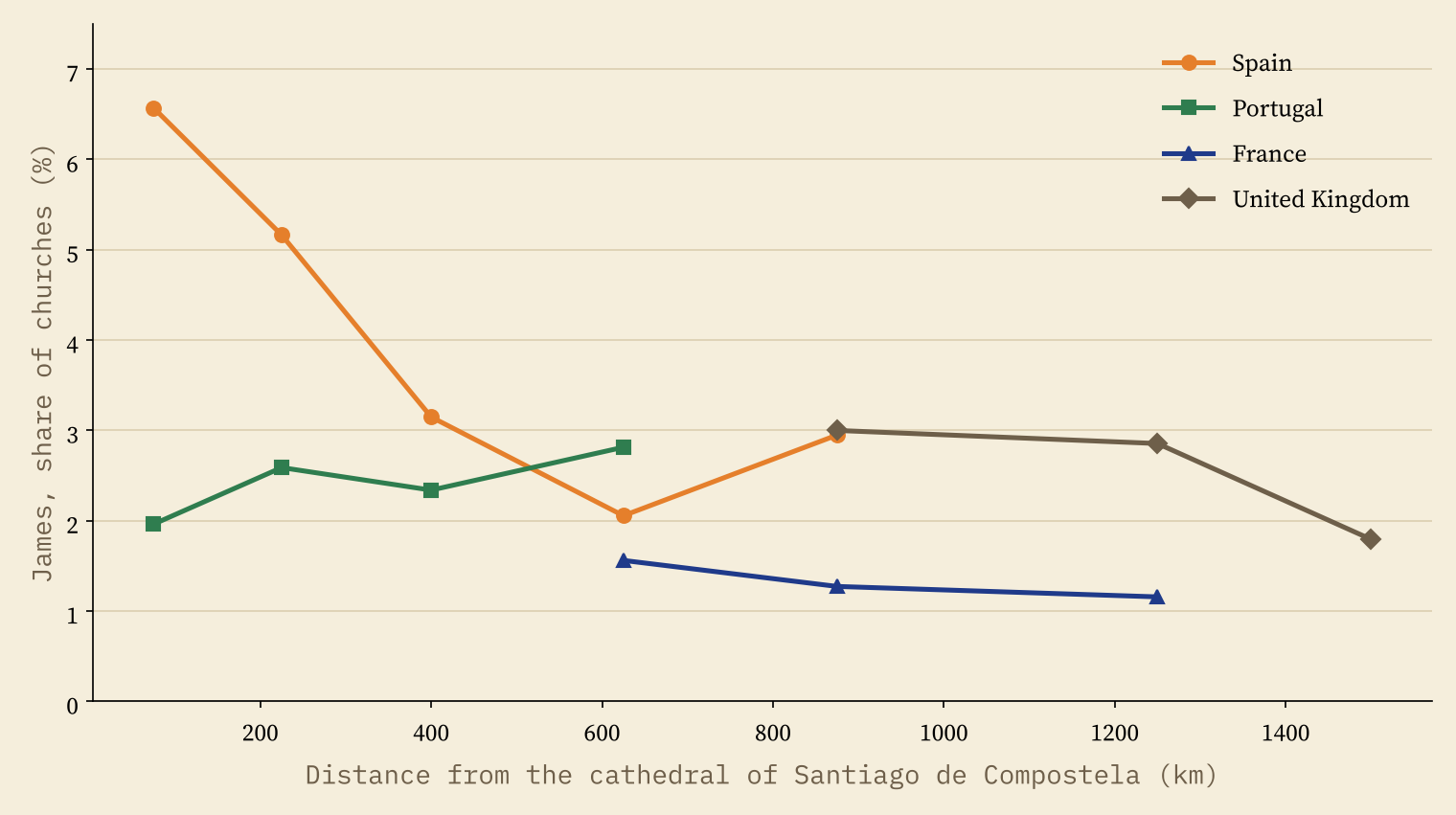
James, by tradition buried at Santiago de Compostela, ought to cluster near his shrine and along the pilgrim roads. Within Spain he does: 6.6% of churches within 150 km of the cathedral, 2.1% at 500 to 750 km. But beyond the Pyrenees the trail goes cold. France’s share hardly changes with distance, and the UK, at 2.8%, has more of him than France (1.2%).
Michael the archangel is said to love high places: Mont-Saint-Michel, St Michael’s Mount, Glastonbury Tor. Where I have terrain data, in Britain and Ireland, his 1,143 churches do stand higher above sea level (a median of 70 m against 57 m), but they are no more often on a local high point: 6.7% against 6.2% for other churches. Michael ranks 14 of 32 saints on that measure. The hilltop Michaels are memorable, not typical.
Brigid’s water
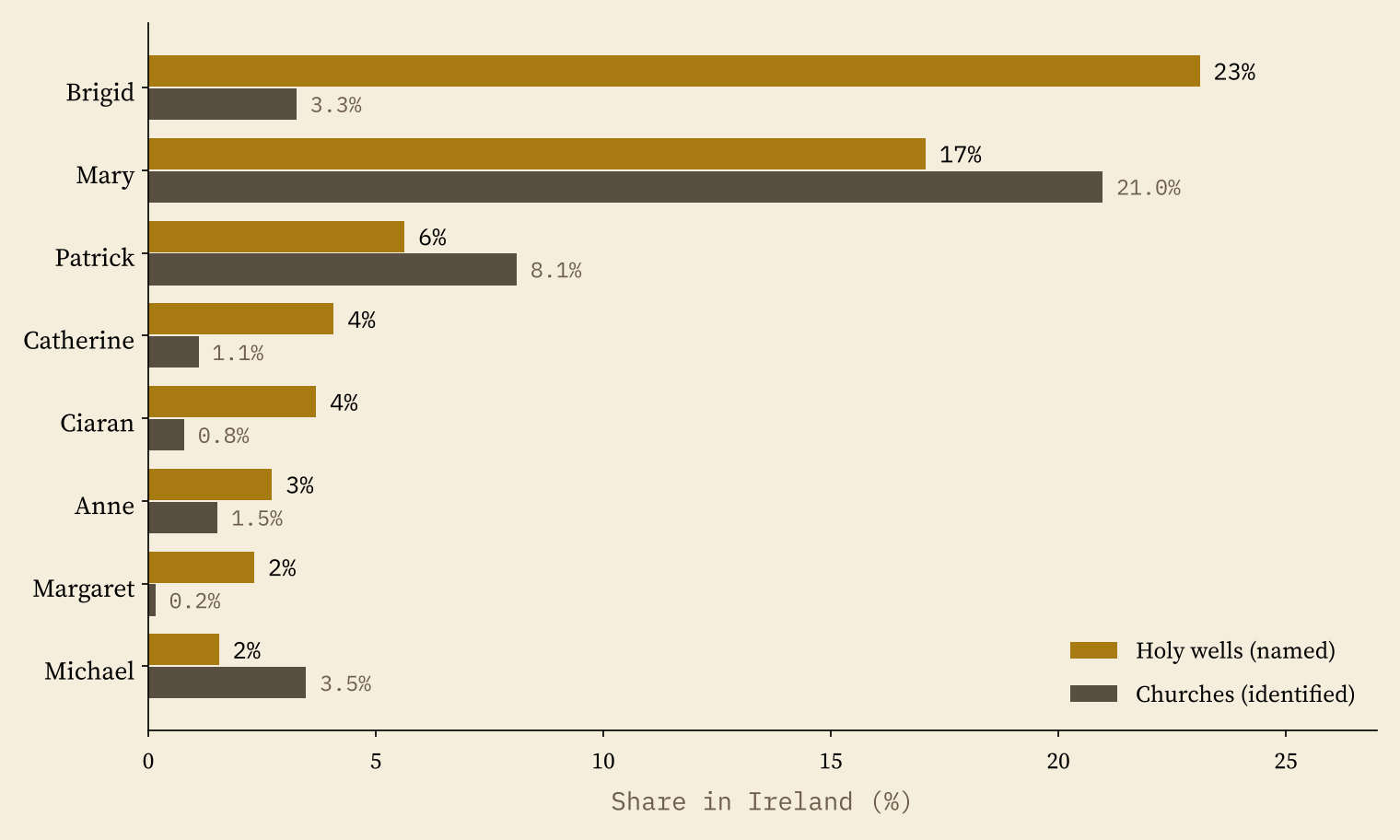
Holy wells are older, smaller and more local places of devotion, and in Wikidata they are almost all Irish (1,021 of 1,178). Their saints look nothing like the churches’. Brigid holds 23% of Irish wells with a saint’s name, against 3.3% of Irish churches. Together, the early Irish and Celtic saints hold 39% of the wells and 22% of the churches.
How I did this
The churches are every Wikidata item classed as a church building with coordinates in the twelve countries, clipped to mainland Europe and its islands. Where Wikidata records ‘dedicated to’, I used it. Otherwise a parser reads the name: saint prefixes in each language, French forms such as Saint-Martin (but not ‘église de Saint-Rémy’, which is a place), German and Dutch compounds such as Martinskirche and Nikolaikirche, and Marian titles from Notre-Dame to Onze-Lieve-Vrouw. Saints are grouped by name, so John covers the Baptist and the Evangelist. Hexagons are 20 km from centre to corner and regions are the EU’s NUTS 2 regions.
The big caveat is coverage. Wikidata holds 220 churches per 1,000 km² for Italy but 42 for Spain, and many German churches carry only a village name. That is why every number here is a share within a country or region, never a raw count across borders. The name reader can only be checked where Wikidata has a structured dedication, and today’s name is not always the medieval one.
Notes and sources
- Churches and holy wells: Wikidata, CC0.
- Regions: Eurostat GISCO NUTS 2016, © EuroGeographics for the administrative boundaries. Country outlines: Natural Earth.
- Terrain for the Michael test: AWS Terrain Tiles by Mapzen/Tilezen.
- Background reading: Frances Arnold-Forster, Studies in Church Dedications (1899); Nicholas Orme, English Church Dedications (1996).
- Paper, data and code: Zenodo and GitHub. Derived data and text CC BY 4.0, code MIT.
- I wrote the text, with drafting and editing assistance from Claude (Anthropic), which also helped prepare the analysis code. I reviewed and checked all text and results.

