
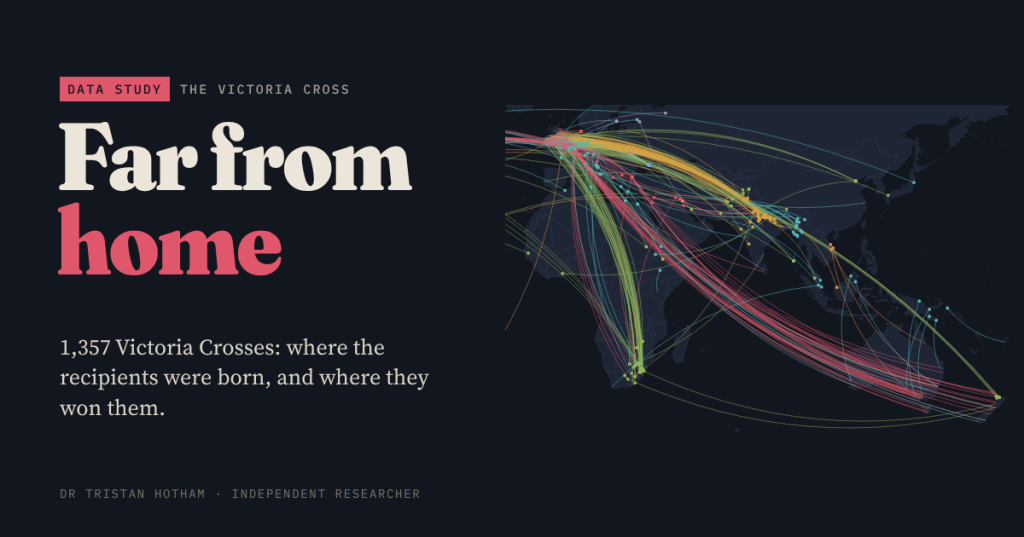
1,357 Victoria Crosses, from the Crimea in 1854 to Afghanistan in 2013. I put the birthplace of every recipient I could on a map, and the place of every deed I could locate, and measured the distance between them.
Every Victoria Cross has two places attached to it. One is where the recipient was born. The other is where they did the thing the citation describes: a breach at Lucknow, a mission station at Rorke’s Drift, a shell hole on the Somme. Biographies give both, but I had never seen them on one map. So I built one.
The Wikipedia lists give 1,354 named recipients and, because three men won it twice, 1,357 awards. Wikidata gives a birthplace with coordinates for 1,338 of them. The place of the deed is harder: the main lists do not record it, so I could locate only 448 awards, about a third. That shapes everything below, and I come back to it.
From home to the deed
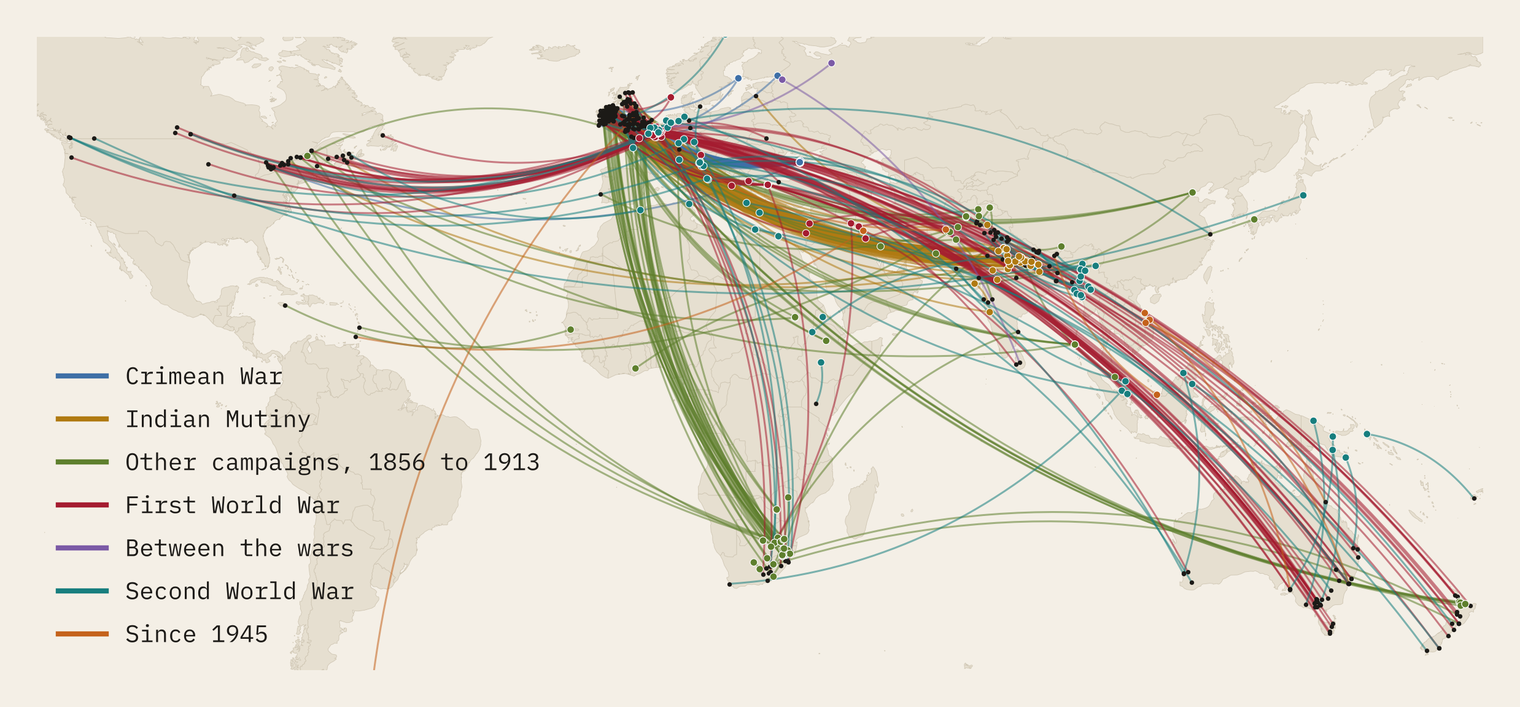
The lines tell the story of an empire’s wars. Thick gold bundles run from Britain and Ireland to northern India: the Indian Mutiny of 1857 and 1858. Green threads run to southern Africa for the Zulu and Boer wars. Then the red of the First World War pulls everything back into a small patch of France and Belgium, with long red lines reaching it from Australia, New Zealand and Canada.
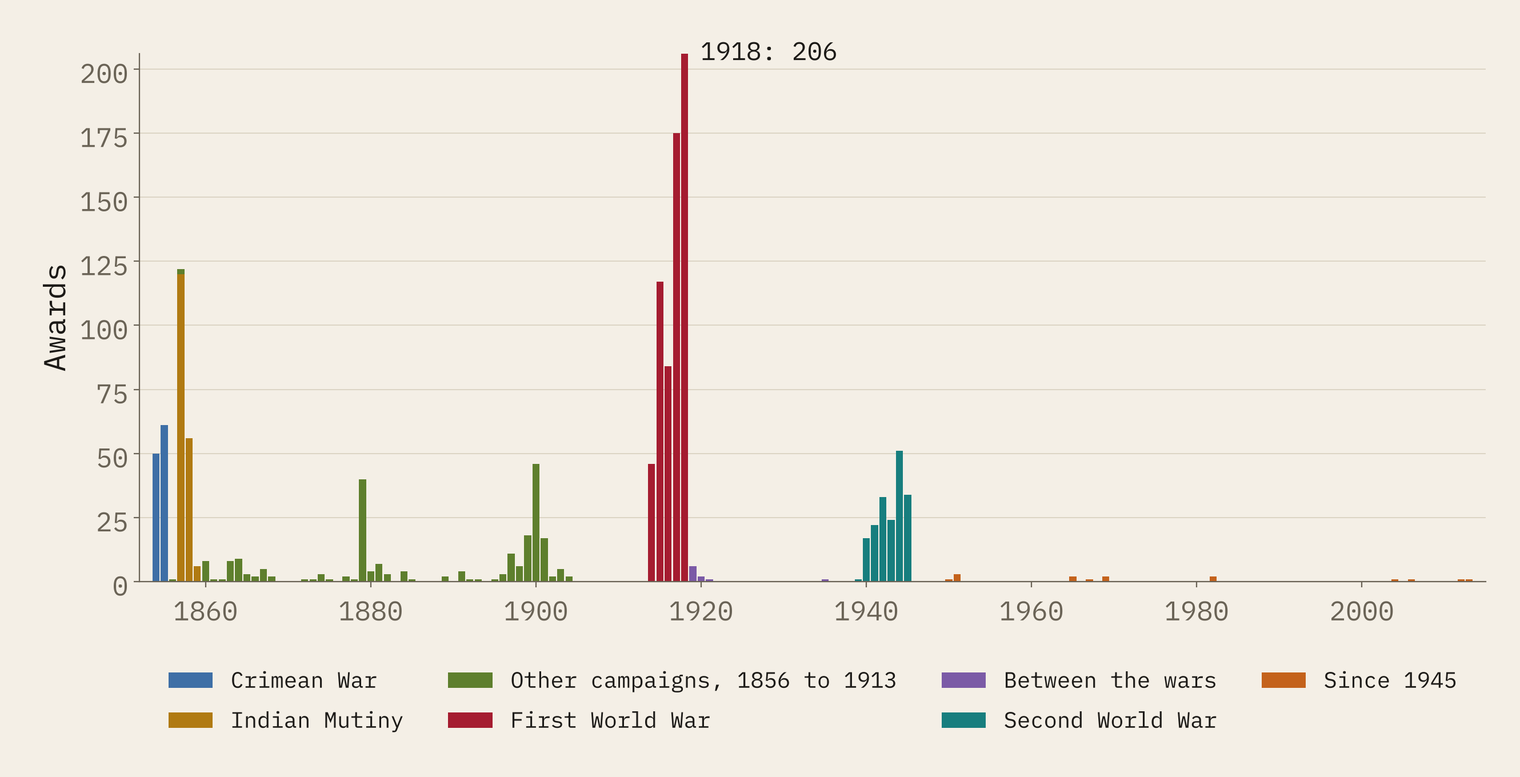
Sixty years of small wars, then 1918
The Crimean War produced 111 crosses and the Indian Mutiny 182. Then came six decades of what were called small wars, in Afghanistan, Sudan, New Zealand, China, Ashanti and southern Africa: 229 awards between 1856 and 1913. The First World War dwarfs all of it. 628 crosses, 46% of every one ever awarded, and 206 for deeds in 1918 alone.
Where the recipients came from
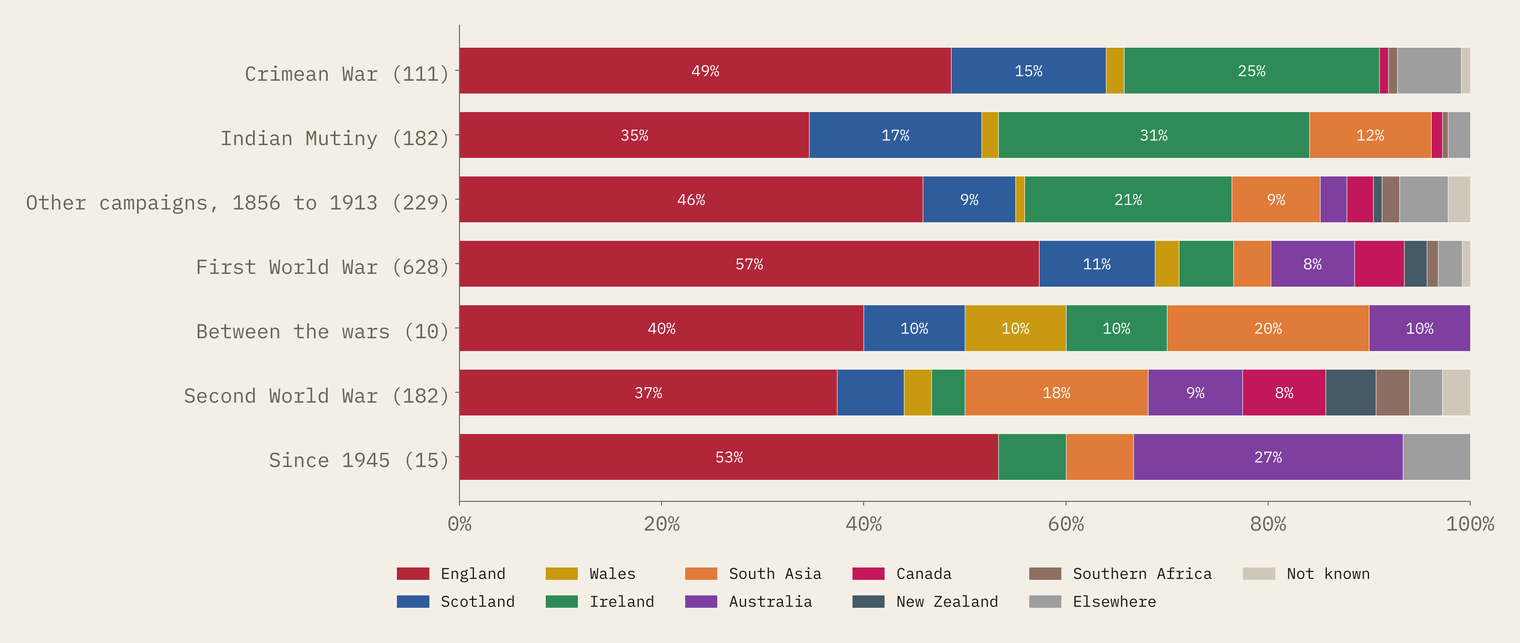
Just under half of all recipients, 660, were born in England. Scotland gave 154, Wales 28, and the island of Ireland 173, which is 13% of the total.
That Irish figure hides a dramatic change. In the Crimea a quarter of recipients were Irish-born, and in the Indian Mutiny 31%: the Victorian army recruited heavily in Ireland. By the First World War the share was 5%, and in the Second 3%. Meanwhile the empire’s own armies came in. Recipients born in Australia, Canada, New Zealand and southern Africa were 2% in the Crimea, 17% in the First World War and 26% in the Second, when another 18% were born in South Asia.
Within Britain, Greater London (as it is today) was the birthplace of 159 recipients, far ahead of anywhere else, followed by Greater Manchester (31), Merseyside (28), Hampshire (28) and Devon (25). These are raw counts. I do not have county populations for the right decades, so I cannot say which county produced the most per head, and big counties naturally lead.
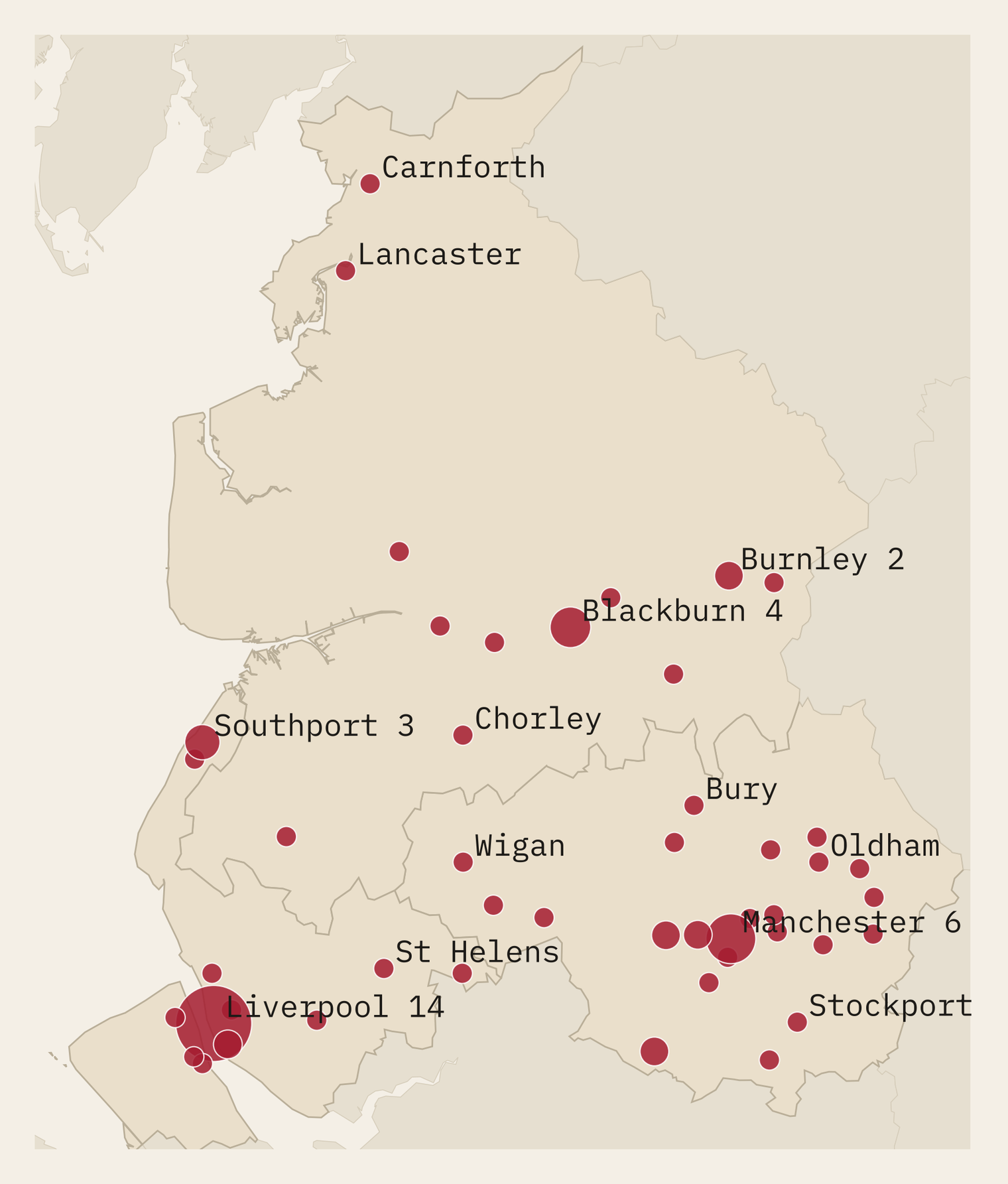
Lancashire’s own
Lancashire is close to home, so I looked closer. Today’s Lancashire, Greater Manchester and Merseyside, which between them cover most of the old county, were the birthplace of 75 recipients. Taken as one area, that would be second only to Greater London. Liverpool alone has 14, Manchester 6 and Blackburn 4, and there are crosses from Burnley, Lancaster, Wigan, Chorley and a string of mill towns. 55 of the 75 were won in the First World War, and 15 are marked as posthumous.
Where the crosses were won
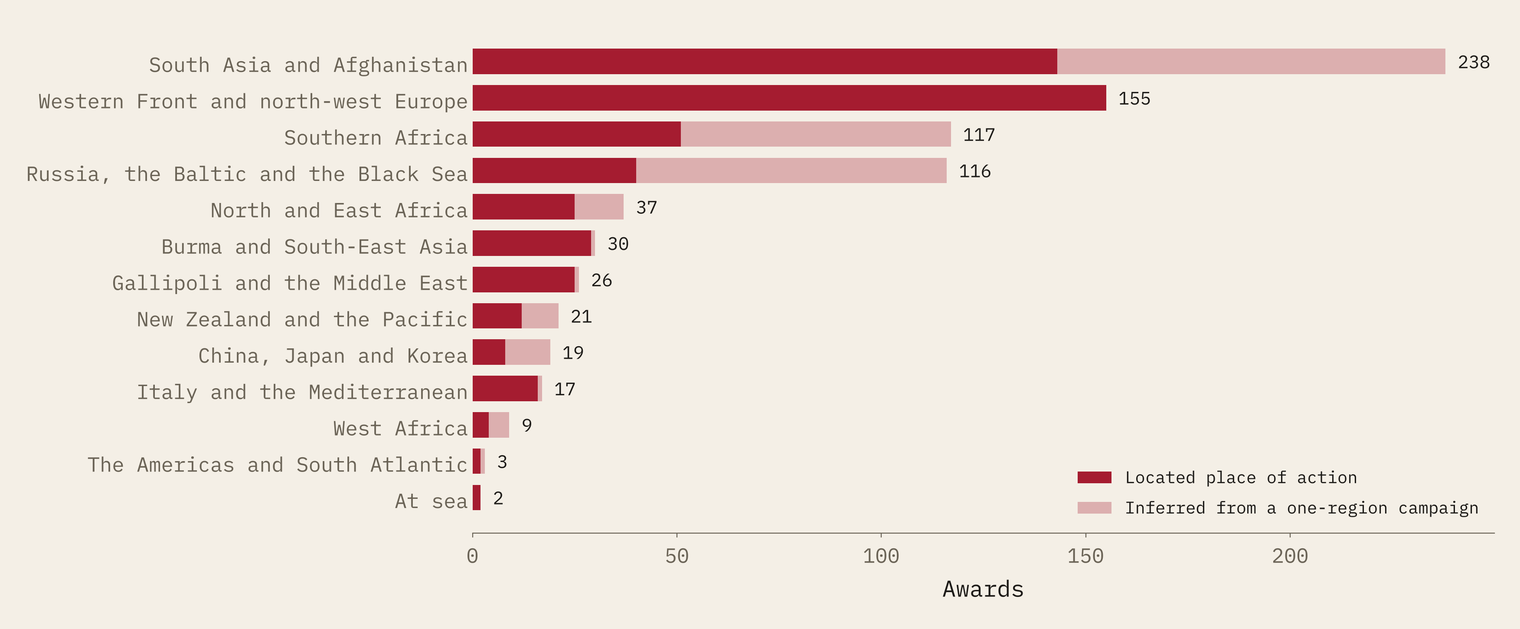
Among the located deeds, the busiest places are the Ypres salient (40), the Somme (38), Lucknow (37), Sevastopol and Balaklava (28) and Delhi (24). Rorke’s Drift and Isandlwana, fought on the same two days in January 1879, account for 10. These are floors: the Western Front in particular is under-counted. Adding the campaigns that were fought in one region, such as the Mutiny in India or the Boer wars in southern Africa, puts 792 awards in a region. South Asia and Afghanistan lead, with 238.
How far from home
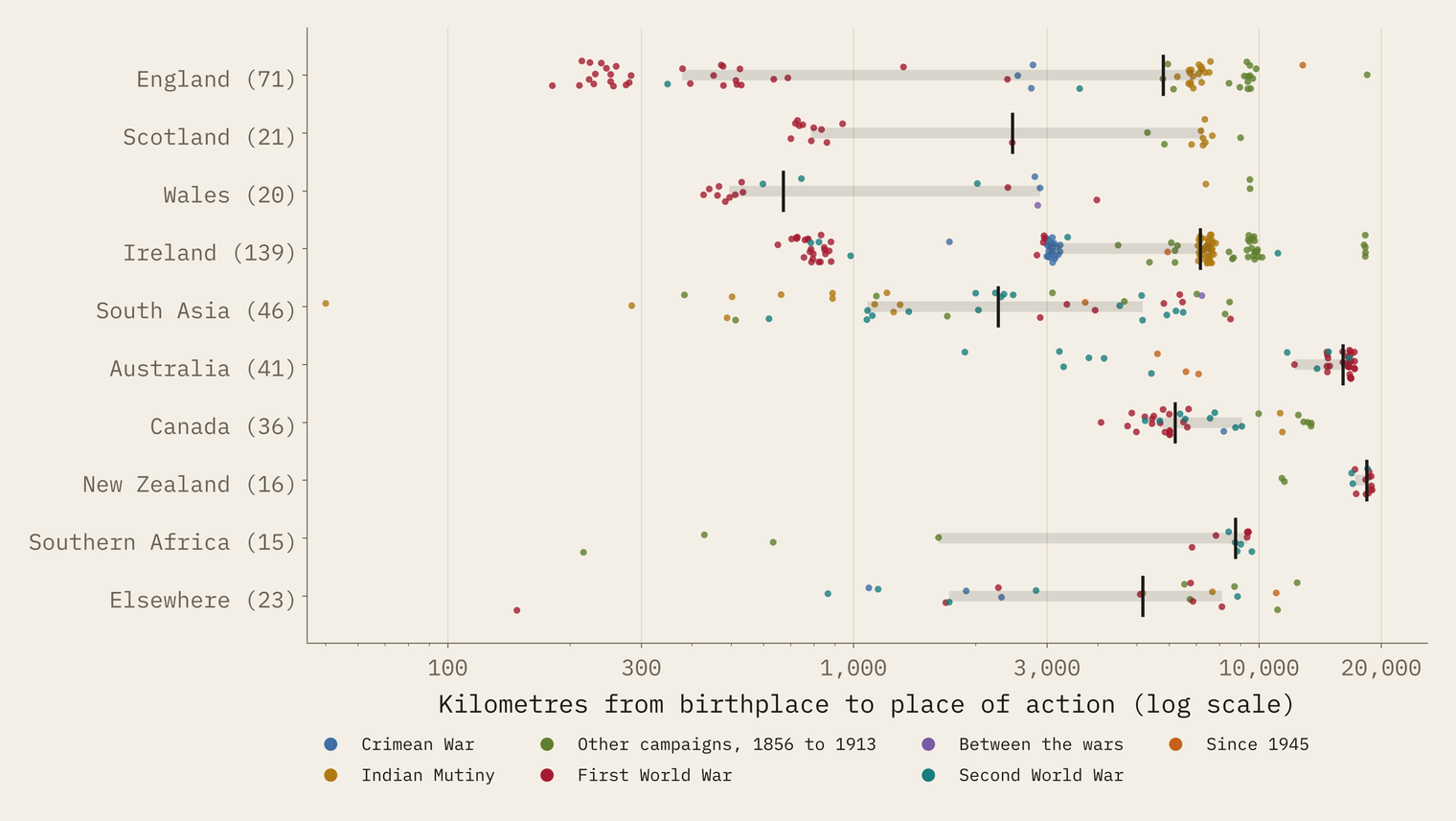
For 428 awards I can measure the straight-line distance from birthplace to deed. Their median is 6,486 km, but that sample leans towards Irish-born and dominion recipients, because those are the lists that record a place. Reweighting it to match the full list’s mix of birthplaces and wars gives a typical distance of about 2,819 km.
The average hides the real story, which is the spread. English-born recipients in the First World War won their crosses a median of 282 km from where they were born. Australians in the same war: 16,679 km. New Zealanders: 18,620 km. The longest journey in the data is Donald Brown’s, from Dunedin to High Wood, France in 1916: 18,992 km.
For the English soldier of 1916 the cross was won a few hundred kilometres from home. For the New Zealander beside him it was nearly nineteen thousand.
How I did this
The master list is the three Wikipedia tables of Victoria Cross recipients, A to Z. I joined each recipient to Wikidata through their Wikipedia article to get a birthplace. The main tables have no place of action, so I took places from the six Wikipedia lists that have one (Irish, Indian Army, Australian, Canadian, New Zealand and by nationality) and located them through the linked Wikipedia articles, checked against the stated country, or through GeoNames when the name was unambiguous. I added 34 awards whose Wikidata record names a single battle. 131 of the 717 places in those lists could not be located, mostly small villages and woods; the full lookup file is published with the data.
The big caveat is coverage. Located deeds are 32% Irish-born, against 13% of all awards, so English, Scottish and Welsh soldiers of British regiments are under-represented. A birthplace is not always home, and counties are today’s. These are real people, and many of them did not come home at all: the map shows where their lives began and where, for many, they ended.
Notes and sources
- Recipients: Wikipedia, List of Victoria Cross recipients (A to F, G to M, N to Z), and the Irish, Indian Army, Australian, Canadian, New Zealand and by nationality lists (CC BY-SA 4.0).
- Birthplaces and battles: Wikidata (CC0). Place names: GeoNames (CC BY 4.0). Boundaries: Natural Earth (public domain) and the Office for National Statistics (OGL v3).
- Paper, data and code: Zenodo and GitHub.
- I wrote the text, with drafting and editing assistance from Claude (Anthropic), which also helped prepare the analysis code. I reviewed and checked all text and results.

