
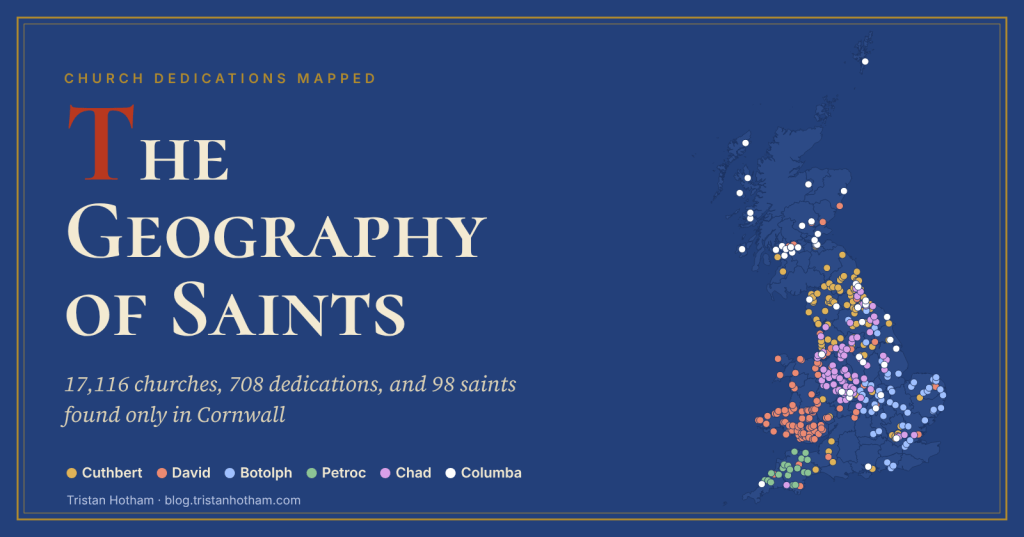
Most British churches are named for a saint, and the choice was rarely random. I mapped the dedications of 17,116 churches across Great Britain to see where each saint’s following lies.
The data comes from OpenStreetMap. I read each church’s dedication from its tags or its name, including Welsh forms such as Sant, Santes, Dewi and Mihangel. I kept the established churches, most of them old parish churches, and left out Roman Catholic and nonconformist chapels, which are mostly Victorian or later. That leaves 708 different dedications.
Three nations, three saints
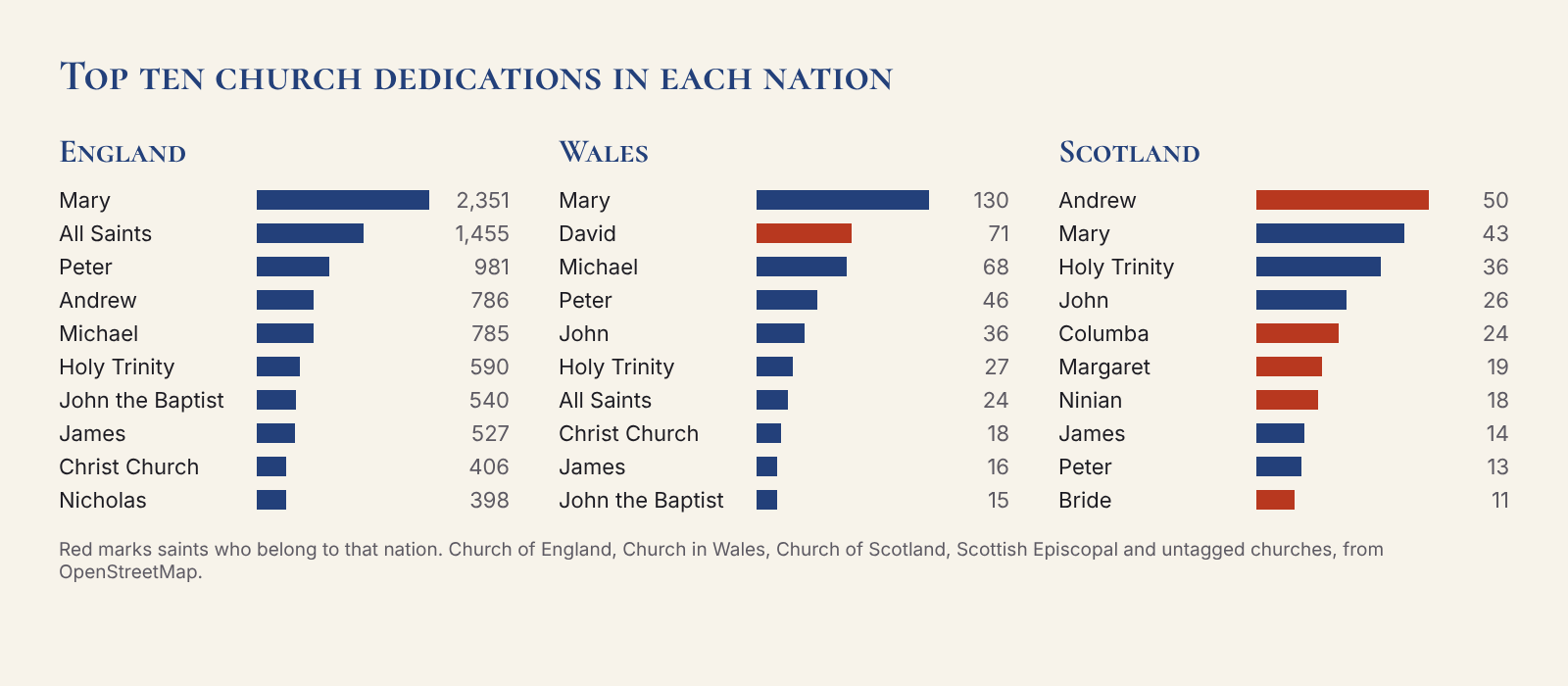
Mary leads in England and Wales, as she does across Latin Christendom. Below her the nations part ways. In England, All Saints, Peter, Andrew and Michael follow. In Wales, David is second, ahead of every apostle. In Scotland, Andrew comes first, ahead of Mary, with Columba, Margaret and Ninian close behind. National saints show up in the dedications, not just on flags.
Old kingdoms, still visible
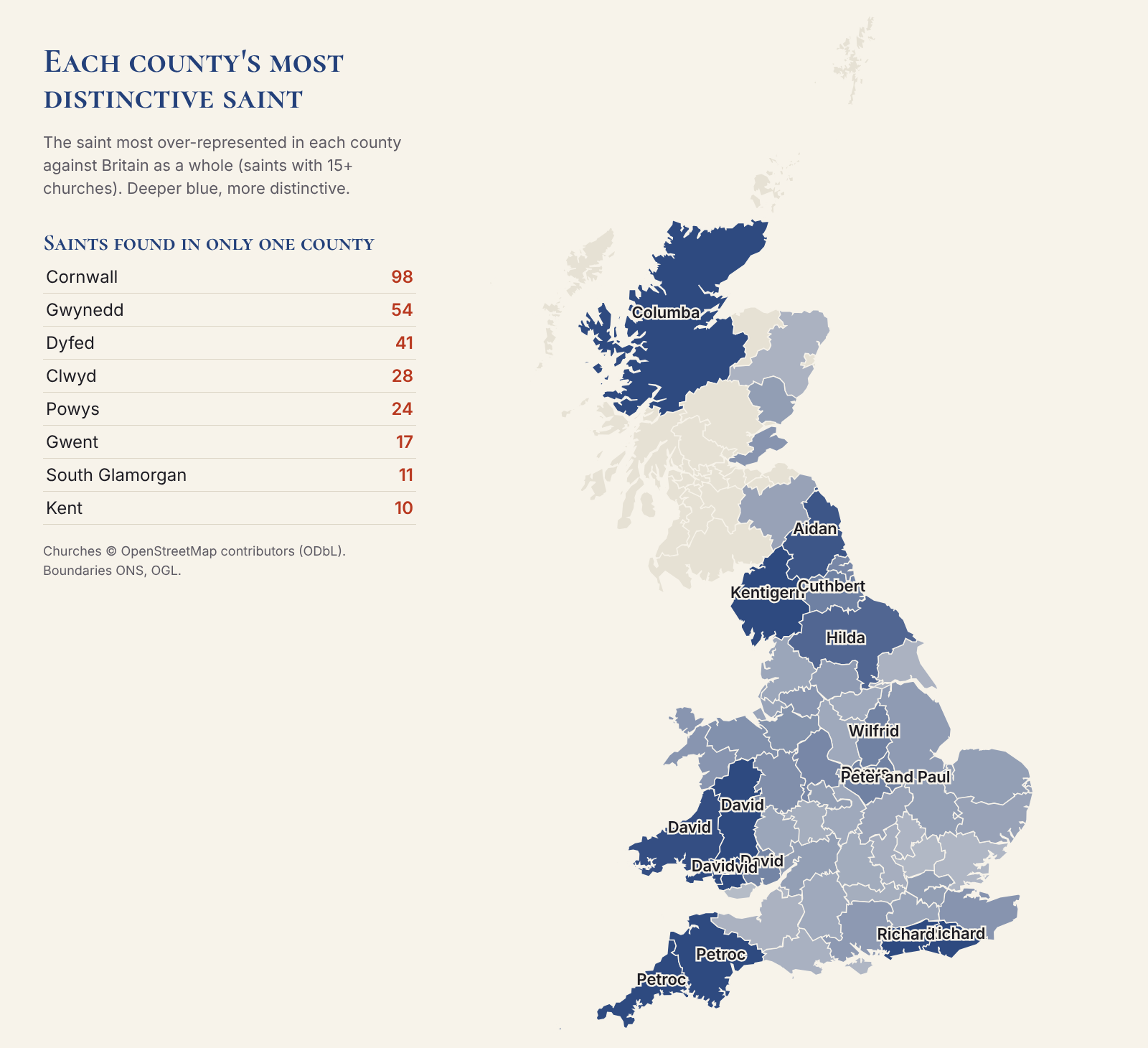
Ask which saint is most over-represented in each county, and the answers sketch a map of early medieval Britain. Cuthbert, Aidan, Oswald, Wilfrid and Hilda trace the old kingdom of Northumbria. Chad, bishop of the Mercians at Lichfield, leads in Staffordshire and Shropshire. Botolph and Edmund belong to East Anglia. Kentigern stands out in Cumbria, Petroc in Devon and Cornwall, Columba in the Highlands, and David across Wales. All Saints is commonest in the east, in Norfolk, Suffolk, Bedfordshire, Northamptonshire and the East Riding. Michael is strongest along the Welsh border.
Ninety-eight saints found nowhere else
The clearest regional pattern is local saints, dedications found in one county and nowhere else in Britain. Cornwall stands far ahead with 98 of them. Most are obscure holy men and women of the fifth and sixth centuries, such as Austell, Breaca, Buryan, Endellion, Euny and Gwinear, and many survive in the names of their parishes. Gwynedd (54) and Dyfed (41) come next, where the llan churches carry the names of their founders.
Two cautions apply. Scotland is thinly covered, because many Scottish parish churches are named after their parish rather than a saint. And a few variant spellings of one saint may count twice in the local lists.
Sources
- Church data © OpenStreetMap contributors, Open Database Licence, downloaded through the Overpass API in October 2026.
- Boundaries: Office for National Statistics. Contains OS data © Crown copyright and database right. Open Government Licence.
- Data and code: GitHub, archived as doi:10.5281/zenodo.23676497.
- AI use: written with drafting, data and coding help from Claude (Anthropic).

